Wet/dry separation matters because a genuinely waterproof backpack is also a sealed vapour chamber: a wrung swimsuit still carries 150 to 400 ml of water, and inside a closed welded body that moisture has nowhere to go, lifting internal relative humidity to 95 to 100 percent within 30 to 60 minutes and dampening everything it touches. The answer is a dedicated wet zone of 5 to 12 litres, built either as a welded internal divider, a removable welded liner, a drained external pocket or a twin-compartment body with separate closures. Specify a wet-side face fabric with a hydrostatic head above 5,000 mm, divider welds of 15 to 25 mm, and a drain path of 4 to 6 mm that cannot wick back. Empty and dry the wet zone within 24 hours, because microbial growth and odour begin inside that window.
Why a Sealed Body Makes Wet/Dry Separation Mandatory
Waterproofness and moisture management pull in opposite directions, and almost nobody expects it. A body that keeps rain out with a welded shell and a rolled collar also keeps vapour in, so the damp items a user packs after a swim, a gym session or a wet walk have no escape route. The result is not a leak and cannot be fixed by a better rating: it is physics, and the only workable answers are physical separation of the wet items or a deliberate ventilation path that admits drying air.
| Moisture source | Water carried | Where it goes in a sealed body | Consequence |
|---|---|---|---|
| Wrung swimsuit | 150 to 400 ml | Evaporates into the whole interior | Damp clothing and damp documents |
| Wet towel, hand wrung | 1.2 to 1.8 kg of retained water | Saturates the base of the body | Puddle at the bottom seam |
| Damp trainers | 50 to 150 ml per pair | Raises humidity in the lower compartment | Odour within 24 to 48 h |
| Wetsuit or rash vest | 300 to 800 ml | Wicks into any absorbent liner | Wet lining that never dries |
| Condensation from a temperature drop | 5 to 20 ml per night | Deposits on the coolest film surface | Mist on screens and optics |
| Rain entering during an opening | 5 to 30 ml per opening | Trapped by the next closing | Slow cumulative damp |
Numbers scale faster than intuition suggests. One wrung swimsuit at 250 ml into a 25 litre body raises internal humidity close to saturation within an hour, because the air volume inside a packed 25 litre bag is only 5 to 8 litres and it takes under 20 ml of vapour to saturate that at 30 degrees Celsius. Once saturated, additional moisture condenses on any cooler surface, which is why the first casualty is usually a phone screen or a paper document rather than the clothing.
The practical reading is that separation is a system property rather than a feature. A pack with a perfect IPX7 body and no wet zone will keep its contents wetter over a week of swimming than a pack rated IPX5 with a well-drained 8 litre wet compartment, because the second pack gives the water somewhere to be that is not the dry core.
Four Ways to Build the Wet Compartment
There are four established constructions, and each one suits a different mix of use, price and cleanability. The choice should be made early in a development programme because it drives the seam layout, the weld tooling and the final weight, and it is very expensive to change after samples are approved.
| Construction | How it works | Typical wet volume | Trade-off |
|---|---|---|---|
| Welded internal divider | A film panel welded on three sides inside the main body | 5 to 12 L | Permanent, adds internal seam length |
| Removable welded liner | A separate sealed pouch that lifts out | 3 to 10 L | Cleanable, can be lost or left behind |
| Drained external pocket | Open-top pocket with a mesh base and grommet | 2 to 5 L | Dries fast, not sealed from rain |
| Twin-compartment body | Two independent chambers, each with its own closure | 8 to 15 L wet side | Heaviest and most complex to weld |
The welded internal divider is the default for swim and gym programmes because it costs little, weighs 60 to 120 g and cannot be forgotten at home. Its weakness is cleaning: a divider that has held a salty swimsuit for a season will smell, and it cannot be removed for a proper wash. Where the use case involves saltwater or muddy kit, the removable liner is the better engineering answer despite the higher unit cost.
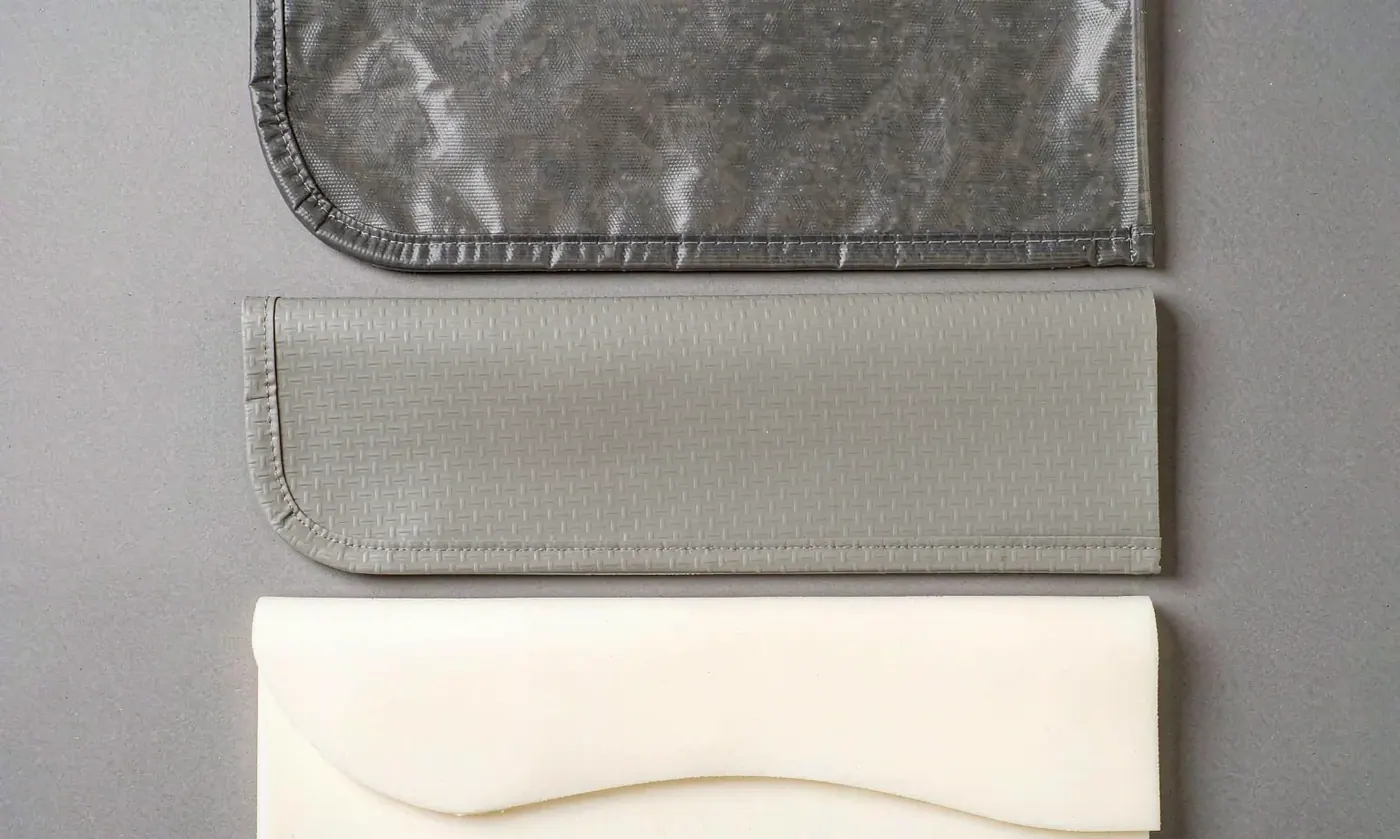
Removable liners also let one body serve two markets. A commuter pack can ship with a 5 litre liner for swim use and without it for a laptop-focused retail channel, which keeps tooling common and lets the same shell appear at two price points. The liner must still be genuinely welded rather than stitched, because a stitched liner is a wicking path rather than a barrier.
Twin-compartment bodies are the premium answer and are worth it when the wet load is large and regular, such as dive, surf or paddle use. Two independent closures mean wet kit can be sealed away from the dry core without any shared air volume at all, and the wet chamber can be hosed out and dried in minutes. The cost is 150 to 300 g of extra weight and a noticeably more complex weld schedule.
Material and Laminate Choices for Each Side
The two sides of a wet/dry pack want different materials, which is the part most specifications get wrong. The dry side wants low weight, abrasion resistance and a smooth face that packs easily. The wet side wants a face fabric that will not absorb water, a coating that resists hydrolysis, and a surface that can be wiped dry in seconds rather than dried overnight.
| Component | Specification | Why | Failure to avoid |
|---|---|---|---|
| Wet-side face fabric | 420D to 600D TPU laminate at 0.35 to 0.50 mm | Wipes dry, resists hydrolysis | PVC film that stiffens below 5 degrees |
| Wet-side coating | Hydrostatic head above 5,000 mm | No strike-through under a wet load | Face wetting out and wicking |
| Dry-side shell | 420D ripstop with a TPU face | Packs small and resists abrasion | Heavy coated fabric that adds 200 g |
| Divider film | 0.30 to 0.45 mm clear or tinted TPU | Weldable on three sides | Film that creases white at the fold |
| Liner base | 840D patch or moulded EVA base | Resists puncture from fins and shoes | Abraded base that leaks |
| Harness on the wet side | Closed-cell foam, no fabric cover | Does not hold water | Open-cell foam that stays wet |
Hydrostatic head is the number to argue about, and it is measured rather than claimed. Water resistance by hydrostatic pressure is defined in the ISO hydrostatic head test method for coated fabrics, and for a wet compartment that regularly holds 2 to 5 kg of saturated kit the working target is above 5,000 mm, since the load itself presses water against the film at the base. A fabric rated at 1,500 mm will pass a spray test and still strike through under a wet towel.
Avoid absorbent linings entirely on the wet side. A brushed tricot or a cotton-feel liner is pleasant in a dry pocket and disastrous in a wet one, because it holds 100 to 300 ml and takes more than 24 hours to dry inside a closed body. Plain film or a smooth woven backing is the only sensible choice for any surface that will regularly meet a wet swimsuit.
Seam and Weld Engineering at the Divider
Every internal divider adds seam length to a body that was previously simple, and internal seams are the most common source of warranty claims in this category. A divider welded on three sides inside a closed shell introduces 1.5 to 2.5 m of new weld, and the corners where the divider meets the side panels carry peel stress every time the pack is stuffed. Those corners should be radiused rather than square and should be peel-tested rather than only visually checked.
| Seam or detail | Specification | Risk if wrong | Test |
|---|---|---|---|
| Divider-to-shell weld | 15 to 25 mm wide, radiused corners | Peel under a stuffed load | Peel test at 90 degrees, 3 samples |
| Divider top edge | Bound or turned, no raw cut | Wicking along the cut edge | Wipe test with indicator paper |
| Corner radius | Minimum 15 mm internal radius | Crack initiation point | 500 stuff cycles then inspect |
| Base seam | Welded, no stitch through the shell | Capillary leak path | 24 h standing water test |
| Closure on the wet chamber | Roll or covered zip | Cross-contamination to the dry side | Pour 2 L, hold 30 min, check the dry side |
| External drain | 4 to 6 mm grommet above the base seam | Wicks back or leaks into the body | Fill and drain timing test |
Ratings apply to the finished assembly rather than to the fabric, and the definitions are maintained in the IEC 60529 ingress protection reference. A pack can honestly claim IPX6 for the outer body while the wet compartment itself is only splash resistant, and that is acceptable provided the specification states it. What is not acceptable is a single rating applied to a body where the two chambers have genuinely different performance.
One detail prevents a surprising number of complaints: the divider top edge. A raw cut edge on a laminate wicks water along the yarn by capillary action, so a wet compartment that passes a standing-water test can still dampen the dry side through its own top edge. Turn and bind that edge, or weld a narrow tape over it, and the wicking path disappears.
Size the Wet Compartment to the Activity
Sizing is where programmes most often overshoot. Buyers ask for a 15 litre wet compartment because bigger sounds better, and end up with a pack where the dry core is too small for a laptop and the wet zone is permanently half empty. Match the wet volume to the bulkiest single wet item rather than to the total wet load, because items can be stacked but cannot be compressed.
| Activity | Bulkiest wet item | Wet volume | Notes |
|---|---|---|---|
| Pool or gym swim | Swimsuit and towel | 5 to 8 L | A separate 3 L pouch handles the suit alone |
| Open-water swim | Wetsuit and tow float | 10 to 15 L | Needs a drain path and a wide mouth |
| Surf session | Wetsuit and booties | 12 to 18 L | Twin compartment is worth the weight |
| Kayak or paddle board | Spray deck and PFD | 8 to 12 L | Salt rinsing access matters more than volume |
| Rainy commute | Wet shell and shoes | 4 to 6 L | External drained pocket is enough |
| Family beach day | Towels and swim nappies | 8 to 12 L | Removable liner for washing |
The gym and swim backpack guide covers the pool and gym case in depth, where a 5 to 8 litre wet zone plus a 3 litre pouch for the suit is usually the right answer. For users whose wet load is a wetsuit rather than a swimsuit, the numbers roughly double and the mouth of the compartment needs to be wide enough to accept a rolled suit without forcing it.
Leave the dry core honest. Whatever the wet volume, the dry side should still take the items that must stay dry: for a commuter that is a 15 inch laptop, a charger and a document folder, which needs 6 to 9 litres of clear space. A pack that fits a wetsuit but not a laptop has solved the wrong problem for most buyers.
Drainage, Grommets and the External Wet Pocket
A wet compartment that cannot drain becomes a water tank, and a water tank inside a backpack is how base seams fail. The cheapest effective answer is a 4 to 6 mm grommet set 15 to 25 mm above the base seam on the outside of the wet chamber, which lets a litre of standing water leave in 30 to 60 seconds while staying high enough that the pack cannot leak through it when set down in a puddle.
| Drain feature | Specification | Performance | Risk |
|---|---|---|---|
| Single grommet | 4 to 6 mm, 20 mm above the base seam | 1 L drains in 30 to 60 s | Blocked by sand or grit |
| Twin grommets | Two at 5 mm, opposite corners | Faster, self-clearing | Two potential leak points |
| Mesh base panel | Open mesh over a drained floor | Continuous drip drying | Snags on fins and hooks |
| Roll-down drained pocket | Open top, mesh floor | Air dries while walking | Rain enters from above |
| No drain | Sealed wet chamber | Water retained until emptied | Base seam stress and odour |
The external drained pocket is the right answer for a rainy commute and the wrong one for surf. It dries continuously while being carried, weighs under 40 g and takes a wet shell or a pair of shoes without wetting anything else, but it is open to rain from above and it will hold whatever falls into it. For programmes where the wet load is rain-driven rather than immersion-driven, it is the cheapest and lightest option available.
Think about where the drained water actually goes. A grommet that empties onto the wearer is a design failure, and on a pack that will be set down in a boat or a car boot the drain needs to exit sideways rather than downwards. Two small decisions at the sample stage prevent the most common owner complaint in this category.
Keep the Dry Side Dry: Electronics and Documents
The dry side has its own enemy, and it is vapour rather than liquid. A laptop, a phone or a passport will survive a splash easily and will be ruined by a fortnight of 95 percent internal humidity, because corrosion at connectors and boards starts long before anything feels wet to the touch. The control is a genuinely sealed dry core plus a desiccant load of 30 to 60 g for a 25 litre pack, regenerated or replaced on a monthly cycle during heavy use.
| Dry-side item | Vapour risk | Control | Check |
|---|---|---|---|
| Laptop or tablet | Board corrosion at 90 percent RH | Sealed sleeve plus a 30 g gel sachet | Power on weekly to warm it |
| Phone | Port corrosion and screen mist | Sealed pouch, port closed | Dry ports before charging |
| Passport and documents | Cockling and mould | Welded document pouch | Flat storage, no folding |
| Chargers and cables | Green corrosion on contacts | Sealed accessory pouch | Inspect contacts monthly |
| Camera body and lens | Fungal growth above 70 percent RH | Sealed module, 50 g gel | Inspect glass every 2 days |
| Medication | Humidity degradation | Original blister plus a pouch | Check expiry after any soak |
Buyers whose primary concern is a laptop should read the waterproof laptop backpack range and then come back to the separation question, because the two requirements interact. A wet compartment welded into the lower body of a laptop pack reduces the drop protection available at the base, and the laptop sleeve should never share a wall with the wet chamber for exactly that reason.
The main waterproof backpack overview sets out where wet/dry separation sits among the other decisions in the range, from closure type to volume. For most buyers it is the third or fourth priority rather than the first, and it should be specified after the closure and the body rating have been settled.
Odour, Bacteria and the Twenty-Four Hour Rule
Odour in a wet compartment is not dirt, it is biology. A wet zone holding a chlorinated swimsuit or a saltwater towel at 25 to 35 degrees Celsius develops a microbial population within 24 to 48 hours, and once that population is established in a welded film compartment, no amount of airing removes the smell. The only reliable control is a time limit: empty and dry the wet zone within 24 hours of every use.
| Interval after use | State of the wet zone | Action | Consequence if skipped |
|---|---|---|---|
| 0 to 2 h | Standing water, still wet | Drain, shake out, wipe | Water reaches the base seam |
| 2 to 12 h | Damp, humid, warm | Open the compartment to air | Humidity transfers to the dry side |
| 12 to 24 h | Microbial growth begins | Wash and dry open | Odour becomes established |
| 24 to 48 h | Visible biofilm risk | Disinfect with a dilute solution | Permanent smell in the film |
| After every week of use | Residue build-up | Wash the liner and dry fully | Residue feeds the next cycle |
| Off-season | Dry and clean | Store open and unrolled | Mildew on the dry side too |
Antimicrobial finishes are testable rather than a matter of claim, and textile antibacterial assessment is covered by AATCC antibacterial and moisture management test methods. A specification can require a stated reduction against a named organism after a stated number of washes, which is a far more useful requirement than a marketing phrase on a hangtag.
Salt and chlorine change the cleaning routine. Saltwater residue holds moisture and must be rinsed with fresh water, while chlorine residue should be rinsed because it stiffens elastane and fades prints. A five litre rinse of the wet compartment after every saltwater session costs two minutes and removes both problems before they become an odour.
Qualify and Specify a Wet/Dry Programme
Qualification for a wet/dry pack has to test the two chambers separately, which is the step most programmes skip. The outer body can pass a spray test while the divider fails a standing-water test, and the only way to know is to fill the wet compartment with a realistic load of water and wet fabric, close the pack, and inspect the dry side with indicator paper after a stated interval.
| Qualification test | Condition | Pass criterion | Record |
|---|---|---|---|
| Wet chamber standing water | 2 L for 30 min, pack upright | No moisture on the dry side | Indicator paper photographs |
| Loaded wipe test | Wet towel at 1.5 kg against the divider | No strike-through after 60 min | Weight and wipe notes |
| Divider peel | 90 degree pull on 3 samples | No peel at the radiused corners | Peel values in newtons |
| Drain timing | 1 L through the grommet | Empty in under 90 s | Timer readings |
| Stuff cycles | 500 cycles with a wet load | No weld crack at corners | Corner inspection log |
| Odour screen | 48 h closed with a wet swimsuit | No persistent odour after washing | Panel assessment notes |
Commercial terms are stable across the category. The baseline is 500 pcs per design and colour, samples take 6 to 10 working days, bulk production takes 35 to 50 days, and every shipment is inspected at AQL 2.5 before release. Materials are screened for REACH and California Prop 65, production runs under BSCI and ISO 9001 systems, and shipping is available FOB Xiamen or DDP to more than 100 countries.
QUANZHOU JUNYUAN BAGS can hold the standing-water, peel and drain-timing sequence on file for a wet/dry programme. Send a brief with target wet volume, construction preference and colourway to service@junyuanbags.com and the first sample set follows inside the 6 to 10 working day window.
Decide the construction type before the colour, because it is the only decision in this category that cannot be changed cheaply later. A welded divider, a removable liner, a drained pocket and a twin-chamber body each suit a different use pattern, and picking the wrong one produces a pack that is technically waterproof and practically disappointing.
People Also Ask
What is wet/dry separation in a backpack?
It is a dedicated sealed or drained compartment that keeps wet items away from the dry core. Without it, a wrung swimsuit carrying 150 to 400 ml lifts internal humidity to 95 to 100 percent inside a sealed welded body and dampens everything else.
How big should the wet compartment be?
Size it to the bulkiest single wet item: 5 to 8 litres for a swimsuit and towel, 8 to 12 litres for a spray deck, and 12 to 18 litres for a wetsuit. Oversizing the wet zone leaves too little room in the dry core.
Is a welded divider or a removable liner better?
A welded divider is cheaper at 60 to 120 g and cannot be left at home, but it cannot be removed for washing. A removable welded liner is the better choice for saltwater, muddy or chlorine-heavy use because it can be rinsed properly.
Can I just use a dry bag inside my backpack?
Yes, and for occasional use it is a perfectly good answer. A 5 to 10 litre welded pouch inside the main body does the same job as a built-in divider, at the cost of packing efficiency and one more item to remember.
Why does my wet compartment smell?
Microbial growth starts within 24 to 48 hours at 25 to 35 degrees Celsius. Drain and wipe the compartment within two hours, air it within twelve, and wash and dry it fully inside 24 hours of every use.
Does a wet compartment reduce the pack waterproof rating?
The outer body rating stands, but the two chambers have different performance. A pack can be IPX6 overall while the wet chamber is only splash resistant, and the specification should state both rather than quoting one number.
Frequently Asked Questions
Q1. Do I really need wet/dry separation if my backpack is already waterproof?
Yes, for any regular swim, gym or watersport use. Waterproofness stops water entering and also stops vapour leaving, so a wet swimsuit dampens the whole interior. Separation gives that moisture a place to be that is not the dry core.
Q2. How much water does a wet swimsuit actually carry?
A hand-wrung swimsuit retains 150 to 400 ml, and a wrung towel holds 1.2 to 1.8 kg of water. Inside a packed 25 litre body with only 5 to 8 litres of air, that is more than enough to reach saturation within an hour.
Q3. What hydrostatic head should the wet compartment fabric have?
Above 5,000 mm. The load itself presses water against the base film, so a fabric rated at 1,500 mm can pass a spray test and still strike through under a wet towel. Specify the value and ask for the test report.
Q4. Should the wet compartment have a drain hole?
It should have a drain path of 4 to 6 mm set 15 to 25 mm above the base seam. One litre then leaves in 30 to 60 seconds, and the height stops the pack from leaking through the grommet when it is set down in a puddle.
Q5. Can a wet compartment leak into the dry side?
Yes, through a raw cut edge on the divider or a crack at a square corner. Turn and bind the top edge, radius the internal corners at 15 mm minimum, and run a 30 minute standing-water test with indicator paper on the dry side.
Q6. How do I clean a welded wet compartment?
Drain it, rinse with about 5 litres of fresh water, wipe with a mild detergent at pH 6 to 8, then dry it fully open for 8 to 12 hours. Salt and chlorine residue left behind feeds odour and stiffens elastane.
Q7. Will an antimicrobial finish stop the smell permanently?
No. It slows growth but does not remove the need to empty and dry the compartment within 24 hours. Ask for a stated reduction against a named organism after a stated number of washes rather than a marketing claim.
Q8. Is a wet compartment worth it for a rainy commute?
A drained external pocket of 2 to 5 litres is usually enough and weighs under 40 g. It dries while being carried and is the cheapest option, but it is open to rain from above and will hold whatever falls into it.
Q9. How do I keep a laptop safe in a pack with a wet compartment?
Keep the laptop sleeve away from any shared wall with the wet chamber, use a sealed sleeve and add 30 to 60 g of desiccant for a 25 litre pack. Vapour damages boards long before anything feels wet.
Q10. What are the MOQ and lead time for a wet/dry backpack?
The baseline is 500 pcs per design and colour, samples take 6 to 10 working days and bulk takes 35 to 50 days, inspected at AQL 2.5. Construction type, divider weld width and drain specification should be fixed at approval.