A waterproof backpack is defined by a tested rating, not by a coating claim: per IEC 60529, IPX4 survives splashing, IPX5 and IPX6 survive water jets, IPX7 survives 30 minutes at 1 m depth, and IPX8 survives continuous immersion beyond 1 m. In sourcing terms the working envelope is 20-30 L daypacks at 700-1,100 g empty, 35-55 L travel and hiking packs at 1.2-1.9 kg, TPU-laminated shells at 5,000-10,000 mm hydrostatic head, and closures that are roll-top, airtight-zip or fully RF-welded. Programmes start at 500 pcs per design/colour, samples take 6-10 working days, and bulk ships in 35-50 days from FOB Xiamen.
What Waterproof Actually Means: IPX Levels and the Test Behind Them
Waterproof is a test result, not an adjective. The scale buyers should write into a specification is the IPX code defined in IEC 60529 ingress protection ratings, which assigns a number to a measured exposure: jet nozzle diameter, flow rate, duration and immersion depth. A pack sold as shower-resistant with a 1,500 mm coating will wet out in 20 minutes of steady rain, while a welded-shell pack rated IPX6 will not. The distinction between weather-resistant and genuinely sealed construction is spelled out further in our comparison of waterproof and water-resistant backpacks.
| IPX level | IEC 60529 test condition | Real-world exposure | Typical pack build |
|---|---|---|---|
| IPX3 | Spray at 60 degrees from vertical, 10 min | Light drizzle, sea mist | Coated shell with storm flap |
| IPX4 | Splashing from any direction, 10 min | Urban rain shower | Coated shell plus taped seams |
| IPX5 | 6.3 mm nozzle, 12.5 L/min, 3 min | Heavy rain, boat spray | Roll-top with welded side seams |
| IPX6 | 12.5 mm nozzle, 100 L/min, 3 min | Deck wash, storm riding | RF-welded body, coated zip |
| IPX7 | 30 min immersion at 1 m | Capsize, river crossing | Welded body plus airtight zip |
| IPX8 | Continuous immersion beyond 1 m | Extended submersion, canyoning | Welded body, TIZIP closure, purge valve |
Two numbers appear on every serious specification sheet and they measure different things. The IPX code measures the assembled pack, closure included, under a jet or immersion test. Hydrostatic head, reported in millimetres of water column, measures only the flat fabric: a 5,000 mm shell resists a 5 m column of water before the third drop penetrates. Fabric that tests at 10,000 mm will still leak if the closure is a stitched zip, which is why the closure architecture in the next section matters more than the fabric denier printed on the hangtag.
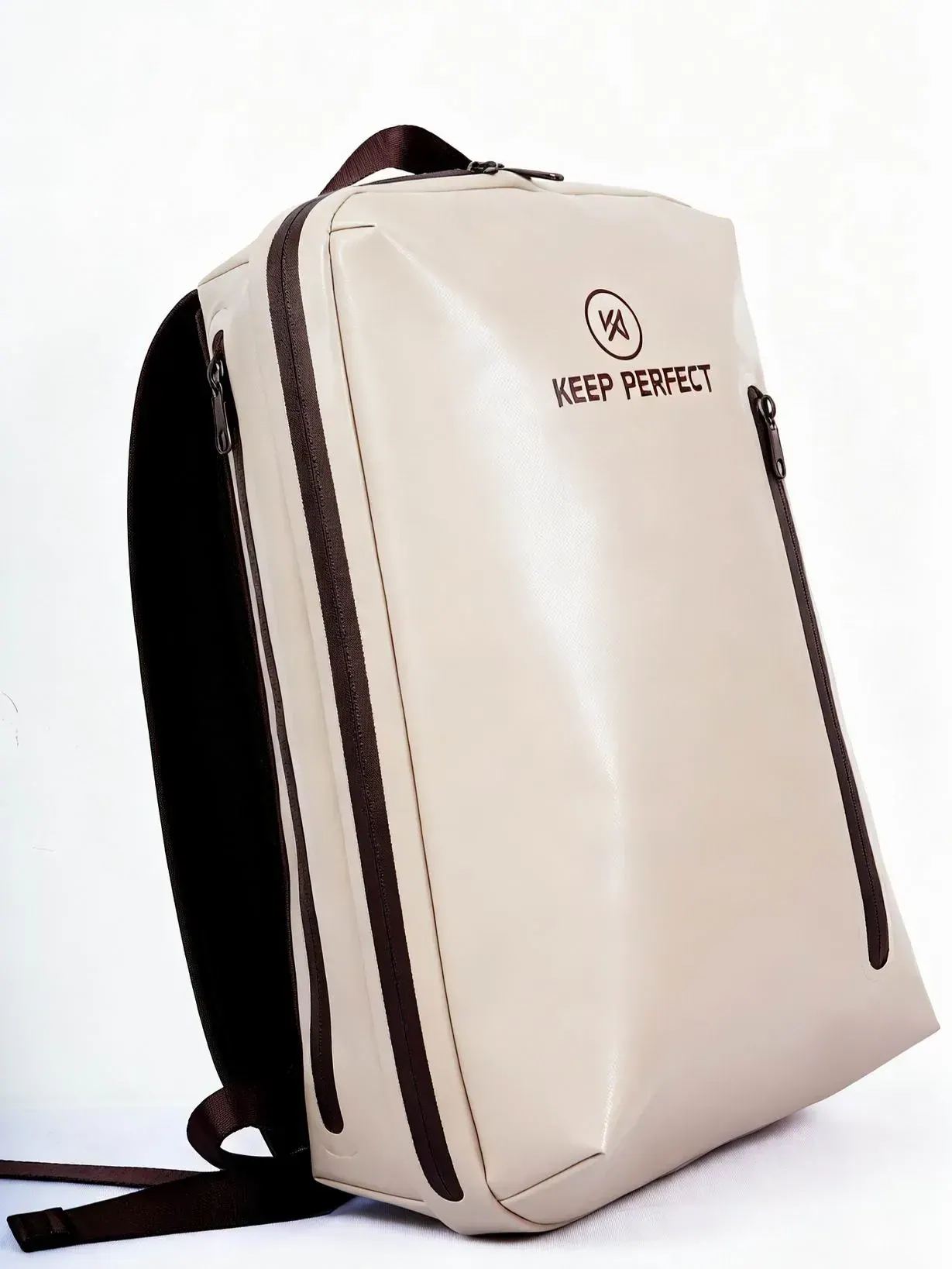
Five Closure Architectures and Where Each One Wins
Every leak path on a pack ends at an opening. Sealed bodies fail at the mouth, at the zip tape, or at a stitch line, so the closure choice sets the achievable rating long before fabric is selected. The five architectures below account for most of the waterproof backpack volume shipped out of Xiamen, and each carries a distinct cost index, weight penalty and user-behaviour requirement.
| Closure architecture | Realistic rating | Volume range | Empty weight band | Cost index | Best application |
|---|---|---|---|---|---|
| Roll-top with side buckles | IPX5-IPX6 | 18-40 L | 620-980 g | 1.0 | Hiking, daily carry, kayaking |
| Roll-top plus coated front zip | IPX5-IPX6 | 25-45 L | 880-1,350 g | 1.3 | Travel, commuting with laptop |
| Airtight TIZIP main zip | IPX7-IPX8 | 20-35 L | 1,050-1,500 g | 2.4 | Submersible camera and dive support |
| RF-welded body with purge valve | IPX7 | 30-70 L | 1,100-1,900 g | 1.6 | Rafting, paddle camping, marine |
| Flap with storm skirt and storm zip | IPX4-IPX5 | 30-55 L | 1,250-1,900 g | 1.1 | Trekking, hunting, expedition |
Roll-top dominates because it is tolerant of user error and cheap to assemble, but it only seals if the user rolls at least three full turns and the fold is 60-80 mm deep before the buckles engage. Airtight zips give the highest rating and the fastest access, yet they need clean grit-free teeth and periodic lubrication, and they roughly double unit cost. The welded dry-bag body is the value play for immersion: no zip at all, just a rolled mouth and a one-way valve, which is why it carries 70 L expedition loads in expedition rafting at under 2 kg.
- Roll-top: three turns minimum, 60-80 mm fold, clip the side buckles before the top strap.
Coated zips sit between the two: a polyurethane-laminated tape with tight interlocking teeth reaches IPX5-IPX6 at about a third of the cost of an airtight zip, and it fails gracefully by weeping rather than opening. For programmes where the pack will be opened 30-50 times a day, that serviceability usually beats a higher laboratory number.
Shell Fabrics, Coatings and Seam Construction
Shell choice is a three-way trade between abrasion resistance, cold-weather flexibility and weight. TPU-laminated polyester holds flexibility down to about -30 degrees Celsius and welds cleanly at 27.12 MHz; PVC tarpaulin is cheaper and highly abrasion-resistant but stiffens noticeably below -10 degrees Celsius, which is a real problem for winter programmes shipped to northern Europe and Canada.
| Shell material | Construction | Hydrostatic head | Seam method | Low-temp flex limit | Fabric weight |
|---|---|---|---|---|---|
| 500D polyester | TPU film 0.35 mm, single side | 5,000 mm | RF welded | -30 degrees C | 285 g/m2 |
| 840D nylon | TPU film 0.45 mm, both sides | 8,000-10,000 mm | RF welded + taped | -35 degrees C | 410 g/m2 |
| 1000D PVC tarpaulin | Knife-coated PVC 0.52 mm | 10,000 mm | HF welded | -10 to -15 degrees C | 610 g/m2 |
| 420D ripstop nylon | PU coating, liner use | 1,500-3,000 mm | Stitched, bound | -25 degrees C | 165 g/m2 |
| 210D recycled PET | PFAS-free DWR, liner use | 1,200 mm | Stitched, bound | -20 degrees C | 120 g/m2 |
Finishing chemistry is now a purchase criterion rather than a footnote. Durable water repellent based on short-chain or PFAS-free formulations is required for most EU and several US state tenders; the regulatory background is summarised in the EPA PFAS programme pages. Welded seams should reach at least 90 percent of base fabric tensile strength, and the acceptance method for the enclosure test itself is published as IEC 60529, edition 2.2. Buyers comparing film types can go deeper in our breakdown of TPU versus PVC waterproof backpack shells.
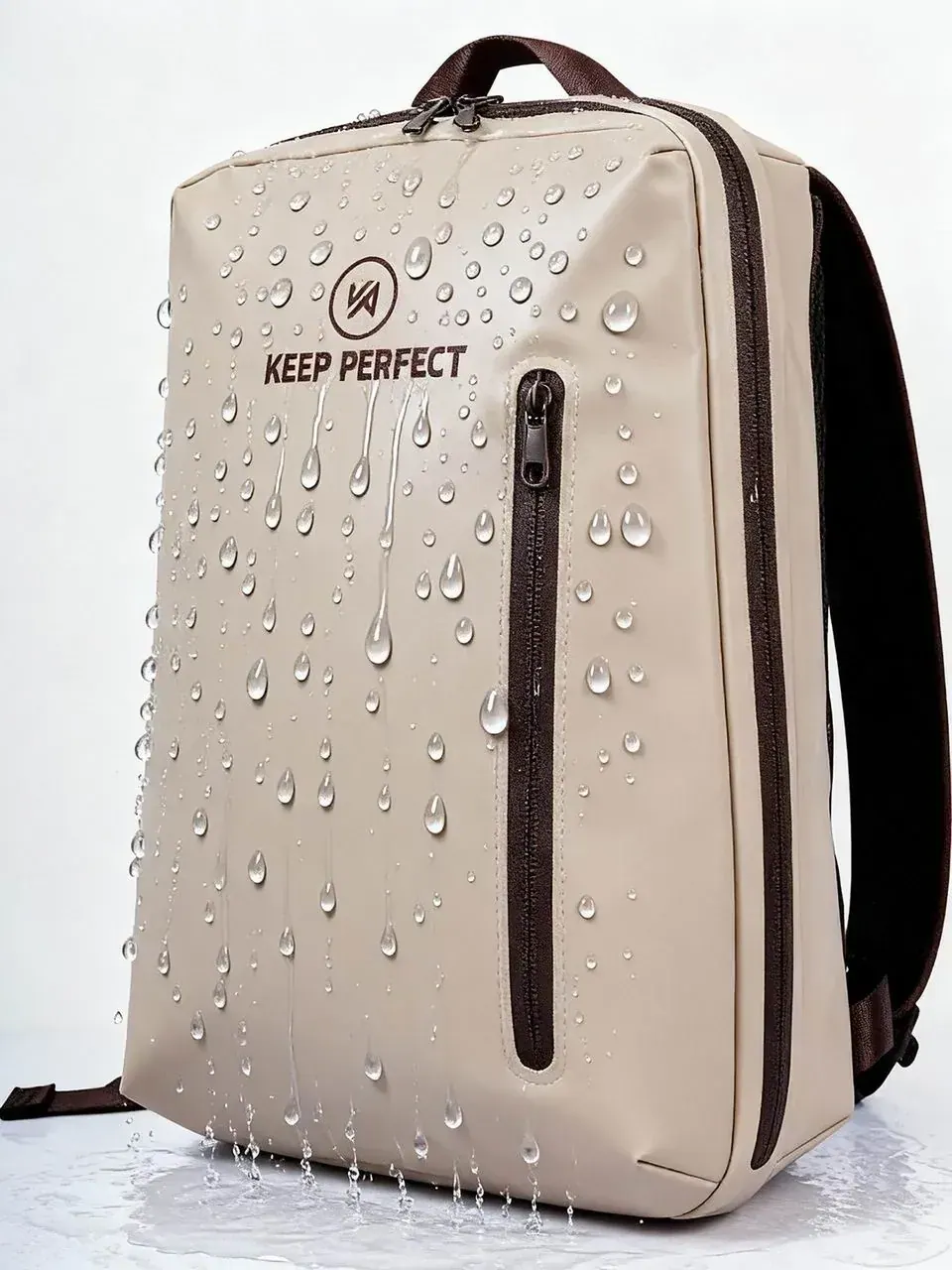
Matching the Pack to the Activity
The same 30 L shell serves a commuter badly and a kayaker well, because the feature set that matters changes with the exposure. Commuters need a suspended laptop sleeve and flat back panel; paddlers need lash points, a purge valve and no external pockets that catch rope; riders need harness geometry that will not shift at 100 km/h. The matrix below is the shortlist we issue to buyers before a sampling round.
| Activity | Volume | Minimum rating | Non-negotiable features | Nice to have |
|---|---|---|---|---|
| Hiking, day | 25-35 L | IPX5 | Hip belt, trekking pole loops | Hydration sleeve 2-3 L |
| Hiking, multi-day | 45-65 L | IPX5 | Load lifters, 8-12 kg comfort | Sleeping bag compartment |
| Air travel | 35-45 L | IPX4-IPX5 | Carry-on dimensions, lay-flat laptop bay | Compression straps |
| Urban commute | 20-30 L | IPX5 | Suspended 15.6-16 in sleeve, reflective hits | Key clip, bottle pocket |
| Motorcycle riding | 25-40 L | IPX6 | Harness stability, helmet carry system | Retroreflective panel |
| Boating and kayak | 30-70 L | IPX7 | Welded body, lash points, purge valve | Buoyancy insert |
Volume selection interacts with the activity in predictable ways. Full sub-categories are covered in the dedicated guides for waterproof hiking backpacks, waterproof travel backpacks, waterproof commuter backpacks and waterproof motorcycle backpacks, and ranked shortlists live in our guide to the best waterproof backpacks by use case. Riders and paddlers weighing a sealed pack against a sack should read waterproof backpack versus dry bag before committing a tooling budget.
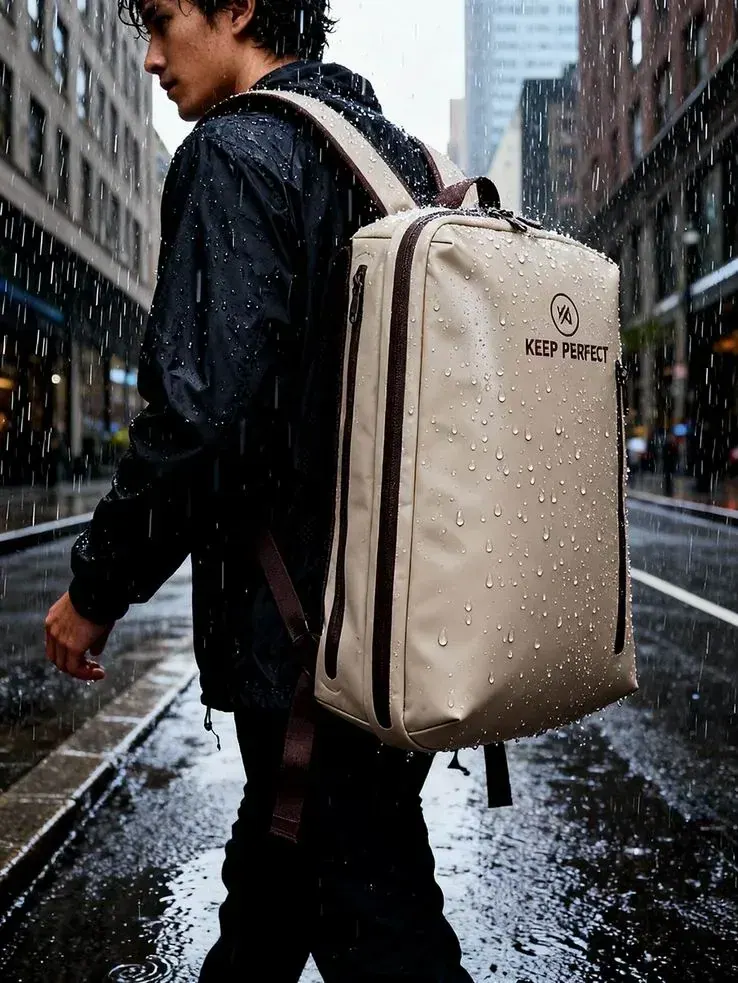
Volume, Dimensions and Load Ratings
Published litre figures are measured by filling the main body with beads, so a 30 L pack holds about 30 L of loose fill but noticeably less of rigid cargo such as camera bodies or tackle trays. Procurement specs should therefore state both the nominal volume and the usable load in kilograms, plus the harness rating that determines how that load feels after four hours.
| Nominal volume | Typical H x W x D | Usable load | Trip length | Target user |
|---|---|---|---|---|
| 18 L | 42 x 26 x 16 cm | 4-6 kg | Half day | Trail running, city errands |
| 25 L | 48 x 29 x 18 cm | 6-8 kg | Full day | Day hiking, commute |
| 30 L | 52 x 31 x 20 cm | 8-10 kg | 1-2 days | Weekend hiking, overnight |
| 40 L | 56 x 34 x 24 cm | 10-13 kg | 2-4 days | Carry-on travel |
| 50 L | 62 x 36 x 26 cm | 13-16 kg | 4-7 days | Trekking, expedition approach |
| 65 L | 70 x 38 x 30 cm | 16-20 kg | 7+ days | Multi-day rafting, portage |
Harness geometry decides whether the stated load is comfortable. A padded hip belt should transfer 70-80 percent of the load off the shoulders at 10 kg and above; below 8 kg a webbing belt is enough and saves 120-180 g. Load lifters set at roughly 45 degrees pull the top of the pack toward the shoulders, and a sternum strap adjustable over 80 mm of range keeps the shoulder straps from sliding outward on steep descents.
Ordering Terms: MOQ, Sampling, Packaging and Freight
Programme economics are driven by colour count more than by total volume, because every additional colourway resets the material minimum for fabric, webbing and zip tape. Budgeting against the bands below keeps unit cost predictable when a first drop of 500 pcs grows into a seasonal reorder of 10,000 pcs, and it explains why consolidating to two colours often saves more than doubling the order size.
| Order band | Unit price index | Sample lead time | Bulk lead time | Typical notes |
|---|---|---|---|---|
| 500-999 pcs | 1.00 | 6-10 working days | 35-40 days | One colourway, stock fabric |
| 1,000-2,999 pcs | 0.93 | 6-10 working days | 38-45 days | Up to two colourways |
| 3,000-9,999 pcs | 0.86 | 7-10 working days | 40-50 days | Pantone-matched webbing available |
| 10,000+ pcs | 0.79 | 8-10 working days | 45-50 days | Dedicated material run, printed liner |
Standard packing is one piece per polybag, 10-20 pieces per export carton depending on volume, with carton dimensions around 60 x 40 x 35 cm and gross weight held under 15 kg for manual handling. A 20 ft container takes roughly 1,400-1,600 pieces of 30 L welded packs when cartoned flat at 10 per carton; quoting FOB Xiamen keeps freight in the buyer's control, while DDP is available into more than 100 countries for buyers who prefer landed cost. Material compliance screening against REACH and California Prop 65 is included in every quotation, and the production walkthrough for the wider bag range is documented.
- The opening quantity is 500 pcs for each design and colourway; mixed colours can be consolidated from 3,000 pcs.
- Samples take 6-10 working days and the production run 35-50 days, shipping FOB Xiamen or DDP into more than 100 countries.
- Nothing leaves the line until an AQL 2.5 inspection passes, and the signed report is stapled to the packing list.
- A one-line brief is enough to start a quotation: target quantity, volume in litres and preferred closure, sent to service@junyuanbags.com.
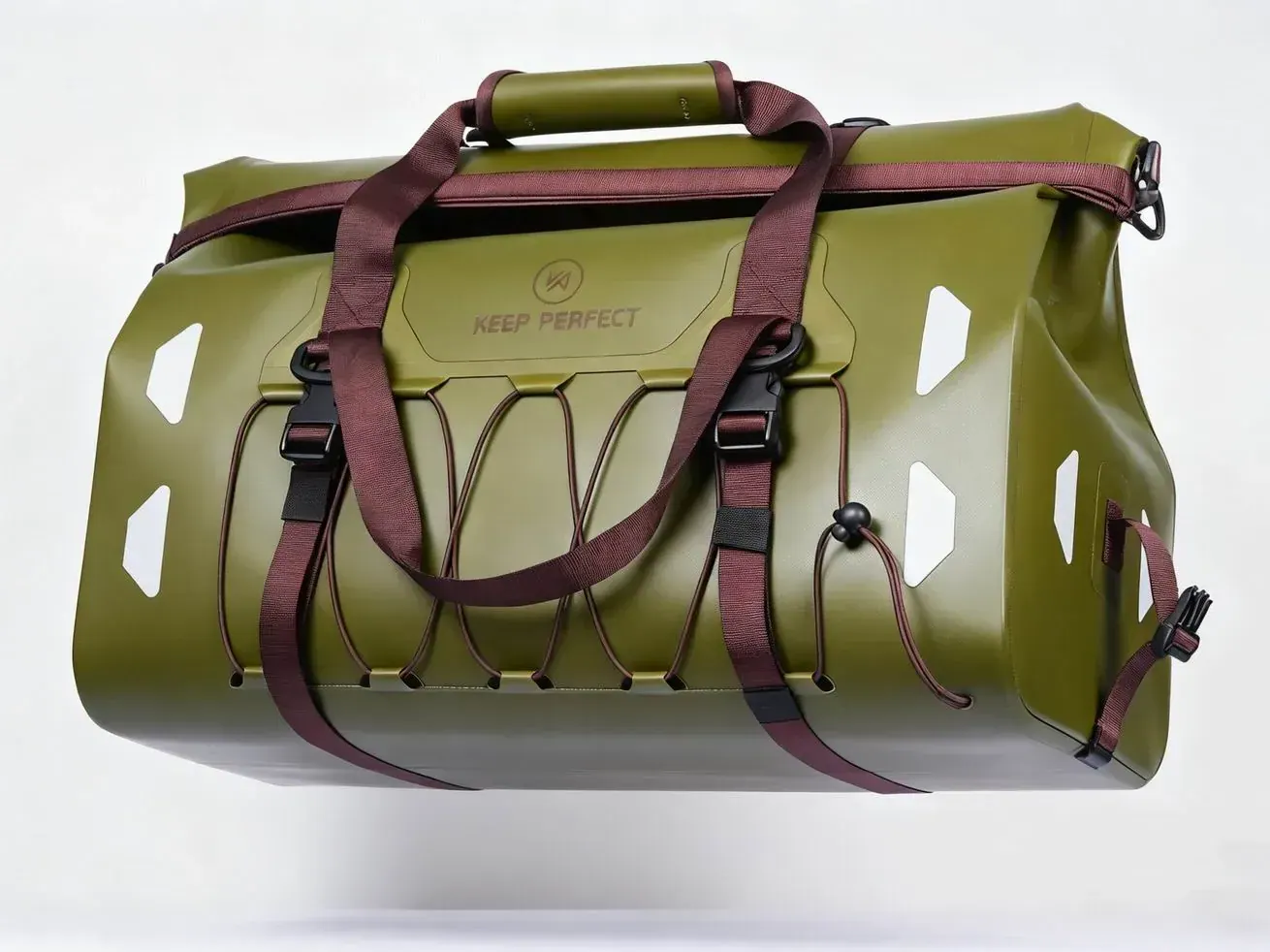
Pre-Shipment Checks That Catch Leaks Before They Reach the Customer
Leak failures are cheap to find in a sampling round and expensive to find in a retail return queue. The test matrix below takes about four working days per style and costs a small fraction of a recall; it is the same schedule applied to bulk release, with sampling levels set by AQL 2.5 so that a 500 pc order draws a statistically meaningful sample rather than a token two pieces.
| Check | Method | Pass criterion | Frequency |
|---|---|---|---|
| Enclosure integrity | Low-pressure air decay on sealed body | Under 10 percent loss over 3 min | Every colourway, first article |
| Zip cycling | Open and close 500 cycles, then spray | No moisture on indicator paper | Per zip lot |
| Seam peel strength | Tensile pull on welded coupon | At least 90 percent of fabric strength | Per production week |
| Abrasion | Martindale, ISO 12947-2 | 25,000 cycles to first yarn break | Per fabric lot |
| Colour fastness to light | Xenon arc, AATCC 16 | Grade 4 or better at 20 hours | Per colourway |
| Chemical screening | REACH SVHC and Prop 65 list check | Non-detect on declared substances | Per material lot |
Two practical notes close the loop for buyers. First, insist that the sample used for the enclosure test is a production-tooled piece, not a hand-welded prototype, because weld parameters are the variable that drifts when a style moves from development to the floor. Second, keep one retained sample per colourway under ambient conditions; when a field claim arrives eight months later, having a control piece to compare against makes root-cause analysis fast instead of adversarial.
People Also Ask
What is the difference between a water-resistant and a waterproof backpack?
A water-resistant pack uses a coated shell and sheds light rain for 10-20 minutes before wetting out, while a waterproof pack carries an IPX rating under IEC 60529 and survives defined jets or immersion. The practical test is the closure: sealed bodies with roll-top or welded construction hold IPX5 and above, coated shells with stitched zips stop at IPX3-IPX4.
How many litres should a waterproof backpack hold for a weekend?
For a two-day trip with a change of clothes, a 30-35 L pack is usually sufficient at 8-10 kg, while a three-season sleeping system pushes the requirement to 45-55 L. Buyers should state usable load in kilograms alongside litres, because a 30 L pack of camera bodies weighs far more than 30 L of clothing.
Does an IPX8 rating mean a backpack can be taken diving?
No. IPX8 certifies continuous immersion beyond 1 m under conditions set by the maker, typically 1.5-3 m for 30-60 minutes in static water, and it does not rate the pack against pressure change, current or decompression use. For scuba support the sealed pack protects gear in transit, not in the water column alongside the diver.
Can a waterproof backpack carry liquids through airport security?
Yes, the pack itself is not restricted; the bottles and tubes inside still fall under the 100 ml container limit and the single 1 L transparent bag requirement. A welded liner does not exempt toiletries, but it does keep a leaking bottle from reaching clothing and electronics during the flight.
How long do welded TPU seams last on a backpack?
Properly welded TPU seams typically outlast the shell, with service life of 5-8 years under seasonal use when the pack is stored dry and out of direct sun. Hydrolysis and UV exposure are the two failure drivers, and both accelerate sharply if the pack is stored wet in a sealed container.
Why does a waterproof backpack smell musty and how do I stop it?
The smell comes from microbial growth in damp foam and liner fabric, since a fully sealed shell also traps moisture inside once wet gear is packed. Rinse the interior with fresh water, dry with the mouth propped open for 12-24 hours, and store with the closure unrolled so air can circulate between trips.
Frequently Asked Questions
Q1. What IPX rating should a waterproof backpack have?
IPX5 covers heavy rain and boat spray and is the sensible default for hiking, travel and commute programmes. Specify IPX6 for motorcycle and deck work where a 100 L/min jet is realistic, and reserve IPX7-IPX8 for packs that are genuinely meant to be submerged, since the closure hardware roughly doubles unit cost.
Q2. Are roll-top backpacks fully waterproof?
A roll-top pack is waterproof to the rating it was tested at, usually IPX5-IPX6, provided the user rolls three full turns with a 60-80 mm fold before clipping the buckles. One lazy turn reduces the effective rating by roughly two levels, which is why user instruction cards matter as much as the construction.
Q3. How much does a waterproof backpack weigh compared with a standard pack?
Expect a 150-350 g penalty on a 25-35 L pack: TPU-laminated shell adds 60-120 g, welded seam construction adds 40-90 g, and sealed hardware adds 50-140 g. A 30 L waterproof daypack therefore lands at 850-1,100 g where an uncoated equivalent sits at 650-800 g.
Q4. What does hydrostatic head mean in millimetres?
Hydrostatic head is the height of a water column the fabric supports before the third drop penetrates, measured by ISO 811 or AATCC 127. At 1,500 mm a fabric is shower-resistant, 3,000-5,000 mm is rainproof, and 8,000-10,000 mm is the band used for welded shells intended for spray and brief immersion.
Q5. Can I put a 16 inch laptop in a 30 L waterproof backpack?
Yes, a 30 L pack with a flat back panel accepts a suspended sleeve sized for 15.6-16 in devices, which means an internal bay of roughly 380 x 265 mm. The bay needs 20 mm of clearance under the sleeve so the device never rests on the base seam when the pack is put down.
Q6. Do welded seams delaminate over time?
Correctly welded TPU seams rarely delaminate in service; the failures seen in the field trace back to under-power welds, contaminated film or plasticiser migration in PVC shells after 3-4 years. A seam peel test at 90 percent of base fabric strength on production coupons catches the problem long before shipping.
Q7. How do I test whether a backpack is waterproof at home?
Start with air, then water. Inflate the sealed body through the purge valve to about 3 kPa and confirm it holds for three minutes, then hose every face from 1 m at 12 L per minute for five minutes with dry indicator paper inside. Any damp patch points to the closure or a lifting weld, and a pack claiming IPX7 should then sit in a bath for 15 minutes under 5 kg of weight.
Q8. What is the minimum order quantity for a waterproof backpack programme?
MOQ is 500 pcs per design per colourway, and consolidating three colours into one larger run from 3,000 pcs is usually cheaper per unit than three separate 500 pc drops. Material minimums for webbing, zip tape and film are what set the threshold, not assembly capacity.
Q9. How long do samples take before a bulk order?
Samples take 6-10 working days from confirmed artwork, with welded-body styles at the longer end because tooling for the weld jig has to be cut first. Bulk then runs 35-50 days depending on order band, colourway count and whether Pantone-matched webbing is required.
Q10. Can waterproof backpacks be made without PFAS chemistry?
Yes. PFAS-free DWR on the face fabric combined with a TPU film barrier achieves the same hydrostatic head in laboratory testing, and it is now the default for EU-bound programmes because several member states restrict long-chain fluorinated treatments. State the requirement in the tech pack so the correct finish is quoted from the start.
Q11. Will a waterproof backpack float if it goes overboard?
Only if it is designed to. A sealed pack with trapped air floats briefly, perhaps 10-20 minutes depending on load, but a 10 kg pack sinks once the air escapes; buoyant programmes add closed-cell foam panels or a removable flotation insert. Never treat a standard waterproof pack as a flotation device.
Q12. What fabric denier is best for a waterproof backpack?
500D polyester with TPU film is the volume sweet spot: adequate abrasion resistance at 285 g/m2 and clean weld behaviour. Move to 840D or 1000D for expedition and marine packs where abrasion matters more than weight, and to 210D-420D liners where the shell carries the structural load.
Q13. How should a waterproof backpack be cleaned?
Rinse with fresh water and a soft sponge, using pH-neutral soap at under 40 degrees Celsius for salt or mud; never machine wash, never use solvents, and never tumble dry. Reapply a spray-on DWR once water stops beading on the face fabric, which for a weekly-use pack is typically after 12-18 months.
Q14. Does cold weather make waterproof fabric crack?
TPU-laminated shells stay flexible to about -30 degrees Celsius and are safe for winter programmes, whereas PVC tarpaulin stiffens below -10 to -15 degrees Celsius and can crease-crack if folded when frozen. Specify the low-temperature flex requirement in the tech pack if the destination market includes Canada, Scandinavia or alpine retail.
Q15. What packaging and carton specifications apply to bulk orders?
Standard packing is one piece per polybag and 10-20 pieces per export carton, with cartons near 60 x 40 x 35 cm and gross weight under 15 kg. Carton drop testing at 80 cm on one corner, one edge and one face is included, and palletised loads are stretch-wrapped with corner board on request.