A waterproof backpack size chart is four numbers, not one: length, width, height and litre capacity, and the first three decide whether the pack fits your back, your gear and your airline cabin while the fourth only describes space. A 30 litre body typically measures 52 by 31 by 22 centimetres and weighs about 980 grams empty; a 40 litre body runs 60 by 33 by 26 centimetres at roughly 1,340 grams; and a 55 litre body reaches 68 by 36 by 30 centimetres at about 1,800 grams. Torso length governs fit more than any of them, measured from the seventh cervical vertebra to the iliac crest, with 38 to 43 centimetres taking a small back system and 48 to 53 centimetres taking a large one. Cabin limits are the practical ceiling for travel bodies: 55 by 40 by 20 centimetres is the widely applied overhead figure and 40 by 30 by 15 centimetres the under-seat one, both of which sit below a 30 litre pack. Programme entry for a sized range is 500 pcs per design and colour, prototypes in 6 to 10 working days, bulk in 35 to 50 days, FOB Xiamen.
Dimensions, Not Litres: How to Read a Size Chart
Litre figures are rounded for a range and are not what you should be matching. What determines whether a pack works is the external footprint against your back and against the space it has to fit into, and the internal height against the longest thing you intend to carry. A 35 litre pack that is 56 centimetres tall carries a long item comfortably; a 35 litre pack that is 46 centimetres tall and wider does not, even though both hold identical gear by volume.
Read a size chart in a fixed order. Height first, because it interacts with torso length and with overhead bins. Width second, because it interacts with your shoulders and with doorways, turnstiles and scrub. Depth third, because it is the number that governs whether the pack catches on rock, on branch and on other people in a crowded carriage. Volume last, as a check that the first three are consistent with the intended load.
| Nominal volume | Length, cm | Width, cm | Depth, cm | Empty weight |
|---|---|---|---|---|
| 18 litres | 44 | 25 | 16 | 620 grams |
| 22 litres | 46 | 28 | 18 | 740 grams |
| 25 litres | 48 | 29 | 20 | 810 grams |
| 30 litres | 52 | 31 | 22 | 980 grams |
| 35 litres | 56 | 32 | 24 | 1,150 grams |
| 40 litres | 60 | 33 | 26 | 1,340 grams |
| 45 litres | 64 | 34 | 27 | 1,480 grams |
| 55 litres | 68 | 36 | 30 | 1,800 grams |
| 65 litres | 74 | 38 | 32 | 2,150 grams |
Two patterns in that table are worth memorising. Depth grows far more slowly than height: from 16 centimetres at 18 litres to 32 centimetres at 65 litres, so a large pack is long rather than bulky, which is why expedition bodies clear most doors and why they catch on low branches instead. And empty weight grows roughly in proportion to surface area rather than volume, so doubling the litres increases the weight by about 75 percent rather than 100 percent.
Where the Litre Figure Actually Comes From
Multiply the three dimensions and you will not get the litre figure on the chart, which surprises everyone the first time. A 30 litre pack at 52 by 31 by 22 centimetres encloses 35.5 litres of rectangular space, yet it is sold as 30 litres. The gap is the fill factor: a soft body with rounded corners, a tapered top and a roll top collar cannot be filled to the corners, and the usable fraction for a soft pack is typically 0.55 to 0.65 of the bounding box, against 0.75 to 0.85 for a hard case.
| Body type | Bounding box fill factor | Worked example | Planning implication |
|---|---|---|---|
| Soft pack with roll top collar | 0.55 to 0.65 | 35.5 litres box gives about 30 litres usable | Add 10 percent to any estimate |
| Soft pack with a flat zippered top | 0.65 to 0.72 | 35.5 litres box gives about 25 litres usable | Closest box to real capacity |
| Framed body with a fixed lid | 0.68 to 0.75 | 40 litres box gives about 29 litres usable | Predictable, easy to pack |
| Hard case or moulded shell | 0.75 to 0.85 | 30 litres box gives about 24 litres usable | Buy on internal dimensions only |
| Dry bag style, no structure | 0.50 to 0.60 | 25 litres box gives about 14 litres usable | Least efficient, most compressible |
The practical rule is to convert in one direction only. If you know the internal dimensions you need, multiply them and take 60 percent to estimate usable litres. If you know the litres you need, divide by 0.6 and take the cube root to estimate the side length of a roughly cubic body, then adjust the proportions to the shape you actually want. Both conversions are accurate to within about 10 percent, which is as good as any printed figure.
Waterproof construction lowers the fill factor further, because a roll top collar consumes 12 to 15 centimetres of height and welded seams turn inward rather than out. Matching volume to trip length uses a different method again, based on days rather than geometry, and that is set out in the volume matching guide.
Torso Length and Back System Fit
Torso length is the measurement that decides whether a pack carries well, and it is not the same as height. Measure from the seventh cervical vertebra, the bone that stands out when you tip your head forward, down the spine to the iliac crest, which is the top of the hip bone at the level you would rest your hands on your hips. That distance, not your overall height, selects the back system, and two people of identical height can differ by 8 centimetres or more.
| Torso length | Back system size | Suitable volume band | Fit notes |
|---|---|---|---|
| Up to 38 centimetres | Extra small | 15 to 22 litres | Youth and small adults |
| 38 to 43 centimetres | Small | 18 to 30 litres | Most common for lighter walkers |
| 43 to 48 centimetres | Medium | 25 to 45 litres | The default for most adults |
| 48 to 53 centimetres | Large | 35 to 65 litres | Check the hip belt sits on the crest |
| 53 to 58 centimetres | Extra large | 45 litres and above | Often needs a tall back panel |
| Adjustable harness, 10 cm range | One system, several users | 30 to 50 litres | Best for shared or rental fleets |
Three checks confirm the fit once the torso number is right. The hip belt should sit on the iliac crest rather than around the waist, and it should carry 70 to 80 percent of the load once tensioned. The shoulder straps should meet the body roughly 5 centimetres below the top of the shoulder rather than pulling away at the top. And the load lifters, where fitted, should run at roughly 45 degrees upward from the shoulder to the pack body; a strap running horizontally is not doing anything.
A pack that fits badly wastes capacity in a specific way: the load sits away from the spine, the effective lever arm increases, and a 12 kilogram load feels like 16 kilograms. Fit is therefore a size decision rather than a comfort accessory, and choosing on volume alone is the most common reason people own three packs and use one. Fit by activity is covered further in the types by activity guide.
Cabin, Carry-On and Under-Seat Limits
For travel bodies the airline figures are the hard constraint, and they are tighter than most buyers expect. The widely applied overhead allowance is 55 by 40 by 20 centimetres, which corresponds to roughly 30 litres of bounding box and about 20 litres of genuinely usable space. The under-seat allowance is typically 40 by 30 by 15 centimetres, around 18 litres of box and 11 litres usable. Anything above 30 litres nominal is an overhead item at best and a checked item in practice.
| Stowage position | Typical limit, cm | Bounding box litres | Largest pack that fits |
|---|---|---|---|
| Under-seat personal item | 40 x 30 x 15 | 18 litres | 18 litre body, soft shell |
| Overhead bin, most carriers | 55 x 40 x 20 | 44 litres | 30 litre body, compressed depth |
| Overhead bin, generous carriers | 56 x 45 x 25 | 63 litres | 40 litre body, soft sides |
| Checked hold, soft pack | No fixed internal limit | Not applicable | 65 litre body with straps stowed |
| Regional aircraft overhead | Often smaller than mainline | Varies by aircraft | 20 litre body is safe |
Depth is the dimension that fails the gauge, not height, because a soft pack can be compressed in one direction and not the others. A 30 litre body at 22 centimetres depth will usually compress to 19 or 20 centimetres with the collar rolled and the compression straps pulled, which is the difference between acceptance and a gate check. Practise the compression once at home rather than at the aircraft door, and note the depth achieved.
Limits vary by carrier and by aircraft, and regional fleets are frequently smaller than the mainline figures quoted above, so treat the table as a planning guide rather than a guarantee. Cabin rules, weight allowances and the practicalities of packing to them are set out in the carry-on airline rules guide, and travel specific sizing is covered in the waterproof travel backpack overview.
Laptop and Device Sleeve Dimensions
Device sleeves are the most frequently mis-specified dimension on any size chart, because the stated figure describes a bare screen diagonal and the real requirement is a padded sleeve that accepts the device in its case. Screen size is measured diagonally in inches, which tells you nothing about the footprint; a 15 inch device in a slim sleeve needs roughly 36 by 25 centimetres of clear internal space, and the same device in a rugged case needs another 5 to 10 millimetres in each direction.
| Device class | Bare device, cm | Sleeve needed, cm | Body volume that suits it |
|---|---|---|---|
| 13 inch laptop | 31 x 22 | 33 x 24 | 18 to 22 litres |
| 14 inch laptop | 32 x 23 | 34 x 24 | 20 to 25 litres |
| 15 inch laptop | 34 x 24 | 36 x 25 | 22 to 30 litres |
| 16 inch laptop | 36 x 25 | 38 x 26 | 25 to 35 litres |
| 17 inch laptop | 39 x 27 | 41 x 28 | 30 to 40 litres |
| Tablet with keyboard case | 25 x 18 | 27 x 20 | 15 to 20 litres |
Two specifications matter beyond the footprint. The sleeve must be suspended, meaning it stops 3 to 5 centimetres short of the base of the pack so a drop onto the bottom does not drive the device corner into the ground, and it should be lined with a soft face that does not abrade the device over a season of daily insertion. Both are cheap to specify and neither appears in a product photograph. Larger device sizing is covered in the 17 inch laptop sleeve guide, and protection detail in the laptop protection explainer.
Where a commute involves both a device and wet kit, the useful dimension is the height of the wet compartment rather than its volume. A separated lower cavity of 4 to 6 litres and at least 20 centimetres internal height keeps a wet shell or swim kit clear of a laptop sleeve, and it costs roughly 80 to 150 grams against a single cavity of the same total capacity. Commuters choosing on this basis are usually better served by a 22 litre body with separation than by a 30 litre body without it.
Daypack and Trail Sizes
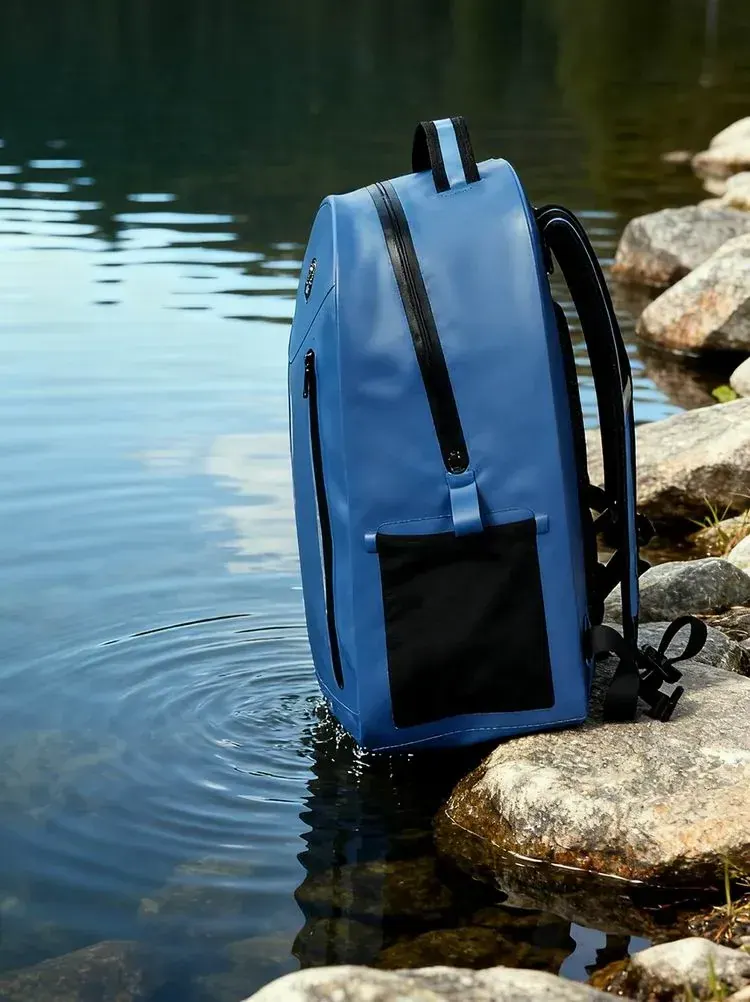
Trail use drives sizes toward the lower end of the range, because a pack carried for eight hours is sized for what the day needs rather than for what the trip might. An 18 to 22 litre body covers a summer day walk with water, food, a shell and a small first aid kit; 25 to 30 litres covers a winter day or a day with a camera; and anything above 30 litres on a day walk is usually carrying items that were packed by habit rather than by plan.
- Summer day walk, 4 to 8 hours: 18 to 22 litres, 4 to 6 kilograms, depth under 20 centimetres.
- Winter day walk with extra insulation: 25 to 30 litres, 6 to 9 kilograms, check the collar still makes four turns.
- Day walk with camera gear: 25 to 30 litres with a padded insert, or 20 litres plus a separate lens pouch.
- Trail running and fast packing: 12 to 18 litres, 3 to 5 kilograms, harness stability matters more than capacity.
- Overnight with a compact sleep kit: 30 to 35 litres, 9 to 12 kilograms, the smallest size that genuinely works.
Stability is the reason trail sizes stay small. A load that sits close to the spine with a low centre of mass does not shift on off camber ground, and the way to achieve it is a narrow, tall body rather than a wide, shallow one. Width above 30 centimetres on a pack carried at speed tends to catch on vegetation and to swing on descent, so for trail use prefer the narrower figure even when two sizes have the same nominal volume.
Fabric weight interacts with size here more than anywhere else, because a daypack is judged on grams in a way an expedition pack is not. The relationship between denier, coating thickness and total mass is set out in the ripstop nylon fabric guide, and test methods for the shell are published by AATCC, whose numbers make a specification comparable rather than descriptive.
Empty Weight and Loaded Weight
Weight is the specification most often quoted without a basis. Empty weight means different things depending on whether the harness, the hip belt, any rain cover and the internal frame are counted, and the difference across those conventions is 120 to 300 grams on a mid-size body. Ask what is included, then decide whether the figure matters: on a 20 litre daypack it does, on a 55 litre expedition body it rarely does.
| Weight term | What it includes | Typical value, 35 litre body | When it matters |
|---|---|---|---|
| Shell weight | Body only, no harness | 620 to 780 grams | Comparing fabric specifications |
| Empty weight, stripped | Body plus fixed harness | 980 to 1,150 grams | The usual quoted figure |
| Empty weight, as sold | Adds hip belt, lid, any rain cover | 1,150 to 1,400 grams | What you actually carry |
| Designed load | Mass the suspension is rated for | 12 to 16 kilograms | The governing limit |
| Packed weight, real | Everything including water | 9 to 15 kilograms | Compare to 20 percent of body weight |
The governing check is packed weight against body weight, and the comfortable band is 15 to 25 percent with the sweet spot at 15 to 20 percent for anything longer than a day. A 68 kilogram walker should finish between 10 and 17 kilograms including water. Above that band the pack is not the problem; the load is, and the cheapest correction is usually carrying less water rather than buying a larger body.
Two lighter-weight traps are worth naming. A shell that achieves a low figure through a thinner coating will abrade sooner and lose hydrostatic performance earlier, so ask for the coating thickness in millimetres alongside the weight. And hardware is where weight savings are least visible and most costly: a buckle that is 20 grams lighter and fails at the two hundredth cycle is a bad trade on any pack that sees daily use.
Choosing Sizes for a Retail or Rental Range
A size range is a commercial decision before it is a technical one. Three sizes cover roughly 85 percent of demand, four cover about 93 percent, and a fifth adds very little while increasing inventory risk and tooling overhead. The usual first season set is 20 litres for day and commute, 30 litres for weekend and travel, and 45 litres for expedition and paddle camping, with a shared back system across the upper two sizes to reduce tooling by 6 to 12 percent.
| Range decision | Effect on coverage | Effect on cost | Recommendation |
|---|---|---|---|
| Two sizes in the range | About 65 percent of demand | Lowest inventory risk | Only for a narrow niche |
| Three sizes in the range | About 85 percent of demand | Baseline | The standard first season set |
| Four sizes in the range | About 93 percent of demand | Plus 4 to 9 percent overhead | Add in season two |
| Shared back system across sizes | No effect on coverage | Minus 6 to 12 percent tooling | Share on adjacent sizes |
| Adjustable harness, 10 cm range | Fits more users per size | Plus 2 to 4 USD per unit | Best for rental fleets |
| Separate youth size | Adds 6 to 9 percent coverage | Full tooling for small volume | Delay until demand exists |
Rental and guide fleets have a different optimum, because one pack has to fit many users. An adjustable harness with a 10 centimetre range and a hip belt that accommodates two sizes lets a single 35 litre body serve most adults, which reduces the fleet to one or two stock keeping units at a cost of 2 to 4 USD per unit. For a fleet, fit range is worth far more than size range.
Ingress performance should be specified per size rather than once for the range, because the closure length and the seam length both grow with the body. A 20 litre body and a 55 litre body with the same closure specification do not have the same risk profile, and the rating codes and their test definitions are published by IEC. Test methods for the coated shell are maintained by ASTM, and citing both the code and the method turns a description into an enforceable requirement.
QUANZHOU JUNYUAN BAGS has built sized waterproof ranges since 2014, with the founding team in the industry since 2004, monthly output of 200,000 units verified by SGS and certification to BSCI and ISO 9001. Programme entry is 500 pcs per design and colour, prototypes in 6 to 10 working days, bulk production in 35 to 50 days, FOB Xiamen or DDP into more than 100 countries. Materials are screened against REACH and California Prop 65, every lot is inspected at AQL 2.5 before release, and dimensions are stated in centimetres with coating thickness in millimetres on every specification. Size charts, dimension templates and range planning notes are published. Enquiries go to service@junyuanbags.com.
People Also Ask
What size is a 30 litre waterproof backpack?
About 52 by 31 by 22 centimetres, weighing roughly 980 grams empty. Those dimensions give a bounding box of 35.5 litres, of which about 60 percent is usable because a roll top collar and rounded corners reduce the fill factor.
Will a 40 litre backpack fit in an overhead bin?
Only on carriers applying the 56 by 45 by 25 centimetre allowance, and only with the body compressed. The common 55 by 40 by 20 centimetre gauge corresponds to a 30 litre body, so 30 litres is the safer travel size.
How do I measure my torso for a backpack?
Tip your head forward and find the seventh cervical vertebra, then measure down the spine to the iliac crest at the top of the hip bone. Up to 38 centimetres takes extra small, 38 to 43 small, 43 to 48 medium, and 48 to 53 large.
Why is the litre figure lower than the dimensions suggest?
Because a soft body fills to only about 0.55 to 0.65 of its bounding box. Multiply length by width by depth and take 60 percent to estimate usable litres from dimensions, or divide by 0.6 to go the other way.
What backpack size fits a 15 inch laptop?
A sleeve of at least 36 by 25 centimetres, which is the bare device at 34 by 24 centimetres plus 5 to 10 millimetres for a case. A 22 to 30 litre body usually carries that sleeve with room for the rest of a workday load.
Is a bigger backpack always better for a day hike?
No. Eighteen to 22 litres covers a summer day walk at 4 to 6 kilograms, and stability improves with a narrower body. Width above 30 centimetres tends to catch on vegetation and swing on descent.
Frequently Asked Questions
Q1. What are the dimensions of a 30 litre waterproof backpack?
Typically 52 by 31 by 22 centimetres at about 980 grams empty. The bounding box is 35.5 litres, but a soft body with a roll top collar fills to roughly 60 percent of that, which is where the 30 litre figure comes from.
Q2. How do I convert backpack dimensions to litres?
Multiply length by width by depth in centimetres and divide by 1,000 to get the bounding box in litres, then take about 60 percent for a soft pack or 80 percent for a hard case. A 52 by 31 by 22 body gives 35.5 litres of box and about 21 litres usable.
Q3. What size waterproof backpack is carry-on compliant?
Around 30 litres, which compresses into the widely applied 55 by 40 by 20 centimetre overhead gauge. Under-seat allowances of 40 by 30 by 15 centimetres suit an 18 litre body. Regional aircraft are often smaller, so check the specific carrier.
Q4. How do I measure torso length for a backpack?
Tip the head forward and locate the seventh cervical vertebra, then measure down the spine to the iliac crest at the top of the hip bone. That distance selects the back system: 38 to 43 centimetres is small, 43 to 48 medium, 48 to 53 large.
Q5. What size sleeve do I need for a 15 inch laptop?
At least 36 by 25 centimetres of clear internal space. The bare device is about 34 by 24 centimetres and a case adds 5 to 10 millimetres per side, so always specify the sleeve from the cased dimension rather than the screen diagonal.
Q6. Why is my 35 litre pack shorter than another 35 litre pack?
Because litre figures are rounded for a range and external shape varies. One body may be 56 centimetres tall and 24 deep while another is 46 tall and 28 wide. Height governs what long items fit and depth governs what it catches on.
Q7. How much should an empty waterproof backpack weigh?
About 620 grams for an 18 litre body, 980 grams for 30 litres, 1,340 grams for 40 litres and 1,800 grams for 55 litres. Always check whether the figure includes the hip belt, lid and rain cover, which can add 120 to 300 grams.
Q8. What is the difference between 20 and 30 litre backpacks?
Roughly 6 centimetres of height, 6 of width and 6 of depth, plus 200 to 400 grams of empty weight and 3 to 4 kilograms of designed load. Twenty litres suits a day or commute; 30 litres suits a weekend or a travel body.
Q9. How heavy can I load a 40 litre waterproof backpack?
Between 12 and 18 kilograms by design, but the real ceiling is 15 to 25 percent of body weight. A 68 kilogram walker should finish between 10 and 17 kilograms including water regardless of what the pack is rated for.
Q10. Do waterproof backpacks run smaller than ordinary ones?
Yes, by roughly 8 to 12 percent of usable space. Welded seams turn inward, a roll top collar consumes 12 to 15 centimetres of height, and a laminated shell is stiffer than a woven face, so corners pack less efficiently.
Q11. What backpack size suits a weekend trip?
25 to 35 litres. Two days in temperate conditions needs about 22 litres by volume planning, three days needs about 30 litres, and a 30 litre body covers both with the collar as the adjustment.
Q12. Should a rental fleet buy one size or several?
One or two, with an adjustable harness covering a 10 centimetre torso range and a hip belt spanning two sizes. That costs 2 to 4 USD more per unit but lets a single 35 litre body serve most adults, which matters more than size variety.
Q13. How many sizes should a first season range include?
Three: 20 litres for day and commute, 30 litres for weekend and travel, and 45 litres for expedition and paddle camping. That covers about 85 percent of demand, and a shared back system across the upper two cuts tooling by 6 to 12 percent.