Yes, waterproof bags for fishing are a distinct product category, and the specification starts with four protection levels: shower resistant, rain resistant, splash proof, and submersible. Most anglers need level two or three, built on 500D to 1000D shell fabric with welded or taped seams and a rolled or sealed closure. A serious kayak or surf programme should aim at level four with an IPX7 finished-bag result at a stated depth and duration. Sourcing baseline is MOQ 500 pcs per design and colour, samples in 6-10 working days, bulk in 35-50 days, and AQL 2.5 inspection before shipment.
What Actually Counts as a Waterproof Fishing Bag
A fishing bag earns the waterproof label only when the finished product, not the fabric swatch, passes a stated water test with the load and trays fitted. Fabric alone proves very little: a 1000D shell with stitched seams will leak at the needle holes within minutes of sustained rain, while a 500D laminate with welded seams can hold a splash test indefinitely. The seam construction and the closure are the two decisions that determine the result.
The second distinction is between water resistant and waterproof. A water resistant bag sheds a shower and then wets through under pressure or duration. A waterproof bag maintains a dry interior under a defined condition. Marketing language often blurs the two, so the only reliable safeguard is to require the test condition in writing: method, duration, water delivery rate or depth, and the pass criterion.
| Level | Condition | Typical build | Suitable use |
|---|---|---|---|
| 1 Shower resistant | Light rain, 5 min | Coated fabric, stitched seams | Bank fishing in fair weather |
| 2 Rain resistant | Sustained rain, 60 min | Taped seams, flap or roll closure | Most freshwater angling |
| 3 Splash proof | Spray and wash, IPX6 | Welded seams, roll or sealed zip | Boat, pier, and wading use |
| 4 Submersible | Temporary immersion, IPX7 | RF welded body, airtight closure | Kayak, surf, and raft use |
Choosing the right level is a cost decision as much as a performance one. Level two construction typically costs 20-35 percent less than level four, because welding equipment, airtight closures, and 100 percent water screening add real process cost. Paying for level four on a bank-fishing bag that never leaves dry ground is money spent on the wrong variable; paying for level two on a kayak bag is a decision that will be remembered the first time the craft tips.
Shell Fabric, Coatings, and Seam Construction
Three shell materials cover the market. PVC-coated polyester at 500D to 1000D is the workhorse: cheap, abrasion tolerant, and easy to weld, at the cost of stiffness in cold weather and a heavier hand. TPU-laminated nylon or polyester at 420D to 840D costs more but stays flexible below 5 degrees, resists hydrolysis better, and produces a cleaner weld. Plain coated ripstop with no weldable film is the budget option and can only be seam-taped, never welded.
Denier selection should follow the abrasion environment rather than habit. A 500D shell suits bank and boat use where the bag rests on a deck or grass. An 840D to 1000D shell suits kayak, pier, and surf use where the base meets concrete, rock, and sand daily. The base itself deserves separate treatment: a welded 0.5 mm TPU patch over an 840D or heavier fabric is standard practice on bags expected to be set down in the wash zone.
| Material | Denier range | Weldable | Cold behaviour | Typical use |
|---|---|---|---|---|
| PVC-coated polyester | 500D-1000D | Yes | Stiffens below 5 degrees | General and saltwater |
| TPU-laminated nylon | 420D-840D | Yes | Flexible to minus 10 degrees | Cold and kayak use |
| Coated ripstop | 210D-420D | No | Good | Budget and packable |
| Moulded EVA base | Not applicable | Bonded | Stable | Rigid bottom and tote styles |
Seam method follows material. Welded seams fuse two films under heat and pressure with no needle holes, and they are the only construction that supports a credible submersible claim. Taped seams stitch first and then seal the stitch line with a 20-25 mm tape, which works well to level two and level three but leaves the tape edge as the first place to lift after 300 open and close cycles. The welded versus stitched fishing bag seam comparison sets out the trade-offs with test data.
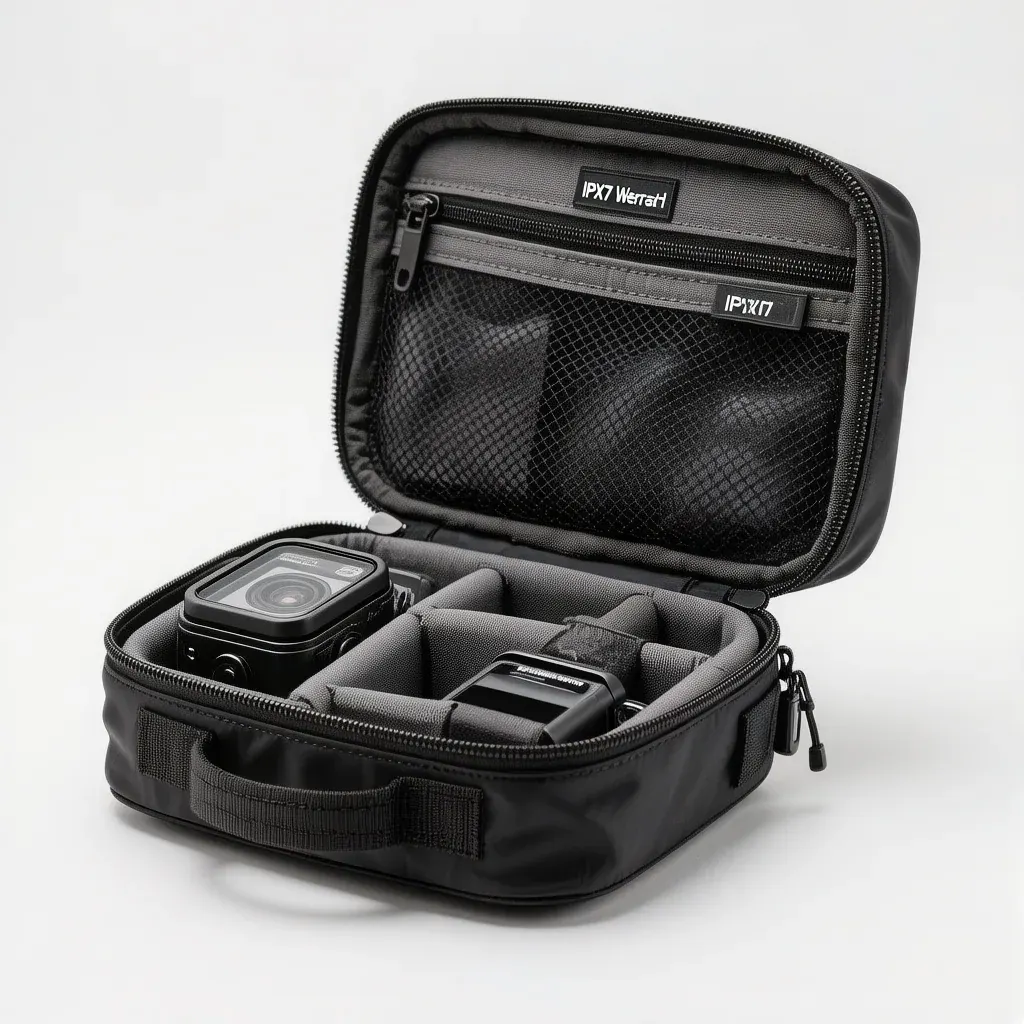
Formats: Backpack, Sling, Tote, Waist, and Crate
Format should follow the water and the walking. A backpack suits long walks and heavy loads, carrying 20-40 L with both shoulders and keeping the hands free for a rod. A sling suits short sessions where one tray and a few tools are enough, and it rotates to the front for access without being set down. A tote suits boat and pier use where the bag stays put and open-top access matters more than weather sealing. A waist pack suits wading, and a crate bag suits kayak tank wells.
| Format | Volume | Water level | Best situation |
|---|---|---|---|
| Tackle backpack | 20-40 L | 2 to 4 | Long walks, heavy loads |
| Sling pack | 8-15 L | 2 to 3 | Short sessions, one tray |
| Open-top tote | 15-30 L | 1 to 2 | Boat decks and piers |
| Waist or hip pack | 4-10 L | 2 to 3 | Wading and minimal kit |
| Crate bag | 20-35 L | 2 to 3 | Kayak tank wells |
The fishing tackle backpack range covers the full-volume end of the category, while the fishing sling pack range handles the light-session end. Most anglers end up owning two: a backpack for travel days and a sling or waist pack for short sessions. Programmes that sell both see noticeably higher repeat rates than programmes selling only one format, because the second purchase is usually made within twelve months.
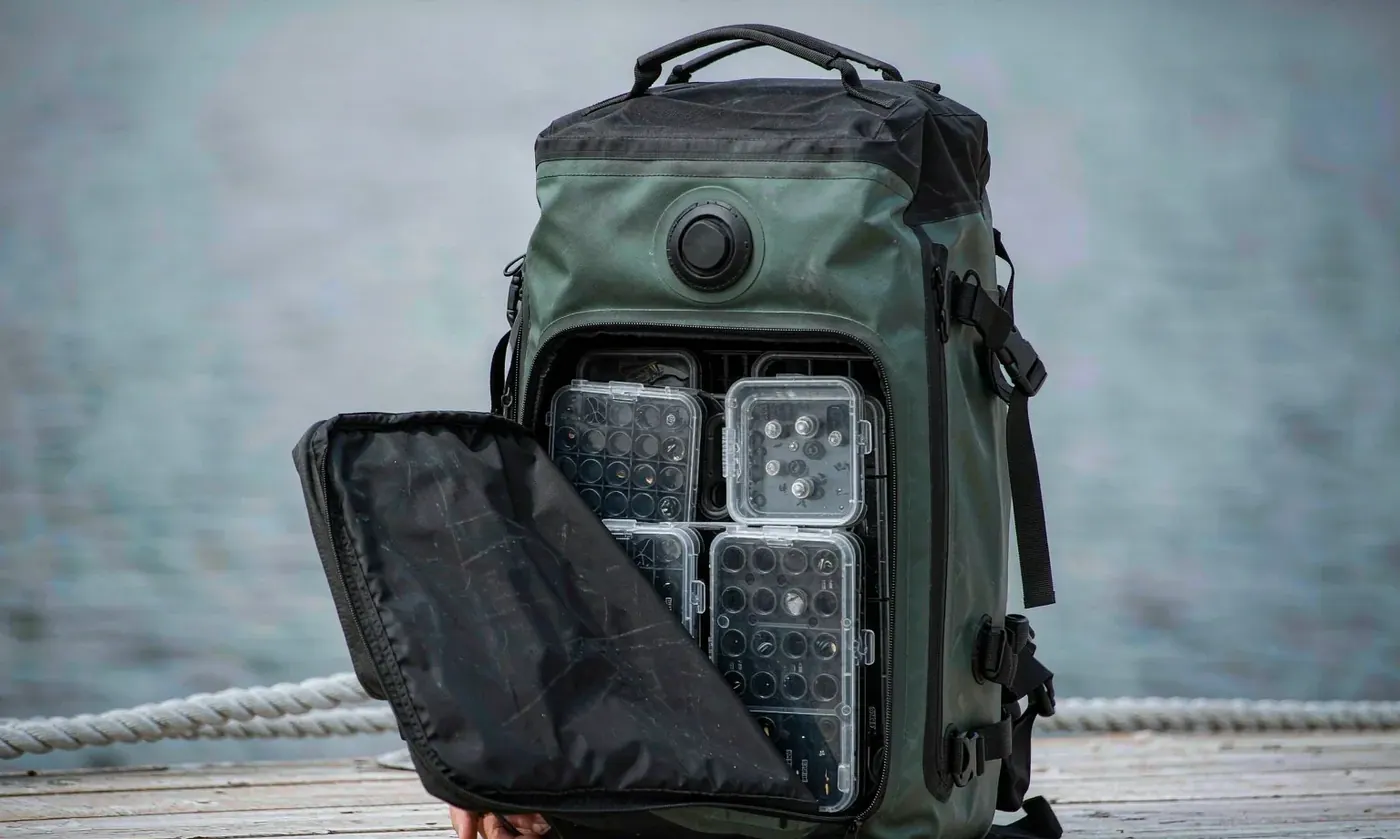
Tray Compatibility: 3600 and 3700 Standards
Tray fit is the specification detail that causes the most returns. A 3600-size tray is roughly 270 x 180 x 40 mm and a 3700-size tray is roughly 360 x 230 x 45 mm; those two sizes account for the majority of utility trays sold. A bag advertised as holding four trays may mean four 3600 or four 3700, and the difference in internal width is close to 90 mm. Always state the tray standard, the count, and whether trays are included.
Internal geometry matters as much as the raw count. Trays should slide in horizontally on rails or shelves so any tray can be removed without unpacking the bag, and the tray stack should sit against the back panel rather than floating in the middle of the chamber. Reserve at least 20 mm of clearance above the top tray so a loaded bag can still close without compressing the tray lids.
| Tray standard | External size | Typical bag capacity | Orientation |
|---|---|---|---|
| 3600 | 270 x 180 x 40 mm | 4 to 6 trays in a backpack | Horizontal rails |
| 3700 | 360 x 230 x 45 mm | 3 to 5 trays in a backpack | Horizontal rails |
| Mixed 3600 and 3700 | Both standards | 2 plus 2 common | Separate shelf heights |
| Deep 3700 plus | 360 x 230 x 70 mm | 2 to 3 trays | Check lid clearance |
Leader line, terminal tackle, and tools need homes too. Specify a spool pocket that takes four to eight 100 mm spools, plier sheaths sized for 200-250 mm tools, and a sealed pocket for phone and keys that sits above the tray stack. The tackle tray organisation guide covers layout patterns that keep the most-used tray at the top of the stack.
Freshwater and Saltwater Are Different Specifications
Saltwater changes three things at once: hardware, closure maintenance, and drying routine. Hardware that is perfectly adequate on a trout stream will show rust bloom within one coastal season, because chloride exposure attacks plain steel and low-grade zinc first at the spring and the slider. Specify 304 stainless as a baseline and 316 stainless where the bag is rinsed irregularly or used from a boat.
Closure maintenance is the second difference. Salt crystals left in zipper teeth or in a roll fold act as an abrasive and a moisture attractor at the same time, so a saltwater bag needs a fresh water rinse after every session and a drying period before storage. Skipping that step shortens closure life by more than half in field reports, and it is the single most common cause of a water test failure on an otherwise sound bag.
| Item | Freshwater specification | Saltwater specification |
|---|---|---|
| Hardware | Coated alloy acceptable | 304 or 316 stainless |
| Base fabric | 500D to 840D | 840D to 1000D plus welded patch |
| Rinse routine | As needed | Fresh water after every session |
| Drying | 8-24 hours open | 8-24 hours plus hardware check |
| Screen interval | Every 6 months | Every 3 months |
The saltwater fishing bag range is specified around those three differences rather than around colour or capacity, and the corrosion proof hardware guide explains the hardware grades in detail. Programmes selling into coastal markets should treat the saltwater clause as a default rather than an upgrade.
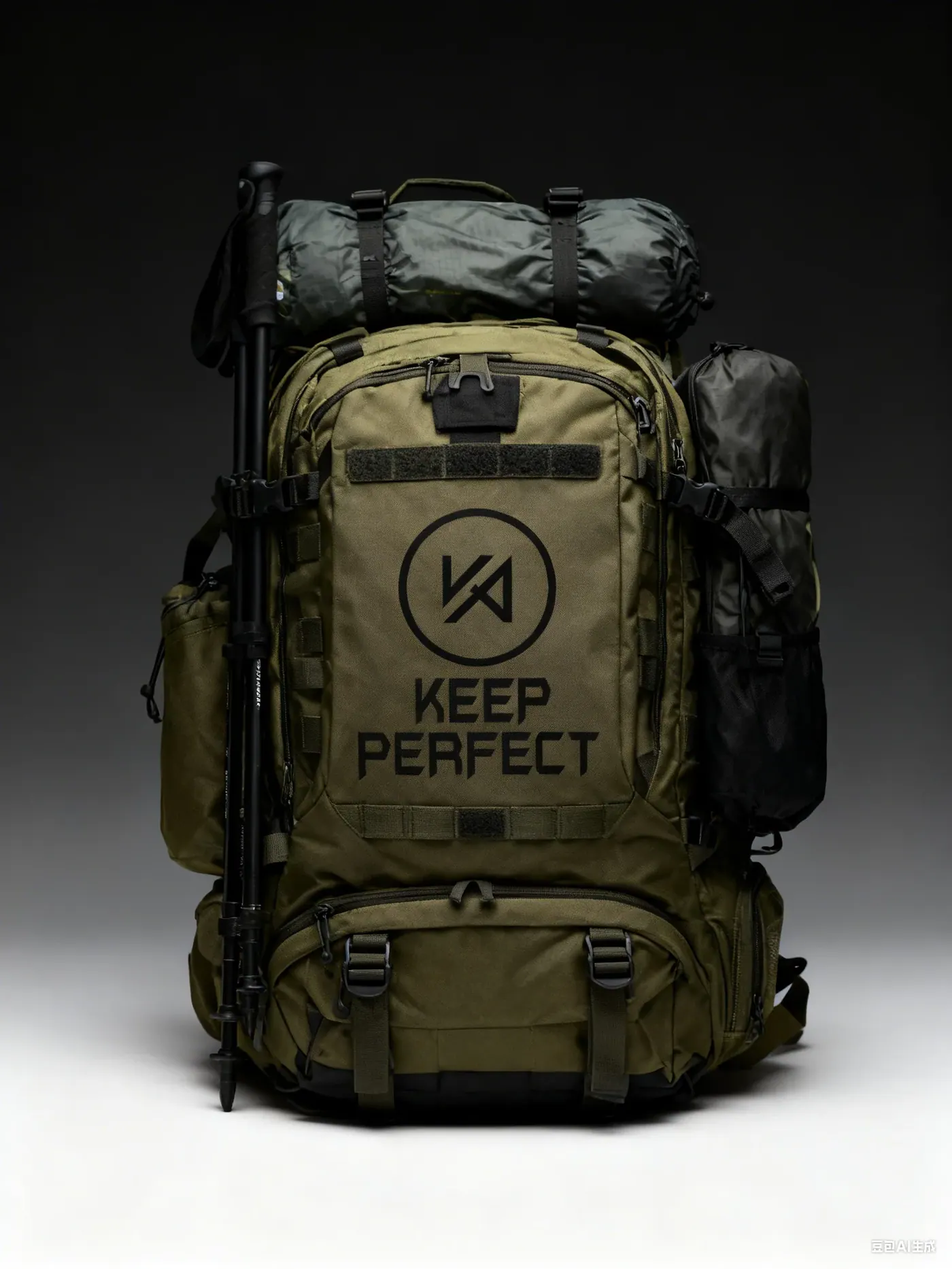
IPX Ratings and How Fishing Bags Are Tested
The ingress codes used on fishing bags are defined by the IEC ingress protection framework. IPX4 covers splashing from any direction, IPX5 covers water jets, IPX6 covers powerful jets, and IPX7 covers temporary immersion at a stated depth and duration. A bag marked IPX7 without a depth and duration is not a complete specification, and IPX8 should always be quoted with the agreed condition.
Testing the finished bag is the only meaningful check, and it must include the trays and the load. A bag screened empty can pass and then fail once 3 kg of trays presses the closure out of alignment. Place dry indicator tissue at both closure corners, at every seam junction, behind external pockets, and at the base, then run 60 minutes of directed spray at roughly 20 mm per hour before any immersion step.
- Screen the finished bag with trays, tools, and the normal load fitted.
- Run 60 minutes of directed spray from above and from the rear spray angle.
- Add the immersion step only where level four is claimed, with depth and duration stated.
- Open the bag on a dry surface so exterior droplets are not mistaken for ingress.
- Re-screen after 300 open and close cycles because folds change with use.
The IPX rating and fishing bag testing guide sets out a repeatable protocol that a buyer can hand to any workshop. Requiring that protocol in the purchase document removes most disputes, because both sides then measure the same thing in the same way.
Organisation, Access, and On-Water Behaviour
A fishing bag is used differently from a hiking pack. It is opened many times per session, often with wet or fish-slimed hands, and the user needs one specific tray rather than the whole contents. That argues for horizontal tray rails, a clamshell or drop-front opening, and a closure that can be operated one-handed. A top-loading bag that requires unpacking to reach the bottom tray will be abandoned by the third session regardless of how well it seals.
Wet and dry separation matters here too. A dedicated external pocket for a wet rag, a landed fish measure, or a rain shell keeps slime and water out of the tray chamber. Where a bag includes a cooler section, require a welded liner with a drain and keep it physically separate from tray storage, because condensation from ice will migrate and rust hooks faster than any splash.
Float behaviour is often asked about and frequently misunderstood. A sealed bag with trapped air may float, but load density, tray mass, and valve state all change the result, and behaviour varies minute to minute. Treat any float characteristic as a gear-recovery convenience only and never as a safety device. Where personal flotation is relevant on a boat or kayak, follow applicable national guidance and wear a properly selected device.
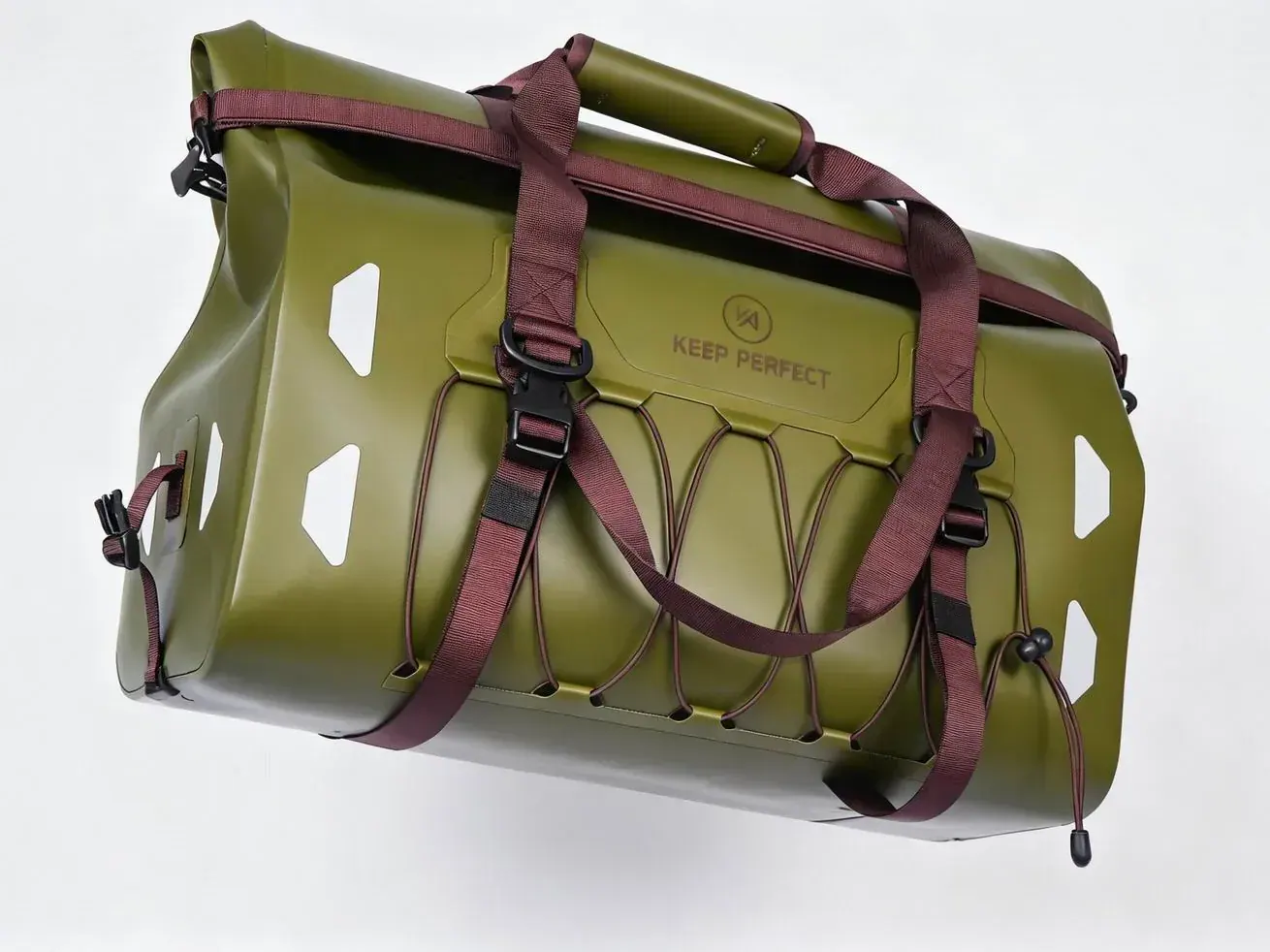
Care, Cleaning, and Rust Prevention
Hooks rust faster inside a bag than outside it, because a closed wet chamber holds humidity against the metal for hours. Two habits solve most of it: dry trays and tools before they go back in, and store the bag open for 8-24 hours after every session. Adding a small desiccant sachet of 10-20 g to the tray chamber is cheap insurance in humid climates, and it should be replaced every two to three months.
- Rinse the shell and hardware with fresh water after every saltwater session.
- Remove trays, empty the base, and dry open for 8-24 hours.
- Clear sand and grit from zipper teeth before operating the closure.
- Use mild pH-neutral soap only; never solvents, never machine washing.
- Inspect tape edges, weld lines, and hardware monthly in coastal use.
Off-season storage should be loose, dry, and out of direct sun at 15-25 degrees. Leave closures open so folds are not under constant stress, and remove trays so their weight does not deform the bag over months. The off-season fishing bag storage guide covers the full sequence, including how to check for mildew before the season starts.
Material Compliance and Chemical Screening
Fishing bags sold into the European Union and into several United States retail channels must meet chemical restrictions on coatings, films, inks, and hardware finishes. REACH is administered in the European Union by ECHA, and California Proposition 65 applies in that state. Screening should cover the shell coating, any printed logo, the seam tape adhesive, and metal hardware plating rather than only the face fabric.
Per- and polyfluoroalkyl substances deserve particular attention because durable water repellent finishes were historically a common source. Specifying a PFAS-free finish avoids the issue at the material selection stage, which is far cheaper than reformulating after a retail channel raises the question. The REACH and Prop 65 fishing bag materials guide lists the documentation a buyer should request.
| Requirement | Scope | Document to request |
|---|---|---|
| REACH | EU market, substances of concern | Material declaration per component |
| California Prop 65 | California retail | Warning assessment or test report |
| PFAS-free finish | Voluntary, increasingly requested | Finish specification statement |
| AQL 2.5 inspection | Every bulk order | Inspection report with defect list |
| Colour fastness | Printed and dyed parts | Fastness to rubbing and light |
Weather and water conditions should always be checked before a session, and NOAA weather resources support that review in the United States. Equipment preparation is not a substitute for route judgement, local knowledge, and appropriate personal safety equipment on the water.
Programme Baseline: MOQ, Lead Time, and Quality Control
Write the brief as one document: protection level, shell material and denier, seam method, closure type, tray standard and count, hardware grade, colour and branding method, compliance documents, and the water screen protocol. Then add acceptance criteria for dimensions, litres, seam appearance, coating thickness, and hardware finish. Approve at least three samples, because one dry result does not establish consistency across a run.
| Programme item | Baseline | Note |
|---|---|---|
| MOQ | 500 pcs per design and colour | Colour split negotiable above baseline |
| Sampling | 6-10 working days | Add 3-5 days for a hardware change |
| Bulk | 35-50 days | From approved sample and deposit |
| Inspection | AQL 2.5 | Include litres, tray fit, closure, water screen |
| Capacity | 200,000 units per month | Verified by SGS |
QUANZHOU JUNYUAN BAGS has developed waterproof bag programmes since 2014, with the founding team active in the industry since 2004. Monthly output of 200,000 units is verified by SGS, and BSCI and ISO 9001 systems structure the workflow. Materials are screened for REACH and California Prop 65, and every bulk order is inspected at AQL 2.5 before shipment.
A fishing bag brief can be emailed to service@junyuanbags.com; include target water level, tray standard, hardware grade, market, and quantity. FOB Xiamen or DDP service to more than 100 countries follows an approved sample and a complete test record. The waterproof fishing backpack range shows how the level three and level four builds differ in practice.
People Also Ask
Are there waterproof bags made specifically for fishing?
Yes. Fishing bags are built around tray storage, tool access, and saltwater hardware rather than around general travel packing, and the waterproof claim should come from a finished-bag water screen rather than from the fabric alone.
What denier fabric is best for a fishing tackle bag?
Five hundred denier suits bank and boat use, and 840 to 1000 denier suits kayak, pier, and surf use where the base meets rock, concrete, and sand daily. The base deserves its own welded patch regardless of shell denier.
Do waterproof fishing bags float if they go overboard?
A sealed bag with trapped air may float, but load density, tray mass, and valve state change the result. Treat any float behaviour as a gear-recovery convenience only, never as personal safety equipment.
How do 3600 and 3700 tray sizes compare?
A 3600 tray is roughly 270 by 180 by 40 mm and a 3700 is roughly 360 by 230 by 45 mm, a width difference of close to 90 mm. Any bag advertised by tray count should state which standard it means.
How often should a saltwater fishing bag be rinsed?
After every session, with fresh water over the shell and hardware, followed by 8-24 hours of open drying. Skipping the rinse is the most common cause of closure and hardware failure on coastal bags.
Can hooks rust inside a waterproof bag?
Yes, more readily than outside it, because a closed wet chamber holds humidity against the metal. Dry trays and tools before packing, store the bag open, and use a 10-20 g desiccant sachet in humid climates.
Frequently Asked Questions
Q1. What does waterproof mean for a fishing tackle bag?
It means the finished bag passes a stated water test with trays and load fitted. Fabric denier and coating alone do not establish it; seam construction and closure type do.
Q2. What are the four levels of waterproof fishing bags?
Shower resistant, rain resistant, splash proof, and submersible. Most freshwater anglers need level two or three, and kayak or surf anglers should specify level four with a stated immersion condition.
Q3. Are welded seams better than taped seams on fishing bags?
Welded seams have no needle holes and are the only construction that supports a credible submersible claim. Taped seams work well to level three but the tape edge is the first place to lift after roughly 300 cycles.
Q4. What fabric denier should I choose?
Five hundred denier for bank and boat use, and 840 to 1000 denier for kayak, pier, and surf use. Specify a welded base patch in both cases.
Q5. Do fishing tackle bags come with trays included?
Sometimes, and the listing should say so explicitly. Confirm the tray standard, the count, and the internal clearance above the top tray before ordering.
Q6. What is the difference between a 3600 and a 3700 tray?
A 3600 tray is roughly 270 by 180 by 40 mm; a 3700 is roughly 360 by 230 by 45 mm. The width difference is close to 90 mm, so a bag holding four of one will not hold four of the other.
Q7. Should I buy a backpack or a sling for fishing?
A backpack suits long walks and loads above 8 kg, while a sling suits short sessions with one tray. Most anglers eventually own both.
Q8. What hardware grade do I need for saltwater?
Use 304 stainless as a baseline and 316 stainless where rinsing is irregular or the bag is used from a boat. Plain steel and low-grade zinc show rust bloom within one coastal season.
Q9. How do I stop hooks rusting inside the bag?
Dry trays and tools before packing, store the bag open for 8-24 hours, and use a 10-20 g desiccant sachet in humid climates. Replace the sachet every two to three months.
Q10. What IPX rating should a kayak fishing bag have?
IPX7 at a stated depth and duration, because temporary immersion is credible. A bag marked IPX7 with no condition is not a complete specification.
Q11. How is a waterproof fishing bag tested?
Screen the finished bag with trays and load fitted: 60 minutes of directed spray at about 20 mm per hour, then the agreed immersion condition, with dry indicator tissue at closures, seams, pockets, and base.
Q12. Can I put ice and drinks in the same bag as my trays?
Only if the cooler section has a welded liner, a drain, and physical separation from tray storage. Condensation from ice rusts hooks faster than most splashes.
Q13. Are PFAS-free water repellent finishes available?
Yes, and specifying one at the material stage is far cheaper than reformulating later. Several retail channels now ask for this documentation by default.
Q14. What compliance documents should I request?
A material declaration covering REACH, a California Prop 65 assessment where relevant, a finish specification statement, colour fastness results, and an AQL 2.5 inspection report per shipment.
Q15. How should a fishing bag be stored in the off-season?
Clean, dry, and loose at 15-25 degrees out of direct sun, with closures open and trays removed so weight does not deform the body over months.
Q16. What is the MOQ and lead time for a fishing bag programme?
MOQ is 500 pcs per design and colour, samples take 6-10 working days, and bulk runs 35-50 days from approved sample and deposit.