A fishing tackle backpack should be sized from the tray load outward: 25-30 L for a four-hour session with three 3600 trays, 30-40 L for a full day with five trays plus food and a rain shell. Fit starts with torso length, measured from the seventh vertebra to the iliac crest, and most adults fall between 40 cm and 50 cm. Loaded weight typically lands at 8-14 kg, so the harness needs 60-75 mm shoulder straps and a hip belt that transfers 60-70 percent of that mass. Sourcing baseline is MOQ 500 pcs per design and colour, samples in 6-10 working days, and bulk in 35-50 days.
Size the Pack From the Session, Not From the Shelf
Tackle backpacks are sold by litres and bought by tray count, which is why the two numbers rarely agree in a buyer mind. A 25 L body comfortably holds three 3600 trays plus tools and a light layer. A 30-35 L body holds four to five 3600 trays or three 3700 trays with room for food. A 40 L body is a travel and expedition format and is heavier than most anglers need for a single session.
Volume should also be read as usable litres after the closure is made. A roll-top consumes 3-4 L and a flap closure consumes 1-2 L, so a bag printed as 35 L may deliver 31 L in use. Ask for the usable figure measured with the closure closed and the tray stack in place, because that is the number that decides whether the last tray fits.
| Session | Usable volume | Tray load | Loaded weight |
|---|---|---|---|
| Two to four hours | 22-28 L | 2 to 3 trays at 3600 | 5-8 kg |
| Half day | 28-32 L | 3 to 4 trays at 3600 | 7-10 kg |
| Full day | 32-38 L | 4 to 5 trays at 3600 | 9-13 kg |
| Travel or expedition | 38-45 L | 5 to 6 trays, mixed | 11-15 kg |
Food, water, and a rain shell are the items anglers forget when sizing. A day session adds 2-3 L of food and water and another 2-4 L for a packed shell in cool weather. Buy the volume that fits the worst realistic day rather than the average one, because a bag that is 3 L too small will be overpacked every single time it is used. Overpacking is not a neutral event: it stresses the closure, deforms the tray shelves, and is the most common precursor to a water test failure on a bag that was correctly built.
Weight should be checked alongside volume. An empty tackle backpack of 30 L typically weighs 1.2-1.8 kg, and a body with moulded shelves, a cooler section, and rod holders can reach 2.2 kg before any tray is added. Subtract that empty mass from the total the user can carry comfortably, usually 10-12 kg for an adult on mixed ground, and the remaining figure is the real tray budget.
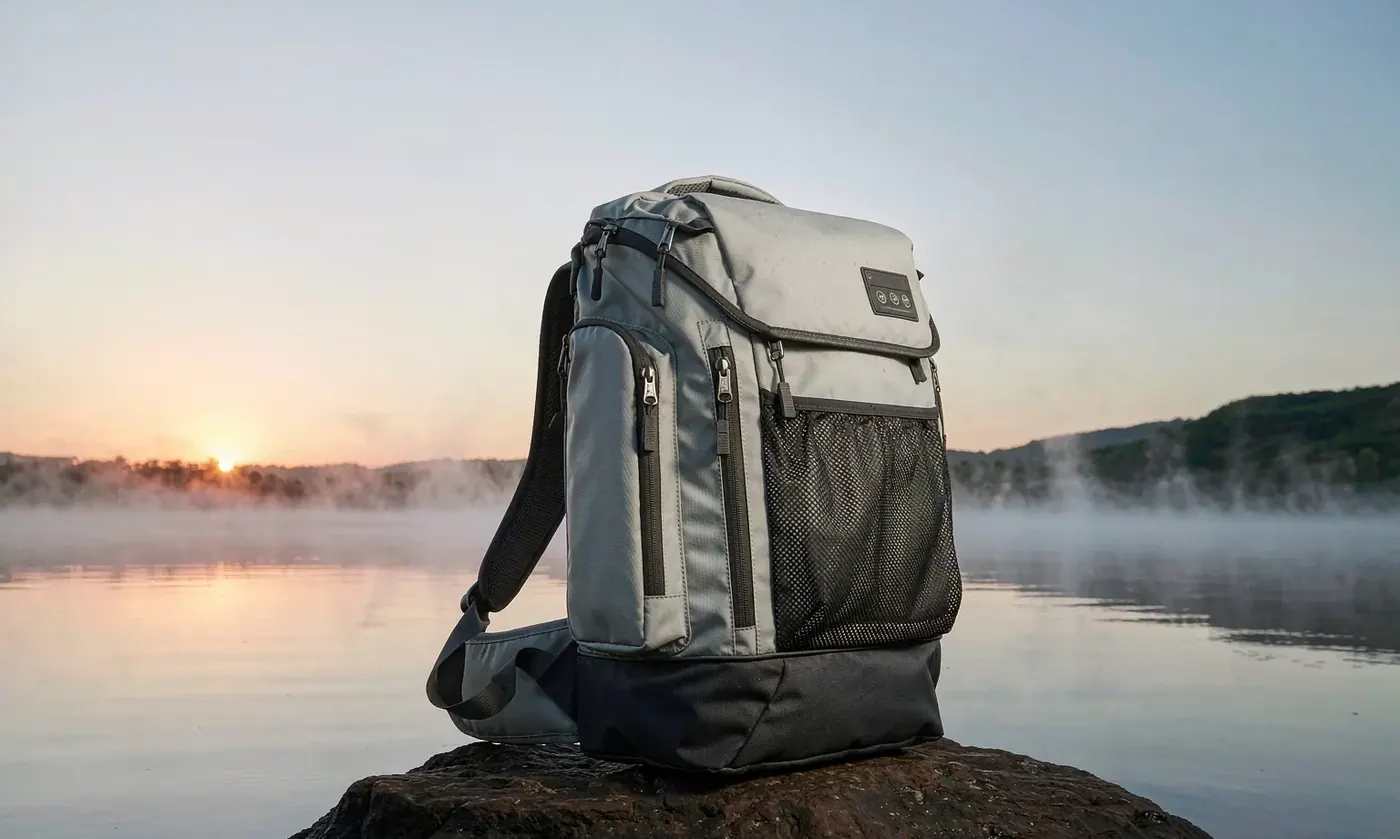
Tray Capacity and Stack Geometry
Two standards dominate. A 3600 tray measures roughly 270 x 180 x 40 mm, and a 3700 tray measures roughly 360 x 230 x 45 mm. Because the width difference is close to 90 mm, a bag that holds four trays of one standard will not hold four of the other. The 3600 versus 3700 tray comparison shows the dimensional detail and the shelf heights involved.
Geometry matters more than raw count. Trays should ride on horizontal rails or shelves against the back panel so any tray can be pulled without unpacking, and the top tray needs at least 20 mm of clearance so a loaded bag closes without compressing lids. A stack that sits in the middle of the chamber shifts under load and makes the pack feel unstable on a long walk.
| Configuration | Internal width needed | Typical clearance | Suits |
|---|---|---|---|
| 3 trays at 3600 | 190-210 mm | 25 mm above top tray | Half day sessions |
| 4 trays at 3600 | 190-210 mm, taller body | 20 mm above top tray | Full day sessions |
| 3 trays at 3700 | 240-260 mm | 25 mm above top tray | Boat and pier use |
| Mixed 2 plus 2 | 240-260 mm, split shelves | 20 mm each stack | Mixed lure sizes |
Tool storage finishes the internal plan. Specify a plier sheath sized for 200-250 mm tools, a spool pocket for four to eight 100 mm spools, and a sealed pocket above the tray stack for phone, keys, and licence. Keeping the electronics pocket above the trays is deliberate: it is the driest zone in the bag and the easiest to reach without unpacking.
Harness Fit: Torso Length, Strap Width, and Load Transfer
Fit starts with torso length, measured from the seventh vertebra to the top of the iliac crest. Most adults measure between 40 cm and 50 cm, and a pack whose harness cannot be adjusted across that range will fit only part of any market. Specify an adjustable back panel with at least 80 mm of travel, or offer two harness sizes if the programme targets a wide audience.
Strap width and belt geometry carry the load. At 8-14 kg, use 60-75 mm shoulder straps with 10-15 mm foam, a sternum strap adjustable across 80 mm of height, and a hip belt that transfers 60-70 percent of the mass to the pelvis. A belt that merely touches the hips carries nothing; it needs to wrap and sit above the iliac crest without interfering with waders or a wading belt.
- Measure torso length from the seventh vertebra to the iliac crest before selecting harness size.
- Require at least 80 mm of harness adjustment travel, or two size options.
- Use 60-75 mm shoulder straps with 10-15 mm foam for loads above 8 kg.
- Confirm the hip belt clears waders and a wading belt without riding up.
- Test with the actual load, not with an empty pack on a showroom floor.
A loaded fitting test is worth ten minutes. Load the bag to its realistic weight, walk 1 km on uneven ground, climb 20 steps, and check three things: whether the belt stays on the crest, whether the load moves more than 30 mm laterally, and whether the shoulder straps create a hot spot at the trapezius. Any of those three failing means the harness is wrong for the intended user, regardless of how good the storage layout is.
Packing Order and Load Distribution
Dense items belong close to the back and between hip and shoulder-blade height. Trays are dense and rectangular, so they naturally sit against the back panel, which is exactly right. Food and water should sit just above or beside the tray stack, and a rain shell or a light layer belongs at the top or in an external pocket where it can be grabbed in five seconds.
The most common packing error is putting the heaviest tray at the bottom and soft items above it, which moves the centre of mass away from the spine and creates a pendulum effect on a long walk. Distribute tray mass evenly around the vertical middle of the stack and keep the total within the harness rating. A 12 kg load packed well feels lighter than a 9 kg load packed badly.
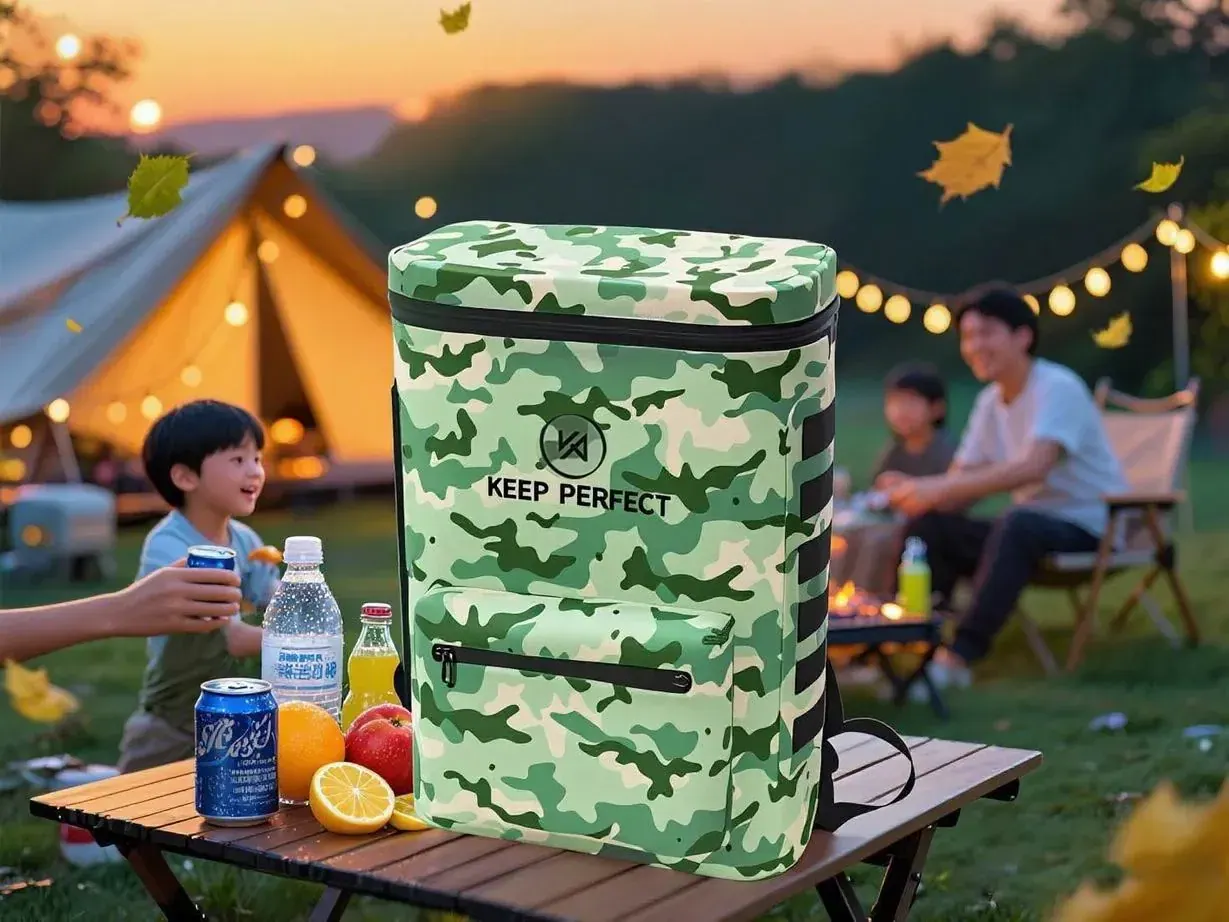
Cooler Sections, Rod Holders, and External Attachments
A cooler compartment is the most requested add-on and the most likely to cause problems if it is poorly separated. Insulation of 6-10 mm with a welded liner and a drain plug is the baseline, and the compartment must be physically isolated from tray storage. Condensation from ice migrates, and it rusts hooks and swivels faster than almost any splash an angler will meet.
Rod holders need geometry, not just straps. A holder should support a rod at two points separated by at least 250 mm so the rod cannot pivot, and the lower pocket should be closed so a butt section cannot slip through on a steep bank. Diagonal carriers suit long walks; vertical holders suit boat decks and short moves. Check that a holder does not block tray access when loaded.
| Attachment | Specification | Failure mode | Check |
|---|---|---|---|
| Rod holder | Two points 250 mm apart | Rod pivots and strikes the wearer | Shake test with rod fitted |
| Plier sheath | 200-250 mm tool length | Tool falls out when bending | Bend test loaded |
| Cooler compartment | 6-10 mm insulation, welded liner | Condensation reaches trays | 24-hour ice test |
| Water bottle pocket | 500-1000 ml, drained | Bottle lost on a scramble | Inversion test |
| Net or tool dock | External rear island | Snags on bank vegetation | Walk through cover |
Every external attachment is a potential leak path when it is stitched through a waterproof shell. Where a bag is built to a splash proof or submersible level, external islands should be welded or bonded with a reinforcement patch rather than sewn through the chamber wall. That single construction choice decides whether an otherwise well-designed bag holds its rating after a season.
Waterproof Level for a Backpack Format
Backpacks have an advantage over open totes in wet weather because their closures sit high and can be rolled or sealed, but they also have more seams and more attachment points. For bank and general freshwater use, a rain resistant build with taped seams and a rolled or flapped closure is usually enough. For kayak, surf, and wading use, specify welded seams and a closure that supports IPX6 or better.
Ingress codes are defined by the IEC ingress protection framework. IPX6 covers powerful jets and suits boat spray; IPX7 covers temporary immersion and must always be quoted with a depth and duration. Screen the finished bag with trays and load fitted, because a tray stack pressing on the closure is a different test from an empty shell.
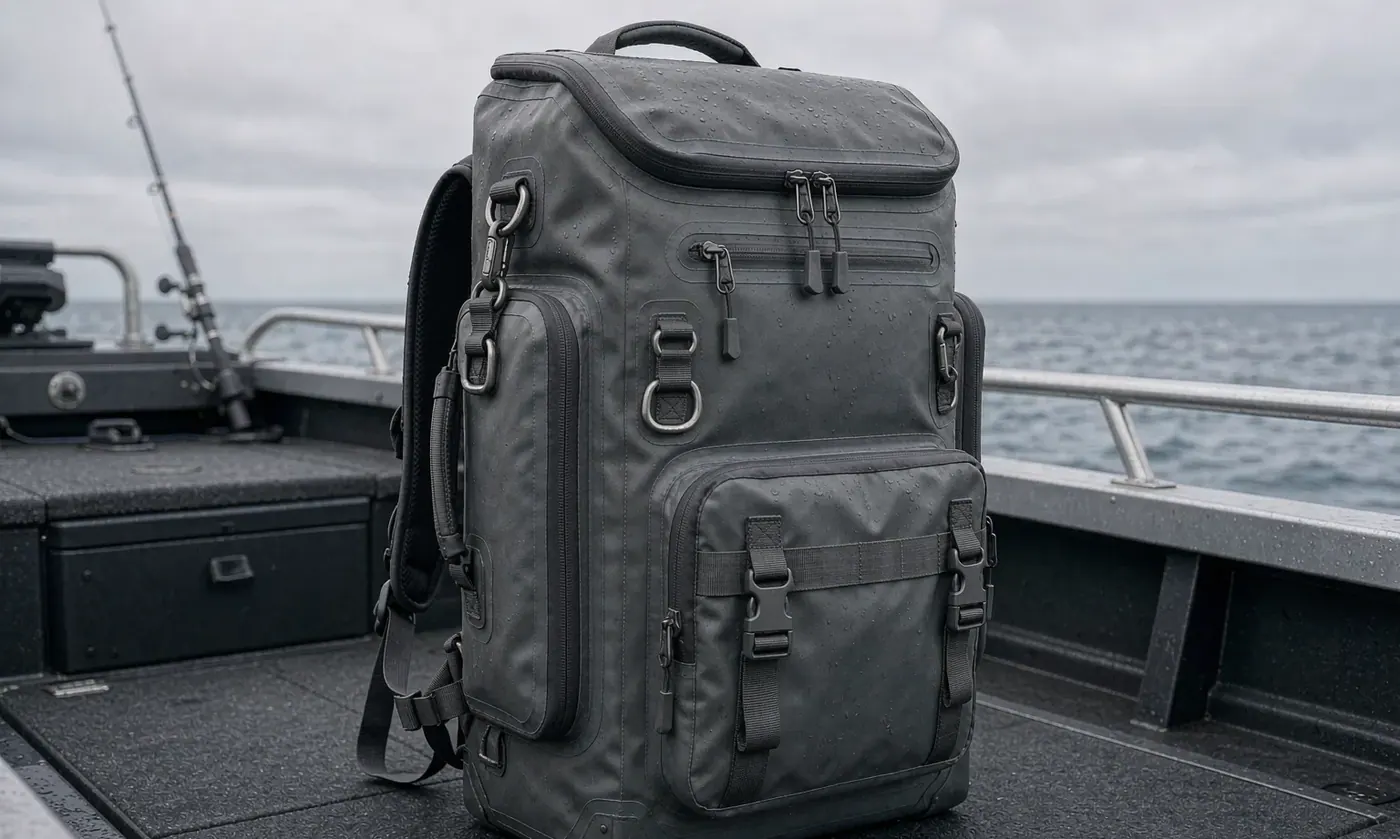
The waterproof fishing backpack range groups bodies by protection level rather than by colour, which is the faster way to match a bag to the water it will actually meet. The waterproof fishing tackle bag overview explains how the four protection levels are defined and tested across all formats.
Fit Across Different Body Types
A single harness rarely fits everyone well. Shorter torsos under 42 cm need a shorter back panel and higher sternum strap position, or the belt will ride on the ribs. Taller torsos above 48 cm need more panel length and a longer belt, or the load will sit too low. Programmes aimed at a general market should offer a two-size harness or an adjustable panel covering 40-50 cm.
| Torso range | Panel length | Belt size | Note |
|---|---|---|---|
| Under 42 cm | Short panel | Small, 70-90 cm | Higher sternum position |
| 42-48 cm | Medium panel | Medium, 90-110 cm | Most common adult range |
| Above 48 cm | Long panel | Large, 110-130 cm | Check load lifter angle |
| Youth | Short panel, narrow straps | Small or none | Keep load under 6 kg |
Shoulder width and strap spacing matter as much as torso length. Straps spaced 180-220 mm apart at the neck suit most adults; narrower spacing chafes a broad shoulder and wider spacing slides off a narrow one. Where a programme targets a mixed audience, a sternum strap on a sliding rail solves most of the variance without a second harness size.
Load limits should be stated per size. A youth or small-size harness should not be rated above 6-8 kg, and a medium harness should be rated to 12-14 kg with the belt engaged. Publishing those limits is both a safety practice and a way to reduce harness-related returns, which are among the most expensive claims a bag programme can receive.
One more fit variable deserves a line in the brief: clothing. A harness fitted over a shirt behaves differently from the same harness over a winter jacket or waders, and the difference in effective torso length can reach 30 mm. Run the loaded fitting test in the clothing the user will actually wear, and require the harness to retain at least 40 mm of adjustment travel beyond that fitted point.
Care, Drying, and Off-Season Storage
A tackle backpack holds more moisture than any other fishing format, because trays, tools, and a cooler section all retain water after a session. Empty the bag completely, remove trays, wipe the interior, and dry open for 8-24 hours after every trip. A bag closed damp overnight will smell within two days and can grow mildew within a week in warm conditions.
- Rinse the shell and hardware with fresh water after every saltwater session.
- Remove trays and dry them separately before they go back in.
- Clear grit from zipper teeth before operating the closure.
- Use mild pH-neutral soap only; never solvents, never machine washing.
- Store loose and dry at 15-25 degrees with closures open and trays out.
Two habits extend working life more than any material choice. Rotate which tray sits at the top of the stack, so no single tray lid and no single shelf takes the same load every session, and keep the bag off rough ground by setting it on its back panel rather than its base whenever possible. Both cost nothing and together they typically add one to two seasons before the first seam or shelf issue appears.
Abrasion performance can be checked against published methods from ASTM International, which gives both sides a shared language for whether a base fabric or a strap webbing is fit for the intended use. Requiring a stated cycle count is far more useful than asking for heavy duty construction, which means nothing measurable. Weather and water conditions should also be checked before any session; NOAA weather resources support that review in the United States.
Programme Brief and Acceptance Criteria
Write one document covering usable litres, tray standard and count, internal clearance, harness adjustment range and load rating, attachment geometry, protection level with the test condition, hardware grade, and compliance. Then set acceptance criteria for dimensions, seam appearance, coating thickness, colour fastness, and hardware finish. Approve at least three samples per design, because a single dry result does not establish consistency.
| Programme item | Baseline | Note |
|---|---|---|
| MOQ | 500 pcs per design and colour | Colour split negotiable above baseline |
| Sampling | 6-10 working days | Add 3-5 days for a cooler or rod holder change |
| Bulk | 35-50 days | From approved sample and deposit |
| Inspection | AQL 2.5 | Include tray fit, litres, harness travel, water screen |
| Compliance | REACH and California Prop 65 | Screen coatings, films, inks, hardware |
QUANZHOU JUNYUAN BAGS has developed waterproof bag programmes since 2014, with the founding team active in the industry since 2004. Monthly output of 200,000 units is verified by SGS, and BSCI and ISO 9001 systems structure the workflow. Every bulk order is inspected at AQL 2.5 before shipment, and materials are screened for REACH and California Prop 65.
A tackle backpack brief can be emailed to service@junyuanbags.com; include tray standard and count, target torso range, protection level, hardware grade, and quantity. FOB Xiamen or DDP service to more than 100 countries follows an approved sample and a complete test record. The rule that matters most is simple: fit the trays first, then fit the person, and let the litre number follow both.
People Also Ask
What size tackle backpack do I need for a day of fishing?
Thirty-two to 38 L of usable volume suits a full day with four or five 3600 trays plus food and a shell. Halve that to 22-28 L for a two to four hour session.
How many 3600 trays fit in a tackle backpack?
Three to five is typical, depending on body width and shelf height. A bag holding five needs a taller body and at least 20 mm of clearance above the top tray.
How do I measure torso length for a fishing backpack?
Measure from the seventh vertebra, the bony bump at the base of the neck, down to the top of the iliac crest. Most adults fall between 40 cm and 50 cm.
Should a tackle backpack have a hip belt?
Yes for loads above 8 kg. The belt should transfer 60-70 percent of the mass to the pelvis and must clear waders and a wading belt without riding up.
Is a cooler compartment in a tackle backpack a good idea?
It is convenient when it has a welded liner, a drain, and physical separation from the trays. Without separation, condensation from ice rusts hooks faster than most splashes.
How much clearance should sit above the top tray?
At least 20 mm, and 25 mm is better on taller bodies. Without it a loaded bag compresses tray lids and the closure cannot be made properly at the end of a session.
Frequently Asked Questions
Q1. What size fishing tackle backpack should I buy?
Match usable litres to session length: 22-28 L for two to four hours, 28-32 L for a half day, and 32-38 L for a full day with four or five trays.
Q2. How many trays does a tackle backpack hold?
Usually three to five trays at 3600 size, or three at 3700 size. Confirm the standard and the clearance above the top tray before ordering.
Q3. Are trays included with the backpack?
Not always. Listings should state whether trays are supplied, and a programme brief should specify whether the buyer or the brand provides them.
Q4. How do I know if the harness fits me?
Measure torso length from the seventh vertebra to the iliac crest, then check that the belt sits on the crest and the load moves under 30 mm during a 1 km walk at realistic weight.
Q5. What shoulder strap width is right for a loaded tackle pack?
Sixty to 75 mm with 10-15 mm foam suits loads of 8-14 kg. Narrower straps concentrate pressure and create hot spots within an hour.
Q6. Do I need a hip belt on a fishing backpack?
Yes above 8 kg. The belt should carry 60-70 percent of the load and must clear waders and a wading belt without riding up onto the ribs.
Q7. Can I carry a rod on a tackle backpack?
Yes, using a holder that supports the rod at two points at least 250 mm apart. A single-point strap lets the rod pivot and strike the wearer on a scramble.
Q8. What waterproof level should a tackle backpack have?
Rain resistant with taped seams suits bank fishing. Welded seams and IPX6 or better suit boat, kayak, surf, and wading use where spray and immersion are credible.
Q9. How heavy is a loaded tackle backpack?
Typically 8-14 kg. A full day with five trays, water, food, and a shell commonly reaches 11-13 kg, so the harness rating matters more than the volume figure.
Q10. Should the cooler section be separate from the trays?
Yes, physically separated with a welded liner and a drain. Condensation from ice migrates and rusts hooks and swivels faster than almost any splash.
Q11. How should a tackle backpack be packed?
Trays close to the back between hip and shoulder-blade height, food and water beside or just above them, and the rain shell at the top or in an external pocket for five-second access.
Q12. How do I dry a tackle backpack after a wet session?
Remove trays, wipe the interior, dry open for 8-24 hours, and store loose at 15-25 degrees with closures open. A bag closed damp will smell within two days.
Q13. What hardware grade suits freshwater use?
Coated alloy is acceptable for freshwater, but 304 stainless is worth specifying anyway, because it costs little and removes the most common corrosion complaint.
Q14. What is the MOQ and lead time for a tackle backpack programme?
MOQ is 500 pcs per design and colour, samples take 6-10 working days, and bulk runs 35-50 days from approved sample and deposit.