A 3600 tray measures 10.88 x 7.5 x 1.75 inches and holds about 1.9 litres usable, while a 3700 measures 14 x 9 x 2.63 inches and holds about 4.2 litres, so the larger tray is worth slightly more than two of the smaller ones in capacity but weighs the same as two filled 3600 boxes. That ratio is why the question resolves almost entirely on bag geometry rather than on which tray is better: some backpacks take three 3700 trays comfortably and no arrangement of 3600 boxes, others suit four 3600 trays and cannot accept a single 3700 across their internal width. The decision table below maps both options against internal bag dimensions, stack height, filled weight from 1.1 to 2.8 kg, and realistic carry loads.
The Two Dimensions That Must Match
Bag fit reduces to two measurements, and quoting neither is why returns happen. The first is internal width across the sleeve, because a 3700 needs nearly 360 mm of clear opening while a 3600 needs about 279 mm. The second is internal height above whatever sits below, because the trays stack and every additional layer adds its own depth plus a few millimetres of divider bulge.
| Measurement | 3600 requirement | 3700 requirement | Difference |
|---|---|---|---|
| Internal width clear | 279 mm minimum | 356 mm minimum | 77 mm wider needed |
| Internal depth clear | 191 mm minimum | 229 mm minimum | 38 mm deeper needed |
| Layer height | 44 mm plus tolerance | 67 mm plus tolerance | 23 mm per layer |
| Three-layer stack | 150 mm including tolerance | 215 mm including tolerance | 65 mm of extra height |
| Nominal footprint | 276 x 191 mm | 356 x 229 mm | Roughly 1.55 times the area |
| Usable capacity each | About 1.9 L | About 4.2 L | 2.2 times, not proportional |
Tolerance deserves quite specific treatment because it causes intermittent rather than consistent failures, which are the expensive kind. An injection-moulded tray carries draft angle, so its widest point near the base can run 1.5-2 mm larger per dimension than nominal. Allowing 4 mm per dimension and 6-8 mm over a full stack covers tray variation, fabric thickness differences, and sleeve seam bulk together.
The Two-for-One Insight
Most buyers assume a 3700 replaces either one or two of the smaller trays, and the geometry has a useful surprise in store. Two standard 3600 trays placed side by side along their short edges occupy roughly 276 x 382 mm, while one 3700 occupies 356 x 229 mm. The pair needs more width and the single needs more depth, and each arrangement therefore suits a differently shaped bag.
| Arrangement | Footprint occupied | Total usable volume | Suits a bag that is |
|---|---|---|---|
| One 3700 | 356 x 229 mm | About 4.2 L | Wide across the front panel |
| Two 3600 across | 276 x 382 mm | About 3.8 L | Narrow but deep front to back |
| Two 3600 stacked | 276 x 191 mm | About 3.8 L | Compact but tall |
| Three 3600 across | 276 x 573 mm | About 5.7 L | Very few bags qualify |
| Two 3700 stacked | 356 x 229 mm | About 8.4 L | Backpacks above about 35 L |
The practical consequence is that a bag advertised as taking three 3700 trays will often take four 3600 trays, and vice versa, because internal width and internal depth are independent. Buyers who publish both configurations in their specification rather than one fanciful maximum sell better and are returned less, since anglers generally own a mix of both classes already.
Filled Weight Is the Real Limit
Volume almost never decides this question; weight does. A standard 3600 filled with mixed lures reaches 1.1-1.4 kg and a 3700 reaches 2.2-2.8 kg, so a pair of 3700 trays already weighs as much as four 3600 boxes. Comfort, not geometry, sets how many trays an angler will actually carry out to the water.
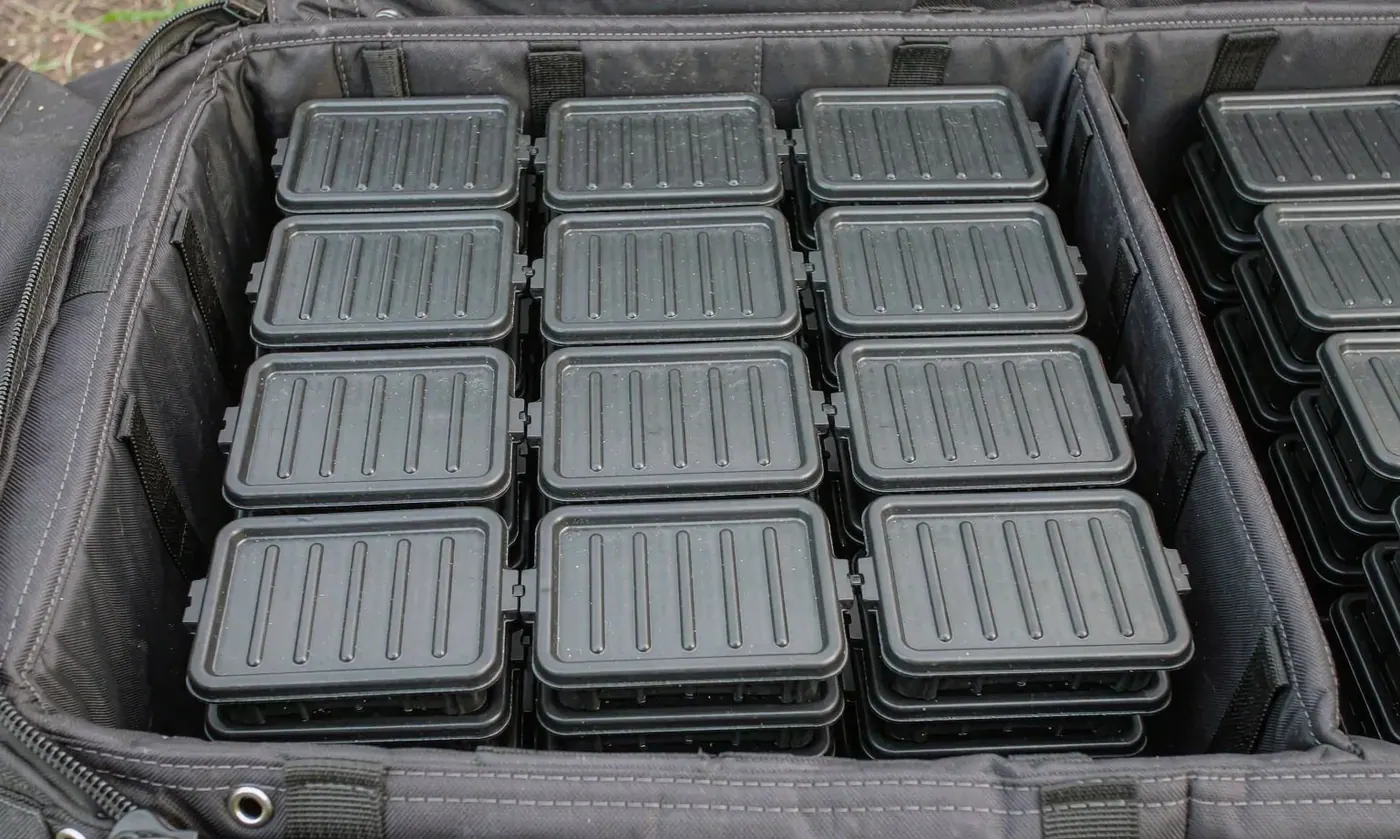
| Build-up | Tackle weight | Plus bag and incidentals | Carry verdict |
|---|---|---|---|
| Two 3600 trays | 2.2-2.8 kg | About 4.5 kg total | Sling is workable |
| Three 3600 trays | 3.3-4.2 kg | About 5.6 kg total | Sling at its limit |
| Four 3600 trays | 4.4-5.6 kg | About 7.0 kg total | Backpack territory |
| Two 3700 trays | 4.4-5.6 kg | About 7.0 kg total | Backpack territory |
| Three 3700 trays | 6.6-8.4 kg | About 10.0 kg total | Backpack with a hip belt |
| Four 3700 trays | 8.8-11.2 kg | About 13.0 kg total | Only for short carries |
The thirty-five percent uplift for bag and incidentals is worth internalising rather than treating as a rounding error. Water weighs roughly 2 kg for two litres, a rain shell plus a warm layer add about 1.2 kg, and food across a full day adds around 0.8 kg, none of which ever appears in a tray-based estimate. Three 3700 trays therefore become a 10 kg pack, which is comfortably within a good harness and entirely beyond any single-shoulder carry.
Which Bag Classes Accept Which
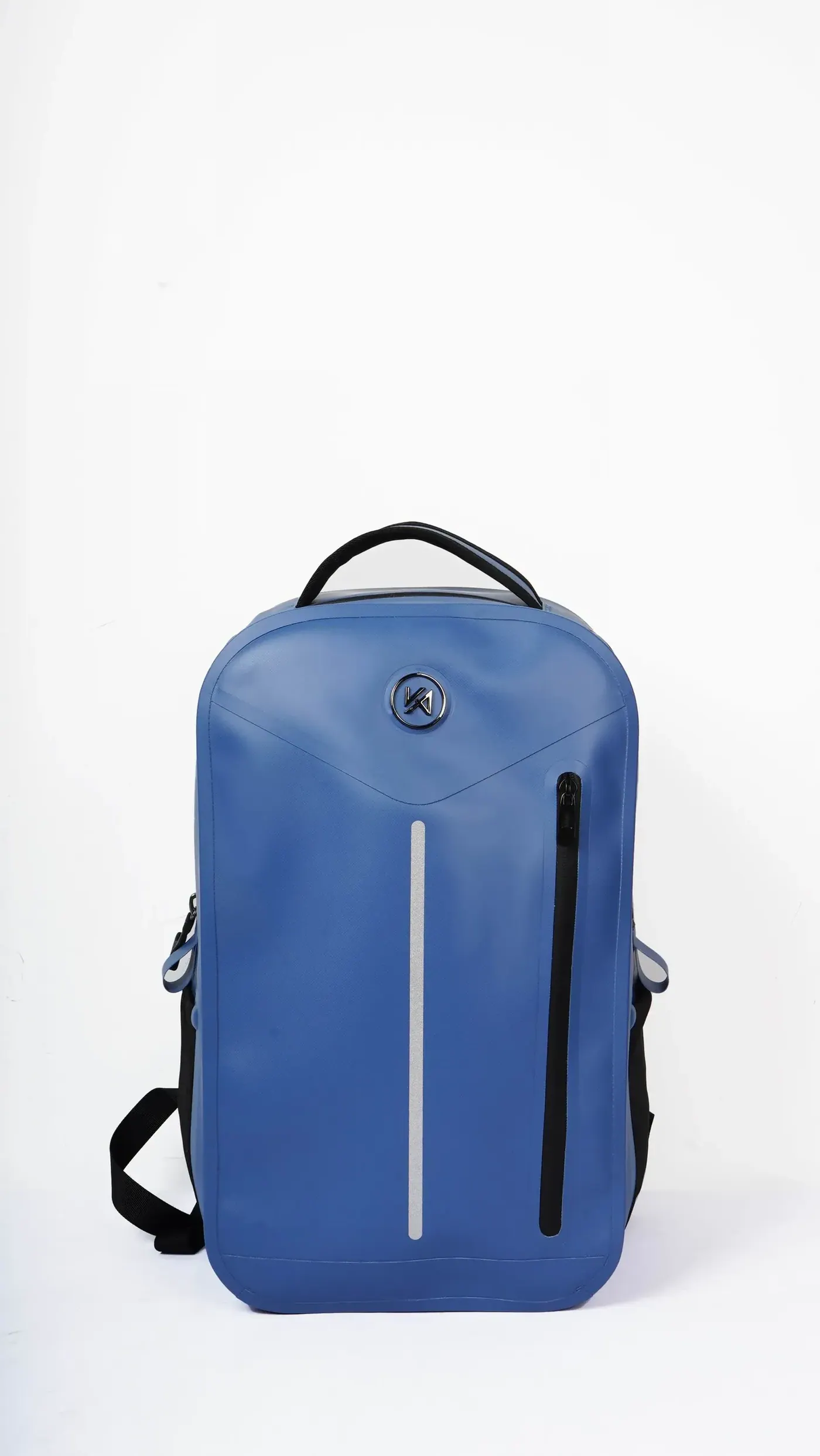
Bag classes can be sorted by which tray they accept, and the pattern is cleaner than the litre numbers suggest. Body-worn packs almost never accept a full-width 3700 across the front panel, whereas anything above about 30 litres generally does.
| Bag class | 3600 count | 3700 count | Limiting dimension |
|---|---|---|---|
| Chest pack | 1 | 0 | Width across the chest panel |
| Waist pack | 1-2 | 0 | Width and casting clearance |
| Sling pack, 8-18 L | 1-2 | 0 | Front panel width |
| Compact backpack, 20-25 L | 3-4 | 1-2 | Width if narrow, height if shallow |
| Standard backpack, 25-35 L | 4-5 | 2-3 | Stack height |
| Large backpack, 35-45 L | 6-8 | 3-4 | Weight rather than geometry |
| Rolling bag, 60-100 L | 12-20 | 6-12 | Wheel-base weight limit |
Reading down that table reveals why the standard tackle backpack settled at 25-35 litres. It is the smallest body that accepts either format in useful numbers, which is precisely why it dominates retail ranges, and why both smaller and larger bodies serve narrower customers.
Access Patterns Differ More Than Capacity
Which tray suits a type of fishing is mostly about how often it is opened and how many categories the angler works through, because the two formats encourage different organisational habits. A 3600 naturally becomes a themed tray: jigs in one, topwater in another, soft plastics in a third. A 3700 tends to become a single large selection, and either habit can be right.
- A 3600 suite supports rotation between categories, since a different tray can be brought for a different water type without repacking anything.
- A single 3700 suits an angler working one water type with a deep selection, and it avoids the juggling that comes with several smaller boxes.
- Themed 3600 trays let two anglers share a bag on a boat, each running their own boxes without negotiation.
- Larger 3700 bodies take up useful slack space less efficiently, because a partially filled 3700 wastes more volume than a partially filled 3600.
- Retrieval from a 3600 is faster at arm's length, since the closer half of the tray is fully visible without reaching.
The sharing point above is underrated and it applies to guides and boats especially well. A guide running two clients on one boat can hand each a themed 3600 tray rather than sorting through one large selection, and that alone justifies the smaller class for any charter operation regardless of what capacity arithmetic suggests.
Cost, Shipping, and Storage
Unit cost is not proportional to size, because cooling time in the mould rather than raw material dominates the difference between these two classes. Shipping and storage follow a different pattern again, since the smaller tray nests more efficiently and is cheaper to hold in inventory.
| Factor | 3600 | 3700 | Comment |
|---|---|---|---|
| Unit cost | About 1.8-3.2 USD | About 3.6-6.0 USD | Roughly double, not proportional to volume |
| Deep variant premium | 12-18 percent | 12-18 percent | Same percentage either way |
| Nesting height per unit | About 26-32 mm | About 40-48 mm | Smaller trays nest much tighter |
| Units per shipping carton | Higher by roughly 1.8 times | Lower | Freight per unit favours the 3600 |
| Retail shelf footprint | 279 x 191 mm plan view | 356 x 229 mm plan view | The larger format needs more facing space |
Shelf economics deserve a note for retail buyers specifically. A 3700 needs about 1.55 times the plan area per unit and typically retails at roughly double the price, so margin per square metre slightly favours the larger tray. Volume-wise the smaller tray moves faster in unit terms, and most ranges are better served by stocking both than by picking one on paper economics alone.
Keeping Either Class Dry Between Sessions
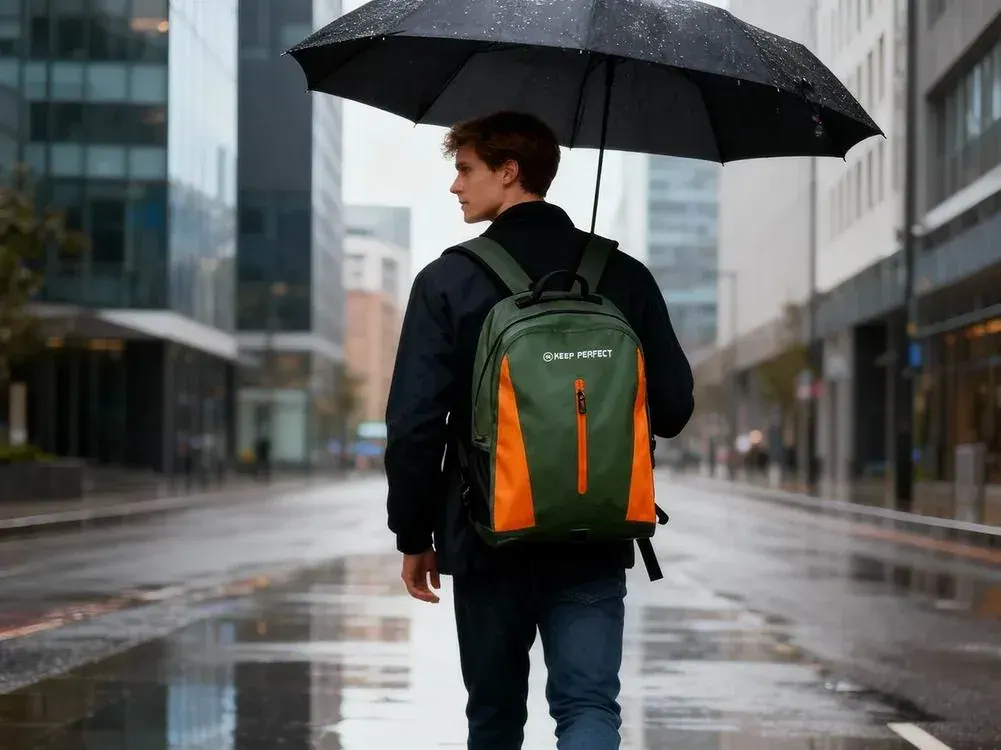
Neither class has any advantage for managing dampness, and this is where a great deal of quiet damage occurs. A tray closed while wet starts corroding hooks within about two days, spreads across neighbouring items by roughly day four, and leaves staining that no cleaning fully removes.
| Habit | Frequency | Benefit | Failure if skipped |
|---|---|---|---|
| Open trays to air dry fully | After every session | Eliminates hook rust entirely | Rust within about two days |
| Rinse in fresh water after salt | Every coastal session | Removes hygroscopic salt crystals | Damp persists for weeks |
| Store with lids slightly open | Off season | No mildew, no trapped odour | Mildew within a month |
| Keep lead separate from steel hooks | Continuous | Prevents contact staining | Accelerated corrosion on steel |
| Check divider retention monthly | Monthly | Stops item migration between slots | Trays become a jumble |
The lead separation point is easy to overlook and easy to fix. A lead jig resting against a steel hook establishes contact that accelerates corrosion on the steel side, and simply keeping lead items in their own compartments removes the problem at no cost.
Quality Standards for Both Classes
Both classes should be specified to the same material standard, because day count rather than tray size decides how long a moulded box lasts. The hinge is almost always what fails first and is the only component worth arguing about.
| Element | Requirement | Test reference | Acceptance |
|---|---|---|---|
| Body polymer | Impact-modified polypropylene | Impact methods from ASTM | No crack at 1 m drop and -10 C |
| Live hinge | 0.4-0.6 mm wall | Flex cycle count | 5,000 cycles without whitening |
| Latch | Positive stop snap fit | Open and close cycles | 3,000 cycles retaining closure |
| Divider height | At least 80 percent of wall | Migration check | No item crossover after 500 moves |
| Dimensional tolerance | Within 1.5 mm of nominal | Coordinate measurement | Fits the sleeve with 4 mm allowance |
Plastics test methods referenced above are published by ASTM International, and dimensional and tolerance practice follows standards maintained by the International Organization for Standardization. Naming both in a brief is what makes a dimensional argument resolvable rather than a matter of opinion between parties.
The Decision Table
Putting every factor together, the answer is usually determined by bag internal width first and carry weight second. Everything else is preference, and preferences are worth respecting rather than correcting.
| If this is true | Choose | Reason |
|---|---|---|
| The bag is narrower than 356 mm internally | 3600 | A 3700 will not enter the opening at all |
| The bag is shallow front to back | 3600 | A 3700 needs 229 mm of depth clear |
| The load must stay under 5 kg | 3600 | One 3700 alone already reaches 2.2-2.8 kg |
| One angler, one water type, deep selection | 3700 | Fewer boxes to manage for the same selection |
| Two anglers sharing one bag | 3600 | Each can run their own themed tray |
| Guiding with two clients on a boat | 3600 | Hand each angler their own tray |
| Maximum volume in one large body | 3700 | Fewer wasted gaps in a 40 L shell |
Note that three of those seven rows end in the smaller tray for reasons that have nothing to do with capacity, which is the honest summary of this whole comparison. The 3700 wins on capacity per unit handled and nothing else, while the 3600 wins on fit flexibility, sharing, load management, and cost. Buyers unsure between them should default to the smaller class and stock the larger one alongside it.
Reading a Stated Tray Count Honestly
Packaging habitually quotes a maximum tray count that describes physical fit rather than anything wearable, and understanding how that number is arrived at makes it useful instead of merely misleading. The maximum is derived by dividing available internal volume by tray volume, which ignores both weight and the fact that no tray stack ever occupies a rectangular space completely.
- A stated count assumes about 85 percent packing efficiency in reality rather than the 100 percent implied by simple division, because stacking leaves gaps at corners and above the lid.
- The maximum usually assumes the shallow variant of each class, so a stated four 3700 may describe four shallow boxes rather than four standard ones.
- No tray count accounts for anything else living in the bag, and a rain shell, a water bladder, and a camera remove one to two tray slots in practice.
- Counts quoted for one class never apply to the other, even when the volume arithmetic appears close, because width and depth are independent constraints.
- Counting from stated litres rather than stated trays is more reliable, yet still needs the 35 percent uplift for incidentals before it means anything.
A working rule that survives contact with reality is to take the stated maximum and divide it by roughly 1.4 for a tray count an angler will genuinely carry. A bag sold as holding seven 3700 trays is realistically a four-tray bag with some room left for clothing and water, and describing it that way in a specification produces fewer complaints than repeating the headline figure.
Programme, Pricing, and Compliance
Tray programmes should be frozen in the same brief as the bag that carries them, because a sleeve tool cut for one class will not accept the other. A range covering both needs one sleeve tool per class, which is a real cost worth planning rather than discovering during development.
| Programme item | Baseline | Note |
|---|---|---|
| MOQ | 500 pcs per design and colour | Applies to the bag; trays may be bundled into the same order |
| Tray unit cost | 3600 about 1.8-3.2 USD, 3700 about 3.6-6.0 USD | Deep variants add 12-18 percent |
| Sleeve tooling | One tool per tray class | Both classes means two tools |
| Sampling | 6-10 working days | Add 3-5 days when freezing tray dimensions together |
| Bulk | 35-50 days | From approved sample and deposit |
| Inspection | AQL 2.5 | Include insertion cycles and loaded lid closure |
QUANZHOU JUNYUAN BAGS has developed waterproof bag programmes since 2014, with the founding team working in the trade since 2004. Monthly output of 200,000 units is verified by SGS, and BSCI and ISO 9001 systems structure the workflow. Materials are screened for REACH and California Prop 65, and every bulk order is inspected at AQL 2.5 before shipment.
A tray and sleeve brief can be emailed to service@junyuanbags.com with tray class, build-up count, internal bag dimensions, and quantity. FOB Xiamen or DDP service to more than 100 countries follows an approved sample and a complete test record. Buyers should cross-check against the 3600 dimension sheet, the 3700 dimension sheet, and the build-up calculator before cutting any tooling.
People Also Ask
Which is better, a 3600 or a 3700 tackle box?
Neither universally. Check bag internal width first, because a 3700 needs 356 mm clear while a 3600 needs 279 mm, and check loaded weight second, since a single 3700 reaches 2.2-2.8 kg.
Will a 3700 fit in my tackle backpack?
Only if the internal clear width exceeds about 356 mm and internal depth exceeds about 229 mm. Below either figure no arrangement of 3700 trays will enter the opening.
How many trays can I realistically carry?
Two 3700 or four 3600 before comfort becomes the limit. Adding 35 percent for the bag and incidentals, four 3600 trays become about 7 kg total, which is backpack territory.
Is one 3700 equal to two 3600 trays?
Slightly more by volume, at about 4.2 litres against 3.8 litres for a pair, and identical in filled weight. The pair needs more bag width, the single more bag depth.
Why do guides prefer the smaller trays?
Sharing and rotation. Two clients can each run their own themed 3600 tray, and a different tray can be brought for each water type without repacking anything.
Do larger trays cost proportionally more?
About double the unit cost for 2.2 times the volume, since mould cooling time rather than raw material dominates the difference between the two classes.
Frequently Asked Questions
Q1. What size is a 3600 tackle box?
Roughly 10.88 x 7.5 x 1.75 inches, holding about 1.9 litres usable. It needs roughly 279 mm of internal bag width and about 44 mm of sleeve height per layer.
Q2. What size is a 3700 tackle box?
Roughly 14 x 9 x 2.63 inches, holding about 4.2 litres usable. It needs roughly 356 mm of clear internal width and about 67 mm of sleeve height per layer.
Q3. Which tackle tray fits most bags?
The 3600, because it needs 77 mm less clear width. Any body narrower than 356 mm internally cannot accept a 3700 across the opening at all.
Q4. How much does a filled 3700 tray weigh?
About 2.2-2.8 kg with mixed lures and roughly 1.8-2.4 kg with soft plastics. Two of them already match four filled 3600 trays in weight.
Q5. How much does a filled 3600 tray weigh?
About 1.1-1.4 kg with mixed lures. Four trays reach 4.4-5.6 kg of tackle, which becomes roughly 7 kg once the bag, water, and clothing are added.
Q6. Do I get more tackle in two 3600 or one 3700?
About the same volume, at 3.8 litres against 4.2 litres, and the same weight. Choose by bag shape, since the pair needs more width and the single more depth.
Q7. How many 3700 trays fit in a 35 litre backpack?
Three to four by geometry, though the practical limit is set by weight. Three filled trays already imply about 10 kg once everything else is included.
Q8. How much tolerance does the sleeve need?
About 4 mm per dimension over nominal, and 6-8 mm over a complete stack. Moulded draft angle can add 1.5-2 mm per dimension to the base of a tray.
Q9. Is the 3600 cheaper to ship?
Yes, roughly 1.8 times more units per carton because the smaller tray nests tighter at 26-32 mm per nested unit against 40-48 mm for the 3700.
Q10. Why do my hooks rust inside the tray?
A tray closed while wet begins corroding hooks within about two days and spreads by roughly day four. Open trays and air dry fully after every session.
Q11. Should lead and steel be kept separate?
Yes. A lead jig resting against a steel hook accelerates corrosion on the steel side, and separating them by compartment costs nothing.
Q12. What makes a tackle tray last?
Almost always the hinge. Require 0.4-0.6 mm of live hinge wall surviving 5,000 flex cycles, and impact-modified polypropylene with no cracking at a 1 m drop at -10 C.
Q13. What is the MOQ and timeline for a tray programme?
Bag MOQ is 500 pcs per design and colour, sleeve tooling runs one tool per tray class, samples take 6-10 working days plus 3-5 days for frozen dimensions, and bulk runs 35-50 days.