A backpack genuinely fits 3700 trays only if three dimensions line up: an internal chamber at least 240 mm wide and 365 mm deep, a rail pitch of 60-65 mm per tray, and total depth for the stack plus 30 mm of headroom. Eight builds were assessed for 2026 across 28-62 litres holding two to eight deep trays, 1.25-2.95 kg empty, and 20-64 USD FOB Xiamen bands at MOQ 500 pcs per design and colour. Samples take 6-10 working days and bulk 35-50 days. The pick is the 42 L four-tray build at 1.95 kg.
The Three Dimensions That Decide 3700 Fit
A 3700 tray measures about 355 x 230 mm with a depth of 55 mm, and those three numbers determine the shell. Chamber width must exceed 240 mm, chamber depth must exceed 365 mm, and the rail stack needs 60-65 mm of pitch per tray. A bag that misses any one of them does not fit 3700 trays, whatever the listing says, and the most common failure is width, because a shell designed around 3600 trays is usually 10-15 mm narrow.
| Requirement | Number | Why | Failure if missed |
|---|---|---|---|
| Chamber width | 240 mm minimum | Tray is 230 mm wide | Tray wedges against the seam |
| Chamber depth | 365 mm minimum | Tray is 355 mm long | Tray cannot seat |
| Rail pitch | 60-65 mm per tray | Tray is 55 mm deep plus clearance | Tray binds under load |
| Stack headroom | 30 mm above the top tray | Tray must clear the rail on the way out | Tray has to be angled out |
| Base flatness | Under 3 mm of deviation | Trays seat square | Trays rock and lids pop open |
Tolerance deserves its own note because it is the reason two bags with identical nominal dimensions behave differently. Injection-moulded trays vary by about plus or minus 0.8 mm, and fabric under load compresses by 2-4 mm. A shell cut to exactly 230 mm of internal width will therefore bind on the widest tray in a batch once the pack is loaded, and the correct allowance is 8-12 mm over nominal rather than zero.
How Many 3700 Trays Fit Which Volume
Deep trays consume volume quickly, and the arithmetic is worth doing before a brief is written. One 3700 tray occupies about 4.5 litres of chamber space including the rail gap, so two trays need roughly 28-30 litres, four need 38-42, six need 50-56, and eight need 62-70. Those figures assume a full tray set with tools and a water bottle aboard, and they are typically two litres above the figure printed on a hangtag.
| Trays | Chamber volume needed | Shell size to buy | Loaded tray weight | Total with tools |
|---|---|---|---|---|
| 2 | 9.0 L | 28-30 L | 2.8-3.6 kg | 5.2 kg |
| 3 | 13.5 L | 34-36 L | 4.2-5.4 kg | 6.9 kg |
| 4 | 18.0 L | 38-42 L | 5.6-7.2 kg | 9.0 kg |
| 6 | 27.0 L | 50-56 L | 8.4-10.8 kg | 13.4 kg |
| 8 | 36.0 L | 62-70 L | 11.2-14.4 kg | 17.6 kg |
Weight is the constraint that surprises buyers. A loaded 3700 tray of terminal tackle weighs 1.4-1.8 kg, so four trays is 5.6-7.2 kg before water, tools, and a shell are added, and nine kilograms is a load that needs a hip belt rather than a day pack harness. The dimensional maths above is easy; the weight maths is what decides whether the bag is comfortable.
The two standards are compared dimension by dimension in the 3600 versus 3700 tray comparison, and the exact tray measurements with tolerance notes are set out in the 3700 tray dimensions guide. Both are worth reading before specifying a shell, because switching a design between the two standards changes the geometry rather than the capacity alone.
The Eight Builds at a Glance
Tray counts are what each build holds with tools and a bottle aboard, not the maximum the chamber can swallow. Empty weights are listed separately from loaded weights, which include full trays. Every build here clears the three dimensional requirements rather than approximating them, which is the only meaningful claim a 3700-compatible bag can make.
| Build | Volume | Empty / loaded | Trays | Rating | FOB band |
|---|---|---|---|---|---|
| Four-Tray 42 | 42 L | 1.95 / 9.0 kg | 4 | IPX5 | 36-45 USD |
| Compact 30 | 30 L | 1.35 / 5.2 kg | 2 | IPX5 | 22-28 USD |
| Six-Tray 52 | 52 L | 2.45 / 13.4 kg | 6 | IPX5 | 44-54 USD |
| Slim 38 | 38 L | 1.75 / 8.6 kg | 4 | IPX6 | 33-41 USD |
| Submersible 46 | 46 L | 2.25 / 9.6 kg | 4 | IPX7 | 46-56 USD |
| Three-Tray 34 | 34 L | 1.60 / 6.9 kg | 3 | IPX5 | 29-36 USD |
| Guide 62 | 62 L | 2.95 / 17.6 kg | 8 | IPX6 | 52-64 USD |
| Value 28 | 28 L | 1.25 / 5.0 kg | 2 | IPX4 | 20-26 USD |
Rail Pitch and Why Trays Bind
Rail pitch is the spacing between slots, and it is the specification most often cut by 5 mm to save a centimetre of shell height. A 3700 tray is 55 mm deep and the tray above it must not press on its lid, so pitch needs to be 60-65 mm. At 58 mm the trays fit on an empty bag and bind once the pack is loaded and the fabric compresses, which is the classic complaint of a bag that works in the shop and fails on the water.
| Pitch | Behaviour empty | Behaviour loaded at 9 kg | Verdict |
|---|---|---|---|
| 55 mm | Fits | Binds, lids pop | Fail |
| 58 mm | Fits with a push | Binds on the widest tray | Fail |
| 60 mm | Fits freely | Fits, slight drag | Minimum acceptable |
| 65 mm | Fits freely | Fits freely | Recommended |
| 70 mm | Fits, rattles | Rattles | Too generous, wasted height |
Rattle at the other end of the range is a real complaint too. A pitch of 70 mm lets trays move in the rails, and a loaded pack walked 2 km produces a noise that customers describe as a defect. Sixty-five millimetres is the sweet spot: enough clearance for compression and tolerance, tight enough that trays do not move.
1. Four-Tray 42: Best Overall
Forty-two litres at 1.95 kg holding four 3700 trays with tools and a bottle aboard, at about 9 kg loaded, on a 90 mm hip belt and a 2 mm frame sheet. Rail pitch is 65 mm and the chamber measures 245 x 370 mm. The FOB band is 36-45 USD.
Four deep trays is the configuration most anglers want and the one that exposes dimensional shortcuts, and this build clears every requirement with margin: 15 mm over nominal width, 15 mm over depth, and 10 mm of pitch clearance. The belt and frame are specified for nine kilograms, which is the load four full trays actually represent rather than the load a lighter shell would suggest.
2. Compact 30: Best for Two Trays
Thirty litres at 1.35 kg holding two 3700 trays at about 5.2 kg loaded, with a 70 mm belt and a removable panel. The FOB band is 22-28 USD, and it is the smallest shell that genuinely fits the deep standard.
Two trays is the honest limit at this size and it is worth stating rather than stretching: a third tray needs another 4.5 litres and pushes the pack past 34 litres. For an angler fishing two methods from a bank or a kayak, this is the right size, and the removable panel keeps the empty weight down where it matters.
3. Six-Tray 52: Best Capacity
Fifty-two litres at 2.45 kg holding six 3700 trays at about 13.4 kg loaded, on a 100 mm belt with a stiffener and a 3 mm frame sheet. The FOB band is 44-54 USD.
At 13.4 kg this is a serious load and the suspension is specified accordingly: the belt transfers about 70 percent into the hips and the 3 mm sheet stops the pack folding. The honest limitation is carry distance, and buyers should be advised to treat this as a vehicle-to-water bag rather than a walking bag.
4. Slim 38: Best for Boat Hatches
Thirty-eight litres at 1.75 kg holding four trays in a tall narrow body 330 mm wide, so it passes a standard 360 mm hatch, with an IPX6 rating. The FOB band is 33-41 USD.
Holding four deep trays in a 330 mm wide body is possible only because the trays are stacked vertically rather than side by side, which is the correct orientation for a boat bag anyway. The height that results needs load lifters set at 35-45 degrees, or the pack sways when walked, and this build includes them at two anchor points.
5. Submersible 46: Best for Wet Boats
Forty-six litres at 2.25 kg with a welded liner tested to 30 minutes at 1 m, holding four trays at about 9.6 kg loaded, with a drain path at the base. The FOB band is 46-56 USD, roughly 12 USD above the equivalent spray-rated shell.
Drainage is the detail that makes a submersible tray bag work. Four wet trays in a sealed chamber produce condensation that reads as leakage, and a base channel plus a vented upper chamber costs about 1.60 USD and removes the complaint. Ratings are defined by the IEC ingress protection framework, and the condition must be stated as a depth and a duration.
6. Three-Tray 34: Best Middle Option
Thirty-four litres at 1.60 kg holding three trays at about 6.9 kg loaded, on an 80 mm belt with a 2 mm sheet. The FOB band is 29-36 USD.
Three is an underrated number: it covers two methods plus terminal tackle, and it keeps the loaded weight under seven kilograms where a day-pack harness is still comfortable. The trade is that the odd tray count leaves a rail slot unused unless the builder includes a utility shelf, and this build does, taking a 3500 tray or tools in the third position.
7. Guide 62: Best for Guide Duty
Sixty-two litres at 2.95 kg holding eight trays at about 17.6 kg loaded, with a 105 mm belt, a 3 mm sheet with an alloy stay, bolted strap anchors, and a serviceable closure. The FOB band is 52-64 USD.
Eight deep trays is a guide carrying inventory for clients as well as personal kit, and it is the point where a backpack is at its limit. Bolted anchors and a replaceable harness are what make it viable commercially: at 120-plus sessions a season, a strap that can be swapped in 15 minutes is worth more than any additional capacity.
8. Value 28: Best Budget Build
Twenty-eight litres at 1.25 kg holding two trays at about 5 kg loaded, with a coated 600D shell and an IPX4 rating. The FOB band is 20-26 USD.
The savings are the rating and the frame: IPX4 handles rain but not a deck wash, and a removable panel replaces a moulded sheet. Both are defensible at this price. The dimensional requirements are not cut, because a bag that does not fit the trays it advertises is not a cheap bag, it is a wrong one.
What to Keep Out of the Tray Stack
A deep tray stack fills the chamber efficiently and leaves nowhere for the small items every angler carries. A phone, a licence, a set of keys, and a small first-aid kit do not belong in a 3700 tray and always end up loose at the bottom of the chamber if no home is provided.
| Item | Home | Why not a tray | Cost |
|---|---|---|---|
| Phone and keys | Sealed pouch in the lid | Lost at the bottom of the chamber | 1.00-2.00 USD |
| Licence | Rigid sleeve in the lid | Paper wets through | 1.60-2.40 USD |
| Pliers and cutters | Shoulder dock or holster | Dulls hooks, punctures packets | 0.90-1.40 USD |
| Leader spools | Utility tray or a rack | Coils unwind loose | 2.20-3.00 USD |
| First aid | Flat lid pocket | Should not be under tackle | 1.20-1.80 USD |
Adding a Cooler Without Losing a Tray Slot
Insulated capacity and tray capacity compete for the same chamber, and adding a cooler pocket to a four-tray bag typically costs one tray. The efficient arrangement is a separate insulated compartment outside the tray chamber rather than an internal divider, because the tray stack needs uninterrupted height.
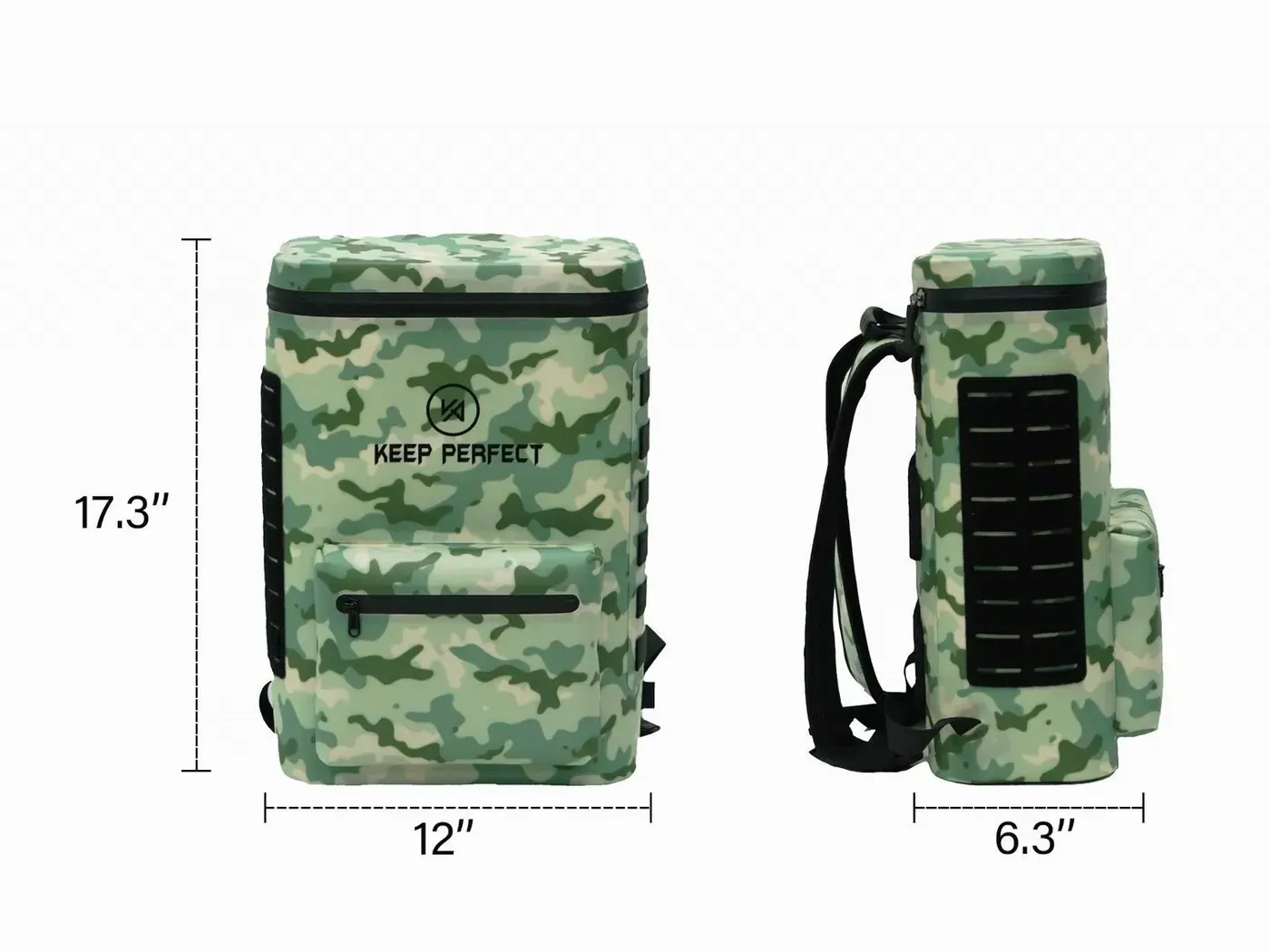
Where a cooler must share the body, the honest arithmetic is that a 6 litre pocket takes about one tray slot, and buyers should be told which tray they are giving up. A separate external pocket costs about 250 g and roughly 4.50 USD, and it preserves the full stack, which is usually the better trade for an angler who bought a 3700 bag for the trays.
Living With a 3700 Build: Transport and Storage
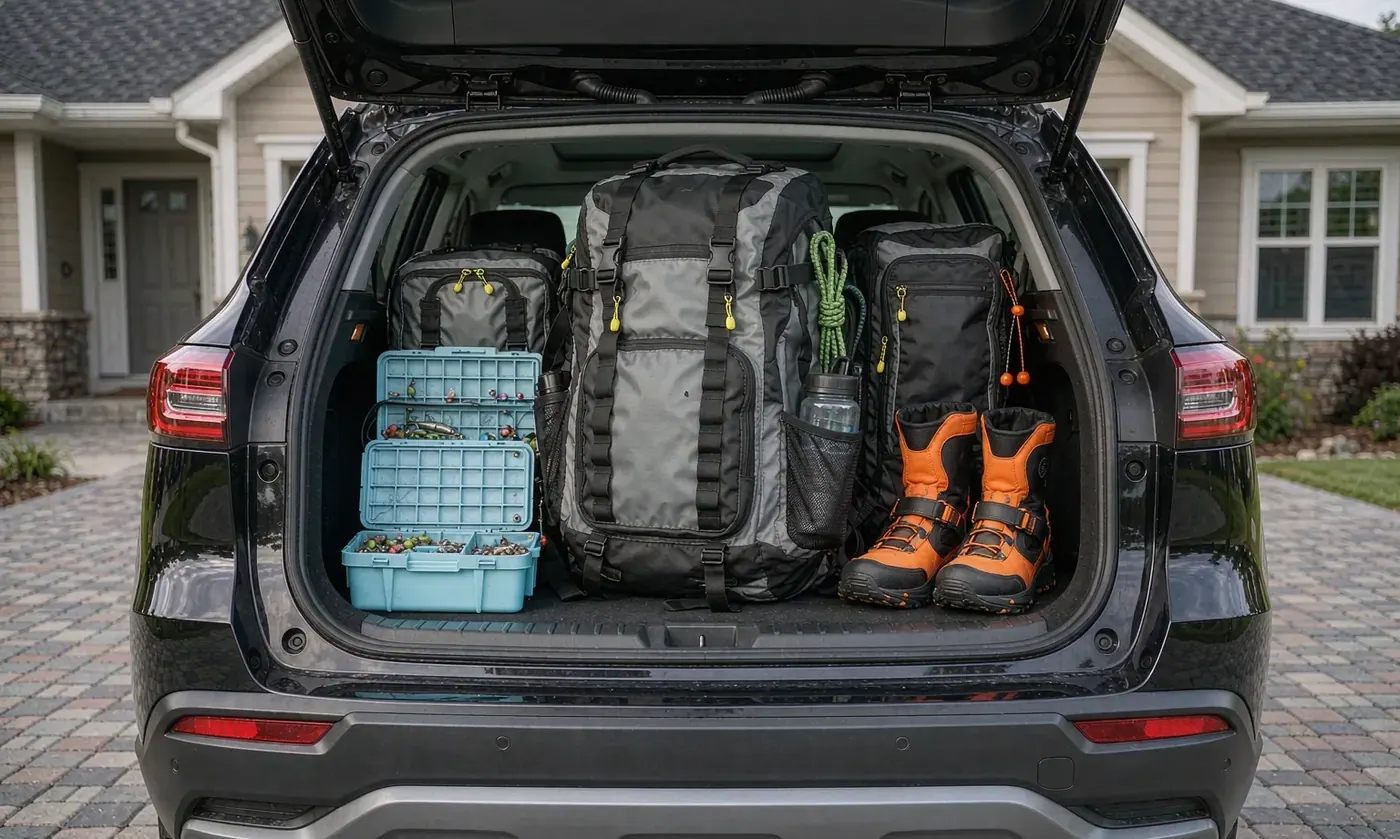
A 3700 bag is bigger and heavier than its tray count suggests, and that shows up in a vehicle and in a cupboard. A four-tray build at 42 litres is roughly 450 x 350 x 300 mm, which fits a car boot but not a small hatchback shelf, and a six-tray build at 52 litres does not lie flat in most boots at all.
| Build | External size | Boot fit | Storage note |
|---|---|---|---|
| Compact 30 | 400 x 320 x 260 mm | Any boot, lies flat | Fits a cupboard shelf |
| Four-Tray 42 | 450 x 350 x 300 mm | Most boots | Needs a shelf 320 mm deep |
| Six-Tray 52 | 520 x 400 x 340 mm | Estate or SUV | Floor standing |
| Guide 62 | 560 x 430 x 380 mm | Estate only | Floor standing, heavy |
Storage between trips matters as much as transport. A bag stored with trays loaded and damp compresses the rail foam and deforms the tray feet, and the habit worth recommending is to empty the stack, dry the chamber, and store the bag open. That takes about three minutes and it is what keeps a deep-tray bag fitting properly in year three.
Checks Before Approving a 3700 Sample
The approval protocol for a deep-tray bag is dimensional first and everything else second, because a bag that does not fit the trays has no other virtue worth testing. Five checks take about 40 minutes and require a set of production trays from at least two moulds rather than a single hand-picked sample tray.
| Check | Method | Pass condition | Catches |
|---|---|---|---|
| Chamber fit | Insert the full tray count plus tolerance trays | All fit freely | Nominal dimensions with no allowance |
| Loaded draw | Load to stated weight, draw each tray | No bind | Pitch cut to 58 mm |
| Inversion | Hold loaded pack upside down 10 s | No tray moves | No positive stop in the rail |
| Rattle | Walk 500 m loaded, listen | No movement | Pitch over 70 mm |
| Base flatness | Set on a flat floor loaded | Trays seat square | Deviated moulded base |
Strength and abrasion requirements should reference published methods from ASTM International, with the rail attachment included, because rails carrying four loaded trays at 7 kg put a sustained pull on their anchor points that a fabric pocket never sees.
Programme, Pricing, and Compliance
A 3700 brief should open with the tray count and the dimensional allowance, because those decide the shell and the tooling. Specify rail pitch and chamber dimensions next, then suspension for the resulting weight, and treat features as last. Settling the dimensions first avoids the most expensive revision in this category, which is a re-cut chamber after sampling.
| Programme item | Baseline | Note |
|---|---|---|
| MOQ | 500 pcs per design and colour | Tray colour can be split above the baseline |
| Sampling | 6-10 working days | Add 5-7 days for a moulded base tool |
| Bulk | 35-50 days | From approved sample and deposit |
| Inspection | AQL 2.5 | Include chamber fit, loaded draw, inversion, rattle |
| Compliance | REACH and California Prop 65 | Screen coatings, films, inks, hardware, tray polymer |
QUANZHOU JUNYUAN BAGS has developed waterproof bag programmes since 2014, with the founding team in the trade since 2004. Monthly output of 200,000 units is verified by SGS, and BSCI and ISO 9001 systems structure the workflow. Materials are screened for REACH and California Prop 65, and every bulk order is inspected at AQL 2.5 before shipment.
A deep-tray brief can be emailed to service@junyuanbags.com with tray count, dimensional allowance, volume, rating, and quantity. FOB Xiamen or DDP service to more than 100 countries follows an approved sample and a complete test record. The general category sits in the fishing tackle backpack range.
People Also Ask
What size backpack do I need for 3700 trays?
About 28-30 L for two trays, 38-42 L for four, 50-56 L for six, and 62-70 L for eight. One 3700 tray needs roughly 4.5 litres of chamber space.
Will 3700 trays fit in a bag made for 3600 trays?
Usually not. A 3700 tray is 15 mm deeper and slightly larger in footprint, so a shell built for 3600 trays is typically 10-15 mm narrow and the pitch is too tight.
How much does a loaded 3700 tray weigh?
About 1.4-1.8 kg for terminal tackle. Four trays is 5.6-7.2 kg before water and tools, which is why four-tray bags need a hip belt.
Why do trays stick in my backpack when it is full?
The rail pitch is too tight. A 3700 tray is 55 mm deep and needs 60-65 mm of pitch, because fabric compresses 2-4 mm under load.
How many 3700 trays should I carry?
Four for most anglers and six for tournament work. Four represents about 9 kg loaded, which is the practical ceiling for a comfortable carry.
Does adding a cooler pocket cost a tray slot?
Usually one. An external insulated compartment preserves the full stack for about 250 g and 4.50 USD, while an internal divider takes about 4.5 litres of chamber.
Frequently Asked Questions
Q1. What is the best backpack for 3700 trays?
A 42 L build at 1.95 kg holding four deep trays with tools aboard, on a 90 mm hip belt and a 2 mm frame sheet, with a 65 mm rail pitch, at a 36-45 USD FOB band.
Q2. What chamber size fits a 3700 tray?
At least 240 mm wide and 365 mm deep, allowing 8-12 mm over the nominal 230 x 355 mm tray for moulding tolerance and fabric compression.
Q3. How many 3700 trays fit in 40 litres?
Four, with tools and a bottle aboard. Four deep trays occupy about 18 litres of chamber space, and the rest of a 40 litre shell goes to the suspension and pockets.
Q4. What rail pitch do 3700 trays need?
60-65 mm. A tray is 55 mm deep and fabric compresses 2-4 mm under load, so 58 mm binds when the bag is full and 70 mm rattles.
Q5. How heavy is a backpack full of 3700 trays?
About 5.2 kg for two trays, 9.0 kg for four, 13.4 kg for six, and 17.6 kg for eight, including tools and water. Above about 9 kg a hip belt is required.
Q6. Can I put 3700 trays in a 3600 backpack?
Rarely. The deep tray is 15 mm deeper and slightly larger in footprint, so a shell built around 3600 trays is usually too narrow and the pitch too tight.
Q7. Do I need a hip belt for four 3700 trays?
Yes. Four loaded trays plus tools and water is about 9 kg, and a belt with a stiffener transfers around 70 percent of that into the hips.
Q8. What suits a boat with a 3700 tray bag?
A tall narrow body around 330 mm wide so it passes a 360 mm hatch, with trays stacked vertically and load lifters set at 35-45 degrees to stop sway.
Q9. Is a submersible 3700 bag worth the cost?
For kayaks and open boats, yes, at 46-56 USD. It needs a drain path and a vented upper chamber, because four wet trays in a sealed shell produce condensation that reads as leakage.
Q10. How do I stop trays rattling in the bag?
Hold the rail pitch at 65 mm rather than 70 mm, and check for a positive stop at the base of each rail. Rattle on a 2 km walk is a common complaint with generous pitches.
Q11. What is the MOQ and lead time for a 3700 tray backpack programme?
MOQ is 500 pcs per design and colour, samples take 6-10 working days plus 5-7 days for a moulded base tool, and bulk runs 35-50 days from approved sample and deposit.