A fishing backpack labelled 40 litres gives about 30 litres of genuinely usable space, holds six to ten trays depending on their format, and weighs 11 to 16 kilograms once loaded; the same bag labelled 20 litres gives roughly 15 usable litres, holds two to four trays, and carries 6 to 8 kilograms. The gap between nominal and usable is not marketing dishonesty so much as arithmetic: corners, insert walls, closure folds, and the space above a tray stack all consume 18 to 28 percent of what was advertised. Build a capacity budget from what you actually carry, and the choice of size usually settles itself within five minutes.
How Litres Get Measured
There is no single agreed method for stating the volume of a soft bag, which is the root of the confusion. Some brands multiply external length by width by height, which counts every rounded corner and both faces of the padding as space. Some measure the main compartment only and exclude pockets entirely. A few genuinely fill the shell with a measured volume of water or beads, which is the most honest approach and the least flattering to the number on the label.
| Measurement approach | Typical result on one 30 litre design | How to spot it |
|---|---|---|
| External dimensions multiplied | 32 to 36 litres | The stated figure exceeds what the panels suggest |
| Main compartment only | 26 to 29 litres | Pockets are excluded and rarely described |
| Insert capacity counted separately | 28 to 32 litres | Tray statement and litre statement conflict |
| True fill with beads or water | 24 to 27 litres | The label seems modest for the bag's size |
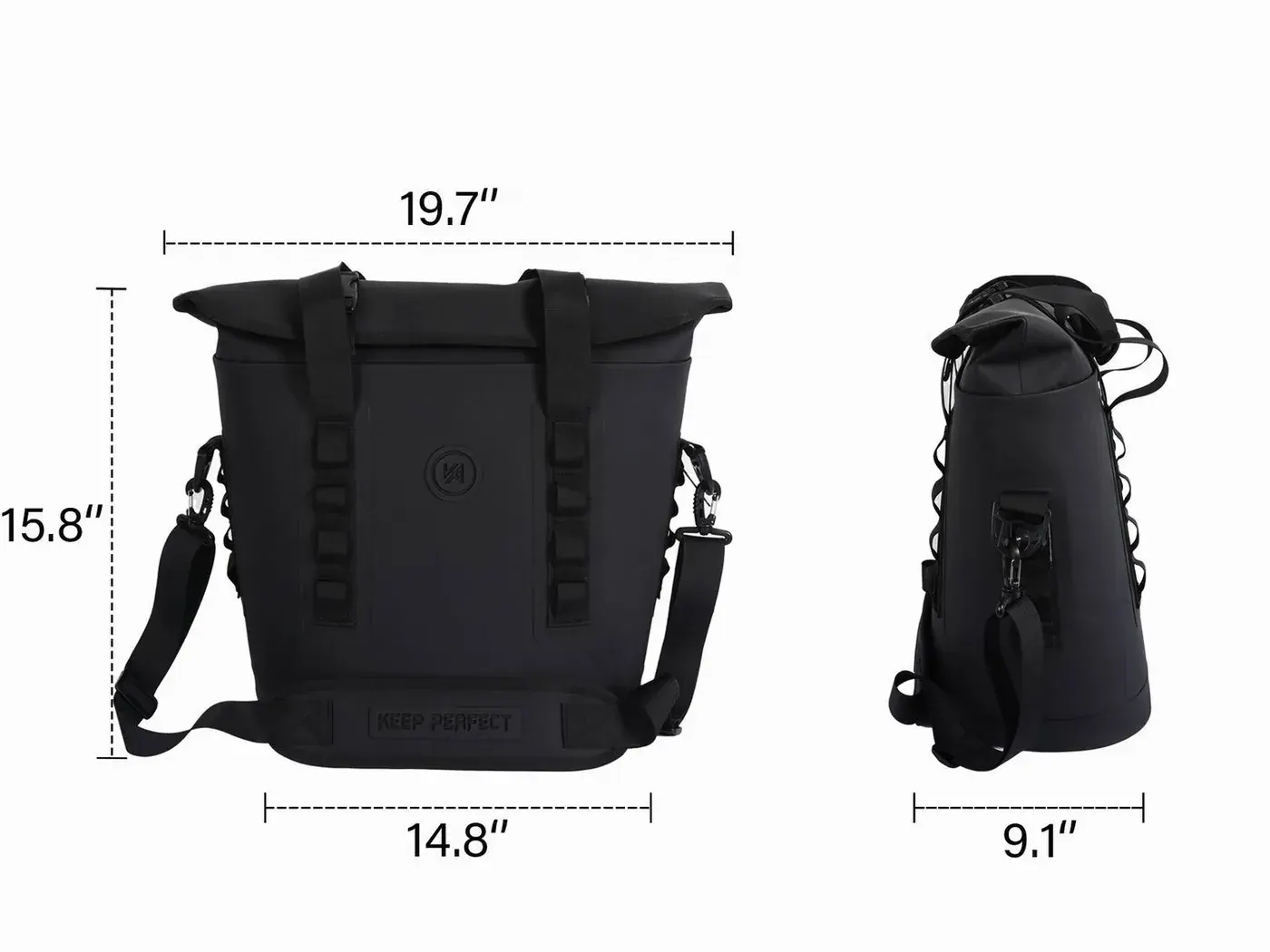
None of this is hidden from a careful buyer. Compare the bag's external dimensions against the stated volume: if the multiplication of those three numbers roughly equals the advertised litres, then the figure is external rather than usable, and it should be discounted by around a quarter before making decisions.
The 0.75 Rule
For a soft-bodied pack with a tray insert, somewhere between 72 and 82 percent of nominal volume ends up usable. If the bag has no internal structure, the figure can reach 85 percent; if it has a moulded base, thick padding and a full width insert, it can fall below 70. Rather than guess, apply the deductions below to whatever number is advertised.
| Deduction | Typical range | Why it happens |
|---|---|---|
| Corner and seam dead space | 8 to 12 percent | Rounded geometry cannot be filled with rectangular trays |
| Insert walls and dividers | 6 to 10 percent | Each divider is doubled fabric plus seam allowance |
| Compression when packed tight | 5 to 8 percent | Soft panels bow inward under strap tension |
| Closure and roll fold | 3 to 5 percent | Every roll-top turn removes usable height |
| Working gap above the tray stack | 4 to 6 percent | Trays must be lifted out, not wedged in |
Applied together those deductions rarely total less than 18 percent and can reach 28, which is why a 0.75 multiplier is a fair working assumption for most structured packs and roughly 0.82 for unstructured ones. Being slightly conservative here costs nothing and prevents the common error of buying one size too small.
20, 30 and 40 Litres Side by Side
The middle of the range is where most anglers should end up, but the spread is worth seeing in one table because it makes the trade-offs obvious. Note particularly how quickly loaded weight grows: tray contents are dense, so volume and mass do not rise in proportion.
| Nominal size | Usable litres | Trays realistically carried | Loaded weight | Typical session |
|---|---|---|---|---|
| 18 to 20 litres | 13 to 15 | Two to four 3600-size trays | 6 to 8 kilograms | Two or three hours from the bank |
| 25 litres | 18 to 20 | Three to five trays | 7 to 9 kilograms | Half day walking a bank |
| 30 litres | 22 to 24 | Four to six trays | 8 to 11 kilograms | Full day, mixed methods |
| 35 litres | 26 to 28 | Five to eight trays | 10 to 13 kilograms | Full day plus weather gear |
| 40 litres | 29 to 32 | Six to ten trays | 11 to 16 kilograms | Multi-day or travelling angler |
Loaded weight is the column buyers most often regret ignoring. Anything above about 10 kilograms wants a padded hip belt rather than shoulder straps alone, because below that mass the harness barely matters and above it everything changes about how comfortable the walk feels.
Build a Capacity Budget
Rather than picking a size from a chart, add up what will actually be carried. Each item has a known footprint, and the total converts neatly into litres. A 3600-size tray occupies around 2.4 litres externally, a 3700-size around 5.5, a one litre bottle takes about 1.2 in packed reality, a rain shell around 2, and a lunch box close to 2.5.
- List the trays to be carried and multiply their count by 2.4 litres for 3600-size or 5.5 for 3700-size.
- Add 1.2 to 1.4 litres of slack per tray, since nothing packs perfectly and fingers need room to lift them.
- Add consumables: water at its stated volume, food containers at about 2.5 litres, and clothing at 2 to 4.
- Add tools and soft goods, typically 2 to 3 litres even when they are clipped externally.
- Divide the total by 0.75 to convert usable litres back to the nominal figure to shop with.
| Angler profile | Tray count | Extras | Usable litres needed | Nominal size to buy |
|---|---|---|---|---|
| Weekend bank angler | Three | Lunch, light shell | About 13 litres | 20 litres |
| Regular day angler | Five | Water, camera, rain gear | About 19 litres | 25 to 28 litres |
| Bass angler changing methods | Eight | Several lure categories | About 26 litres | 35 litres |
| Travelling angler | Six | Clothing, travel paperwork | About 28 litres | 35 to 40 litres |
Worked honestly, this method usually lands one size below what instinct suggests, because instinct counts trays and forgets that water, food and clothing are heavier and bulkier than everything else combined.
Shape Beats Litres
Volume tells half the story; the other half is whether the internal space has the right proportions. Trays are rectangular and unforgiving, so a bag that is tall and narrow can hold fewer trays than a shorter, wider bag with a smaller stated number. Three dimensions decide this before capacity does.
- Internal width must exceed the longest tray dimension by 10 to 15 millimetres; for 3600-size that means about 285 millimetres clear.
- Stacking depth needs multiples of tray thickness plus tolerance: about 48 millimetres per 3600 tray and 70 for the deeper 3700.
- Height must allow the stack plus roughly 30 millimetres of finger clearance above it, or loading becomes a two-handed shove.
- A wide flat front panel accepts trays far better than a tapered one, whatever figure appears on the label.
- Bags tapered for appearance lose the bottom 40 to 60 millimetres of usable tray width, which is often the difference between four trays and three.
Where a listed bag gives only external dimensions, subtract panel and padding thickness before applying any of that: typically 15 to 25 millimetres per side for a padded, structured pack and 5 to 10 for a light one.
When a Bigger Bag Is Worse
Extra volume is not free, and the cost is paid on every trip. Four effects show up reliably in the field. Larger packs invite more contents, with each additional litre of usable space typically attracting 150 to 250 grams of extra gear over time. Access takes longer because any given item sits deeper. Bulk catches on scrub, hatch coamings and rod rests. And ground contact increases because a deeper pack sits lower in crooked positions.
| Downside | What it looks like in practice | Who notices most |
|---|---|---|
| Contents expand to fill the space | A 40 litre pack gains three kilograms of rarely used kit | Everyone, within one season |
| Slower access | Reaching a tray at the bottom takes twice as long | Anyone changing method often |
| Bulk in tight spaces | Does not fit a kayak hatch or a car footwell | Paddlers and travelling anglers |
| Higher centre of mass | Less stable on wet rock and steep banks | Bank and surf anglers |
| Strap pressure increases | More weight through the same shoulder contact | Anyone walking beyond about two kilometres |
The practical remedy is buying for the ordinary session rather than the ambitious one. Anglers consistently report using maybe 60 percent of what they carry, and a modest bag used to its limit is more pleasant to fish from than a large one never filled.
Matching Size to Session Type
Different sessions make genuinely different demands, and matching size to the dominant session rather than averaging them across a season gives the better result. Where someone fishes several styles, the compromise usually lands at 25 to 30 litres with modular additions for the longer days.
| Session type | Recommended size | Reasoning | Alternative |
|---|---|---|---|
| Short bank session, two hours | 18 to 20 litres | Two or three trays and no weather gear | A moderately sized sling pack |
| Full bank day with walking | 25 to 30 litres | Balances tray count against carried weight | Sling with an added strap pouch |
| Boat or pier work | 25 to 35 litres | No walking, so weight matters far less | Open-top tote for quick access |
| Kayak or paddle board | 18 to 25 litres | Hatch openings and tank wells limit size | Crate-mounted storage bag |
| Travel and destination trips | 35 to 40 litres | Must also absorb clothing and documents | Duffel plus a small day pack |
Anyone whose dominant session is from a boat or pier can comfortably size up, since none of the walking penalties apply. Those penalties return sharply the moment anything has to be carried more than a few hundred metres.
Growing Beyond One Bag
Two strategies exist for anyone whose needs vary widely, and the modular one usually wins. A mid-sized pack of 25 to 30 litres with two or three attachment points handles most sessions and can be extended with a strap pouch or belt wallet for the long days. Buying one large bag instead solves the long days and taxes every short one.
- Keep the base kit permanently packed so short sessions need no preparation at all.
- Add a small external pouch rather than carrying a second shoulder bag, which interferes with casting.
- Use a smaller insert in a larger pack for mixed days rather than repacking the whole tray layout.
- Consider one spare change of everything, so short notice trips still happen.
- Review contents twice a season; anything unused across three trips does not belong in the bag.
Friction-free preparation is the real benefit. A mid-sized pack kept ready means sessions actually happen, whereas a large one requiring half an hour of packing tends to stay in the hallway more often than anyone admits.
Getting Good Measurements Before Buying
Three checks take under ten minutes with a tape measure and remove most size surprises. They should be done against external dimensions rather than the stated volume, since that is the only figure available before purchase and the only one independent of marketing convention.
- Multiply the three external dimensions, then discount by 25 percent for padding, taper and closure to estimate usable volume.
- Divide that estimate by 2.4 litres per 3600 tray, which converts abstract litres into the tray count that matters.
- Check the narrowest internal width against the longest tray dimension plus 15 millimetres of clearance.
- Compare the result against the budget built earlier rather than against a shopping habit.
- If the figures are marginal, choose one size up only when most sessions are static.
Heavier loads also deserve stronger materials, and stronger materials are verifiable. Breaking strength of the shell fabric and its tear resistance can be requested against published methods from ASTM International and from ISO, both of which let two quotations be compared rather than merely admired.
Packing Order Changes What Fits
Two people with identical bags and identical gear reach quite different conclusions about whether everything fits, and the difference is sequence. Dense items belong low and against the back panel, soft items belong in the gaps, and anything needed mid-session belongs within one movement of the top. Packed in that order the same bag appears to gain several litres; packed randomly it never quite closes.
| Packed sequence | Position in the bag | Why that position | Typical saving |
|---|---|---|---|
| Heaviest trays | Lowest slots, closest to the spine | Keeps the centre of mass high and inward | Better balance rather than space |
| Bulky soft items | Around the tray stack, not beneath it | Fills irregular corners nothing else reaches | 1 to 2 litres recovered |
| Water and food | Side or external pockets | Frees internal height for trays | 1 to 1.5 litres recovered |
| Rain shell | Directly under the lid | Needed first when weather turns | Seconds rather than litres |
| Rarely used items | Bottom of the stack only if dense | Avoid bringing them at all if possible | Several litres on some days |
Repacking in this order for one session is enough to learn it permanently, and most anglers who do so find they can step down a size next purchase rather than up.
Torso Length and Load Placement
Capacity interacts with body geometry, which is why the same 30 litre pack suits one person perfectly and another not at all. Taller packs transfer load further from the hips unless their internal layout keeps dense items low, and that leverage is felt long before the weight itself becomes the problem.
| Torso length | Suits which pack height | Where dense items go | Watch for |
|---|---|---|---|
| Short torso, under 45 centimetres | Up to about 50 centimetres of pack height | Lowest tray slots | Top of the bag contacting the head on slopes |
| Medium torso, 45 to 50 centimetres | 50 to 58 centimetres | Middle to low slots | Strap angles cutting into the shoulder |
| Long torso, above 50 centimetres | 58 centimetres and above | Distributed low and central | Load swinging outward when walking |
| Any torso with a hip belt fitted | Taller packs become viable | Lower third of the bag | Belt riding too high to transfer load |
Where two sizes seem equally plausible, the shorter and wider option usually carries better, because it keeps mass closer to the spine and lowers the centre of gravity. That advantage grows with distance, and beyond roughly two kilometres it outweighs nearly everything else in the decision.
What Size Regret Usually Sounds Like
Patterns in what people say six months after buying are remarkably consistent, and each one is preventable. Too small almost never appears as a complaint about tray count; it appears as the discovery that weather gear, water and lunch have nowhere to live. Too large almost never appears as a complaint about volume either; it appears as an unopened bag that felt like too much effort to prepare. Both problems are solved at the budgeting stage rather than the purchase stage.
| Reported complaint | Real cause | Fix before buying again |
|---|---|---|
| Nothing fits once the rain gear is in | Weather clothing was never budgeted | Add 2 to 4 litres before choosing a size |
| Too heavy to bother carrying | Size invited more contents than sessions need | Buy for the ordinary session, not the ambitious one |
| Cannot reach the tray I need | Poor packing order, not poor capacity | Sequence by frequency of use |
| Does not fit under the seat or in the hatch | External dimensions ignored | Check the longest dimension first |
| Straps dig in on long walks | Volume fine, harness overloaded | Keep loaded weight under 10 kilograms |
Reading those patterns honestly is the cheapest way to choose well, since the mistakes are made in very predictable places and none of them requires expert knowledge to avoid.
Sizing for Production Programmes
QUANZHOU JUNYUAN BAGS has supported waterproof bag work since 2014, behind a founding team in the trade since 2004, and produces 200,000 pieces each month under SGS verification with BSCI and ISO 9001 governance. Materials are screened for REACH and California Prop 65 compliance, and lots are inspected at AQL 2.5 before release. Sizing discussions start from what the tray layout demands rather than from a round litre number, because the internal geometry follows from that and not the reverse.
Send external dimensions, target internal width and depth, tray format and count, whether a moulded base is required, shell material, colours, and quantity. Five hundred pieces per design and colour opens development; sampling takes six to ten working days, with thirty-five to fifty days for bulk once the sample passes and the deposit lands. Shipments run FOB Xiamen or DDP toward one hundred destinations. Sizing files go to service@junyuanbags.com. Sizing logic continues in how to size a tackle backpack, tray arithmetic is worked through in how many trays fit, and larger builds are reviewed among the big-capacity tackle packs.
People Also Ask
Is 30 litres enough for a tackle backpack?
Yes for most day sessions. Around 22 to 24 usable litres carries four to six trays plus water and a shell, which covers everything except travel and multi-method days.
How much bigger is 40 litres than 20 litres in practice?
About double the usable volume at 29 to 32 litres against 13 to 15, but loaded weight roughly doubles too, reaching 11 to 16 kilograms.
Why does a 40 litre bag not hold double the 20 litre tray count?
Because trays must fit the internal width and stack height, so allowances for finger clearance and irregular corners reduce real capacity below nominal.
How much does a loaded tackle backpack weigh?
Around 6 to 8 kilograms at 20 litres, 8 to 11 at 30, and 11 to 16 at 40. Anything above about 10 kilograms needs a padded hip belt.
Do I need a bigger bag for boat fishing?
You can use one, since there is no walking penalty, but most anglers still work comfortably from 25 to 35 litres with good visibility of contents.
How do I convert litres into tray numbers?
Divide usable volume by 2.4 litres for each 3600-size tray or 5.5 for each 3700-size tray, then allow a further litre per tray for handling clearance.
Frequently Asked Questions
Q1. What does 20 litres hold in a fishing backpack?
About 13 to 15 usable litres, which takes two to four 3600-size trays plus water, lunch and a light shell, weighing roughly 6 to 8 kilograms loaded.
Q2. What does 40 litres hold in a fishing backpack?
Roughly 29 to 32 usable litres, enough for six to ten trays along with clothing and food, though the load then reaches 11 to 16 kilograms.
Q3. How accurate are the litre figures printed on bags?
They vary by method. The most common approach multiplies external dimensions, which overstates usable space by around 25 percent before padding or taper are considered.
Q4. Why is usable capacity smaller than advertised?
Corners, insert dividers, closure folds, compression under strap tension, and the clearance needed above a tray stack together remove 18 to 28 percent.
Q5. Which internal width do I need for standard trays?
About 285 millimetres clear for 3600-size trays, which is their longest dimension plus 10 to 15 millimetres of working clearance.
Q6. Is a 25 litre tackle backpack a good compromise?
Yes. It typically gives 18 to 20 usable litres and carries three to five trays, covering most half and full day bank sessions without a heavy penalty.
Q7. How much weight can a tackle backpack comfortably carry?
Up to about 10 kilograms on shoulder straps alone. Beyond that, harness design matters more than volume, and a padded hip belt becomes worthwhile.
Q8. Does a bigger bag get filled automatically?
Almost always. Each additional litre of usable space tends to attract 150 to 250 grams of extra contents over a season, most of which is rarely used.
Q9. Should I size up for travel fishing?
Usually yes, stepping to 35 or 40 litres, because clothing and documents compete directly with tackle for the same space on those trips.
Q10. Is shape more important than stated volume?
Often. A wide, flat-fronted 28 litre pack can hold more trays than a tapered 35 litre one, because trays are rectangular and need clear width and stack depth.
Q11. Can I use sling packs instead of a backpack for the same capacity?
Up to about 15 usable litres, yes. Beyond that the single-strap load becomes uncomfortable and a two-shoulder design is the better answer.
Q12. What should I tell a designer when specifying size?
Give tray format and count, required internal width and stacking depth, external limits such as hatch openings, target loaded weight, and expected carry distance.