Most anglers need between 25 and 35 litres, and nearly everybody who buys larger regrets it. Published capacities count every pocket and every void, so a body advertising 40 litres typically yields 24-32 litres of genuinely usable space, and loaded tackle generally weighs 0.35-0.5 kg for every litre of that usable figure. Working backwards gives the answer quickly: decide how many trays must come along, multiply their combined volume by roughly four to cover rails, clearance, and access, and add 8-14 litres for clothing, water, and tools. Everything outside that calculation tends to be aspirational rather than practical.
Published Litres and Usable Litres Are Different Numbers
The single most useful fact in this whole subject is that the advertised figure and the useful figure rarely agree, and the gap grows as a design becomes more pocket-heavy. Understanding why prevents buying either too large or too small.
| Body | Published | Usable for tackle | Reason for the gap |
|---|---|---|---|
| Compact or youth body | 20 L | 14-17 L | Straps, back panel, voids |
| All-round design | 30 L | 21-26 L | Pockets and linings used |
| Pocket-heavy model | 40 L | 24-31 L | Organisation steals tray space |
| Large guide design | 50 L | 36-43 L | Still loses around a quarter |
| Minimalist technical body | 25 L | 20-23 L | Few pockets, honest volume |
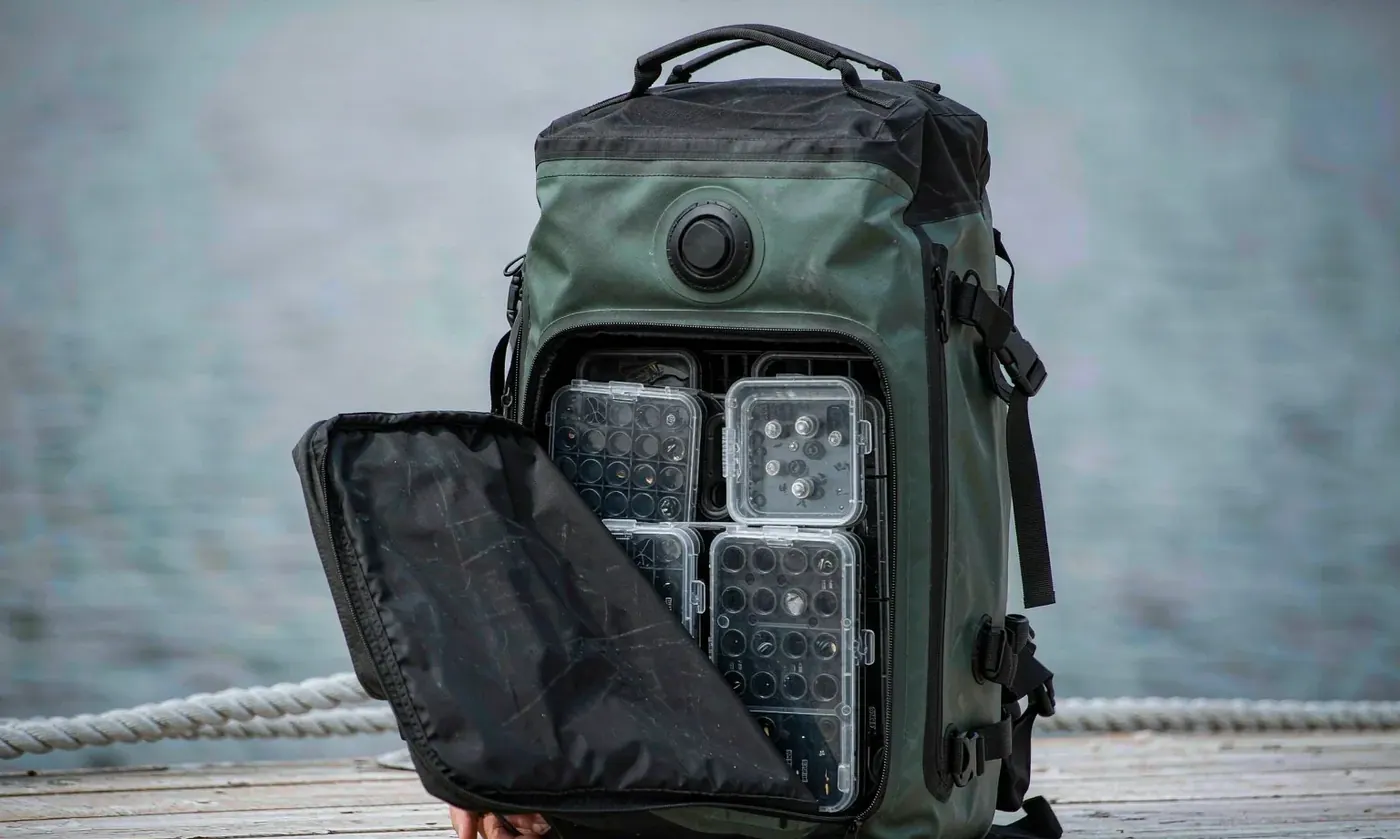
A rule of thumb follows directly from that table and it is accurate enough for purchasing. Multiply any published figure by about 0.7 to obtain realistic usable space, then check the result against the trays the buyer intends to carry. Models that fall well below 0.7 have spent their volume on organisation, which is sometimes the right choice but should never be discovered after purchase. If a specification quotes only the published figure, ask for usable litres alongside it, because honest ranges usually publish both rather than relying on whichever number reads better in a listing.
The Tray Calculation
Counting trays produces a far better answer than guessing litres, because trays are bulky, rigid, and cannot compress to fit. Starting from what must be carried and working outwards is the reliable method.
| Tray carried | Volume per tray | Body needed | Session it suits |
|---|---|---|---|
| One 3600 size | 2.0-2.4 L | 18-22 L | Short sessions, one method |
| Two 3600 size | 4.0-4.8 L | 24-30 L | Most half-day fishing |
| One 3700 size | 3.6-4.2 L | 24-28 L | Mobile anglers wanting range |
| Two 3700 size | 7.2-8.4 L | 30-38 L | Full day, varied methods |
| Three 3700 size | 10.8-12.6 L | 38-48 L | Boat and guide use only |
Notice that the multiplier runs around four, meaning that a litre of tray needs roughly four litres of bag. Allowing 8-12 mm of clearance above each tray, rails between them, and space to get fingers around a loaded tray accounts for most of that. It is also why adding one more tray frequently forces a jump of five to eight litres rather than merely two or three.
Weight should be checked at the same stage, because volume limits and weight limits rarely coincide. A loaded 3600 tray typically weighs 900-1,400 g and a loaded 3700 around 1,400-2,200 g, so three loaded 3700 trays already reach 4.2-6.6 kg before water, tools, or clothing are added. For anything carried further than about a kilometre, the weight ceiling usually binds before the volume ceiling does.
Sizing by Session Length
Where the tray method is impractical, session length gives a reliable shortcut. The figures below assume a moderate amount of tackle rather than a comprehensive collection.
| Session | Recommended size | Loaded weight | What comes along |
|---|---|---|---|
| One to two hours after work | 18-24 L | 5-7 kg | One tray, tools, water |
| Half day moving between swims | 24-30 L | 7-10 kg | Two 3600 trays, light layer |
| Full day on foot, 3-8 km | 30-36 L | 9-13 kg | Two 3700 trays, shell, food |
| Full day from a vehicle or boat | 35-45 L | 11-16 kg | Three trays, bulkier gear |
| Two days or professional guiding | 45-55 L | 13-19 kg | Everything, mostly carried short distances |
The honest pattern in that table is that size rises far more slowly than most buyers assume. Going from an after-work session to a full day on foot adds only about ten litres, because what increases is clothing and food rather than tackle. The overwhelming majority of purchases above 45 litres are made by people imagining a session they fish twice a year rather than the one they fish weekly.
Sizing by Target Species
Species matters because it dictates lure sizes and thus the volume of each item, and this is a more reliable guide than session length for anglers who fish one method consistently.
| Target | Typical kit | Recommended size | Note |
|---|---|---|---|
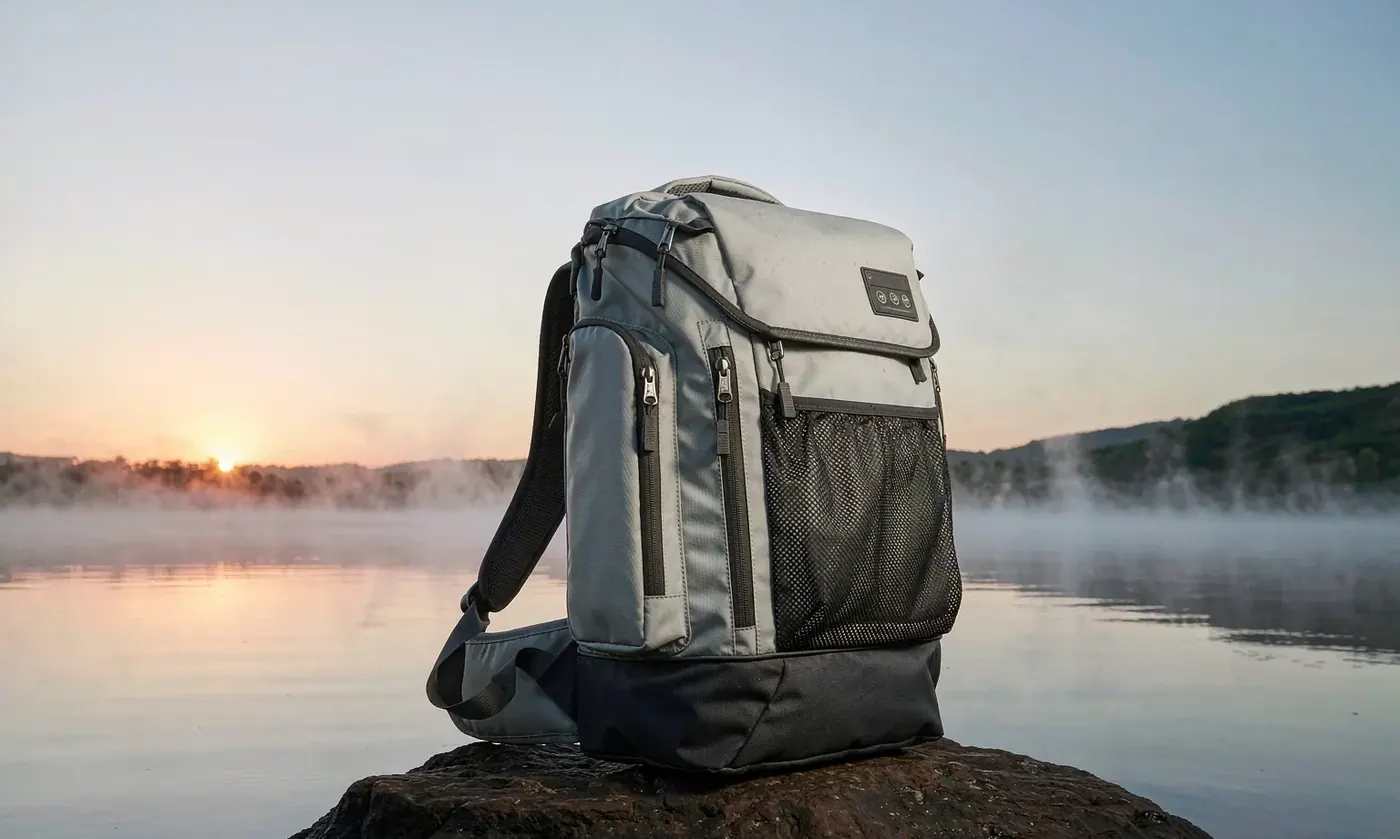
| Trout and small stream species | Small boxes, tippet, a few lures | 18-24 L | Weight matters more than space |
| Bass, single method | Two or three 3600 trays | 24-32 L | Balanced default |
| Bass, varied methods all day | Two 3700 trays plus tools | 32-40 L | Common upper practical range |
| Pike and predator species | Large lures, long trays, leaders | 35-45 L | Bulky individual items |
| Carp and specialist coarse | Rigs, leads, bait pouches | 30-40 L | Bait adds unexpected volume |
| Coastal saltwater species | Corrosion kit plus rinse gear | 30-40 L | Rinse bottle adds bulk |
The pike row illustrates something worth generalising: sometimes it is the size of individual items rather than their number that drives the specification. A large predator lure can measure 200-300 mm and will not fit a tray intended for trout lures at any price, so exceptional items should always be measured before sizes are compared.
Travel, Transport, and Storage
How the bag travels is its own constraint and one that surprises anglers buying larger capacity, because at some point the bag stops fitting into anything else.
| Transport case | Limiting dimension | Largest practical body |
|---|---|---|
| Airline carry-on baggage | 55 x 40 x 23 cm typical | 38-42 L depending on shape |
| Under-seat personal item | 40 x 30 x 15 cm typical | 18-22 L soft body |
| Small car boot alongside other gear | Depends entirely on the vehicle | 30-40 L |
| Kayak hull hatch at 203 mm bore | About 185 mm clear | 20-25 L compressible only |
| Shed or garage storage between trips | No real limit | Any size, but it still gets carried |
The under-seat row matters increasingly because many fares now exclude a carry-on bag, leaving only the smaller allowance. An angler flying to a destination regularly should check which allowance applies before buying, since a body that is excellent for local fishing may not qualify as personal-item size even when mostly empty.
Storage at home is also worth a moment, though it sounds trivial. A bag that must be carried up attic stairs or lifted onto a high shelf gets used less often, and perceived bulk away from the water measurably reduces how frequently equipment is actually taken out. Anyone whose storage is awkward should treat that as a genuine argument for choosing the smaller size, since the best bag in the shed is of no use to anybody.
Two smaller adjustments complete this section. A body intended to sit in a vehicle permanently should be sized for that role rather than for carrying, because the weight penalty disappears entirely and the extra capacity finally becomes useful. Conversely, anything that must be carried on public transport benefits from the smallest workable body, since gate gauges and crowded carriages punish bulk far more severely than they punish a missing tray.
Four Sizing Mistakes
Most sizing errors are variations on the same theme: choosing for an imagined session rather than the one that actually gets fished. Naming the mistakes is cheaper than discovering each one in person.
- Buying for the biggest trip of the year rather than the weekly one, which accounts for the great majority of oversized purchases.
- Assuming that published litres describe usable space, then finding only about 70 percent of it available for trays and gear.
- Failing to weigh the loaded result, so a comfortable 30 litre body becomes a 13 kg load nobody wants to carry.
- Ignoring the largest single item, then discovering a favourite lure or a reel case will not fit through the opening at all.
- Choosing by size alone without checking the physical reach from the shoulder to the lowest pocket, which decides real usability.
Fabric strength and load performance are measured by methods published by ASTM International, and requesting tear and tensile figures alongside volume prevents the common situation where a larger body is built from lighter material and takes the extra load badly. Volume claims without a strength figure are incomplete specifications at any size. Hydrostatic head and water penetration procedures referenced across this guide belong to the textile series maintained by ISO, which is how spray resistance and immersion behaviour are quoted consistently rather than guessed.
The Eighty Percent Rule
When trade-offs cannot be resolved, one principle resolves nearly all of them, and it is simple enough to apply without any spreadsheet.
| Situation | Recommendation | Reason |
|---|---|---|
| Torn between 25 L and 32 L | Take the 25 L | The smaller body gets carried more often |
| Torn between 32 L and 40 L | Take the 32 L | Above about 36 L many bodies exceed carry-on size |
| Genuinely uncertain about the future | Buy the mid size now | A second small bag costs less than replacing an oversized one |
| Fish two very different session types | Own two bodies | One cannot serve both well |
| Guide or lodge use | Buy larger without hesitation | Kit is carried short distances only |
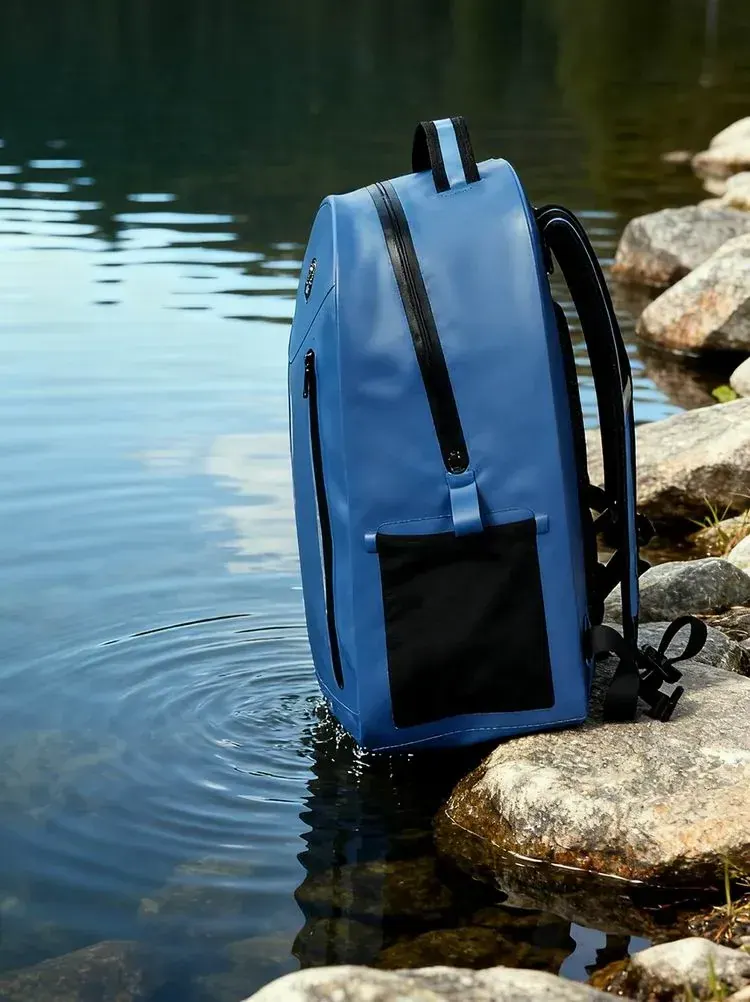
Buying for eighty percent of trips rather than the remaining twenty usually means selecting the smaller size, because the smaller body handles the frequent case better and the occasional larger session can be served by leaving one tray at home. Leaving a tray behind costs almost nothing in practice, whereas carrying unnecessary weight every week never stops being felt. The trap to avoid is treating a big session as evidence that the smaller choice was wrong, because a bag that copes badly twice a year has still served the other fifty weekends properly.
How Body Shape Changes the Answer
Two bags of identical published volume can perform very differently, because volume distribution matters as much as the total. Tall narrow bodies and wide shallow ones suit different gear, and this explains plenty of apparently contradictory advice.
| Shape | Advantage | Drawback | Best for |
|---|---|---|---|
| Tall and narrow | Carries high, clears scrub | Tips when set down | Bank anglers in cover |
| Wide and shallow | Stable, easy to search | Catches on brush at hip width | Boat and pier use |
| Front loading panel | Everything reachable at once | Panel zip is a failure point | Organised session anglers |
| Top loading single cavity | Fewest failure points | Everything sinks downward | Minimalists and travellers |
| Box shaped with tray rails | Best tray access by far | Bulky when empty | Anglers using three or more trays |
The first two rows deserve a practical test that anyone can run with a tape measure. Lay the proposed bag flat and measure its longest dimension, then compare that against the widest gap the angler regularly walks through. A body 650 mm tall with a rod in hand behaves very differently from one 550 mm tall but 200 mm wider, even when their litre figures are identical.
Empty bulk follows from the same geometry and is worth mentioning because it affects storage far more than buyers expect. A box-shaped body with tray rails will not compress at all, so it occupies its full volume in a hallway cupboard twelve months of the year, whereas a soft top-loader squashes to perhaps 60-70 percent once its trays are removed.
Moving Up or Down a Size
Finally, people rarely get this right first time, so it helps to know what moving one step actually changes and when that is worth doing.
- Going up one band typically adds 5-8 litres of published space, which converts to roughly 4-6 litres usable, meaning one extra 3700 tray.
- Going up one band also adds about 400-700 g of empty weight, most of it fabric and strap length rather than hardware.
- Going down one band almost always removes one tray from what can be carried, so it should follow rather than precede a decision about tray count.
- A hip belt becomes worthwhile at the point where loaded weight exceeds around 10 kg, which usually corresponds to bodies above 35 litres.
- Replacing an oversized body is more common than replacing an undersized one, which is the strongest argument for erring smaller first.
That last point reflects how the trade actually works. Under-sized bags tend to get supplemented with a sling or a chest pack for the occasional larger day, while oversized bags simply get left at home, so they are quietly replaced by nothing at all. Erring small is almost always the lower-risk mistake.
Dimensions to Check on a Specification
Litres are a derived figure and two different shapes can produce the same number, so checking physical dimensions is the only reliable way to predict whether something will actually work. Three measurements are enough.
| Size band | Typical height | Typical width | Typical depth |
|---|---|---|---|
| 18-24 L compact | 420-480 mm | 260-300 mm | 160-200 mm |
| 25-32 L all-round | 480-540 mm | 300-340 mm | 180-220 mm |
| 33-42 L large | 540-620 mm | 330-380 mm | 200-250 mm |
| 45-55 L expedition | 600-700 mm | 360-420 mm | 230-280 mm |
The depth column is the one with real consequences for trays, because a standard 3700 size tray sits around 50 mm deep and two of them stacked require 110-130 mm of internal height once clearance is allowed. Any body shallower than about 150 mm internally will struggle with two stacked trays regardless of what its litre figure claims, which is another reason to check dimensions rather than rely on the headline number.
Width deserves the same scrutiny from anyone fishing tight cover. A body measuring 380 mm across catches on brambles and fence lines at hip height far more often than a taller but narrower one does, and this single factor explains why experienced bank anglers frequently prefer bodies that look disproportionately tall next to their capacity.
Size Range, Cost, and Ordering
Finally, what each size costs and how long it takes to produce, assuming MOQ 500 pcs per design and colour.
| Size band | FOB Xiamen | Note |
|---|---|---|
| 18-24 L compact | 20-32 USD | Usually one tray plus tools |
| 25-32 L all-round | 24-38 USD | The best-selling range by volume |
| 33-42 L large | 28-44 USD | Strap and frame cost rises here |
| 45-55 L expedition | 34-56 USD | Requires load lifters and a hip belt |
| Sampling and bulk | 6-10 working days, then 35-50 days | From approved sample and deposit |
QUANZHOU JUNYUAN BAGS has developed waterproof bag programmes since 2014, with the founding team working in the trade since 2004. Monthly output of 200,000 units is verified by SGS, and BSCI and ISO 9001 systems structure the workflow. Materials are screened for REACH and California Prop 65, every bulk order is inspected at AQL 2.5 before shipment, and usable volume figures can be quoted alongside published ones.
A sizing question can be emailed to service@junyuanbags.com with target tray count, typical session length, carry distance, and yearly quantity. FOB Xiamen or DDP service to more than 100 countries follows an approved sample. Related reading includes the fishing backpack litres guide, the how many 3600 trays fit article, and the twelve-point tackle backpack checklist.
People Also Ask
What size tackle backpack is best for most anglers?
Between 25 and 35 litres. Most of that will be consumed by two trays and everyday items, and anything above 45 litres suits only boat or guide use where nothing is carried far.
How many litres do I lose to pockets and linings?
Roughly 30 percent. Multiply any published figure by about 0.7 to estimate genuinely usable space, and check the result against the trays you intend to carry.
How much can a 30 litre tackle backpack hold?
Two 3700 size trays plus clothing, water, and tools, giving a loaded weight of around 9-13 kg. Anything past that usually exceeds comfortable carry limits.
Is a 40 litre tackle backpack too big?
For most people, yes. Bodies above about 36 litres frequently exceed airline carry-on dimensions and encourage carrying more tackle than any session requires.
How much does loaded tackle weigh per litre?
About 0.35-0.5 kg per litre of usable space, so 30 litres realistically reaches 9-13 kg once trays, water, tools, and clothing are included.
Should I size up for occasional longer trips?
No. Buy for eighty percent of your trips and leave one tray behind on the rare longer day, since weekly weight matters more than occasional convenience.
Frequently Asked Questions
Q1. What size tackle backpack do I need?
Most anglers need 25-35 litres. Work backwards from the trays you must carry, multiplying their combined volume by roughly four to allow for rails and clearance, then add 8-14 litres for clothing, tools, and water.
Q2. How much of a published litre figure is usable?
About 70 percent on typical designs. A pocket-heavy 40 litre model often yields only 24-31 litres of usable space, which is why counting trays beats comparing litres.
Q3. Is 20 litres enough for fishing?
Yes for short sessions or species requiring small lure choice, holding one 3600 size tray plus tools at around 5-7 kg loaded. Below 18 litres it becomes restrictive for regular use.
Q4. What size suits a full day on foot?
30-36 litres, typically carrying two 3700 size trays alongside a shell layer and food, giving 9-13 kg loaded across perhaps 3-8 km of walking.
Q5. When does a tackle backpack become too big?
Above roughly 45 litres for anyone carrying it distances, and above about 36 litres it often stops qualifying as airline carry-on baggage. Weight becomes the limiting factor before volume does.
Q6. How much does loaded tackle weigh?
Around 0.35-0.5 kg per litre of usable space. A loaded 3600 tray weighs 900-1,400 g and a loaded 3700 around 1,400-2,200 g, before water or clothing are added.
Q7. Do I need one large bag or two smaller ones?
Two bodies if your sessions genuinely differ, since one cannot serve both well. The second small body costs less than replacing an oversized one bought for every occasion.
Q8. What is the largest size that still fits airline carry-on?
Usually 38-42 litres, subject to shape as well as volume, since the typical limit is 55 x 40 x 23 cm. Personal item allowances restrict this further to roughly 18-22 litres.
Q9. Does target species change the size I need?
Yes. Trout and small stream fishing suit 18-24 litres, bass around 24-32, and predator species 35-45 litres because individual lures measure 200-300 mm and demand correspondingly longer trays.
Q10. How do I judge size from photographs?
Compare against a familiar object rather than the description alone. A body shot beside a folding chair or a fuel bottle communicates bulk far more accurately than any litre figure.
Q11. What is the best-selling size range?
25-32 litres, which covers the majority of anglers and most half-day to full-day sessions. It also sits comfortably inside nearly every airline carry-on allowance.
Q12. What are MOQ and lead time for a new size?
MOQ is 500 pcs per design and colour. Samples take 6-10 working days and bulk production runs 35-50 days from approved sample and deposit.