A small fishing backpack for day trips should land between 14 and 24 litres and weigh under 1.05 kg empty, and those two limits decide everything else: 14-16 L carries one 3600 tray, 18-20 L carries two, and 22-24 L carries two 3700 trays. Seven compact builds were assessed for 2026 on litres per 100 g, torso fit from 400 to 460 mm, tray capacity, and 11-35 USD FOB Xiamen bands at MOQ 500 pcs per design and colour. Sampling takes 6-10 working days and bulk 35-50 days. The pick is the 18 L featherweight at 0.72 kg.
The Day-Trip Band and Why It Is Narrow
A day trip is four to eight hours away from the vehicle, and that duration sets a surprisingly tight capacity window. Below 14 litres, an angler cannot carry two trays, a water bottle, a rain shell, and tools at once, and something stays behind. Above 24 litres, the pack is no longer a day pack: it gains a hip belt, a stiff back panel, and 400-700 g, none of which is useful on a four-hour session.
The measure worth briefing on is litres per 100 g of shell weight. A good compact build returns 20-26 L per 100 g; a heavy one returns 12-16. The gap comes from the back panel and the hardware, not from the fabric, which is why the lightest builds in this group use a removable foam panel instead of a moulded frame sheet and single-pull zips instead of a drop-down door.
| Capacity | Trays carried | Session length | Typical empty weight | Best use |
|---|---|---|---|---|
| 12-14 L | 1 x 3600 plus tools | 2-4 hours | 0.50-0.65 kg | Short wading sessions |
| 16-18 L | 2 x 3600 | 4-6 hours | 0.65-0.80 kg | General day trips |
| 20-22 L | 2 x 3700 | 6-8 hours | 0.85-1.00 kg | Full day, two methods |
| 24 L | 2 x 3700 plus a shell | 8 hours plus | 0.95-1.10 kg | Long walks, mixed weather |
What Actually Fits, Counted Honestly
Capacity claims on compact packs are optimistic by roughly two litres, because the quoted figure usually counts external pockets and the hydration sleeve. The main chamber is what holds trays, and on an 18 L pack the main chamber is typically 13-14 L. An angler shopping by the number on the tag will buy a 16 L pack expecting two trays and get one tray and a squeeze.
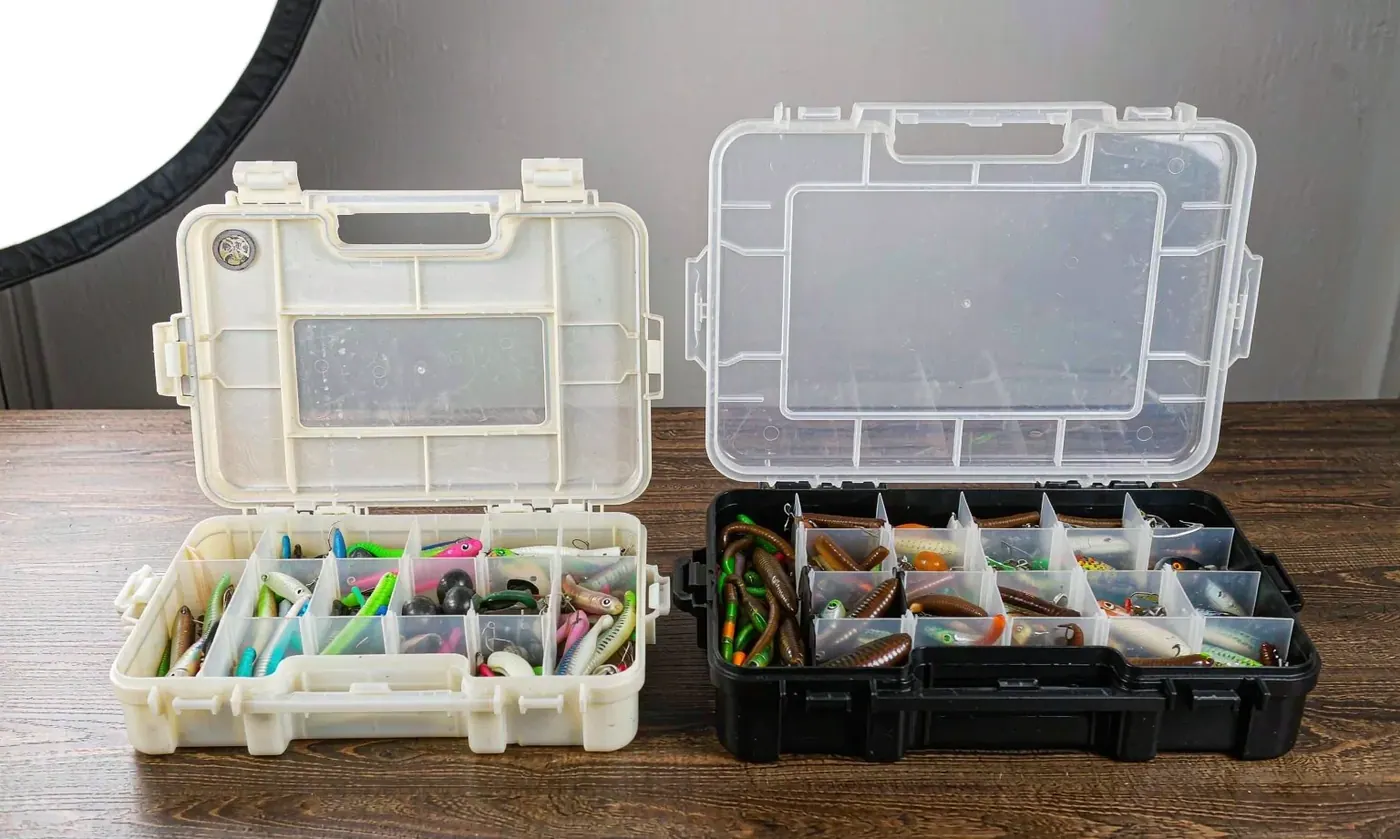
Tray choice then decides the outcome more than litres do. Two shallow 3600 trays fit an 18 L chamber with tools alongside; a single deep 3700 tray plus the same tools does not, because the 15 mm of extra depth costs the same volume as a second shallow tray. Small-pack buyers should be advised on tray type before capacity, and the trade is set out in the fishing backpack litres guide.
| Item | Volume it takes | Fits in 16 L? | Fits in 20 L? |
|---|---|---|---|
| One 3600 tray | 3.1 L | Yes | Yes |
| Two 3600 trays | 6.2 L | Yes, tight with tools | Yes, with tools |
| Two 3700 trays | 9.0 L | No | Yes |
| 1.0 L water bottle | 1.0 L | Yes | Yes |
| Packable rain shell | 0.8 L | Yes | Yes |
| Pliers, leader, tools | 0.9 L | Yes | Yes |
The Seven Builds at a Glance
All seven are sized for a day session rather than a weekend, so none carries more than two trays and none exceeds 1.05 kg. Torso fit is listed because a compact pack has no hip belt to correct a poor match, and a back panel that misses the torso by 40 mm puts the load on the neck within an hour. The wider compact category is tracked in the tackle backpack comparison.
| Build | Volume | Empty weight | Trays | Torso | FOB band |
|---|---|---|---|---|---|
| Featherweight 18 | 18 L | 0.72 kg | 2 x 3600 | 420-460 mm | 15-19 USD |
| Two-3700 Day 22 | 22 L | 0.95 kg | 2 x 3700 | 430-470 mm | 20-26 USD |
| Wading Micro 14 | 14 L | 0.60 kg | 1 x 3600 plus utility | 400-440 mm | 13-17 USD |
| Submersible Zip 20 | 20 L | 1.05 kg | 2 x 3600 | 420-460 mm | 28-35 USD |
| Travel Fold 24 | 24 L | 0.88 kg | 2 x 3600 | 430-470 mm | 21-27 USD |
| Starter 16 | 16 L | 0.55 kg | 1 x 3600 | 380-420 mm | 11-15 USD |
| Hydration Day 20 | 20 L | 0.98 kg | 2 x 3600 | 420-460 mm | 22-29 USD |
Comfort at Four to Six Kilograms
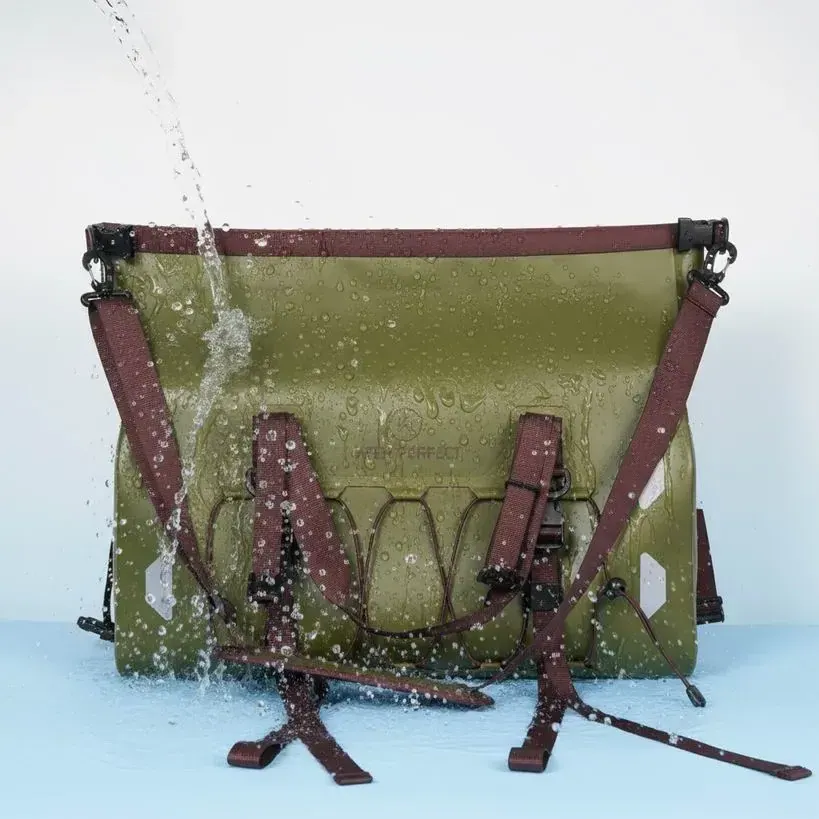
A small pack is worn at 4-6 kg all-up, which is light enough that most builders skip a load-transfer belt. That is correct up to about 6 kg and wrong above it. At 8 kg, a beltless compact pack puts roughly 90 percent of the load on the trapezius, and the angler finishes the session with a neck ache that gets blamed on the pack being too small rather than too heavy.
Strap specification is what carries the load in this class. Straps should be 45-55 mm wide with closed-cell foam of 8-10 mm, because a narrow strap at 6 kg creates a pressure line across the shoulder within 45 minutes and a thin foam bottoms out against the webbing. Sternum strap height matters too: adjustable across 120 mm lets the straps sit off the neck, and a fixed sternum strap is the most common comfort failure in compact builds.
| Load | Belt needed | Strap width | Expected comfort window |
|---|---|---|---|
| Under 4 kg | No | 40-45 mm | Full day, no issue |
| 4-6 kg | Optional webbing belt | 45-55 mm | Full day with foam of 8-10 mm |
| 6-8 kg | Padded belt advised | 55-65 mm | About 4 hours without a belt |
| Above 8 kg | Yes | 60-70 mm | Not a compact pack any more |
Back panel length is the dimension most often skipped in a brief and the one that decides returns. A 420 mm panel suits a torso of about 430 mm; an angler with a 480 mm torso wearing that pack carries the load 60 mm too high. Offering two panel lengths, or one panel with a 60 mm adjustable harness, removes most fit complaints at a cost of about 1.10 USD.
1. Featherweight 18: Best Overall
Eighteen litres at 0.72 kg carrying two 3600 trays, with a removable foam panel, 50 mm straps, and an adjustable sternum strap across 120 mm. It lands at 15-19 USD FOB and returns 25 L per 100 g, the best ratio in this group. Loaded for a day session it sits at about 4.6 kg.
What makes it work is what was left out. There is no moulded frame sheet, no drop-down door, and no hip belt, and the pack is lighter and more comfortable for a six-hour session than a 24 L build carrying the same kit. The compromise is access: trays come out of the top, so the pack has to be set down to change a lure.
2. Two-3700 Day 22: Best for Longer Days
Twenty-two litres at 0.95 kg holding two deep 3700 trays, which is the configuration for an angler fishing two methods across a full day. Straps are 55 mm with 10 mm foam and there is a webbing belt that transfers roughly 30 percent of the load. The FOB band is 20-26 USD and the realistic all-up weight is about 5.8 kg.
The webbing belt is the useful detail. It adds 90 g and about 1.20 USD, and on a 5.8 kg pack it moves the load off the trapezius enough to add two hours of comfortable wear. Buyers who skip it to hit a price point will hear about it by the second session of the season.
3. Wading Micro 14: Best for Wading
Fourteen litres at 0.60 kg, one 3600 tray plus a utility tray, a high-mounted body so the pack sits above a wading belt, and drainage at the base. It is the only build here designed to be worn in water to the waist, and it lands at 13-17 USD. All-up weight is about 3.4 kg.
Two wading specifics matter. The pack must sit high enough to clear a wading belt at about 300 mm above the hip, or it rides on the belt and pulls the angler backward in current. And it must drain: a chamber holding a wet tray grows odour within two sessions, so a base grommet and a mesh panel are required rather than optional. Wading configurations are compared further in the wade fishing bag ranking.
4. Submersible Zip 20: Best for Wet Conditions
Twenty litres at 1.05 kg with a welded liner and a submersible zip rated IPX7 for 30 minutes at 1 m, carrying two 3600 trays. It is the build for kayaks, open boats, and any session where the pack is more likely to go in the water than to get rained on. The FOB band is 28-35 USD, roughly 11 USD above the equivalent showerproof shell.
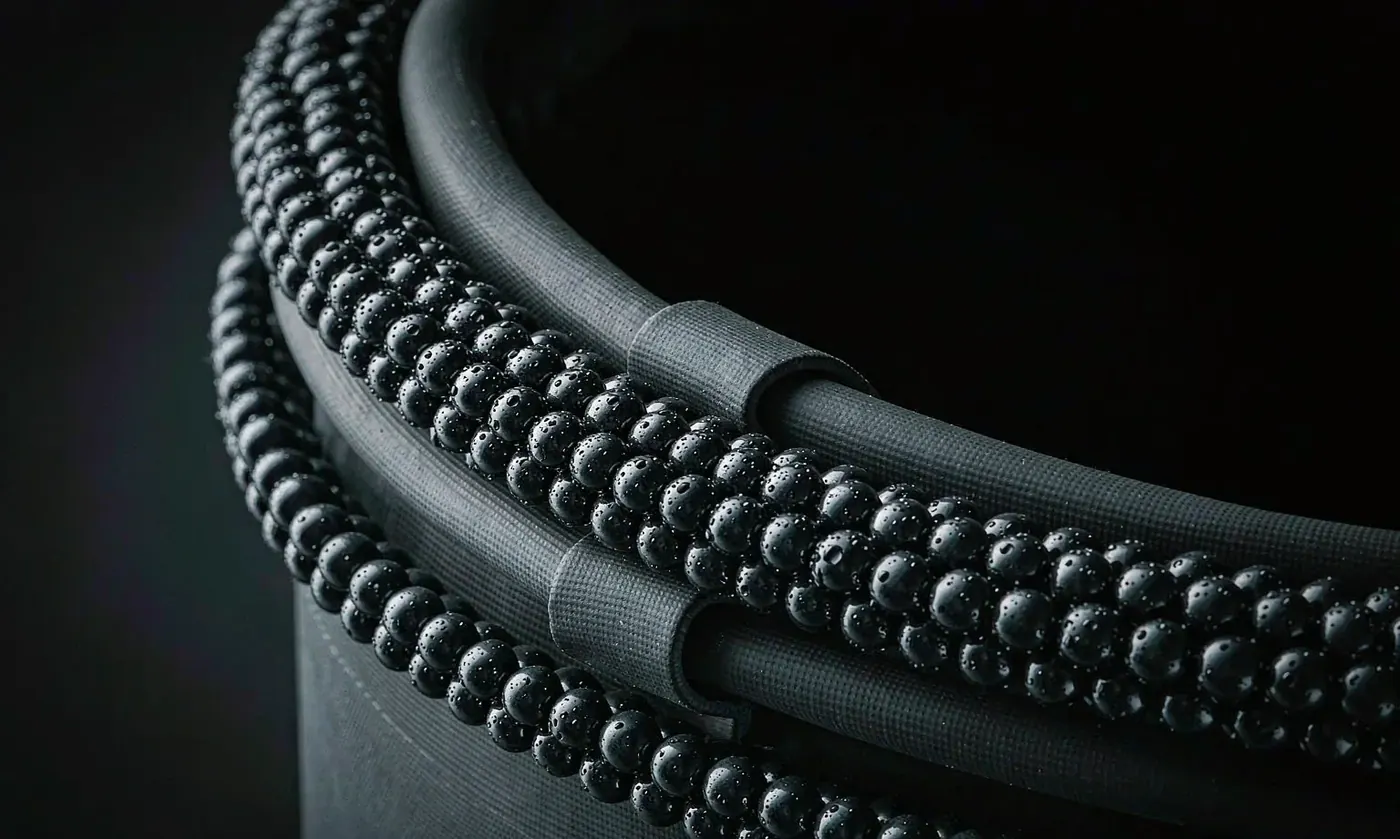
The zip is both the cost and the risk. A genuine submersible zip costs 6-9 USD against 1.20 USD for a coated coil zip, and the two look similar in a photograph. The test is a 30-minute submersion at 1 m with tissue inside, not a shower test. Ingress codes are defined by the IEC ingress protection framework, and a claim without a depth and a duration is marketing.
5. Travel Fold 24: Best for Travel
Twenty-four litres at 0.88 kg that folds flat to about 55 mm and weighs less than most day packs while holding two 3600 trays. The panel is removable and the straps detach into a rear sleeve, so the pack goes into a suitcase without a bulky shape. The FOB band is 21-27 USD.
Two travel details decide whether it works: the folded pack must fit a 400 x 300 mm footprint to sit flat in a case, and the tray chamber must be protected in transit, since a moulded tray loaded in a soft pack cracks at the latch under airline handling. A semi-rigid insert weighing 120 g solves the second problem for about 1.60 USD.
6. Starter 16: Best Value
Sixteen litres at 0.55 kg carrying one 3600 tray, at 11-15 USD FOB. It is the entry build for a first tackle bag, a junior angler, or a promotional line, and the honest description is that it holds one tray properly and a rain shell, and nothing else.
At this price the specified fabric is 420D rather than 600D and there is no coating beyond a light polyurethane finish, which is fine for occasional use and not for weekly use. The one element that should not be cut is strap foam: a 6 mm foam at 5 kg bottoms out in an hour, and 8 mm costs about 0.70 USD more.
7. Hydration Day 20: Best for Hot Weather
Twenty litres at 0.98 kg with an insulated sleeve for a 1.5 L bladder, a hose port at each shoulder, and two 3600 trays. It is the build for summer sessions in heat above 30 degrees, where an angler drinking less than 1.5 L over six hours will feel it by mid-afternoon. The FOB band is 22-29 USD.
Insulation on the hose rather than the bladder is the detail that matters, because a hose lying in the sun delivers water at 45 degrees for the first 300 ml. A foam sleeve over the first 400 mm of the hose costs about 0.90 USD and removes the complaint entirely. The sleeve should also be drained, since condensation inside a sealed chamber wets the trays.
Packing a Small Pack in a Fixed Order
Order matters more in a small pack than in a large one, because there is no spare volume to absorb a poor decision. The rule is heavy and flat against the back, trays in the middle, and soft items at the outside, and breaking it turns a 20 L pack into a 16 L pack that pulls backward.
| Position | What goes there | Reason | Common mistake |
|---|---|---|---|
| Against the back panel | Water bladder or bottle, flat items | Keeps the load close to the spine | Trays against the back, load swings out |
| Middle of the chamber | Two trays, stacked | Heaviest items near the centre of gravity | Trays at the bottom, pack sags |
| Top of the chamber | Rain shell, food | Needed without unpacking | Buried under trays |
| External pockets | Tools, leader, licence | Reachable with the pack worn | Tools inside, trays come out to reach them |
| Liner pocket | Phone, keys, licence | One dunk should not end the day | Loose in the main chamber |
Weight placement also decides how a small pack behaves on a wet rock. A pack loaded with trays at the bottom and a bladder at the top has a centre of gravity behind and below the shoulders, and it pulls the angler backward on a steep bank. Moving the trays to the middle costs nothing and is the cheapest comfort improvement available.
When a Small Pack Is the Wrong Choice
Three situations argue against a compact build, and stating them plainly saves a returns conversation. The first is a session longer than eight hours, which needs water, food, and a shell for at least two people in most cases and pushes past 24 L. The second is cold weather, where a bulky jacket and gloves add 5-8 L on their own.
The third is any angler carrying more than two methods. A third tray does not fit a compact chamber, and the workaround of stacking trays outside a rail is unstable and noisy. In those cases the right advice is a 30-36 L build, and the trade-offs are mapped in the fishing tackle backpack overview and the lightweight daypack guide.
Checks Before Approving a Compact Sample
Five checks catch most compact-pack failures and take under 40 minutes on an approval sample. Two of them concern fit rather than materials, which reflects where the returns actually come from: a pack that leaks is returned once, and a pack that hurts is returned every season.
| Check | Method | Pass condition | Catches |
|---|---|---|---|
| Tray fit | Insert two stated trays plus tools | Closes without force | Optimistic litre claim |
| Six-hour wear | Load to 5.5 kg, wear 6 hours | No shoulder pressure line | Thin strap foam, narrow straps |
| Torso match | Measure panel against a 430 mm torso | Within 20 mm | Single panel length for all sizes |
| Submersion, if claimed | 30 min at 1 m with tissue inside | Tissue dry | Coated coil zip sold as submersible |
| Drain test | Soak the base, invert, time the drain | Empty in under 90 seconds | Sealed chamber holding wet trays |
Fabric and colour performance belong in the same test record. Colour fastness to light and rubbing can be specified against published methods from AATCC, which matters on a compact pack sold in bright colours for visibility, because a red panel that fades to pink within one season reads as a quality failure even when the bag still works.
Programme, Pricing, and Compliance
A compact-pack brief should open with the session length and the tray type, because those two decide litres and therefore everything else. Specify empty weight as a hard ceiling next, then torso range, then strap width. Settling the weight ceiling early matters because it is the constraint that forces every subsequent choice.
| Programme item | Baseline | Note |
|---|---|---|
| MOQ | 500 pcs per design and colour | Two colourways can share a panel length |
| Sampling | 6-10 working days | Add 5 days for a removable panel |
| Bulk | 35-50 days | From approved sample and deposit |
| Inspection | AQL 2.5 | Include tray fit, wear test, submersion, drain time |
| Compliance | REACH and California Prop 65 | Screen coatings, films, inks, hardware |
QUANZHOU JUNYUAN BAGS has run waterproof bag programmes since 2014, with the founding team in the trade since 2004. Output of 200,000 units a month is SGS-verified, and BSCI and ISO 9001 systems structure the work. Materials are screened against REACH and California Prop 65, and bulk orders are inspected at AQL 2.5 before shipment.
A compact day-pack brief can be sent to service@junyuanbags.com with litres, tray type, target empty weight, torso range, and quantity. FOB Xiamen or DDP service to more than 100 countries follows an approved sample and a complete test record.
People Also Ask
What size fishing backpack do I need for a day trip?
Between 14 and 24 litres. Below 14 L the pack cannot hold two trays plus water and tools, and above 24 L it gains the weight and hardware of a multi-day bag.
How many tackle trays fit in a small fishing backpack?
One 3600 tray in 14-16 L, two 3600 trays in 18-20 L, and two 3700 trays in 22-24 L. Quoted litres usually include external pockets, so the main chamber is about 3 L smaller.
How heavy should an empty day fishing pack be?
Under 1.05 kg, and ideally 0.65-0.90 kg. The useful measure is litres per 100 g: a good compact build returns 20-26 L per 100 g, a heavy one 12-16.
Does a small backpack need a hip belt?
Not below 6 kg. Above that a padded belt transfers 60-70 percent of the load to the hips, and a beltless compact pack puts almost all of it on the trapezius.
Is a 3700 tray better than two 3600 trays in a small pack?
Two shallow 3600 trays usually win in 18-20 L, because the extra 15 mm of depth on a 3700 tray costs about the same volume as a whole second shallow tray.
Can a small fishing backpack be submersible?
Yes, with a welded liner and a genuine submersible zip, but that adds 11-13 USD to FOB. Verify with a 30-minute submersion at 1 m rather than a shower test.
Frequently Asked Questions
Q1. What is the best small fishing backpack for day trips?
An 18 L build at 0.72 kg carrying two 3600 trays, with 50 mm straps, an adjustable sternum strap, and a removable panel, at a 15-19 USD FOB band.
Q2. What size fishing backpack suits a day session?
14-24 L depending on session length: 14-16 L for two to four hours, 18-20 L for four to six hours, and 22-24 L for a full day with two methods.
Q3. How much should a small fishing backpack weigh empty?
Under 1.05 kg, and 0.65-0.90 kg is the practical target. Judge on litres per 100 g rather than weight alone, with 20-26 L per 100 g being a good result.
Q4. How many tackle trays fit in a 20 litre fishing backpack?
Two 3600 trays with tools, or two 3700 trays if the tools move to external pockets. The main chamber of a 20 L pack is typically 16-17 L, not 20 L.
Q5. Do I need a hip belt on a small tackle backpack?
Not under 6 kg. Above 8 kg a padded belt is required, and beltless compact packs put about 90 percent of the load on the trapezius at that weight.
Q6. What shoulder strap width is right for a day pack?
45-55 mm with 8-10 mm of closed-cell foam. Narrow straps create a pressure line at about 6 kg, and thin foam bottoms out against the webbing within an hour.
Q7. Why does my small fishing backpack pull me backward?
The load is sitting low and away from the spine. Put flat heavy items against the back panel and trays in the middle of the chamber, which costs nothing and fixes it.
Q8. Is a waterproof small fishing backpack worth the extra cost?
Yes if the pack can go in the water, which means kayaks and open boats. A submersible zip and welded liner add 11-13 USD and are the only way to get a genuine rating.
Q9. What suits wading with a small pack?
A high-mounted 14 L build that clears a wading belt at about 300 mm above the hip, with base drainage and a mesh panel so a wet tray does not sour the chamber.
Q10. How much water should a day fishing pack carry?
At least 1.0 L and preferably 1.5 L for a six-hour session above 30 degrees. Insulate the first 400 mm of hose, because a hose in the sun delivers 45-degree water.
Q11. What is the MOQ and lead time for a compact fishing backpack?
MOQ is 500 pcs per design and colour, samples take 6-10 working days plus 5 days for a removable panel, and bulk runs 35-50 days from approved sample and deposit.