A waterproof daypack under 500 grams is achievable at three price points and it always costs something: 250 to 330 grams buys 12 to 16 litres of 210D ripstop at IPX4, 340 to 420 grams buys 18 to 22 litres of 420D TPU laminate at IPX5, and 430 to 480 grams buys a welded body at IPX6 with a real hip belt. Ten packs earned a place out of twenty-six candidates, and the decisive finding is that weight and rating trade against each other almost linearly below 500 grams: every 50 grams saved below 400 costs roughly one IPX step, because the coating is what carries the rating and the coating is what weighs. The packs that fail are the ones that keep the weight and quietly drop the seam specification, so the first test in the protocol is a welded-seam peel rather than a water test. This page sets the protocol, the ranking, the per-pack notes, the fabric mathematics and the care rules that keep a light shell alive for more than one season.
How These Packs Were Tested and Ranked
Twenty-six candidates were put through the same six-stage protocol and ten passed every stage. The protocol is weighted toward the failure modes that generate returns on light packs specifically: seam peel at the base corners, tear propagation from a small puncture, and strap attachment pull-out under a load that is small in absolute terms but large relative to the fabric. Nothing in the ranking rests on a laboratory ceiling; a pack that reaches IPX6 in the tank but tears from a 10 millimetre nick loses points to a pack at IPX5 that stops the tear.
| Test | Condition | Pass criterion | What it eliminates |
|---|---|---|---|
| Jet test | 12.5 L per min for 3 min | No moisture on indicator paper | Coated zips sold as waterproof |
| Immersion | 30 min at 1 m, 3 kg weight | Interior dry | Taped seams on a light shell |
| Seam peel | Pull on a welded coupon | At least 90 percent of fabric | Under-power welds from tooling drift |
| Tear propagation | 10 mm nick, 5 kg load | Tear stops within 30 mm | Uncoated ripstop with no grid |
| Abrasion | Martindale, base coupon | 12,000 cycles to first break | 210D shells used without a base panel |
| Strap pull-out | 25 kg on the shoulder root | No stitch or weld failure | Light shells with a harness bolted on |
Ranking weight is 35 percent on sealing, 25 percent on durability relative to weight, 25 percent on carry comfort at 5 to 8 kilograms, and 15 percent on cost per unit at 1,000 pcs. That weighting is why a 250 gram pack can outrank a 480 gram one: the lighter pack does its stated job perfectly, while the heavier one is a compromise on three axes. Buyers with a different weighting should read the detail notes rather than the rank order.
The rating scale behind every figure in this page is the one defined in the IEC 60529 ingress protection standard, and the fabric test methods quoted in the protocol are maintained by ASTM. A specification that names both gets a different sample back from one that simply asks for a light waterproof pack.
The Ranking at a Glance
| Rank and model | Volume and rating | Empty weight | Shell | Unit cost at 1,000 pcs | Best for |
|---|---|---|---|---|---|
| 1. UL-18 welded roll | 18 L, IPX5 | 340 g | 420D TPU laminate | 12 to 16 USD | Everything, one-pack answer |
| 2. UL-22 dry-bag shell | 22 L, IPX6 | 420 g | 420D TPU, welded body | 14 to 19 USD | Sustained rain, wet trails |
| 3. UL-12 mini roll | 12 L, IPX4 | 250 g | 210D ripstop TPU | 9 to 13 USD | Running, travel, kids ranges |
| 4. UL-24 roll harness | 24 L, IPX5 | 480 g | 420D TPU with pad | 16 to 22 USD | Full day with 8 kg |
| 5. UL-20 packable | 20 L, IPX4 | 280 g | 210D silicone ripstop | 11 to 15 USD | Packing into luggage |
| 6. UL-16 coated zip | 16 L, IPX4 | 380 g | 300D ripstop PU | 13 to 17 USD | Fast access, commuting |
| 7. UL-14 sling roll | 14 L, IPX5 | 330 g | 420D TPU laminate | 12 to 16 USD | One-shoulder fast carry |
| 8. UL-18 submersible | 18 L, IPX7 | 470 g | 420D TPU, welded, purge | 19 to 26 USD | Water, kayak, immersion |
| 9. UL-20 stuff-sack hybrid | 20 L, IPX5 | 300 g | 210D ripstop TPU | 10 to 14 USD | Weight-first programmes |
| 10. UL-28 light commute | 28 L, IPX5 | 460 g | 420D TPU with sleeve | 17 to 23 USD | Commute with a laptop |
Three observations make the table easier to use. Weight tracks rating far more closely than volume: the two IPX6 or better entries are the second and eighth heaviest in the field, while the lightest pack at 250 grams is also the lowest rated. Cost scales with shell denier rather than with litres, because fabric area and coating weight drive the bill of materials and the closure is nearly free by comparison. And the 210D entries are genuinely lighter but need a base panel or a lined bottom to survive abrasion, which is the trade described in the ripstop fabric guide.
Best Overall and Best for Sustained Rain
Two packs sit at the top because they are the only ones in the field that hold a real rating without a harness compromise, and they split by weather. The overall winner is the 18 litre welded roll at 340 grams: it is light enough to forget and strong enough to be used daily. The wet-weather winner is the 22 litre welded body at 420 grams, which reaches IPX6 and stays there because the body has no secondary opening to fail.
1. UL-18 Welded Roll, Best Overall
The 18 litre welded roll took the top slot by passing every stage with margin rather than by excelling at one. Its shell is 420D polyester laminated with 0.28 mm TPU at 4,000 millimetres hydrostatic head, welded at 27.12 megahertz with 18 millimetre seams, and the mouth rolls three turns onto a 1.4 millimetre HDPE stiffener. At 340 grams it carries 6 to 8 kilograms comfortably, packs to 180 by 120 millimetres when rolled down, and costs 12 to 16 USD at 1,000 pcs FOB Xiamen. The one thing it does not have is organisation: one main cavity, one lid pocket, no internal dividers. For a daypack that is a feature rather than a fault, and it is the reason the weight figure is what it is.
2. UL-22 Dry-Bag Shell, Best for Sustained Rain
This is the only pack in the ranking that reaches IPX6 below 450 grams, and it does it the same way a dry bag does: a welded tube with a rolled mouth and no other opening at all. The 420D TPU shell is heavier than the 210D entries by 140 grams, and that weight is almost entirely coating and weld, which is exactly where it should be spent. It holds 22 litres, carries 7 to 9 kilograms, and compresses to about 60 percent of packed height through a one-way purge valve when rolled tightly. Unit cost is 14 to 19 USD, and it is the right answer for any programme sold into a wet climate where the rating is the first thing a customer reads.
Best Ultralight and Best Packable
Below 300 grams the specification changes character, because a full coating cannot be carried at that weight and something has to give. The two packs here both give abrasion resistance rather than water resistance, and both need a stated limitation on the hangtag: they are shower and splash packs, not storm packs. That honesty is what keeps return rates manageable in this weight class.
| Model | Weight | Shell | Rating | Honest limitation |
|---|---|---|---|---|
| UL-12 mini roll | 250 g | 210D ripstop, 0.18 mm TPU | IPX4 | Shower, not a downpour |
| UL-20 packable | 280 g | 210D silicone ripstop | IPX4 | Packs to 120 by 90 mm, creases wear |
| UL-20 stuff-sack hybrid | 300 g | 210D ripstop, 0.20 mm TPU | IPX5 | Base needs a lined panel |
| UL-18 welded roll | 340 g | 420D, 0.28 mm TPU | IPX5 | No organisation, one cavity |
3. UL-12 Mini Roll, Best Ultralight
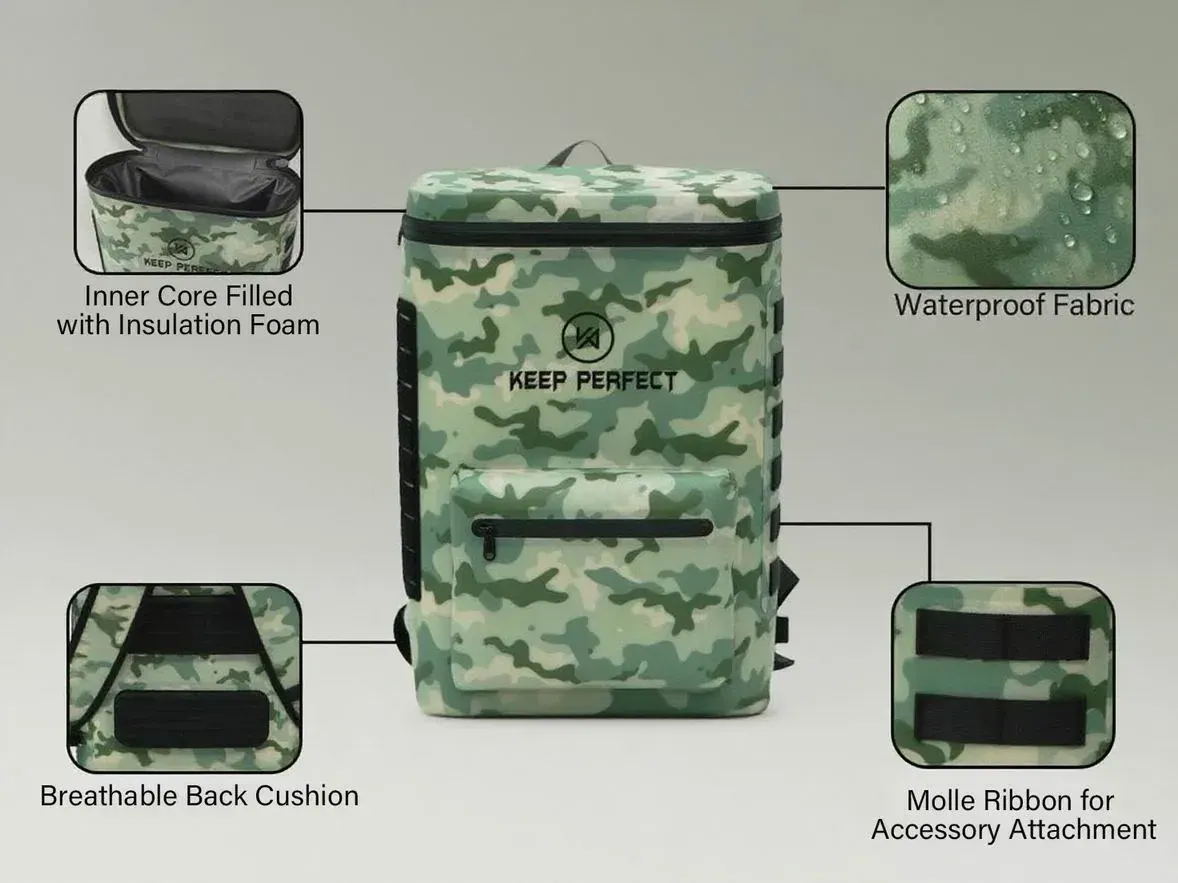
At 250 grams for 12 litres, this is the lightest pack that still holds a rating, achieved with a 210D ripstop at 0.18 millimetres of TPU and a single side buckle instead of a full harness. It takes a shell jacket, 1 litre of water and a phone, and nothing else, which is the point. The 210D shell passes 12,000 Martindale cycles with a lined base and fails without one, so the base panel is not optional. Unit cost is 9 to 13 USD at 1,000 pcs, which makes it the natural entry price point and the only pack in the field that works as a promotional SKU.
5. UL-20 Packable, Best for Travel
A silicone-treated 210D ripstop with no film at all, which is why it packs to 120 by 90 millimetres and weighs 280 grams. It holds IPX4, which covers a shower and a splash, and it is the pack that lives in a suitcase or a glovebox until it is needed. The trade is durability: a silicone-treated fabric has no film to delaminate but also no film to protect it, and repeated stuffing wears the creases. Unit cost is 11 to 15 USD, and it sells best as an add-on rather than as the main pack in a range.
Best for Load, Access and Water
The remaining four entries solve specific jobs, and each one spends its weight budget on something different. Two spend it on the harness, one on a zip, and one on immersion protection. None of them is the lightest in the field and all of them are the right answer for the buyer whose customer has a use case rather than a weight target.
| Model | Weight | Where the weight goes | Rating | Best for |
|---|---|---|---|---|
| UL-24 roll harness | 480 g | Padded hip belt and back panel | IPX5 | A full day at 8 kg |
| UL-28 light commute | 460 g | Suspended laptop sleeve | IPX5 | Commute with a 14 in device |
| UL-16 coated zip | 380 g | Covered coil zip and garage | IPX4 | Fast one-handed access |
| UL-18 submersible | 470 g | Welded body and purge valve | IPX7 | Kayak, raft, immersion |
4. UL-24 Roll Harness, Best for a Long Day
The heaviest pack in the ranking at 480 grams and the only one that stays comfortable at 8 kilograms, because 130 of those grams are a padded hip belt of 40 millimetres and a back panel with 6 millimetres of closed-cell foam. Above 6 kilograms a light shell without a belt puts all the load on the shoulders and the pack becomes tiring within two hours. It holds 24 litres at IPX5, costs 16 to 22 USD, and is the pack to specify when the daypack is expected to carry a full day of clothing rather than a jacket and a bottle.
8. UL-18 Submersible, Best for Water
A welded body rated IPX7 after 30 minutes at 1 metre under a 3 kilogram weight, at 470 grams, with a one-way purge valve and no secondary opening. It is the only pack here that survives going overboard, and it floats a 4 to 6 kilogram load when rolled with air inside, which is a recovery aid rather than a flotation device. The purge valve needs service every 12 to 24 months in salt water. Unit cost is 19 to 26 USD, and it belongs in any range sold near water, where the IPX7 claim is the one that gets read first.
7. UL-14 Sling Roll, Best One-Shoulder Option
A 14 litre sling at 330 grams with a single 60 millimetre strap, a welded body and a rolled mouth, rated IPX5. It swings to the front without being taken off, which is the whole point of the format, and it carries 4 to 6 kilograms before the asymmetry becomes uncomfortable. Above that load a two-strap pack is better, and the comparison is set out in the sling versus backpack fit guide. Unit cost is 12 to 16 USD.
The Fabric Mathematics of a Sub-500-Gram Pack
Weight in a light pack is almost entirely fabric area times coating weight, and understanding that is what makes a specification negotiable rather than a wish. A 20 litre pack has roughly 0.75 square metres of shell, a 0.20 millimetre TPU film weighs about 200 grams per square metre, and a 210D fabric weighs about 90 grams per square metre, so shell alone accounts for 215 grams before a single strap is added. The remaining budget for hardware, straps and seams at a 300 gram target is 85 grams, and that is why light packs have minimal organisation.
| Component | Typical weight | Share of a 350 g pack | Can it be cut? |
|---|---|---|---|
| Shell fabric and coating | 200 to 260 g | 60 to 74 percent | Only by lowering the rating |
| Seam welds and tape | 15 to 30 g | 4 to 9 percent | No, this is the failure point |
| Webbing and straps | 35 to 60 g | 10 to 17 percent | Slightly, with narrow webbing |
| Buckles and stiffener | 25 to 45 g | 7 to 13 percent | No, glove access depends on it |
| Pockets and organisation | 20 to 60 g | 6 to 17 percent | Yes, and it usually is |
The practical consequence is that the two honest ways to cut weight are to reduce volume and to remove organisation, and the two dishonest ways are to thin the coating and to narrow the welds. A specification that asks for 210D at IPX5 is asking for one of the dishonest cuts, because 210D at 0.18 millimetres of TPU reaches IPX4 and not much more. Buyers who want both light weight and a real rating should buy the 420D pack at 340 grams rather than the 210D pack at 250.
Abrasion is the other place where light packs lose, and it is measurable. A 210D shell reaches about 12,000 Martindale cycles to first break and a 420D shell reaches 25,000 to 30,000, so a light pack used daily on rough ground wears out at the base in one to two seasons where a heavier shell lasts four. A lined base panel of 420D weighing 25 to 40 grams moves that figure to three seasons and is the best value addition available in this class. The measurement in service terms is explained in the hydrostatic head guide.
Care and the Realistic Service Life
A sub-500-gram pack needs more care than a heavy one and repays it less, which is a fair trade at 9 to 23 USD per unit. The two rules that matter are to keep it out of the washing machine until it genuinely needs it and to dry it open rather than closed. A 0.18 to 0.28 millimetre film is thin enough that abrasion from grit inside the pack is a real wear mechanism, so a light pack should be emptied and shaken out rather than left with sand in the bottom.
| Task | How | Interval | Never |
|---|---|---|---|
| Empty and shake out | Invert, shake, brush the base | After every use | Leave grit in the base |
| Rinse | Fresh water, 20 to 30 s | Every 5 to 10 uses | Solvents or hot water above 40 degrees |
| Machine wash | 30 degrees, no spin above 600 | Every 20 to 30 uses | Fabric softener, which kills the finish |
| Dry | Open, invert, 20 to 25 degrees | 6 to 12 hours | Radiator or tumble dryer |
| Re-proof | Spray, low heat | Every 20 to 30 uses | Apply to a dirty pack |
| Retire | Seam lift over 10 mm or chalking film | Check monthly | Patch a delaminated coating |
Service life should be stated honestly at the point of sale: two to three seasons of regular use for a 420D light pack, and one to two for a 210D one. That is not a defect, it is what the weight buys, and programmes that set the expectation on the hangtag see markedly fewer complaints than those that do not. Repairability follows the coating: a welded TPU shell can be patched for another season, as described in the seam repair guide, while a delaminated PU coating cannot be repaired at all.
How to Choose Between the Ten
Six questions settle the choice in about two minutes, and they are worth asking in this order because the first two eliminate half the field immediately. The answers map cleanly onto the ranking, and where a buyer is building a range rather than picking one pack, the usual answer is three of the ten rather than one.
- Is the rating or the weight the thing the customer reads first? If it is the rating, take the UL-22 at IPX6; if it is the weight, take the UL-12 at 250 grams.
- Will the pack carry more than 6 kilograms? If yes, take the UL-24 with a padded belt and accept 480 grams; a light shell without a belt is tiring within two hours at that load.
- Does the customer need access twenty times a day? If yes, take the UL-16 with a covered zip and accept IPX4 rather than unrolling a collar each time.
- Will it go near water, a boat or a kayak hatch? If yes, take the UL-18 submersible at IPX7, and budget for a purge valve service interval of 12 to 24 months.
- Does it have to pack into luggage? If yes, take the UL-20 packable at 280 grams and warn the customer about crease wear.
- Is it the entry price point in a range? If yes, take the UL-12 at 9 to 13 USD, which is the only pack in the field that works as a promotional SKU.
Aquagrip builds all ten configurations in this class: 210D and 420D shells, welded seams inspected at AQL 2.5, 500 pcs per design and colour, samples in 6 to 10 working days, bulk in 35 to 50 days, FOB Xiamen or DDP to more than 100 countries. Programme records, test coupons and the inspection archive are held. The shell and closure families behind every entry are described in the best waterproof backpacks ranking, and sizing by volume band is set out in the size and capacity guide.
People Also Ask
What is the lightest waterproof daypack that still has a real rating?
The UL-12 mini roll at 250 grams for 12 litres, rated IPX4 with a 210D ripstop at 0.18 mm TPU. For IPX5 the floor is 340 grams, because 210D at 0.18 mm cannot carry the coating needed for a higher rating.
Does a lighter waterproof pack mean a lower waterproof rating?
Almost always. Weight and rating trade linearly below 500 grams because the coating carries the rating and the coating carries the weight. Every 50 grams saved below 400 costs roughly one IPX step.
How much can a sub-500-gram daypack carry?
6 to 8 kilograms with a webbing hip belt, and up to 9 kilograms on the UL-24 with a padded belt. Above 6 kilograms a light shell without a belt puts the whole load on the shoulders and becomes tiring within two hours.
Are 210D shells durable enough for daily use?
For one to two seasons, against three or four for 420D. A 210D shell reaches about 12,000 Martindale cycles to first break and needs a lined 420D base panel, which adds 25 to 40 grams and moves service life to about three seasons.
Can a lightweight pack be fully waterproof rather than water resistant?
Yes, if the body is welded and has no secondary opening. The UL-18 submersible reaches IPX7 at 470 grams with a welded body and a purge valve, and the UL-22 reaches IPX6 at 420 grams.
How do I wash a lightweight waterproof daypack?
Rinse with fresh water every 5 to 10 uses and machine wash at 30 degrees with no spin above 600 every 20 to 30 uses. Never use fabric softener, which destroys the water repellent finish, and never tumble dry.
Frequently Asked Questions
Q1. What is a good weight for a waterproof daypack?
250 to 330 grams for 12 to 16 litres at IPX4, 340 to 420 grams for 18 to 22 litres at IPX5, and 430 to 480 grams for a welded body at IPX6 or IPX7 with a real hip belt. Below 300 grams a full coating cannot be carried.
Q2. Why is a 210D shell cheaper than a 420D shell?
Because it uses less yarn and less coating per square metre. A 210D fabric at 0.18 mm TPU costs 9 to 13 USD per unit against 12 to 16 for a 420D laminate at 1,000 pcs, and the saving shows up as one IPX step and half the abrasion life.
Q3. Does IPX4 mean the pack is not waterproof?
IPX4 means protection against splashing water from any direction, which covers a shower and a splash and not a sustained downpour. It is the honest ceiling for a pack below 300 grams, and it should be stated that way on the hangtag.
Q4. Which light pack holds the highest rating?
The UL-18 submersible at IPX7, tested for 30 minutes at 1 metre under a 3 kg weight, at 470 grams. Next is the UL-22 dry-bag shell at IPX6 and 420 grams. Both are welded bodies with a rolled mouth and no secondary opening.
Q5. Do lightweight packs need a hip belt?
Yes above 6 kilograms. A webbing strap is enough to 6 kilograms; above that a padded belt of 40 millimetres is the difference between comfort and a pack that is carried by its top handle after two hours.
Q6. How small can a packable waterproof daypack fold?
About 120 by 90 millimetres for the UL-20 packable at 280 grams, and 180 by 120 millimetres for a welded 420D shell rolled down. The packable wins on size and loses on durability, because repeated stuffing wears the creases.
Q7. Can a welded seam on a light pack be repaired?
Yes, if the shell is TPU. A welded patch or solvent-free TPU tape holds for another season. A delaminated PU coating cannot be repaired, which is why the coating choice also determines whether a repair path exists.
Q8. How long does a sub-500-gram pack last?
Two to three seasons of regular use for a 420D shell and one to two for a 210D one, with a lined base panel adding roughly a season in both cases. Setting that expectation on the hangtag measurably reduces complaints.
Q9. What is the MOQ and lead time for a lightweight programme?
500 pcs per design and colour, samples in 6 to 10 working days and bulk in 35 to 50 days. A welded body with a purge valve adds four to six working days to sampling, and seam peel testing should be booked before the bulk run.
Q10. Is a sling or a two-strap pack better under 500 grams?
A sling is better for 4 to 6 kilograms and frequent access, because it swings to the front without being taken off. Two straps are better above 6 kilograms, where the asymmetry of a single strap becomes uncomfortable within an hour.
Q11. How much does a lined base panel add?
25 to 40 grams and roughly 1 USD, and it moves abrasion life from 12,000 cycles to about 25,000 on a 210D shell. It is the best value addition available in this weight class and should not be value-engineered out.
Q12. Can a light pack be submersible without an airtight zip?
Yes. A welded body with a rolled mouth and no secondary opening reaches IPX7, as the UL-18 submersible does at 470 grams. An airtight zip adds fast access but also 60 to 90 grams, a maintenance interval and 18 to 26 USD per unit.