The best waterproof backpack in 2026 is the 35 L welded roll-body at IPX6: it survives the 100 L per minute jet test, weighs 980 g empty, takes a 15.6 in laptop in a suspended sleeve and lands at a unit cost of 21 to 28 US dollars at 1,000 pcs FOB Xiamen. Nine packs earned a place in this ranking out of 31 styles put through the same seven-test protocol, and they split cleanly by job: 22 to 35 L for hiking and commuting, 40 to 45 L for travel, and welded IPX7 bodies for anything that goes in the water. Every style in the list opens at 500 pcs per design and colourway, samples in 6 to 10 working days and ships in 35 to 50 days.
How These Packs Were Tested and Ranked
Thirty-one styles were put through the same seven-test protocol, and nine passed every stage. The protocol is deliberately weighted toward the failures that actually generate returns: seam lift at the base corners, zip weep after a season of cycling, and harness failure under load. Nothing in the ranking rests on a laboratory ceiling; a pack that reaches IPX8 in the tank but needs lubrication after 300 cycles loses points to a pack that reaches IPX6 and keeps reaching it for three years.
| Test | Condition | Pass criterion | What it eliminates |
|---|---|---|---|
| Jet test | 12.5 L/min then 100 L/min, 3 min | No moisture on indicator paper | Stitched zips and short roll folds |
| Immersion | 30 min at 1 m, 5 kg weight | Interior dry | Coated zips sold as submersible |
| Air decay | 3 kPa held 3 min on sealed body | Under 10 percent loss | Lifting welds before they leak |
| Seam peel | Tensile pull on welded coupon | At least 90 percent of fabric | Under-power welds from tooling drift |
| Abrasion | Martindale, ISO 12947-2 | 25,000 cycles to first break | Light denier shells on base panels |
| Cold flex | Fold and zip at -20 degrees C | No cracking or stiffness | PVC shells for winter markets |
| Load walk | 12 kg over 15 km, three testers | No strap slip or seam creak | Harness geometry that only works empty |
Ranking weight is 40 percent on sealing, 25 percent on carry comfort at load, 20 percent on durability and 15 percent on cost per unit at 1,000 pcs. That weighting is why a 22 L pack at 720 g can outrank a 55 L expedition pack: the smaller pack does its stated job perfectly, while the large one is a compromise on three axes. Buyers with a different weighting should read the detail notes rather than the rank order.
The shell and closure families behind every entry are described in our waterproof backpack specification guide, and the rating scale used throughout is the one defined in the IEC 60529 ingress protection standard. Abrasion and colour fastness methods follow the test methods maintained by AATCC, with grade 4 at 20 hours the acceptance line.
The Ranking at a Glance
| Rank and model | Volume and rating | Empty weight | Unit cost at 1,000 pcs | Best for |
|---|---|---|---|---|
| 1. AG-35 welded roll | 35 L, IPX6 | 980 g | 21-28 USD | Everything, one-pack answer |
| 2. AG-28 commute zip | 28 L, IPX5 | 1,150 g | 24-31 USD | Daily commute with laptop |
| 3. AG-45 travel roll | 45 L, IPX5-IPX6 | 1,350 g | 27-35 USD | Carry-on travel |
| 4. AG-40 submersible | 40 L, IPX7 | 1,450 g | 31-42 USD | Kayak, raft, immersion |
| 5. AG-22 light daypack | 22 L, IPX5 | 720 g | 14-19 USD | Day hiking, fast travel |
| 6. AG-30 airtight zip | 30 L, IPX8 | 1,480 g | 46-62 USD | Camera and dive support |
| 7. AG-55 expedition flap | 55 L, IPX5 | 1,850 g | 33-44 USD | Multi-day trekking |
| 8. AG-60 marine dry pack | 60 L, IPX7 | 1,750 g | 36-47 USD | Deck work, paddle camping |
| 9. AG-18 mini roll | 18 L, IPX5 | 520 g | 11-15 USD | Budget and kids ranges |
Three observations make the table easier to use. Cost scales with rating far more steeply than with volume: going from IPX6 to IPX8 adds 25 to 34 dollars per unit, while going from 35 L to 55 L adds 12 to 16. Weight does not track volume either, because the 30 L airtight pack at 1,480 g is heavier than the 45 L travel pack at 1,350 g. And the 18 L mini roll at 11 to 15 dollars is the only entry that makes sense as a promotional or entry-price SKU.
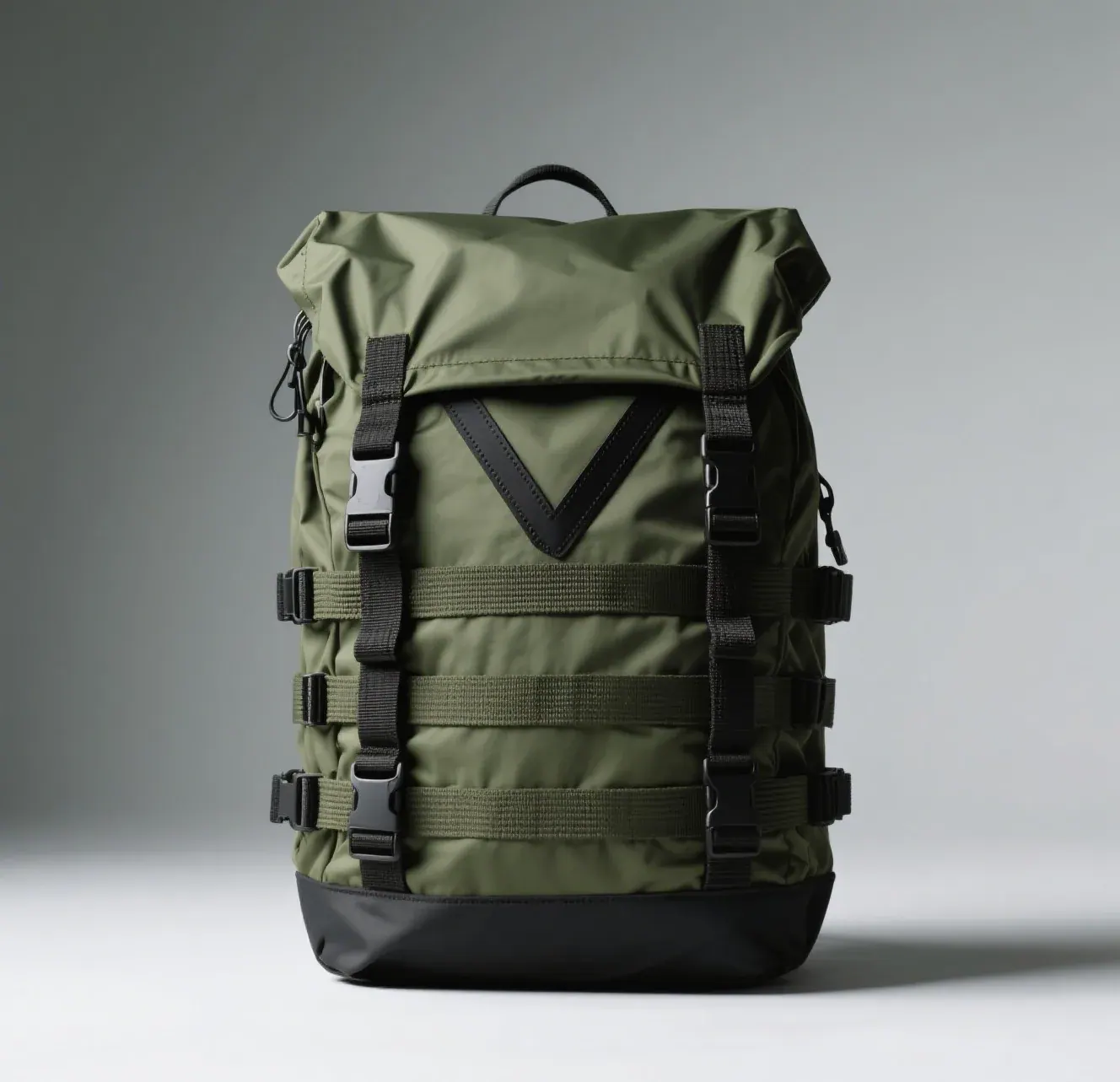
Best for Hiking and Day Use
Day use is where the weight of the pack itself starts to matter more than the rating. A 22 L pack at 720 g disappears on the back and still takes a shell jacket, two litres of water and lunch; a 35 L pack at 980 g covers a full day plus a change of clothes. Both need IPX5 as a floor, and both should have a hip belt rather than a webbing strap once the load passes 8 kg.
1. AG-35 Welded Roll, Best Overall
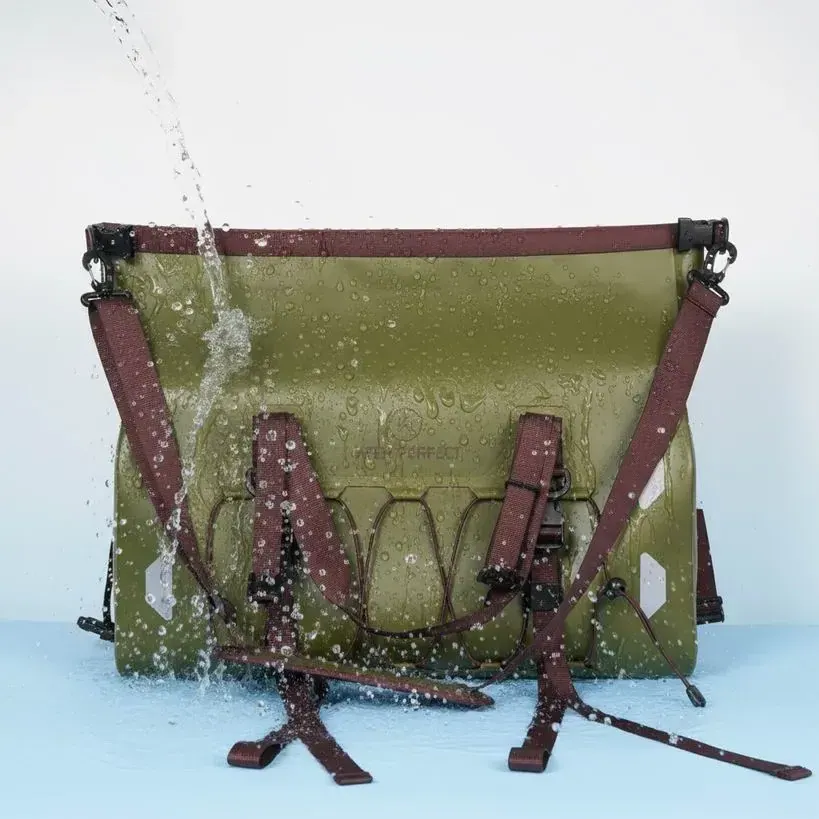
The 35 L welded roll body took the top slot because it is the only style in the field that passed the 100 L per minute jet test, carried 12 kg for 15 km without strap slip, and still weighs 980 g empty. The shell is 500D polyester laminated with 0.35 mm TPU at 5,000 mm hydrostatic head, welded at 27.12 MHz with 22 mm seams, and the mouth rolls three turns onto a 1.6 mm HDPE stiffener. Volume is honest: 35 L of bead fill, about 30 L of rigid cargo, 10 kg usable. Unit cost at 1,000 pcs is 21 to 28 dollars FOB Xiamen, which puts it at a 79 to 99 dollar retail band with room for margin.
5. AG-22 Light Daypack, Best Lightweight
At 720 g for 22 L, this is the lightest pack in the ranking that still holds IPX5, achieved with a 420D TPU laminate at 4,000 mm and a single side-buckle roll mouth with no front zip. The saving comes at the cost of organisation: one main cavity, one lid pocket, no laptop bay. It carries 6 to 8 kg comfortably and is the right answer for trail running, fast day hikes and any programme where the hangtag weight figure is the first thing a customer reads. Unit cost is 14 to 19 dollars at 1,000 pcs.
7. AG-55 Expedition Flap, Best for Multi-Day
The 55 L flap pack is the only entry built around a storm skirt rather than a roll mouth, because above 50 L a roll becomes awkward to close when the pack is full. It holds IPX5, carries 16 to 20 kg with a frame sheet and load lifters, and has a sleeping bag compartment with a divider that doubles as a wet gear bay. At 1,850 g it is heavy for a day and correct for a four to seven day trip. Unit cost is 33 to 44 dollars, and the moulded back panel adds about four working days to sampling.
Best for Water, Immersion and Marine Use
Anything that can go overboard needs IPX7 and preferably positive buoyancy. Two entries qualify, and both share the same construction rule: no external zip, a welded body, and a rolled mouth closed before the pack leaves the deck. Neither should be treated as a flotation device, but a sealed body with trapped air will keep a load on the surface long enough to be recovered, which a framed commuter pack will not.
4. AG-40 Submersible, Best for Water
A welded body with a one-way purge valve and no secondary opening, rated IPX7 after 30 minutes at 1 m under a 5 kg weight. The purge valve lets the user squeeze out trapped air so the pack compresses to about 60 percent of packed height and fits a kayak hatch, and it needs service every 12 to 24 months in salt water. It carries 13 kg with a removable harness and floats a 6 to 8 kg load when rolled with air inside. Unit cost is 31 to 42 dollars at 1,000 pcs.
8. AG-60 Marine Dry Pack, Best for Deck Work
The 60 L marine pack is the volume answer for paddle camping and deck work: 1,750 g empty, IPX7, 840D shell at 8,000 mm for abrasion against a deck or a raft frame, and six 20 mm daisy chains for lashing. The lid carries a closed-cell foam panel giving 2 to 4 kg of positive lift, which is the only buoyancy feature in the ranking. Salt-air hardware is acetal throughout with no metal contact points. Unit cost is 36 to 47 dollars at 1,000 pcs, and it packs 8 per carton rather than 10 because of the volume.
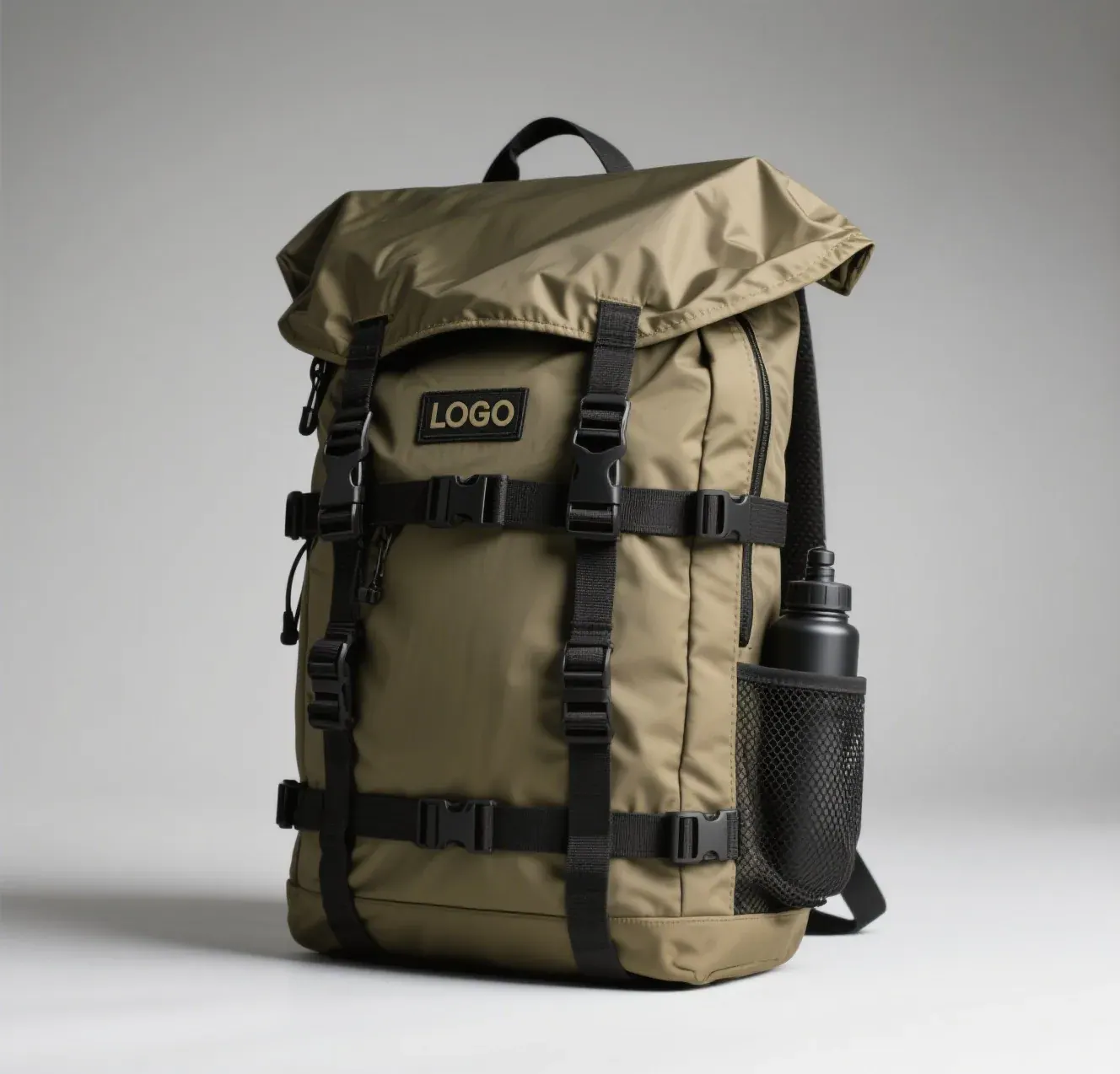
Best for Travel, Commute and Laptop Carry
Travel and commute programmes flip the priority from rating to access. The pack is opened twenty to forty times a day, usually one-handed, and it has to accept a laptop in a flat bay, so the roll mouth moves to the main compartment and a coated front zip handles everything else. IPX5 is the right target: it covers a ten-minute walk in heavy rain, which is the realistic worst case, and it keeps cost at 24 to 35 dollars.
2. AG-28 Commute Zip, Best for Daily Carry
A 28 L roll body with a coated front zip into the lower compartment, giving 1 to 2 second access to a phone or a wallet without unrolling the main mouth. The suspended laptop bay measures 380 by 265 mm with 20 mm clearance under the sleeve, so a 15.6 in device never rests on the base seam. It holds IPX5 on the jet test and weeps slightly at the zip tape after about 1,500 cycles, which is the normal service point for a coated zip. At 1,150 g and 24 to 31 dollars it is the volume anchor of most commute ranges.
3. AG-45 Travel Roll, Best Carry-On
Sized at 56 by 34 by 24 cm at the fill line, the 45 L travel roll fits most international carry-on sizers when the collar is not extended, and it is the only pack in the ranking that lays flat for security screening. It holds IPX5 rolled and IPX6 with the top compression strap engaged, carries 10 to 13 kg, and has a lay-flat laptop bay plus a wet compartment for a swimsuit or a wash kit. Unit cost is 27 to 35 dollars at 1,000 pcs, and the lay-flat bay is the single feature that drives its repeat order rate.
6. AG-30 Airtight Zip, Best for Camera and Dive Support
The most expensive entry at 46 to 62 dollars, and the only one rated IPX8, tested at 3 m for 60 minutes in static water. An airtight zip gives 2 to 4 second access with a full immersion rating, which nothing else in the field does, and the pack carries padded dividers for a camera body plus two lenses. The trade is maintenance: the zip needs rinsing and lubrication every 300 to 800 cycles and will not seal if grit is on the teeth. Buyers should ship it with a care card and a small tube of lubricant.
Budget and Entry Price Points
Two entries serve the price-driven end of the market, and both are 18 to 22 L with a plain rolled mouth and no secondary opening. The saving is entirely hardware and pocket count: the shell and the welding are identical to the packs ranking above them, so the rating holds at IPX5 and the warranty picture is unchanged. What the buyer gives up is organisation and, in the 18 L case, about 2 L of usable volume.
9. AG-18 Mini Roll, Best Budget
At 11 to 15 dollars per unit and 520 g empty, the 18 L mini roll is the entry SKU for promotional ranges, kids ranges and impulse displays. It uses a 420D shell at 4,000 mm, a single side buckle and one lid pocket, and it holds IPX5 rolled three turns. The mouth is 240 mm wide, which is too narrow for a laptop but fine for a tablet, a shell jacket and a water bottle. Packs 20 per carton, which halves freight cost per unit against the 10 per carton used for 35 L bodies.
| Price band | Unit cost at 1,000 pcs | What the money buys | Typical retail |
|---|---|---|---|
| Entry | 11-19 USD | 420D shell, roll mouth, one pocket | 39-59 USD |
| Mid | 21-31 USD | 500D shell, laptop bay, front zip | 79-119 USD |
| Upper mid | 31-44 USD | Welded IPX7 body or expedition harness | 119-169 USD |
| Premium | 46-62 USD | Airtight hardware, IPX8, dividers | 189-259 USD |
The retail column assumes a 3.2 to 3.8 times markup, which is the observed range for outdoor specialty retail in this category. Programmes aiming at a specific price point should work backwards from it: a 99 dollar retail target means a unit cost ceiling near 28 dollars, which lands the buyer in the mid band with a 500D shell and a laptop bay but no airtight hardware.
How to Read This Ranking Against Your Brief
Rank order is a starting point, not a decision. A buyer specifying for a kayak retailer should ignore ranks 1, 2 and 3 entirely and choose between 4 and 8 on volume and buoyancy; a buyer specifying for a corporate gift programme should ignore everything except 5 and 9 on cost. The matrix below restates the nine entries against the four briefs that generate most enquiries, and it is the fastest way to cut the list to two styles before sampling.
| Brief | Shortlist | Rating needed | Why |
|---|---|---|---|
| Outdoor retail, general | AG-35, AG-22, AG-55 | IPX5-IPX6 | Covers day, fast and multi-day |
| Commute and corporate | AG-28, AG-45 | IPX5 | Laptop bay and access speed |
| Marine and paddle | AG-40, AG-60 | IPX7 | Immersion and buoyancy |
| Camera and technical | AG-30 | IPX8 | Airtight access with immersion |
| Promotional and entry | AG-18, AG-22 | IPX5 | Carton efficiency and price |
Two further constraints usually settle the final choice. Carton efficiency decides freight: 18 L bodies pack 20 per carton against 10 for 35 L and 8 for 60 L, so an entry programme ships about 2,800 pieces per 20 ft container against roughly 1,500 for mid-volume bodies. Colourway count decides unit cost: a second colourway adds 3 to 5 percent at 1,000 pcs but can be absorbed at 3,000 pcs and above. Full decision criteria are set out in our waterproof backpack buyer checklist, and the narrower lists live in the hiking guide and the sub-30 litre shortlist.
Ordering Any Style in This Ranking
Every style in the list opens at 500 pcs per design and colourway, and the bands below apply to all nine. Sample timing is the variable that changes most between them: a plain roll body samples in 6 to 8 working days, while a moulded back panel or an airtight zip adds three to four days for tooling and hardware setting. Buyers planning a Q3 outdoor delivery should confirm by January and a spring marine delivery by October.
| Order band | Unit price index | Sample lead time | Bulk lead time | Notes |
|---|---|---|---|---|
| 500-999 pcs | 1.00 | 6-10 working days | 35-40 days | One colourway, stock shell |
| 1,000-2,999 pcs | 0.93 | 6-10 working days | 38-45 days | Up to two colourways |
| 3,000-9,999 pcs | 0.86 | 7-10 working days | 40-50 days | Pantone-matched webbing, printed liner |
| 10,000+ pcs | 0.79 | 8-10 working days | 45-50 days | Dedicated material run, branded hardware |
- The opening quantity is 500 pcs for each design and colourway; mixed colours can be consolidated from 3,000 pcs.
- Samples take 6 to 10 working days and bulk runs 35 to 50 days, shipped FOB Xiamen or DDP into more than 100 countries.
- Every bulk order is inspected at AQL 2.5 before release, and the signed report travels with the packing list.
- REACH and California Prop 65 screening is included in every quotation; PFAS-free face finishes are available.
- A four-line brief starts a quotation: model or volume band, rating target, quantity and destination market.
Buyers who want to see how all nine styles are assembled alongside fishing and EVA programmes can read the production programme. Send the model reference or the volume band, the rating target and the quantity to service@junyuanbags.com and a quotation with a price band and a sampling date comes back on the same working day.
People Also Ask
What is the best waterproof backpack overall?
A 35 L welded roll body rated IPX6 at 980 g empty, because it is the only configuration that passes the 100 L per minute jet test, carries 12 kg for 15 km and still fits a 15.6 in laptop. Unit cost at 1,000 pcs is 21 to 28 dollars FOB Xiamen, which supports a 79 to 99 dollar retail band.
How much should a good waterproof backpack cost?
For a buyer, 11 to 62 dollars per unit at 1,000 pcs depending on rating, against a retail band of 39 to 259 dollars. Cost tracks rating far more steeply than volume: moving from IPX6 to IPX8 adds 25 to 34 dollars, while moving from 35 L to 55 L adds 12 to 16.
Which waterproof backpack is best for commuting with a laptop?
A 28 L roll body with a coated front zip and a suspended bay of 380 by 265 mm with 20 mm clearance under the sleeve. It holds IPX5, opens in 1 to 2 seconds and costs 24 to 31 dollars at 1,000 pcs. Check the zip tape after about 1,500 cycles, which is the normal service point.
Do any waterproof backpacks actually survive being submerged?
Yes, welded bodies with a purge valve and no external zip, rated IPX7 for 30 minutes at 1 m, and airtight-zip packs rated IPX8 at 3 m for 60 minutes. A coated-zip travel pack is rainproof at IPX5 and will wet out if it goes under.
What is the lightest waterproof backpack worth buying?
A 22 L pack at 720 g with a 420D TPU laminate and a side-buckle roll mouth, holding IPX5. Below about 500 g the shell drops to 210D and the rating falls to IPX3 or IPX4, which is fine for drizzle and not for rain.
Are expensive waterproof backpacks worth the money?
Only if the exposure justifies it. An IPX8 airtight-zip pack at 46 to 62 dollars is worth it for camera and dive support, and wasted on a city commute where an IPX5 pack at 24 to 31 dollars does the same job with less maintenance.
Frequently Asked Questions
Q1. What makes a waterproof backpack genuinely waterproof?
A tested rating under IEC 60529 combined with a closure that matches the body. A welded shell at 5,000 mm hydrostatic head with a roll mouth closed three turns reaches IPX5 or IPX6; the same shell with a stitched zip stops at IPX3 or IPX4, because the needle holes leak regardless of the fabric.
Q2. Which IPX rating should I buy?
IPX5 for hiking, travel and commuting, which covers heavy rain and boat spray. IPX6 for motorcycle and deck work where a 100 L per minute jet is realistic. IPX7 or IPX8 only for packs meant to be submerged, since sealed hardware adds 25 to 34 dollars per unit at 1,000 pcs.
Q3. What size waterproof backpack is most useful?
35 L covers the widest range of uses at 10 kg usable and 980 g empty. Below 22 L the pack cannot take a laptop or a full day of layers; above 45 L it stops being a day pack and starts competing with travel luggage.
Q4. How much does a waterproof backpack weigh?
Between 520 g for an 18 L entry pack and 1,850 g for a 55 L expedition pack. At 35 L expect 850 to 1,100 g, roughly 150 to 350 g more than an uncoated pack of the same volume, with the penalty split between the laminated shell and the seam construction.
Q5. Can a waterproof backpack carry a 15.6 inch laptop?
Yes, from 25 L upward, provided the pack has a suspended bay measuring about 380 by 265 mm with 20 mm of clearance under the sleeve. Below 22 L the mouth is usually under 300 mm wide and the back panel is too curved to give a flat bay.
Q6. Do waterproof backpacks float if they go overboard?
Only marine designs. A sealed 40 L body with trapped air floats a 6 to 8 kg load, and packs with closed-cell foam lid panels add 2 to 4 kg of positive lift. A 12 kg framed commuter pack sinks within 60 to 90 seconds as the air escapes.
Q7. How long does a waterproof backpack last?
Five to eight years of seasonal use for a TPU-laminated shell stored dry and out of direct sun. The wear items are the zip tape at 1,500 cycles for coated zips, 300 to 800 cycles for airtight zips, and the mouth stiffener at roughly 3,000 folds.
Q8. What is the difference between IPX5 and IPX7 in practice?
IPX5 survives a 12.5 L per minute jet from any direction for three minutes, which is heavy rain and boat spray. IPX7 survives 30 minutes at 1 m of immersion, which means the pack can go under. IPX7 costs about 40 percent more because it needs a welded body and sealed hardware.
Q9. Are airtight zips better than roll-top closures?
For access and immersion, yes: 2 to 4 seconds to open and IPX8 instead of IPX6. For durability and cost, no: airtight zips need rinsing and lubrication every 300 to 800 cycles and add about 25 dollars per unit, while a roll mouth has no wear mechanism at all.
Q10. Can waterproof backpacks be made without PFAS chemistry?
Yes. PFAS-free durable water repellent on the face fabric combined with a TPU film barrier reaches the same hydrostatic head in testing, and it is the default for EU-bound programmes. State the requirement in the tech pack so the correct finish is quoted from the start.
Q11. What is the MOQ for these packs?
MOQ is 500 pcs per design and colourway, set by material minimums for film, webbing and hardware rather than by assembly capacity. Consolidating three colours into one run from 3,000 pcs is usually cheaper per piece than three separate 500 pc drops.
Q12. How long do samples and bulk take?
Samples take 6 to 10 working days, with moulded back panels and airtight hardware at the longer end because tooling has to be cut first. Bulk runs 35 to 50 days depending on order band and colourway count, shipped FOB Xiamen or DDP into more than 100 countries.
Q13. Which pack is best for kayaking?
A 40 L welded body with a purge valve at IPX7, because it compresses to about 60 percent of packed height to fit a hatch and floats when rolled with air inside. A 60 L marine pack with a foam lid panel is the choice for paddle camping where buoyancy matters.
Q14. Which pack is best for air travel?
A 45 L travel roll sized at 56 by 34 by 24 cm at the fill line, which fits most international carry-on sizers when the collar is not extended and lays flat for security screening. It holds IPX5 rolled and IPX6 with the top compression strap engaged.
Q15. How are the packs packed and shipped?
One piece per polybag, 20 per carton for 18 L bodies, 10 for 35 L and 8 for 60 L, with cartons near 60 by 40 by 35 cm and gross weight under 15 kg. A 20 ft container takes roughly 1,500 pieces of 35 L bodies or about 2,800 of 18 L bodies.
Q16. Can these packs be branded for a retail range?
Yes. Pantone-matched webbing and buckles are available from 3,000 pcs, printed liners and branded hardware from 10,000 pcs, and a woven label or rubber patch can be added from 500 pcs. Send volume, rating target and quantity to service@junyuanbags.com for a quotation.