Choose a waterproof backpack by deciding nine things in a fixed order, starting with exposure rather than features: pick the IPX rating the activity needs under IEC 60529, then volume in litres and kilograms, then closure type, shell and seam, harness, features, compliance, landed cost and finally quality-control sign-off. For most programmes the answers converge on a 28 to 35 L body at IPX5 or IPX6, a 500D TPU-laminated shell at 5,000 mm hydrostatic head, a roll mouth or a coated front zip, and a padded hip belt above 8 kg. Programmes open at 500 pcs per design and colourway, sample in 6 to 10 working days and ship in 35 to 50 days from FOB Xiamen, with a landed cost roughly 15 to 25 percent above the quoted unit price once freight, duty and inspection are included.
The Nine-Point Checklist in One Table
Most buying mistakes come from deciding in the wrong order. Buyers start with features and price, discover late that the closure cannot reach the rating they assumed, and then re-sample. The order below fixes that: exposure sets the rating, the rating sets the closure, and only then do volume, fabric and features get decided. Work down the table and every later decision has a constraint to respect.
| Order | Decision | How to choose | What to write in the spec |
|---|---|---|---|
| 1 | Exposure and rating | Rain needs IPX5, deck wash IPX6, immersion IPX7 | Rating under IEC 60529, with test method named |
| 2 | Volume and load | Litres plus kilograms usable, not litres alone | Nominal volume, fill-line height, usable load in kg |
| 3 | Closure type | Rating ceiling plus how often it is opened | Roll turns and fold depth, or zip type and cycle life |
| 4 | Shell and seam | Abrasion and low-temperature limit | Denier, film thickness, hydrostatic head, seam width |
| 5 | Harness and fit | Load above 8 kg needs a padded hip belt | Belt foam thickness, load transfer percentage |
| 6 | Features | Only those that survive a cost-benefit check | Laptop bay size, pocket count, lash point count |
| 7 | Compliance | Destination market rules | REACH, Prop 65, PFAS-free finish requirement |
| 8 | Landed cost | Unit price plus freight, duty and inspection | Incoterm, target landed cost per unit, carton count |
| 9 | Quality control | Sampling level and acceptance criteria | AQL 2.5, retained samples, sign-off documents |
The table is deliberately short on numbers because the sections below supply them, but note what is in the right-hand column: every line converts into something a tech pack can state and a laboratory can test. A specification that cannot be tested is a preference, and preferences are what cause disputes nine months later when a claim arrives.
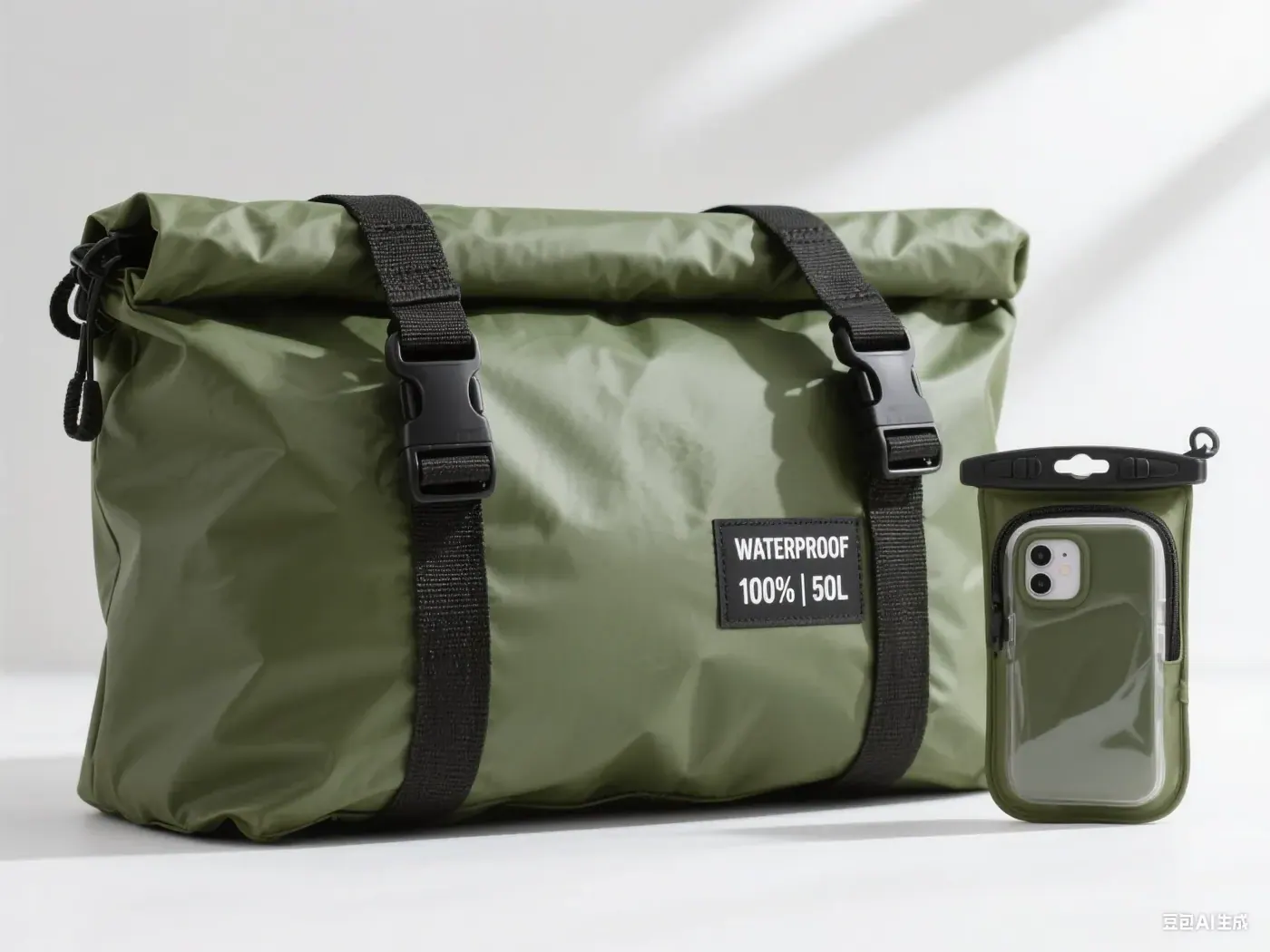
For buyers who want to skip to a shortlist, the ranked comparison is in our guide to the best waterproof backpacks. For the rating scale itself, IEC 60529 defines each level, and our IPX rating guide translates each one into field exposure.
Step 1: Define the Exposure Before the Rating
The rating is not a quality grade, it is a description of what the pack was tested against, so the first question is what the pack will actually meet. A commuter walking ten minutes in heavy rain needs IPX5 and nothing more; a kayak angler whose pack sits in a hatch and may go overboard needs IPX7. Specifying IPX8 for the commuter adds 25 to 34 dollars per unit and a lubrication routine the end user will never follow.
| Real exposure | Rating to specify | Closure this implies | Cost consequence |
|---|---|---|---|
| Drizzle and light shower | IPX3-IPX4 | Coated shell with storm flap | Baseline |
| Heavy rain, urban walk | IPX5 | Roll mouth or coated zip | Plus 6-9 USD per unit |
| Sustained storm, motorcycle | IPX6 | Welded body, roll mouth | Plus 9-14 USD per unit |
| Hatch storage, may go overboard | IPX7 | Welded body, purge valve | Plus 14-21 USD per unit |
| Canyoning, dive support | IPX8 | Airtight zip, welded body | Plus 25-34 USD per unit |
Two caveats keep this step honest. First, a rating applies to the assembled pack with the closure shut as designed, which is why a shell rated at 10,000 mm hydrostatic head can still produce an IPX4 pack if the zip is coated rather than sealed. Second, immersion ratings are tested in static water at a stated depth and duration; they say nothing about current, pressure change or impact, so an IPX8 pack protects gear in transit rather than in the water column.
Step 2: Volume in Litres and Load in Kilograms
Litres alone cause more sizing complaints than any other specification, because litre figures are derived from bead-filling the body and rigid cargo does not behave like beads. State two numbers: nominal volume and usable load in kilograms. A 30 L pack holds 30 L of clothing at about 7 kg and roughly 22 L of camera bodies or tackle trays at the same weight, and the difference is dead corners.
| Use | Volume | Usable load | Packed size at fill line | Empty weight |
|---|---|---|---|---|
| Half day, city | 18 L | 4-6 kg | 42 x 26 x 16 cm | 480-700 g |
| Full day hiking | 25-30 L | 6-9 kg | 48 x 29 x 18 cm | 720-1,100 g |
| Overnight, 1-2 days | 32-35 L | 8-10 kg | 52 x 31 x 20 cm | 850-1,300 g |
| Carry-on travel | 40-45 L | 10-13 kg | 56 x 34 x 24 cm | 1,200-1,450 g |
| Multi-day trek | 50-60 L | 13-20 kg | 62 x 36 x 26 cm | 1,700-1,900 g |
| Expedition, marine | 60-70 L | 16-22 kg | 70 x 38 x 30 cm | 1,750-2,400 g |
For a roll-top body the fill-line height matters as much as the litre figure, because a pack filled to within 40 mm of the top cannot make three turns and the rating drops two levels. Ask for the collar extension to be specified and for a fill line to be printed inside the body. Detailed packing geometry is covered in our waterproof backpack size and capacity guide, and volume selection by activity in how to choose the right volume.
Step 3: Choose the Closure Against Access Frequency
The closure is the decision that caps everything else, so it belongs early in the checklist. The trade is always between rating and access speed: a folded mouth has no wear mechanism and costs the least, while an airtight zip opens in two seconds and holds IPX8 at two and a half times the cost. Count how many times a day the pack will be opened and the answer usually selects itself.
| Closure | Rating ceiling | Access time | Service requirement | Cost index |
|---|---|---|---|---|
| Roll mouth, side buckles | IPX6 | 4-7 s | Stiffener at 3,000 folds | 1.00 |
| Roll mouth plus front zip | IPX5-IPX6 | 1-2 s | Zip tape at 1,500 cycles | 1.30 |
| Coated laminated zip only | IPX4-IPX5 | 1-2 s | Laminate wear from 1,500 cycles | 1.35 |
| Welded body, purge valve | IPX7 | 6-9 s | Valve service 12-24 months | 1.60 |
| Airtight zip | IPX8 | 2-4 s | Rinse and lubricate every 300-800 cycles | 2.40 |
| Storm flap with skirt | IPX5 | 3-5 s | Buckle wear from 2,000 cycles | 1.10 |
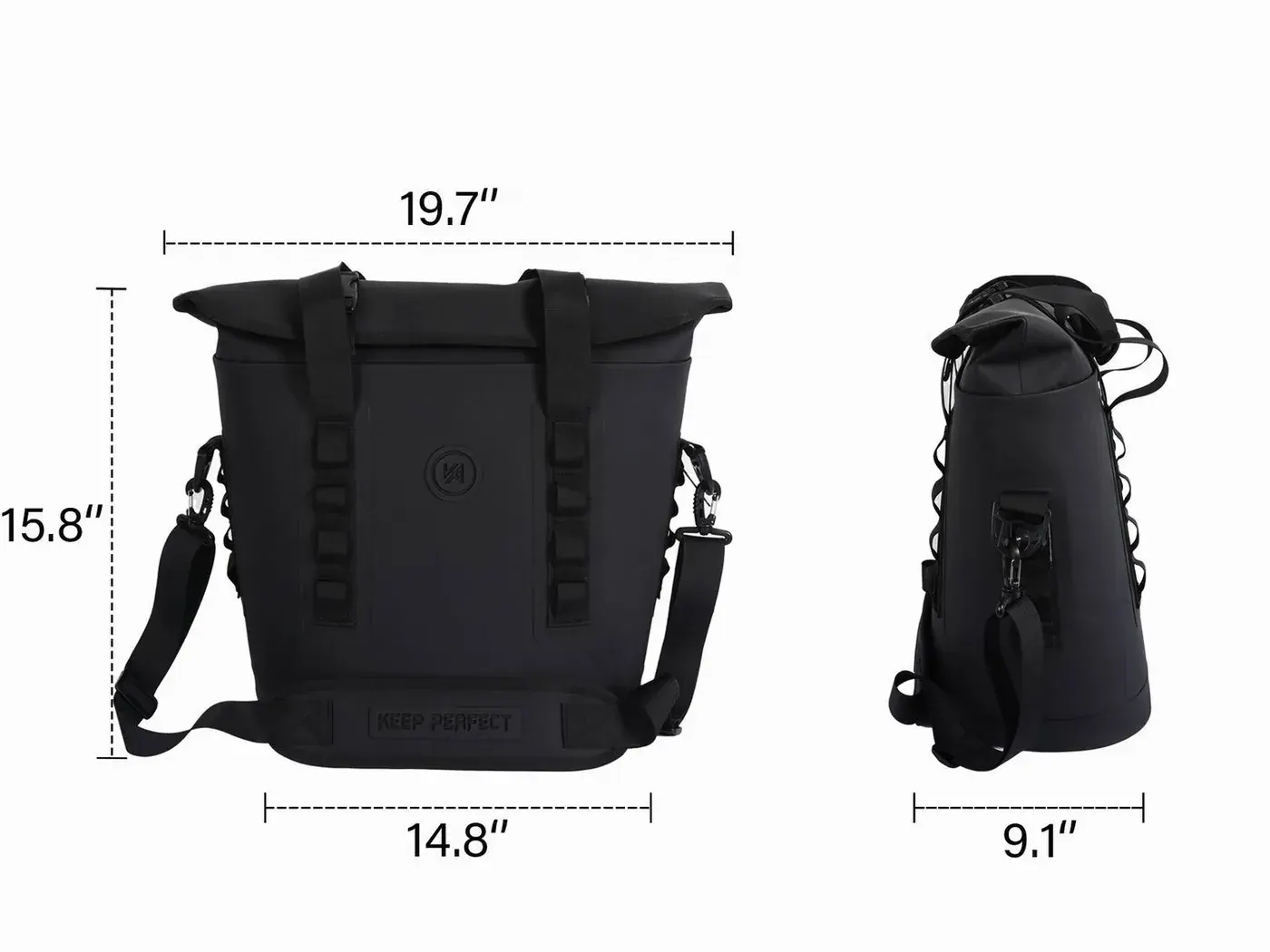
Buyers stocking a single SKU should default to a roll mouth with a coated front zip: it gives 1 to 2 second access for the items users reach constantly and keeps a sealed roll for the main body. Buyers stocking two SKUs should split on exposure instead of on size, one roll body for land and one welded tube for water.
Step 4: Shell, Seam and Low-Temperature Limits
Shell choice is a three-way trade between abrasion resistance, cold flexibility and weight, and the low-temperature limit is the one most often missed. PVC tarpaulin is cheap and tough but stiffens below minus 10 to minus 15 degrees Celsius, which produces crease-cracks on packs sold into Canada, Scandinavia and alpine retail. TPU laminate costs more and stays flexible to about minus 30 degrees Celsius.
| Shell | Hydrostatic head | Abrasion life | Low-temp limit | Weight |
|---|---|---|---|---|
| 420D polyester, TPU 0.30 mm | 4,000-5,000 mm | 15,000-20,000 cycles | -28 degrees C | 230 g/m2 |
| 500D polyester, TPU 0.35 mm | 5,000-6,000 mm | 25,000 cycles | -30 degrees C | 285 g/m2 |
| 840D nylon, TPU 0.45 mm | 8,000-10,000 mm | 35,000-45,000 cycles | -35 degrees C | 410 g/m2 |
| 1000D PVC tarpaulin | 10,000 mm | 40,000+ cycles | -10 to -15 degrees C | 610 g/m2 |
| 210D recycled PET liner | 1,200 mm | 8,000-10,000 cycles | -20 degrees C | 120 g/m2 |
Two seam rules close this step. Welded seams should reach at least 90 percent of base fabric tensile strength when pulled on a production coupon, and that figure should be checked weekly rather than per lot, because weld power drifts as electrodes warm. Hydrostatic head is measured on flat fabric by the ISO 811 method referenced through the International Organization for Standardization, and it measures the fabric only, never the assembled pack.
Step 5: Harness, Fit and the 8 Kilogram Threshold
Below 8 kg, harness geometry is a comfort question; above it, it is a returns question. A padded hip belt should transfer 70 to 80 percent of the load off the shoulders, which needs 10 to 12 mm of closed-cell foam over a 38 mm webbing core, and load lifters set near 45 degrees to stop the pack pulling backward on descents. Below 8 kg a webbing belt saves 120 to 180 g and is the right call.
- Under 6 kg: webbing belt, 15 mm shoulder foam, sternum strap with 80 mm of adjustment.
- 6 to 12 kg: 38 mm padded belt, 10 mm shoulder foam, load lifters, frame sheet.
- Above 12 kg: moulded belt with 12 mm foam, load lifters at 45 degrees, frame sheet plus stay.
- Torso fit: check the strap anchor sits between C7 and the iliac crest; one size covers roughly 40 to 48 cm.
- Ask for a 12 kg, 15 km load walk in the sampling round, with three testers of different torso lengths.
Step 6: Features That Earn Their Cost and Those That Do Not
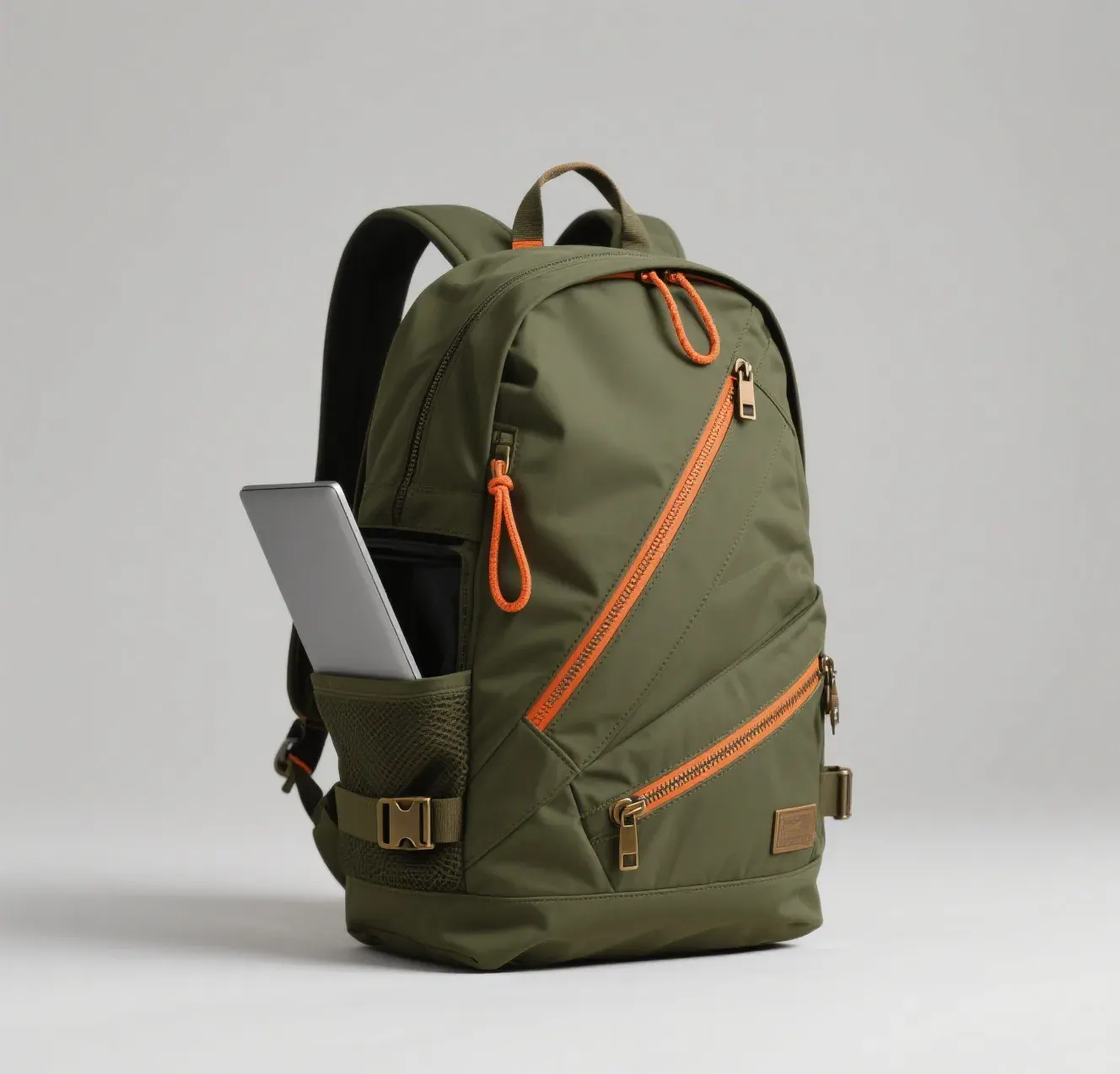
Feature lists inflate unit cost faster than any material decision, and half of what appears on a buyer wish list never survives contact with the end user. The table sorts the common requests by whether they change a purchase decision or a return rate, which is the only test worth applying. Anything in the bottom group should be cut before the sampling round rather than after the price comes back.
| Feature | Cost added | Verdict | Why |
|---|---|---|---|
| Suspended laptop bay | 1.80-3.20 USD | Earns its cost | Drives commute and travel purchase decisions |
| Coated front zip | 3.50-5.00 USD | Earns its cost | Cuts access time from 6 s to 2 s |
| Padded hip belt | 2.20-3.60 USD | Earns its cost above 8 kg | Prevents comfort returns |
| External lash points | 0.60-1.10 USD | Earns its cost for outdoor | Carries bulky wet gear outside the body |
| Reflective panel | 0.40-0.80 USD | Earns its cost for commute | Night visibility, low cost |
| MOLLE grid | 2.40-4.10 USD | Rarely earns it | Adds weight and snag points most users ignore |
| Built-in rain cover | 1.90-3.30 USD | Rarely earns it | Redundant on a pack that is already sealed |
| Solar panel pocket | 4.50-7.00 USD | Does not earn it | Low use rate, adds failure points |
| Removable daypack | 5.20-8.40 USD | Does not earn it | Doubles zip count and leak paths |
The cost column is the addition to unit price at 1,000 pcs, and it is worth reading as a budget in itself: a buyer who asks for a MOLLE grid, a rain cover and a removable daypack has added 9.50 to 18.80 dollars to a pack before touching the shell. Cutting those three usually funds an upgrade from a coated zip to a welded body, which is a far better use of the same money.
Step 7: Compliance and the Chemistry Questions
Compliance is now a purchase criterion rather than a formality. Most EU tenders and several US state programmes require PFAS-free durable water repellent, and material declarations against REACH SVHC and California Prop 65 are routinely requested at the quotation stage rather than after an order is placed. Asking early costs nothing; asking after a fabric run has been booked costs a full re-quote.
| Requirement | Where it applies | Evidence to request | Timing |
|---|---|---|---|
| REACH SVHC screening | EU, UK | Declaration per material lot | At quotation |
| California Prop 65 | California retail | Declaration per material lot | At quotation |
| PFAS-free DWR | EU tenders, several US states | Finish specification and test report | Before fabric booking |
| ISO 9001 system | General retail onboarding | Certificate copy | During onboarding |
| BSCI social audit | EU retail onboarding | Audit report reference | During onboarding |
| AQL 2.5 inspection | Every bulk order | Signed report with packing list | Before shipment |
The regulatory background for durable water repellent chemistry is summarised in the EPA PFAS programme pages, and it is moving quickly enough that a finish accepted last season may not be acceptable next season. State the requirement explicitly in the tech pack so the correct finish is quoted from the start rather than substituted later.
Step 8: Budget and Landed Cost
Unit price is the number everyone negotiates and the one that matters least on its own. Freight depends on carton efficiency, duty depends on classification and destination, and inspection and rework costs land on whoever did not specify the acceptance criteria clearly. The worked example below uses a 35 L roll body at 1,000 pcs and is the arithmetic buyers should run before comparing two quotations.
| Cost component | Per unit at 1,000 pcs | Note | Who controls it |
|---|---|---|---|
| Quoted unit price | 24.00 USD | 500D TPU shell, roll mouth, laptop bay | Buyer, via spec and volume |
| Tooling amortised | 0.35 USD | Weld jig and any moulded panel | Buyer, via design stability |
| Freight, FOB Xiamen | 1.80 USD | 10 per carton, 20 ft container | Buyer, via carton efficiency |
| Duty and import | 1.20-2.90 USD | 5 to 12 percent by destination | Destination market |
| Inspection and QC | 0.25 USD | AQL 2.5, third party optional | Shared |
| Landed cost | 27.60-29.30 USD | About 15 to 22 percent over unit price | All of the above |
The lever with the most room is carton efficiency, decided at design stage: an 18 L body packs 20 per carton against 10 for a 35 L body, roughly halving freight per unit. Buyers shipping DDP into more than 100 countries should ask for both quotations.
Step 9: Sampling, Quality Control and Sign-Off
The last step is the one that decides whether the first eight survive contact with a production floor. Sampling confirms the design; quality control confirms the run; and the documents that tie them together are what settle a dispute. Below is the minimum schedule, run on production-tooled pieces rather than hand-made prototypes, because weld parameters and stiffener geometry are exactly what drift when a style leaves development.
| Stage | What is checked | Pass criterion | Output |
|---|---|---|---|
| First article | Enclosure, dimensions, fold geometry | Under 10 percent air loss, dry interior | Signed first-article report |
| Pre-production | Seam peel, abrasion, colour fastness | 90 percent peel, 25,000 cycles, grade 4 | Laboratory report |
| In-line | Weld power and dwell, zip alignment | Within 5 percent of set parameters | Daily in-line log |
| Final, AQL 2.5 | Visual, function, enclosure sample | Acceptance numbers per AQL 2.5 | Signed inspection report |
| Retained sample | One per colourway, ambient storage | Held for the life of the programme | Control piece for claims |
- Samples take 6 to 10 working days and bulk runs 35 to 50 days, shipped FOB Xiamen or DDP into more than 100 countries.
- MOQ is 500 pcs per design and colourway; three colours consolidated from 3,000 pcs is cheaper per piece than three drops.
- Ask for the enclosure test to run twice: once closed by a technician, and once after 200 closures by somebody untrained.
- Keep the retained sample; when a claim arrives in month nine, it turns root-cause analysis into a five-minute comparison.
- Send a four-line brief to start: volume band, rating target, quantity and destination market.
With those nine decisions made in order, the brief writes itself. Buyers ready to start can send volume band, rating target, quantity and destination market to service@junyuanbags.com, or read the production programme to see how the pack, fishing and EVA ranges are put together.
Five Mistakes That Cost the Most
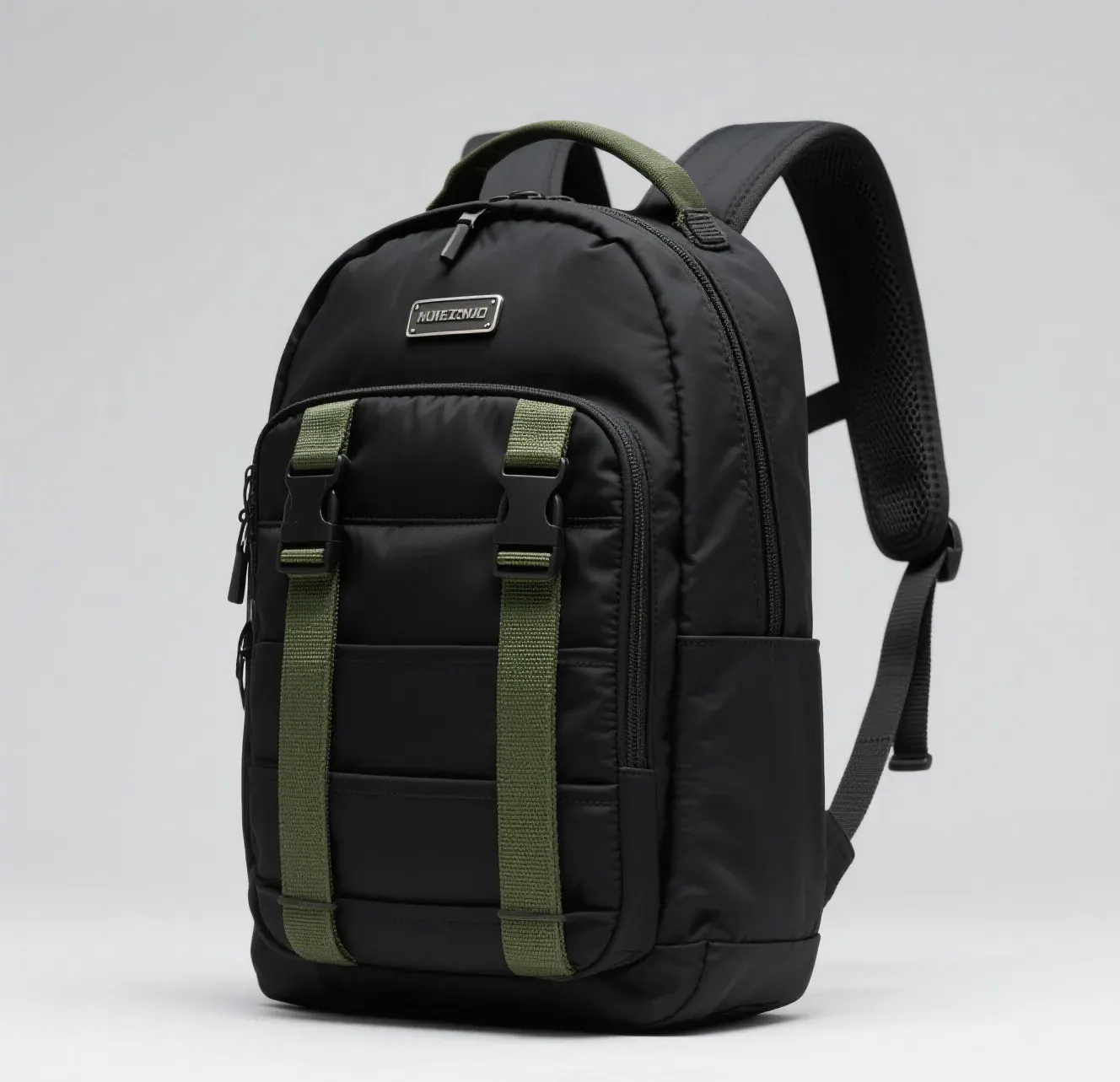
Each of these is cheap to avoid at the specification stage and expensive to fix after sampling. The common thread is deciding a later step before an earlier one.
- Choosing features before the rating: a MOLLE grid and a rain cover do not make a pack waterproof, and the money belongs in the closure.
- Quoting litres without kilograms: a 30 L pack of camera bodies carries very differently from 30 L of clothing, and comfort complaints follow.
- Assuming a coated zip is submersible: it reaches IPX4 or IPX5 and weeps after about 1,500 cycles, so immersion needs a welded body.
- Specifying PVC for a winter market: it stiffens below minus 10 to minus 15 degrees Celsius and crease-cracks if folded frozen.
- Skipping the retained sample: without a control piece, a month-nine claim becomes a correspondence exercise instead of a five-minute check.
People Also Ask
What should I look for first when buying a waterproof backpack?
The IPX rating under IEC 60529, because it caps everything else. Heavy rain and commuting need IPX5, deck work and motorcycling need IPX6, and only immersion needs IPX7 or IPX8. Decide exposure first, then volume, then closure.
How do I know what size waterproof backpack to buy?
Match litres to the trip and kilograms to the load: 25 to 30 L at 6 to 9 kg for a full day, 32 to 35 L at 8 to 10 kg for an overnight, and 40 to 45 L at 10 to 13 kg for carry-on travel. State both figures, because rigid cargo uses about 25 percent fewer litres than clothing does.
Is a more expensive waterproof backpack always better?
No. Above IPX6 the extra 25 to 34 dollars per unit buys immersion protection and airtight hardware that a commuter will never use and will not maintain. Spend on the closure and the harness first, and cut features such as MOLLE grids and rain covers, which add 2 to 8 dollars each without changing performance.
What is the difference between waterproof and water-resistant?
A water-resistant pack uses a coated shell and sheds light rain for 10 to 20 minutes before wetting out, reaching IPX3 or IPX4. A waterproof pack carries a tested rating, usually IPX5 or above, and uses a roll mouth, welded seams or airtight hardware. The closure is the tell, not the fabric marketing.
How can I tell if a waterproof backpack is good quality?
Ask for three numbers: seam peel strength as a percentage of base fabric, hydrostatic head in millimetres, and the tested IPX level with the method named. A serious specification gives at least 90 percent peel, 5,000 mm or better, and an IPX level backed by a report rather than a hangtag claim.
Do I need a hip belt on a waterproof backpack?
Above 8 kg, yes. A padded belt with 10 to 12 mm of foam over a 38 mm webbing core transfers 70 to 80 percent of the load off the shoulders. Below 8 kg a webbing belt is lighter by 120 to 180 g and is the better choice for a day pack.
Frequently Asked Questions
Q1. What IPX rating do I need for everyday use?
IPX5, which covers heavy rain and boat spray under IEC 60529. It is the sensible default for commuting, hiking and travel, and it costs 6 to 9 dollars per unit more than a shower-resistant build. Move to IPX6 only for motorcycling or deck work where a 100 L per minute jet is realistic.
Q2. How many litres should a waterproof backpack be?
25 to 30 L for a full day at 6 to 9 kg, 32 to 35 L for an overnight at 8 to 10 kg, and 40 to 45 L for carry-on travel at 10 to 13 kg. For a roll-top body, also specify the fill-line height, because a pack filled to within 40 mm of the top cannot make three turns.
Q3. Which closure type should I choose?
A roll mouth with side buckles for rating and durability, at a cost index of 1.00 with no wear mechanism. Add a coated front zip if the pack is opened more than ten times a day, which takes the index to 1.30 and cuts access time from 6 seconds to 2. Choose an airtight zip only for immersion.
Q4. What fabric denier is right for a waterproof backpack?
500D polyester laminated with 0.35 mm TPU is the volume answer at 285 g per square metre, 25,000 abrasion cycles and 5,000 mm hydrostatic head. Move to 840D for expedition and marine packs and to 420D for lightweight day packs under 25 L.
Q5. Does a waterproof backpack need a rain cover?
No. A rain cover on a sealed pack is redundant weight, adds 1.90 to 3.30 dollars per unit and, once it is wet and stuffed in a pocket, adds a damp item to a dry pack. Spend that money on the closure instead, which is where rain performance actually comes from.
Q6. Can a waterproof backpack be used in freezing weather?
Yes with TPU laminate, which stays flexible to about minus 30 degrees Celsius. PVC tarpaulin stiffens below minus 10 to minus 15 degrees Celsius and can crease-crack if folded when frozen, so it should not be specified for Canada, Scandinavia or alpine retail.
Q7. How much should I budget per unit?
11 to 62 dollars per unit at 1,000 pcs depending on rating and features, against a retail band of 39 to 259 dollars. Landed cost runs about 15 to 22 percent above the quoted unit price once freight, duty and inspection are included, so a 24 dollar pack lands at 27.60 to 29.30 dollars.
Q8. What is the minimum order quantity?
MOQ is 500 pcs per design and colourway, set by material minimums for film, webbing and hardware rather than by assembly capacity. Consolidating three colours into one run from 3,000 pcs is usually cheaper per piece than three separate 500 pc drops.
Q9. How long does sampling and production take?
Samples take 6 to 10 working days from confirmed artwork, with welded bodies and moulded panels at the longer end because tooling has to be cut. Bulk runs 35 to 50 days depending on order band and colourway count, shipped FOB Xiamen or DDP into more than 100 countries.
Q10. Are PFAS-free finishes as effective as conventional DWR?
Yes, in laboratory testing a PFAS-free durable water repellent over a TPU film barrier reaches the same hydrostatic head as a fluorinated finish. It matters commercially because most EU tenders and several US state programmes now require it, and substituting later means a full re-quote.
Q11. How do I check quality before shipment?
Run a first-article enclosure test, pre-production laboratory checks on seam peel and abrasion, in-line monitoring of weld power and dwell, and a final AQL 2.5 inspection. Ask for the enclosure test to run twice, once by a technician and once after 200 closures by somebody untrained.
Q12. What should I do if a seam leaks after a season?
Compare against the retained sample first, which usually identifies whether the weld, the stiffener or the fill line moved. A clean puncture takes a 70 by 120 mm TPU patch in 60 to 90 seconds; a lifting weld along a base corner means the pack should be replaced, not patched.
Q13. Can I put a laptop in any waterproof backpack?
Only from about 25 L upward, and only with a suspended bay of roughly 380 by 265 mm with 20 mm of clearance under the sleeve. Under 22 L the mouth is under 300 mm wide and the panel too curved for a flat bay.
Q14. Should I buy one pack for all activities?
Only in the 28 to 35 L band, where a roll body with a coated front zip covers commuting, hiking and travel adequately. Outside that band, split by exposure rather than by size: a welded tube for anything that goes near water, and a harnessed pack for land.
Q15. What documents should come with a bulk waterproof backpack order?
A signed AQL 2.5 inspection report, material declarations for REACH SVHC and California Prop 65, a laboratory report covering seam peel, abrasion and colour fastness, and a first-article report with dimensions. Keep one retained sample per colourway for the life of the programme.