Hydrostatic head is the height of a column of water, in millimetres, that a fabric can hold before the third drop appears on the back face. It is a pressure measurement, not a weather rating: 1,000 mm equals 9.8 kilopascals, 10,000 mm equals 98 kilopascals or 0.98 bar, and 20,000 mm equals 196 kilopascals. On a backpack, the practical thresholds are 1,500 mm for light rain, 3,000 mm for sustained rain, 5,000 mm for sustained rain under a loaded harness, and 10,000 mm and above once the pack is kneeled on, set down in standing water or used on the water. The number that matters is not the shell figure on the data sheet but the seam and closure figure on the finished body, which typically runs 30 to 60 percent lower. Bulk production starts at 500 pcs per design and colourway, with samples in 6 to 10 working days and bulk in 35 to 50 days.
What the mm Number Actually Measures
A hydrostatic head figure answers one question: how much pressure, expressed as the height of a column of water, does it take to push liquid through this piece of fabric. A laboratory clamps a 100 square centimetre specimen over a well, raises the column at a fixed rate, and stops when the third drop appears on the dry side. If that happens when the column is 5,000 millimetres high, the fabric is rated 5,000 mm. Nothing in that test involves rain, wind, movement or time, which is exactly why the number is both useful and routinely oversold.
| Hydrostatic head | Pressure equivalent | What it survives in practice | Comfort margin |
|---|---|---|---|
| 1,000 mm | 9.8 kPa | Light shower, 5-10 minutes | None, wets through at straps |
| 1,500 mm | 14.7 kPa | Light rain, 30 minutes | Thin, the usual entry point |
| 3,000 mm | 29.4 kPa | Sustained rain, 2 hours | Adequate for commuting |
| 5,000 mm | 49.0 kPa | Sustained rain under a loaded harness | Good for hiking |
| 10,000 mm | 98.0 kPa, 0.98 bar | Standing water, kneeling, boat deck | Strong |
| 20,000 mm | 196.0 kPa, 1.96 bar | Immersion to about 1 m, dive support | Very strong |
| 30,000 mm | 294.0 kPa | Beyond any backpack requirement | Marketing territory |
The pressure column is worth reading twice, because it is where the mm rating meets the bar rating on a sealed zip. Ten metres of water is 1.0 bar, and a fabric rated 10,000 mm is 0.98 bar, so a shell quoted at 10,000 mm is, on paper, resisting almost exactly the pressure found at 10 metres of depth. It will not in practice, because a fabric is not supported the way a test clamp supports it, but the arithmetic is why 10,000 mm is the working threshold for anything that goes near the water rather than merely under the rain.
How the Test Is Run, and Why Two Labs Disagree
Three method variables move the result by more than the difference between two fabrics. The rate of increase is the first: raising the column faster gives a higher reading, because the fabric has less time to wet out, and the standard rates differ between methods. The endpoint is the second, since the third drop and the first drop can be several hundred millimetres apart on a woven shell. And the specimen is the third, because a fabric tested flat and new is not the fabric in a pack that has been flexed across a base seam for two seasons.
| Method | Rate of increase | Endpoint | Typical user | Note |
|---|---|---|---|---|
| ISO 811 | 10 or 60 cm per minute | Third drop appears | Europe, most technical mills | The reference method for woven shells |
| AATCC 127 | 10 cm per minute | Third drop appears | North America, brand specs | Closely comparable to ISO 811 at the same rate |
| JIS L 1092 A | 10 cm per minute | Third drop appears | Japan, some Asian mills | Method B uses a different rate and reads higher |
| ISO 4920 spray | Fixed spray, no column | Surface wetting graded 0-5 | DWR finish checks | Measures beading, not pressure |
| ASTM D3393 | Pass or fail at a stated head | No penetration | Coated fabric specifications | Used for specification, not comparison |
Because of those variables, a specification should always name the method and the rate, and a buyer comparing two quotations should ask for the method before comparing the figures. A 5,000 mm result at 60 centimetres per minute is not the same fabric as a 5,000 mm result at 10 centimetres per minute. Hydrostatic resistance methods are maintained by ISO 811 in the European system and by AATCC test method 127 in the North American one, and both are accepted in a technical file.
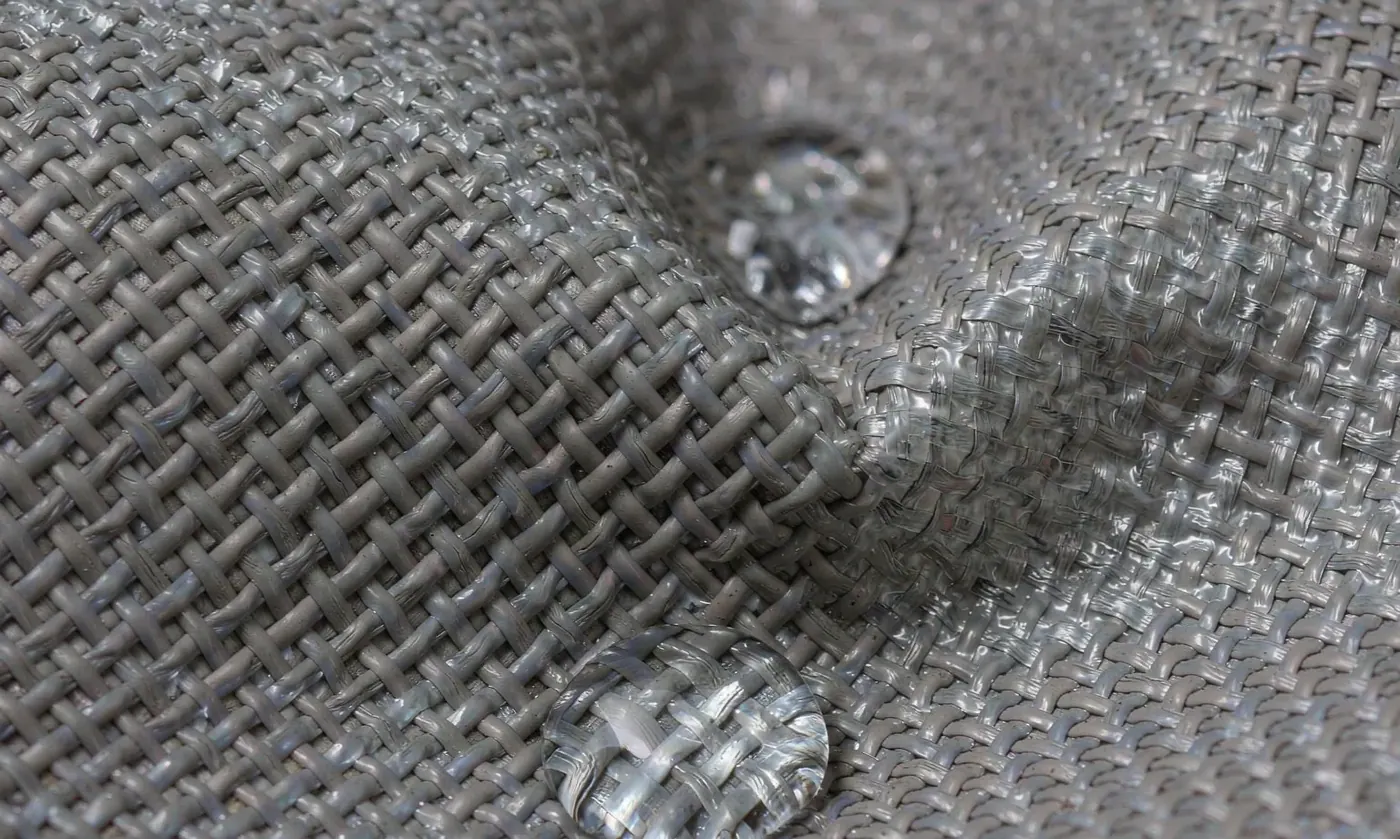
The spray test in that table deserves a warning, because it is the number most often mistaken for a hydrostatic head. A spray rating of 4 or 5 out of 5 tells you the durable water repellent finish is alive, which matters for breathability and for how long the face fabric stays light. It tells you nothing about pressure. A shell can bead water beautifully at 80 on the spray scale and still pass liquid at 800 mm, which is why a pack that looks waterproof in a product photograph can wet a laptop in an hour of real rain.
Why the Fabric Rating Is Not the Pack Rating
This is the gap that costs buyers money. A shell rated 10,000 mm does not produce a 10,000 mm backpack, because water does not need to penetrate the fabric when it can go around it. Three paths exist on every pack: the stitch line, the closure, and the hardware attachment. A sewn seam introduces 5 to 7 needle holes per centimetre, and even a taped seam measures 3,000 to 8,000 mm against a shell rated 10,000 mm and above. A coated coil closure measures effectively zero against a pressure test. And every strap anchor, daisy chain and buckle attachment is a hole in the barrier unless it is welded.
| Point on the pack | Rating if sewn | Rating if taped | Rating if welded | Against a 10,000 mm shell |
|---|---|---|---|---|
| Flat panel | 10,000 mm | 10,000 mm | 10,000 mm | Full rating |
| Main body seam | Under 200 mm | 3,000-8,000 mm | 10,000 mm and above | Welded only holds the shell figure |
| Front pocket closure | Under 100 mm | Under 100 mm | 0.3-1.0 bar if sealed | Closure is usually the limit |
| Strap anchor | Under 200 mm | Under 200 mm | 8,000-10,000 mm | Weld the anchor or accept the loss |
| Whole body, as finished | IPX3-IPX4 | IPX4-IPX5 | IPX6-IPX8 | Closure decides the final code |
The last row is the one to quote internally: on a finished body the closure sets the rating, not the fabric. That is why a programme buying a 20,000 mm shell and a coated coil zip ends up with an IPX4 pack and a complaint file, while a programme buying a 5,000 mm shell with welded seams and a roll-top ends up with an IPX6 pack and no complaints. The relationship between fabric ratings and finished-body ingress codes is set out in the IPX rating guide, and the distinction between the two words themselves is treated in waterproof vs water-resistant.
Abrasion, Ageing and Where the Number Goes
A hydrostatic head is measured on a new, flat, clean specimen, and every one of those three conditions is violated within a month of use. Abrasion is the fastest: the face of a coated shell is a thin film, and rubbing against a rock, a boat gunwale or a conveyor removes micrometres at a time. Ageing is slower and chemical, since polyester-based polyurethane coatings take up moisture and hydrolyse, and the coating loses cohesion long before it looks damaged. Contamination is the third, because sunscreen, insect repellent and fuel are all solvents for a coating and all of them end up on a pack.
| Condition | Testing applied | Head retained | Loss | Comment |
|---|---|---|---|---|
| New, flat, clean | None | 100 percent | 0 percent | The figure on the data sheet |
| 1,000 Martindale cycles | ISO 12947 abrasion | 60-80 percent | 20-40 percent | Simulates a season of normal use |
| 5,000 Martindale cycles | ISO 12947 abrasion | 30-50 percent | 50-70 percent | Base and strap contact areas |
| 168 h at 70 C, 95 percent RH | Accelerated hydrolysis | 50-75 percent | 25-50 percent | Predicts tropical storage |
| After 20 domestic washes | Care cycle | 40-70 percent | 30-60 percent | Detergent strips the finish |
| Sunscreen and repellent contact | Spot contamination | 20-60 percent | 40-80 percent | The most under-rated failure |
Temperature deserves a line of its own, because it moves the number in both directions and surprises buyers who test in a cold laboratory. Water at 20 degrees Celsius has a different surface tension and viscosity from water at 2 degrees, and a cold specimen of a coated shell is measurably stiffer, so a winter test on a PVC laminate can read 10 to 20 percent below the same fabric tested at room temperature while performing better in the field. The practical instruction is to condition specimens at 20 degrees Celsius and 65 percent relative humidity for at least four hours before testing, and to record the conditioning on the report.
Two practical consequences follow. The first is that a specification should carry a retained figure after abrasion, not just an initial one, and the honest target is 60 percent of the initial head after 1,000 cycles. The second is that the finish has to be maintained, because re-proofing restores the beading and takes real load off the coating. Cleaning and re-proofing routines are covered in how to clean a waterproof backpack, and the chemistry of coating thickness against durability is set out in fabric coating thickness.
- Specify a retained head after abrasion, not only an initial head: 60 percent of the initial figure after 1,000 Martindale cycles is a fair target.
- Ask for the aged figure after 168 hours at 70 degrees Celsius and 95 percent relative humidity for any tropical programme.
- Treat any sunscreen, repellent or fuel contact as coating damage, and re-proof the affected panel rather than washing it harder.
- Retest at goods-in on the finished body, because a flat coupon result tells you nothing about the seam.
Matching the mm Figure to Real Use
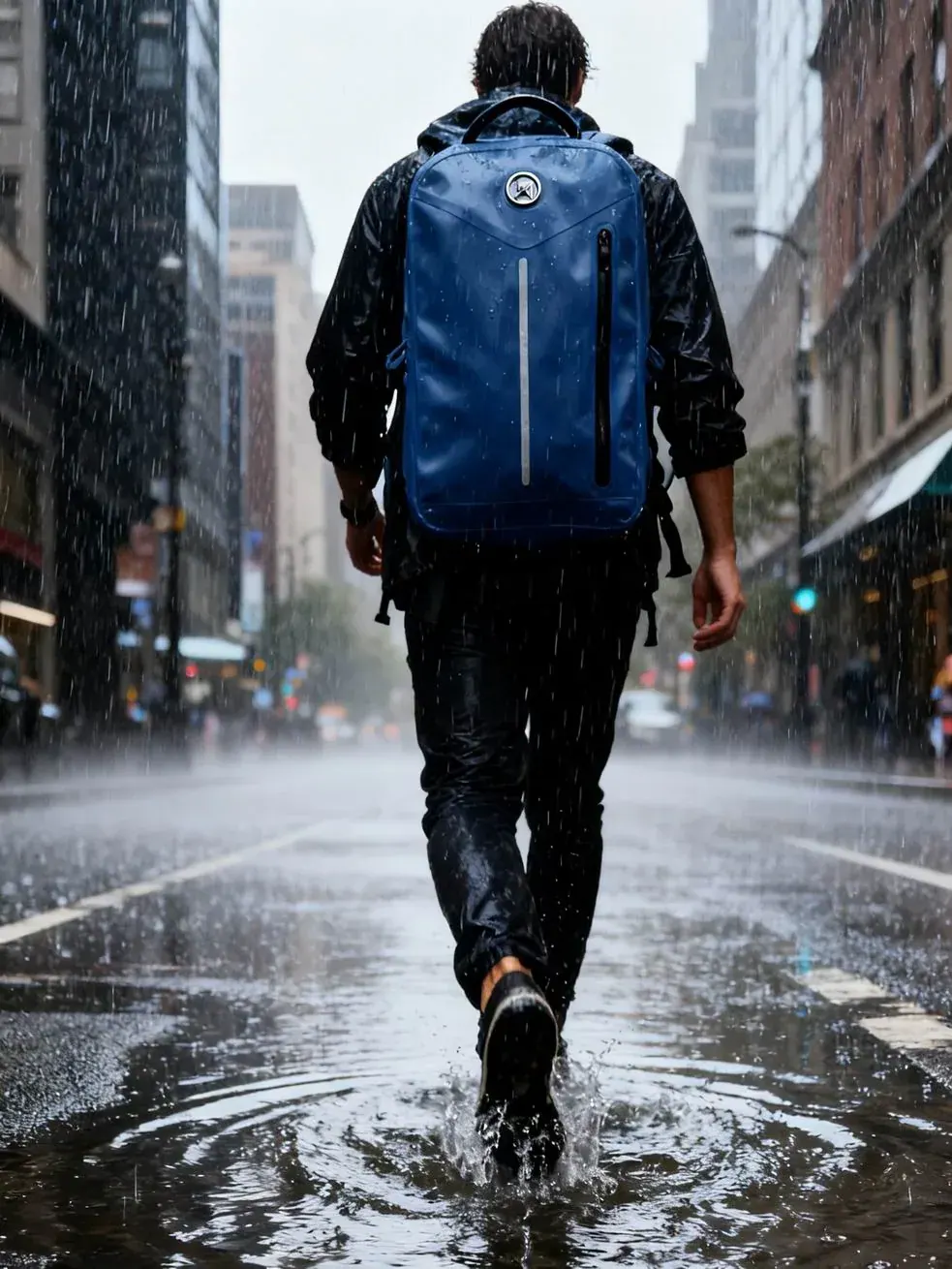
The right way to choose a rating is from the worst pressure the pack will meet, not from the weather it will meet. Rain falling at 50 millimetres per hour applies very little pressure. A user kneeling on a pack to rummage in it, or setting it down in 20 millimetres of standing water while loading a boat, applies a great deal more, and that is the load case that decides the number. Once you frame it as pressure rather than weather, the ratings sort themselves out quickly and the specification gets cheaper in most cases.
| Use case | Worst pressure case | Minimum shell head | Seam requirement | Realistic body rating |
|---|---|---|---|---|
| Office commute | 20 min rain, no load point | 3,000 mm | Taped or welded | IPX4-IPX5 |
| Day hiking | Sustained rain, harness load | 5,000 mm | Welded body | IPX5-IPX6 |
| Multi-day trekking | Kneeling on wet ground | 8,000-10,000 mm | Welded body | IPX6 |
| Laptop and electronics | Set down in standing water | 10,000 mm | Welded body | IPX6 |
| Kayak and rafting | Capsize, brief immersion | 10,000 mm | Welded, sealed closure | IPX7 |
| Surf and swim | Immersion plus sand abrasion | 10,000-15,000 mm | Welded, sealed closure | IPX7 |
| Dive support | Depth to about 10 m | 15,000-20,000 mm | Welded, 1.0 bar closure | IPX8 |
There is one more load case that is routinely missed at the specification stage, and it is the one that generates the most warranty claims on commuter and laptop packs. A pack set down on a wet pavement, a wet boat deck or a wet changing-room floor concentrates the whole weight of the contents onto the base panel over an area of perhaps 300 square centimetres. A 12 kilogram load over that area produces a pressure equivalent to a head of roughly 2,000 to 4,000 millimetres at the contact face, and it is sustained for minutes rather than seconds. That is why the base is always specified one or two steps above the side panels, and why a moulded or laminated base panel is worth more per dollar than a higher rating on the upper shell. A programme that puts a 10,000 mm base under a 5,000 mm side panel will outperform a uniform 8,000 mm body in the field and cost less than a uniform 10,000 mm one.
The pattern in that table is that 10,000 mm covers everything short of immersion, and above 20,000 mm the extra head is being bought for a marketing claim rather than for a load case. Buyers who move a programme from 20,000 mm to 10,000 mm and put the saving into welded seams and a proper closure consistently end up with a better pack, because they have fixed the path that was actually leaking. The full decision sequence, including volume and harness, is laid out in the waterproof backpack buying guide.
Specifying and Verifying a Head Figure
A purchase specification for hydrostatic head has four lines and needs no more. Name the method and the rate, because ISO 811 at 60 centimetres per minute and AATCC 127 at 10 centimetres per minute are not interchangeable. State the initial minimum head. State the retained minimum after abrasion, with the cycle count. And state that the test is run on the finished laminate rather than on the base fabric, because the coating is what is being tested and a base cloth result is meaningless.
| Specification line | Commute programme | Hiking programme | Immersion programme |
|---|---|---|---|
| Method and rate | ISO 811, 60 cm per minute | ISO 811, 60 cm per minute | ISO 811, 10 cm per minute |
| Initial head, minimum | 3,000 mm | 8,000 mm | 15,000 mm |
| Retained after 1,000 cycles | 1,800 mm | 4,800 mm | 9,000 mm |
| After hydrolytic ageing | Not required | 4,000 mm | 9,000 mm |
| Seam requirement | Taped, 3,000 mm | Welded, matches shell | Welded, matches shell |
| Body rating target | IPX4-IPX5 | IPX6 | IPX7-IPX8 |
| Test frequency in bulk | One per 500 pcs | One per 500 pcs | One per 200 pcs plus pressure check |
Verification at goods-in takes about twenty minutes and needs a small rig. Cut three coupons from a finished body across a seam rather than from a flat panel, clamp them, and run the column at the specified rate. A coupon that includes a seam and still reaches the specified head is the only result that predicts field behaviour. Bodies rated for immersion add an inflation or vacuum check on the whole unit, which is why an immersion programme carries a higher test frequency than a commuting one and adds two to four days to the bulk schedule.
- Every bulk order is inspected at AQL 2.5 before release, with hydrostatic coupons taken across a seam rather than from flat panels.
- Materials are screened against REACH and California Prop 65, and monthly output of 200,000 units is verified by SGS.
- Bodies are built under BSCI and ISO 9001 systems, with FOB Xiamen or DDP to more than 100 countries.
- MOQ is 500 pcs per design and colourway, colours can be consolidated from 3,000 pcs, samples take 6 to 10 working days.
The closing recommendation is to stop treating the mm figure as a quality ranking and start treating it as a load case. Ask what pressure the pack will meet, specify a head with a margin of about two times that, and then spend the rest of the budget on the seam and the closure, which is where the rating is actually decided. Shell ratings, seam coupons and pressure rigs are all shown. Enquiries go to service@junyuanbags.com.
People Also Ask
What is a good hydrostatic head for a backpack?
3,000 mm for commuting, 5,000 to 8,000 mm for hiking under a loaded harness, and 10,000 mm and above for anything set down in standing water or used on the water. Above 20,000 mm the extra rating buys a claim rather than a load case.
Is 10,000 mm waterproof enough for a backpack?
Yes for everything except immersion. 10,000 mm equals 98 kilopascals, or 0.98 bar, which covers sustained rain, kneeling on wet ground and a boat deck. The limiting factor at that point is the seam and the closure, not the fabric.
What does 5,000 mm hydrostatic head mean in rain?
It means the fabric held a 5 metre column of water before the third drop passed through, which equals 49 kilopascals. In practice it survives sustained rain for about two hours under a loaded harness, and it is the usual threshold for a serious hiking shell.
How is hydrostatic head measured?
A 100 square centimetre specimen is clamped over a well, the water column is raised at a fixed rate, and the height is recorded when the third drop appears on the dry side. ISO 811 typically uses 10 or 60 centimetres per minute and AATCC 127 uses 10 centimetres per minute.
Does a higher mm rating always mean a better backpack?
No. The finished body is limited by its weakest path, which is almost always the seam or the closure. A 5,000 mm shell with welded seams and a roll-top outperforms a 20,000 mm shell with sewn seams and a coated coil zip by two IPX levels.
How much hydrostatic head does a pack lose with wear?
Typically 20 to 40 percent after 1,000 Martindale cycles and 50 to 70 percent after 5,000, plus 25 to 50 percent after accelerated hydrolytic ageing. That is why a specification should carry a retained figure and not only an initial one.
Frequently Asked Questions
Q1. What is hydrostatic head on a waterproof backpack?
It is the height in millimetres of a column of water that the fabric withstands before the third drop penetrates to the dry side. It is a pressure measurement: 1,000 mm equals 9.8 kilopascals, 10,000 mm equals 98 kilopascals or 0.98 bar, and 20,000 mm equals 196 kilopascals.
Q2. What hydrostatic head do I need for a hiking backpack?
5,000 mm for day hiking in sustained rain and 8,000 to 10,000 mm for multi-day trekking, because kneeling on the pack on wet ground applies far more pressure than rainfall does. Above 10,000 mm there is no load case left to cover on a hiking pack.
Q3. Is 3,000 mm hydrostatic head waterproof?
It is water-resistant to sustained rain for about two hours, which is enough for a commute but not for a loaded harness or for being set down in standing water. A 3,000 mm shell on a welded body reaches IPX4 to IPX5 overall.
Q4. Which test standard measures hydrostatic head?
ISO 811 is the European reference and AATCC 127 the North American one, and both record the head at which the third drop appears. JIS L 1092 is used by some Asian mills, and ASTM D3393 is written as a pass or fail specification for coated fabrics rather than as a comparison method.
Q5. Why do two labs report different mm values for the same fabric?
Because the rate of increase and the endpoint differ. Raising the column faster gives a higher reading, and the third drop and the first drop can be several hundred millimetres apart on a woven shell, so a specification must name both the method and the rate.
Q6. Does the spray test rating mean the same thing?
No. A spray rating of 4 or 5 out of 5 measures the durable water repellent finish and how well the face beads, and it says nothing about pressure. A shell can bead water well and still pass liquid at 800 mm of head.
Q7. Why does my 10,000 mm backpack still leak?
Because water goes around the fabric rather than through it. A sewn seam measures under 200 mm, a taped seam measures 3,000 to 8,000 mm, and a coated coil closure measures effectively zero against a pressure test, so the closure and the seam set the real rating.
Q8. How much hydrostatic head is lost through abrasion?
About 20 to 40 percent after 1,000 Martindale cycles and 50 to 70 percent after 5,000. Sunscreen, insect repellent and fuel are worse, since they are solvents for the coating and can remove 40 to 80 percent of the head on contact.
Q9. Can hydrostatic head be restored after wear?
Partly. Washing restores the beading by removing contamination, and a re-proofing treatment puts a fresh finish on the face, which can recover much of the spray rating. It cannot repair a coating that has hydrolysed, and that loss is permanent.
Q10. What hydrostatic head should I specify for a waterproof backpack order?
Name the method and rate, then set an initial minimum and a retained minimum after abrasion. A commute programme asks for 3,000 mm initial and 1,800 mm retained, a hiking programme 8,000 mm and 4,800 mm, and an immersion programme 15,000 mm and 9,000 mm, tested on the finished laminate.