Clean a TPU or PVC waterproof backpack by hand in water no warmer than 30 degrees Celsius with a pH neutral detergent diluted to 0.1 to 0.2 percent, then air dry it open and inverted for 6 to 12 hours at 15 to 25 degrees. Machine washing is prohibited: a 600 to 1,200 revolutions per minute spin flexes welded seams beyond their design angle and alkaline detergent at pH 9 to 11 attacks the ester bonds in thermoplastic polyurethane. Tumble drying is worse, because chamber temperatures of 60 to 80 degrees approach the softening point of the coating and delaminate it from the base textile in a single cycle. A correct hand wash takes 25 to 40 minutes of working time and adds years of service life, and the whole procedure needs only a basin, a soft cloth, and about 45 litres of water.
Why Machine Washing and Tumble Drying Are Prohibited
A waterproof backpack is not a laundry item. Its protection comes from a continuous film, 0.15 to 0.60 millimetres thick, bonded or laminated to a woven base, plus seams that are welded rather than stitched. Every property that makes it waterproof is also a property that a washing machine is designed to defeat, and the damage is usually invisible until the next heavy rain.
Three mechanisms do the harm. First, agitation: a drum rotating at 40 to 55 revolutions per minute folds the pack 200 to 400 times in a 30 minute cycle, concentrated at the roll top fold line where the coating is already working. Second, spin: at 600 to 1,200 revolutions per minute the pack is pressed against the drum wall at 50 to 150 times its own loaded weight, which opens welded seams at the corners. Third, chemistry: standard laundry detergent is formulated at pH 9 to 11, and thermoplastic polyurethane begins to hydrolyse above pH 8.5 at elevated temperature.
Drying is a separate failure mode with a faster onset. Tumble dryer chambers run at 60 to 80 degrees, and coated textiles of this class start to soften between 60 and 90 degrees. Above that threshold the film loses adhesion to the base fabric in patches, a defect that appears as bubbling or a milky haze the first time the pack gets wet again. A hair dryer on a hot setting reaches 70 to 90 degrees at 100 millimetres and does exactly the same damage in a smaller area.
| Damage mechanism | Machine wash | Tumble dry | Visible symptom |
|---|---|---|---|
| Mechanical flexing | 200 to 400 folds per cycle | Continuous tumbling | Crazing at the fold line |
| Pressure | 50 to 150 times load at 600 to 1,200 rpm | Low, but sustained | Corner seams opening |
| Temperature | 40 to 60 degrees in the wash | 60 to 80 degrees chamber | Coating bubbles or haze |
| Chemistry | Detergent at pH 9 to 11 | None, but heat accelerates residue | Sticky or dull surface |
| Time to visible failure | 3 to 8 cycles | 1 to 2 cycles | Leak at the next heavy rain |
What You Need Before You Start
The kit is deliberately short, because every additional chemical is an additional risk to the coating. A basin or a bath of 40 to 60 litres, a soft cloth or non-abrasive sponge, a soft brush with bristles under 0.3 millimetres for zippers and buckles, a pH neutral detergent, and two or three towels. Nothing else is required for 95 percent of jobs.
Detergent selection is the one decision worth care. Use a pH neutral liquid detergent at pH 6.5 to 7.5, dosed at 5 to 10 millilitres per 5 litres of water, which is a concentration of 0.1 to 0.2 percent. Products carrying the EPA Safer Choice mark are a practical way to identify formulations without solvents, optical brighteners or quaternary compounds, all of which can leave a residue that interferes with the surface energy of the coating.
Avoid four categories outright: bleach above 1 percent, any solvent including acetone and white spirit, fabric softener of any kind, and abrasive pads. Fabric softener deserves particular mention because it is cationic and leaves a film that makes the outer surface wet out rather than bead, which users misread as waterproofing failure.
| Item | Specification | Why that number |
|---|---|---|
| Water temperature | 20 to 30 degrees, never above 30 | Above 40 accelerates hydrolysis of the film |
| Detergent pH | 6.5 to 7.5, neutral | Above pH 8.5 attacks TPU ester bonds |
| Detergent dose | 5 to 10 ml per 5 litres | 0.1 to 0.2 percent is enough and rinses clean |
| Brush bristles | Under 0.3 mm, soft | Stiffer bristles score the coating |
| Rinse volume | 15 to 20 litres per rinse, two to three rinses | Residue attracts dirt and weakens beading |
| Working time | 25 to 40 minutes | Most of it is soaking and drying, not scrubbing |
The Six Step Hand Wash Procedure
Work in the shade on a surface that can get wet, and empty the pack completely first. Open every closure, unfold the roll top fully, pull the liner out if it is removable, and shake out loose sand and grit, which is the most abrasive material the pack will ever meet and the one most likely to be ground into the coating during washing.
- Dry strip: shake out grit, vacuum the corners at the base, and brush zipper teeth with a soft dry brush so sand does not become an abrasive paste later.
- Pre rinse: fill a basin with 30 to 40 litres of clean water at 20 to 30 degrees and submerge the pack for 10 to 15 minutes to loosen surface salt and soil.
- Wash: add 5 to 10 millilitres of pH neutral detergent per 5 litres, then wipe the whole surface with a soft cloth using overlapping strokes and 2 to 3 kilograms of pressure at most; give the base and the shoulder strap undersides 2 to 3 minutes each.
- Detail: clean the zipper with a soft brush along the teeth in one direction only, then wipe buckles and strap adjusters with a damp cloth so grit does not remain in the mechanism.
- Rinse twice: drain, refill with clean water, and submerge for 5 minutes per rinse, using 15 to 20 litres each time; two rinses remove 95 percent of residue and three remove effectively all of it.
- Strip and invert: shake out free water, blot the exterior with a towel, then hang the pack upside down with every closure open and the roll top unfolded.
Pressure control is the skill in step three. The coating is 0.15 to 0.60 millimetres thick and a scrubbing pad removes it faster than dirt, so use many light passes rather than one hard pass. Soil on a coated textile is nearly always surface bonded and lifts with contact time, not force.
Step four is where most people skip and later regret. A waterproof zipper carries a sealing profile that traps grit, and grit in the profile is the leading cause of a zipper that stops closing fully. Brushing along the teeth in one direction for 60 to 90 seconds, then exercising the slider 5 to 10 times before drying, prevents most of the zipper complaints that appear in the second season.
Removing Salt, Sand, Sunscreen and Mildew
Saltwater is the most aggressive soil a pack meets, and timing matters more than technique. Seawater carries about 35 grams of dissolved salt per litre, and as it dries that salt crystallises inside the zipper channel and at the seam edge, expanding and abrading from the inside. Rinse within 4 hours of exposure, and if that is impossible, soak for 15 to 30 minutes in fresh water before the pack dries out.
Sand should be removed dry. Grit of 0.1 to 2 millimetres is harder than the coating and will score it under pressure, so vacuum or brush the interior and the base corners before any water touches the pack. Working the 20 to 40 millimetre crease at the base corners removes most accumulated grit in about 2 minutes.
Sunscreen and insect repellent are oil based and resist a neutral detergent wash. Treat the spot with a small amount of the same detergent applied undiluted, leave it for 60 to 120 seconds, then wipe with a barely damp cloth and rinse the area immediately. Oils left in place for weeks plasticise the surface film, leaving it permanently tacky, which is the single most common cosmetic complaint in beach and resort programmes.
Mildew is a moisture problem before it is a cleaning problem. Surface growth on a coated film wipes off with a solution of one part white vinegar to three parts water, applied for 5 to 10 minutes and rinsed thoroughly; persistent growth in a stitched seam may need a second pass. Health authorities including the US Centers for Disease Control and Prevention advise that the controlling factor is moisture: clean the surface, then fix the drying and storage conditions, or the growth returns within 2 to 4 weeks.
| Soil type | Treatment | Contact time | Caution |
|---|---|---|---|
| Sea salt | Fresh water soak, 15 to 30 minutes, then rinse | Rinse within 4 hours of exposure | Crystals abrade from inside the seam |
| Sand and grit | Remove dry by brush or vacuum | 2 minutes at the base corners | Never scrub wet grit into the coating |
| Sunscreen and repellent | Undiluted neutral detergent on the spot | 60 to 120 seconds, rinse at once | Left in place, oils plasticise the film |
| Surface mildew | One part vinegar to three parts water | 5 to 10 minutes | Fix the drying conditions or it returns |
| Adhesive residue | 70 percent isopropyl alcohol on a cloth | 30 seconds, then wash the area | Never acetone or solvent cleaners |
| Rust or tackle stains | Paste of baking soda and water, pH about 8 | 3 to 5 minutes, rinse fully | Short contact only, then neutralise |
Zippers, Buckles and Hardware
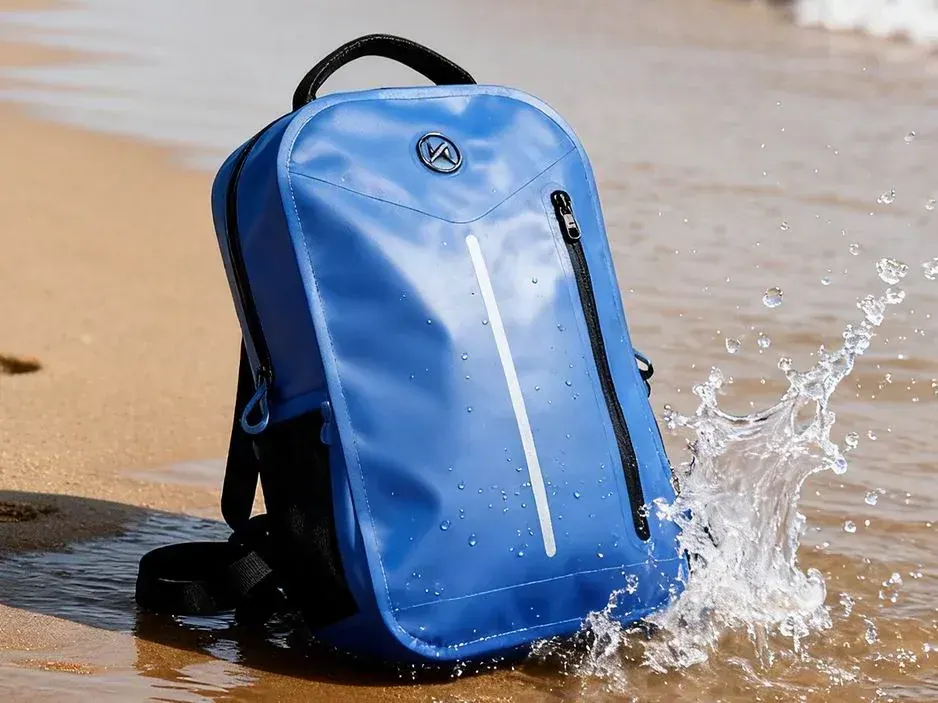
Hardware needs less water and more attention than the body. A waterproof zipper should be rinsed with fresh water, brushed along the teeth in one direction, and exercised 5 to 10 times while still wet so the slider clears the channel. Once dry, a silicone free lubricant applied sparingly to the slider track restores smooth action; petroleum based lubricants should be avoided because they swell the sealing profile by 2 to 5 percent and cause the zipper to bind.
Buckles and strap adjusters are usually acetal or aluminium and need nothing more than a fresh water rinse, but they are where sand hides. Flush each buckle for 10 to 20 seconds under running water and work the release 3 to 5 times. On a pack used in saltwater, do this on the same day, because a buckle that has dried with salt inside it will typically stiffen within 2 to 4 weeks and may not release at all after 8 to 12 weeks.
Metal hardware deserves a corrosion check rather than a clean. Look for white powder on aluminium, which is aluminium oxide and indicates the anodising has been breached, and for brown staining on steel rivets. Either sign means the part should be replaced before the next season; replacement hardware costs 0.20 to 1.50 USD and the failure it prevents is the loss of a strap root under load.
Drying: Time, Method and Why Heat Is the Enemy
Drying is the step that determines whether the cleaning was worth doing. Hang the pack upside down with every closure open, the roll top unfolded, and removable liners pulled out, in a shaded ventilated space at 15 to 25 degrees with relative humidity below 60 percent. A 30 litre pack dries in 6 to 12 hours under those conditions, a 50 to 65 litre body takes 12 to 24 hours, and a pack with a padded harness and a moulded back panel can take 24 to 36 hours.
Airflow cuts that time more effectively than warmth. A fan moving 0.5 to 1.5 metres per second across the surface roughly doubles the evaporation rate and cuts total drying time by 40 to 55 percent, while raising the room temperature from 20 to 30 degrees only improves it by 20 to 30 percent and moves the film closer to its softening range. Choose the fan.
Direct sunlight is a trap. Ultraviolet exposure of 3 to 6 hours on a wet pack accelerates surface oxidation and chalking, and roughly 200 to 400 hours of strong sun visibly degrades an unprotected coating across a season. Dry in shade or indoors. Never use a radiator, a hair dryer, a heat gun, or a tumble dryer, all of which operate at 60 degrees or more.
| Drying condition | Time for a 30 L pack | Effect on the coating |
|---|---|---|
| Shaded, ventilated, 20 degrees, RH 50 percent | 6 to 12 hours | None |
| Same with a fan at 0.5 to 1.5 metres per second | 3 to 6 hours | None, and 40 to 55 percent faster |
| Warm room at 30 degrees, still air | 5 to 9 hours | Mild risk, avoid going higher |
| Direct sun, 3 to 6 hours on a wet pack | 2 to 4 hours | UV oxidation and chalking |
| Tumble dryer, 60 to 80 degrees | 40 to 70 minutes | Delamination after 1 to 2 cycles |
| Hair dryer at 100 mm, 70 to 90 degrees | Localized, fast | Localized bubbling and haze |
Odour, Disinfection and What Not to Use
Odour in a waterproof pack is almost always trapped moisture rather than bacteria on the surface, which is why drying fixes most cases and perfume products do not. If a smell persists after a full 24 hour dry, wash again with the neutral detergent solution and add 30 minutes of soak time, then dry completely before reassessing. Adding a scented product to a damp pack masks the symptom for 2 to 3 days and leaves the cause in place.
For genuine disinfection after flood water or sewage contact, use a sodium hypochlorite solution at 500 to 1,000 parts per million, which is roughly 10 to 20 millilitres of household bleach at 5 percent per litre of water, with a contact time of 5 to 10 minutes followed by two full rinses. That concentration is safe for a coated film in a single application but will fade colour and weaken webbing if repeated, so it is an exceptional measure and not part of routine care.
The prohibited list is short and worth memorising: no machine wash, no tumble dry, no bleach above 1 percent in routine use, no solvents including acetone and alcohol above 70 percent on the body, no fabric softener, no abrasive pads, and no pressure washer. A pressure washer deserves a specific warning, because a nozzle at 80 to 120 bar will strip a coating and open a welded seam in seconds, and the damage looks like a material defect rather than user error.
Re-waterproofing, Inspection and When Cleaning Is Not Enough
Cleaning does not restore protection, it reveals the true condition of the pack. Once dry, run a bead test: sprinkle 20 to 30 millilitres of water across the outer surface and watch for 30 seconds. Water that stands in beads of 3 to 6 millimetres and rolls off means the finish is healthy; water that spreads into a flat sheet within 10 seconds means the outer finish has worn and a renewal treatment is warranted.
Renewal is a spray or wash-in finish applied to a clean, dry pack at 2 to 4 grams per square metre, then cured at room temperature for 12 to 24 hours or with 20 to 30 minutes of heat below 60 degrees. That restores shedding on the outer face but does not repair the film underneath. If the hydrostatic head of the fabric has fallen, no topical treatment will bring it back.
Where a numeric figure is required, water penetration resistance is measured as a hydrostatic head and reported in millimetres of water column, with laboratory methods published by AATCC and by ISO. A pack fabric that started above 3,000 millimetres and now tests below 1,000 has lost its functional margin and should be retired from critical use, regardless of how clean it looks.
| Inspection item | Healthy reading | Action threshold | Remedy |
|---|---|---|---|
| Water bead test | Beads of 3 to 6 mm, rolls off | Flattens within 10 seconds | Apply a renewal finish |
| Hydrostatic head | Above 3,000 mm | Below 1,000 mm | Retire from critical use |
| Fold line | No crazing under 5 times magnification | Visible cracks at 1,500 to 3,000 folds | Seam repair or replace |
| Seam peel | Above 70 N per 25 mm | Below 40 N per 25 mm | Professional repair |
| Zipper closure | Closes fully with 2 to 3 kg pull | Gaps or binding | Clean, lubricate, then replace |
| Odour after 24 hour dry | None | Persistent | Repeat wash, fix storage humidity |
Care Schedule, Commercial Programmes and Specification
Frequency should be stated on the hangtag, because use-based schedules are consistently ignored and calendar schedules are followed. A reasonable baseline is a light wipe down every 4 to 6 weeks, a full hand wash every 3 months or every 60 to 90 uses whichever comes first, and a fresh water rinse after every saltwater exposure. Rental and guide operations, where packs see 150 to 250 uses per year, should move to a monthly full wash and a quarterly inspection.
Off-season storage follows cleaning directly and has its own procedure in the long-term storage guide. Coastal and boat programmes should pair this with the saltwater corrosion guide for zippers and hardware, because salt is the one soil that damages a pack mechanically rather than cosmetically. The seam types and coating thicknesses that decide how a body responds to cleaning are set out across the waterproof backpack range.
QUANZHOU JUNYUAN BAGS develops TPU and PVC laminated bodies with coating thickness from 0.15 to 0.60 millimetres and RF welded seams, with care instructions, detergent compatibility and coating care documented per specification. Programme entry is 500 pcs per design and colour, samples in 6 to 10 working days, bulk in 35 to 50 days, FOB Xiamen or DDP into more than 100 countries. Compliance screening covers REACH and California Prop 65, every release is inspected at AQL 2.5, and ISO 9001 governs the quality system. Material and seam options for easy-care constructions are summarised. Briefs may be sent to service@junyuanbags.com.
The whole discipline reduces to three sentences: wash by hand in cool water with a neutral detergent, rinse until no residue remains, and dry in shade with every closure open. Follow those and a coated pack will outlast its hardware; ignore them and no repair will restore what one wash cycle removed.
People Also Ask
Can you put a waterproof backpack in the washing machine?
No. A 600 to 1,200 revolutions per minute spin presses the pack at 50 to 150 times its load and flexes welded seams 200 to 400 times per cycle, while detergent at pH 9 to 11 attacks the coating. Visible failure typically appears after 3 to 8 machine cycles.
Can you tumble dry a waterproof backpack?
No. Chamber temperatures of 60 to 80 degrees approach the softening point of TPU and PVC coatings and delaminate the film from the base textile in one to two cycles. Air dry open and inverted for 6 to 12 hours instead.
What water temperature should I use to wash a waterproof pack?
20 to 30 degrees Celsius, and never above 30. Warm water speeds cleaning but also accelerates hydrolysis of the coating, and the gain in cleaning speed over 2 to 3 minutes of extra contact time is not worth the material risk.
How long does a waterproof backpack take to dry?
6 to 12 hours for a 30 litre pack hung upside down in shade at 20 degrees with humidity below 60 percent, and 12 to 24 hours for a 50 to 65 litre body. A fan at 0.5 to 1.5 metres per second cuts that by 40 to 55 percent.
How do I remove mildew from a waterproof backpack?
Wipe with one part white vinegar to three parts water for 5 to 10 minutes, rinse twice, then dry for a full 24 hours. Mildew is a moisture problem, so unless the drying and storage conditions improve it returns within 2 to 4 weeks.
How often should I wash a waterproof backpack?
Every 3 months or every 60 to 90 uses, whichever comes first, with a light wipe down every 4 to 6 weeks and a fresh water rinse within 4 hours of any saltwater exposure. Rental fleets seeing 150 to 250 uses per year should wash monthly.
Frequently Asked Questions
Q1. Can I machine wash a TPU or PVC waterproof backpack?
No. Machine washing flexes welded seams 200 to 400 times per cycle and presses the pack at 50 to 150 times its loaded weight during a 600 to 1,200 revolutions per minute spin, while standard detergent at pH 9 to 11 hydrolyses the film. Hand wash at 20 to 30 degrees with a pH neutral detergent instead.
Q2. Can I put a waterproof backpack in the dryer?
No, under any setting. Dryer chambers run at 60 to 80 degrees and coatings of this class begin to soften between 60 and 90 degrees, so the film delaminates in one to two cycles. The same applies to radiators, heat guns and hair dryers, which reach 70 to 90 degrees at close range.
Q3. What detergent is safe for a waterproof backpack?
A pH neutral liquid detergent at pH 6.5 to 7.5, dosed at 5 to 10 millilitres per 5 litres of water. Avoid bleach above 1 percent, solvents, fabric softener and abrasive pads. Fabric softener is especially harmful because it leaves a cationic film that kills water beading.
Q4. How do I clean sea salt off a waterproof backpack?
Soak in fresh water for 15 to 30 minutes within 4 hours of exposure, then rinse twice with 15 to 20 litres per rinse. Seawater carries about 35 grams of salt per litre, and if it dries the crystals expand inside the zipper channel and abrade the seam from the inside.
Q5. How do I remove sunscreen or insect repellent stains?
Apply a small amount of undiluted pH neutral detergent to the spot, wait 60 to 120 seconds, wipe with a barely damp cloth and rinse the area immediately. Oils left in place for weeks plasticise the surface film and leave it permanently tacky.
Q6. Is vinegar safe on a waterproof backpack?
Yes, diluted at one part white vinegar to three parts water for 5 to 10 minutes to treat surface mildew, followed by two rinses. Undiluted vinegar at pH 2 to 3 should not be left on the coating for longer than a few minutes.
Q7. How do I clean a waterproof zipper?
Rinse with fresh water, brush along the teeth in one direction with a soft brush, then exercise the slider 5 to 10 times while wet. Once dry, apply a silicone free lubricant sparingly; petroleum lubricants swell the sealing profile by 2 to 5 percent and cause binding.
Q8. How long should a waterproof backpack dry before storage?
Until it is completely dry, which is 6 to 12 hours for a 30 litre pack and 12 to 24 hours for a 50 to 65 litre body at 20 degrees with humidity below 60 percent. Storing at even 5 percent residual moisture is enough to start mildew within 2 to 4 weeks.
Q9. Can I use bleach to disinfect a waterproof backpack?
Only as an exceptional measure after flood or sewage contact, at 500 to 1,000 parts per million, roughly 10 to 20 millilitres of 5 percent bleach per litre, for 5 to 10 minutes followed by two rinses. Repeated use fades colour and weakens webbing.
Q10. How do I know when cleaning is no longer enough?
Run a bead test after drying: water that flattens within 10 seconds instead of beading at 3 to 6 millimetres means the finish is spent. If the hydrostatic head has fallen below 1,000 millimetres from a starting value above 3,000, retire the pack from critical use.
Q11. Can I use a pressure washer on a waterproof backpack?
No. A nozzle at 80 to 120 bar strips the coating and opens welded seams in seconds, and the damage is easily mistaken for a material defect. Use a basin, a soft cloth and 2 to 3 kilograms of hand pressure at most.
Q12. How should care instructions be written for a commercial programme?
State a calendar schedule rather than a use count, specify 20 to 30 degree hand washing with pH neutral detergent, prohibit machine washing and tumble drying by name, and require a fresh water rinse within 4 hours of saltwater exposure. Rental fleets should add a quarterly bead test and seam inspection.