Store a waterproof backpack clean and completely dry, in a dark interior space held between 10 and 25 degrees Celsius at 30 to 50 percent relative humidity, lightly stuffed to 60 to 70 percent of volume with every closure open and the roll top unfolded. Those four conditions matter in a fixed order: residual moisture causes mould within two to four weeks, sustained heat above 30 degrees accelerates coating hydrolysis, ultraviolet exposure chalks the outer face within 200 to 400 hours, and permanent compression flattens foam and sets creases into the film. A garage or an attic fails at least two of the four, because summer attic temperatures reach 50 to 70 degrees and an unheated garage swings from minus 10 to 40 with humidity between 70 and 90 percent. Check the pack every 90 days and re-commission it with a bead test and a leak test before the first trip of the season.
Four Variables, In a Fixed Order of Importance
Long-term storage damage is almost always attributed to age, and almost always caused by one of four controllable conditions. Ranked by how fast they do harm, they are moisture, heat, light and compression. Working through them in that order covers every realistic storage failure, and each one has a numeric threshold that can be measured with a 10 USD hygrometer.
Moisture is first because it acts fastest. A pack put away with 3 to 5 percent residual moisture in the harness foam and the back panel will grow visible mould in 2 to 4 weeks at 20 degrees and 60 percent humidity, and the growth starts inside the foam where it cannot be wiped off. Heat is second: hydrolysis of a thermoplastic polyurethane film roughly doubles in rate for every 10 degrees of temperature rise, so a pack stored at 30 degrees ages about twice as fast as the same pack at 20.
Light is third and cumulative. Ultraviolet exposure of 200 to 400 hours on a stored pack produces visible chalking and colour shift, and because the pack is stationary the same face takes all of it. Compression is fourth and slowest, but it is the one that produces permanent rather than cosmetic damage: foam compressed to under 40 percent of its thickness for six months does not fully recover, and a roll top held folded under 2 kilograms of load will retain a crease that no longer seals cleanly.
| Variable | Safe range | Damage threshold | Time to visible damage |
|---|---|---|---|
| Residual moisture | Fully dry, under 1 percent by weight | 3 to 5 percent residual | Mould in 2 to 4 weeks |
| Temperature | 10 to 25 degrees | Sustained above 30 degrees | Rate doubles per 10 degrees |
| Relative humidity | 30 to 50 percent | Sustained above 65 percent | Hydrolysis and mould risk |
| Ultraviolet exposure | None, store dark | 200 to 400 hours cumulative | Chalking and colour shift |
| Compression | Loosely stuffed, 60 to 70 percent volume | Under 40 percent thickness for 6 months | Permanent foam and crease set |
Clean and Dry Before Anything Else
Storage begins with cleaning, and skipping it is the most common single cause of a pack that comes out of storage unusable. Soil, salt, sunscreen and body oils all remain active during storage rather than going inert, and salt in particular keeps drawing moisture from the air because it is hygroscopic. A pack put away with 35 grams per litre of dried sea salt residue will stay damp at the seams long after the rest of the bag is dry.
Wash by hand in water at 20 to 30 degrees with a pH neutral detergent at 0.1 to 0.2 percent, rinse twice with 15 to 20 litres per rinse, then dry open and inverted in shade until completely dry. The full procedure is set out in the cleaning guide for TPU and PVC packs. Expect 6 to 12 hours for a 30 litre body and 12 to 24 hours for a 50 to 65 litre body, and add 12 hours for a pack with a moulded back panel.
Confirm dryness rather than assuming it. Weigh the pack on a kitchen scale before washing and again after 24 hours of drying; a difference of more than 1 percent of pack weight means moisture remains in the foam. As a second check, press a dry paper towel against the back panel and the harness padding for 30 seconds and look for any transfer. Either test failing means another 12 hours of drying, not a decision to store anyway.
- Empty every pocket and unroll the closure fully, because a forgotten food wrapper or a wet map is enough to start mould inside a sealed body.
- Wash at 20 to 30 degrees with pH neutral detergent, then rinse twice at 15 to 20 litres per rinse.
- Dry open and inverted in shade for 6 to 24 hours depending on volume and back panel construction.
- Confirm dryness by weight, allowing no more than 1 percent difference from the dry baseline.
- Remove batteries from any packed device and take silica gel sachets out of the pack before storage.
Choosing the Location: What an Attic and a Garage Actually Do
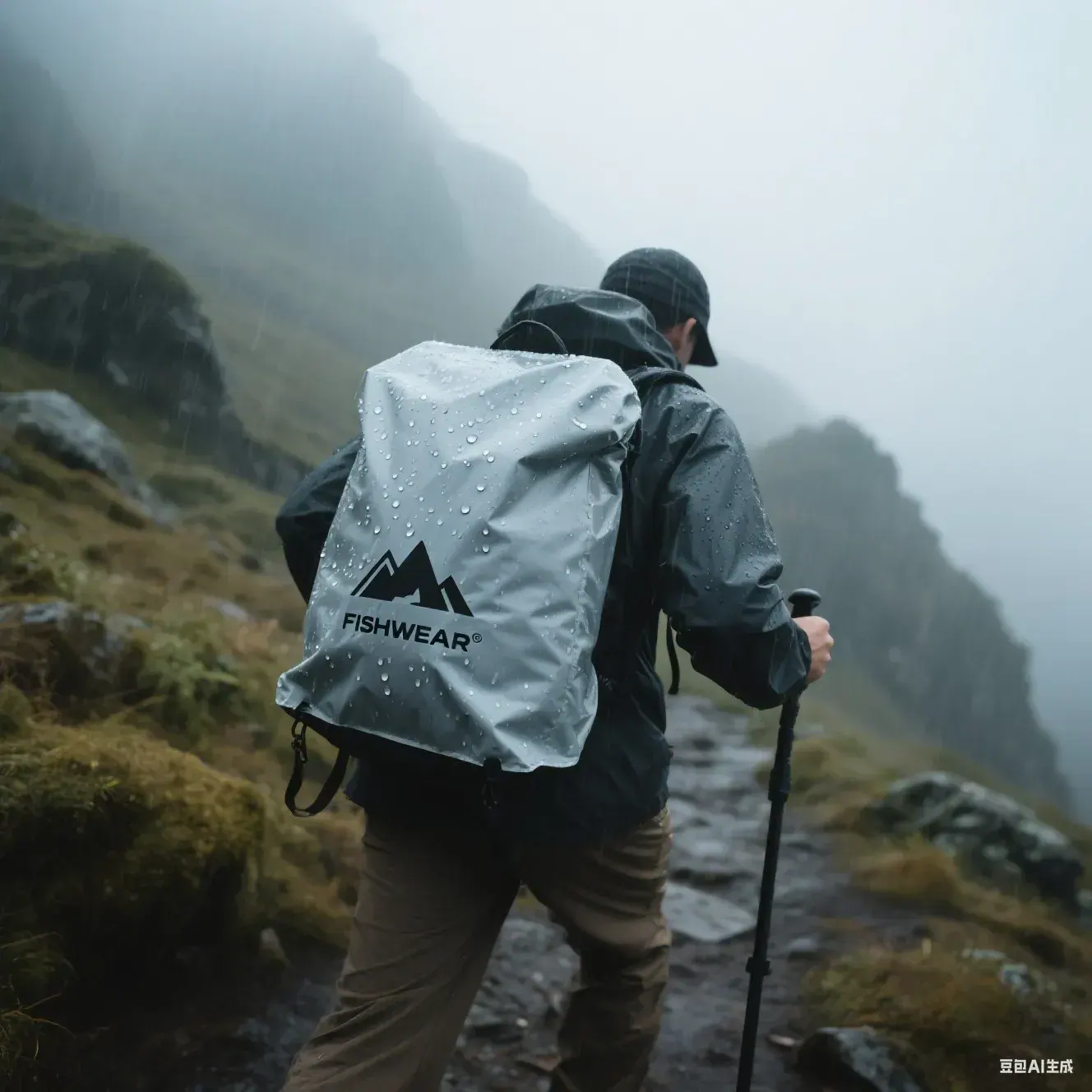
The correct location is a dark interior cupboard or a cupboard under a stair, anywhere that shares the conditioned environment of the living space. Those spaces hold 10 to 25 degrees and 30 to 50 percent humidity without intervention in most temperate climates, which is exactly the safe band. The two locations people actually choose, the attic and the garage, are the two that fail.
An attic in summer reaches 50 to 70 degrees under a dark roof, and in winter drops below freezing. That is a 60 to 80 degree annual swing, and the coating responds to both ends: heat accelerates hydrolysis, and cold stiffens a PVC film enough that unfolding a roll top at 0 degrees can crack it. A garage adds humidity to the same problem, commonly 70 to 90 percent in an unheated space, plus petrol and solvent vapours from a vehicle or a store of paint.
Climate matters and should be checked rather than assumed. Monthly temperature and humidity normals for a region are published by national meteorological services, and marine and coastal figures from NOAA show how far a coastal location sits from the 30 to 50 percent target. In a humid coastal climate a 10 to 20 gram sachet of indicating silica gel per 50 litres of pack volume, renewed every 3 to 6 months, is cheap and effective insurance.
| Location | Typical temperature | Typical humidity | Verdict |
|---|---|---|---|
| Interior cupboard | 10 to 25 degrees | 30 to 50 percent | Correct |
| Under-stair cupboard | 12 to 24 degrees | 35 to 55 percent | Correct |
| Garage, unheated | Minus 10 to 40 degrees | 70 to 90 percent | Avoid, solvent vapours too |
| Attic or loft | Minus 5 to 70 degrees | 40 to 80 percent | Avoid, worst case |
| Car boot | Minus 5 to 60 degrees | Varies with weather | Never, not even short term |
| Basement with damp | 8 to 20 degrees | 60 to 85 percent | Avoid unless dehumidified |
Position: Stuffed, Hung or Flat
How the pack rests is nearly as important as where it rests. The best option for a soft body is loosely stuffed to 60 to 70 percent of volume with clean, dry, unbleached material, then stood upright on a shelf. The stuffing maintains the shape of the roll top collar and prevents the creases that become leak paths, while leaving enough slack that nothing is under sustained tension.
Hanging is acceptable and better than folding, but only by the grab handle and only if the handle is rated for it. A grab handle tested to 15 to 30 kilograms will hold a 1 to 2 kilogram pack indefinitely, but hanging by a shoulder strap concentrates the load on 25 to 50 millimetres of webbing against a strap root that was designed for a different load direction. Over six months that produces measurable stitch creep at the root.
Never store folded or rolled tight. A roll top held folded under 1 to 2 kilograms for a season retains a crease, and a crease across the sealing line is a leak path rather than a cosmetic mark. If space is genuinely short, loosely roll the pack with the roll top left open and unfolded, which uses about 40 percent less shelf space and puts the closure under no load at all.
| Position | Space used | Effect after six months | Recommendation |
|---|---|---|---|
| Upright, loosely stuffed 60 to 70 percent | Full footprint | Shape retained, no creases | Best option |
| Hung by the grab handle | Vertical space | No distortion if handle rated 15 to 30 kg | Good second choice |
| Hung by a shoulder strap | Vertical space | Strap root creep of 2 to 5 mm | Avoid over a season |
| Folded with the closure rolled | About 40 percent less space | Crease set across the sealing line | Never |
| Flat with items stacked on top | Shelf footprint | Foam compressed below 40 percent | Never above 2 kg |
Closure Position and Hardware State
Leave every closure open. That is the opposite of how a pack is carried and it is deliberate: a roll top folded and buckled for six months sets a crease, and a waterproof zipper left closed under tension takes a permanent set in its sealing profile. Unroll the top fully, open every pocket zipper, and release every buckle so nothing is under load.
Two exceptions apply. If the pack will be stored somewhere dusty, close the main opening but leave it unrolled and unbuckled, so the closure is shielded without being compressed. And if a zipper has been lubricated, exercise it 5 to 10 times before storage so the lubricant is distributed rather than pooled at one end, because a pooled silicone free lubricant attracts dust and dries into a sticky residue over 3 to 6 months.
Remove or isolate anything metal that touches the coating. Steel buckles and rivets stored in contact with a damp film leave rust staining within 4 to 8 weeks, and the stain migrates into the coating rather than sitting on it. Slip a piece of acid free tissue under any metal fitting, or better, store the pack with the harness folded outward so nothing metal rests against the body.
Mould, Odour and Pest Prevention
Mould needs three things and only one of them is within the pack: spores, organic soil, and moisture. Spores are everywhere and cannot be excluded, so the defence is to remove the soil by cleaning and to hold the humidity below 60 percent. A pack that is genuinely dry and stored at 45 percent humidity will not grow mould, regardless of how long it sits.
Health guidance on damp indoor environments makes the same point from the other direction. Advice published by the US Centers for Disease Control and Prevention treats moisture control as the primary intervention and cleaning as the secondary one, which is exactly the priority order a storage plan should follow: fix the humidity first, then clean whatever has already grown.
Pest prevention has one hard rule: never use mothballs or naphthalene. Both sublimate into a vapour that plasticises a TPU or PVC coating within weeks, leaving a permanently tacky surface, and both leave an odour that does not come out. Cedar blocks are safe and mildly effective; a sealed storage box is more effective still; and a pack stored clean in a closed cupboard rarely has a pest problem in the first place.
Odour on removal from storage should be treated as a signal, not as a task. A smell after six months means moisture was present at some point, so dry the pack again for 24 to 48 hours with a fan at 0.5 to 1.5 metres per second and re-inspect the foam rather than reaching for a deodoriser. Masking the smell leaves the cause in place and it returns within days of the first wet trip.
Material Aging: What Storage Actually Slows Down
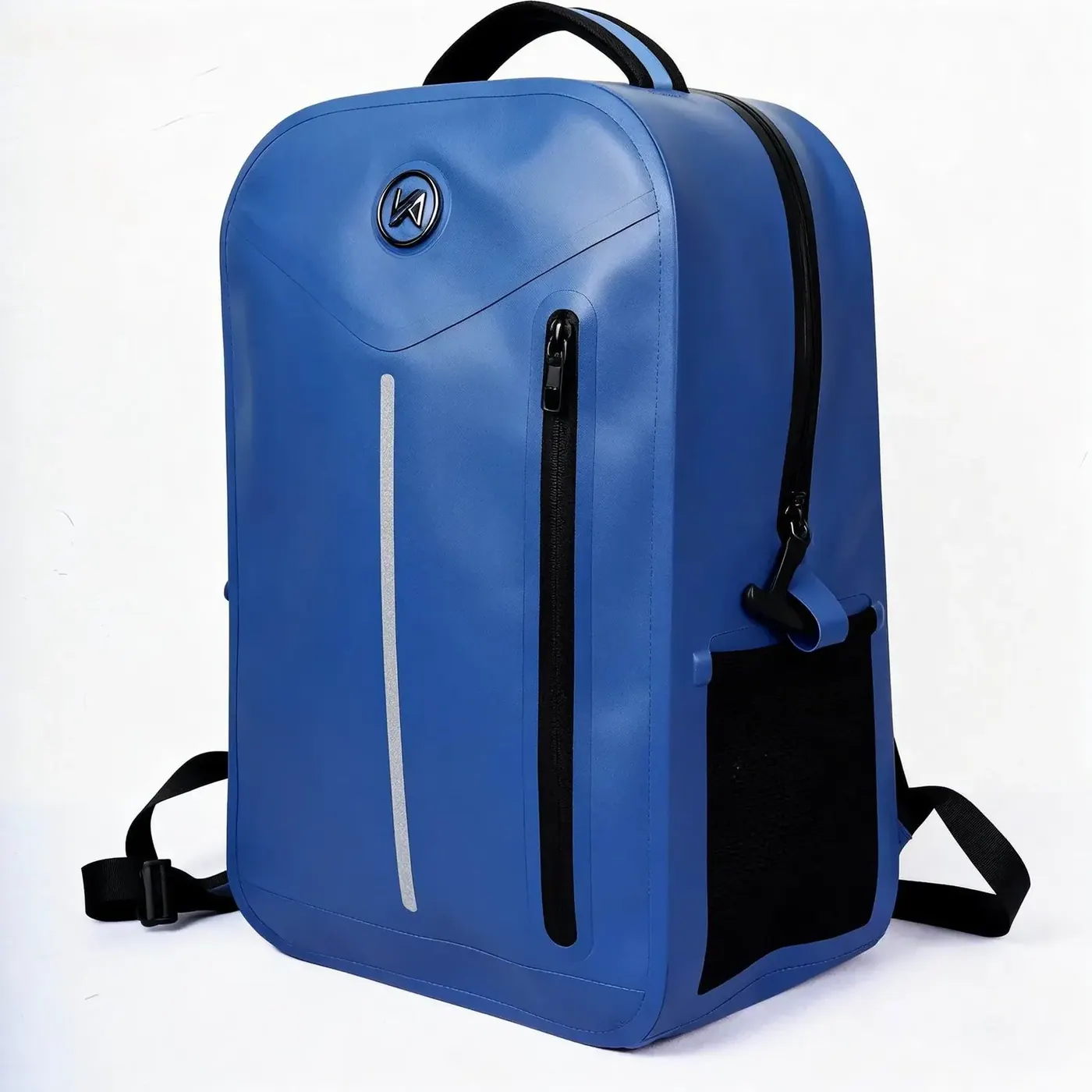
Two chemistries dominate the category and they age differently. Thermoplastic polyurethane loses strength through hydrolysis, driven by heat and humidity together; the rate roughly doubles for every 10 degrees of temperature rise and accelerates sharply above 65 percent relative humidity. Plasticised PVC loses flexibility through plasticiser migration, driven by heat and by contact with solvents or oils, and it stiffens noticeably below 0 degrees.
That difference produces different storage priorities. A TPU pack should be stored cool and dry above all, and humidity control is the single highest value intervention. A PVC pack should be stored away from anything petroleum based, including a garage with a vehicle, and should never be folded or unrolled while cold, because a film at minus 5 degrees is markedly less tolerant of flexing than the same film at 20.
Aging is measurable rather than a matter of opinion. Accelerated aging and physical property retention procedures published by ASTM International are the shared reference for coating and textile durability, and the practical version is simple: compare a stored pack against a known good one by bead test, by fold flexibility and by seam peel. A stored pack that has lost 30 percent or more of its original hydrostatic head should be retired from critical use. The aging mechanisms themselves are described in the TPU aging guide.
| Failure mode | TPU film | PVC film | Storage defence |
|---|---|---|---|
| Primary mechanism | Hydrolysis from heat and humidity | Plasticiser migration from heat and solvents | Control both heat and humidity |
| Accelerating condition | Above 30 degrees, above 65 percent RH | Above 30 degrees, solvent vapours | Interior cupboard, away from vehicles |
| Cold behaviour | Stays flexible to minus 20 degrees | Stiffens below 0 degrees | Never unfold a cold PVC roll top |
| Visible sign | Tacky surface, milky haze | Surface cracking, stiff hand feel | Inspect every 90 days |
| Rate factor | Doubles per 10 degrees of rise | Proportional to vapour exposure | Keep at 10 to 25 degrees |
The 90 Day Check and Re-commissioning
Storage is not a set-and-forget activity. A 10 minute inspection every 90 days catches everything that a yearly check misses, and the list is short: read the hygrometer, look for any surface growth, flex the roll top twice, and exercise every zipper 5 times. If the hygrometer reads above 60 percent for two consecutive checks, move the pack or add silica gel rather than waiting for the season to end.
Re-commissioning before the first trip takes 24 to 48 hours and three tests. Air the pack out in shade for 24 hours, then run a bead test with 20 to 30 millilitres of water across the outer face: beads of 3 to 6 millimetres that roll off mean the finish is healthy, and water that flattens within 10 seconds means a renewal treatment is warranted. Then run a tissue paper leak test for 10 minutes before trusting the pack with anything valuable.
Re-proofing after storage is normal and should be budgeted rather than treated as a fault. A spray or wash-in finish applied at 2 to 4 grams per square metre and cured for 12 to 24 hours at room temperature restores shedding on the outer face. It does not restore the film underneath, so if the pack fails the tissue test after re-proofing, the coating has aged and the pack should be retired from critical use.
| Stage | Interval | Check | Action if failed |
|---|---|---|---|
| Storage inspection | Every 90 days | Hygrometer, growth, fold flex, zipper cycles | Move location or add 10 to 20 g silica gel |
| Air out | Before first trip | 24 hours in shade, fan optional | Extend to 48 hours if odour is present |
| Bead test | After airing | 20 to 30 ml water, beads of 3 to 6 mm | Apply a renewal finish at 2 to 4 g per square metre |
| Tissue leak test | After beading | 20 to 30 sheets, 10 minutes of spray | Retire from critical use |
| Hydrostatic head check | Every 2 to 3 years | Compare against the original figure | Retire if down 30 percent or more |
Programme Numbers, Packaging and Commercial Storage
For brand owners and distributors, storage is a specification item as much as a user instruction. Bulk shipments held for 3 to 12 months before retail distribution should be warehoused under the same rules: 10 to 25 degrees, 30 to 50 percent humidity, no direct sunlight, and cartons stacked no more than 5 high so the bottom layer is not under sustained compression above its rated load.
Packaging should support those conditions rather than fight them. Individual polybags trap moisture and should be perforated or omitted for a pack that has been packed at residual humidity above 1 percent; a desiccant sachet of 5 to 10 grams per carton is standard for a sea freight container, where internal humidity routinely exceeds 80 percent during a 25 to 40 day transit. Carton stacking strength should be specified at 150 to 250 kilograms for a five-high stack.
QUANZHOU JUNYUAN BAGS supplies TPU and PVC laminated bodies with coating thickness from 0.15 to 0.60 millimetres and RF welded seams, with storage, care and re-proofing guidance documented per specification. Order entry stands at 500 pcs per design and colour, with prototypes in 6 to 10 working days and bulk production in 35 to 50 days, shipped FOB Xiamen or DDP into more than 100 countries. REACH and California Prop 65 screening is available across the material library, AQL 2.5 is applied at release, and the operation is certified to ISO 9001. Packaging, desiccant and warehousing parameters are covered. Briefs may be sent to service@junyuanbags.com.
The ranges most affected by storage practice, including everyday bodies and travel bodies with moulded back panels, are documented across the waterproof backpack range. Users who rotate a pack through a full year rather than storing it should follow the year-round maintenance calendar instead, because a pack in weekly use has a different risk profile from one in a cupboard.
Reduced to one line: clean it, dry it completely, stuff it loosely, leave everything open, keep it dark and cool, and look at it every 90 days. Do that and a coated pack will come out of a winter in a cupboard in the same condition it went in.
People Also Ask
How do I store a waterproof backpack for the winter?
Clean it, dry it for 6 to 24 hours until the weight is within 1 percent of dry, stuff it loosely to 60 to 70 percent of volume, leave every closure open and unrolled, and keep it in a dark interior cupboard at 10 to 25 degrees and 30 to 50 percent humidity. Inspect every 90 days.
Should I hang my backpack or lay it flat in storage?
Stand it upright loosely stuffed, which is the best option. Hanging by the grab handle is acceptable if the handle is rated to 15 to 30 kilograms. Never hang by a shoulder strap over a full season, because it creeps the strap root by 2 to 5 millimetres.
Can I store a waterproof backpack in the garage?
No. An unheated garage swings from minus 10 to 40 degrees with humidity of 70 to 90 percent, and it adds petrol and solvent vapours that migrate plasticiser out of a PVC film. Use an interior cupboard that shares the conditioned space of the house.
Why did my backpack grow mould in storage?
Residual moisture. A pack stored with 3 to 5 percent moisture in the harness foam grows visible mould in 2 to 4 weeks at 20 degrees and 60 percent humidity. Confirm dryness by weighing the pack before and after drying, allowing no more than 1 percent difference.
Is it bad to leave a roll top folded during storage?
Yes. A roll top held folded under 1 to 2 kilograms for a season sets a crease across the sealing line, and that crease is a leak path rather than a cosmetic mark. Always unroll and unbuckle the closure before storing.
How often should I check a stored backpack?
Every 90 days, for about 10 minutes. Read the hygrometer, look for surface growth, flex the roll top twice and exercise every zipper 5 times. If humidity reads above 60 percent on two consecutive checks, move the pack or add a 10 to 20 gram silica gel sachet.
Frequently Asked Questions
Q1. What is the best temperature to store a waterproof backpack?
Between 10 and 25 degrees Celsius. Hydrolysis of a thermoplastic polyurethane film roughly doubles in rate for every 10 degrees of temperature rise, so a pack stored at 30 degrees ages about twice as fast as one stored at 20.
Q2. What humidity level is safe for long-term storage?
30 to 50 percent relative humidity, and never sustained above 65 percent. Above that threshold both mould growth and coating hydrolysis accelerate sharply, and a 10 to 20 gram silica gel sachet per 50 litres is cheap insurance in a humid coastal climate.
Q3. How dry does a backpack need to be before storage?
Completely dry, confirmed by weight rather than by feel. Allow no more than 1 percent difference between the dry baseline and the stored weight. A pack put away with 3 to 5 percent residual moisture in the foam grows visible mould in 2 to 4 weeks.
Q4. Can I store a backpack in a plastic bag or a sealed box?
A sealed box is fine once the pack is genuinely dry, but an individual polybag traps moisture and should be perforated or omitted. Never seal a pack that has any residual humidity, because the trapped moisture has nowhere to go and mould follows.
Q5. Should I stuff my backpack for storage?
Yes, loosely to 60 to 70 percent of volume with clean dry unbleached material. Stuffing holds the shape of the roll top collar and prevents creases, while leaving enough slack that nothing is under sustained tension or compression.
Q6. Are mothballs safe for storing outdoor gear?
No. Mothballs and naphthalene sublimate into a vapour that plasticises a TPU or PVC coating within weeks, leaving a permanently tacky surface and an odour that does not come out. Cedar blocks are a safe alternative.
Q7. Can I store gear in an attic or a garage?
Avoid both. A summer attic reaches 50 to 70 degrees and an unheated garage runs 70 to 90 percent humidity with solvent vapours from vehicles and paint. Either location fails at least two of the four storage variables.
Q8. How do I know if my stored backpack has aged out?
Compare it against a known good pack with a bead test, a fold flexibility check and a seam peel. If the hydrostatic head has fallen 30 percent or more from its original figure, retire the pack from critical use regardless of how clean it looks.
Q9. Do I need to re-waterproof a backpack after storage?
Usually yes, and it is normal rather than a fault. Apply a spray or wash-in finish at 2 to 4 grams per square metre to a clean dry pack and cure for 12 to 24 hours at room temperature. That restores shedding but does not repair the film underneath.
Q10. How should bulk shipments be warehoused before retail?
At 10 to 25 degrees and 30 to 50 percent humidity with no direct sunlight, cartons stacked no more than five high. Use 5 to 10 grams of desiccant per carton for sea freight, where internal container humidity exceeds 80 percent during a 25 to 40 day transit.