A 0.35 mm TPU composite is usually the balanced choice for a 20 to 35 litre waterproof backpack, while 0.5 mm TPU suits harder abrasion and 0.7 mm PVC suits heavy, price-led bodies where low weight and cold flexibility matter less. Gauge must be defined as total composite thickness, not coating alone: a 420D or 600D carrier contributes part of the measurement, so two sheets labelled 0.5 mm may contain different barrier mass. Moving from 0.35 mm TPU to 0.7 mm PVC can add roughly 450 to 700 grams to a 30 litre body, raise fold stiffness by 60 to 120 percent, and reduce low-temperature performance from near minus 25 degrees Celsius to around minus 10 degrees. Production programmes commonly begin at 500 pcs per design and colour, with 6 to 10 working days for samples and 35 to 50 days for bulk.
Start by Defining What the Gauge Measures
Backpack coating thickness is often discussed as if a calliper reads only polymer. In practice, coated pack sheet is a composite: a woven carrier, a tie layer, and one or two faces of TPU or PVC. A calliper reading of 0.35 mm is normally the total compressed thickness under a stated foot pressure, not 0.35 mm of pure resin. The carrier can account for 0.18 to 0.30 mm, leaving a much thinner continuous barrier. If one quotation reports total gauge and another reports polymer add-on, the figures cannot be compared until both are converted to the same basis.
Measurement pressure also matters because a textile surface has peaks and valleys. A heavy calliper foot compresses yarn crowns and can read 0.04 to 0.10 mm lower than a light foot on the same sheet. Take at least 10 readings across the useful width, avoid selvage and embossed marks, and report average, minimum, maximum, foot diameter, and force. A useful incoming tolerance is plus or minus 0.03 mm for a 0.35 mm TPU composite and plus or minus 0.05 mm for a 0.7 mm PVC composite. A single centre reading provides too little evidence for a roll that may vary over 50 metres.
| Declared gauge | Likely construction | Typical areal mass | Useful tolerance | Common pack role |
|---|---|---|---|---|
| 0.25 mm TPU | 210D to 420D carrier plus thin film | 260 to 390 gsm | ±0.03 mm | Light 10 to 20 L daypack |
| 0.35 mm TPU | 420D carrier plus balanced films | 380 to 520 gsm | ±0.03 mm | 20 to 35 L all-round body |
| 0.50 mm TPU | 600D to 840D carrier plus heavy film | 560 to 760 gsm | ±0.04 mm | Technical 30 to 45 L pack |
| 0.50 mm PVC | 500D carrier plus calendered faces | 650 to 850 gsm | ±0.05 mm | Value dry pack and duffel |
| 0.70 mm PVC | 1000D carrier plus heavy faces | 850 to 1150 gsm | ±0.05 mm | High-abrasion heavy body |
Write the specification as total thickness plus areal mass, because either number alone can be manipulated. A sound line might read 0.35 mm average, 0.32 mm minimum, 420 to 500 grams per square metre, measured at 10 locations after 24 hours of conditioning. Add carrier denier and weave separately. The ripstop waterproof backpack fabric guide explains why denier describes yarn mass rather than finished sheet thickness.
0.35 mm TPU: The Balanced Middle Gauge
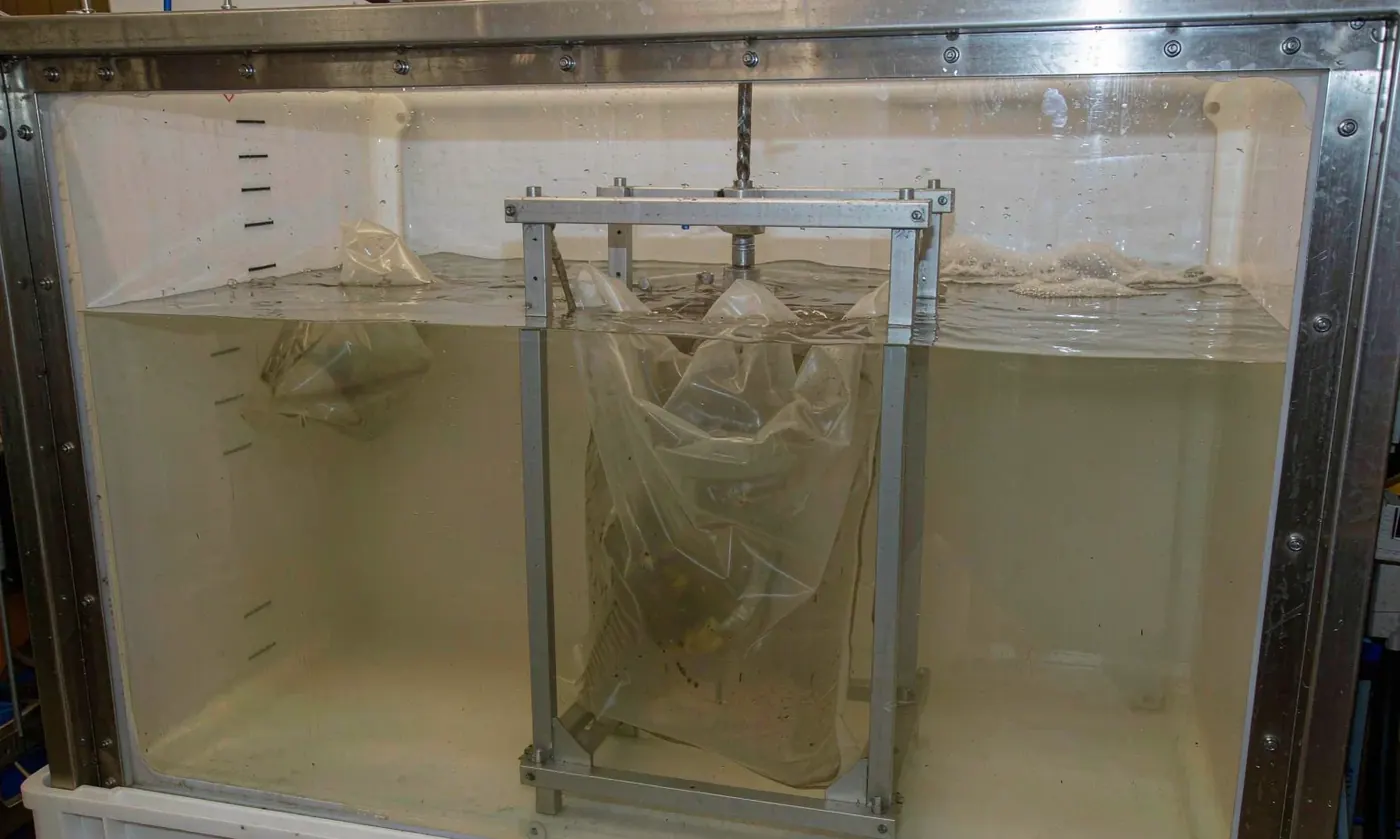
At 0.35 mm total gauge, a TPU composite usually folds into a roll-top radius of 12 to 18 mm without a pronounced hinge. That flexibility helps a user complete 3 clean closure turns with 75 to 100 mm of sealing height. A typical sheet weighs 380 to 520 grams per square metre. A 30 litre backpack consumes around 1.25 to 1.55 square metres after panels, reinforcements, and allowances, so the shell contributes approximately 475 to 805 grams before straps, foam, buckles, and trim.
The barrier performance is not limited by those fractions of a millimetre in ordinary rain. A sound 0.35 mm TPU composite commonly exceeds 10,000 mm hydrostatic head and may reach 20,000 mm, while a poorly welded corner can leak below 1,000 mm equivalent pressure. This is why thickness should be set after the seam method, not before it. For a welded roll-top body rated IPX6 or IPX7, 0.35 mm gives enough polymer at the seam for repeatable energy absorption without making the opening cumbersome.
- Use 0.35 mm TPU when a finished 25 to 35 L body must remain near 0.9 to 1.3 kg before accessories.
- Set a minimum gauge of 0.32 mm and a mass window no wider than about 100 gsm to control roll variation.
- Validate at least 20,000 flex cycles around a 10 mm mandrel if the pack will be opened daily.
- Specify 3 roll turns and test the complete closure, because film head alone does not establish an ingress code.
0.5 mm TPU: More Abrasion Margin, More Folding Work
Increasing TPU composite gauge from 0.35 to 0.5 mm adds around 180 to 280 grams per square metre depending on carrier and resin density. Across 1.4 square metres, that is about 250 to 390 grams on the finished pack. The benefit is a deeper wear reserve at exposed corners and a broader weld window: there is more polymer to flow across small yarn irregularities. Peel strength can rise from roughly 35 to 55 newtons per 25 mm to 50 to 75 newtons per 25 mm when carrier and process remain comparable.
The penalty appears every time the user folds the opening. A 0.5 mm laminate can require 25 to 50 percent more bending force than a 0.35 mm version, especially below 0 degrees Celsius. The roll becomes larger, consuming another 20 to 35 mm of effective body height for 3 turns. That may remove 1.5 to 3 litres from usable capacity. The thicker option earns its mass on guide packs, rental fleets, rocky canyon work, or exposed motorcycle loads; it is usually unnecessary for a 20 litre urban commuter.
| Property | 0.35 mm TPU | 0.50 mm TPU | Decision effect |
|---|---|---|---|
| Typical mass | 380 to 520 gsm | 560 to 760 gsm | Adds about 250 to 390 g on 1.4 m² |
| Fold radius | 12 to 18 mm | 18 to 28 mm | Thicker roll uses more opening height |
| Weld peel target | 35 to 55 N per 25 mm | 50 to 75 N per 25 mm | More seam reserve at high gauge |
| Cold flex target | Around -25°C | Around -25°C with higher force | Chemistry still matters more than gauge |
| Best volume | 20 to 35 L | 30 to 45 L | Match mass to load and abrasion |
0.5 to 0.7 mm PVC: Heavy-Duty Value With Limits
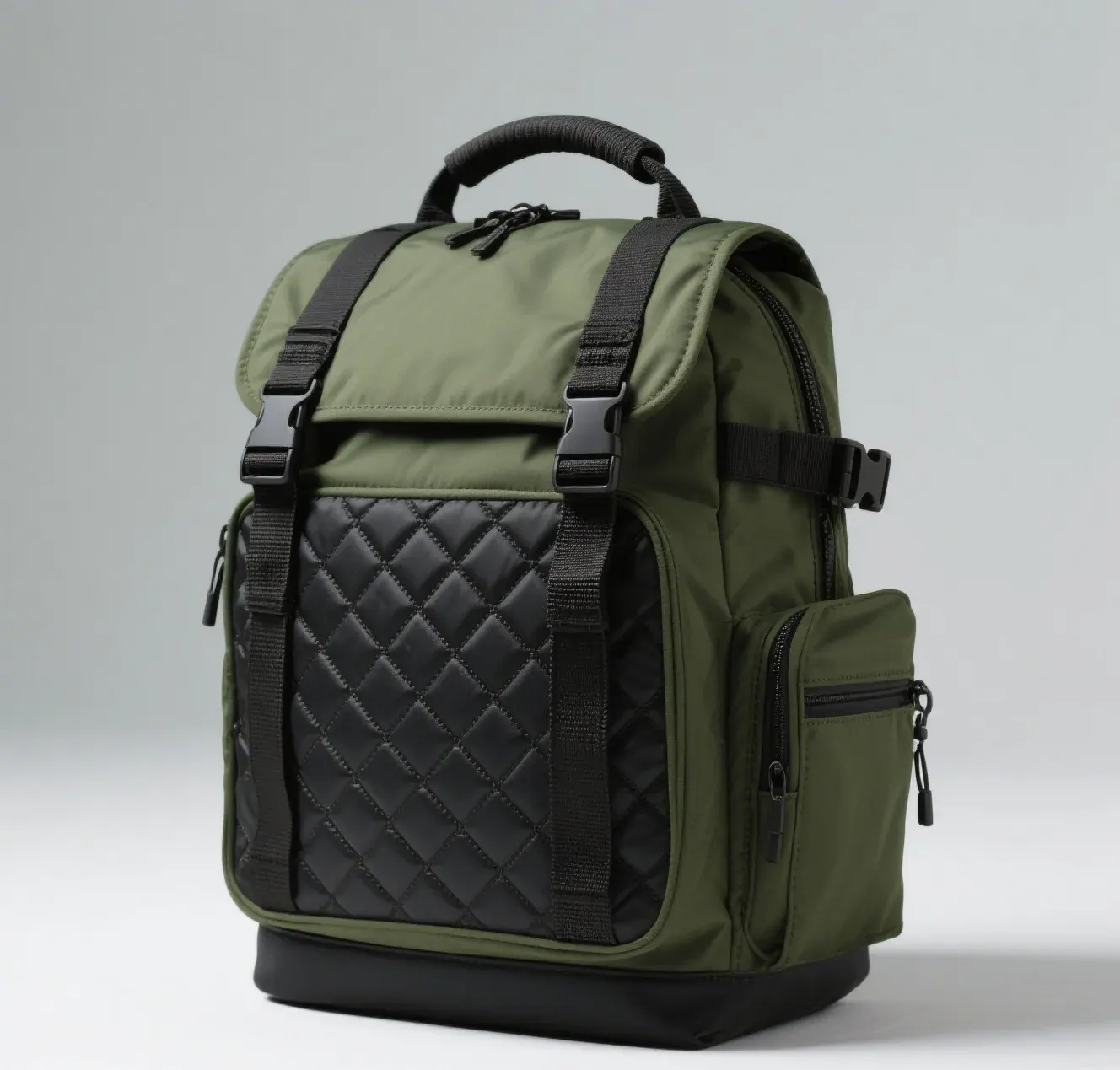
PVC reaches useful stiffness and abrasion resistance at a lower raw sheet price, which is why 0.5 and 0.7 mm gauges remain common in heavy dry bags. Density is the cost hidden by thickness. Flexible PVC is typically around 1.2 to 1.4 grams per cubic centimetre, versus roughly 1.1 to 1.25 for TPU systems, and the common PVC construction also uses a heavier 500D to 1000D polyester carrier. A 0.7 mm composite therefore lands around 850 to 1,150 grams per square metre.
For a 30 litre body using 1.4 square metres, 0.7 mm PVC can place 1.19 to 1.61 kg in the shell alone. Add 350 to 650 grams of harness, foam, webbing, closures, and reinforcements, and the completed pack may reach 1.6 to 2.2 kg before loading. The same geometry in 0.35 mm TPU may finish around 0.9 to 1.35 kg. A difference of 500 to 850 grams becomes meaningful after 10 km, yet it can be acceptable on a bag moved from vehicle to deck rather than carried all day.
Cold behaviour is the second limit. Plasticiser keeps PVC flexible, and its formulation determines whether a sheet remains workable at minus 10 or minus 20 degrees Celsius. Gauge does not rescue unsuitable chemistry; a thicker cold-stiff sheet can actually concentrate bending stress at a fold. Specify a low-temperature bend test and record cracking, whitening, and recovery after 4 hours of conditioning. TPU generally keeps a wider elastic range without depending on migratory plasticiser, which supports cold hiking and year-round logistics.
Thickness Does Not Equal Waterproof Rating
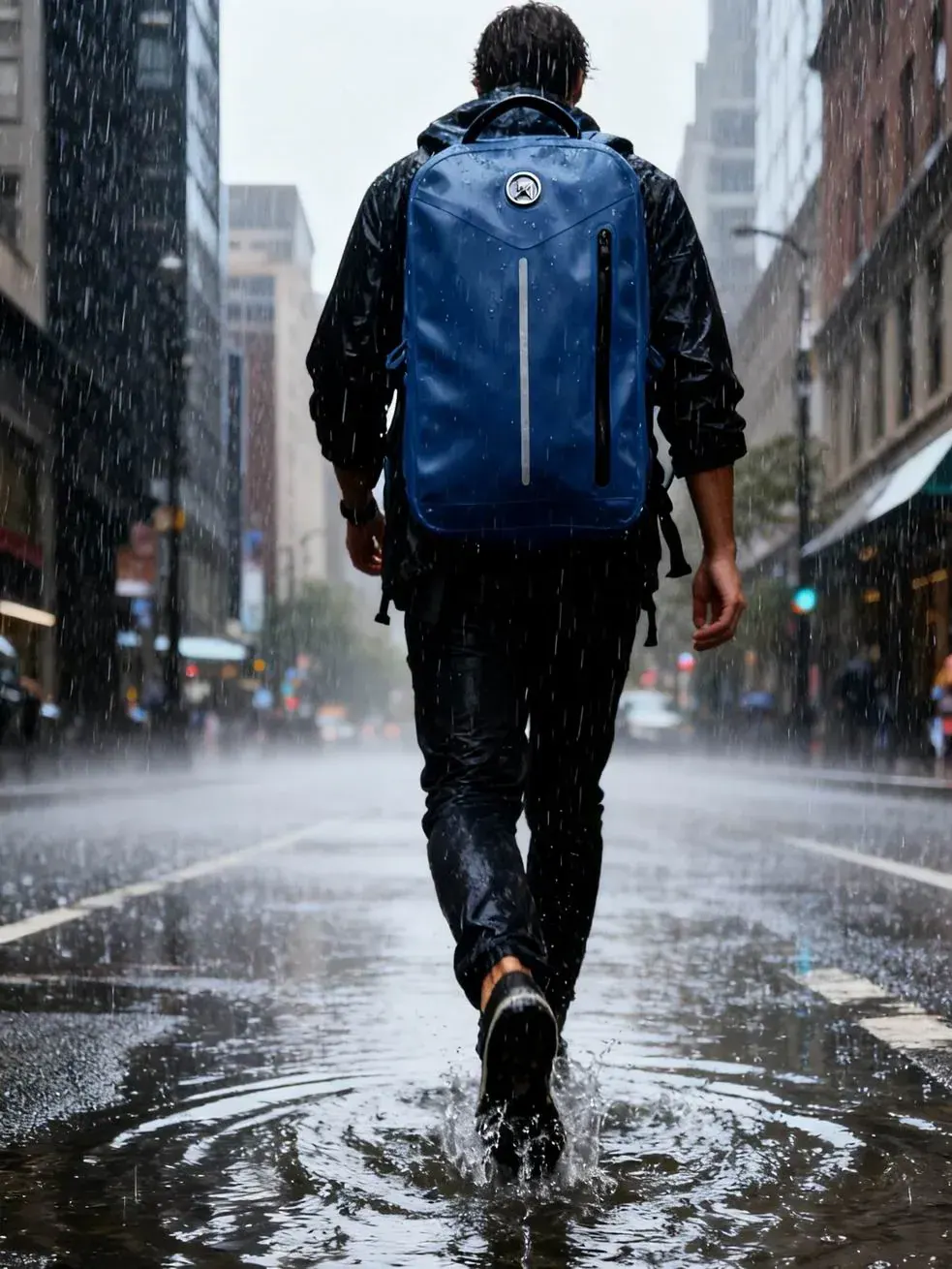
Water resistance of an intact film rises rapidly long before backpack use reaches the limit. Even a relatively thin TPU layer may pass more than 10,000 mm hydrostatic head, which equals about 98 kilopascals. Rain produces far less static pressure. The complete article fails first at a closure, weld termination, valve, or stitched attachment. Doubling composite gauge from 0.35 to 0.7 mm can double weight without changing an exposed coil zipper beyond IPX4. The money would have produced more protection if allocated to a sealed closure or a cleaner seam architecture.
Hydrostatic pressure can be compared under methods such as those published by the International Organization for Standardization, but a flat swatch result must not be presented as a whole-pack code. Ingress codes under IEC 60529 test an enclosure in a defined configuration. IPX5 uses a 6.3 mm nozzle and 12.5 litres per minute; IPX6 uses 100 litres per minute; IPX7 places the closed article in temporary immersion for 30 minutes. Each step asks more of seams and closure than of the centre of a panel.
| Claim or test | What it measures | Typical number | What it cannot prove | Buying response |
|---|---|---|---|---|
| Calliper gauge | Compressed total sheet thickness | 0.35, 0.50, or 0.70 mm | Whole-pack ingress | Request foot force and 10 readings |
| Areal mass | Mass of one square metre | 380 to 1,150 gsm | Flex life | Use with gauge and carrier denier |
| Hydrostatic head | Flat material pressure | 5,000 to 20,000 mm | Closure performance | Request method and failure point |
| IPX6 | Complete-body powerful jet exposure | 100 L per minute | Immersion survival | Check tested configuration |
| IPX7 | Temporary complete-body immersion | 30 minutes | Continuous deep use | Verify closure steps and depth |
The most efficient specification sequence is rating, closure, seam, carrier, and then gauge. A useful overview of those decisions appears in the waterproof backpack range, while material chemistry is compared in the TPU versus PVC backpack guide.
Abrasion, Puncture, and Flex Fatigue
Gauge improves some durability modes but not all of them. Abrasion removes material from the surface, so another 0.15 to 0.20 mm provides a real wear reserve. Puncture resistance depends on carrier yarn, weave density, and local tension as much as polymer depth. A sharp 1 mm hook can separate yarns in a thick 500D sheet, while a thinner ripstop with dense yarn intersections may redirect the point. Flex fatigue can become worse with thickness because strain concentrates at the outside of a tight fold.
Use separate tests. Run abrasion until substrate exposure, puncture with a defined probe and travel rate, and flex around a defined mandrel for 20,000 to 50,000 cycles. Methods and apparatus definitions can be sourced through ASTM International. Record retained hydrostatic head after abrasion and flex, because a sheet that looks acceptable may have microscopic coating fractures. A robust acceptance plan tests 5 specimens in each direction and reports the lowest result, not only the average.
| Durability mode | Main controlling variable | Useful test condition | 0.35 mm TPU expectation | 0.7 mm PVC expectation |
|---|---|---|---|---|
| Surface abrasion | Polymer wear layer | 5,000 to 20,000 cycles | Moderate to high | High before carrier exposure |
| Sharp puncture | Carrier weave and tension | Defined 1 to 3 mm probe | Strong with dense 420D carrier | Strong but heavy |
| Repeated folding | Resin elasticity and radius | 20,000 to 50,000 cycles | High at 10 to 15 mm radius | Lower at tight cold folds |
| Weld peel | Polymer flow and process window | N per 25 mm strip | 35 to 55 N target | 45 to 70 N target |
| Cold bend | Chemistry and plasticiser | 4 h conditioning | Often near -25°C | Often around -10°C to -20°C |
Welding Window and Seam Geometry
A stable weld needs enough compatible polymer at both faces, controlled energy, pressure, and cooling. Thin sheet has a narrow energy window: too little energy leaves weak fusion, while too much exposes or damages the carrier. Heavy sheet accepts more energy but stores more heat and can distort during cooling. For radio-frequency or hot-air seams, begin with 20 to 25 mm overlap, keep the active weld band around 10 to 15 mm, and leave 5 mm of clean margin from high-bulk webbing.
Corners reveal whether gauge and geometry are working together. Four layers crossing at one point create a stack 1.4 mm thick in 0.35 mm material and 2.8 mm thick in 0.7 mm material before compression. That abrupt step prevents uniform electrode pressure. Stagger panel ends by 15 to 25 mm, taper reinforcements, and keep hardware away from the fusion path. A carefully designed 0.35 mm seam can outperform a bulky 0.7 mm intersection because pressure reaches every part of the lighter stack.
- Approve weld peel on the minimum-gauge roll, because that is where polymer reserve is smallest.
- Condition specimens for 24 hours before destructive testing so warm seams do not produce optimistic numbers.
- Cut 25 mm strips across straight seams and around at least 4 corner transitions per inspection lot.
- Reject channel voids longer than 5 mm or edge lift wider than 2 mm even when a quick shower test passes.
Weight, Capacity, and Cost Trade-Offs
A material decision should be translated into a finished body rather than left in grams per square metre. Use net shell area, then add 12 to 18 percent for seam overlaps, reinforcements, and cutting allowance. A 20 litre body may consume 0.9 to 1.15 square metres, a 30 litre body 1.25 to 1.55, and a 45 litre body 1.65 to 2.05. Multiplying the high end by 1,150 gsm shows why 0.7 mm PVC becomes impractical for a long-carry 45 litre backpack.
| Body volume | Net material area | 0.35 mm TPU shell | 0.50 mm TPU shell | 0.70 mm PVC shell |
|---|---|---|---|---|
| 15 L | 0.75 to 0.95 m² | 285 to 495 g | 420 to 720 g | 640 to 1,090 g |
| 25 L | 1.05 to 1.35 m² | 400 to 700 g | 590 to 1,025 g | 890 to 1,550 g |
| 30 L | 1.25 to 1.55 m² | 475 to 805 g | 700 to 1,180 g | 1,060 to 1,780 g |
| 45 L | 1.65 to 2.05 m² | 625 to 1,065 g | 925 to 1,560 g | 1,400 to 2,360 g |
Price moves in the opposite direction to weight. Depending on colour, carrier, finish, and order scale, a 0.35 mm TPU composite may add 1.50 to 3.50 USD per body over 0.5 mm PVC, while 0.5 mm TPU can add another 1.20 to 2.80 USD. Those differences are modest next to a premium closure, which can add 6 to 21 USD. Do not save 2 USD on sheet and then lose the intended rating at a zip, but do not spend on heavy film where the closure already fixes the ceiling at IPX4.
A Repeatable Incoming and Programme Specification
An incoming checklist should name total gauge, areal mass, carrier denier, colour, surface texture, minimum hydrostatic head, weld peel, cold bend, abrasion retention, and restricted-substance requirements. Sample 5 rolls per colour when the lot is large, take 10 gauge readings across each selected roll, and retain a labelled A4 control piece. Pair dimensional evidence with a functional pack test at AQL 2.5 so material drift and assembly drift are both visible.
QUANZHOU JUNYUAN BAGS handles programmes from 500 pcs per design and colour, with samples typically ready in 6 to 10 working days and bulk in 35 to 50 days. Materials can be screened for REACH and California Prop 65, with shipment available FOB Xiamen or DDP to more than 100 countries. Gauge control, weld development, and pack-level checks are shown. Enquiries can be directed to service@junyuanbags.com.
The decision rule is concise. Choose 0.35 mm TPU for balanced 20 to 35 litre carry, 0.5 mm TPU for higher abrasion and seam reserve, and 0.5 to 0.7 mm PVC when economy and stationary toughness outweigh mass and cold flexibility. Then verify the choice with 10-point gauge data, grams per square metre, retained head after flex, and a complete-body ingress test. Thickness is useful only when those four numbers travel with it.
People Also Ask
Is 0.35 mm TPU thick enough for a waterproof backpack?
Yes for most 20 to 35 litre welded bodies. A typical 0.35 mm TPU composite weighs 380 to 520 grams per square metre, exceeds 10,000 mm hydrostatic head when sound, and folds into a 12 to 18 mm radius. Closure and seam design determine whether the complete pack reaches IPX6 or IPX7.
How much heavier is 0.7 mm PVC than 0.35 mm TPU?
The sheet difference is commonly 450 to 700 grams per square metre. On a 30 litre shell using about 1.4 square metres, that becomes roughly 630 to 980 grams before differences in trim are considered. Actual comparison requires total gauge, carrier, and areal mass from both sheets.
Does thicker coating increase hydrostatic head?
It can, but intact thin films already exceed the pressure needed for rain and temporary immersion. Whole-pack ingress normally starts at the closure or a seam termination, so moving from 0.35 to 0.7 mm may add mass without changing the IPX result. Test the complete article after setting gauge.
Why are thickness readings different across one roll?
Woven yarn crowns, coating flow, embossing, and calliper pressure create variation. Take at least 10 readings away from selvage, report foot force and diameter, and control minimum as well as average. A useful tolerance is ±0.03 mm near 0.35 mm and ±0.05 mm near 0.7 mm.
Which gauge is better below freezing?
A 0.35 or 0.5 mm TPU composite generally remains easier to fold near minus 25 degrees Celsius. Many flexible PVC sheets become markedly stiffer around minus 10 to minus 20 degrees, depending on plasticiser. Chemistry decides the transition; extra thickness cannot correct an unsuitable cold formulation.
How many thickness checks should incoming material receive?
Use at least 10 measurements across each selected roll and sample 5 rolls per colour for a large lot. Record average, minimum, maximum, test pressure, and conditioning time. Retain an A4 control piece and connect the data to weld peel and complete-body ingress results.
Frequently Asked Questions
Q1. What does backpack coating thickness mean?
It should mean the compressed total thickness of the coated composite, including woven carrier, tie layer, and polymer faces. Because some sheets report only polymer add-on, a specification must state total gauge, measurement pressure, minimum value, and areal mass to make comparisons valid.
Q2. What is the usual weight of 0.35 mm TPU backpack fabric?
About 380 to 520 grams per square metre, depending on whether the carrier is 420D, 500D, or another construction. A 30 litre body using 1.25 to 1.55 square metres therefore places roughly 475 to 805 grams in the shell before harness and trim.
Q3. What is the usual weight of 0.7 mm PVC backpack fabric?
Roughly 850 to 1,150 grams per square metre for common heavy coated polyester constructions. The shell of a 30 litre body can therefore weigh about 1.06 to 1.78 kg, and the completed backpack may reach 1.6 to 2.2 kg before contents.
Q4. Is 0.5 mm TPU better than 0.35 mm TPU?
It is better only when extra abrasion reserve and weld peel justify 250 to 390 grams more on a 1.4 square metre shell. For daily commuting and 20 to 35 litre carry, 0.35 mm is often more comfortable. For rocky guide use or rental fleets, 0.5 mm can earn its mass.
Q5. Can 0.7 mm PVC reach IPX7?
Yes, if the complete body uses suitable welded seams and a closure that survives temporary immersion. The thick sheet alone cannot establish IPX7. An exposed coil zip may limit the article near IPX4 even when the flat PVC material has very high hydrostatic resistance.
Q6. How does gauge affect a roll-top closure?
Thicker sheet increases fold radius and consumes more vertical space. A 0.35 mm TPU opening may fold around 12 to 18 mm, while a 0.5 mm version may need 18 to 28 mm. Three turns in the heavier material can reduce usable height by another 20 to 35 mm.
Q7. Which figure should accompany millimetre thickness?
Areal mass in grams per square metre is the first companion figure. Add carrier denier, minimum hydrostatic head, cold-bend condition, and weld peel in newtons per 25 mm. Together those values expose whether two sheets with the same calliper gauge are materially different.
Q8. How should coating thickness be measured?
Condition the sheet for 24 hours, use a defined calliper foot and force, avoid edges and embossed marks, and take 10 readings across useful width. Report average, minimum, and maximum. Never approve a 50 metre roll from one centre reading.
Q9. Does a thicker sheet always resist puncture better?
No. Thickness adds a wear layer, but puncture also depends on carrier yarn, weave density, local tension, and point geometry. A dense thinner ripstop can redirect a sharp probe better than a heavy open weave. Test abrasion, puncture, and flex separately.
Q10. What are the MOQ and timing for a coated waterproof backpack project?
A practical starting point is 500 pcs per design and colour. Evaluation samples usually require 6 to 10 working days, and bulk completion takes about 35 to 50 days after approval. Inspection may follow AQL 2.5, with FOB Xiamen or DDP shipping options.