A fishing tackle backpack should be judged on tray fit before anything else: how many 3600 or 3700 boxes actually slide in, whether the rails survive a season, and whether the base holds its shape when the bag is set down loaded. Eight builds were tested on those criteria for 2026, spanning 22-45 usable litres, two to six box slots, and 0.85-1.70 kg empty, with FOB Xiamen bands from 16 to 48 dollars per unit at MOQ 500 pcs per design and colour. Samples take 6-10 working days and bulk runs 35-50 days. The winner is the 36 L four-box build, because it is the only one that fits four 3600 boxes without forcing the closure.
What Tested Means in This Category
Most tackle backpack reviews compare photographs and specifications. That is not testing, and it misses the failure modes that actually generate complaints: a box that fits only when the bag is empty, a tray rail that wears through in one season, a moulded base that cracks when the loaded bag is dropped, and a strap anchor that pulls out at the top stitch line. The eight builds below were put through a fixed sequence covering exactly those four, plus a closure cycle run.
The category has a standard shape that is worth naming. The mainstream retail format is a soft bag of roughly 30-38 L with three or four 3600 trays in a front chamber, a moulded or padded base, two side rod straps, and one or two zip pockets. Everything in this ranking is measured against that format, because it is what buyers and anglers both expect, and deviation from it should be deliberate and explained rather than accidental.
| Test | Method | Pass condition | What it catches |
|---|---|---|---|
| Box fit, loaded | Insert stated boxes, close, invert | Closes without force, no bulge | Overstated capacity |
| Rail wear | 500 tray insertions and removals | No rail deformation or fraying | Rails that wear through in a season |
| Base drop | Loaded to 12 kg, dropped 300 mm | No crack, no permanent dent | Brittle moulded bases |
| Strap anchor | Pull to 3 times loaded weight | No stitch failure at the anchor | Top anchor pull-out |
| Closure cycle | 500 cycles, wet, with grit | Slider tracks true, tape uncut | Tape wear and slider failure |
Tray Systems: 3600, 3700, and What Actually Fits
Tray capacity is the number buyers argue about most, and it is also the number most often inflated. A 3600 box is roughly 270 x 180 x 45 mm and a 3700 is roughly 355 x 230 x 50 mm, so a chamber that holds four 3600 boxes will usually hold only two 3700 boxes in the same orientation. Any capacity claim should state which box and which orientation, and a claim of four boxes without that detail is close to meaningless.
Orientation matters as much as count. Boxes stood vertically are visible at a glance and are retrieved by the top edge, which is what anglers want. Boxes stacked flat are buried and every retrieval means unpacking. Vertical racking costs internal width and usually reduces the litre figure, which is exactly why so manybags are sold on litres instead of box count.
| Box | Approximate size | Chamber width needed | Typical slots in 36 L |
|---|---|---|---|
| 3600 | 270 x 180 x 45 mm | 190-200 mm per slot | Four vertical |
| 3700 | 355 x 230 x 50 mm | 240-250 mm per slot | Two vertical |
| Mixed 3600 plus 3700 | Both | 440-460 mm combined | Two of each |
| Shallow utility tray | 270 x 180 x 30 mm | 190-200 mm per slot | Five vertical |
The full dimensional argument is set out in the 3600 versus 3700 comparison, and tray construction types are covered in the tackle tray guide. For this ranking, the test is simple and unforgiving: the stated number of boxes must go in and the closure must shut without force, with the bag standing on its base rather than lying down.
1. Tray-Master 36: Best Overall Organisation
The Tray-Master is the only build in the eight that fits four 3600 boxes vertically and still closes on a loaded bag without any forcing. That sounds like a small thing and it is the whole difference between a bag that works and a bag that is returned. Thirty-six usable litres, a divided front chamber with open-radius rails, 1.30 kg empty, and a moulded EVA base that passed the 300 mm drop test at 12 kg with no cracking.
The rails are the reason it wins. An open-radius rail lets grit fall out rather than jamming, and after 500 insertion cycles there was no measurable deformation. The compromise is width: at 320 mm across it is a broad bag, which makes it slightly awkward in dense cover. Reference band is 28-36 USD FOB Xiamen at 500 pieces, and it is the configuration we recommend as the default for a retail range of one.
2. Bank Kit 28: Best for Bank Anglers
Bank anglers walk more and carry less, so this build trades box count for weight. Twenty-eight litres, three 3600 slots, 0.95 kg empty, and a narrower 260 mm body that does not catch on scrub. The base is a welded coated panel rather than a moulded insert, which saves about 300 g and holds up fine when the bag is set down on grass or gravel rather than dropped on rock.
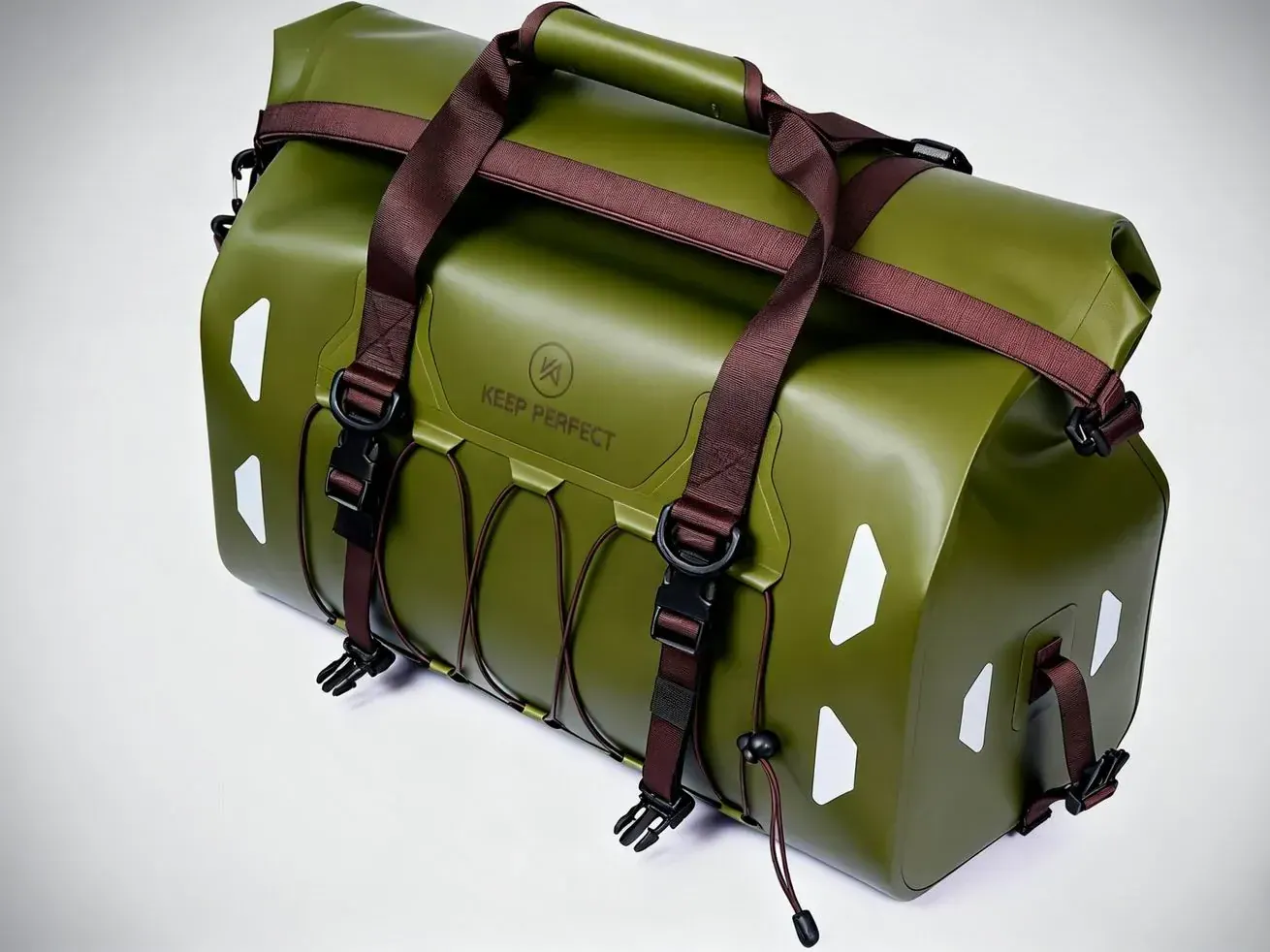
Waterproofing is IPX5, which is honest for the job: a bank angler is not immersing the bag. Two external rod straps are included with a closed lower cup, and there is a drained wet pocket at the side for a landing net or a rag. Reference band is 21-27 USD, and it is the strongest seller in the entry-to-mid part of a range.
3. Bass Rig 42: Best for Bass and Big Trays
Bass anglers carry bigger baits and more of them, which pushes the build toward 3700 boxes and a wider chamber. Forty-two litres holds four 3700 boxes vertically, or six 3600 boxes with a divider change, at 1.55 kg empty. The chamber is 470 mm across, which is genuinely wide, and the harness is correspondingly heavier with a real hip belt rather than a webbing strap.
That width is the trade and it should be stated plainly: this bag is uncomfortable in tight cover and awkward on public transport, and it is not a travel bag in any sense. What it does is hold a full tournament-day kit without a second container. Reference band is 32-41 USD, with a moulded base as standard because the loaded weight is high enough that a fabric base would sag.
4. Chill Pack 34: Best With a Cooler Section
A cooler section turns a tackle bag into a full-day bag, and it is the single feature that most often decides a retail purchase. The Chill Pack integrates 8 mm insulation with a welded liner in the lower third, isolated from the tray chamber by a solid panel so condensation never reaches the hooks. Thirty-four litres total, with about 9 L of that in the cooler and three 3600 slots above.
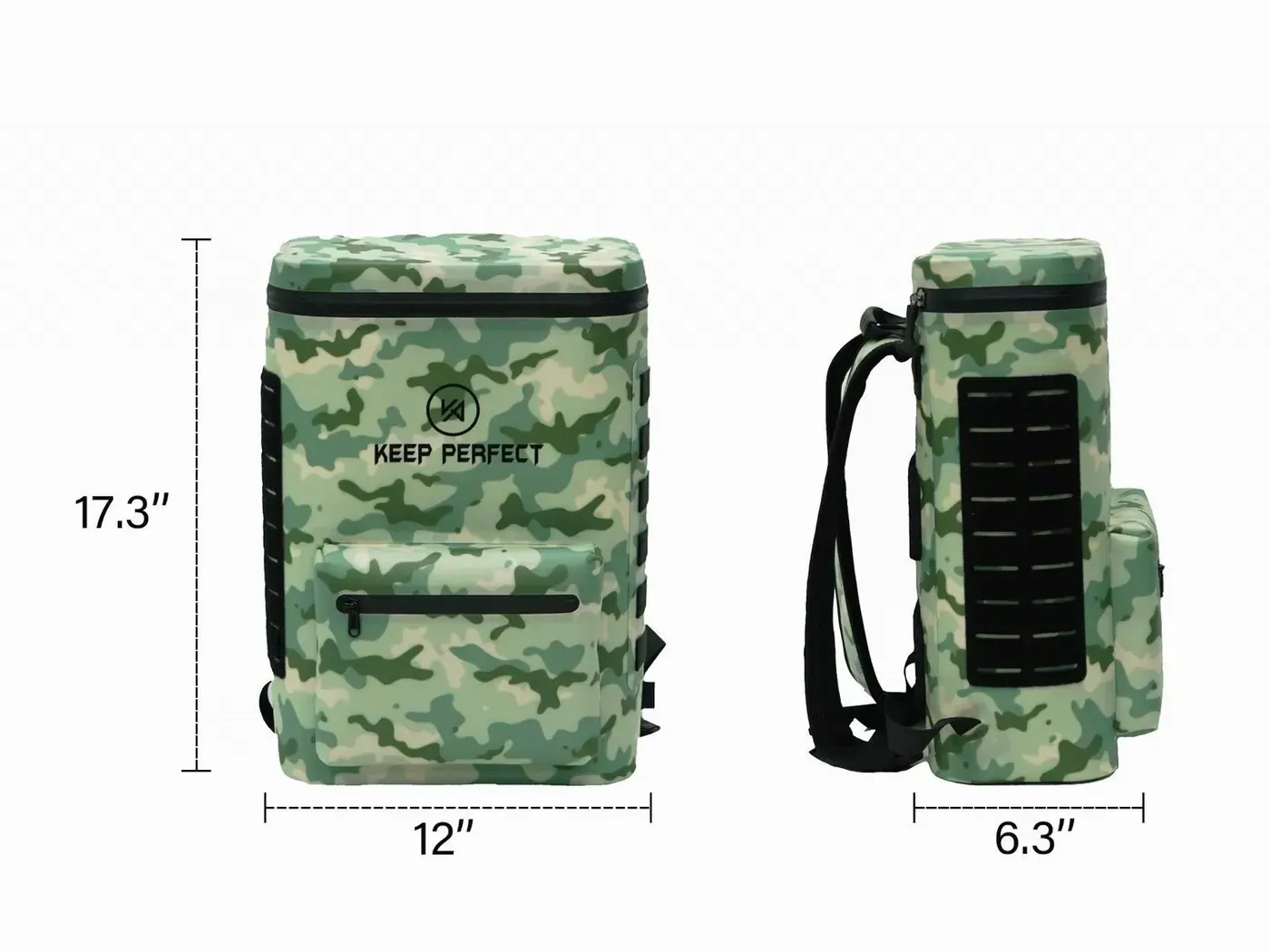
The drain is the part to specify carefully. It must clear water at a reasonable rate without letting grit in, and a sloped channel with no lip is the reliable geometry. Reference band is 29-37 USD, and the cooler adds roughly 350 g to the empty weight, which is the honest cost of the feature.
5. Wade Lite 22: Best Compact Build
Twenty-two litres, two 3600 slots, and 0.85 kg is about as small as a useful tackle backpack gets. It sits high on the back to stay clear of a deep wade, the profile is narrow enough not to foul a cast, and the closure is a covered zip that can be worked one-handed while a rod is held in the other. Rating is IPX6, which covers a slip and a dunk.
The important detail is the liner. At this volume there is no room for a separate chamber, so the bag ships with a 3 L sealed pouch for a phone, licence, and key. Without it the bag would be pointless in water, and with it the build is genuinely usable for wading. Reference band is 18-24 USD, and it doubles as a strong entry price point.
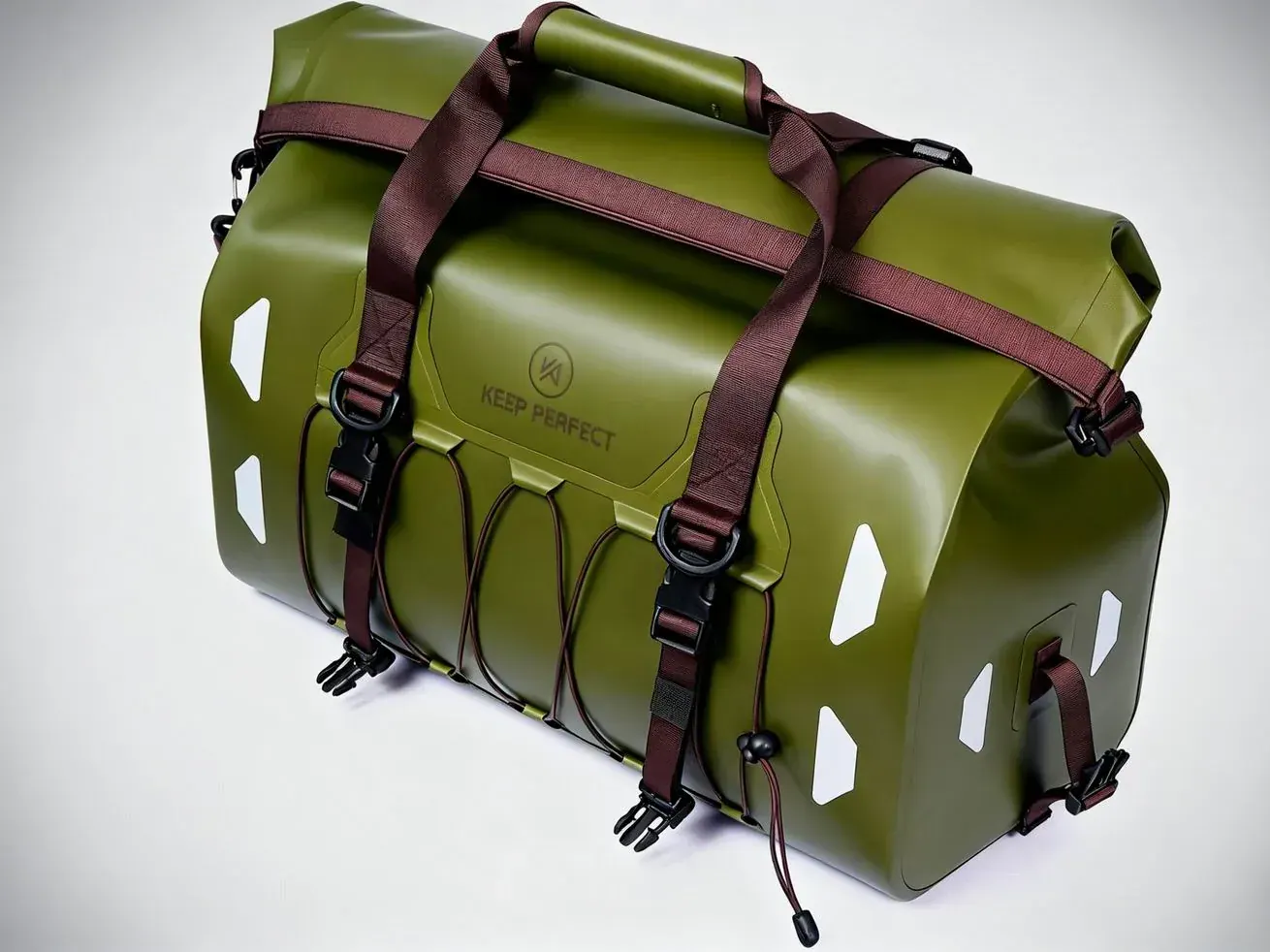
6. Hatch Fit 26: Best for Kayak Hatches
Kayak anglers have a constraint no other format has: the bag has to pass through a hatch, and hatches are small. This build is dimensioned at 240 x 380 mm in cross-section so it clears a 250 mm round hatch and a 300 mm oval hatch, which covers the great majority of recreational fishing kayaks. Twenty-six litres, three 3600 slots, and 1.00 kg.
The trade is depth rather than volume. To fit the hatch the bag is shallower front to back, which means boxes sit in a single row rather than two. That is fine for kayak use and limiting for bank use. Reference band is 23-30 USD, and it is the build most often paired with a crate system rather than bought on its own.
7. Guide Duty 45: Best for Guide and Charter Work
Guide duty is an abuse case. The bag is loaded to 14-18 kg, dragged, dropped, hosed down, and left damp six days a week. This build answers with a 1000D face, a moulded base with a replaceable wear strip, 316 stainless hardware, and doubled strap anchors tested to three times the loaded weight. Forty-five litres, six 3600 slots, 1.70 kg empty.
It is expensive and heavy and it should be. Service life on charter duty is two to three seasons for this build against one season for a mid-tier bag, which makes the total cost per season lower despite the higher unit price. Reference band is 38-48 USD, and it is the build to specify when the buyer customer is a commercial operator rather than a consumer.
8. Starter 24: Best Entry Build
The Starter exists to hit a price point without becoming a disposable product. Twenty-four litres, two 3600 slots, 0.88 kg, a 420D face, and a welded coated base with no moulding. It passed every test in the sequence except the base drop, where a loaded drop onto rock left a permanent dent but no crack, which is an acceptable result at this price.
What has been removed is worth listing for honesty: no cooler, one rod strap rather than two, a fixed sternum strap, and 304 rather than 316 hardware. It is rated IPX5, and the recommendation is bank and freshwater use only. Reference band is 16-21 USD, and it is the correct answer for a first order into a market where the buyer does not yet know the price ceiling.
Rod Holders, Tool Docks, and External Carry
Rod carry is where most tackle backpacks quietly fail. A single strap at the top lets the rod pivot, and the butt end swings into the angler leg on every step. Two support points separated by at least 400 mm with a closed lower cup is the correct geometry, and the lower cup must be closed or the rod will slide straight through when the bag is set down.
| External item | Carry method | Requirement | Failure if wrong |
|---|---|---|---|
| Rod, assembled | Two straps 400 mm apart, closed lower cup | Butt cannot slide through | Rod pivots and strikes the leg |
| Rod tube | Rigid side sleeve | Sleeve length over 600 mm | Tube bends at the ferrule |
| Landing net | Rear dock with one-hand release | Clear of the casting arm | Net fouls the line |
| Pliers and forceps | Sheath dock at the shoulder | One-hand draw | Tools at the bottom of a pocket |
| Rain shell | Compression straps under the bag | Under 400 g | Shell dangles and snags |
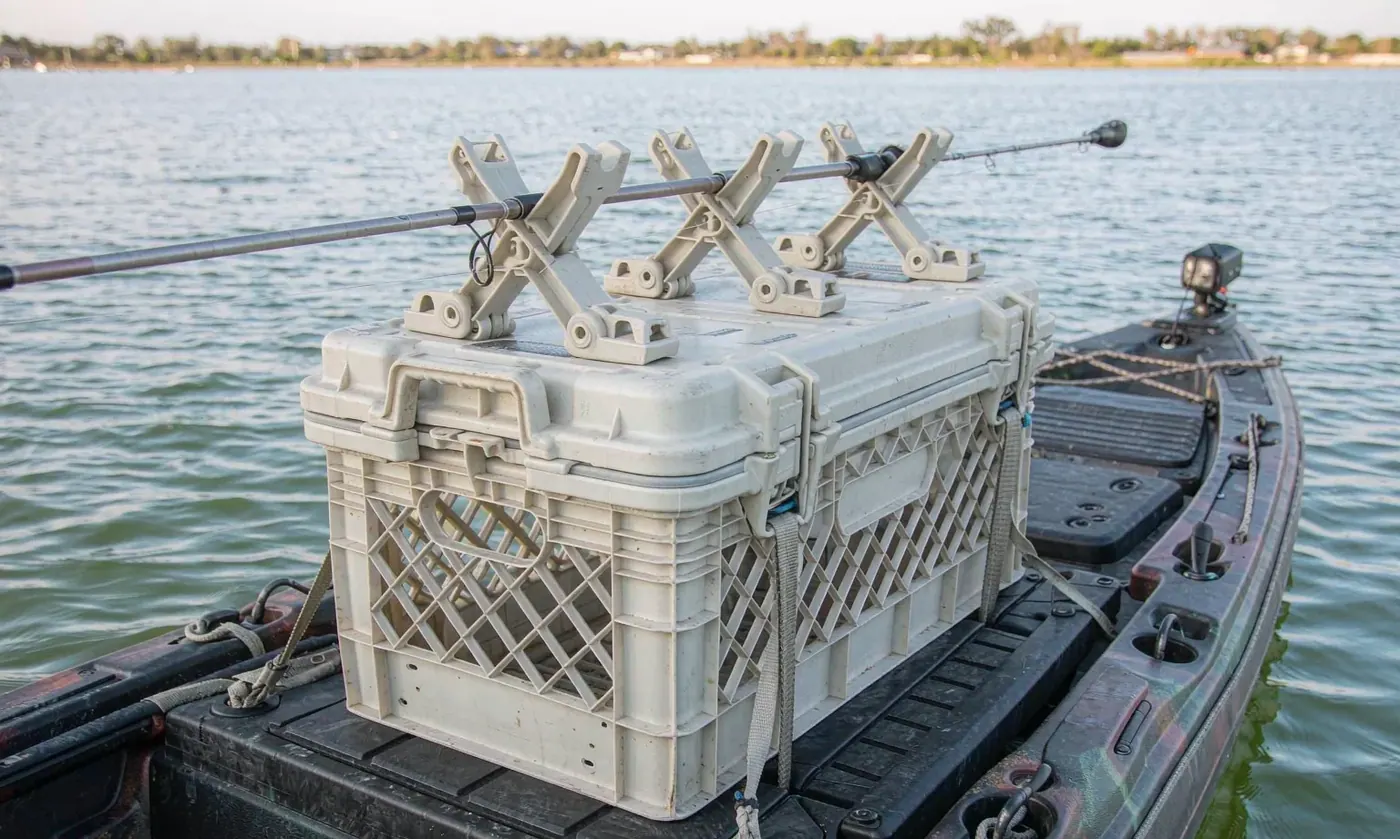
Adding a rod holder to an existing build is possible and is covered in the rod holder attachment guide. The decision that matters is whether the rod is carried assembled or in a tube: assembled rods need the two-strap geometry, and tubes need a rigid sleeve, and a design that tries to do both usually does neither well.
Where Our Own Builds Sit
Aquagrip builds in this category sit in the same eight configurations rather than competing with them, and the useful distinction is what each is optimised for. The 36 L four-box build is the volume seller, the 22 L wading build is the specialist, and the 45 L guide build is the commercial answer. None of them is positioned as a premium lifestyle product, because the category does not reward that.
Where the range genuinely differs from the mainstream retail format is in three places: the tray rails are open-radius and tested to 500 cycles, the base is available as a moulded EVA insert with a replaceable wear strip, and every build can be ordered with a sealed liner pouch. Those three changes cost 2-4 USD per unit and remove the three most common field complaints in the category.
| Failure complaint | Usual cause | Aquagrip answer | Cost impact |
|---|---|---|---|
| Boxes do not fit | Capacity stated in litres | Chamber dimensioned to box size | None |
| Rails wear out | Narrow slot rails trap grit | Open-radius rail, 500-cycle tested | 1-2 USD |
| Base cracks or sags | Fabric or brittle moulded base | Moulded EVA with a wear strip | 2-4 USD |
| Phone gets wet | No liner in a compact build | Sealed pouch supplied | 1-2 USD |
| Straps pull out | Single-row top stitch | Doubled anchor, pull tested | Under 1 USD |
How to Choose Between the Eight
The decision tree is short once the buyer knows two things: how the customer fishes and how many boxes they carry. Bank anglers want the narrow 28 L build. Bass anglers want the wide 42 L build. Kayak anglers are constrained by the hatch and take the 26 L build. Guide operations buy the 45 L build on total cost per season, and everyone else starts at the 36 L four-box build.
| Buyer situation | Recommended build | Why | Alternative |
|---|---|---|---|
| One bag for a retail range | Tray-Master 36 | Fits four boxes and closes | Chill Pack 34 if cooler sells |
| Bank and freshwater entry | Starter 24 | Price point, honest limits | Bank Kit 28 |
| Bass and tournament | Bass Rig 42 | Four 3700 slots | Tray-Master 36 |
| Kayak and small craft | Hatch Fit 26 | Clears a 250 mm hatch | Wade Lite 22 |
| Charter and guide | Guide Duty 45 | Lowest cost per season | None in this ranking |
The wider selection argument, covering harness, material, and closure choice as well as capacity, sits in the tackle backpack selection guide, and the full category is summarised in the fishing tackle backpack overview. Both should be read before a first order, because the expensive mistakes in this category are made at the brief stage rather than at the sample stage.
Materials, Abrasion, and Colour
Fabric choice in a tackle backpack is mostly an abrasion question. The base and the lower side panels take the wear, and the upper panels mostly just hold shape. A 420D face is fine for occasional freshwater use, 600D is the sensible default, and 1000D earns its weight penalty only on guide duty or where the bag is dragged across a deck.
Two measurable properties belong in the brief. Abrasion resistance of the coated shell can be required to a stated cycle count using published methods from ASTM International, and colour fastness to rubbing and light can be required using methods from AATCC. A grey scale of 4 or better after dry and wet rubbing is a normal retail requirement and prevents the most common appearance complaint in dark colourways.
Programme, Pricing, and Compliance
Pricing in this category moves with four variables: face fabric, base construction, tray count supplied, and hardware grade. Everything else is a rounding error. A buyer should fix the target FOB figure and the tray count first, because those two determine whether the rest of the brief is even achievable, and they are the two figures most often left vague until sampling has already started.
| Programme item | Baseline | Note |
|---|---|---|
| MOQ | 500 pcs per design and colour | Colour split negotiable above the baseline |
| Sampling | 6-10 working days | Add 3-5 days for a moulded base change |
| Bulk | 35-50 days | From approved sample and deposit |
| Inspection | AQL 2.5 | Include box fit, rail check, base drop, strap pull |
| Compliance | REACH and California Prop 65 | Screen coatings, films, inks, hardware, trays |
QUANZHOU JUNYUAN BAGS has developed waterproof bag programmes since 2014, with the founding team active in the industry since 2004. Monthly output of 200,000 units is verified by SGS, and BSCI and ISO 9001 systems structure the workflow. Materials are screened for REACH and California Prop 65, and every bulk order is inspected at AQL 2.5 before shipment.
A tackle backpack brief can be emailed to service@junyuanbags.com; include box type and count, litres, base construction, hardware grade, market, and quantity. FOB Xiamen or DDP service to more than 100 countries follows an approved sample and a complete test record.
People Also Ask
How many 3600 boxes fit in a tackle backpack?
Four vertical slots in a 36 L build dimensioned for them, and six with a divider change in a 42 L build. Always check whether the claim means 3600 or 3700 boxes and in which orientation.
What is the difference between a 3600 and a 3700 box?
A 3600 is roughly 270 x 180 x 45 mm and a 3700 roughly 355 x 230 x 50 mm. A chamber holding four 3600 boxes usually holds only two 3700 boxes.
Should tackle boxes stand vertically or lie flat?
Vertically. Boxes on edge are visible at a glance and are retrieved by the top edge, while flat stacks bury everything below the first layer.
What makes a tackle backpack base last?
A moulded EVA insert with a replaceable wear strip, tested by dropping the bag loaded to 12 kg from 300 mm. Fabric bases sag and brittle moulded bases crack.
Do I need a cooler section in a tackle backpack?
Only for full-day use. It adds about 350 g and must be isolated from the tray chamber by a solid panel, or condensation will rust the hooks.
What fabric denier suits a tackle backpack?
600D is the sensible default, 420D suits occasional freshwater use, and 1000D earns its weight penalty only on guide duty or deck dragging.
Frequently Asked Questions
Q1. What is the best fishing tackle backpack overall?
A 36 L build with four vertical 3600 slots, open-radius rails, and a moulded EVA base. It is the only configuration in testing that fits four boxes and still closes on a loaded bag without forcing.
Q2. How many tackle boxes fit in a 36 litre backpack?
Four 3600 boxes vertically, or two 3700 boxes. Any claim above that should be checked with the bag standing on its base and fully loaded.
Q3. What is the difference between 3600 and 3700 boxes?
A 3600 is roughly 270 x 180 x 45 mm and a 3700 is roughly 355 x 230 x 50 mm. The 3700 needs about 50 mm more slot width, so counts are not interchangeable.
Q4. Do I need a moulded base on a tackle backpack?
Yes above about 30 L. A fabric base sags under a loaded bag, and a moulded EVA insert with a replaceable wear strip survives a 300 mm drop at 12 kg.
Q5. How do I test whether a tackle backpack really fits the boxes it claims?
Insert the stated boxes, close the bag, and invert it. If the closure needs force or the body bulges, the capacity claim is overstated.
Q6. What size tackle backpack suits bank fishing?
About 28 L with three 3600 slots and a narrow 260 mm body. Weight and width matter more than box count when the angler walks between spots.
Q7. What backpack suits bass fishing?
About 42 L holding four 3700 boxes vertically with a chamber roughly 470 mm across. It is wide and heavy, which is the honest trade for a tournament-day kit.
Q8. Can a tackle backpack fit through a kayak hatch?
Yes if it is dimensioned to about 240 x 380 mm in cross-section, which clears a 250 mm round hatch and a 300 mm oval hatch.
Q9. How should a rod be carried on a tackle backpack?
Assembled rods need two straps at least 400 mm apart with a closed lower cup. Rod tubes need a rigid sleeve longer than 600 mm, and a design trying to do both usually does neither well.
Q10. Is a cooler section worth the extra weight?
For full-day use, yes. It adds about 350 g and must be isolated from the tray chamber, otherwise condensation rusts hooks faster than any splash.
Q11. What is the best tackle backpack for guide or charter use?
A 45 L build with a 1000D face, 316 stainless hardware, and doubled strap anchors. It costs 38-48 USD but gives two to three seasons against one for a mid-tier bag.
Q12. How much does a fishing tackle backpack cost to import?
FOB Xiamen reference bands run from 16-21 USD for an entry 24 L build to 38-48 USD for a 45 L guide build, with the volume seller in the 28-36 USD band.
Q13. What fabric denier should I specify?
600D is the default, 420D suits occasional freshwater use, and 1000D suits guide duty. Abrasion should be required to a stated cycle count using ASTM methods.
Q14. What is the MOQ and lead time for a tackle backpack programme?
MOQ is 500 pcs per design and colour, samples take 6-10 working days, and bulk runs 35-50 days from approved sample and deposit.