A fishing sling pack is built for sessions where the angler needs one or two trays and frequent access without setting the bag down. The useful range is 8-15 L holding one or two 3600 trays, with a loaded weight of 2-5 kg and a single strap of 50-75 mm that rotates the body from back to chest in one motion. It is not a substitute for a 30 L backpack on a full-day walk. Specify a rotation angle of at least 120 degrees, an ambidextrous strap anchor where the market is mixed, and IPX5 or better for wet use.
What a Sling Pack Is For, and What It Is Not
A sling pack solves one problem extremely well: reaching gear without stopping. The body rides on the back, rotates around the torso on a single strap, and presents the tray compartment at chest height where both hands can work. That is ideal for a bank session, a pier, a short wade, or a boat deck where the angler changes lures every few minutes and does not want to put anything down on wet ground.
It is not a load carrier. A single strap cannot distribute 10 kg comfortably, and the asymmetric loading becomes obvious within twenty minutes of walking. Above roughly 5 kg, or on any walk longer than 1 km, a backpack is the correct format. The honest framing is that a sling and a backpack are complementary: the sling for short sessions with a small selection, the backpack for travel days and full kits.
| Situation | Sling suitability | Reason | Alternative |
|---|---|---|---|
| Two to four hour bank session | Excellent | Frequent access, light load | Not needed |
| Pier or jetty | Excellent | Hands free, small kit | Tote for larger kit |
| Kayak or boat deck | Good | Compact, stays clear | Crate bag for bulk |
| Short wade | Good | Rotates clear of water | Waist pack for minimal kit |
| Full day walk over 1 km | Poor | Asymmetric load above 5 kg | Tackle backpack |
The fishing backpack versus sling comparison works through that decision with load and distance figures. Most anglers who own both reach for the sling far more often, simply because short sessions outnumber long ones by a wide margin in most seasons.
Capacity, Tray Fit, and Internal Layout
Eight to 15 L is the working range. An 8-10 L body holds one 3600 tray plus tools and a small pouch. A 12-15 L body holds two 3600 trays or one 3700 tray with room for a light layer. Anything above 15 L stops behaving like a sling, because the body becomes tall enough to catch the arm during casting and wide enough to interfere with a rod stroke.
Tray access direction matters more here than in a backpack. A sling should present trays horizontally at chest height when rotated, so the lid opens away from the body and the contents are visible without tilting. A tray that opens vertically or toward the wearer forces an awkward wrist angle and is the most common reason a well-built sling gets returned.
| Volume | Tray load | Loaded weight | Session length |
|---|---|---|---|
| 8-10 L | 1 tray at 3600 | 2-3 kg | Up to 3 hours |
| 11-13 L | 1 to 2 trays at 3600 | 3-4 kg | 3 to 5 hours |
| 14-15 L | 2 trays at 3600 or 1 at 3700 | 4-5 kg | Half day |
| Above 15 L | Not recommended | Above 5 kg | Use a backpack |
Pockets finish the layout. Specify a plier sheath for 200-250 mm tools, a spool pocket for four 100 mm spools, a drained external pocket for a wet rag or a small landed fish measure, and a sealed flat pocket for phone and licence. Keeping the sealed pocket on the strap side of the body means it stays accessible when the pack is rotated forward. Weight distribution inside a sling is less forgiving than in a backpack, so heavy items belong close to the spine and low, while soft light items sit at the outer edge where they cannot pull the body away from the back.
One more layout rule matters at this size: limit the number of internal pockets. A sling with six pockets fills them all and then cannot close, because each pocket steals from a body that has no spare volume. Three well-placed pockets outperform six, and a programme brief should state the pocket count rather than leaving it to interpretation during development.
Strap Geometry and Rotation Mechanics
The strap is the whole product. It needs to be wide enough to carry 4 kg without cutting, narrow enough not to interfere with a casting arm, and anchored so the body rotates smoothly rather than sliding. A width of 50-75 mm with 8-12 mm foam covers most users. Below 50 mm the strap concentrates pressure on the trapezius within thirty minutes; above 75 mm it crowds the neck on smaller frames.
Rotation is a geometry problem, not a strength one. The strap should anchor at two points on the body separated by at least 200 mm vertically, so the pack pivots predictably instead of twisting. Test for at least 120 degrees of travel from full-back to full-chest with the load fitted, and confirm the body does not swing more than 40 mm laterally when the wearer bends forward to land a fish.
- Use 50-75 mm strap webbing with 8-12 mm foam and a breathable face.
- Anchor at two points separated by at least 200 mm vertically.
- Confirm at least 120 degrees of rotation travel under load.
- Add a secondary stabiliser strap for scrambling or wading.
- Check that the strap buckle does not sit under the pack body when rotated.
Ambidextrous design is worth specifying whenever the market is mixed. A sling built for right-shoulder carry is awkward for a left-handed caster, and roughly one in ten anglers will notice immediately. Convertible anchor points that allow either shoulder cost little and remove a common reason for a return that has nothing to do with product quality.
The buckle position is the detail that separates a pleasant sling from an annoying one. If the buckle sits under the body when rotated forward, the wearer has to lift the whole pack to adjust it, which defeats the purpose of the format. Place the adjuster on the front strap run where it can be reached with the free hand while the other holds a rod, and confirm the position with a loaded rotation test rather than on an empty pack.
Cooler Inserts, Tool Carry, and Small Add-Ons
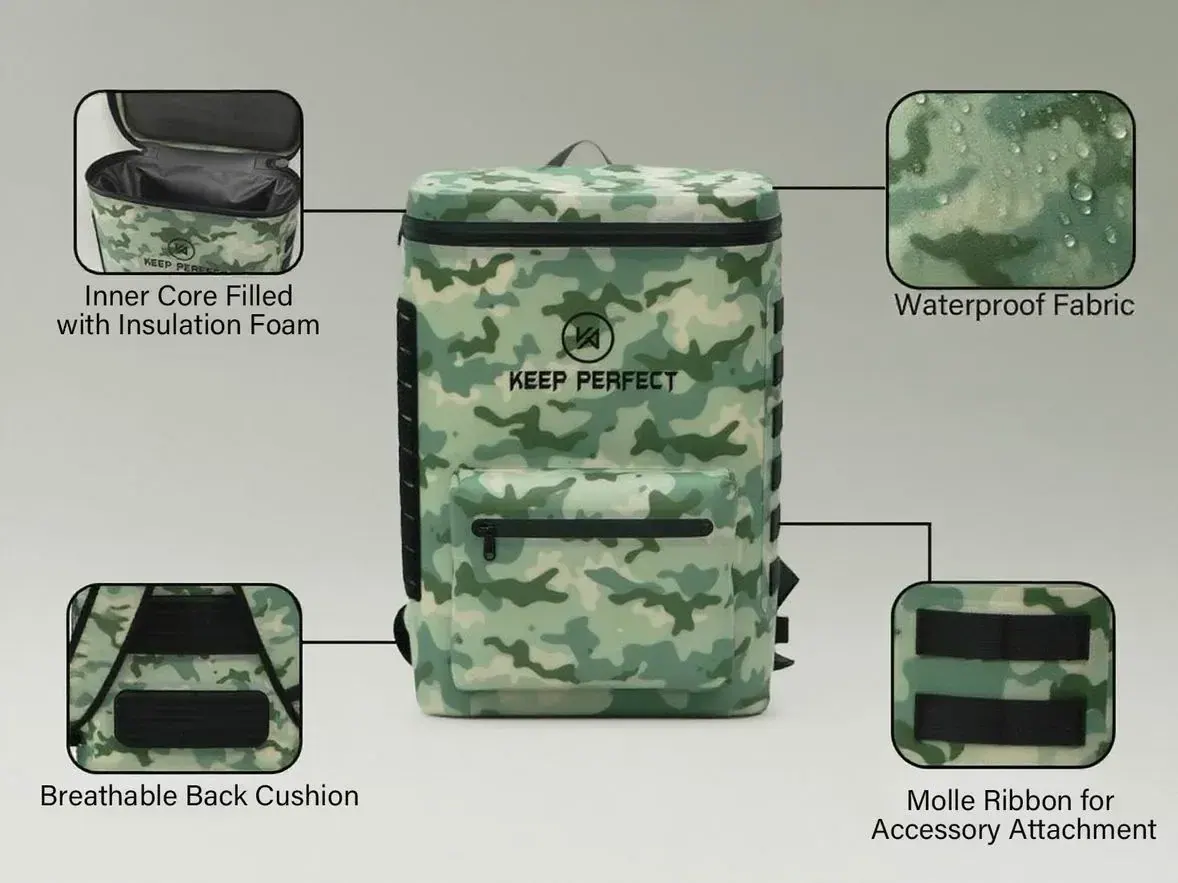
A sling can carry a small insulated insert, but the space budget is tight. A 2-4 L insert holding 500-750 ml of drink and a snack is realistic; anything larger steals tray space and pushes the loaded weight past the comfort ceiling. If a cooler section is specified, it must have a welded liner and a drain, and it must be physically separated from the tray, because condensation rusts hooks faster than most splashes.
Tool carry on a sling benefits from external attachment rather than internal pockets, because internal tools consume tray volume. A plier sheath on the strap side, a retractor dock for nippers, and a small MOLLE-style field for a leader spool cover most needs without adding bulk. Every external attachment on a waterproof body should be bonded on a reinforcement island rather than stitched through the shell.
| Add-on | Realistic size | Weight impact | Caution |
|---|---|---|---|
| Insulated insert | 2-4 L | Plus 0.4-0.8 kg loaded | Needs welded liner and drain |
| Plier sheath | 200-250 mm tool | Plus 0.2 kg | Keep off the casting arm side |
| Retractor dock | Nippers and line cutters | Under 0.1 kg | Check snag risk in cover |
| Rod or net dock | Short, external | Plus 0.2-0.4 kg | Must not block rotation |
| Water bottle pocket | 500-750 ml | Plus 0.5-0.8 kg | Drain and secure the bottle |
Waterproof Level for a Sling Format
A sling sits higher on the body than a tote and lower than a backpack, which puts it in the splash zone during wading and boat use without fully immersing it. IPX4 to IPX5 covers bank and fair-weather use; IPX6 is the sensible target for boat, pier, and wading use. A genuine IPX7 claim is possible on a sling but rarely worth the cost, because the format is chosen for short sessions rather than for immersion exposure.
Ingress codes are defined by the IEC ingress protection framework, and the condition always matters more than the number. Screen the finished pack with the tray and tools fitted, using 60 minutes of directed spray at roughly 20 mm per hour from above and from a side angle, with dry indicator tissue at the closure, seam junctions, and base.
Closure choice on a sling favours a sealed zipper or a gasket flap over a roll-top, because a roll-top adds 60-100 mm of height and that height interferes with rotation and with a casting stroke. A well-seated waterproof zipper with a protected garage is usually the better answer at this size, provided the maintenance routine is stated in the product information.
Fit, Load Limits, and Different Body Types
Fit on a sling is simpler than on a backpack but not universal. The strap length needs to cover torso circumferences from roughly 80 cm to 130 cm, and the body height should sit between the shoulder blade and the lower ribs. A body that hangs below the ribs will swing during wading and strike the hip on every step.
| Body measure | Specification | Failure sign | Correction |
|---|---|---|---|
| Strap length range | 80-130 cm adjustable | Cannot rotate comfortably | Extend range or offer two sizes |
| Body height on back | Shoulder blade to lower ribs | Strikes the hip when walking | Shorten the body or raise the anchor |
| Load ceiling | 5 kg maximum | Trapezius pain in 30 min | Move to a backpack format |
| Stabiliser strap | Optional secondary | Body swings when bending | Add a captured stabiliser |
Publishing a load ceiling is a genuine safety and satisfaction measure. A sling rated to 5 kg that is routinely loaded to 8 kg will generate shoulder complaints that look like a product defect and are not. Stating the limit in the product information and in the programme brief prevents most of those claims, and it also tells the buyer when to move a customer up to a backpack instead of losing the sale to a competitor format.
Shoulder and neck sensitivity varies more than torso size does, so a strap that suits one angler can be uncomfortable for another of identical build. Where a programme supplies staff or guides, allow a two-week trial period with the strap length recorded, and treat any report of neck pain within thirty minutes as a fit issue rather than a quality issue. That distinction shortens the path to a real fix.
Abrasion and webbing performance can be checked against published methods from ASTM International, which gives both sides a shared basis for whether strap webbing and base fabric are fit for the intended use. Require a stated cycle count rather than a generic heavy duty claim.
Care, Drying, and Off-Season Storage
A sling dries faster than a backpack simply because it holds less, but the same rules apply. Rinse the shell and hardware with fresh water after salt exposure, clear grit from zipper teeth before operation, empty every pocket, and dry open for 8-24 hours. A sling closed damp inside a vehicle will smell within a day.
- Rinse with fresh water after every saltwater session, including the zipper garage.
- Remove the tray and dry it separately before it goes back in.
- Lubricate a waterproof zipper with the product the maker specifies.
- Use mild pH-neutral soap only; never solvents, never machine washing.
- Store loose and dry at 15-25 degrees with the closure open.
Weather and water conditions should be checked before any session; NOAA weather resources support that review in the United States. Equipment is not a substitute for local knowledge, route judgement, or appropriate personal safety equipment on or near water.
Setting Up a Sling for Kayak, Boat, and Wade Use
On a kayak the sling should stay compact and low, because anything tall catches on rod holders and on the paddle stroke. Choose a 10-13 L body, keep external tools on the inboard side, and secure the pack at one point so it cannot leave the craft during an unexpected tip. That attachment is equipment retention, not a tether to the person, and it should never create a loop that could encircle a wrist or ankle.
On a boat deck the priority changes from compactness to stability. A sling set on a wet deck will slide, so specify a base with a high-friction welded patch and a body that stands upright when loaded to its tray capacity. Rotating the pack to the chest works well at a rail or a casting platform, and it keeps the tray out of the wash zone entirely.
| Platform | Priority | Recommended body | Watch for |
|---|---|---|---|
| Kayak | Low profile, one-point retention | 10-13 L, inboard tools | Snagging on rod holders |
| Boat deck | Upright stability | 12-15 L, high-friction base | Sliding on a wet deck |
| Wading | Rotation clear of water | 8-13 L, stabiliser strap | Body swinging at the hip |
| Pier or jetty | Hands-free access | 10-13 L, sealed pocket | Wind and spray from the side |
In wading, add a secondary stabiliser strap. Without it the body swings forward every time the angler bends, which is both annoying and a genuine balance concern on a slippery bed. The stabiliser should be short and captured, and it should release with one hand so the pack can be rotated without stopping or putting anything down.
One habit improves all three setups: decide before launching which single tray sits at the top of the stack. In a sling there is usually room for two, and the top tray is the only one that can be reached quickly while the pack is on the back. Putting the most-used tray second guarantees a rotation every few minutes for the whole session.
Programme Brief and Acceptance Criteria
Write one document covering usable litres, tray standard and count, access direction, strap width and length range, rotation travel, ambidextrous requirement, closure type, protection level with the test condition, hardware grade, and compliance. Add acceptance criteria for dimensions, seam appearance, coating thickness, colour fastness, and hardware finish. Approve at least three samples per design.
| Programme item | Baseline | Note |
|---|---|---|
| MOQ | 500 pcs per design and colour | Colour split negotiable above baseline |
| Sampling | 6-10 working days | Add 3-5 days for a closure change |
| Bulk | 35-50 days | From approved sample and deposit |
| Inspection | AQL 2.5 | Include tray fit, rotation travel, water screen |
| Compliance | REACH and California Prop 65 | Screen coatings, films, inks, hardware |
QUANZHOU JUNYUAN BAGS has developed waterproof bag programmes since 2014, with the founding team active in the industry since 2004. Monthly output of 200,000 units is verified by SGS, and BSCI and ISO 9001 systems structure the workflow. Materials are screened for REACH and California Prop 65, and every bulk order is inspected at AQL 2.5 before shipment.
A sling pack brief can be emailed to service@junyuanbags.com; include tray standard, shoulder preference split, protection level, and quantity. FOB Xiamen or DDP service to more than 100 countries follows an approved sample and a complete test record. The waterproof fishing tackle bag overview places the sling format alongside the other four, and the best fishing sling packs roundup compares specific configurations.
People Also Ask
How much can a fishing sling pack carry?
Eight to 15 L holding one or two 3600 trays, with a loaded weight of 2-5 kg. Above 5 kg or on walks longer than 1 km a backpack is the better format.
Is a sling pack better than a backpack for fishing?
For short sessions with frequent access, yes. For full days, heavy loads, or long walks, no. Most anglers end up owning both and reach for the sling more often.
Can a sling pack be worn on either shoulder?
It can when the strap has convertible anchor points. Since roughly one in ten anglers casts with the other hand, ambidextrous design is worth specifying.
What strap width is comfortable on a fishing sling?
Fifty to 75 mm with 8-12 mm foam. Narrower straps cut into the trapezius within thirty minutes and wider ones crowd the neck on smaller frames.
Does a sling pack need to be fully waterproof?
IPX4 to IPX5 suits bank use and IPX6 suits boat, pier, and wading use. A true IPX7 build is possible but rarely worth the cost at this size.
Can a fishing sling hold a cooler insert?
Yes, at 2-4 L holding 500-750 ml. The insert needs a welded liner, a drain, and physical separation from the tray, because condensation rusts hooks.
Frequently Asked Questions
Q1. What size fishing sling pack should I buy?
Eight to 15 L depending on tray count. An 8-10 L body holds one 3600 tray; a 12-15 L body holds two, or one 3700 with room for a light layer.
Q2. How many trays fit in a fishing sling pack?
One or two at 3600 size, or one at 3700 in the largest bodies. Trays should open horizontally at chest height when the pack is rotated forward.
Q3. Is a sling pack comfortable for a full day of fishing?
Not usually. Asymmetric loading becomes obvious above 5 kg and on walks beyond 1 km. Use a backpack for full days and a sling for short sessions.
Q4. Can I wear a sling pack on either shoulder?
Only if it has convertible anchor points. Specify that for a mixed market, because a fixed-shoulder design suits roughly nine out of ten anglers.
Q5. What strap width should a fishing sling have?
Fifty to 75 mm with 8-12 mm foam and a breathable face. Confirm at least 120 degrees of rotation travel under load.
Q6. Do sling packs interfere with casting?
They can above 15 L or with a tall body. Keep the body between the shoulder blade and the lower ribs and test a full casting stroke before approving a design.
Q7. What waterproof rating should a sling pack have?
IPX4 to IPX5 for bank use, and IPX6 for boat, pier, and wading. A full IPX7 claim is possible but rarely worth the added cost at this size.
Q8. Is a zipper or a roll-top better on a sling?
A sealed zipper usually is, because a roll-top adds 60-100 mm of height that interferes with rotation and with a casting stroke.
Q9. Can a sling pack hold a water bottle?
Yes, in a drained external pocket of 500-750 ml. Secure the bottle so it cannot fall out when the pack rotates forward.
Q10. How should a fishing sling pack be cleaned?
Fresh water rinse, mild pH-neutral soap, no solvents, no machine washing, and air dry open for 8-24 hours. Lubricate a waterproof zipper as the maker specifies.
Q11. What load limit should a sling pack state?
Five kilograms. Publishing that ceiling prevents shoulder complaints that otherwise look like a product defect and are not.
Q12. What is the MOQ and lead time for a sling pack programme?
MOQ is 500 pcs per design and colour, samples take 6-10 working days, and bulk runs 35-50 days from approved sample and deposit.