A fishing waist pack is the right choice when the kit fits in 4-10 L and the water reaches the waist. Loaded weight should stay between 1.5 kg and 4 kg, the belt should be 38-50 mm webbing sized across an 80-130 cm hip range, and the body should rotate to the front for access without being removed. Water to mid-thigh sits at roughly 500-700 mm on an adult, so a waist pack is a shallow-water tool and a sling or chest pack is the answer deeper. Programme baseline is MOQ 500 pcs per design and colour, samples in 6-10 working days, and bulk in 35-50 days.
When a Waist Pack Is the Right Answer
A waist pack wins on three conditions: the kit is genuinely small, the water is shallow, and the angler wants nothing on the shoulders. It keeps the back completely free for ventilation, it does not interfere with a casting stroke, and it rotates to the front so the contents can be worked on with both hands while standing in a river. For a warm-weather session with two fly boxes and a few spools, nothing else is as comfortable.
It loses as soon as any of those conditions breaks. Above 4 kg the belt pulls and the body sags; in deeper water the pack takes splash continuously; and on a long walk the load sits on the hips in a way that chafes. Honest framing of those limits prevents most of the dissatisfaction attributed to the format.
| Condition | Waist pack | Better alternative |
|---|---|---|
| Kit under 4 kg | Ideal | None needed |
| Water to waist | Good | None needed |
| Water to mid-thigh | Marginal | Sling or chest pack |
| Walk beyond 1 km | Poor | Sling or backpack |
| Cold weather bulk | Poor | Sling with a layer pocket |
The most common misuse is carrying a waist pack loaded like a sling. Four large fly boxes, a drink, and a rain jacket put the load past 4 kg, and the belt then has to be tightened enough to be uncomfortable. If the kit needs that much space, the correct answer is a different format rather than a tighter belt. A useful self-check is the belt test: if the belt has to be tightened past the point where a finger slides under it, the load belongs in a sling or a backpack.
Weight distribution around the body also explains why two packs of identical volume feel completely different. A flat load sits close to the hips and feels light; the same mass in a deep body levers outward and feels heavy within twenty minutes. That is why depth, not litres, is the dimension that decides comfort in this format, and why a well-shaped 8 L pack often carries better than a poorly shaped 6 L one.
Capacity and Layout for a Minimal Kit
Four to 10 L covers the format. A 4-6 L body holds one or two fly boxes, four tippet spools, nippers, and forceps. A 7-10 L body adds a small insert of two utility trays, a drink, and a compact rain shell. Above 10 L the body becomes deep enough to strike the thigh while wading and to catch on the hip during a scramble over rock.
Depth matters more than volume here. A waist pack should be no deeper than about 150 mm front to back, because anything deeper sits against the thigh when the angler bends or kneels. Wider and shallower is the right proportion, and that single rule shapes the internal layout more than any other dimension.
| Volume | Kit | Loaded weight | Depth limit |
|---|---|---|---|
| 4-6 L | 1 to 2 fly boxes, spools, tools | 1.5-2.5 kg | 110-130 mm |
| 6-8 L | 2 to 4 boxes or one small tray insert | 2.5-3.5 kg | 130-150 mm |
| 8-10 L | Tray insert, drink, compact shell | 3-4 kg | 150 mm maximum |
| Above 10 L | Not recommended | Above 4 kg | Strikes the thigh |
Pocket count should be deliberately low. Three or four well-placed pockets outperform six, because a waist pack has no spare volume and every pocket steals from the main compartment. Specify one flat box zone, one spool pocket with individual sleeves, one external drained pocket for a wet item, and one sealed flat pocket for phone and licence.
Belt, Fit, and Rotation
The belt is the product. It needs to be wide enough to carry 4 kg without rolling, stiff enough not to twist under the body weight, and adjustable across an 80-130 cm hip range so one size covers a market. Webbing of 38-50 mm with a stiffened insert behind the body is the usual answer, and the buckle should sit off-centre so it does not press into the spine when the pack is rotated.
Rotation is the defining behaviour. The body should slide around the belt from the back to the front in one motion, with the belt staying put. That requires a smooth belt interface and a body attachment that does not bind, and it is best tested with the load fitted rather than empty. A pack that walks around the belt on its own is a different and worse problem, usually caused by a body that is too heavy for the belt friction.
- Use 38-50 mm webbing with a stiffened section behind the body.
- Cover an 80-130 cm hip range with one adjustable size where possible.
- Offset the buckle so it does not press into the spine when rotated.
- Confirm the body rotates to the front with the load fitted.
- Check that the body does not migrate around the belt on its own.
Where a programme sells into a wide market, offer two belt lengths rather than one very long one. A belt sized to 130 cm leaves a long tail on an 85 cm waist, and that tail catches on vegetation, on a net handle, and on a rod butt. A tail keeper is a cheap partial fix, but two belt sizes is the real answer. Fit should also be checked over the clothing the angler actually wears, because a winter jacket adds 40-60 mm to effective hip circumference and a belt bought in summer may not close in winter.
Wading: Waterline, Belt Interaction, and Safety
Water to mid-thigh reaches roughly 500-700 mm on an adult, which is at or above the top of most waist packs. That is the hard limit of the format: below the knee it is comfortable, at the waist it takes continuous splash, and above that the contents will get wet regardless of the material. Anglers who regularly wade deeper should use a sling or chest pack and treat the waist pack as a warm-weather tool.
The wading belt interaction is the second issue. A wading belt is worn to slow water ingress into waders in a fall, and a fishing belt worn over or under it can shift it out of position. Wear the fishing belt above the wading belt, check that rotation does not lift the wading belt, and keep both belts free of loose tails that could snag.
Cold water deserves plain language. Immersion in water below 15 degrees affects breathing and muscular control within minutes, and wet clothing accelerates heat loss afterwards. Public health guidance on cold exposure and hypothermia is published by the Centres for Disease Control and Prevention, and it is worth reading before any cold-season wading. A waist pack cannot compensate for inadequate clothing, an unsuitable crossing, or a missing wading belt.
Waterproof Level and Immersion Testing
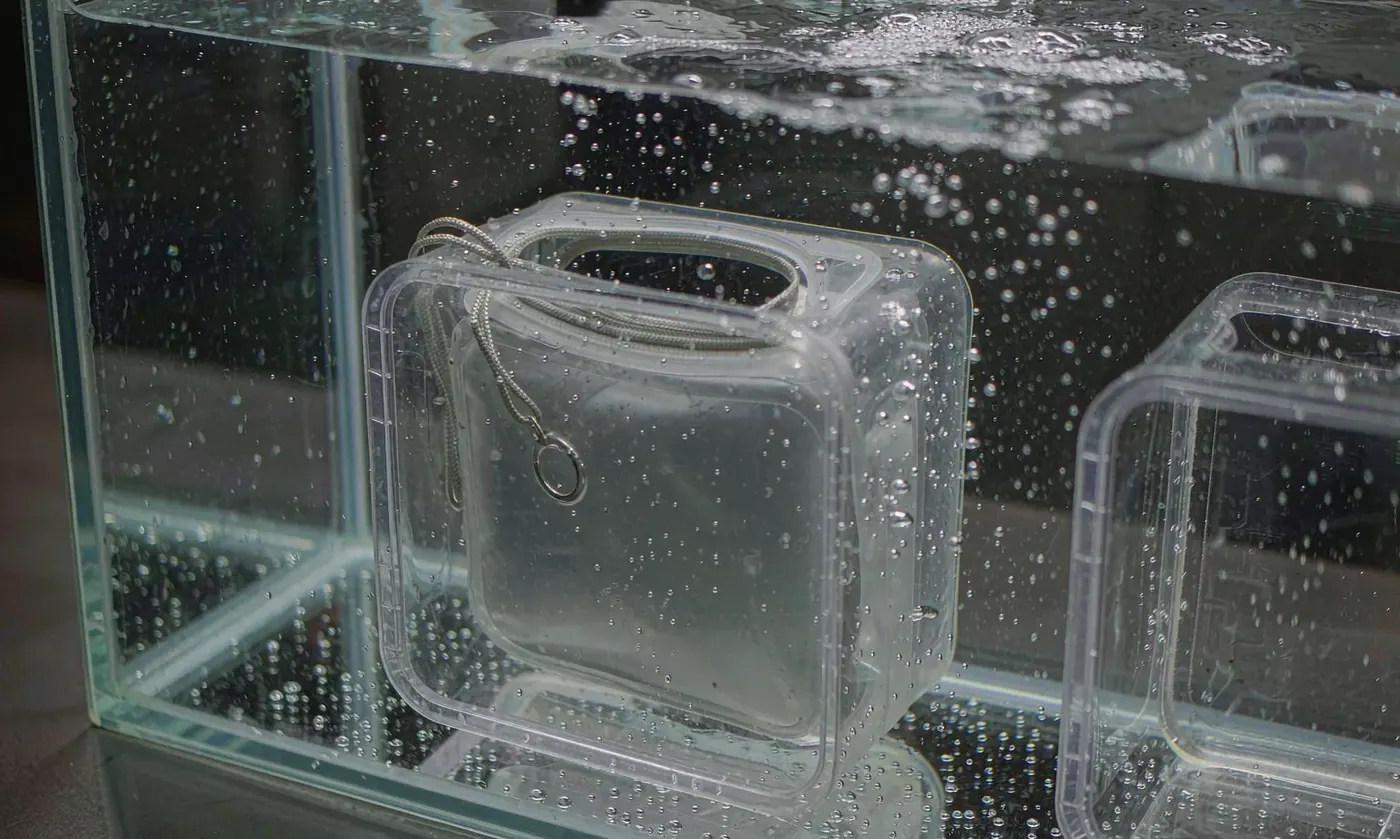
Most waist packs sit at IPX4 to IPX5. That covers splash and short showers, which is the realistic exposure for a pack used in shallow water. A genuine IPX6 or IPX7 claim is possible but rarely worth the cost at this size, because the pack is small enough to protect with a sealed pouch for the few items that cannot get wet.
Ingress codes are defined by the IEC ingress protection framework, and any rating must be quoted with its condition. Screen the finished pack loaded, using 30-60 minutes of directed spray at roughly 20 mm per hour, with dry indicator tissue at the closure, seam junctions, and base. Where immersion is claimed, state the depth and duration and re-screen after rinsing, because a contaminated closure behaves differently.
Hydration, Tools, and Add-Ons
Hydration is the most useful add-on at this size. A 500-750 ml bottle in an external drained pocket keeps the weight off the spine and avoids the shoulder load of a reservoir. Where a reservoir is preferred, a 1-1.5 L bladder in a dedicated sleeve at the back of the belt works, but it adds mass directly over the hips and raises the loaded weight toward the ceiling quickly.
Tool attachment follows the same rule as every other fishing format: external and drained. A retractor dock for nippers, an open plier sheath, and a small leader spool field cover most needs. Every attachment should sit where it cannot snag when the angler moves through cover, and it should be bonded on a reinforcement island on any body specified above IPX4.
| Add-on | Realistic size | Weight impact | Caution |
|---|---|---|---|
| Bottle pocket | 500-750 ml | Plus 0.5-0.8 kg | Must drain and retain the bottle |
| Small reservoir | 1-1.5 L | Plus 1-1.5 kg | Pushes toward the load ceiling |
| Retractor dock | Nippers and cutters | Under 0.1 kg | Check snag risk in cover |
| Plier sheath | 200-250 mm tool | Plus 0.2 kg | Open and drained, never closed |
| Net loop | Rear, low | Plus 0.3-0.5 kg | Must not cross the casting arm |
Weather and flow should be checked before every session; NOAA weather resources support that review in the United States. Flow level often matters more than rainfall, because a river can rise from upstream conditions hours after local rain has stopped. A rising river also moves the waterline limit the whole format depends on, so a pack that was dry in the morning can be taking water by afternoon on the same beat. The fly fishing bag and pack guide places the waist format alongside chest, sling, and backpack options.
When to Step Up to a Sling or a Backpack
Three signals say the waist pack is no longer enough. The load has passed 4 kg and the belt needs to be tightened uncomfortably to stay put. The water regularly reaches mid-thigh and the contents come home damp. Or the walk to the water exceeds 1 km and hip carry becomes chafing rather than convenience.
| Signal | Meaning | Move to |
|---|---|---|
| Load above 4 kg | Belt has to be over-tightened | Sling pack |
| Water at mid-thigh | Continuous splash at the closure | Sling or chest pack |
| Walk beyond 1 km | Hip carry chafes | Backpack |
| Cold-season bulk | No room for a layer | Sling with a layer pocket |
The fishing sling pack range is the natural next step, because it keeps one-shoulder freedom while lifting the load off the hips and raising the contents above the waterline. Most anglers who move up do so for exactly one of those two reasons, and knowing which one applies makes the choice straightforward.
Packing a Waist Pack So It Actually Works
A waist pack punishes poor packing faster than any other format, because there is no spare volume to absorb a mistake. Work to a fixed order: heaviest and flattest items against the body, most-used items in the outer pocket, and anything wet in the drained external pocket only. If an item has to be forced in, the kit has outgrown the pack.
| Zone | Contents | Rule | Why |
|---|---|---|---|
| Against the body | Fly boxes, flat items | Flattest items nearest the belt | Keeps the centre of mass close |
| Outer pocket | Most-used box or spools | Reachable without opening the main body | Access while standing in water |
| Sealed flat pocket | Phone, licence, keys | Always above the waterline | Fails permanently if wet |
| Drained pocket | Wet rag, fish measure | External only | Keeps water out of the main body |
| Belt-mounted | Retractor, nippers | Short, snag-free | Avoids catching on cover |
Balance across the body matters as much as order. A waist pack loaded heavily on one side rotates on its own and pulls the belt around, which is uncomfortable and eventually loosens the fit. Split mass evenly between the two sides of the body, and place the single heaviest item centrally against the belt.
Repacking between seasons is worth the ten minutes it takes. Lure and fly selection changes with the water, and a layout that worked in spring is often wrong by late summer. A waist pack re-sorted twice a year stays usable; one left alone becomes the pack that gets left in the vehicle.
One last practical habit: decide at the start of a session which single item will be needed most often, and put it in the outer pocket. In a pack this small, the difference between reaching one pocket and opening the main compartment while standing in a current is the difference between a quick change and a lost fish.
Care, Drying, and Off-Season Storage
Waist packs dry quickly because they are small, which is one of their genuine advantages over larger formats. Even so, empty every pocket, open the main compartment, and dry for 8-24 hours after a wet session. Pay particular attention to the belt interface, where water and grit collect between the webbing and the body attachment.
- Rinse with fresh water after every saltwater or silty session.
- Open every pocket and dry the pack for 8-24 hours.
- Clean the belt interface, where grit collects and abrades webbing.
- Use mild pH-neutral soap only; never solvents, never machine washing.
- Store dry and loose at 15-25 degrees with closures open.
Off-season, check the belt for stiffness and the buckle for corrosion, and replace elastic retention before the new season rather than during it. Elastic is the shortest-life component on most waist packs and costs very little to renew.
Programme Brief and Acceptance Criteria
Write one document covering usable litres, body depth, belt width and adjustment range, buckle position, rotation behaviour, protection level with the test condition, attachment docks, hardware grade, and compliance. Add acceptance criteria for dimensions, seam appearance, coating thickness, colour fastness, and hardware finish. Approve at least three samples per design.
| Programme item | Baseline | Note |
|---|---|---|
| MOQ | 500 pcs per design and colour | Colour split negotiable above baseline |
| Sampling | 6-10 working days | Add 3-5 days for a hardware change |
| Bulk | 35-50 days | From approved sample and deposit |
| Inspection | AQL 2.5 | Include box zone, rotation test, water screen |
| Compliance | REACH and California Prop 65 | Screen coatings, films, inks, hardware |
QUANZHOU JUNYUAN BAGS has developed waterproof bag programmes since 2014, with the founding team active in the industry since 2004. Monthly output of 200,000 units is verified by SGS, and BSCI and ISO 9001 systems structure the workflow. Materials are screened for REACH and California Prop 65, and every bulk order is inspected at AQL 2.5 before shipment.
A waist pack brief can be emailed to service@junyuanbags.com; include target water depth, kit list, belt size range, market, and quantity. FOB Xiamen or DDP service to more than 100 countries follows an approved sample and a complete test record. The best fishing waist pack comparison shows how these choices appear in finished designs.
People Also Ask
How much can a fishing waist pack carry?
Four to 10 L at 1.5-4 kg loaded. Above 4 kg the belt has to be tightened uncomfortably, which is the signal to move to a sling pack.
Can a waist pack be used for deep wading?
Not really. Water to mid-thigh reaches 500-700 mm on an adult, which is at or above the top of most waist packs. Use a sling or chest pack deeper than the waist.
What belt width is comfortable on a fishing waist pack?
Thirty-eight to 50 mm webbing with a stiffened section behind the body, adjustable across an 80-130 cm hip range and with the buckle offset from the spine.
Should the fishing belt go above or below a wading belt?
Above it. Wear the fishing belt above the wading belt and check that rotating the pack does not lift or shift the wading belt out of position.
Do waist packs need to be fully waterproof?
Usually not. IPX4 to IPX5 covers splash and short showers, and the pack is small enough that a sealed pouch protects the few items that cannot get wet.
Why does my waist pack slide around my hip?
The body is too heavy for the belt friction, or the belt is too loose to stop migration. Tighten the belt first; if that is uncomfortable, the load is past the format limit.
Frequently Asked Questions
Q1. What size fishing waist pack should I buy?
Four to 6 L for one or two fly boxes and tools, and 7-10 L for a tray insert, a drink, and a compact shell. Keep body depth under about 150 mm.
Q2. How deep can a waist pack be before it is uncomfortable?
Around 150 mm front to back. Anything deeper strikes the thigh when bending or kneeling, so wider and shallower is the right proportion.
Q3. What waterproof level suits a fishing waist pack?
IPX4 to IPX5 for splash and short showers. A higher rating is possible but rarely worth the cost, since a sealed pouch protects the few items that cannot get wet.
Q4. Can I wear a waist pack with waders?
Yes, above the wading belt. Check that rotating the pack does not lift the wading belt, and keep both belts free of loose tails that could snag.
Q5. How heavy can a loaded waist pack be?
About 4 kg. Beyond that the belt must be tightened uncomfortably to stay put, which is the signal to move to a sling pack.
Q6. How do I stop the pack sliding around my hip?
Tighten the belt first and check the body attachment. If the belt has to be uncomfortable to stop migration, the load is beyond the format and a sling is the better answer.
Q7. Should I choose one long belt or two belt sizes?
Two sizes is better. A belt sized to 130 cm leaves a long tail on an 85 cm waist, and that tail catches on vegetation, nets, and rod butts.
Q8. Can a waist pack hold a water bottle?
Yes, in an external drained pocket of 500-750 ml. Make sure the pocket retains the bottle when the pack is rotated to the front.
Q9. Is a waist pack better than a sling in hot weather?
Yes for ventilation, because it leaves the back completely free. The trade is a lower load ceiling and a lower waterline limit.
Q10. How should a fishing waist pack be cleaned?
Fresh water rinse, mild pH-neutral soap, no solvents, no machine washing, and air dry open for 8-24 hours. Clean the belt interface where grit collects.
Q11. What is the shortest-life component on a waist pack?
Elastic retention. Check it before each season and replace it then rather than during the season, because it costs very little.
Q12. What is the MOQ and lead time for a waist pack programme?
MOQ is 500 pcs per design and colour, samples take 6-10 working days, and bulk runs 35-50 days from approved sample and deposit.