Fly fishing carry is a small-kit problem: most sessions need two to four fly boxes, four to six tippet spools, nippers, forceps, and a landing net, which fits in 4-12 L and weighs 2-5 kg. The right format depends on water depth rather than on volume: a sling or chest pack for wading to mid-thigh, a waist pack for minimal kit, and a backpack only when the walk exceeds 1 km. Specify splash protection at IPX4 to IPX6, one-handed access, and a net dock that clears a casting stroke. Programme baseline is MOQ 500 pcs per design and colour, samples in 6-10 working days, and bulk in 35-50 days.
What Makes Fly Fishing Carry Different
Fly fishing carries less and accesses more. A conventional tackle bag is organised around trays that are opened a few times an hour; a fly pack is organised around small items that are reached for every few minutes, often with one hand holding a rod and the other managing a fly. That single behavioural difference drives every design decision in the category.
Water is also different. Fly anglers stand in it rather than beside it, so the relevant exposure is a moving waterline rather than rainfall, and the failure mode is a soaked fly box rather than a flooded chamber. Because the kit is small and frequently handled, drying matters more than absolute sealing, and a pack that drains and dries quickly often outperforms a heavier sealed body in practice.
| Format | Volume | Water depth | Best situation |
|---|---|---|---|
| Chest pack | 4-8 L | To mid-thigh | Short sessions, minimal kit |
| Sling pack | 8-12 L | To mid-thigh | Most river and stillwater use |
| Waist or hip pack | 4-10 L | To waist | Warm weather, minimal kit |
| Backpack | 18-30 L | Bank only | Walks beyond 1 km, travel days |
Most fly anglers settle on a sling. It carries more than a chest pack, rotates for access without being set down, and stays higher and drier than a waist pack when the water rises. The fishing sling pack range covers that middle ground, and the fishing waist pack range covers the genuinely minimal end. Deciding between them is easier with a simple test: if the angler needs to reach the pack more than once every five minutes, choose the sling; if the whole kit fits in two boxes and a few spools, the waist pack is lighter and cooler on a warm day.
A useful secondary check is what happens in the last hour of a session. Fatigue changes how a pack is used more than any design feature, and a body that rotates cleanly when fresh becomes a nuisance when the angler is cold and tired. Try the loaded pack after an hour of walking and wading rather than only in a shop, because shoulder and neck tolerance drops noticeably with fatigue.
Capacity, Fly Boxes, and Tippet Layout
Volume in this category is small and easily overspecified. A 4-8 L chest or waist pack holds two to four fly boxes plus tools. An 8-12 L sling holds four to six boxes, a spare reel or a light layer, and a drink. Anything above 12 L on a river is carrying something that will not be used, and extra bulk interferes with a casting stroke far more than extra capacity helps.
Box dimensions should drive the internal layout rather than a generic litre figure. Most fly boxes fall between 120 x 90 x 30 mm and 190 x 110 x 40 mm, and a pack should hold the largest box flat rather than on edge, because an edge-stored box dumps flies when opened in a hurry. Reserve a dedicated flat zone at least 200 x 130 mm for boxes, and keep it separate from tippet and tools.
| Item | Typical size | Storage | Access target |
|---|---|---|---|
| Fly box, standard | 120 x 90 x 30 mm | Flat internal zone | Under 10 seconds |
| Fly box, large | 190 x 110 x 40 mm | Same zone, flat | Under 10 seconds |
| Tippet spools | 4 to 6 spools | Dedicated spool pocket | Under 5 seconds |
| Nippers and forceps | On a retractor | External dock | Instant |
| Floatant and gel | 50-100 ml | Sealed small pocket | Under 15 seconds |
Tippet deserves its own pocket rather than sharing space with boxes. Spools are small, round, and roll into corners, and a pocket with individual sleeves or an elastic loop per spool prevents the tangle that costs five minutes on a riverbank. Specify four to six spool positions and check that a gloved or cold-wet hand can remove one.
Rod, Net, and Staff Attachments
A fly pack carries things a conventional tackle bag never does: a landing net, often a wading staff, and sometimes a spare rod tube. Each needs a dock that keeps the item secure while walking and clear while casting. A net dock on the rear of a sling, with a magnetic or elastic release, is the common solution and it works well provided the net handle cannot swing across the casting arm.
Attachment geometry deserves testing rather than assumption. Shake the loaded pack with the net fitted, walk 50 m through bank vegetation, and execute a full casting stroke with every accessory in place. A dock that snags once in twenty casts will be removed by the user within a week, and the pack will be judged on the accessory rather than on the bag itself.
| Attachment | Requirement | Test | Common failure |
|---|---|---|---|
| Net dock | Rear mount, one-hand release | Shake test plus 50 m walk | Net swings into the casting arm |
| Wading staff loop | Low, rear, drained | Draw and stow 10 times | Staff falls during a scramble |
| Rod tube straps | Two points, 200 mm apart | Walk and bend test | Tube pivots and strikes the leg |
| Retractor dock | External, snag-free | Pull 500 times | Cable fouls on vegetation |
Wading: Waterline, Height, and What Stays Dry
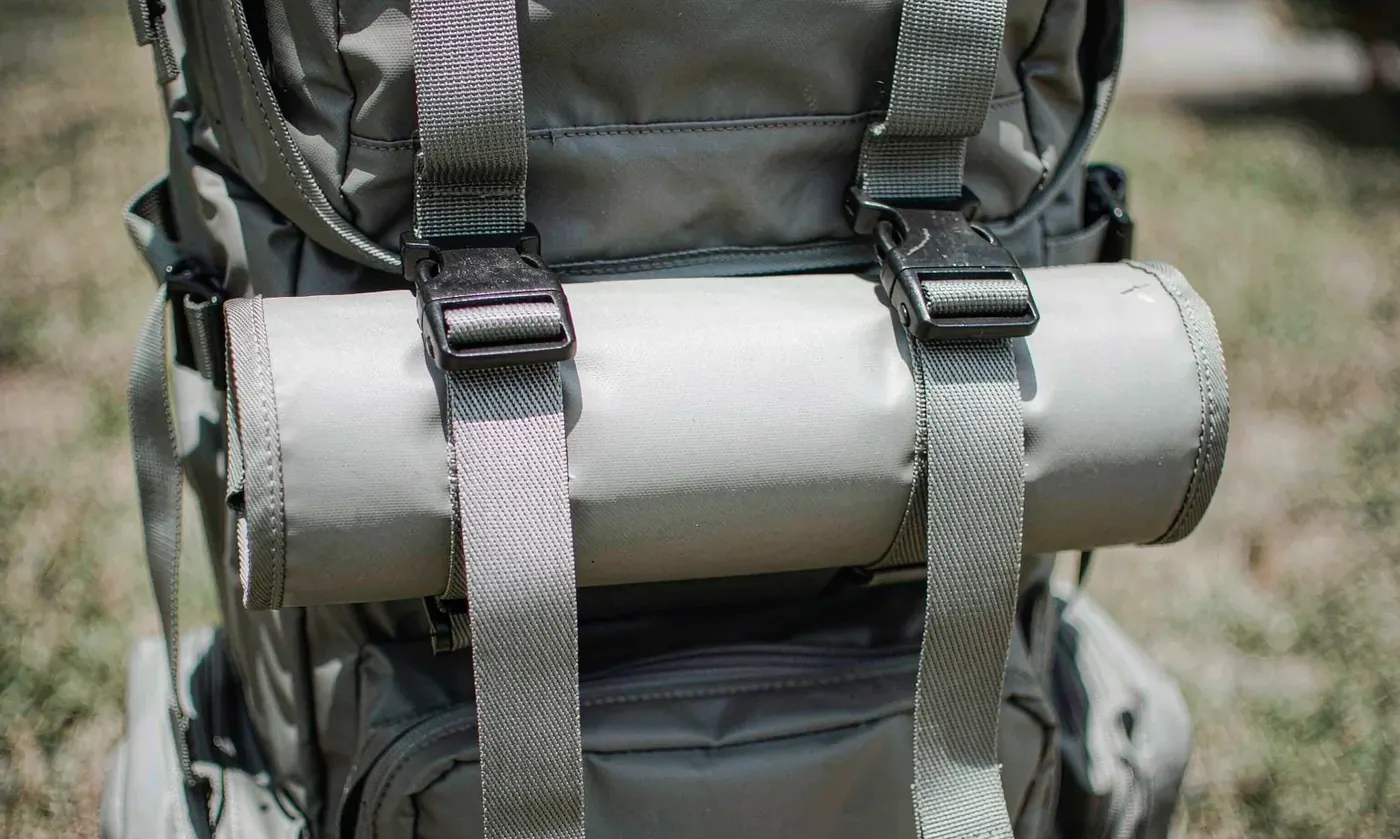
Wading sets a hard constraint on pack height. Water to mid-thigh reaches roughly 500-700 mm on an adult, so anything hanging below that level will be immersed, and anything within 150 mm above it will be splashed continuously. That is why a waist pack is marginal in deeper water and why a sling or chest pack, which rides at 700-900 mm, keeps the fly boxes dry.
The second wading issue is the wading belt. A pack worn below or across a wading belt fights it, and in cold water that matters because the belt is part of the safety system. Position any pack above the belt, and check that rotating a sling does not lift or twist the belt. Where a wading staff is carried, its loop should be at the rear so it can be drawn without crossing the body.
- Keep fly boxes above 700 mm, which is clear of water to mid-thigh.
- Position the pack above the wading belt and check that rotation does not disturb it.
- Use a drained external pocket for anything wet, never the box compartment.
- Choose a body that drains in under 60 seconds after a slip.
- Secure the pack at one point only, never to the person.
A slip happens to most wading anglers eventually, and the pack will go in. Design for recovery rather than for denial: use a body that drains fast, keep flies in boxes with positive latches, and accept that a phone and a car key need a sealed pouch regardless of how good the pack is. Two independent layers is the standard for anything that cannot survive immersion, and the second layer should be bright coloured so it can be seen if it is dropped in clear water.
Wading footwear and the bed itself deserve a line in any planning note, because most falls come from the surface rather than from the load. Felt or studded soles suit different beds and are regulated differently in some waters, so follow local rules and qualified advice. A pack should never change how an angler chooses a crossing, and any session where the pack affects balance is a session where the load is too heavy.
Waterproof Level and How Fly Packs Are Tested
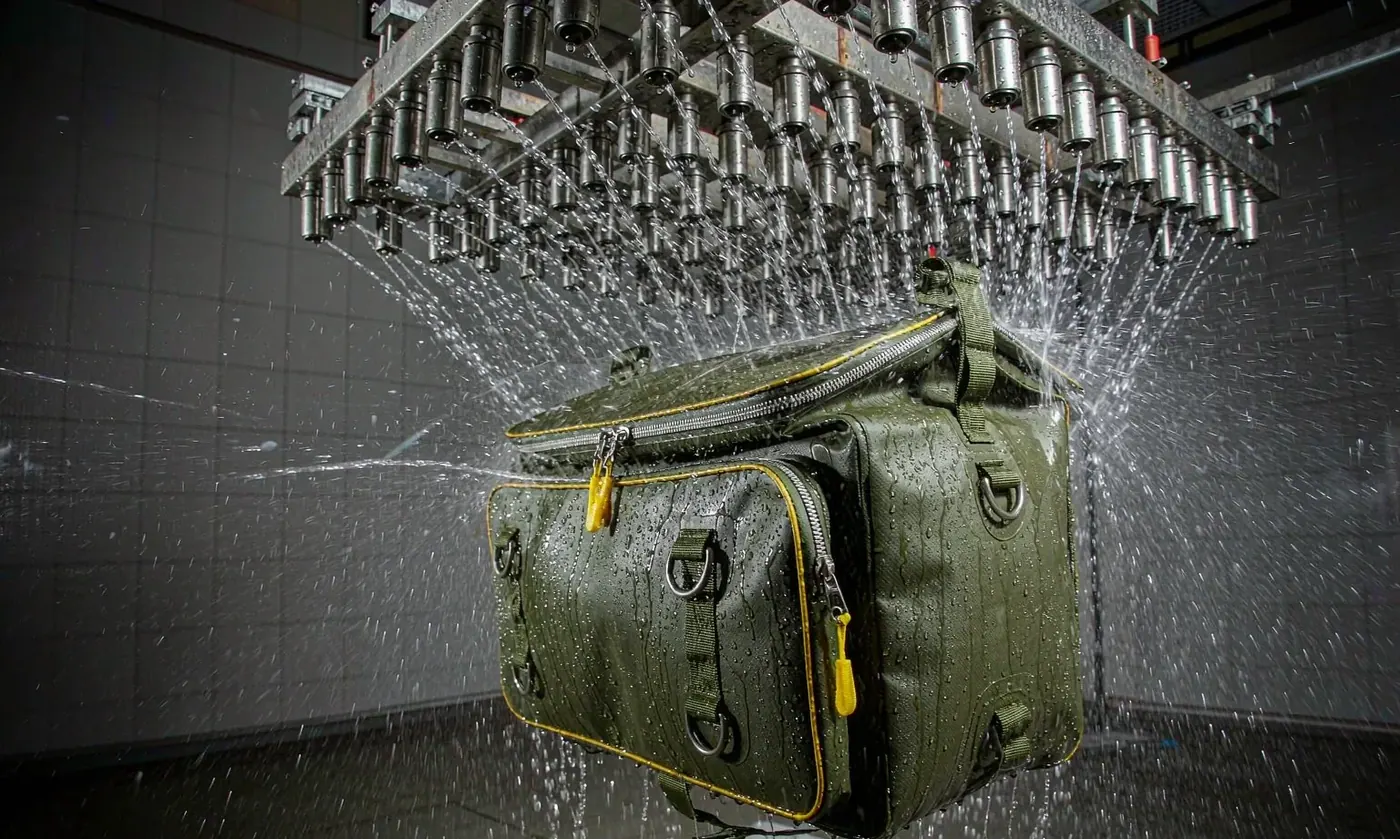
Most fly packs sit at IPX4 to IPX6. IPX4 covers splashing and suits bank and shallow wading; IPX5 to IPX6 suits deeper wading, boat use, and sustained rain. Full submersion ratings are rare in this category because the kit is small, frequently handled, and easier to protect with a pouch than with a heavier sealed body.
Ingress codes are defined by the IEC ingress protection framework, and the condition matters more than the number. Screen the finished pack with boxes and tools fitted, using 60 minutes of directed spray at roughly 20 mm per hour, with dry indicator tissue at the closure, seam junctions, and base. Then add a drain test: fill the body with 500 ml of water and confirm it clears in under 60 seconds.
Access Design: One-Handed and Cold-Handed Operation
Every opening on a fly pack should work one-handed. A zipper pull that needs two hands, a buckle that needs visual alignment, or a flap that requires setting the rod down will each cost the angler a fish eventually. Magnetic closures, large loop pulls, and elastic retention are all better answers than a small slider in this category.
Cold hands change the requirement again. Below about 8 degrees, finger dexterity drops sharply, and a 10 mm pull tab becomes genuinely difficult. Specify pulls of at least 25 mm, closures that can be operated with a whole hand rather than a pinch, and a colour contrast that makes the pull visible against the body in low light.
| Design element | Specification | Why | Test |
|---|---|---|---|
| Zipper pulls | 25 mm minimum loop | Cold and wet hands | Operate wearing gloves |
| Closures | Magnetic or elastic where possible | One-handed operation | Open and close 10 times |
| Colour contrast | Pull contrasts with body | Low light visibility | Check at dusk |
| Box latches | Positive, audible close | Prevents fly loss | Drop test from 1 m |
| Retractor reach | 150-250 mm extension | Tool reaches the fly | Extend and release 500 times |
The best fly fishing sling pack comparison looks at how these details differ across finished designs. The differences that matter most are rarely the ones listed on a specification sheet; they are pull length, dock position, and drain rate.
Cold Water, Weather, and Safety
Cold water is the real hazard in this category, not rain. Immersion in water below 15 degrees affects breathing and dexterity within minutes, and wet clothing greatly increases heat loss afterwards. Carry appropriate insulation, understand the water temperature and flow, and follow qualified local guidance about where and when to wade.
Public health guidance on cold exposure and hypothermia is published by the Centres for Disease Control and Prevention, and it is worth reading before any cold-season wading programme. A pack cannot compensate for inadequate clothing, an unsuitable crossing, or a wading belt that is not worn. Equipment supports judgement; it does not replace it.
Weather and water conditions should be checked before every session, and NOAA weather resources support that review in the United States. Flow level often matters more than rainfall, because a river can rise from upstream conditions hours after local rain has stopped.
Care, Drying, and Off-Season Storage
Fly packs collect moisture in places other bags do not: inside fly box foam, under tippet sleeves, and in a retractor cable housing. Open every box after a wet session, remove spools, and dry the pack open for 8-24 hours. Fly hooks rust faster than almost anything else in fishing, and a box closed damp overnight will show rust within two days.
- Open all fly boxes and dry them separately after every wet session.
- Remove tippet spools and dry the spool pocket.
- Rinse the pack and hardware with fresh water after any saltwater session.
- Use mild pH-neutral soap only; never solvents, never machine washing.
- Store dry and loose at 15-25 degrees with closures open.
Off-season, remove everything, check retractor cables for corrosion, and replace any elastic that has lost tension. Elastic retention is the shortest-life component on most fly packs and it is cheap to replace before the season rather than during it.
Stillwater, Salt, and Travel Variations
Stillwater fly fishing from a boat or a float tube changes the brief in two ways. There is no wading waterline to plan around, so pack height matters far less, and the exposure becomes wind-driven spray rather than a moving waterline. That argues for a slightly higher protection level, IPX5 or better, and for a body that can be set down on a wet deck without tipping.
Saltwater fly fishing is the most demanding variation, because chloride attacks hardware and the session often involves wading in warm water for hours. Move to 304 stainless as a minimum, rinse after every session, and dry completely rather than partially. A sling that performs perfectly on a chalk stream will show hardware bloom within one tropical season if it is specified to a freshwater standard.
| Variation | Key change | Protection level | Hardware |
|---|---|---|---|
| River wading | Height above waterline | IPX4 to IPX5 | Coated alloy acceptable |
| Stillwater boat | Wind spray, deck stability | IPX5 to IPX6 | 304 stainless |
| Saltwater flats | Chloride and long wading | IPX5 to IPX6 | 304 or 316 stainless |
| Travel | Packability and airline limits | IPX4 plus liner | 304 stainless |
Travel adds a constraint most fly packs ignore: packability. A sling with a moulded back panel does not flatten, and a rigid fly box zone adds bulk that eats into an airline allowance. Where a programme targets travelling anglers, specify a collapsible body with a removable box insert, and check the packed dimensions against a cabin bag limit rather than against a specification sheet.
One more variation is worth naming: the guide or instructor pack. It carries spare tippet, a first aid item, and often a client spare layer, so it needs 12-18 L rather than 8-12 L while keeping the same access logic. Guides are also the most demanding users in the category, and their feedback on dock position and drain rate is worth collecting before a second production run.
Programme Brief and Acceptance Criteria
Write one document covering format, usable litres, fly box zone dimensions, tippet positions, attachment docks with test methods, protection level with the test condition, drain rate, closure pull dimensions, hardware grade, and compliance. Add acceptance criteria for dimensions, seam appearance, coating thickness, colour fastness, and hardware finish. Approve at least three samples per design.
| Programme item | Baseline | Note |
|---|---|---|
| MOQ | 500 pcs per design and colour | Colour split negotiable above baseline |
| Sampling | 6-10 working days | Add 3-5 days for a net dock or hardware change |
| Bulk | 35-50 days | From approved sample and deposit |
| Inspection | AQL 2.5 | Include box zone, drain rate, dock test, water screen |
| Compliance | REACH and California Prop 65 | Screen coatings, films, inks, hardware |
QUANZHOU JUNYUAN BAGS has developed waterproof bag programmes since 2014, with the founding team active in the industry since 2004. Monthly output of 200,000 units is verified by SGS, and BSCI and ISO 9001 systems structure the workflow. Materials are screened for REACH and California Prop 65, and every bulk order is inspected at AQL 2.5 before shipment.
A fly fishing carry brief can be emailed to service@junyuanbags.com; include format, wading depth, box sizes, market, and quantity. FOB Xiamen or DDP service to more than 100 countries follows an approved sample and a complete test record. The waterproof fishing tackle bag overview places the fly formats alongside the other four categories.
People Also Ask
What pack is best for fly fishing?
A sling pack of 8-12 L suits most river and stillwater use, because it rotates for access and sits above mid-thigh water. A chest or waist pack suits minimal kit, and a backpack only when the walk exceeds 1 km.
How much gear does a fly fishing pack need to hold?
Two to six fly boxes, four to six tippet spools, nippers, forceps, and floatant. That fits comfortably in 4-12 L and typically weighs 2-5 kg.
Should a fly pack be fully submersible?
Rarely. IPX4 to IPX6 covers wading and rain, and a pack that drains fast usually performs better in practice than a heavier sealed body. Protect a phone and keys with a separate sealed pouch.
How high should a pack sit when wading?
Fly boxes should sit above 700 mm, which clears water to mid-thigh on an adult and stays above continuous splash. Position the pack above the wading belt as well.
Can I carry a landing net on a sling pack?
Yes, on a rear dock with a magnetic or elastic release. Check that the handle does not swing across the casting arm by walking 50 m and rehearsing a full stroke.
Why do fly hooks rust so fast inside a pack?
Foam linings hold moisture against the metal for hours. Open every box after a wet session and dry the pack open for 8-24 hours; a box closed damp will show rust within two days.
Frequently Asked Questions
Q1. What size pack do I need for fly fishing?
Four to 8 L for a chest or waist pack with two to four boxes, and 8-12 L for a sling holding four to six boxes. Above 12 L the bulk interferes with casting.
Q2. Is a sling or a chest pack better for fly fishing?
A sling carries more and rotates for access; a chest pack is lighter and keeps everything in front. Most anglers choose the sling for river use and the chest pack for short sessions.
Q3. Can I use a waist pack for wading?
Yes in water to waist height, but it rides lower than a sling and takes more splash. Above mid-thigh, use a sling or chest pack.
Q4. How many tippet spools should a pack hold?
Four to six, each in its own sleeve or elastic loop. Loose spools roll into corners and tangle, which costs time on the water.
Q5. What waterproof level should a fly pack have?
IPX4 for bank and shallow wading, and IPX5 to IPX6 for deeper wading, boat use, and sustained rain. Full submersion ratings are rarely worth the weight here.
Q6. How high should the pack sit above the water?
Fly boxes should sit above 700 mm to clear water to mid-thigh, and the pack should sit above the wading belt so it does not disturb it.
Q7. How do I carry a landing net without it swinging?
Use a rear dock with a magnetic or elastic release, then walk 50 m and rehearse a full casting stroke. A net that swings into the arm will be removed by the user within a week.
Q8. Should zipper pulls be larger on a fly pack?
Yes, at least 25 mm. Finger dexterity drops sharply below about 8 degrees, so a small pull becomes genuinely difficult with cold or wet hands.
Q9. What should I do if I slip and the pack goes under?
Design for recovery: use a body that drains in under 60 seconds, keep flies in boxes with positive latches, and carry phone and keys in a separate sealed pouch.
Q10. How do I stop fly hooks rusting in the pack?
Open every box after a wet session, remove tippet spools, and dry the pack open for 8-24 hours. Hooks in damp foam show rust within two days.
Q11. Is cold water wading dangerous with a heavy pack?
Cold water is the real hazard. Pack weight affects balance on a slippery bed, so keep loads low, follow qualified local guidance on wading, and wear a wading belt.
Q12. What is the MOQ and lead time for a fly pack programme?
MOQ is 500 pcs per design and colour, samples take 6-10 working days, and bulk runs 35-50 days from approved sample and deposit.