A fly fishing sling pack is judged on four things the general fishing formats do not care about: how many fly boxes it holds on edge, whether the tippet station works one-handed, where the net hangs, and whether the body snags a running line. Seven builds were ranked for 2026 across 8-14 usable litres, 0.52-1.05 kg empty, and 22-46 dollar FOB Xiamen bands at MOQ 500 pcs per design and colour. Samples take 6-10 working days and bulk runs 35-50 days. The winner is the 10 L build, because it holds four boxes on edge without pushing the angler chin forward.
What Makes a Sling a Fly Sling
The difference is in the details rather than in the format. A general fishing sling is built around a tray chamber and a water bottle. A fly sling is built around fly boxes on edge, a tippet station that dispenses with one hand, a net dock at the rear, and a body with nothing on it that can catch a running line. Put a general fishing sling on a fly angler and the complaints arrive within a session.
The second difference is volume. Fly anglers carry far less than tackle anglers: four fly boxes, tippet, a few tools, and a shell. Ten litres is a large fly sling where it would be a small fishing sling, and a buyer who sizes a fly sling by tackle standards will produce a bag that is too deep, too heavy, and impossible to reach across.
| Element | General fishing sling | Fly fishing sling | Why it differs |
|---|---|---|---|
| Primary storage | Tray chamber with racks | Fly boxes on edge | Boxes are retrieved by the spine |
| Most-used item | Tackle box | Tippet spool | Dispensed dozens of times a day |
| Net | Optional side sleeve | Rear magnetic dock | Both hands busy during a fight |
| Exterior | Webbing loops and sleeves | Smooth, no snag points | Running line catches on anything |
| Typical volume | 12-18 L | 8-12 L | Fly kit is genuinely smaller |
The Seven Builds at a Glance
Box counts below are standard fly boxes of roughly 145 x 95 x 35 mm, which is the size most anglers actually own, rather than the larger saltwater format. Weight is empty and excludes the net. Exposure rating matters here because a fly angler is often standing in water up to the chest, and a slip is common rather than exceptional.
| Build | Volume | Fly boxes | Weight | Rating | FOB band |
|---|---|---|---|---|---|
| River 10 All-Round | 10 L | Four on edge | 0.68 kg | IPX6 | 26-33 USD |
| Trout 8 Minimal | 8 L | Two on edge | 0.52 kg | IPX6 | 22-28 USD |
| Guide 14 | 14 L | Six on edge | 1.05 kg | IPX6 | 38-46 USD |
| Stillwater 12 | 12 L | Four plus a reel case | 0.82 kg | IPX5 | 27-34 USD |
| Salt 10 | 10 L | Three large-format | 0.75 kg | IPX7, 1 m / 30 min | 30-38 USD |
| Euro 9 | 9 L | Three on edge | 0.60 kg | IPX6 | 25-32 USD |
| Travel 11 | 11 L | Four on edge | 0.58 kg | IPX5 | 24-31 USD |
Strap Geometry for a Day on the Water
A fly angler casts continuously, and the strap is the part that interferes. It must not cross the shoulder joint in a way that limits the casting stroke, it must not ride up into the neck when the arm goes overhead, and it must hold the pack stable when the angler turns to fight a fish. Those three constraints together rule out most general-purpose sling geometry.
The specification that satisfies all three is a strap of 32-38 mm anchored at the opposite hip rather than under the arm, with a low-friction slider so the pack can be moved without a buckle. Add a stabiliser point at the front, and the pack stops swinging on a turnover cast. Padding should be thin, at 5-8 mm, because thick padding on a sling restricts the shoulder rather than cushioning it.
| Geometry element | Recommended | Symptom if wrong | Correction |
|---|---|---|---|
| Strap width | 32-38 mm | Rolls under load, limits the cast | Widen to 38 mm |
| Anchor point | Opposite hip, not under the arm | Rides into the neck on a cast | Move the anchor down and across |
| Slider | Low-friction moulded track | Needs a buckle to reposition | Replace with a moulded track |
| Stabiliser | Front point or magnetic catch | Pack swings on a turnover cast | Add a stabiliser strap |
| Padding | 5-8 mm | Restricts the shoulder | Reduce thickness, widen the strap |
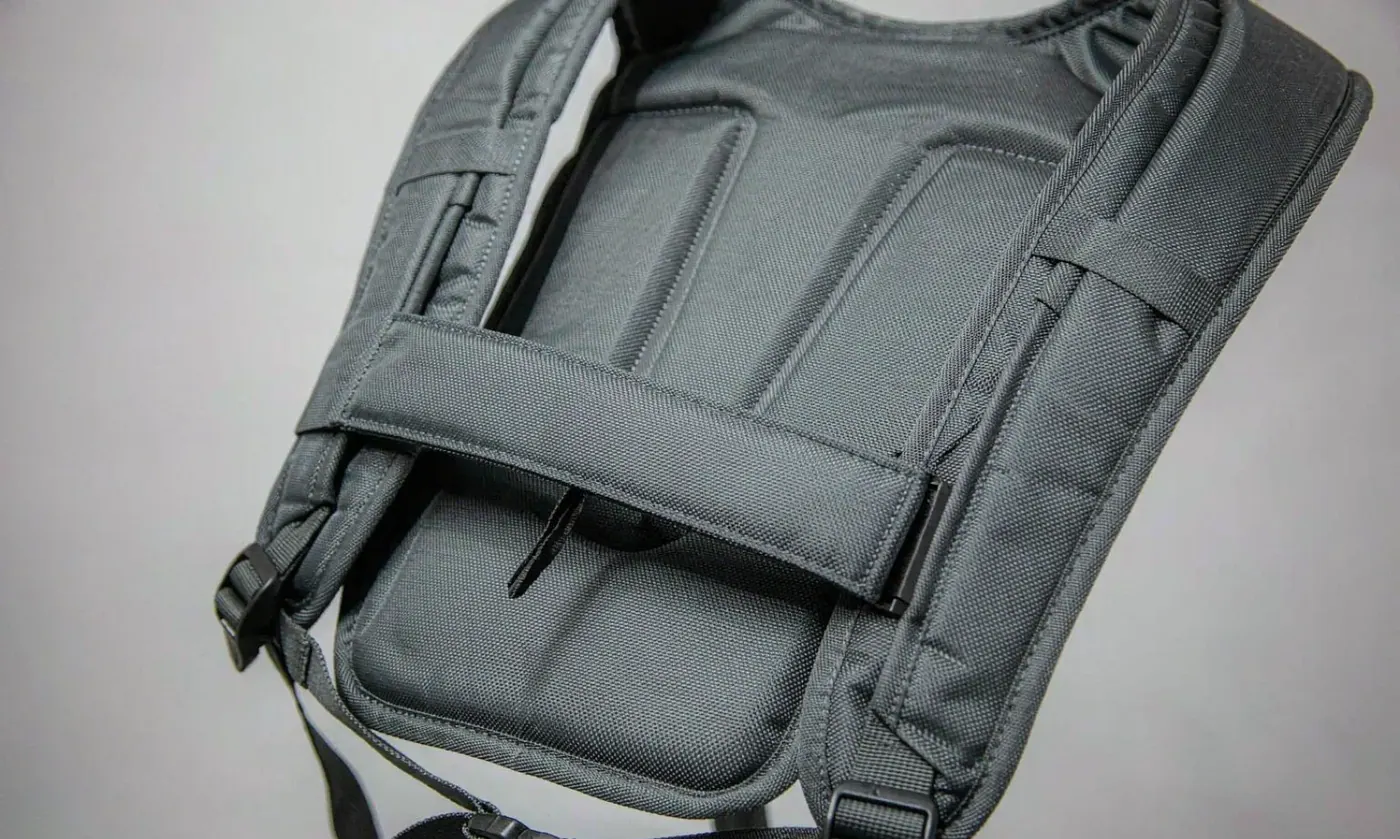
Ambidextrous design matters more in fly fishing than in most formats, because roughly one angler in ten casts left-handed and the strap has to sit on the non-casting shoulder. A reversible strap and mirrored tool docks cost 1-2 USD per unit and are the single most appreciated detail in the category.
Water, Layers, and What Does Not Belong
The most common specification error in a fly sling is adding a cooler. A cooler section takes volume, adds 300-400 g, and puts condensation inside the bag next to fly boxes, which is exactly where it does the most damage. A fly angler does not need to keep bait cold; they need one litre of water and a dry shell, and both are handled better by simpler means.
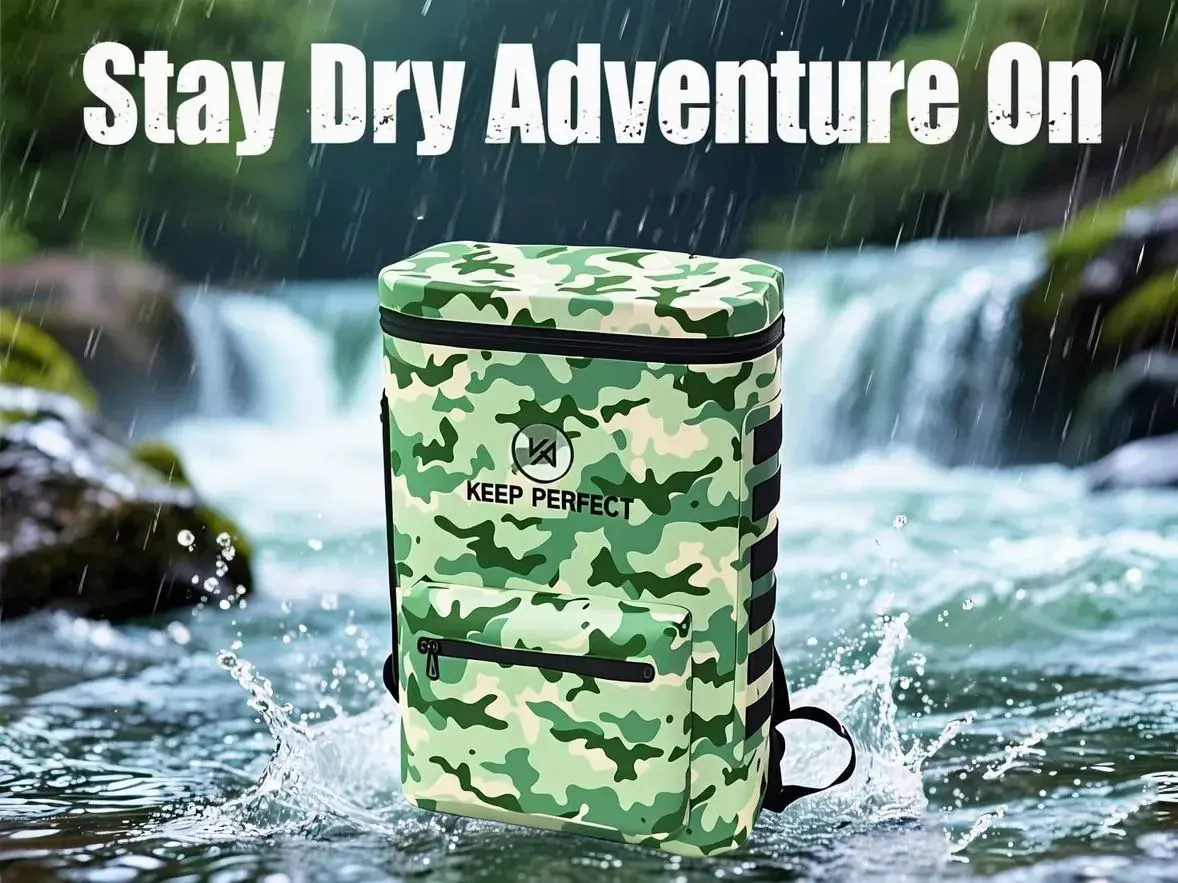
The correct answers are an insulated bottle sleeve with a drained open bottom on the outside of the bag, and compression straps under the body for a shell. Neither adds internal volume, both dry quickly, and both can be added or removed by the angler. A sling that tries to do everything ends at 1.4 kg, at which point it is no longer a sling.
| Item | Where it goes | Why not inside | Notes |
|---|---|---|---|
| One litre of water | External insulated sleeve | Condensation beside fly boxes | Drained open bottom |
| Rain shell | Compression straps under the body | Takes a whole box slot | Under 400 g |
| Food | Small external pocket | Crumbs and damp in the chamber | Wrapped, not loose |
| Camera or phone | Sealed liner inside | Single point of failure | 2-3 L pouch |
| Wading staff | Rear holster, open bottom | Will not fit inside at all | Folded or fixed length |
Fly Box and Tray Layout
Fly boxes are retrieved by the spine rather than by the lid, which means they must stand on edge in a chamber with enough depth to grip them. A chamber of 150-160 mm internal depth holds a standard box upright with about 15 mm of finger space, and that 15 mm is the difference between a box that comes out first time and one that has to be dug out. Most slings get this wrong by a few millimetres.
Racking should be fixed rather than loose. A single open chamber lets boxes lean, slide, and end up stacked against each other, which is fine until the angler needs the one at the back. Two or three fixed slots of 40-45 mm each hold the boxes apart, and they cost almost nothing to add. A sling holding four boxes should have four slots, not one chamber that fits four.
| Layout element | Specification | Failure if wrong | Check |
|---|---|---|---|
| Internal depth | 150-160 mm | Boxes cannot be gripped by the spine | Retrieval test with gloves |
| Slot width | 40-45 mm per box | Boxes lean and stack | Shake test when half loaded |
| Slot count | One per box claimed | Digging for the back box | Time a retrieval |
| Tippet station | Above the work area, one hand | Angler puts the rod down | One-hand dispense test |
| Tool docks | Shoulder height, mirrored | Tools lost in the chamber | Draw test with eyes closed |
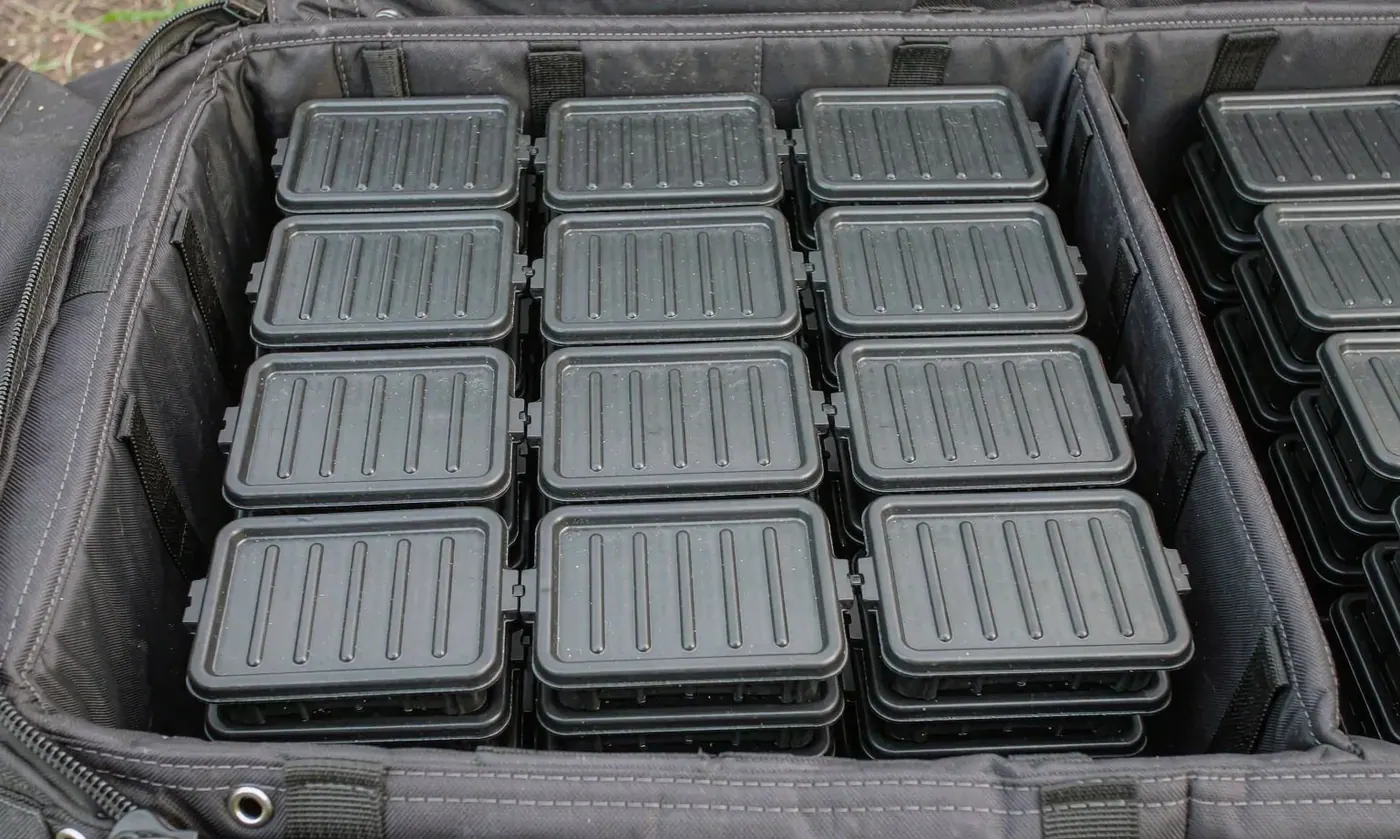
Tippet deserves its own note because it is the item retrieved most often in a session and the one most often badly placed. A station with three to five spools on a post, mounted above the box chamber and reachable without looking, is the correct answer. Putting tippet in a pocket is the most common design error in the category and it is obvious within about twenty minutes on the water.
1. River 10 All-Round: Best Overall
Ten litres, four fly boxes on edge in fixed slots, a five-spool tippet station above the chamber, a rear magnetic net dock, and 0.68 kg. That is the whole specification and it is the one most fly anglers should buy. Rating is IPX6, which covers rain, spray, and a slip, and the body is smooth with no external loops that can catch a running line.
The magnetic dock is rated at 1.5 kg, which is three times the wet weight of a typical trout net at 400-500 g, and it has a mechanical clip as a backup because a wet magnet under a swinging load can release. Reference band is 26-33 USD FOB Xiamen at 500 pieces, and the build is the one to lead a fly range with.
2. Trout 8 Minimal: Best Small Build
Eight litres and 0.52 kg holding two fly boxes, tippet, and tools is the minimal useful fly sling, and it suits a summer evening or a short session on a familiar stream. The body is narrow at 210 mm so it does not obstruct the casting arm, and the whole pack can be worn under a rain shell without feeling bulky.
What is removed is worth listing: no net dock, one tool dock rather than two, and a single external pocket. Rating is IPX6, and the recommendation is to add a 2 L sealed liner for a phone and licence, because at this volume there is no second chamber. Reference band is 22-28 USD, and it is the strongest second-bag seller in a fly range.
3. Guide 14: Best for Guide Duty
Guide duty means six boxes, a spare reel, food for two, and a bag that gets used six days a week. Fourteen litres, 1.05 kg, a 1000D face, 316 stainless hardware, and doubled strap anchors tested to three times the loaded weight. There is a wading staff holster at the rear, a first-aid sleeve, and a hydration sleeve that takes a 1.5 L reservoir.
At 1.05 kg this is at the top of what a sling should weigh, and it works only because the harness is serious: a 45 mm strap, a magnetic stabiliser, and a hip wing that moves part of the load off the shoulder. Reference band is 38-46 USD, and service life on guide duty is two to three seasons against four to six for the River 10 on personal use.
4. Stillwater 12: Best for Lakes
Stillwater fly fishing carries a different kit: more fly boxes, a reel case, a line tray, and often a boat or float-tube context rather than a wading one. Twelve litres, four boxes plus a padded reel case sleeve, 0.82 kg, and a flat base so the bag stands on a boat deck or a bank without tipping. Rating is IPX5, because lake fishing rarely immerses the bag.
The features that matter on still water are a stable base, a large work surface, and somewhere to put a stripping basket when walking. A pair of compression straps at the rear handles the basket, and they cost under 0.50 USD. Reference band is 27-34 USD, and the build sells well into boat and float-tube markets.
5. Salt 10: Best for Saltwater Fly
Saltwater fly changes three things: boxes are bigger, corrosion is real, and the bag goes in the water. Ten litres holding three large-format boxes of roughly 230 x 150 mm, 316 stainless and acetal hardware throughout at a 480-hour salt spray result, IPX7 at 1 m for 30 minutes, and 0.75 kg.
The closure is a covered zip with a full fabric garage, because salt spray destroys an exposed slider within a season, and the drains are acetal with a sloped channel. Rinse after every session is mandatory rather than recommended. Reference band is 30-38 USD, and the build should be sold with the rinse instruction printed on the hangtag.
6. Euro 9: Best for Euro Nymphing
Euro nymphing is a long-rod, close-contact technique with a very specific kit: a long rod held in one hand most of the session, a competition-style net on a long handle, and a lot of tippet. Nine litres, three boxes, a seven-spool tippet station, and a rear holster sized for a folded wading staff. Weight is 0.60 kg and the body is deliberately shallow.
The net dock is the design driver. A competition net and handle can exceed 1.5 kg wet, so this build uses a mechanical clip rather than a magnet, plus a secondary cord, because no realistic magnet holds that load while wading. Reference band is 25-32 USD, and the build is a specialist item that sells in small volume at high margin.
7. Travel 11: Best for Travel Anglers
Eleven litres, four boxes, and 0.58 kg, with a body that folds to about 50 mm and a removable stiffener so the pack can go in a suitcase. Rating is IPX5, hardware is 316 stainless, and the shoulder strap detaches for packing. The reference band is 24-31 USD and the build includes a sealed liner as standard.
Two travel details matter and both are usually missed. The bag must have no external loop long enough to catch on a conveyor belt, and the back panel should be mesh rather than closed-cell foam so it dries in a hotel room within 12 hours. Both cost nothing to specify and both determine whether the bag comes home usable.
Care and Season Checks
A fly sling needs less care than a backpack and more frequent care, because it gets wet on most outings. Rinse in fresh water after any salt session, empty every pocket, open every closure, and hang it by the strap for 8-16 hours. The magnetic dock and the tippet station are the two places to check, because both are load-bearing and both collect grit.
| Task | Frequency | Method | Pass condition |
|---|---|---|---|
| Fresh water rinse | After salt or brackish use | Low pressure over hardware | No visible salt residue |
| Empty and dry open | Every session | 8-16 hours, hung by the strap | Chamber completely dry |
| Net dock check | Monthly | Hang the wet net for 60 seconds | No release under load |
| Tippet station check | Monthly | Dispense one-handed | Spool turns freely |
| Re-proof the face | Every 30-40 sessions | Spray-on, even coverage | Water beads and rolls off |
Testing expectations belong in the brief rather than in a dispute. Abrasion resistance and strap strength can be required to stated values using published methods from ASTM International, and any water claim should carry its condition, since ingress codes are defined by the IEC ingress protection framework. A sling rated IPX6 with a stated condition is defensible; one described as waterproof with nothing behind it is not.
Programme, Pricing, and Compliance
Fly slings are a small-volume, high-margin category, and the brief should reflect that. Buyers usually order fewer units at a higher specification, and the two things worth spending on are the magnetic or mechanical net dock and a moulded tippet station. Both are noticed immediately on the water and both cost 1-3 USD, which makes them the best value additions in the whole category.
| Programme item | Baseline | Note |
|---|---|---|
| MOQ | 500 pcs per design and colour | Colour split negotiable above the baseline |
| Sampling | 6-10 working days | Add 3-5 days for a moulded tippet station |
| Bulk | 35-50 days | From approved sample and deposit |
| Inspection | AQL 2.5 | Include box fit, magnet hold, strap pull, water screen |
| Compliance | REACH and California Prop 65 | Screen coatings, films, inks, hardware |
QUANZHOU JUNYUAN BAGS has developed waterproof bag programmes since 2014, with the founding team active in the industry since 2004. Monthly output of 200,000 units is verified by SGS, and BSCI and ISO 9001 systems structure the workflow. Materials are screened for REACH and California Prop 65, and every bulk order is inspected at AQL 2.5 before shipment.
A fly sling brief can be emailed to service@junyuanbags.com; include litres, box count and size, tippet station type, net dock rating, market, and quantity. FOB Xiamen or DDP service to more than 100 countries follows an approved sample and a complete test record. The wider category sits in the fly fishing bag overview, format trade-offs are covered in the sling versus waist pack comparison, and the general range is in the fishing sling pack overview.
People Also Ask
How many fly boxes should a sling pack hold?
Four standard boxes of about 145 x 95 mm in fixed slots is the practical maximum for a 10 L build. Six needs a 14 L guide build and a serious harness.
Why does box orientation matter in a fly sling?
Boxes are retrieved by the spine, so they must stand on edge. A chamber of 150-160 mm internal depth gives about 15 mm of finger space, which decides whether a box comes out first time.
Where should the net go on a fly sling?
On a rear magnetic dock rated at three times the wet weight, with a mechanical clip as backup. A competition net over 1.5 kg needs a clip rather than a magnet.
Does a fly sling need a cooler section?
No. It costs volume, adds 300-400 g, and puts condensation beside the fly boxes. Use an external insulated sleeve and compression straps instead.
What strap width suits a fly sling?
32-38 mm with 5-8 mm padding, anchored at the opposite hip. Thicker padding restricts the shoulder and limits the casting stroke.
Should a fly sling pack be ambidextrous?
Yes. Roughly one angler in ten casts left-handed and the strap must sit on the non-casting shoulder. Reversible straps and mirrored docks cost 1-2 USD per unit.
Frequently Asked Questions
Q1. What is the best fly fishing sling pack overall?
A 10 L build holding four fly boxes in fixed slots with a five-spool tippet station, a rear magnetic net dock rated at three times the wet net weight, and a weight of about 0.68 kg.
Q2. How many fly boxes fit in a fly sling pack?
Four standard boxes in a 10 L build and six in a 14 L guide build. Boxes should stand on edge in fixed slots rather than leaning in one open chamber.
Q3. Why should fly boxes stand on edge?
They are retrieved by the spine. A chamber depth of 150-160 mm leaves about 15 mm of finger space, which is what makes a box come out first time.
Q4. Where should a landing net go on a fly sling?
On a rear magnetic dock rated at three times the wet weight of the net, with a mechanical clip as a backup. Nets over 1.5 kg need a clip, not a magnet.
Q5. Should a fly sling pack have a cooler?
No. It takes volume, adds weight, and puts condensation beside the fly boxes. An external insulated sleeve and compression straps do the job properly.
Q6. What strap width suits a fly fishing sling?
32-38 mm with 5-8 mm padding, anchored at the opposite hip rather than under the arm, so the casting stroke stays clear.
Q7. What size fly sling suits trout fishing?
Eight to 10 L. A half-day session needs two boxes and tippet, and a full day needs four, which is the 10 L build.
Q8. What suits euro nymphing?
Nine litres with a seven-spool tippet station, a shallow body, and a mechanical net clip rather than a magnet, because a competition net and handle can exceed 1.5 kg wet.
Q9. Do saltwater fly anglers need a different sling?
Yes. Larger boxes, 316 stainless and acetal hardware rated to 480 salt spray hours, a covered zip with a garage, and IPX7 at a stated depth.
Q10. How much should a fly sling pack weigh?
Between 0.52 kg for a minimal 8 L build and 1.05 kg for a 14 L guide build. Above about 1.1 kg the format stops working as a sling.
Q11. Should a fly sling be ambidextrous?
Yes. About one angler in ten casts left-handed, and a reversible strap with mirrored tool docks costs only 1-2 USD per unit.
Q12. What is the MOQ and lead time for a fly sling programme?
MOQ is 500 pcs per design and colour, samples take 6-10 working days, and bulk runs 35-50 days from approved sample and deposit.