A sling pack is faster by roughly six seconds per access, because it swings to the front without being set down while a backpack has to come off or at least be removed from both shoulders. Over a 60-access day that is about six minutes of fishing recovered, which is why slings dominate for roving anglers changing lure every few minutes. The advantage reverses the moment three or more trays are needed: above two trays only a backpack holds a sensible selection, and past about 800 m of walking or 5 kg of load the sling stops being faster at all and simply becomes uncomfortable.
Where the Six Seconds Actually Go
The speed difference is often described vaguely, so it is worth breaking it into measurable steps. Accessing anything in a sling means rotating the body to the front, which takes about 2 seconds and involves no change of footing. Accessing the same item in a backpack means removing it from one or both shoulders, setting it down, reaching in, and picking it up again, which takes 6-12 seconds depending on whether a hip belt is in play.
| Step | Sling pack | Backpack | Difference |
|---|---|---|---|
| Reposition the body | Rotate forward, about 2 s | Remove from both shoulders, 3-5 s | 1-3 s |
| Open the compartment | One zip pull, about 1 s | One or two pulls, 1-2 s | 0-1 s |
| Locate the item | Visible when presented, about 1 s | Reach into the sleeve, 2-3 s | 1-2 s |
| Return to fishing | Rotate back, about 1 s | Put the pack on again, 2-4 s | 1-3 s |
| Total per access | 4-5 s | 8-14 s | 4-9 s per access |
Two of those rows deserve comment because they are where estimates are usually wrong. Putting the pack back on is consistently underestimated, especially with a hip belt that has to be rethreaded rather than merely re-clipped, and it typically costs another 2-3 seconds over a simple webbing belt. The other is that a sling is only genuinely fast when the strap bearing lets the body rotate cleanly rather than requiring the angler to pull it across their own shoulder, which cheap sling builds do not manage.
The Two-Tray Crossover
Everything changes at three trays. Up to two shallow 3600 trays a sling carries the load fine and presents it well, but a third pushes past the limit where one shoulder can comfortably work, and past about 5 kg the access advantage simply stops mattering because the angler stops wanting to wear it.
| Trays needed | Loaded weight | Faster option | Reason |
|---|---|---|---|
| 1 shallow 3600 | 1.1-1.4 kg | Sling, clearly | Well inside the comfort limit, best access |
| 2 shallow 3600 | 2.2-2.8 kg | Sling, clearly | Still comfortable, still fast |
| 3 shallow 3600 | 3.3-4.2 kg | Sling, marginally | Approaching the shoulder limit |
| 4 shallow 3600 | 4.4-5.6 kg | Backpack | One shoulder is simply done at about 5 kg |
| 3 deep 3700 | 6.6-8.4 kg | Backpack, clearly | Double the theoretical sling limit |
| 4 deep 3700 | 8.8-11.2 kg | Backpack, only option | Requires a hip belt to be wearable |
Note how sharply the deep 3700 format moves the decision. Three deep trays reach about 7-8 kg of tackle alone, which is not merely past the sling limit but close to the practical load ceiling for any single-position carry. Anyone whose working selection genuinely requires three or more deep trays has a backpack question and nothing else, and no improvement in access speed changes that.
Distance Reframes the Whole Question
Speed is the wrong metric if the walk matters at all, because a sling loses every advantage it has once distance enters the picture. The threshold sits near 800 m, below which a sling is comfortable for most people and above which asymmetric loading produces shoulder and neck fatigue that dominates the entire session rather than merely the walk.
| Walk distance | Sling | Backpack | Winner |
|---|---|---|---|
| Up to 200 m | Excellent | Fine, slower to don | Sling |
| 200-800 m | Good, mild asymmetry | Good | Sling on speed |
| 800 m to 3 km | Fatiguing past 4 kg | Comfortable to 10 kg | Backpack |
| 3 km and beyond | Not suitable above 3 kg | Correct answer to 14 kg | Backpack |
| Uneven or rocky ground | Shifts on every step | Stable with hip belt | Backpack |
Uneven ground deserves separate mention because it is under-appreciated. A sling body swinging freely is actively destabilising when stepping over wet rock or across a slippery weir, since it moves independently of the torso and shifts the centre of mass with every step. A hip-belt backpack moves with the wearer instead, and that difference matters far more to safety than any question about access speed.
Casting Are the Hidden Constraint
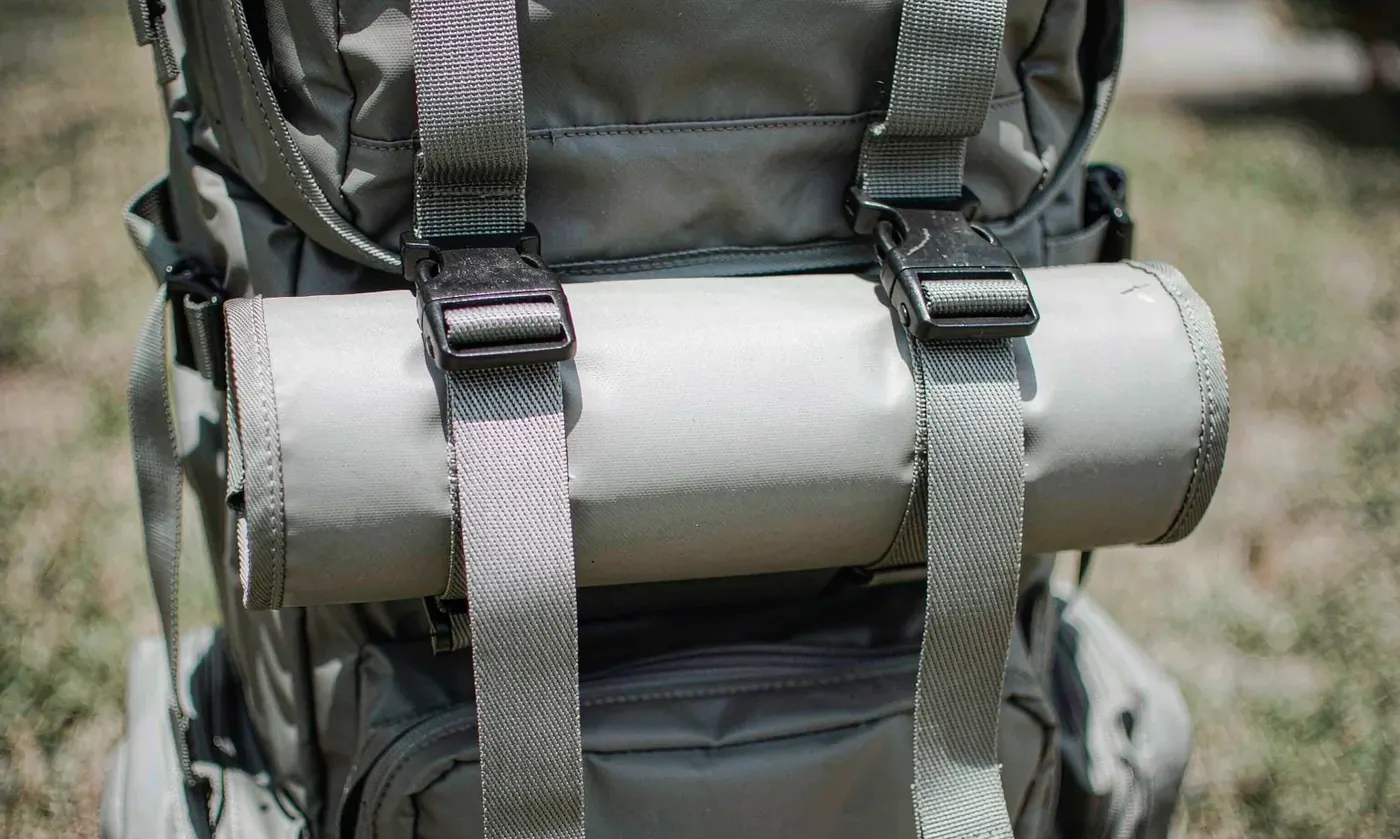
Neither format interferes with a cast if it is designed properly, and both interfere badly if not, because the constraint is identical: nothing may intrude into the space above and behind either shoulder through which a rod butt travels. The difference is that a sling places load and any attached gear on one side only, leaving the other shoulder entirely clear.
- A sling leaves one shoulder completely free, which some anglers prefer even at the cost of asymmetry, particularly for overhead casts.
- A backpack distributes the load but must keep strap width outside roughly 300 mm of clearance above each shoulder to avoid butt contact.
- Rod holder attachments on a sling tend to place the rod across the body where it snags line, while a backpack keeps the rod outside the body line.
- Landing nets mount more cleanly on a backpack rear panel than on any sling, where there is no stable rear surface.
- Water bottles and external pockets behave identically on both, provided they sit below the shoulder line.
That third point is worth expanding because it is not obvious until experienced. A rod carried on the same side as a sling body ends up crossing the angler's own line during a retrieve, which tangles, whereas the same rod on a backpack rear attach point stays clear of everything. Anglers who carry a spare rod set up usually end up preferring the backpack for this single reason.
Weather Response Time
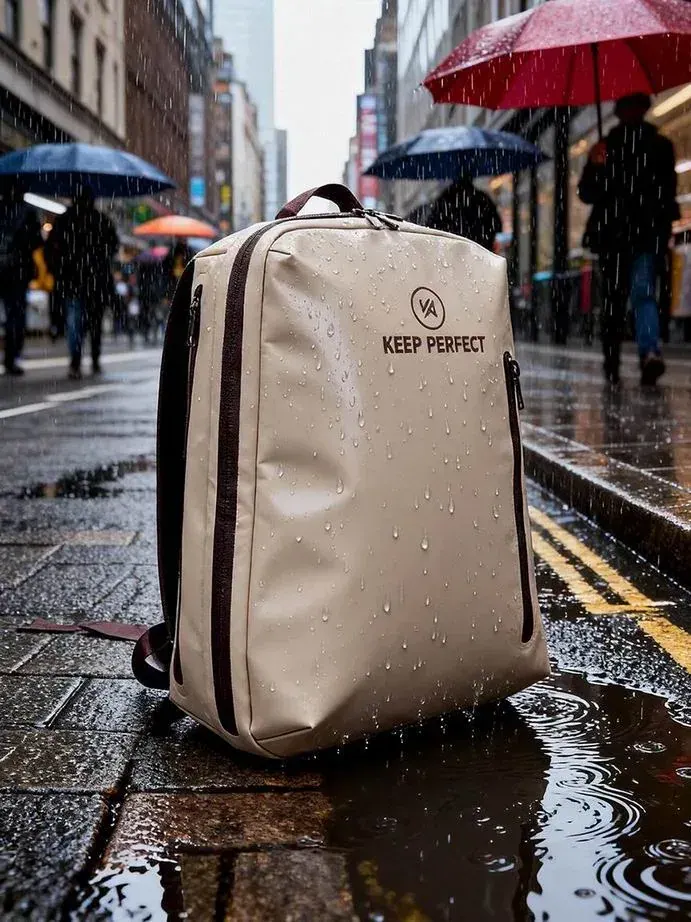
One question neither format wins is how quickly it can be protected when rain starts. Both take roughly 10-20 seconds to seal or cover, and the difference between them disappears entirely once hands are wet and cold.
| Protection type | Sling time | Backpack time | Note |
|---|---|---|---|
| Zip the main compartment shut | 2-4 s | 3-6 s | Sling keeps the marginal edge |
| Fit a rain cover | 10-15 s | 12-20 s | Practically identical |
| Roll and clip a roll-top mouth | 10-14 s | 12-16 s | Format makes little difference |
| Rummage for a rain shell inside | 20-30 s | 25-40 s | Backpack loses for the same reason it loses on access |
Fabric performance should still be specified the same way for either format. Water repellency is measured against methods maintained by AATCC, and tear and abrasion behaviour against methods published by ASTM International. Requiring those numbers makes the comparison objective rather than a matter of how wet either sample looked after a shower.
Water Depth and Direction of Loss
Immersion behaviour separates the two formats more than any other single factor, for a reason that has nothing to do with either design. If the angler slips in deep water, a sling being worn across the body goes in with them, while a backpack can be shrugged off in about 2 seconds or may simply stay higher because it sits higher on the torso.
| Scenario | Sling outcome | Backpack outcome | Implication |
|---|---|---|---|
| Slip in shallow water | Contents wet above the waistline | Lower panel wet only | Both need IPX3 minimum |
| Slip above mid-thigh | Most contents soaked | Lower third soaked | Backpack loses less |
| Wading to the waist intentionally | Cannot be worn above the line | Can be rotated to the chest | Backpack is workable |
| Kayak bilge water | Usually held clear of the floor | Sits in water for hours | Backpack needs a welded floor |
The interesting inversion is the last row. In a kayak the sling's advantage flips completely, because hands are occupied with a paddle and the sling body can be held clear of the hull floor while a backpack sits in whatever has collected in the tankwell. Buyers serving kayak anglers should note this explicitly rather than letting the general conclusion carry over.
What Each Format Costs to Build and Price
Build cost per litre favours the sling, but build cost per unit favours neither, because the strap assembly dominates either way. A sling needs one wide padded strap with a bearing and stabiliser, while a backpack needs a hip belt, two narrower straps, load lifters, and a sternum strap, and those roughly balance out.
| Element | Sling build | Backpack build | Cost delta |
|---|---|---|---|
| Strap assembly | One 65-80 mm padded strap | Two 70 mm straps plus lifters | Backpack plus 2.30 USD |
| Hip belt | Not fitted, or 25 mm webbing | 65 mm padded belt | Backpack plus 2.40 USD |
| Internal structure | Optional single sleeve | Moulded tray sleeve | Backpack plus 3.60 USD |
| Shell fabric per unit | About 0.35 m2 | About 0.95 m2 | Backpack plus 2.80 USD |
| Typical FOB band | 16-32 USD | 26-48 USD | Roughly 10-16 USD gap |
The price gap translates directly into shelf positioning rather than into margin difference, which is the useful insight. A retailer wanting an entry solution below 25 USD retail will find that only the sling configuration reaches it, and a retailer building a flagship above 60 USD will find only the backpack has enough spec to justify that number. They are not competing for the same shopper in most cases.
The Decision Table
Putting the whole comparison together, the decision reduces to three questions answerable in about thirty seconds: how many trays, how far is the walk, and how often is something needed. Answering those three honestly gives a clear answer every time, including the cases where the honest answer is to buy both.
| Trays needed | Walk | Answer | Why |
|---|---|---|---|
| 1-2 shallow | Under 800 m | Sling | Faster access inside the comfort limit |
| 1-2 shallow | Over 800 m | Backpack past 4 kg, else sling | Distance begins to dominate |
| 3 or more | Any distance | Backpack | Above two trays only a backpack holds a sensible load |
| Any | Over 3 km | Backpack | Asymmetric loading fails regardless of tray count |
| Any | Uneven or rocky | Backpack | Stability matters more than access |
| Deep 3700 x 3 | Any distance | Backpack with hip belt | About 7-8 kg of tackle alone |
Readers looking at the first row and the fourth row together will spot the honest conclusion most buying guides avoid. A great many settled anglers own both, using a compact sling for the roving kit and a backpack for the bulk haul to a remote beat, and that combination costs less than trying to find one format that does both badly. Buyers should stock both rather than forcing a choice.
Organisation Differences That Decide It
Tackle is rarely what pushes either format past its limit. Water, food, a rain shell, and a camera together add 2-4 kg that nobody counts when deciding what to carry, and those are the items that tip a sling past comfortable.
- Two litres of water alone weighs 2 kg, which is most of the usable headroom in a sling before any tackle is added.
- A rain shell and a warm layer add about 1.2 kg, and neither can be left behind on a day with changing weather.
- Food across a full day adds around 0.8 kg, usually carried in a pocket rather than accounted for in any load estimate.
- Electronics such as a camera or a phone in a protective case add 0.5-1.2 kg, almost all of it in small dense blocks.
- Total these and a sling loaded with tackle plus incidentals crosses 5 kg well before the owner expects it to.
The practical consequence is that a pack should be sized against the whole day rather than against the tackle alone. A sling that looks correct holding two trays is already at its limit once water and clothing go in, and that is exactly when an angler stops wearing it rather than merely finding it awkward.
Field Checks Before Choosing a Format
Rather than deciding on paper, either format can be settled with about thirty minutes of testing using a realistic load. Four drills cover essentially everything and they are cheap enough to run for any first order.
| Drill | Method | Sling passes at | Backpack passes at |
|---|---|---|---|
| Timed access | 20 accesses, tray two | Under 5 s average | Under 10 s average |
| Loaded walk | 800 m at target load | No shoulder ache at 4 kg | No hip hotspot at 10 kg |
| Cast clearance | 25 full strokes | No contact on the free shoulder | No contact above either shoulder |
| Stability step | Cross wet rock for 50 m | Acceptable below 4 kg | Stable to 12 kg |
The cast clearance drill is the one most often skipped and the one that most reliably reveals a design fault rather than a preference. Twenty-five full strokes will find a strap or load lifter that sits inside the rod's path, and it is a two-minute check that prevents returns from anglers who cannot articulate what they dislike about a pack.
How Often Anglers Actually Reach In
Access counts vary far more between anglers than formats do, and that variance matters more than any single average. An angler fishing soft plastics from a known bank may open the pack six times in a session, while one working through four pattern types across differing water may open it more than eighty times, and the two experiences of the same bag are not comparable.
A useful figure for buyers is roughly thirty to forty accesses across a four-hour session for a competent angler covering varied water, which sits between the two extremes above. At eight seconds of gap per access that translates into about four to five minutes of recovered fishing time for a sling, which is real but is also less than most anglers guess before timing themselves. The practical advice is to decide on load and distance first, treat speed as the tie-breaker rather than the headline, and let the angler choose between two stocked formats rather than being sold one answer.
Programme, Pricing, and Compliance
Both formats run at MOQ 500 pcs per design and colour, with sampling taking 6-10 working days from confirmed artwork. A first backpack sample typically adds 2-3 days over a sling because the harness and sleeve layout take longer to develop than a single strap path, and that difference should be planned into launch timings.
| Programme item | Baseline | Note |
|---|---|---|
| MOQ | 500 pcs per design and colour | Colour split negotiable above 2,000 pcs |
| Sling sampling | 6-10 working days | Strap bearing development included |
| Backpack sampling | Add 2-3 days | Harness and sleeve layout development |
| Bulk | 35-50 days | From approved sample and deposit |
| Inspection | AQL 2.5 | Include timed access, loaded walk, cast clearance, strap cycles |
| Compliance | REACH and California Prop 65 | Screen shell, coating, film, foam, inks, hardware |
QUANZHOU JUNYUAN BAGS has developed waterproof bag programmes since 2014, with the founding team working in the trade since 2004. Monthly output of 200,000 units is verified by SGS, and BSCI and ISO 9001 systems structure the workflow. Materials are screened for REACH and California Prop 65, and every bulk order is inspected at AQL 2.5 before shipment.
A format brief can be emailed to service@junyuanbags.com with format, tray count, walk distance, load target, and quantity. FOB Xiamen or DDP service to more than 100 countries follows an approved sample and a complete test record. Buyers still weighing specific models should compare the sling pack range, the tackle backpack range, and the current sling pack ranking.
People Also Ask
Is a sling pack faster than a fishing backpack?
Yes, by about 4-9 seconds per access, because it swings forward rather than being set down. Over a 60-access day that recovers roughly six minutes of fishing.
At what point is a backpack better than a sling?
At three trays. Up to two shallow 3600 trays a sling stays comfortable, but a third pushes past about 5 kg and the shoulder limit decides it.
How far can I walk with a sling pack?
Comfortably up to about 800 m at 4 kg. Beyond that asymmetric loading produces shoulder and neck fatigue that dominates the rest of the session.
Can you cast with a sling pack on?
Yes, and one shoulder stays completely clear. On a backpack, straps must sit outside roughly 300 mm of clearance above each shoulder to avoid rod butt contact.
Which pack survives a slip while wading?
A backpack loses less, since a sling worn across the body goes in with the angler. In a kayak the advantage flips, because the sling stays clear of bilge water.
Should I own both a sling and a backpack?
Usually yes. A compact sling for the roving working kit and a backpack for the bulk haul costs less than one format doing both jobs badly.
Frequently Asked Questions
Q1. Which is faster, a fishing backpack or a sling pack?
A sling, by roughly 4-9 seconds per access. It rotates forward in about 2 seconds while a backpack must come off both shoulders, be opened, and be put back on.
Q2. How much faster is a sling over a full day?
About six minutes across 60 accesses. That assumes the working selection is visible when presented, which requires a sling with a clean strap bearing rather than one that must be pulled across.
Q3. When should I choose a backpack instead?
At three or more trays, any walk beyond 3 km, any load above 5 kg, or uneven and rocky ground where hip-belt stability matters more than access speed.
Q4. Does the two-tray rule always hold?
Almost. Three shallow 3600 trays reach 3.3-4.2 kg, which is at the sling limit but survivable. Three deep 3700 trays reach 7-8 kg, which is not.
Q5. Can I cast properly wearing a backpack?
Yes, provided straps and load lifters stay outside roughly 300 mm of clearance above each shoulder. Verify with 25 full casting strokes rather than judging from a photograph.
Q6. Which pack is more stable on wet rock?
A backpack with a hip belt, which moves with the torso. A sling swings independently and shifts the centre of mass on every step, which matters at speed over slippery ground.
Q7. Is a sling better in a kayak?
Usually yes, the reverse of the bank situation. The sling can be held clear of the hull floor while a backpack sits for hours in bilge water and needs a welded lower shell.
Q8. Why does my pack push my load past the limit?
Incidentals rather than tackle. Two litres of water is 2 kg, clothing about 1.2 kg, and food roughly 0.8 kg, which together exceed the headroom in a sling before trays are counted.
Q9. Which format is cheaper to build?
Both have similar strap costs, since a sling needs one wide padded strap and a backpack needs two narrower ones plus a hip belt. The shell difference is about 2.80 USD in favour of the sling.
Q10. What is the typical price gap between them?
Sling bodies run 16-32 USD FOB and backpacks 26-48 USD. That gap is about shelf positioning rather than margin, because they rarely compete for the same buyer.
Q11. Do I need a hip belt on a sling?
Not usually, since a webbing stabiliser is enough to stop rotation. A padded hip belt on a sling defeats the single-shoulder carry the format is built around.
Q12. Can rod holders be fitted to both?
Yes, but the rod sits better on a backpack rear panel, clear of the line during a retrieve. On a sling the rod tends to cross the angler's own line and snag.
Q13. What is the MOQ and sampling time for either format?
MOQ is 500 pcs per design and colour. Sling samples take 6-10 working days, backpack samples add 2-3 days for harness and sleeve development, and bulk runs 35-50 days.