Four carry styles cover nearly the whole tackle market, and the decisive difference between them is not volume or price but where the load sits on the body. A tote loads one hand and becomes painful beyond roughly 6 kg or 400 m, a sling loads one shoulder and past 5 kg or two hours causes real fatigue, a backpack distributes across both hips and carries 10-14 kg for several kilometres, and a waist pack puts weight straight onto the skeleton with almost no distance limit. The four are compared below on load limits, realistic walk distance, tray capacity from one shallow 3600 to four deep 3700, time to the first tray of 2-20 seconds, and FOB Xiamen bands of 8-48 USD at MOQ 500 pcs per design and colour, samples in 6-10 working days and bulk in 35-50 days.
Carry Position Is the Specification
Everything else follows from where the weight lands. Volume determines what can be brought, price determines what will sell, but carry position determines whether the angler can actually get it to the water and then fish comfortably for five hours. Two packs of identical capacity can differ by an entire day of usable session length purely through this one variable.
| Style | Where the load sits | Comfortable maximum | Pain threshold | Typical volume |
|---|---|---|---|---|
| Tote | One hand, fingers and wrist | 6 kg | Past 400 m or 15 min | 15-35 L |
| Sling | One shoulder, trapezius | 5 kg | Past 2 h continuous | 8-18 L |
| Backpack | Both hips and sternum | 14 kg | Past 8 km unbroken | 20-45 L |
| Waist pack | Pelvis, directly on the skeleton | 4 kg | Very few arises | 4-12 L |
The pain thresholds deserve more weight than the maximum figures, because they are what actually ends a session. An angler can physically carry 10 kg in a tote for a hundred metres and will happily do it twice, which is why the format persists; the problem appears at 400 m when grip fatigue makes the hand cramp and the same load has to be set down every few minutes. Buyers should understand which of these two numbers governs a given purchase rather than quoting the comfortable maximum alone.
Tote: The Short-Walk Specialist
A tote is a rectangular open or zip-top body carried by one or two hand straps, typically 15-35 litres holding two to four 3700 trays loose at 700 g to 1.4 kg empty, priced 8-24 USD. It is the cheapest way to move a lot of tackle a short distance, and it is the correct answer for anyone fishing from a vehicle, a pier, or a fixed platform.
The single specification that changes everything here is grip geometry. A flat webbing strap of 20 mm concentrates load across roughly 20 mm of palm, producing contact pressure high enough to cause cramping within ten minutes at 6 kg, while a padded wrap of 25 mm or a moulded grip spreads the same load over triple the contact area. That upgrade costs about 0.90 USD and it is the difference between a tote that gets used and one that lives in a garage.
| Specification | Budget build | Improved build | Effect at 6 kg |
|---|---|---|---|
| Grip width | 20 mm flat webbing | 25 mm padded or moulded | Cramping in 10 min versus none |
| Grip count | Two short handles | Two handles plus a shoulder sling | Hands free for the rod |
| Base | Fabric | Moulded EVA panel, 3 mm | Stands upright, stays dry underneath |
| Opening | Open top | Zip top with a stiffened mouth | Contents stay in during transport |
| Internal sleeve | None | Four slot sleeve | Trays stay upright instead of rotating |
Sling: Fast Access, One-Shoulder Cost
A sling rides one strap across the chest and swings forward for access without being set down, typically 8-18 litres with one or two shallow 3600 trays at 12-30 USD. Its advantage is genuine: the angler gets to the working selection in about two seconds while standing, hands otherwise occupied, without putting anything down on wet ground.
The cost is asymmetry, and it should be stated plainly at point of sale. One shoulder takes the whole load through the trapezius, and past roughly 5 kg or two hours the shoulder girdle fatigues in a way two-shoulder carry does not produce at double the weight. Strap padding width is the mitigation, with 65 mm being the practical minimum and 80 mm noticeably better, together with a stabiliser strap that stops the body swinging with every cast.
Backpack: The Distance Answer
A backpack distributes load across both hips with a sternum strap stabilising the harness, spanning 20-45 litres and three or four deep trays at 22-48 USD, accessing contents in about eight seconds. It is the only style here that handles genuine distance, carrying 10-14 kg for several kilometres where any other style fails inside the first 800 m.
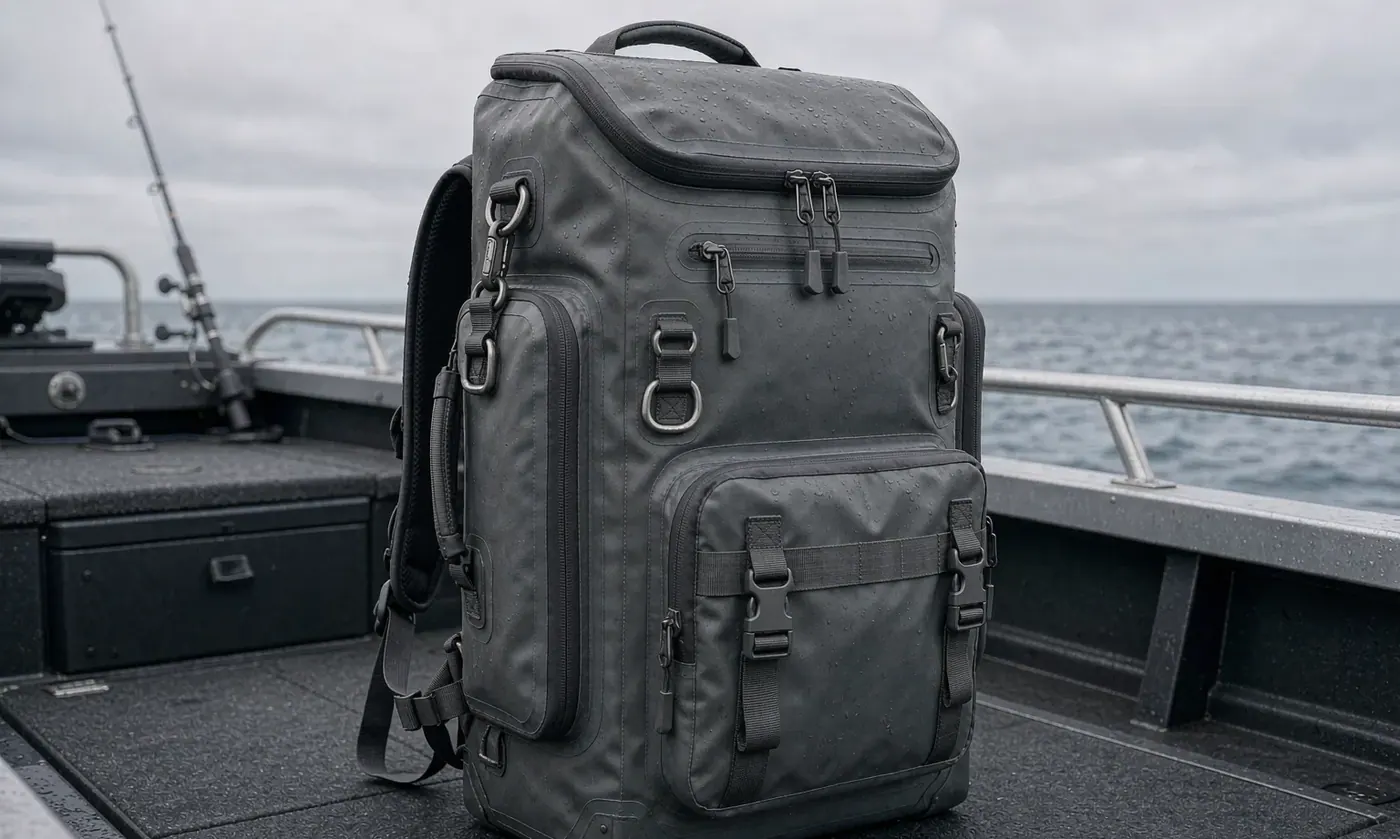
Roughly 80 percent of the load should arrive at the hips rather than the shoulders, which requires a hip belt at least 65 mm wide and mounted above the iliac crest. Get that wrong and the pack becomes a heavy bag hanging from two straps, which is uncomfortable at half the weight. The trade-off against every other style is slower access, and anglers switch away from backpacks for exactly that reason once they start moving rarely and changing often.
Waist Pack: The Longest Single-Day Carry
A waist pack sits on the pelvis, typically 4-12 litres with one or two shallow trays at 9-22 USD, reaching contents in about two seconds. It supports less weight than anything else on this list but it can be worn all day without fatigue, because the load transfers through the skeleton rather than through muscle.
The two details that decide whether it works are strap width where it meets the body, at 50 mm minimum and preferably 75 mm, and a stabiliser that stops rotation on each cast. Below about 4 litres it adds nothing over clothing pockets, and above roughly 12 litres or 4 kg it starts interfering with the casting stroke, which is precisely why the format stops where it does. A dedicated comparison sits in the sling against waist pack guide.
The Decision Table Nobody Prints
Rather than asking customers to self-identify as a type of angler, ask two questions that anyone can answer: how far is the walk, and how often does kit get changed once there. Those two answers select the correct style nearly every time, and they also select the correct second purchase.
| Walk distance | Kit changes per hour | Primary style | Reasonable second item |
|---|---|---|---|
| Under 200 m | 0-1 | Tote | Waist pack for tools |
| Under 200 m | 3-6 | Waist pack or sling | Tote at the vehicle for resupply |
| 200-800 m | 1-3 | Sling | Tote left at the bank |
| 200-800 m | 3-6 | Convertible sling and pack | None needed |
| Over 800 m | 0-1 | Backpack | Waist pack for tools |
| Over 800 m | 3-6 | Front-loading backpack | Sling for the roving kit |
Two cells in that table deserve comment because they are where most buyers make inventory mistakes. At 200-800 m with frequent changes, the convertible body is the honest answer and it is often missing from ranges because it sits between two familiar categories. And no cell recommends a sling for a walk over 800 m, because by that distance one-shoulder fatigue dominates the experience no matter what the strap measures.
How Each Style Handles Water
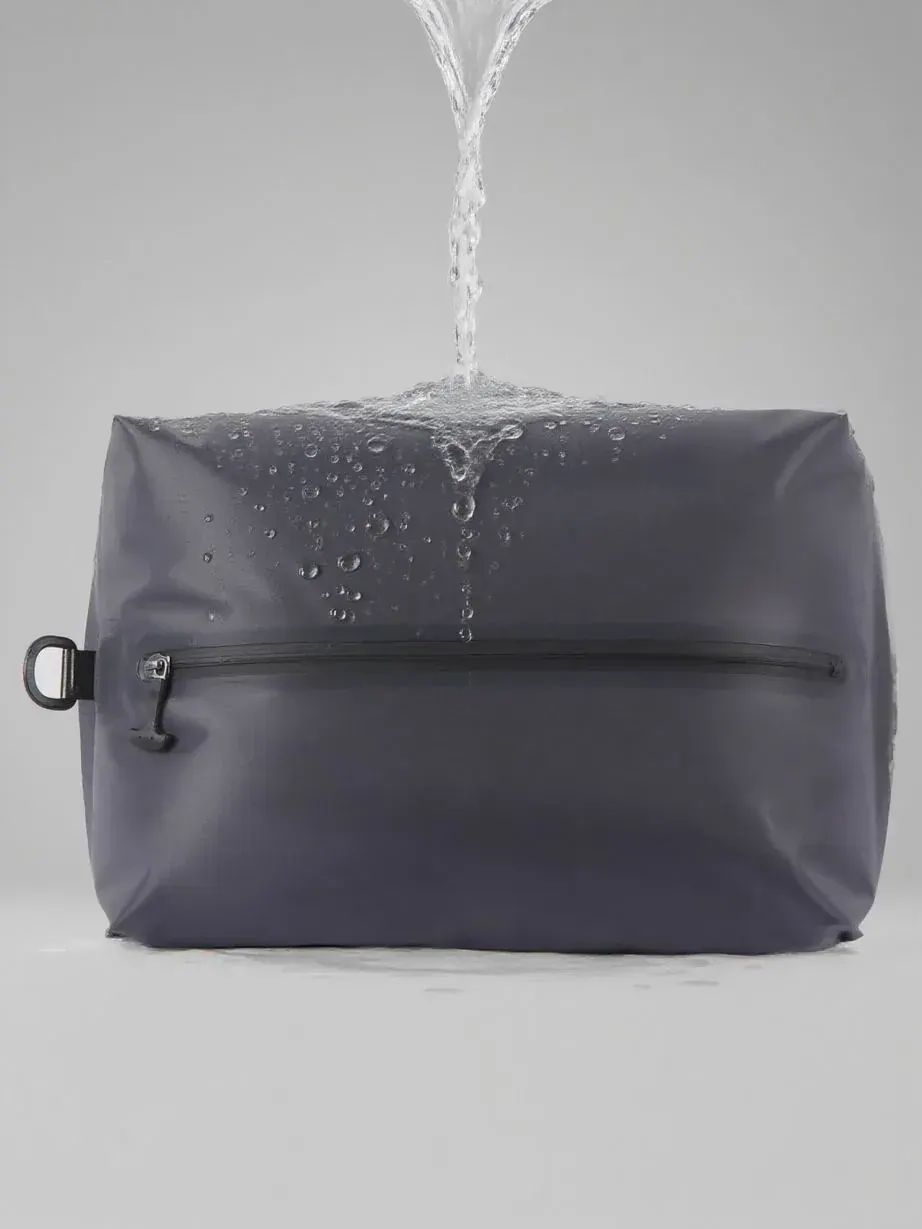
Water behaviour differs across the four styles in a pattern usually explained by accident rather than design. A tote standing on wet ground takes water through its base within minutes unless the base is moulded, and nothing else on the list sits on the ground as often. A backpack stands on a base too but usually gets set down less. Waist and sling bodies stay on the body and so rarely sit in water at all.
| Style | Typical exposure | Minimum sensible rating | Upgrade worth costing |
|---|---|---|---|
| Tote | Set down on wet ground repeatedly | IPX2 sewn with a moulded base | Moulded EVA base, 3 mm, plus 1.60 USD |
| Sling | Worn, exposed to rain only | IPX2 with a PU coat | Coated zip to IPX3, plus 1.70 USD |
| Backpack | Set down in bilge water or mud | IPX3, preferably a welded floor | Welded lower shell to IPX6, plus 5.50 USD |
| Waist pack | Splash and light rain | IPX2 with a coated base | Water-resistant zip only, plus 1.20 USD |
Wet and dry separation is the other half of this and it interacts with carry position in a predictable way. A backpack has room for a dedicated wet compartment and benefits enormously from one, because waders and a wet rain shell otherwise soak the tray contents. A waist pack has no such room and should not pretend otherwise: its contents are intentionally dry-day items and a wet item simply should not go in it. Many of the same trade-offs are set out in the waterproof against water resistant comparison.
Adding a Fourth Item: Insulated Secondary Bags
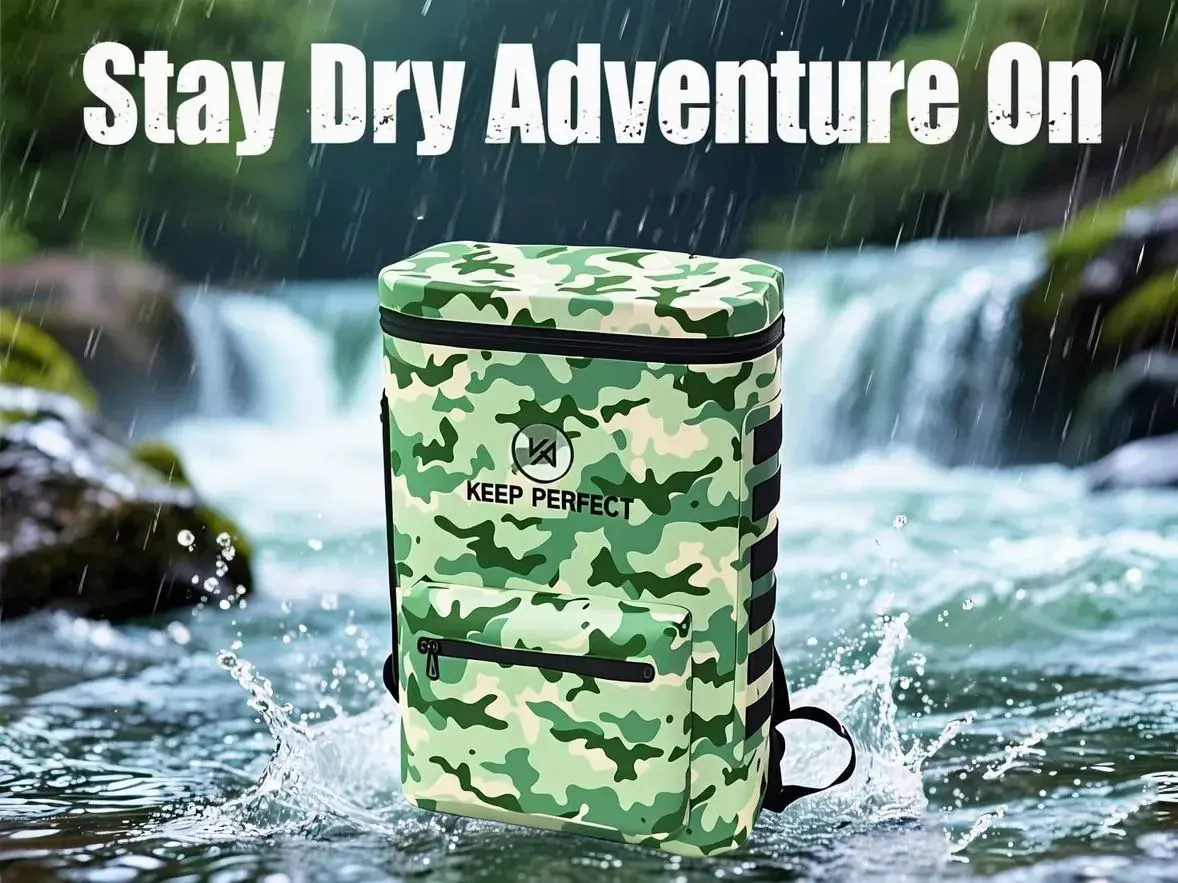
Insulated bags do not compete with the four carry styles because they carry different things: bait, food, water, and harvested fish rather than tackle. A 10-35 litre liner of 4-8 mm closed-cell foam, a heat-welded inner seam, and a drain plug make up the honest specification, and the band runs 12-42 USD.
The useful insight for a buyer is that an insulated body is style-neutral. It works equally alongside a tote at the vehicle and a backpack at the water for the straightforward reason that it is never on the body while fishing, and it does not compete for the same access. Specifying a shoulder strap of 38 mm minimum rather than webbing handles matters more than any other detail, because 8 kg of ice and contents in a 20 mm grip is the same cramping problem the tote already has.
Standards Behind Load and Material Claims
Load-related claims such as a comfortable maximum are advisory, but the material claims behind them can and should be measured. Manual handling and repetitive carrying are addressed in ergonomics standards published by the International Organization for Standardization, which give buyers a defensible basis for strap width and handle geometry rather than a designer preference.
Webbing strength, fabric tear resistance, and abrasion performance should be specified to methods maintained by ASTM International, with the cycle count and acceptance number named on the brief. That turns a strap that must not wear into a strap that has survived 500 abrasion cycles, which is a very different thing to enforce. Chemical restrictions on coatings, films, and inks are governed under REACH, administered by the European Chemicals Agency, and every style on this page should arrive with a screening record rather than a reassurance.
What Each Style Costs to Build
Build cost tracks structure far more closely than it tracks volume, which explains most of the price spread. A 35-litre unstructured tote costs less to produce than an 18-litre sling with a padded strap, because the sling carries twice the hardware and a shaped harness.
| Style | Dominant cost driver | Typical FOB band | Where the money goes |
|---|---|---|---|
| Tote | Shell fabric and grip quality | 8-24 USD | Padded grip, moulded base, optional sleeve |
| Sling | Strap assembly | 12-30 USD | 65-80 mm padding, stabiliser strap, buckles |
| Backpack | Harness and internal sleeve | 22-48 USD | Hip belt, load lifters, moulded tray sleeve |
| Waist pack | Hardware and shaping | 9-22 USD | Buckles, curved body, water-resistant zip |
Across a full range, the strongest margin lever is sharing one harness platform across several bodies. A single tested strap and buckle assembly specified into three different volumes saves roughly 1.80 USD per unit through consolidated purchasing, and it removes an entire category of fit complaints because the same geometry is already proven. Buyers building their first range should ask for this rather than accepting three separate harness designs.
Field Checks Before Committing
Carry-style faults are felt rather than seen, so all four styles should be approved by walking rather than looking. These five checks take about an hour per style, need a realistic load rather than an empty bag, and reliably predict how each will be reviewed by customers.
- Walk the stated maximum distance with the pack loaded to its maximum figure, and note when grip fatigue or shoulder ache begins rather than whether it was bearable at the end.
- Simulate five changes of terminal tackle and time how long hands are occupied, because a style that requires setting the bag down on wet ground scores badly regardless of everything else.
- Carry out twenty full casting strokes with the bag in its working position, checking specifically for contact at the shoulder or hip.
- Set the loaded bag down on wet gravel for ten minutes and inspect the contents, which is the fastest way to judge whether base construction is adequate for that style.
- Check how the bag behaves when emptied at the water: a body that collapses flat and will not stand up generates complaints even though nothing is actually wrong with it.
The last check is underrated and it affects the tote most severely. A body that will not stand upright tips over in the first two minutes of use, spills whatever it holds, and gets poor reviews describing it as flimsy, when in fact the fault is purely that nobody specified stiffening in the base or the side walls.
Freight and Shelf Behaviour Vary by Style
Shipping cost per unit differs more across these four styles than any other line in the landed-cost calculation, because two of them ship full of air. A structured backpack of 35 litres occupies roughly 0.035 cubic metres and cannot be compressed without risking creases in the shell, while an unstructured tote of the same nominal volume folds to about 0.008 cubic metres.
| Style | Shipped volume per unit | Units per 40 ft container | Freight share per unit |
|---|---|---|---|
| Tote, unstructured | 0.008 cubic metres | About 7,000-8,500 | 0.35-0.50 USD |
| Waist pack | 0.004 cubic metres | About 14,000-16,000 | 0.20-0.30 USD |
| Sling | 0.010 cubic metres | About 5,500-6,700 | 0.45-0.60 USD |
| Backpack, structured | 0.035 cubic metres | About 1,600-1,900 | 1.40-1.90 USD |
That last row is the reason a backpack quoted at the same FOB as a larger tote still lands more expensively per unit, and it is a number buyers routinely discover after the first container rather than before the programme. Two mitigations exist and neither is complicated: shipping bodies nested two per polybag where the harness allows it, and asking whether the shell can be partially deflated with the sleeve removed for transit. Both should be raised at sampling rather than at booking, because compressing a body that was never designed for it produces creases that never come out.
Shelf presentation follows the same logic in reverse. A tote that arrived flat must be filled or formed before it looks like anything on a peg, and specifying a removable base stiffener of about 0.70 USD both protects it in transit and lets it stand under retail lighting. A structured backpack ships ready to display, which is why the higher freight line is usually worth paying on anything going straight onto a shelf rather than into a warehouse pick.
Programme, Pricing, and Compliance
A multi-style programme opens at MOQ 500 pcs per design and colour. Sampling takes 6-10 working days from confirmed artwork, and sharing one harness platform across several styles cuts about 3 days from each subsequent sample because the assembly is already approved. Bulk runs 35-50 days from approved sample and deposit.
| Programme item | Baseline | Note |
|---|---|---|
| MOQ | 500 pcs per design and colour | Colour split negotiable above 2,000 pcs |
| Sampling | 6-10 working days | Save about 3 days when reusing an approved harness platform |
| Bulk | 35-50 days | From approved sample and deposit |
| Inspection | AQL 2.5 | Include walk test, cast clearance, wet-set down, base stiffness |
| Compliance | REACH and California Prop 65 | Screen shell, coating, film, foam, inks, hardware |
QUANZHOU JUNYUAN BAGS has developed waterproof bag programmes since 2014, with the founding team working in the trade since 2004. Monthly output of 200,000 units is verified by SGS, and BSCI and ISO 9001 systems structure the workflow. Materials are screened for REACH and California Prop 65, and every bulk order is inspected at AQL 2.5 before shipment.
A carry-style brief can be emailed to service@junyuanbags.com with style, volume, load target, walk distance, and quantity. FOB Xiamen or DDP service to more than 100 countries follows an approved sample and a complete test record. Buyers deciding between related formats should read the backpack against sling comparison and the wider fishing tackle bag family guide.
People Also Ask
Which tackle bag carry style is best?
A backpack for walks beyond 800 m or loads above 5 kg. A sling for 200-800 m with frequent kit changes, a waist pack for hands-free work from a fixed position, and a tote for anything within 200 m.
How heavy is too heavy for a sling bag?
About 5 kg or two hours of continuous wear. Beyond either, one-shoulder fatigue dominates and a backpack carries the same weight comfortably at double the load.
Why do totes hurt your hand?
A flat 20 mm webbing grip concentrates load across roughly 20 mm of palm. A 25 mm padded or moulded grip spreads it over triple the area for about 0.90 USD extra.
Do waist packs work for wading anglers?
Yes, and better than any shoulder-mounted format. Load sits on the pelvis and transfers through the skeleton, and contents stay reachable without raising hands out of the water.
Should I buy a backpack or a sling for trout fishing?
A sling under 800 m of walking with frequent changes, and a backpack beyond that. Between the two limits, a convertible body handles both sides of the day.
Can one tackle bag do everything?
No. Load limits and access needs pull in opposite directions, which is why most settled anglers carry two items, typically a larger body for the inventory and a smaller one for what is in use.
Frequently Asked Questions
Q1. What are the four tackle bag carry styles?
Tote in one hand, sling across one shoulder, backpack on both hips and shoulders, and waist pack on the pelvis. Each has a different load limit and realistic walking distance.
Q2. Which style carries the most weight?
A backpack, comfortably to 14 kg with about 80 percent of the load reaching the hips. A tote manages 6 kg, a sling about 5 kg, and a waist pack roughly 4 kg.
Q3. How far can I realistically carry a tote?
About 400 m or fifteen minutes before grip fatigue forces rest. Beyond that distance a backpack delivers the same load comfortably for several kilometres.
Q4. Is a sling or a backpack better for fishing?
A sling under 800 m with frequent changes, for two-second access without setting the bag down. A backpack beyond 800 m or above 5 kg, accepting roughly eight seconds of access.
Q5. What makes a waist pack comfortable for a full day?
Strap contact of 50 mm minimum and preferably 75 mm, plus a stabiliser stopping rotation on each cast. Above about 4 kg or 12 litres it interferes with the casting stroke.
Q6. Why does my tote tip over at the water?
No stiffening in the base or side walls. Specifying a 3 mm moulded EVA base and lightly stiffened walls costs about 1.60 USD and solves a complaint often described wrongly as flimsiness.
Q7. Do different carry styles need different waterproof ratings?
Yes. A tote sitting repeatedly on wet ground should have a moulded base, and a backpack standing in bilge water benefits from a welded lower shell rated IPX6. Waist packs rarely need more than IPX2.
Q8. Should wet and dry kit be separated?
Yes in a backpack, which has the room for a dedicated wet compartment. A waist pack has no such room and its contents should stay dry-day items only.
Q9. What is the cheapest carry style to build?
A tote, at 8-24 USD, because it has almost no hardware. A sling costs more at 12-30 USD despite half the volume, because the padded strap assembly dominates its bill of materials.
Q10. How do I save cost across a range of styles?
Share one tested harness platform across several bodies, which saves about 1.80 USD per unit through consolidated purchasing and removes a whole class of fit complaints.
Q11. Which style suits a boat angler?
A tote or a hard box, because distance is effectively zero and the priority is protection and stacking. A waist pack is the usual addition for tools and terminal tackle.
Q12. What is the MOQ and lead time for a multi-style order?
MOQ is 500 pcs per design and colour, samples take 6-10 working days minus about 3 days when reusing an approved harness, and bulk runs 35-50 days from approved sample and deposit.