The real difference is not marketing language but whether any thread path exists between the water and the contents. A water-resistant fishing bag uses a coated shell stitched together, survives light rain for perhaps 30-60 minutes, and fails at the seams once anything presses on them. A waterproof fishing bag either welds its seams or carries a rating from IPX4 upward under the IEC enclosure code, with a stated depth and a stated number of minutes. Anything sold without both a code and a duration is water resistant, whatever it says on the hang tag, and this article sets out how to tell them apart on a shop floor in about ninety seconds.
The Single Line That Separates Them
Strip away the adjectives and there is one physical distinction that predicts everything else. If water can reach the contents by travelling along a thread, the bag is water resistant. If every seam is fused so that no thread path exists, and the closure is sealed rather than merely covered, the bag can be tested to an ingress code and can honestly be called waterproof.
| Property | Water-resistant build | Waterproof build | Why it decides |
|---|---|---|---|
| Seam method | Stitched, optionally taped | RF welded or chemically fused | Thread wicks along its whole length |
| Closure | Covered zip or flap | Rolled and clipped, or airtight track | The widest opening is the weakest line |
| Typical ingress code | IPX1 to IPX3 | IPX4 to IPX8 | The code implies a defined test |
| Survives | Light rain 30-60 min | Measured depth and duration | One is hope, one is evidence |
| Typical added cost | Baseline | Plus 4.20-18 USD | Welding and sealed closures are not cheap |
The reason thread matters so much is capillary action rather than the holes themselves. A needle hole is tiny, but sewing thread is made of twisted fibres that pull water along their length and deliver it to the inside face of the fabric in a completely different place from where the water landed. This is why a stitched bag can remain dry outside while its contents are wet in a fold nobody would think to inspect.
What the IPX Numbers Actually Promise
Ingress codes are frequently printed without their test conditions, and a printed number carries no meaning without them. The enclosure code is published by the International Electrotechnical Commission, and each level specifies a particular apparatus, a particular flow or depth, and a particular duration.
| Code | Test described | Duration | What it means in fishing terms |
|---|---|---|---|
| IPX1 | Vertical dripping water | 10 min | Condensation and very light drizzle |
| IPX2 | Dripping at 15 degrees tilt | 10 min | Drizzle while carried |
| IPX3 | Spray at up to 60 degrees | 5 min | Passing rain shower |
| IPX4 | Splashing from any direction | 10 min | Sustained rain on an exposed bank |
| IPX5 | Water jet from a 6.3 mm nozzle | 3 min minimum | Deck wash and heavy spray |
| IPX6 | Powerful jet from a 12.5 mm nozzle | 3 min minimum | Waves breaking over the bow |
| IPX7 | Immersion at 1 m | 30 min | A capsize and recovery |
| IPX8 | Continuous immersion deeper than 1 m | Stated by the maker | Must always be printed with depth and minutes |
Two rows carry most of the practical weight. IPX4 is the honest minimum for a bag that will see full days in weather, because anything lower is only tested against dripping rather than directional rain. IPX8 without a printed depth and duration is meaningless, since the code itself defers those two numbers to whoever claims it, and a responsible claim always states them alongside.
The Exposures Anglers Actually Meet
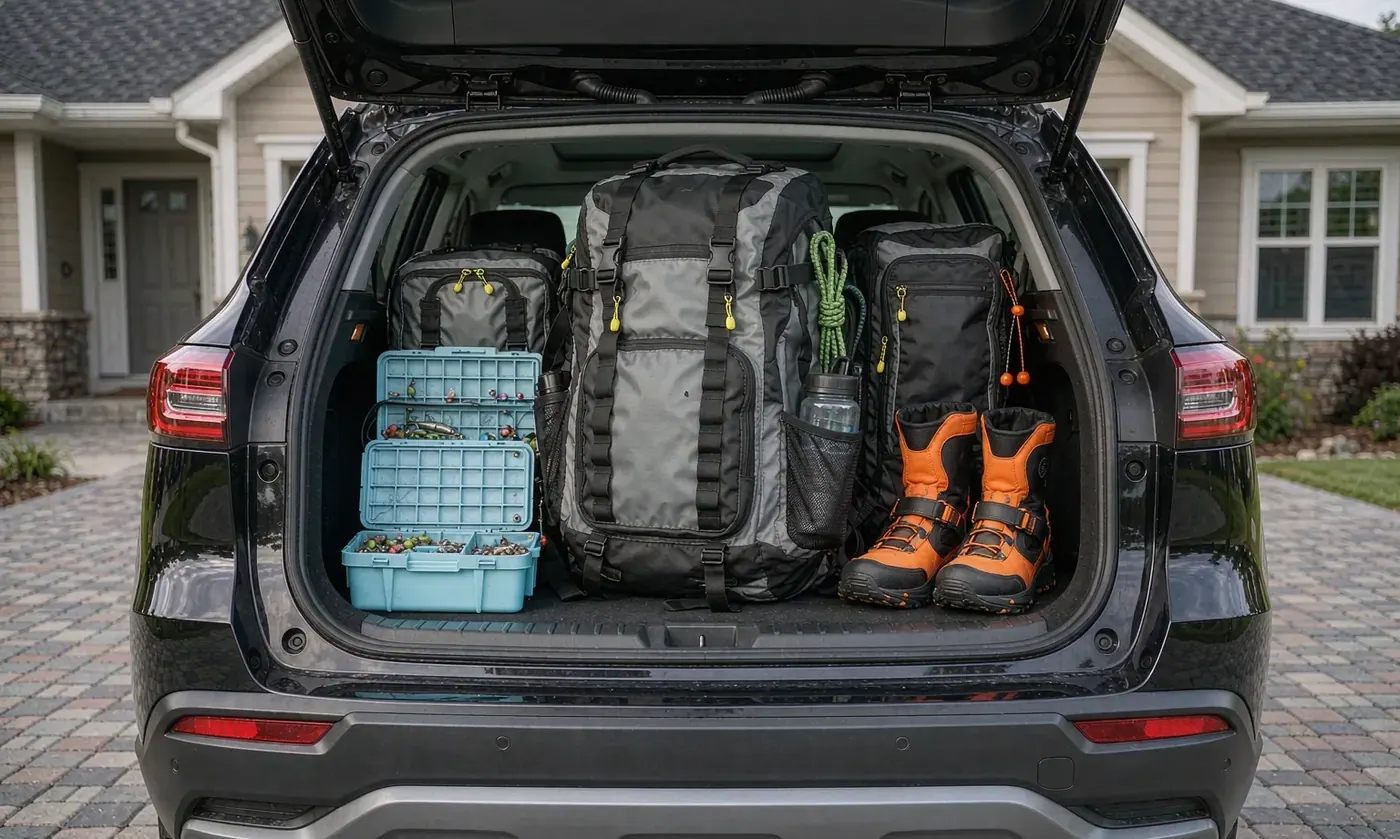
An analysis of what actually gets tackle wet produces a surprising result, because rain ranks lower than expected. Equipment is far more often damaged by transport, storage, and setting a bag down than by rain falling from above, and a buyer who specifies against the wrong exposure ends up solving a problem nobody has.
| Exposure | Frequency | Water volume involved | Rating that survives it |
|---|---|---|---|
| Wet gear sealed in a vehicle for days | Very common | Persistent dampness | IPX4 minimum, plus ventilation |
| Set down in a puddle or wet ground | Very common | Wicking from below | IPX4 with a moulded base |
| Sustained rain during a session | Common | Directional, several hours | IPX4 to IPX5 |
| Spray over the bow of a boat | Seasonal | Intermittent jetting | IPX5 to IPX6 |
| Slip and immerse while wading | Occasional | Full submersion | IPX7 |
| Capsize in open water | Rare | Full submersion under load | IPX7 to IPX8 |
Note the first row and its implication, which is uncomfortable for anyone selling on the basis of storm-proof credentials. A bag holding wet waders and a wet rain shell sealed in a vehicle trunk for three days creates a saturated internal atmosphere regardless of the shell rating, and seam-welding does nothing to prevent it. The correct specification there is a wet compartment plus airflow rather than a higher ingress code, and this is where most mismatches between expectation and performance begin.
Pressure Is What Kills a Water-Resistant Shell
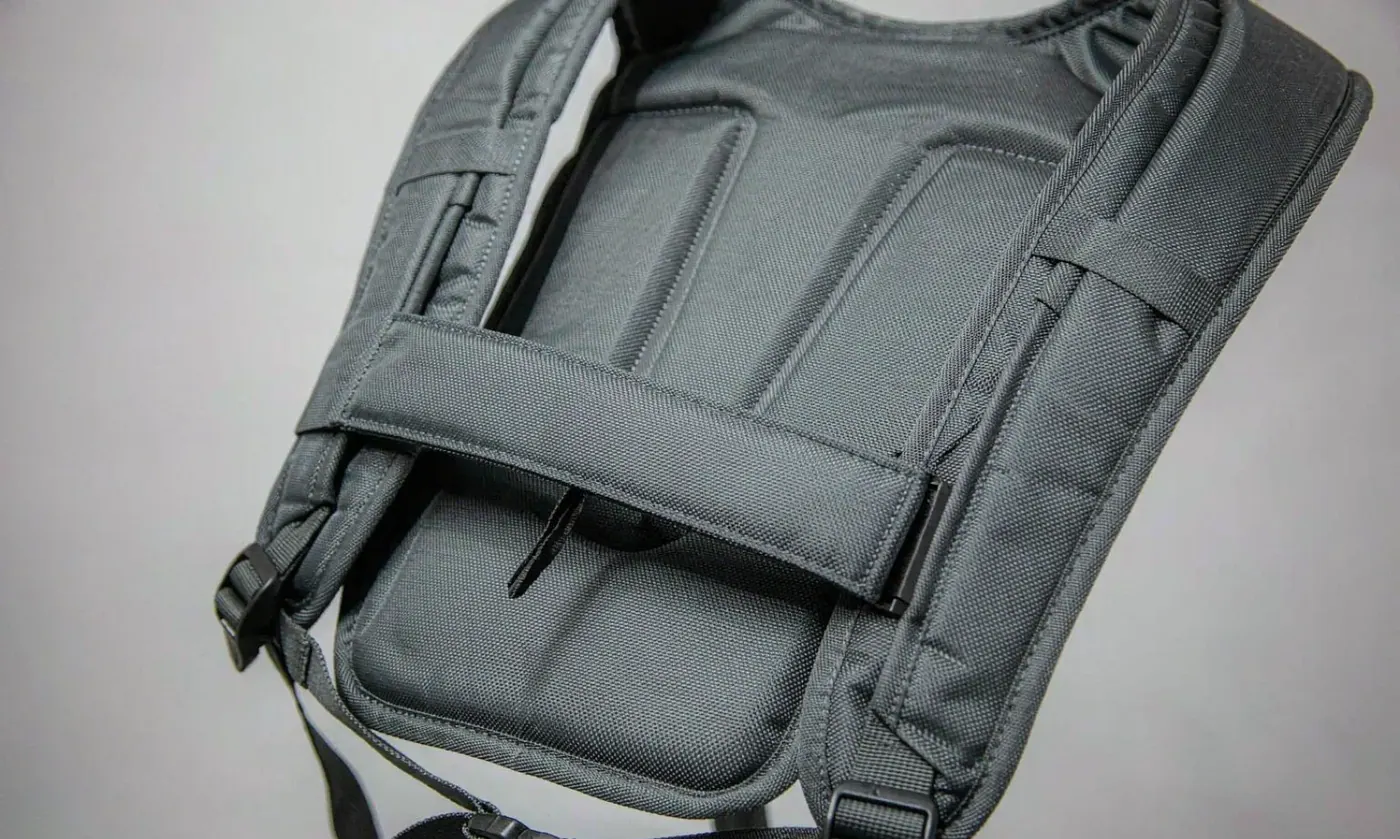
A coated shell passes a rain test and fails in use because rain tests apply water without pressure. In use, a strap presses fabric against the contents, a hip belt does the same at the base, and water sitting at those contact points is driven through the coating by mechanical pressure rather than by wetness alone.
| Contact source | Estimated pressure | Effect on a coated shell | Mitigation |
|---|---|---|---|
| Shoulder strap over a full pack | Moderate, sustained | Wet spot after 30-60 min in rain | Wider strap, 70 mm minimum |
| Hip belt against the base | High, sustained | Wicking into the base seam | Moulded base panel |
| Kneeling on the bag to open it | Very high, brief | Immediate wetting through | Open before kneeling |
| Setting the loaded bag on wet ground | Moderate, persistent | Base wicking within minutes | Moulded EVA base |
| Compression straps pulled tight | High, localised | Soaking along the strap line | Pad the strap contact |
Kneeling on a bag deserves particular mention because it is almost universal and almost never discussed. Every angler sets their pack down and kneels beside it with a knee on the body while fishing, and that single action applies far more pressure than rain ever does. It wets through a coated shell in seconds and it is typically blamed afterwards on a leak when in fact the coating performed exactly as its rating predicted.
How to Tell Them Apart in Ninety Seconds
Neither requires any equipment beyond a torch and a willingness to look inside the bag, and the checks work equally well on a sample table and a shop floor. Run them in this order, since each narrows what to look for next.
- Look for an ingress code printed with both a depth and a duration. A number alone is a claim; a number with conditions is a specification.
- Turn the main body inside out and find a seam. Welded seams appear as a narrow continuous fused line, whereas stitched seams show rows of thread with tape laid over them.
- Inspect the closure. A covered zip or a flap indicates a water-resistant build, while a rolled and clipped mouth or a moulded airtight track indicates a genuinely sealed one.
- Look at the top edge, not the front panel. Countless bags weld the body and then leave a stitched seam at the very top where water enters first.
- Check whether any claim mentions tolerable ingress. Codes permit limited water entry at lower levels, so a rating that says no water is entered is describing a higher level than a stated code.
The fourth check catches more products than everything else combined, and it is worth explaining why. Water runs down the outside of a bag and enters where geometry funnels it rather than where the material is weakest, and the top edge is where every drip gathers before travelling inward. A body that is fully welded but sewn across the top is functionally a water-resistant bag with expensive lower panels.
Testing at Home, In Three Stages
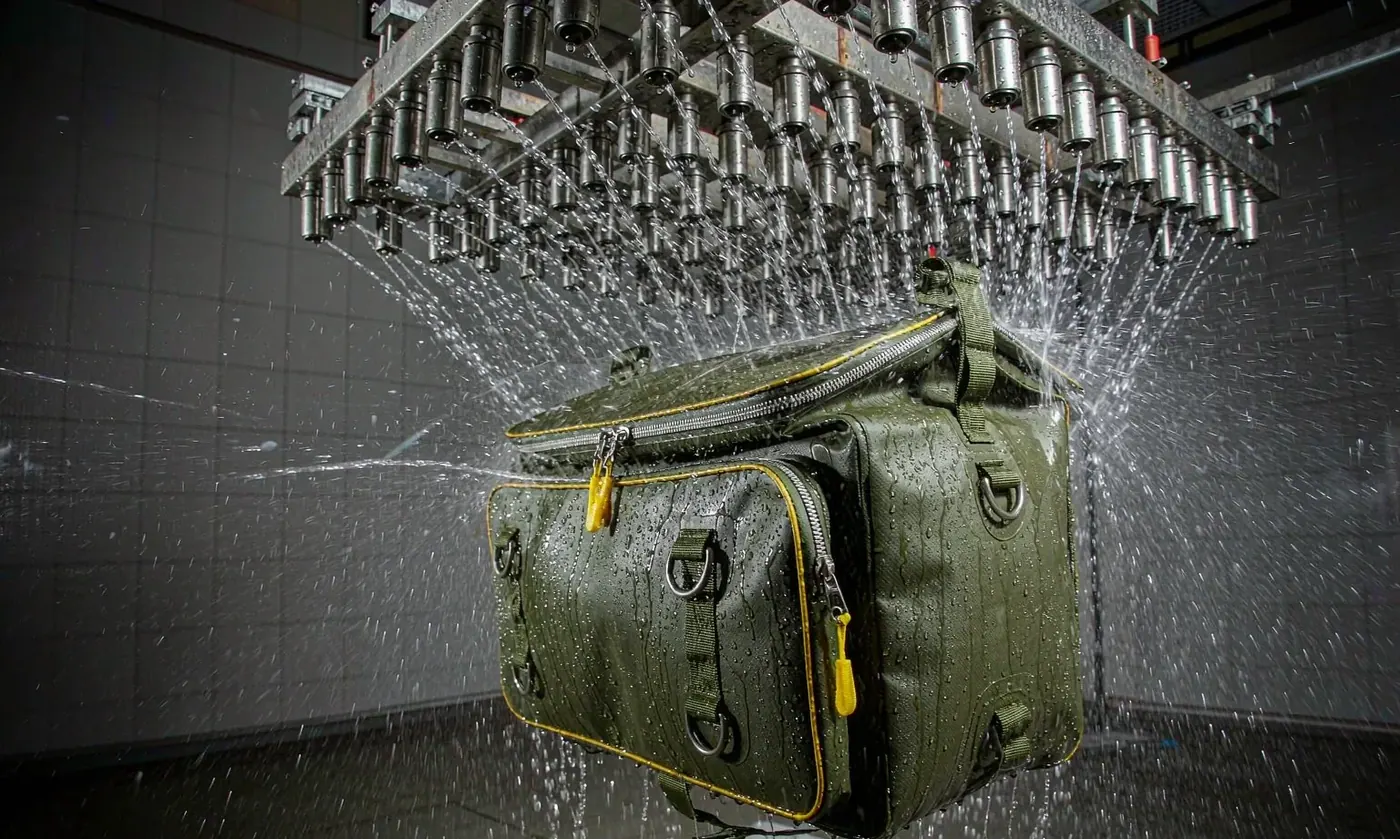
Formal testing belongs in a laboratory, but a reliable three-stage home protocol separates water resistant from waterproof for any given bag in under an hour. Use dry paper in every compartment as the indicator rather than looking at the outside, because the outside always looks fine.
| Stage | Protocol | Duration | Interpretation |
|---|---|---|---|
| 1. Rain exposure | Shower directed at all faces | 5 min per face | Dry inside means at least IPX3 behaviour |
| 2. Pressed rain | Repeat with 2 kg pressing on a strap area | 10 min | Dry inside means genuine IPX4 territory |
| 3. Shallow immersion | Submerge to 200 mm loaded with towels | 30 min | Dry inside means IPX7 is plausible |
Stage 2 is the one home testers skip and the one that matters most, because it introduces the pressure that real use always involves. A great many bags that pass stage 1 comfortably fail stage 2 within six min, which is precisely the pattern that produces a bag described as fine in light rain and useless otherwise.
One caution about stage 3 deserves stating plainly. Submerging a bag that is not rated for it may destroy trays, electronics, and anything left inside, and it should only be run on an empty body loaded with towels as ballast. A bag that fails stage 3 is not defective if it was only ever sold as IPX4, and a home result cannot be used to support a claim in either direction.
The Decision Table
Choosing between the two is a question about the worst realistic event rather than the average day, because a bag only has to fail once. Answer three questions honestly and the right construction follows without further debate.
| If the bag will | Then specify | Reason | Penalty for going lower |
|---|---|---|---|
| Live in a vehicle between sessions | Water resistant plus a wet compartment | Wet gear causes the damage, not rain | Higher code changes nothing |
| Sit on wet ground regularly | Water resistant with a moulded base | Base contact is the exposure | Wicking through the floor |
| Face full days of rain | Waterproof to IPX4 or IPX5 | Directional rain for hours | Damp trays by mid-session |
| Go into bilge water on a kayak | Waterproof to IPX6 in the lower shell | Hours of standing contact | Wet through by lunchtime |
| Be submerged if the angler slips | Waterproof to IPX7 | Full immersion for minutes | Total loss of contents |
| Carry electronics on open water | Waterproof to IPX7 or IPX8 | Losing a phone or sounder is costly | Expensive replacements |
The first row is the uncomfortable one and the most commercially useful, because it describes the majority of buyers. Someone whose bag never leaves a vehicle and never gets submerged does not need a welded body, and selling them one wastes 4-18 USD that delivers nothing they will ever notice. Matching on honest exposure rather than on worst-case fear is what separates a well-assembled range from one built to win arguments.
Where the Money Goes
Moving from water resistant to waterproof costs real money at every step, and understanding where it goes makes the price ladder predictable rather than mysterious. The following figures describe added build cost rather than retail, and they assume an otherwise identical body.
| Upgrade step | Added cost | What it buys | Worth it when |
|---|---|---|---|
| Taped seams | 1.80 USD | Seam protection against rain | Any bag sold for wet weather |
| Coated or laminated zip | 1.70 USD | Closes the widest leak path | Above IPX2 ambitions |
| TPU film rather than PU coat | 3.40 USD | Higher head and weldability | Step before actual welding |
| RF welded seams | 8.50 USD | Removes thread paths entirely | IPX6 and above |
| Airtight moulded closure | 9-16 USD | Seals the mouth under pressure | IPX7 and above |
The jump from the third row to the fourth is where most mis-pricing occurs, because welding changes the construction route rather than merely adding a component. A production line that stitches cannot weld without different machinery, different fixtures, and operators trained on a different process, which is why fully welded bodies appear at a step change in price rather than a gradual slope.
Care Differs Sharply Between the Two
A water-resistant bag can be neglected for a season and recover. A waterproof bag cannot, because its performance depends entirely on surfaces and folds staying clean and pliable, and the failure modes are different enough to warrant separate routines.
- Renew the outer finish on a water-resistant shell roughly every fifteen washes, and treat the loss of beading as the indicator rather than waiting for actual leakage.
- Never store a welded bag rolled and damp, since film bonded along a fold line can separate and will then leak at that crease permanently.
- Rinse and brush every coated zip after any session involving salt or silt, because grit in the track is the single most common cause of a bag that suddenly leaks at the mouth.
- Avoid solvents on TPU surfaces, as some cleaners leave them tacky and permanently attractive to grit.
- Store either type open and completely dry, since a sealed damp body grows mildew within about four days regardless of how it is constructed.
The third habit is the single change that most extends the useful life of a genuinely waterproof bag. A closure that was fine last season and has started weeping this one almost always has grit in its track rather than a material failure, and five minutes with a soft brush under fresh water usually restores full performance at no cost.
Standards Behind Every Claim
Three standards bodies sit behind essentially every honest claim in this area, and naming them in a brief removes ambiguity before it happens. Each covers a different property, and quoting the wrong one is a common source of confusion at the specification stage.
Ingress codes come from the International Electrotechnical Commission, which governs anything described as IPX. Fabric resistance to surface wetting is measured by spray testing maintained by AATCC, and hydrostatic head testing against water penetration before failure is published by the International Organization for Standardization. Head and spray numbers describe fabric, ingress codes describe complete products, and neither substitutes for the other.
Programme, Pricing, and Compliance
Both routes run at MOQ 500 pcs per design and colour, but the sampling timelines differ and should not be quoted as one figure. Water-resistant bodies take 6-10 working days from confirmed artwork, while anything requiring welded seams needs additional time for parameter development and leak verification before a clean first article can be produced.
| Programme item | Baseline | Note |
|---|---|---|
| MOQ | 500 pcs per design and colour | Colour split negotiable above 2,000 pcs |
| Water-resistant sampling | 6-10 working days | Standard sewn route |
| Welded sampling | Add 4-6 days | Weld parameter development and 100 percent leak check |
| Bulk | 35-50 days | From approved sample and deposit |
| Inspection | AQL 2.5 | Include spray or immersion protocol per the stated code |
| Compliance | REACH and California Prop 65 | Screen shell, coating, film, inks, hardware, foam |
QUANZHOU JUNYUAN BAGS has developed waterproof bag programmes since 2014, with the founding team working in the trade since 2004. Monthly output of 200,000 units is verified by SGS, and BSCI and ISO 9001 systems structure the workflow. Materials are screened for REACH and California Prop 65, and every bulk order is inspected at AQL 2.5 before shipment.
A specification brief can be emailed to service@junyuanbags.com with target code, exposure, closure type, and quantity. FOB Xiamen or DDP service to more than 100 countries follows an approved sample and a complete test record. Buyers wanting the underlying engineering should read the construction explainer, the IPX test guide, and the five-level framework.
People Also Ask
How do I know if my fishing bag is waterproof or water resistant?
Look inside at the seams. Welded seams are a narrow fused line, while stitched seams show rows of thread. Also check that any rating carries a depth and a duration.
What IPX rating should a fishing bag have?
IPX4 for full days in rain, IPX5 or IPX6 for boat spray, and IPX7 where submersion is possible. Anything sold without stated conditions is water resistant regardless of the label.
Is hydrostatic head the same as an IPX rating?
No. Head measures fabric resistance to penetration, while IPX describes a whole product including seams and closures. Neither substitutes for the other in a honest specification.
Why does my water-resistant bag leak at the straps?
Pressure rather than wetness alone. A strap presses fabric against the contents and drives water through the coating, typically after 30-60 minutes of rain.
Can I test if my bag is waterproof at home?
Yes, in three stages: five minutes of directed shower per face, ten minutes with 2 kg pressing a strap area, and thirty minutes submerged to 200 mm if the bag is built for it.
Does a higher rating mean less care is needed?
The opposite. Welded bodies need cleaning more carefully, because grit in a closure track is the most common cause of a bag that begins weeping after one season.
Frequently Asked Questions
Q1. What is the difference between waterproof and water-resistant?
Waterproof means the whole product was tested to an ingress code with a stated depth and duration, with no thread path to the contents. Water resistant means a coated shell that survives light rain but fails under pressure at the seams.
Q2. What does IPX4 mean on a fishing bag?
Protection against splashing water from any direction for at least ten minutes. It is the honest minimum for a bag facing full days of directional rain.
Q3. Is IPX7 enough for a fishing bag?
Yes for any realistic fishing use, since it covers thirty minutes submerged at one metre. Only equipment left under water for long periods justifies going higher.
Q4. Can a stitched bag be waterproof?
Not genuinely. Thread wicks along its length and delivers water well away from where it landed, so taped seams extend the survival time rather than removing the failure mode.
Q5. Why does my bag get wet inside when the outside looks dry?
Almost always a seam or the top edge rather than the fabric. Water gathers at the top and travels in through the closure, which is often stitched on an otherwise welded body.
Q6. How much longer does a waterproof bag last in rain?
Indefinitely against the tested exposure. A water-resistant shell typically wets through at pressure points after 30-60 minutes of directional rain.
Q7. Do I need a waterproof bag if I fish from the bank?
Usually not. IPX4 handles sustained rain, and the exposure that actually damages tackle is wet gear sealed in a vehicle, which no rating prevents.
Q8. What is hydrostatic head and is it enough?
It measures how much water pressure fabric resists, typically 1,500-20,000 mm for fishing shells. It is necessary but not sufficient, since it says nothing about seams or closures.
Q9. How much extra does a waterproof bag cost?
About 4.20 USD to reach IPX4 with taped seams and a coated zip, 8.50 USD for welded seams, and 14-18 USD for a fully welded body with an airtight closure.
Q10. Why did my waterproof bag start leaking?
Most often grit in the closure track or a crease stored damp and folded. Rinse the closure with fresh water and air dry it rolled open before assuming material failure.
Q11. Is IPX8 always better than IPX7?
Not comparable without numbers. IPX8 means continuous immersion deeper than one metre for whatever depth and duration the maker states, so both figures must be printed.
Q12. Can I trust a rating printed without a duration?
No. The code itself depends on duration and flow or depth, so a number printed alone cannot describe what was tested or how the result should be read.
Q13. What is the MOQ and lead time for each route?
MOQ is 500 pcs per design and colour. Water-resistant samples take 6-10 working days, welded samples add 4-6 days for parameter development and leak checks, and bulk runs 35-50 days.