The choice between radio frequency welding and stitching decides whether a fishing bag resists rain or survives immersion, and it is made before a single panel is cut. Welding fuses two polar films into one continuous layer in two and a half to four seconds per joint, leaving no penetrations at all, but it only works on materials whose molecules respond to a twenty-seven megahertz field. Stitching joins anything, including glass-coated nylon and polypropylene, but leaves several hundred needle holes per metre of seam that no tape fully closes under pressure. Typical figures: a good weld peels at fifty-five to one hundred and five newtons per twenty-five millimetres, while a well-made sewn seam may pull stronger and still leak.
Two Ways to Join Two Films
Everything else in this comparison follows from one distinction. Welding joins materials to each other by making them one piece; stitching joins them by passing thread through both. In the first case there is no path for water except through the material itself. In the second there is a row of holes at regular intervals for the entire length of the join, each one held open by the thread passing through it.
Both methods can produce a seam strong enough to hold forty kilograms of load. That is not what separates them. What separates them is what the seam does when water sits against it for thirty minutes under pressure, and that difference is why the two methods occupy different price points and different jobs within the same bag.
| Property | RF welded join | Stitched join |
|---|---|---|
| Continuity | Fused, no penetrations | Several hundred holes per metre |
| Materials it works on | Polar films only, such as PVC and TPU | Almost any sheet material |
| Typical joint width | 12 to 30 millimetres | 12 to 15 millimetres allowance |
| Process speed | 2.5 to 4 seconds plus cooling | Twenty to thirty seconds per metre |
| Tooling | Shaped electrode per joint, 350 to 1400 dollars | Machine, foot, and needle, minimal cost |
| Repair in the field | Adhesive patch possible, never as good | Resewn anywhere by anyone |
What RF Welding Can Bond and What It Cannot
This is the constraint that governs the whole decision and it is rarely stated plainly. High frequency welding only heats molecules that are polar enough to align within an alternating field, which includes polyvinyl chloride, thermoplastic polyurethane, ethylene vinyl acetate, and most polyurethanes. It does not meaningfully heat polyethylene, polypropylene, or silicone-treated nylon, none of which respond to the field in the same way.
The consequence for anyone specifying is direct: a shell material choice made for other reasons can force an entire bag down the stitched route. A brand wanting a soft-feel silicone-treated ripstop shell with welded seams cannot have both, and discovering that after sampling costs weeks. Material selection and join method belong in the same conversation, ideally the first one.
| Material | Weldable by RF | Notes |
|---|---|---|
| PVC coated polyester | Yes, readily | Best welding response of common bag films |
| TPU laminated nylon | Yes | Needs tighter parameter control than PVC |
| EVA and moulded foams | Yes | Used for bases and compression panels |
| Polyurethane coated nylon | Usually | Response varies with coating chemistry |
| Polyethylene woven sheet | No | Heat sealing works, RF does not |
| Silicone-treated ripstop | No | Must be stitched and taped |
| Polypropylene nonwoven | No | No practical RF response |
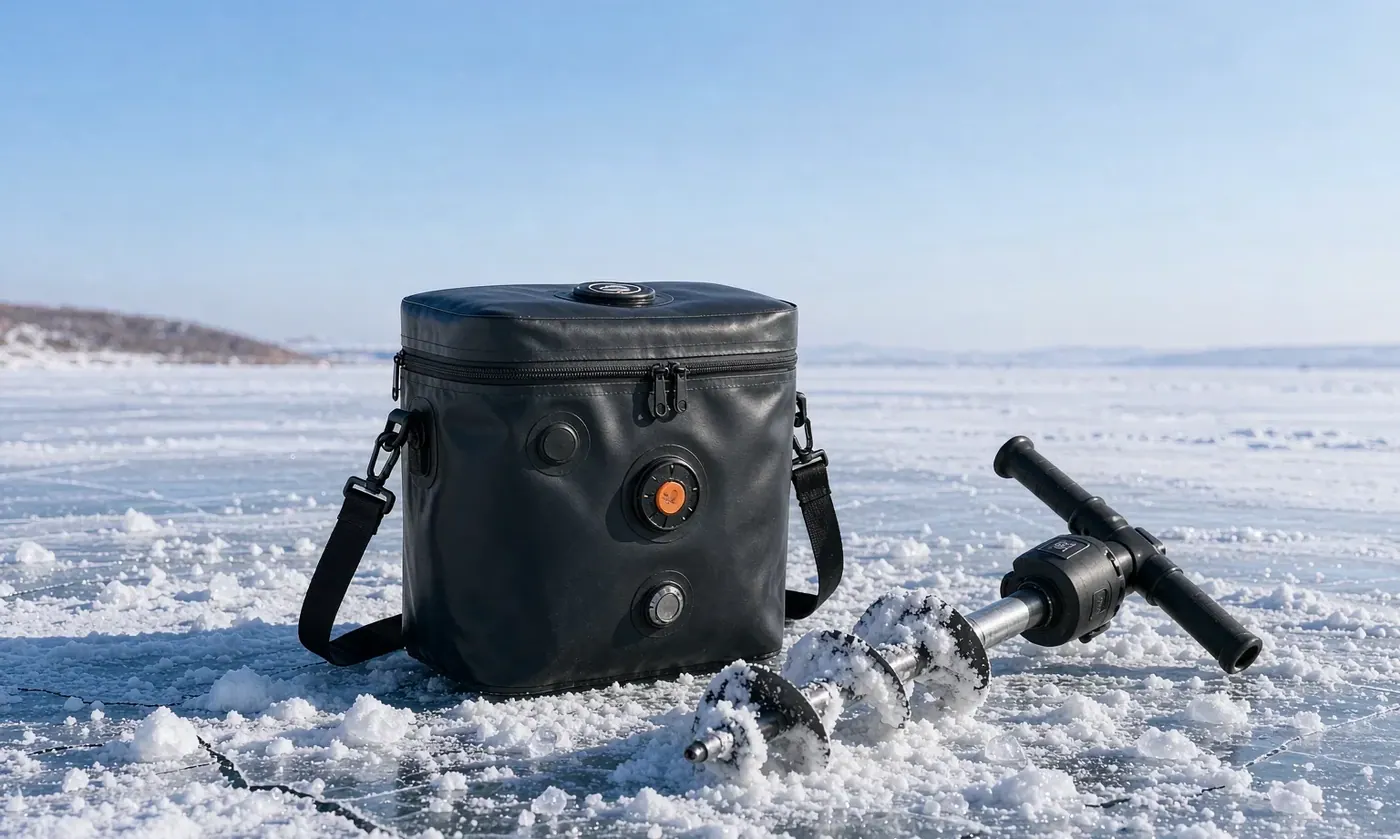
Inside a Weld Cycle
A joint is made by placing two films between a shaped electrode and an earthed bed, closing the press, and applying the field for a few seconds. Heat is generated inside the material rather than conducted into it from outside, which is why the two surfaces reach melt temperature at the same moment as each other and interdiffuse properly. Pressure is held through the cooling phase, because releasing early lets the joint separate as the films shrink.
| Parameter | Common range | Effect outside range |
|---|---|---|
| Frequency | 27.12 MHz industrial band | Off band causes unstable heating |
| Generator output | 1.5 to 3.5 kW for bag-scale joints | Underpowered gives a cold joint |
| Weld time | 2.5 to 4 seconds | Too short gives no fusion, too long carbonises |
| Cooling under pressure | 1 to 2 seconds | Releasing early loses the bond |
| Jaw pressure | 0.3 to 0.6 megapascals | Too low starves contact, too high squeezes film out |
| Electrode width | 12 to 30 millimetres | Narrow joints creep under sustained load |
Verification is destructive, so it is done on samples rather than on goods. A twenty-five millimetre strip is pulled on a tensometer and the record kept in newtons; good production values cluster between fifty-five and one hundred and five newtons, with anything under forty investigated the same day rather than at the end of the run.
Anatomy of a Stitched Seam
A sewn join is stronger than most people expect and leakier than most people expect, and both statements describe the same construction. Bonded polyester or nylon thread, typically Tex forty to Tex seventy, passes through both panels at seven to nine stitches per inch with a twelve to fifteen millimetre seam allowance. Needle size ninety to one hundred and ten leaves a hole around 0.9 to 1.2 millimetres, and at that stitch density there are several hundred such holes per metre of seam.
Strength is genuinely good: a properly specified seam can exceed two hundred newtons per fifty millimetres in shear, far beyond what most bags ever experience. The problem is different. Each hole is a capillary, thread itself wicks water along its length, and the combination means that under ten kilopascals of pressure from thirty minutes of immersion a sewn seam admits water in quantities that are easy to measure and impossible to argue with.
Cold, Water, and Thread Behaviour
Temperature separates the two methods more sharply than anything except water. Nylon and polyester threads absorb moisture, and when a wet seam freezes the ice inside the thread bundle expands, stiffening the seam and in extreme cases bursting the stitch line. A bag used for ice duty and stored wet illustrates it perfectly: the seam that survived all summer is the one that opens first at minus fifteen.
A fused joint has no thread to absorb anything and behaves down to around minus thirty with almost no change in performance, limited only by the film stiffness rather than by the join. Anyone specifying for cold climates should therefore treat the join method as a functional requirement rather than a process preference, particularly because failures there appear suddenly rather than gradually.
Strength Compared Honestly
Numbers get quoted selectively in this argument, so it helps to separate three kinds of strength. Tensile strength across the seam, peel resistance along it, and fatigue life under repeated flexing tell three different stories, and the two methods win different categories.
| Measure | RF welded | Stitched | Which wins |
|---|---|---|---|
| Tensile across the seam | Usually 85 to 100 percent of parent film | Can exceed parent fabric in some axes | Roughly tied |
| Peel along the join | 55 to 105 newtons per 25 mm | Thread failure below this in peel | Welding |
| Fatigue under repeated flex | Excellent, joint flexes with the film | Thread abrades at the contact point | Welding |
| Water resistance under pressure | Continuous barrier | Capillary path at each hole | Welding decisively |
| Repairability anywhere | Requires equipment or adhesive | Any sewing machine | Stitching |
Speed, Tooling, and What It Costs
The economics are less obvious than the technical case. Stitching requires almost no dedicated tooling and can be set up for a new design in an afternoon; welding needs a shaped electrode machined for each joint geometry, costing three hundred and fifty to fourteen hundred dollars depending on complexity and taking ten to fifteen days. That tooling cost is what makes welded construction economical for programmes of several hundred pieces and awkward for single prototypes.
Running speed tells a different story. Once tooled, welding makes a joint in three or four seconds including cooling, whereas sewing the same metre of seam takes twenty to thirty seconds. For bags with many short joins this favours welding decisively; for one very long continuous seam, such as a thirty litre body, the difference narrows considerably.
| Cost element | RF welded | Stitched |
|---|---|---|
| Dedicated tooling per design | 350 to 1400 dollars per electrode | None beyond needles and feet |
| Setup lead time | Ten to fifteen days for tooling | Same day |
| Time per typical joint | Three to four seconds | Twenty to thirty seconds per metre |
| Skilled operator requirement | Higher, parameters matter | Lower, widely available |
| Cost per unit at 500 pieces | Two to six dollars added | Under one dollar added |
Inside the Bag: Why Most Builds Mix Both
Very few bags are entirely one method or the other, and that is not laziness. Structural joins, load-bearing strap anchors, and the main body are welded where the shell allows it, while internal dividers, tray sleeves, and elastic loops are stitched because they need three-dimensional shapes or materials that will not weld. The resulting bag is only as waterproof as its worst external join, which is why mixed construction is normal and still perfectly capable of immersion ratings.
| Component | Usually made by | Why |
|---|---|---|
| Main body joins | Welding where material allows | Must exclude water |
| External pocket seams below the waterline | Welding, or eliminated entirely | First place water enters |
| Internal dividers and tray sleeves | Stitching | Three-dimensional shape, no water role |
| Strap anchors | Stitching plus reinforcement, or welding | Depends on shell chemistry |
| Base-to-body junction | Welding preferred | Highest contact and abrasion zone |
| Elastic loops and small features | Stitching | Speed and flexibility |
Recognising What You Are Looking At
Buyers frequently ask how to tell the methods apart on a finished bag, and there are three reliable indicators that take seconds. First, run a finger along the join: a weld feels like a smooth thickened band with no regular repeats, while stitches produce a subtle regular texture. Second, look from the inside for continuous tape bridging the join, which indicates sewn and taped rather than welded. Third, hold the join up to a bright light; weld lines transmit evenly, stitch lines show a tiny periodicity.
The least reliable indicator is price. Construction method correlates with the price band but only loosely, and plenty of mid-priced bags combine one welded panel with several sewn ones. Ask the question directly and require a recorded peel value rather than inferring anything from how expensive the bag feels.
Choosing by Product Type
Product intent should decide the method rather than habit or marketing. Anything expected to be immersed, to float, or to sit permanently in bilge water needs welded external construction. Anything structural, internal, or simply expected to keep rain off can be stitched and taped, which is cheaper and easier to repair for the customer.
| Product | Recommended construction | Reason |
|---|---|---|
| Kayak day bag that may capsize | Welded external joins | Immersion requires continuity |
| Boat tackle bag sitting in bilge | Welded base and lower joins | Sustained contact, not splash |
| Surf backpack set on wet sand | Welded or raised moulded base | Contact abrasion plus soak |
| Rain-resistant daypack | Stitched and taped | Cheapest route to two hours of rain protection |
| Internal organisers and tray sleeves | Stitched | Shape freedom, no water role |
| Ice fishing bag stored wet | Welded | Thread absorbs water and freezes |
Field Repair: What Actually Works
Everyday damage is different from water performance and worth knowing about before it happens. A torn stitched seam can be closed at home with a needle and Tex sixty thread in ten minutes, using a lockstitch rather than a running stitch, and the repair will be nearly as strong as the original. A split welded joint cannot be reclosed that way, but it responds well to a solvent-based polyurethane patch applied over forty millimetres of overlap with twenty-four hours of cure, which restores most of the water resistance even though it never restores the look.
| Damage | Best repair | Result | Follow-up |
|---|---|---|---|
| Split stitched seam | Resew with bonded thread, lockstitch | Close to original strength | Tape over internally if water matters |
| Split welded join, under 40 mm | PU adhesive patch, 24 hour cure | Water resistance mostly restored | Expect a visible patch |
| Split welded join, long | Professional welding or retire | Home methods will not hold | Contact the seller first |
| Peeling tape inside the bag | Rebond below 30 mm with medium heat | Good result if the tape is still flexible | Retest with a spray check |
| Abrasion thinning at the base | Patch before it perforates | Extends life substantially | Consider a moulded base next time |
The honest summary is that stitched goods are easier to repair badly and welded goods need more patience but respond predictably. Neither method should be chosen on repairability alone, because damage severe enough to matter usually happens late in a product life when replacement is the reasonable answer in either case.
How Each Ages Over Three Seasons
Ageing data is more useful than new-product figures and far less often discussed. Over roughly three years of weekly use, a welded joint loses very little strength provided it was made correctly in the first place, since there is no thread to abrade and no adhesive to hydrolyse. What it does suffer is creep near hard corners, where sustained load slowly opens a few millimetres of the very end of a join.
| Ageing effect | Welded | Stitched and taped |
|---|---|---|
| Strength loss over three years | Under ten percent if bonded correctly | Thread may lose twenty to forty percent to ultraviolet |
| Typical location of first failure | Hard corners and joint ends | Thread at abrasion points and corners |
| Effect of ultraviolet exposure | Minimal on the join itself | Nylon thread degrades faster than the fabric around it |
| Behaviour after repeated soaking | Unchanged | Tape adhesion declines after hundreds of cycles |
| Visible warning before failure | Whitening along the join line | Fraying tape edges and loose stitches |
Ultraviolet is worth singling out because it is the quietest of these effects. Thread sitting proud of a seam receives more exposure than the surrounding fabric, and the standard tests used for textiles generally corroborate what users observe: the stitches go before the cloth does. A bag kept outdoors permanently will therefore open at a seam long before its shell wears through.
Specification Lines That Prevent Arguments
Two sentences in a brief prevent most disputes. The first names the method for external joins rather than saying waterproof, and the second names a measurable acceptance value with the test method. After those, everything else is detail. Requiring the builder to record peel values per production run also makes any later conversation short, because there is either a record or there is not.
QUANZHOU JUNYUAN BAGS has kept waterproof bag programmes running since 2014, drawing on founders present in this industry since 2004. Monthly output is 200,000 units as verified by SGS, under BSCI and ISO 9001 control. Each material is screened against REACH and California Prop 65, and shipments clear only at AQL 2.5. Seam strength figures should be written against recognised methods published by ASTM International, and any water claim should carry its code under the IEC ingress protection framework.
Open a brief with litres, shell chemistry, required join method for the external seams, minimum peel value with the method cited, then colours and quantity. Quote requests start from 500 pieces in each design and colour. Sampling takes six to ten working days, the main run then requires thirty-five to fifty days after approval and deposit, and delivery can be FOB Xiamen or DDP to over one hundred countries. Send the brief to service@junyuanbags.com. Process detail is set out in the RF welding process guide, the broader comparison is in the welded versus seamed breakdown, and tape-based alternatives are covered in the seam taping explainer.
People Also Ask
How does high frequency welding actually work?
The generator drives a twenty-seven megahertz field through the films, and their polar molecules realign with every cycle, heating the material from within for two and a half to four seconds until both faces fuse into one.
Why do stitched seams leak?
Each needle leaves a hole around 0.9 to 1.2 millimetres at seven to nine stitches per inch, several hundred per metre, and the thread itself wicks water along the join.
Can any material be RF welded?
No. PVC, TPU, EVA, and most polyurethanes respond to the field; polyethylene, polypropylene, and silicone-treated ripstop do not and must be stitched.
How strong is a welded seam in a fishing bag?
Typically fifty-five to one hundred and five newtons of peel per twenty-five millimetres, or roughly eighty-five to one hundred percent of the parent film in tension.
Is stitching stronger than welding?
In raw tension they are comparable, and stitching can exceed the parent fabric in some axes. Welding wins decisively on peel, fatigue, and water resistance.
How much does welded tooling cost?
Three hundred and fifty to fourteen hundred dollars per shaped electrode, taking ten to fifteen days, which is why welded programmes suit runs of several hundred pieces rather than prototypes.
Frequently Asked Questions
Q1. What is the difference between RF welded and stitched fishing bags?
Welded joins fuse polar films into one continuous layer in about three seconds with no holes. Stitched joins pass thread through both panels, leaving several hundred holes per metre that admit water under pressure.
Q2. Are welded seams always better?
No. They win on peel resistance, fatigue, and excluding water. Stitching wins on tooling cost, design freedom for three-dimensional shapes, and repairability anywhere with any sewing machine.
Q3. Why can my bag not be welded if I choose a silicone ripstop?
Because that material does not respond to a high frequency field. Material selection and join method must be decided together, before sampling starts.
Q4. How many holes does stitching leave in a seam?
Several hundred per metre at a typical seven to nine stitches per inch, each roughly 0.9 to 1.2 millimetres across, depending on needle size and thread.
Q5. Does tape solve the leakage of stitched seams?
It bridges the holes for rain and light spray, typically twenty millimetres wide bonded at one hundred and thirty to one hundred and sixty degrees. It does not perform the same as fusion under immersion.
Q6. What equipment does a welded join need?
A generator of one and a half to three and a half kilowatts and a shaped electrode machined per joint, with the joint held under pressure through a one to two second cooling phase.
Q7. How long does a weld take to make?
Two and a half to four seconds of heating plus one to two seconds of cooling under pressure, compared with twenty to thirty seconds per metre for sewing the same join.
Q8. What is a good peel value for a fishing bag weld?
Fifty-five to one hundred and five newtons per twenty-five millimetres. Anything under forty newtons should be investigated on the day it is recorded rather than later.
Q9. Do most bags use one method only?
No. External joins are welded where the material allows and internal dividers, sleeves, and elastic features are stitched. Only external joins decide whether the bag takes water.
Q10. How do I tell which construction a bag uses?
Feel for a smooth band rather than stitch texture, look inside for tape bridging the line, and hold the seam to light. Do not infer anything from price alone.
Q11. Which is better for cold weather use?
Welded, clearly. Sewing thread absorbs water and freezes, expanding inside the seam, whereas a fused joint behaves unchanged down to about minus thirty degrees.
Q12. What MOQ and lead time applies to a welded programme?
500 pieces per design and colour, six to ten working days for a sample with existing tooling, ten to fifteen days to cut new electrodes, and thirty-five to fifty days for bulk.