A welded seam is genuinely waterproof and a stitched seam is not, regardless of what any hangtag claims. Every needle puncture through a coated panel is a capillary path, and that single fact drags effective hydrostatic head at the seam line from around 5,000 mm down to below 200 mm even though the fabric between the holes remains excellent. Radio frequency welded seams carry no holes at all, routinely reach 85-100 percent of base fabric strength, and hold full immersion to IPX7 when closed. The honest caveat is that no fishing bag is welded everywhere: straps, buckles, and tray rails still need stitching, so real products are hybrids and the question is where each method belongs.
Why a Stitched Seam Leaks Even in Excellent Fabric
The mechanism is worth understanding rather than accepting, because it explains several behaviours that otherwise look contradictory. A sewing needle does not part the yarns and slip between them; it punches through them, leaving a hole of roughly 0.3-0.6 mm depending on needle size and fabric thickness. At a typical 4-6 stitches per centimetre that is 400-600 holes per metre of seam, each one open to water that has already breached the outer surface.
| Measurement | Fabric mid-panel | At the stitch line | Consequence |
|---|---|---|---|
| Hydrostatic head | 4,000-8,000 mm | Below 200 mm | Seam governs the result |
| Effective barrier | Continuous film | Interrupted film | Water takes the short path |
| Capillary wicking distance | None | 15-40 mm along the thread | Damp spreads outwards |
| Time to first drip at 1 m depth | No failure | 2-15 minutes | Immersion fails quickly |
| Behaviour after abrasion of any coating | Still sound | Wicks faster | Ageing accelerates leakage |
Thread choice changes the numbers but not the outcome. Polyester thread absorbs around 0.4 percent of its weight in water and nylon around 4-8 percent, so polyester is always specified for outdoor work, yet even the best thread transports water along itself by capillary action. Wicking distances of 15-40 mm are routinely measured from a single wet stitch line after thirty minutes, which is why the damp patch on a stitched bag is always wider than the seam itself.
This is also the reason why water resistance and water proofing are separate properties that get conflated in listings. Standardised methods distinguish them, and the textile series maintained by ISO includes hydrostatic head procedures that allow a panel and a seam to be tested and compared directly rather than argued about.
The Six Constructions, Compared
There are not two options but six, and the middle four are where most real products sit. Naming them precisely is the difference between a specification that holds and one that gets quietly reinterpreted during costing.
| Construction | Water performance | Typical use | Cost per metre |
|---|---|---|---|
| Plain stitched, no treatment | Leaks immediately under pressure | Dry pockets, linings | 0.02-0.05 USD |
| Stitched plus liquid seam seal | Resists spray for one to two seasons | Budget rain protection | 0.12-0.30 USD |
| Stitched plus heat-applied tape | Spray and shower proof | Mid-range bags | 0.35-0.75 USD |
| Bound and sealed seam | Spray proof, longer life | Premium soft bags | 0.55-1.10 USD |
| Hot wedge or hot air welded | Fully waterproof | TPU bodies | 0.18-0.45 USD |
| Radio frequency welded | Fully waterproof, strongest bond | PVC and TPU bodies | 0.22-0.52 USD |
The cost column surprises people in both directions. Tape is the most expensive treatment per metre because it is slow, labour intensive, and requires skilled handling on curves, while welding is cheap to run once the tooling exists. What separates them is capital rather than unit cost: an RF electrode set for a given seam profile costs 450-1,800 USD and takes 10-18 days to make, so welding favours stable designs running above roughly 500 units and tape favours short or frequently revised runs.
Where Each Method Fails
Both schools have characteristic failures, and knowing them is what allows a specification to be written defensively. Tape failures dominate warranty claims on mid-priced bags; weld failures dominate them on premium ones, usually for avoidable reasons.
| Failure mode | Typical onset | Visible symptom | Root cause |
|---|---|---|---|
| Tape lift at a curve | 80-150 days of use | Edge curls, then lets water in | Radius too tight for the tape width |
| Adhesive hydrolysis in tape | 2-4 years in humidity | Whole tape releases cleanly | Moisture attacking the adhesive |
| Thread rot at stitch line | 18-36 months | Seam opens under load | UV and microbial attack on thread |
| Cold weld in RF welding | Random, at any age | Seam peels with little force | Insufficient energy or pressure |
| Contaminated weld surface | Immediate | Local peel at the spot | Oil, silicone, or release agent |
| Crease whitening on welded TPU | Cosmetic only | White line along the fold | Stress crystallisation, harmless |
The cold weld row is the one that should worry quality people most, because it is invisible. A weld made with insufficient energy looks perfect, passes a visual check, and separates at 20-40 percent of designed peel strength. The only reliable defence is destructive sampling at a stated frequency, which is why a production file should mandate a peel test every 200-400 units against a minimum value rather than relying on appearance.
What a Properly Made Weld Achieves
A well-parameterised weld is the strongest joint available in this product category, and the numbers are worth stating plainly because they explain why premium fishing bags moved away from stitched main seams almost entirely.
| Property | RF welded TPU | RF welded PVC | Stitched plus tape |
|---|---|---|---|
| Peel strength per 50 mm | 45-90 N | 50-100 N | 12-25 N |
| Share of base fabric strength | 85-95 percent | 90-100 percent | 30-45 percent |
| Hydrostatic head at the seam | Matches the panel | Matches the panel | 200-800 mm typical |
| Immersion result at 1 m for 30 min | Dry | Dry | Damp within 2-15 minutes |
| Cycle life in repeated fold testing | 15,000-25,000 folds | 12,000-20,000 folds | 6,000-10,000 folds |
| Repair in the field | Not practical | Solvent patch possible | Re-tape with a household iron |
The panel-matching hydrostatic figure is the key line. When a body is welded, the seam stops being the weak point and the rating of the fabric becomes the rating of the bag, which is the entire premise of a genuinely submersible product. It also means money spent on a high-grade film is actually realised rather than discarded at the joint.
Everything Is a Hybrid in Practice
No fishing bag is welded from end to end, and buyers should be suspicious of any claim implying otherwise. Load-bearing attachments behave differently from panel joints, and several components cannot be joined by welding at all.
- Shoulder straps and harness webbing are always stitched to the body, because the load path needs mechanical interlock rather than a film-to-film bond, with bar-tack reinforcement at every anchor point.
- Zippers are either sewn and then taped from the inside or welded in a purpose-built jig, where the welded route costs around 380-900 USD in tooling and delivers a far better result.
- Moulded bases, feet, and drainage grommets are attached mechanically or by high-frequency embedding, never with a needle that would puncture the floor of the bag.
- Tray rails and internal dividers require sewn attachment, so even a welded shell contains stitching, which is acceptable because those areas sit outside the outer water barrier.
- Enclosure protection classes are defined in the standard family maintained by IEC, so an IPX7 claim should always name the depth and duration it was tested to.
The useful mental model is that welding protects the water barrier and stitching carries the structural load. Good design keeps those two roles separate rather than asking one method to do both, which is why a strap anchor on a welded body is stitched to a reinforcement patch that is itself welded to the shell. Specifying stitch density and the number of bar-tacks per anchor costs nothing and prevents the most common field failures.
Thread Matters More Than Most Buyers Think
For the stitched portions of any design, thread specification decides whether a bag simply ages or comes apart. This is one area where saving 0.30 USD produces failures worth very much more.
| Thread type | Water absorption | UV resistance after 1,200 hours | Verdict |
|---|---|---|---|
| Bonded polyester | About 0.4 percent by weight | Retains 70-80 percent strength | Specify this one |
| Nylon 6.6 bonded | 4-8 percent by weight | Retains 35-55 percent strength | Avoid for exterior seams |
| Cotton wrapped polyester | Above 10 percent by weight | Poor, and rots biologically | Never use |
| Recycled polyester, rPET | About 0.5 percent by weight | Retains 65-75 percent strength | Good sustainable option |
Two details deserve inclusion in any written file. Thread count matters as much as material: a size 69 bonded polyester suits panel seams while any strap anchor needs size 92 or thicker. And stitch density should be set at 4-6 stitches per centimetre, because denser stitching does not make a seam stronger and simply adds more holes for water to find.
How to Tell Which Construction You Are Looking At
Anyone inspecting a sample, or an angler checking a bag already owned, can identify the construction in under a minute using careful sight and a basin of water. Knowing the difference prevents paying welded prices for a taped product.
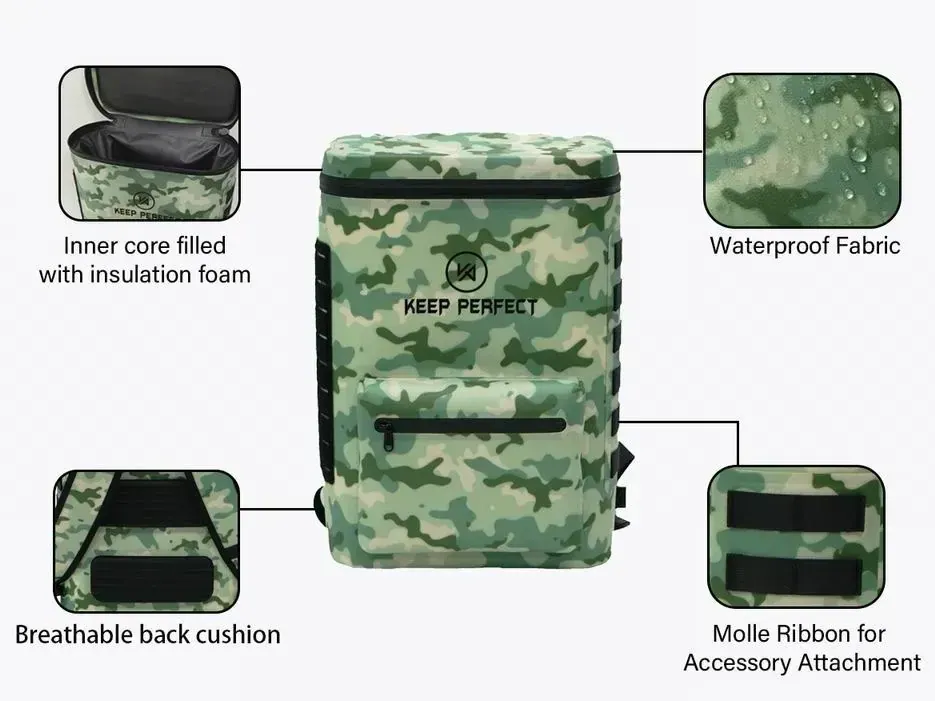
- A welded seam is flat, narrow, and shows no thread anywhere; running a fingernail along it finds a smooth continuous bond 8-20 mm wide.
- A taped seam shows a distinct strip on the inside, often 18-25 mm wide, with slightly visible edges and sometimes a faint woven texture.
- Looking closely at a taped seam often reveals tiny stitch dimples beneath the tape, which confirms a sewn substrate underneath.
- Weighted immersion is the definitive check: three kilograms of ballast, thirty minutes under 300 mm of water, and dry tissue paper placed inside against each seam.
- A taped bag leaks at the seam within 2-15 minutes of that test while a welded one stays dry; this single test resolves nearly every dispute about claims.
It is worth noting that pressure from above and immersion are different events. A taped seam frequently survives a hard shower because nothing presses water through it, and fails within minutes under 300 mm of head because static pressure drives water through the needle holes. Any claim of waterproofing should be tested by immersion rather than by spraying, and the difference explains most of the conflicting reports anglers post about the same bag.
Care Differences Owners Notice
The two constructions also differ in the everyday handling that decides how long any of this lasts, and this is rarely written down anywhere the purchaser will see it. A welded body tolerates neglect; a taped one does not.
| Care situation | Welded body | Taped body |
|---|---|---|
| Stored damp and rolled for a week | No effect | Adhesive softens, then releases |
| Left in direct sun all season | Fine, some chalking at the edges | Tape edges lift from 80 days |
| Machine washed at 30 degrees Celsius | Usually safe | Tape degrades after 5-10 cycles |
| Dried with a heater against the seam | Risk of local distortion | Tape can detach above 60 degrees Celsius |
| Folded tightly every trip | Crease whitening, cosmetic only | Tape cracks at the fold |
Those differences translate into a simple instruction set worth printing inside every bag: rinse in fresh water, dry fully open rather than rolled, keep out of prolonged direct sun during storage, and never machine wash. Following those four points roughly doubles the service life of a taped seam and adds nothing measurable to a welded one, which is another argument for spending the extra on welding wherever the use case justifies it.
Development Cost and Timeline
Choosing welding has consequences for the development calendar that have nothing to do with how the bag performs, and these are often discovered too late. Tooling sits on the critical path in a way that tape simply does not.
| Stage | Welded body | Stitched and taped body | Note |
|---|---|---|---|
| Initial sample build | 6-10 working days | 6-10 working days | Both can be hand-made first |
| Electrode or die tooling | 450-1,800 USD per profile | None required | 10-18 days additional |
| Parameter development | 2-4 days of trials | Not applicable | Lap samples at several settings |
| Pre-production validation | Peel tests plus immersion | Peel tests plus immersion | Identical verification |
| Bulk production | 35-50 days | 35-50 days | From approved sample and deposit |
The practical guidance is straightforward. Welding suits a design that will run unchanged for at least 500 units, where the tooling cost amortises to well under 2 USD per unit. Below that, or where a specific artwork and shape changes every season, tape keeps flexibility and avoids an asset that may never pay for itself.
The Decision Table
Everything above reduces to a short list of questions about how the bag will actually be used, and answering them produces a construction decision quickly without any need to rank the methods abstractly.
| Requirement | Choose | Reason |
|---|---|---|
| Bag must survive full immersion | RF welded body | Matches panel hydrostatic head |
| Bag sits in bilge water all trip | RF welded body | Adhesive tape fails in 2-4 years |
| Only spray and rain protection needed | Stitched and taped | Cheaper, flexible, adequate |
| Expected life under three years | Stitched and taped | Tape lasts 2-4 years anyway |
| Run below 500 units per design | Stitched and taped | Tooling will not amortise |
| Field repairability is essential | Stitched and taped | Repairable with heat and tape |
| Kayak, boat, or wading use | RF welded body | Immersion is routine, not accidental |
Note that three of those seven rows still point to tape, and that is an honest reflection of the market rather than a hedge. A well-taped bag used as intended, kept out of standing water, and dried between trips gives three to five years of service. It is only when the use case includes immersion that welding stops being a preference and becomes a requirement.
How Both Are Verified Before Shipment
Whatever construction is chosen, verification is what separates a specification from a hope, and the cost of doing it properly is small relative to the cost of a recall or a cancelled reorder.
| Check | Method | Acceptance |
|---|---|---|
| Seam peel strength | Tensile bench, 50 mm strip | Minimum value per the agreed standard |
| Immersion | 300 mm depth for 30 minutes | Interior completely dry |
| Spray resistance | Defined spray cabinet cycle | Referenced to the agreed method |
| Abrasion on seam area | Standard rub against abradant | No bond failure |
| Production sampling | Destructive peel every 200-400 units | Above the stated minimum |
Coating and film test procedures referenced across this section belong to the series published by ASTM International, and naming a specific method number in a purchase file is what makes an acceptance criterion enforceable. QUANZHOU JUNYUAN BAGS has developed waterproof bag programmes since 2014, with the founding team working in the trade since 2004. Monthly output of 200,000 units is verified by SGS, and BSCI and ISO 9001 systems structure the workflow. Materials are screened for REACH and California Prop 65, and every bulk order is inspected at AQL 2.5 before shipment.
A seam construction question can be taken up emailed to service@junyuanbags.com with the intended use, required immersion depth, expected yearly volume, and target unit cost. FOB Xiamen or DDP service to more than 100 countries follows an approved sample. Related reading includes the RF welded seam overview, the seam taping explainer, and the how waterproof fishing bags work guide.
People Also Ask
Are welded seams stronger than sewn seams?
Yes. RF welded joints reach 85-100 percent of base fabric strength with peel values of 45-100 N per 50 mm, against 30-45 percent for sewn and taped seams at 12-25 N.
Why do taped seams leak eventually?
The adhesive layer degrades. Adhesive hydrolysis in humid conditions releases the whole strip after two to four years, and each needle hole beneath it remains a capillary path regardless.
How much water pressure can a stitched seam hold?
Below 200 mm of hydrostatic head in practice, versus 4,000-8,000 mm for the fabric between stitches. That is why stitched seams handle spray but fail within 2-15 minutes of immersion.
Can welded and stitched parts exist in the same bag?
Always. Straps, buckles, and internal rails must be sewn, so real bags are hybrids: welding forms the water barrier and stitching carries structural load.
How do I tell if my fishing bag has welded or taped seams?
Look inside. A welded seam is smooth, 8-20 mm wide, and thread free. A taped seam shows a distinct 18-25 mm strip, often with faint stitch dimples visible under it.
Does a higher IPX rating mean the seams are welded?
Usually, though it must be verified. Ratings should always be quoted with test depth and duration, and enclosure classes are defined in the IEC 60529 family.
Frequently Asked Questions
Q1. What is the difference between welded and stitched seams?
A welded seam fuses two coated surfaces into one continuous film with no holes, while a stitched seam sews them together and leaves 400-600 needle punctures per metre, each acting as a capillary path for water.
Q2. Are welded seams waterproof?
Yes, when the parameters are correct. A welded seam matches the hydrostatic head of the panel around it, typically 4,000-8,000 mm, and stays dry through thirty minutes at 300 mm immersion depth.
Q3. Are taped seams waterproof?
They are spray and shower resistant rather than waterproof. Standard constructions test at 200-800 mm of hydrostatic head at the seam, which handles rain but not immersion.
Q4. Why does my bag leak at the seams but nowhere else?
Because the seam is always the weak point on a stitched body. Needle holes carry water through and threads wick it 15-40 mm sideways, so the damp area is wider than the visible seam line.
Q5. How strong is a welded seam compared with the fabric?
Between 85 and 100 percent of base fabric strength depending on the film, with peel strength of 45-100 N per 50 mm against 12-25 N for tape.
Q6. What thread should be used for fishing bag seams?
Bonded polyester, around size 69 for panel seams and size 92 or thicker for strap anchors. It absorbs about 0.4 percent of its weight in water and retains 70-80 percent of strength after 1,200 hours of exposure.
Q7. How long do taped seams last?
Typically two to four years. Failure usually starts at a tight internal radius where the tape lifts after 80-150 days of use, followed by adhesive failure in humid conditions.
Q8. Can a welded fishing bag be repaired?
Not easily in the field. Welding needs heat or radio frequency equipment and a matching film patch, whereas a taped seam can often be re-applied with a household iron and a replacement strip.
Q9. Why is there still stitching on a bag described as welded?
Because structural attachments cannot be welded. Straps, buckles, and internal rails are sewn to reinforcement patches, and those patches are welded to the shell so the outer barrier stays intact.
Q10. How much does RF welding tooling cost?
Between 450 and 1,800 USD per seam profile, plus 10-18 days to produce. It amortises to under 2 USD per unit above roughly 500 pieces per design.
Q11. How can I test whether seams really are waterproof?
Ballast the bag with about three kilograms, submerge it under 300 mm of water for thirty minutes, and line the interior with dry tissue paper. Water marks at a seam line give an immediate answer.
Q12. What are the MOQ and lead time for a welded body?
MOQ is 500 pcs per design and colour. Samples take 6-10 working days, electrode tooling adds 10-18 days, and bulk production runs 35-50 days from approved sample and deposit.