A fishing bag can be tested to a defensible standard at home in under two hours with about fifteen dollars of equipment. Run six checks in ascending severity: a ten minute spray at around ten litres per minute, a thirty minute weighted soak under three hundred millimetres of water with three kilograms inside, a full immersion at one metre for thirty minutes, an air pressure hold at two kilopascals for bags with a valve, a construction audit of seams and closures, and finally a zipper-only isolation test. Record grams of water gained rather than impressions; three grams or less per location is a pass for rain, and zero is the only acceptable result for a bag claimed to survive immersion.
The Answer Depends on What You Mean
Waterproof is used for everything from a shell that survives drizzle to a roll-top that stays dry after a capsize, and those two products have maybe ten percent overlap in what they can do. Six scenarios cover nearly everything asked by anglers: drizzle on a walk, sustained rain for two hours, spray over a gunwale, a bag dropped in a puddle or the wash, a bag that falls overboard and floats, and a bag deliberately submerged. Each has its own test, and passing one says nothing about another.
| Scenario | Exposure | Test that reflects it | Pass criteria |
|---|---|---|---|
| Drizzle on a walk | Ten minutes of light rain | Spray at five litres per minute | Under 3 g water ingress |
| Sustained rain | Two hours at twenty millimetres per hour | Spray at ten litres per minute for ten minutes | Under 3 g per location |
| Boat spray and washdown | Repeated soaking from above | Spray plus three hours of contact with a wet deck | No dampness at the base |
| Dropped in standing water | Thirty seconds at three hundred millimetres | Weighted shallow soak for thirty minutes | Under 5 g inside |
| Falls overboard, floats | Buoyant, partly submerged, moving | Float test plus one hour weighted at the surface | Under 10 g inside |
| Deliberate immersion | Thirty minutes at one metre | Full submersion with three kilograms of ballast | Zero ingress |
Read the Rating Before Testing Anything
Testing interprets a claim rather than replacing one, and knowing what the stated code means prevents arguing with a product that never promised what the user assumed. The second digit after IP describes liquid ingress, and X is used where solid particle testing was not performed. The relevant codes for bags run from IPX1, protection against vertically falling drops, through IPX4 for splashing from any direction, to IPX7 for temporary immersion and IPX8 for continuous immersion under conditions agreed by the parties.
Two facts follow directly from that structure. IPX4 describes splashing, not rain at pressure, and yet it is what most rain-resistant bags legitimately claim. IPX7 describes thirty minutes at a depth of one metre under laboratory conditions, which is a static test that does not include the movement or the surface loading of a real river. The codes themselves are maintained by the IEC ingress protection framework, which publishes the conditions each number describes.
| Code | Condition | Approximate home equivalent |
|---|---|---|
| IPX1 | Vertical drips for ten minutes | Drizzle on a dry day |
| IPX3 | Oscillating spray at sixty degrees | Angled rain while walking |
| IPX4 | Splashing from every direction, about ten litres per minute | Heavy rain or washdown |
| IPX5 | Water jet at twelve and a half litres per minute | Not usually required for bags |
| IPX6 | Powerful jet at one hundred litres per minute | Deck wash by hose |
| IPX7 | Thirty minutes immersed at one metre | Bathtub weighted immersion |
| IPX8 | Continuous immersion beyond one metre, conditions agreed | Requires laboratory confirmation |
Test One: The Construction Audit
Ten minutes of looking predicts most results before a drop of water is involved. Water enters at closures, joins, and openings, in that order, and none of those three is difficult to inspect. Open every closure fully and look along its whole length; then look at how panels meet, how pockets are attached, and whether anything below the waterline has a path in.
- Look at the closure: a watertight coil has flexible lips meeting face to face, while a standard coil with a flap cover behaves very differently.
- Check whether seams are welded or sewn. Sewn seams display visible stitch lines; welded ones show a smooth bond with perhaps a witness line.
- Determine whether seams are additionally taped on the inside, and whether the tape is continuous rather than patchy.
- Inspect pocket attachment: pockets sewn through the shell create thousands of penetrations below about two hundred millimetres of height.
- Look for drainage. Absence of any drain point in an external pocket usually means standing water rather than stored water.
The single most useful observation is the position of the lowest unsound path, because water finds the easiest entry and stopping. A bag with excellent upper construction and a dozen stitched pocket seams one hundred millimetres from the base will fail any immersion test and will probably pass every spray test. That pattern explains most of the arguments between users about whether a given bag is waterproof.
Test Two: The Spray Battery
This is the workhorse test because it is quick, repeatable, and correlates well with what most people actually mean by waterproof. Line the bag internally with pre-weighed absorbent paper at five locations, close every closure exactly as it would be closed in use, hang it loaded to about six kilograms, and spray at roughly ten litres per minute for ten minutes from two metres while moving the nozzle around all sides and angles.
Weighing rather than looking changes everything. An accurate kitchen scale reading to one gram costs about ten dollars, and paper used dry weighs around two and a half grams per sheet. Anything gaining three grams or more at one location is an active leak path regardless of how dry the rest of the interior appears; anything under one gram is condensation or transfer, which is normal.
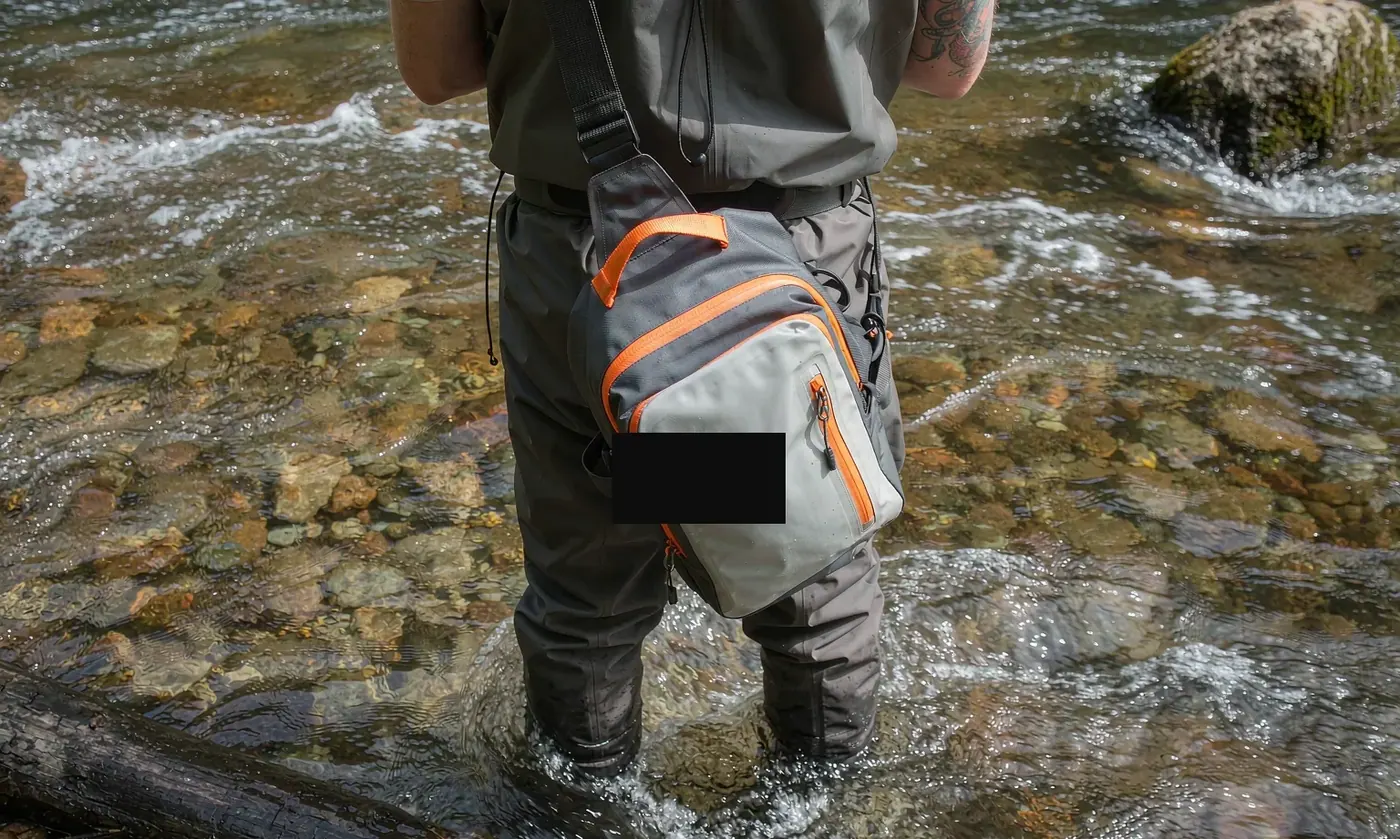
Two variants are worth running. Repeat the spray with the bag kneeling or lying at fifteen degrees, since this is how a bag sits when a fish is being landed rather than how it sits on a hook. And repeat it with the closure orientated downward, which reproduces spray arriving at the seam rather than at the shell.
Test Three: The Weighted Shallow Soak
Immersion to three hundred millimetres with weight inside reproduces the common realistic event, which is a bag standing in water rather than falling into it. Put three kilograms of bagged weight in the base, add pre-weighed absorbent paper above it, place the bag upright in three hundred millimetres of water for thirty minutes, then weigh the paper and inspect the lowest two hundred millimetres of the interior.
The mechanism at work here is hydrostatic pressure at the lowest point, roughly three kilopascals at three hundred millimetres of depth, plus sustained contact time. Fabrics resist that well; stitched seams resist it poorly; an uncovered pocket seam at that depth wets through in under five minutes. Adding the second hundred millimetres of depth doubles the pressure and is a useful way to escalate the test without new equipment.
Test Four: Full Immersion to One Metre
Only a certain class of bag should be given this test and only if its claim supports it. Fill a bathtub, immerse the bag fully closed with three kilograms of ballast inside, weight it down so it stays under for thirty minutes, then lift, dry the outside, open on a clean surface, and inspect every location. Any measurable water inside is a failure of an IPX7 claim, not a marginal result.
Two details make the difference between a valid test and a misleading one. Air trapped inside the bag keeps it buoyant, so genuine submersion needs weighting, typically five to eight kilograms for a thirty litre bag. And compression matters: water pressure at one metre is about ten kilopascals, and anything that presses the bag against a hard surface during the test, which is what hands, straps, and weights do, adds local pressure well above the nominal figure.
Test Five: The Air Pressure Hold
For any roll-top or valve-fitted bag, the fastest and most sensitive test is air rather than water, because a defect that admits litres of water over thirty minutes admits detectable air in seconds. Close the bag fully, attach a low-pressure pump with a gauge to an airstrip valve or adapt through the roll-top, bring internal pressure to about two kilopascals, and leave it thirty minutes. A loss under ten percent is a healthy result.
| Result | Likely cause | Next step |
|---|---|---|
| Holds above 90 percent for thirty minutes | Sound construction | Water test to confirm under load |
| Drops 80 to 90 percent slowly | Micro-path at a weld or a valve | Soap solution to locate the point |
| Drops sharply within two minutes | Closure not fully engaged or a seam split | Inspect every seam while pressurised |
| Will not hold any pressure | Open defect or an unsealed closure detail | Immersion is not necessary to know it fails |
| Pressure rises above three kilopascals | Over-inflated, risk of seam damage | Release to the target and repeat |
Locating the defect is done with a weak detergent solution brushed over suspect areas while the bag holds pressure; bubbles mark the point precisely. Mark it with tape, deflate, and it can usually be repaired rather than replaced. This method is genuinely sensitive: it will find faults that pass twenty minutes of immersion, and for that reason it is often the first test run rather than the fifth.
Test Six: Isolating the Closure
When a bag fails but the reason is not obvious, separating the closure from the shell answers it in fifteen minutes. Line the interior with absorbent paper, cover every closure externally with polyethylene sheet sealed to the shell with waterproof tape so the only difference is that the closure is shielded, and repeat the spray test. If the interior now stays dry, the closure is the path. If not, the shell has a defect elsewhere.
The reverse form is also informative: leave the closure exposed and cover the shell entirely. This attributes responsibility properly, which matters because the two have different remedies. A closure problem usually means slider replacement or flap addition, both cheap. A shell problem generally means either seam repairs or accepting the bag for what it is.
The Fifteen Dollar Instrument Kit
Precise testing needs less equipment than most people assume, and the four items here cover every test described. Everything else is household equipment: a bathtub, a hose, a bucket, and something heavy and bagged to act as ballast.
| Instrument | Cost | What it does | Accuracy needed |
|---|---|---|---|
| Digital kitchen scale | Ten dollars | Weighing paper before and after | One gram |
| Absorbent paper sheets | Two dollars | Detecting and locating ingress | Consistent sheet size |
| Low pressure pump with gauge | Eight dollars | Air hold testing for valve bags | 0.5 kilopascal |
| Soft tape measure and notebook | Two dollars | Recording rather than remembering | One millimetre |
The notebook is not optional. Comparing through imprecision is impossible, and a record showing three grams this season rising to eleven next season tells an owner exactly when maintenance is due and gives grounds for a claim if a product fails inside warranty.
Everything Else Wants Testing Too
Waterproof insulated inserts, sling packs, hip packs, and small electronics pouches all get tested the same way, scaled down. Spray volumes halve, immersion times stay at thirty minutes because contact time rather than pressure is usually what decides the result, and pass criteria tighten to one gram because the interior is smaller and any water has nowhere to spread.
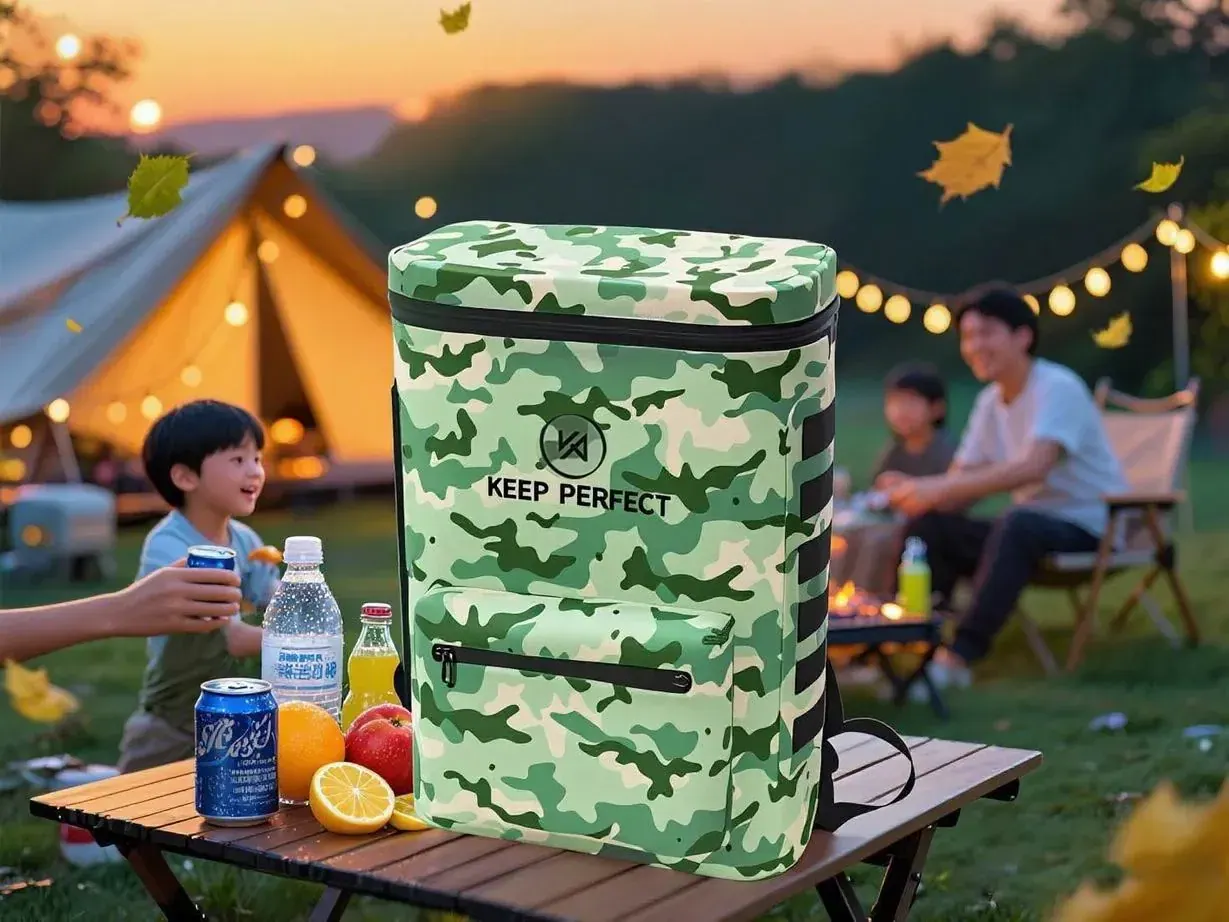
Insulated inserts deserve one extra check nobody runs: the liner-to-shell bond. A welded liner can be filled with one hundred millimetres of water for thirty minutes standing upright, then inspected for dampness at the outer base. Sewn liners fail this routinely, which explains why some coolers leave a damp patch in a car boot and others never do.
False Passes and How to Avoid Them
- Testing dry and empty. Nothing behaves the same unloaded; always ballast to six kilograms or more before drawing conclusions.
- Spraying from one angle only. Real exposures come from below and sideways, so rotate at least four positions.
- Testing a new bag and assuming the result holds. Coatings, tape, and closures change over a season; retest every three months.
- Ignoring temperature. Below about five degrees, coatings stiffen and closure tolerances change measurably.
- Accepting a showroom demonstration. A demonstration with a hose on an empty bag is not a test.
- Confusing beading with sealing. A surface that beads water beautifully can still have stitched seams below the waterline.
The most expensive false pass is assuming that passing the spray battery implies anything about immersion. Those two behaviours depend on completely different features, and plenty of bags that shrug off two hours of rain take water through a hundred millimetre stitched pocket seam within four minutes of standing in a puddle.
Pass Criteria by Activity
Deciding whether a result is good enough means knowing what the activity demands. A bag used only for commuting in drizzle does not need immersion performance and paying for it would be waste, while a kayak bag that fails immersion is unusable regardless of how good it looks in rain. Match the test to the use rather than testing everything to the hardest standard.
| Activity | Required test | Pass figure |
|---|---|---|
| Bank fishing in light rain | Spray for five minutes | Under 3 g |
| All-day rain on a walk-in river | Spray for ten minutes plus kneeling variant | Under 3 g per location |
| Boat fishing with washdowns | Spray plus three hours on a wet deck | No dampness at the base |
| Wading rivers and estuaries | Weighted soak at three hundred millimetres | Under 5 g |
| Kayak and paddleboard use | Thirty minutes floating, weighted | Under 10 g |
| Any immersion or capsize risk | Thirty minutes at one metre with ballast | Zero |
Where results fall between activities, buy one level higher. Every activity list grows over time, and the bag bought for rain today ends up on a kayak within a season. Selecting for the next activity up costs perhaps fifteen dollars and avoids a second purchase.
When Disagreement Needs a Laboratory
Home testing satisfies the user but settles nothing in a commercial disagreement. Independent verification against a named code costs roughly one hundred and fifty to six hundred dollars per configuration, takes five to ten working days, and produces a report referencing the method and the conditions, which is what makes the figure defensible in a contract or a dispute.
For procurement, require that report rather than a marketing figure, and require that the sample tested came from production rather than from a development build. The difference matters: laboratory-friendly prototypes and delivered goods have been known to diverge on exactly the properties being certified. Ask what date, what batch, and what test house, and treat vague answers as no answer.
What to Do With a Bag That Fails
A failed result is information, not a verdict. Failures at the closure usually mean lubrication, cleaning, or a replacement slider at three to eight dollars. Failures at taped seams can often be patched for under five dollars if the lift is under thirty millimetres. Failures across the shell or through multiple seams are describing something that cannot be fixed externally, which is when to reclassify the bag for rain use and buy properly for immersion.
QUANZHOU JUNYUAN BAGS entered waterproof bag programme work in 2014, relying on a founding team with roots in the industry dating to 2004. SGS puts verified monthly output at 200,000 units, achieved within BSCI and ISO 9001 systems. REACH and California Prop 65 screening applies throughout, with AQL 2.5 inspection on every bulk order. Fabric resistance to water penetration under pressure should be specified against a recognised method published by ISO alongside any code claim.
Briefs should state the required code, the hydrostatic head figure, the seam method, the closure class, and the required evidence, whether that is in-house records or third-party certification. The baseline order is 500 pieces per design and colour. Samples turn around in six to ten working days and bulk finishes thirty-five to fifty days after sample sign-off and deposit, with FOB Xiamen terms or DDP shipping to one hundred plus destinations. Send the brief to service@junyuanbags.com. Related reading includes the IPX testing explainer, the waterproof versus water-resistant comparison, and the construction walkthrough.
People Also Ask
How do I test if my fishing bag is waterproof at home?
Run a spray battery: pre-weighed paper inside, ten litres per minute for ten minutes from two metres, then reweigh. Under three grams gained per location is a pass for rain use.
What does IPX7 mean for a fishing bag?
Thirty minutes immersed at one metre under laboratory conditions with no ingress. It is a static test and does not include movement or surface loading.
Is IPX4 enough for fishing in the rain?
Yes for most needs. IPX4 covers splashing from any direction at about ten litres per minute, which corresponds to two hours of twenty millimetres per hour rainfall.
How can I find where my fishing bag leaks?
Isolate variables: shield the closures with sealed polyethylene and repeat the test. A dry interior points at the closure; a wet one points at the shell.
Can I test waterproofing with air instead of water?
Yes, and it is more sensitive. Briefly pressurise to two kilopascals, hold thirty minutes, and look for better than ninety percent retention, then find bubbles with detergent solution.
How much does independent waterproof testing cost?
About one hundred and fifty to six hundred dollars per configuration, taking five to ten working days, producing a report that cites method and conditions.
Frequently Asked Questions
Q1. What is the simplest way to know if a fishing bag leaks?
Pre-weighed absorbent paper inside, ten minutes of spray at ten litres per minute, then reweigh. Anything over three grams gained at one location is an active leak path.
Q2. Does passing a rain test mean a bag is waterproof?
No. Rain performance and immersion performance depend on completely different features; most stitched-seam bags pass every spray test and fail immersion within minutes.
Q3. How much weight do I need to submerge a thirty litre bag?
Typically five to eight kilograms. The bag must be genuinely under the surface, not pushed down by hand, for a thirty minute immersion result to mean anything.
Q4. What depth corresponds to IPX7?
One metre for thirty minutes. Pressure at that depth is about ten kilopascals, and anything pressing the bag against a hard surface adds well above that locally.
Q5. Can I test a roll-top fishing bag without a bath?
Yes, using air. Bring internal pressure to two kilopascals through a valve or the roll-top, hold thirty minutes, and look for better than ninety percent retention.
Q6. How accurate does my weighing need to be?
One gram is enough. A standard digital kitchen scale at about ten dollars resolves differences that matter, since a dry sheet weighs roughly two and a half grams.
Q7. Why does my bag leak when I kneel down?
Because most tests are run upright. On any bag placed at fifteen degrees or with the closure facing down, spray arrives at the seam instead of the shell.
Q8. How often should a bag be retested?
Every three months of regular use, and after any repair. Coatings and seam tape change with time, and a slow rise from three to eleven grams is normal ageing rather than sudden failure.
Q9. What does X mean in IPX7?
That solid particle ingress was not rated. The X is a placeholder, not a claim, and it is why codes should always be quoted in full rather than shortened.
Q10. Should small items be tested differently?
Same tests, half spray volume, thirty minute contact unchanged, and pass criteria tightened to one gram because there is no space for water to spread.
Q11. What should I do if the test fails?
Identify whether the path is the closure or the shell. Closure faults usually cost three to eight dollars to fix; widespread shell or seam faults mean reclassifying the bag for rain use.