A stitch line does not leak because the thread gets wet; it leaks because each needle hole is a capillary that resists barely any pressure. Using the Laplace relationship, a hole of about 0.9 millimetres resists roughly three hundred pascals, which is about thirty-three millimetres of water column, so almost any standing water pushes straight through it. Seam tape bridges those holes from the inside with a polymer film eighteen to twenty-five millimetres wide, bonded under heat and roller pressure at an interface temperature of one hundred and thirty to one hundred and sixty degrees. Done properly it keeps a bag dry through hours of rain; it does not make a sewn bag behave like a welded one under immersion.
Why a Stitch Line Leaks
Start with the hole rather than the thread. A size ninety to one hundred and ten needle leaves an opening close to a millimetre across, and surface tension inside that opening is what briefly holds water out. The Laplace equation describes how much pressure such a curved surface can resist, and putting realistic figures into it gives about three hundred pascals, or three kilopascals short of what one metre of immersion produces. In practical terms that means anything beyond a shallow puddle defeats it.
Thread makes it worse rather than better. Both polyester and nylon threads are bundles of filaments with channels between them, and those channels wick water along the entire length of a seam by capillary action. So not only does each hole admit water, the thread distributes it sideways, which is why a damp line appears along a seam rather than a single wet spot at one penetration.
| Factor | Figure | Consequence |
|---|---|---|
| Needle hole diameter | About 0.9 to 1.2 mm | Set by needle size and fabric thickness |
| Capillary resistance of that hole | Roughly 300 pascals | Equivalent to about 33 mm of water column |
| Pressure at one metre immersion | About 10 kilopascals | Thirty times what the hole resists |
| Stitch density | Seven to nine per inch | Several hundred holes per metre of join |
| Thread wicking | Along the full filament bundle | Turns one entry point into a damp line |
What Tape Does and What It Does Not
Tape bridges rather than fills. It sits on the inside of the seam as a continuous strip covering the whole stitch line, bonded to the coating either side, so there is no longer a direct path from outside to inside at that point. Nothing about it closes the holes; they still exist and they still admit water into the fabric plies, they simply do not reach the interior of the bag.
That distinction has two consequences that matter. Tape is excellent against rain arriving from outside because there is nowhere for the water to go except along the seam inside the plies. It is much less effective against immersion, where the entire construction is saturated and the tape bond itself becomes the path of least resistance, relying on adhesion rather than fusion.
| Expectation | Reality | Why |
|---|---|---|
| Taped seams make a bag waterproof | They make it rain resistant | The bond relies on adhesion, not fusion |
| Tape fills the needle holes | It bridges over them | The holes remain inside the plies |
| Wider tape is always better | Up to a point | Beyond twenty-five millimetres it creases at curves |
| Any heat source can apply it | No | Interface temperature must reach one hundred and thirty degrees |
| Tape lasts as long as the fabric | It is usually the first thing to fail | Adhesives age faster than films |
Tape Constructions Compared
There are three families in common use and the differences are not cosmetic. Single-film tapes are a one-piece polymer with a heat-activated surface, simple and cheap, suited to flat straight joins. Three-layer laminates sandwich an adhesive between two films, handle curves better and cost more. Hot-melt variant tapes carry a thicker adhesive layer that flows into the stitch line, which helps on uneven or heavy assemblies.
| Tape type | Construction | Best for | Relative cost |
|---|---|---|---|
| Single polymer film | One layer, heat activated face | Straight joins on PVC shells | Lowest |
| Three-layer laminate | Film, adhesive, film | Curved joins and corners | Medium |
| Hot-melt heavy grade | Thicker flowable adhesive layer | Heavy coated fabrics and abrasion zones | Highest |
| Narrow reinforcement tape | Twelve to fifteen millimetres | Internal reinforcement rather than waterproofing | Low but not waterproof |
| Double-sided repair strip | Adhesive both faces | Home repair of short lifts | Per metre, small quantities |
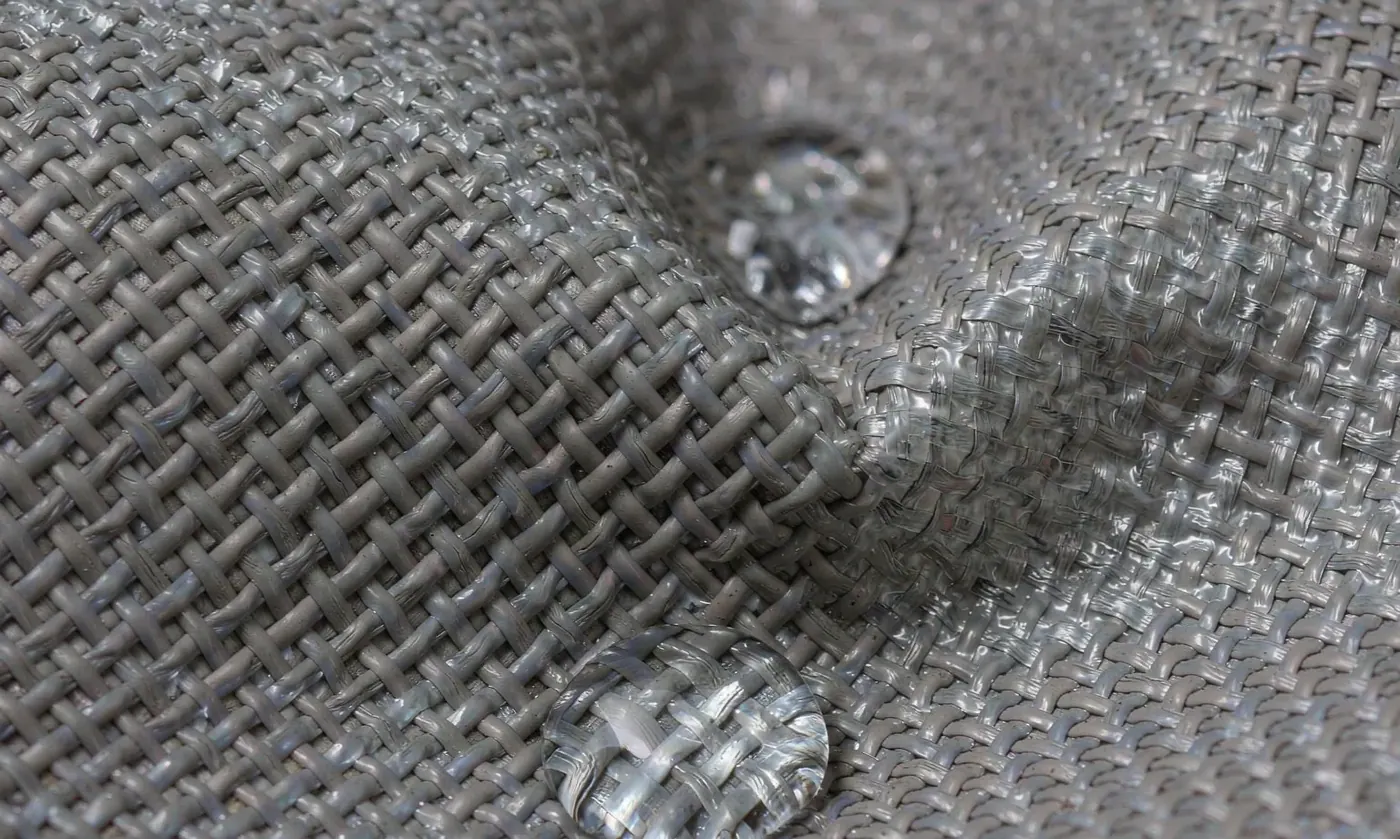
Chemistry has to match the shell, exactly as it does in welding. A tape chosen for PVC will not bond reliably to a silicone-treated face, and choosing the wrong one produces a strip that appears attached and peels away in a single strip after the first hot day. This is the most common assembly fault seen on returned goods.
How Tape Is Applied
Application machinery heats, feeds, and presses simultaneously, and the three settings interact. Hot air issuing from the nozzle at four hundred to five hundred degrees is directed at the interface, but what matters is the temperature actually reached between tape and coating, typically one hundred and thirty to one hundred and sixty degrees. Feed speed of two to three metres per minute and roller pressure of two and a half to four bar complete the picture; a correctly set machine lays a strip that cannot be lifted from either edge by hand.
- Clean and dry the seam area, since any salt residue or plasticiser bloom prevents bonding regardless of temperature.
- Set the interface temperature for the specific coating, usually lower for thin films and higher for heavy coated fabrics.
- Run at two to three metres per minute with roller pressure between two and a half and four bar.
- Overlap by twenty millimetres at every start and stop, because joins in the tape are joins in the barrier.
- Test one metre in every fifty by attempting to peel it from the edge by hand, recording failures immediately.
- Allow twenty-four hours before destructive testing, since most heat-activated adhesives continue to develop strength after cooling.
The operator point deserves emphasis because automated machines do not remove it. Every change of direction needs a hand to guide the tape, and corners are where nearly all failures begin. Experienced operators slow to about half speed through curves, use short relief cuts on inside corners, and then re-press the whole corner area once more.
Corners and Closures: Where Tape Struggles
Ask anyone inspecting returned bags where they fail and the answer is predictable: three-way corners, pocket junctions, and the two points where a closure tape meets a body tape. Flat straight runs almost never fail because nothing is trying to peel them. Corners carry residual stress from the shape itself, and every time the bag is compressed the tape is asked to bend rather than simply to sit there.
Closure junctions have their own problem, which is that the closure arrives at an angle to the seam and the two are rarely coplanar. The fix is a reinforcing patch over the junction rather than trying to run continuous tape around it: a fifty millimetre square of the same material bonded centrally over the meeting point, pressed once more after cooling. It adds about twenty cents and removes the commonest leak on a rain-resistant bag.
Spotting Tape, and Spotting Its Absence
Buyers ask how to tell whether a bag is taped, and there are four reliable checks, none requiring tools. Open the bag fully and look along every seam from the inside: tape reads as a continuous strip, usually slightly glossier than the surrounding coating, bridging the stitch line. Feel it, since it adds a distinct ridge absent from bare seams. Look for the twenty millimetre start and stop overlaps, which reveal machine application. And hold the seam up to a bright lamp, where taped lines show no periodicity at all.
| Check | Taped | Not taped |
|---|---|---|
| Inside appearance | Continuous strip bridging the stitches | Visible thread rows |
| Ridge by feel | Slight raised band either side | Flat, or stitch texture only |
| Light transmission | Even, no periodicity | Tiny regular bright points |
| Marketed claim | Usually stated as taped or sealed | Usually avoided or vague |
| Behaviour in sustained rain | Dry interior for hours | Damp line appearing within an hour |
The unreliability of the fourth row is worth noting. Claims are inconsistent across the category, and plenty of bags are quietly taped while being marketed simply as water resistant, so inspecting the actual construction beats trusting any wording.
How Long Tape Lasts
Tape is almost always the first element of a bag to reach the end of its life, and its life is a chemistry problem rather than a mechanical one. Polyurethane adhesives hydrolyse in the presence of moisture, faster when warm and slower when dry, so the useful figure is not years but years at a given humidity. Stored and used below sixty percent relative humidity at twenty-five degrees, a good tape holds up for around five years; at eighty percent and thirty degrees, the same tape may be finished in two.
| Storage and use condition | Expected tape life | Warning signs |
|---|---|---|
| Below 60 percent relative humidity, temperate | Four to five years | Slight edge lift after year three |
| Sixty to seventy percent, seasonal use | Three to four years | Whitening along the edges |
| Above 75 percent, tropical storage | Two to three years | Whole-length softening and lift |
| Regular salt exposure with no rinsing | One to two years | Powdering and bond loss near the base |
| Stored wet in a closed space | Under one year | Peeling within a single season |
Two behaviours follow from those figures, and both are cheap. Store bags dry, since humidity rather than time is the driver. And expect any bag used daily in the tropics to need seam attention roughly every second year, which is a normal maintenance item rather than evidence of a defective product.
Care Rules for Taped Construction
- Never machine wash a taped bag; agitation combined with detergent attacks the adhesive interface faster than any amount of use.
- Keep heat sources away, including radiators and tumble dryers, since most tapes soften appreciably above seventy degrees.
- Rinse salt off rather than letting it sit, because chloride migration along the bonded edge is what starts most lift.
- Avoid solvents entirely, including alcohol wipes, near seam interiors.
- Open the bag fully when drying so creases do not form along tape lines.
- Store dry and loose; anything folded along a taped line for months will crease the tape permanently.
Detergent is worth highlighting because it surprises people. Modern detergents are formulated to remove oils and they are equally effective at attacking the plasticiser at a bonded interface, so the cleaning that keeps a bag looking new shortens the life of its seams. Cleaning with plain water and a soft brush is almost always sufficient.
Repairing Lifted Tape
Lift under thirty millimetres of length is repairable at home with a reasonable success rate; more than that, or any lift where the tape has gone hard and lost flexibility, generally means the whole run is nearing its end. The repair is heat and patience rather than glue.
- Clean the area and the lifted tape underside with a barely damp cloth, then dry completely.
- Set a household iron to medium, around one hundred and twenty to one hundred and forty degrees at the soleplate.
- Place a folded cotton cloth over the lifted section and press for eight to ten seconds without sliding the iron.
- Lift the cloth, press the tape down along its length with finger pressure while warm, and repeat twice.
- Leave twenty-four hours, then check with a spray test rather than by eye alone.
Adhesive-backed repair strips sold by the metre are a reasonable alternative for anyone without confidence with an iron, applied over thirty to forty millimetres of overlap with firm rolling pressure. They hold well enough for a season and, unlike an iron, they cannot damage the surrounding coating if the temperature is misjudged.
Small Items Get Taped Too
Insulated inserts, soft coolers, hip packs, and waist packs use the same technology, and the same physics applies at reduced scale. Because their interiors are small, any water ingress is proportionally more damaging, so the pass criteria tighten even though the test volumes shrink. A single damp corner inside a nine litre insert ruins its contents in a way that would go unnoticed in forty litres.
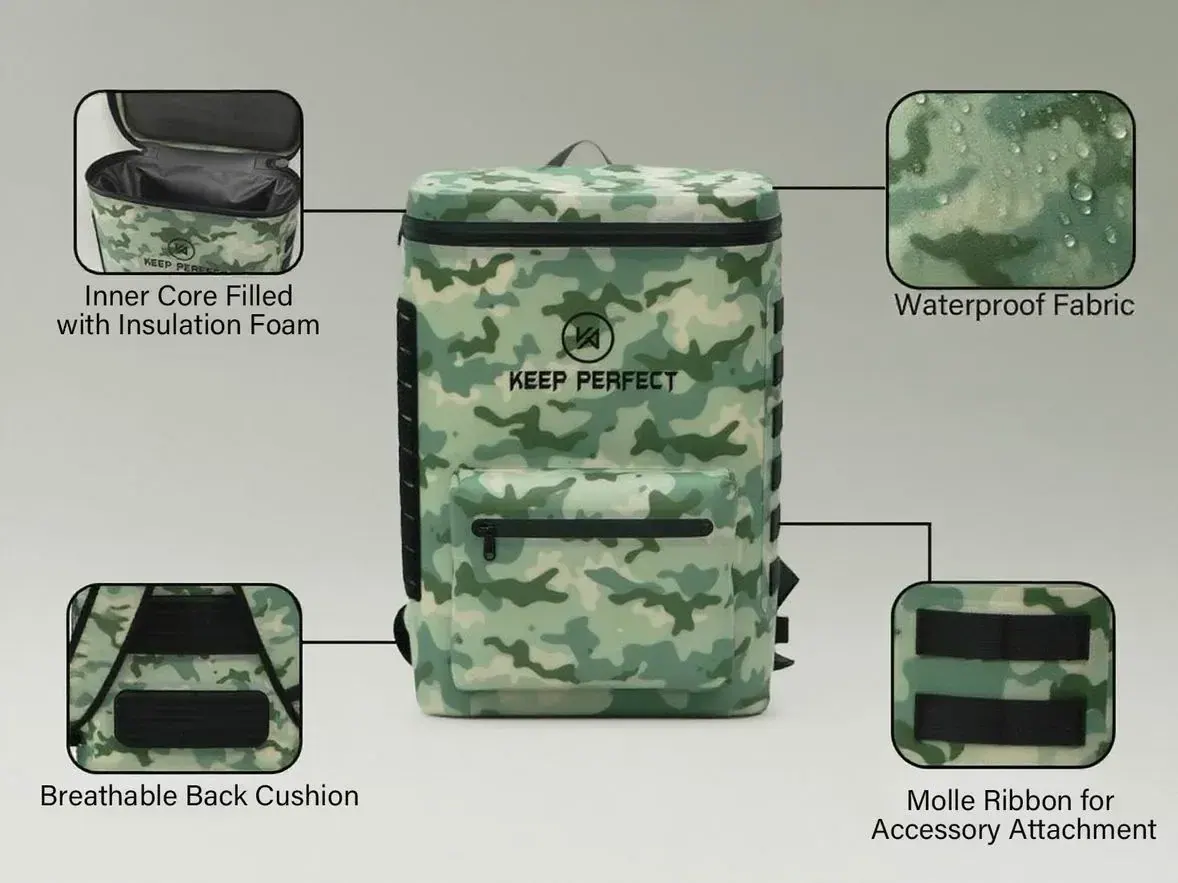
Insulated goods add one requirement unique to them: the liner-to-shell seam near the base carries both thermal load and water load, and it is taped rather than welded on almost all mid-priced products. Inspecting that one join explains why some coolers leave a damp ring on a car seat and others never do.
Why Some Bags Skip Tape Altogether
Entry-level bags are often untaped, and understanding why helps buyers decide whether the saving is real. Hot-air taping equipment costs several thousand dollars, each metre of tape adds about thirty cents of material, and the operation adds two to four minutes per bag of skilled labour. Against a bag retailing under thirty dollars, those numbers leave little room, and leaving seams bare is the decision that preserves the price.
| Bag tier | Seam treatment | What the buyer gets |
|---|---|---|
| Entry, under thirty dollars retail | Sewn only, sometimes a protective flap | Splash resistance and perhaps thirty minutes of drizzle |
| Mid tier | Sewn and fully taped internally | Several hours of rain without interior dampness |
| Upper mid tier | Taped plus raised seams or welded base | Rain plus accidental contact with shallow water |
| Premium | Welded external joins entirely | Immersion behaviour with a certificate to support it |
| Specialist dry shapes | Welded throughout, roll-top closure | Thirty minutes at one metre without ingress |
The honest way to read that table is to match the tier to the intended exposure rather than buying the top row by reflex. Someone fishing from a dry bank three times a year loses nothing by choosing an untaped bag, while anyone whose bag sits in bilge water needs the upper rows regardless of price preference.
When Tape Is Enough and When It Is Not
Tape earns its place in the majority of fishing bags, because most fishing bags need rain resistance rather than immersion resistance, and tape delivers that at a fraction of the cost of welding. It stops being the right answer at two boundaries: where the product is expected to be submerged, and where the shell material cannot be bonded reliably by any tape.
| Requirement | Tape sufficient | Reason |
|---|---|---|
| Drizzle and short rain | Yes | Little pressure, no sustained contact |
| Two hours of heavy rain | Yes if fully taped | Standard use case for taped seams |
| Standing in shallow water for minutes | Usually | Depends on how close the seam sits to the water |
| Immersion at one metre | No | Bond adhesion becomes the failure path |
| Bilge contact for hours | No | Sustained soak plus abrasion |
| Silicone-treated shell | Rarely | Almost nothing adheres to that finish long term |
QUANZHOU JUNYUAN BAGS has operated waterproof bag programmes since 2014, with its founding team trading in this category since 2004. SGS verification covers 200,000 units of monthly capacity, achieved within BSCI and ISO 9001 frameworks. All inputs meet REACH and California Prop 65 expectations, and AQL 2.5 inspection is completed before dispatch. Durability of a tape bond to laundering and environmental cycling should be verified against methods published by AATCC, alongside penetration test methods from ASTM International.
Briefs should state tape width, whether all seams are taped or only selected ones, minimum bond strength with the method cited, and behaviour expected after twenty laundering cycles. Development begins from 500 pieces per design and colour, six to ten working days are needed for a sample, and thirty-five to fifty days for bulk once that sample is approved and the deposit received. Shipments run FOB Xiamen or DDP to one hundred plus countries. Send the brief to service@junyuanbags.com. Related reading includes the welded versus seamed comparison, the RF welding breakdown, and the waterproof construction guide.
People Also Ask
Why do stitched seams let water in?
Each needle leaves a hole close to a millimetre across that resists only about three hundred pascals, roughly thirty-three millimetres of water column, and the thread itself wicks water along the seam.
What does seam tape actually do?
It bridges the stitch line from the inside with a continuous polymer strip, bonded under heat and roller pressure. The holes still exist; water simply cannot reach the interior.
How wide should seam tape be?
Eighteen to twenty-five millimetres for bags. Beyond that it begins to crease along curves, which creates its own leak path.
Can taped seams survive being submerged?
No. Tape relies on adhesion rather than fusion, so once the whole construction is saturated the bond becomes the failure path. Welding is required for immersion.
How long does seam tape last?
Around four to five years below sixty percent relative humidity and twenty-five degrees, falling to two or three years in tropical conditions, because moisture drives hydrolysis of the adhesive.
Can I repair lifted seam tape at home?
Yes below about thirty millimetres of lift. Use a medium iron through cloth for eight to ten seconds and press while warm, or apply an adhesive repair strip over thirty to forty millimetres of overlap.
Frequently Asked Questions
Q1. What is seam taping on a fishing bag?
A polymer strip eighteen to twenty-five millimetres wide bonded over the inside of every stitched join, bridging the needle holes so water entering the fabric plies cannot reach the interior.
Q2. Is a taped seam the same as a welded seam?
No. Tape relies on adhesion and typically handles rain; welding fuses the films into one layer and handles immersion. They are different levels of performance.
Q3. How do I know if my bag is seam taped?
Look inside for a continuous strip bridging each stitch line, feel for its slight ridge, and check for twenty millimetre start and stop overlaps. Do not rely on marketing wording.
Q4. What temperature is used to apply seam tape?
The interface between tape and coating reaches one hundred and thirty to one hundred and sixty degrees, with hot air at four hundred to five hundred degrees at the nozzle, feed at two to three metres per minute, and roller pressure of two and a half to four bar.
Q5. Why does tape peel first at the corners?
Because residual stress from the shape tries to bend it rather than simply sit there. Reinforcing patches over three-way corners and closure junctions prevent most of it.
Q6. Can taped seams be machine washed?
No. Detergent attacks the interface faster than ordinary use, and agitation lifts edges. Clean with clean water and a soft brush instead.
Q7. How heat sensitive is seam tape?
Most start softening appreciably above seventy degrees. Keep bags away from radiators, tumble dryers, and hot car interiors, particularly in summer.
Q8. Does seam tape work on every material?
On most coated fabrics, yes, provided chemistry is matched. Silicone-treated finishes are the notable exception, since almost nothing adheres to them long term.
Q9. How much does taping add to the cost?
About one and a half to three dollars and fifty cents per bag in production, after equipment costing several thousand dollars, which is why it appears on mid-tier rather than entry-level products.
Q10. When should I choose welding instead?
For anything expected to be immersed, to float, or to sit in bilge water for hours. Tape handles rain; it does not substitute for fusion under sustained soak.
Q11. What is a realistic life for a taped bag?
Three to five years in temperate conditions, one to two years with regular salt exposure and no rinsing, and under one year if stored wet in a closed space.