Four materials account for almost every serious fishing bag shell, and they differ more in processability than in headline strength. PVC film weighs 550-900 grams per square metre, welds cleanly at radio frequency and costs 3-6 USD per metre, TPU weighs 400-650 grams, reaches higher heads and stays flexible to -40 C at 7-12 USD, tarpaulin goes to 1,300 grams for abrasion work, and PU-coated nylon drops to 150-400 grams where weight matters more than welds. Each choice locks in a seam method and a set of compliance questions, so the material should be picked before the bag geometry rather than after it.
Material Choice Decides Seam Method First
The most consequential property of any of these four materials is not strength, weight, or even water resistance, but whether it can be welded. Weldable films allow seams with no needle holes, which is what makes a genuinely submersible body possible, while a woven textile has to be sewn and then protected with tape. Choosing a material therefore chooses the entire construction route for the product.
| Material | Typical weight | Hydrostatic head | RF weldable | Cost per metre |
|---|---|---|---|---|
| PU-coated nylon | 150-400 g/m2 | 1,500-5,000 mm | No | 1.5-4 USD |
| PU-coated polyester ripstop | 180-420 g/m2 | 1,500-4,000 mm | No | 1.6-4.5 USD |
| PVC film laminate | 550-900 g/m2 | 5,000-10,000 mm | Yes | 3-6 USD |
| PVC tarpaulin | 900-1,300 g/m2 | 8,000-15,000 mm | Yes | 4-8 USD |
| TPU film laminate | 400-650 g/m2 | 8,000-20,000 mm | Yes | 7-12 USD |
Notice that the two cheapest options sit at roughly a fifth of the hydrostatic head of the three weldable ones. That is not a coincidence, it is the same reason they cannot be welded: a coating thick enough to become a continuous film is thick enough to be fused, and one thin enough to leave the weave visible cannot.
PU-Coated Nylon: Light, Cheap, Sewn
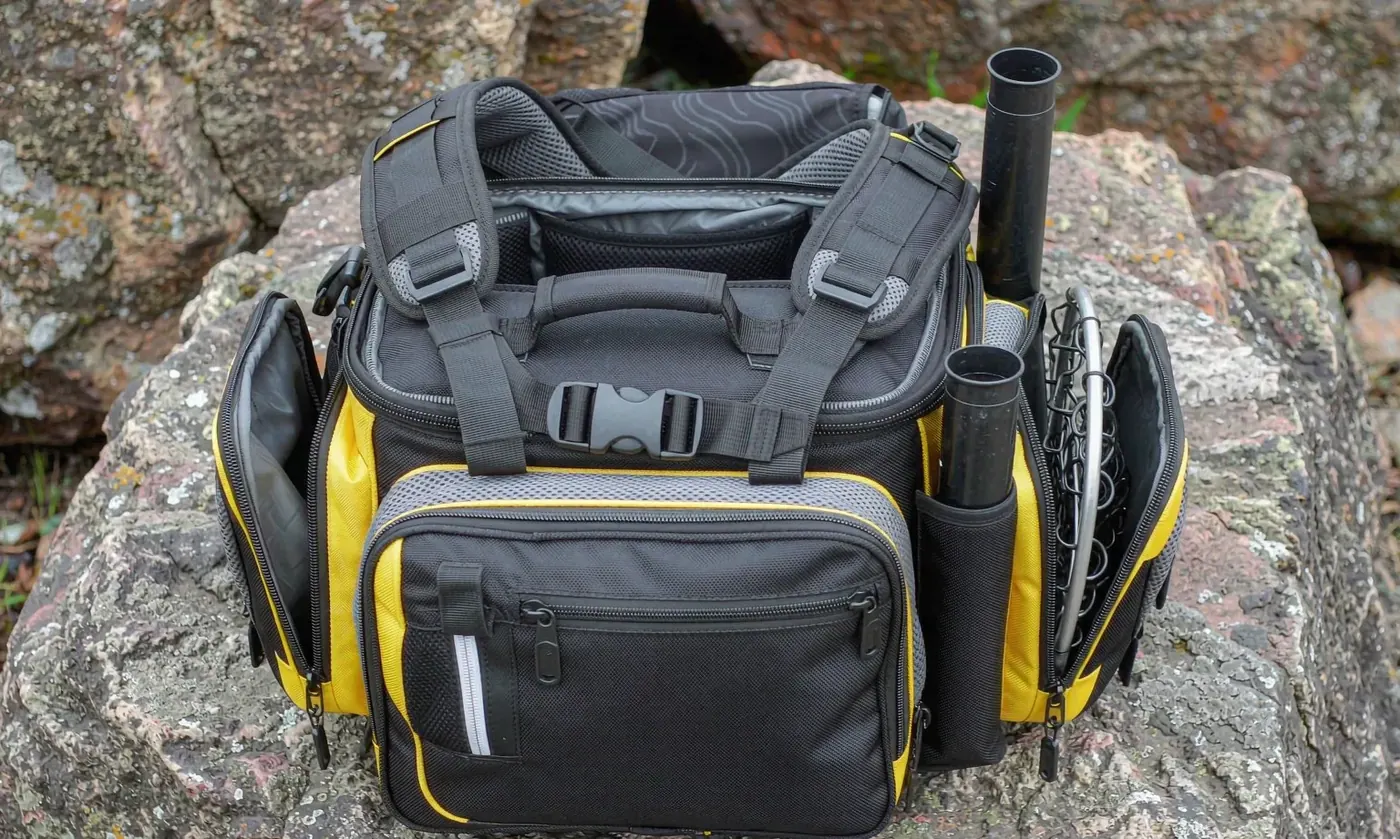
Nylon with a PU coating is the default for any body where weight dominates and the seams will never go under water. A 210D nylon with a 0.08 mm PU coat lands near 180 grams per square metre and around 2,200 mm of head, while a 420D version reaches roughly 320 grams and 2,600 mm for about 35 percent more material cost.
| Denier | Typical weight | Tear strength | Abrasion cycles | Suits |
|---|---|---|---|---|
| 210D | 150-190 g/m2 | Moderate | About 8,000-12,000 | Chest packs, waist packs |
| 420D | 280-340 g/m2 | Good | About 15,000-22,000 | Slings, small backpacks |
| 500D | 340-420 g/m2 | Good | About 20,000-28,000 | Tackle backpacks |
| 840D | 450-560 g/m2 | High | About 30,000-40,000 | Base panels, high wear zones |
| 1680D | 700-900 g/m2 | Very high | About 45,000-60,000 | Abrasion panels only |
Abrasion cycle figures should be quoted against a named method, because two vendors citing different methods can differ by a factor of two on identical fabric. The Martindale and oscillating-cylinder approaches both appear in the market and their results are not interchangeable, so a brief should state which is intended along with the acceptance number. Wider reading on the practical consequence of choosing this route is set out in the PVC against TPU shell comparison, and the wider decision route is set out in the fishing bag material selection guide.
Nylon has one weakness buyers routinely overlook, which is ultraviolet stability. Against polyester ripstop of comparable construction, nylon loses noticeably more tensile strength per thousand hours of accelerated exposure, and a pack left on a boat deck for two seasons shows it as fading followed by a powdery handle. Polyester costs about 8-12 percent more and largely removes the problem, which is usually worth doing for anything sold into high-sun markets.
PVC Film: The Workhorse Weldable
PVC film laminated onto a polyester base fabric is what most genuinely waterproof bodies are made from, and it is the volume material of the category. At 500D equivalent it weighs around 620 grams, reaches 5,000-10,000 mm of head, welds at radio frequency with a seam that can exceed 80 percent of base fabric strength, and costs 3-6 USD per metre.
The properties that follow from PVC being plasticised are what a buyer needs to understand. Flexibility comes from plasticiser held in the polymer matrix, and that plasticiser migrates slowly over the life of the product, which is why a PVC body stiffens and eventually cracks after several years. The second consequence is regulatory: plasticiser type is exactly what restriction regimes screen for, and compliance evidence rather than a marketing claim is what should be requested.
| Property | PVC film | Consequence | Mitigation |
|---|---|---|---|
| Cold flexibility | Cracks near -20 to -30 C | Fails in winter twenty below | Specify a low-temperature grade |
| Plasticiser migration | Stiffens over 3-5 years | Cracking at fold lines | Avoid permanent hard folds |
| Weight | 550-900 g/m2 | Heavy packs | Use film only where needed |
| Weld strength | 80-90 percent of base | Strongest economical seam | Verify parameters per batch |
| Compliance load | Highest of the four | Screening burden | Request full material dossier |
PVC Tarpaulin: Where Abrasion Rules
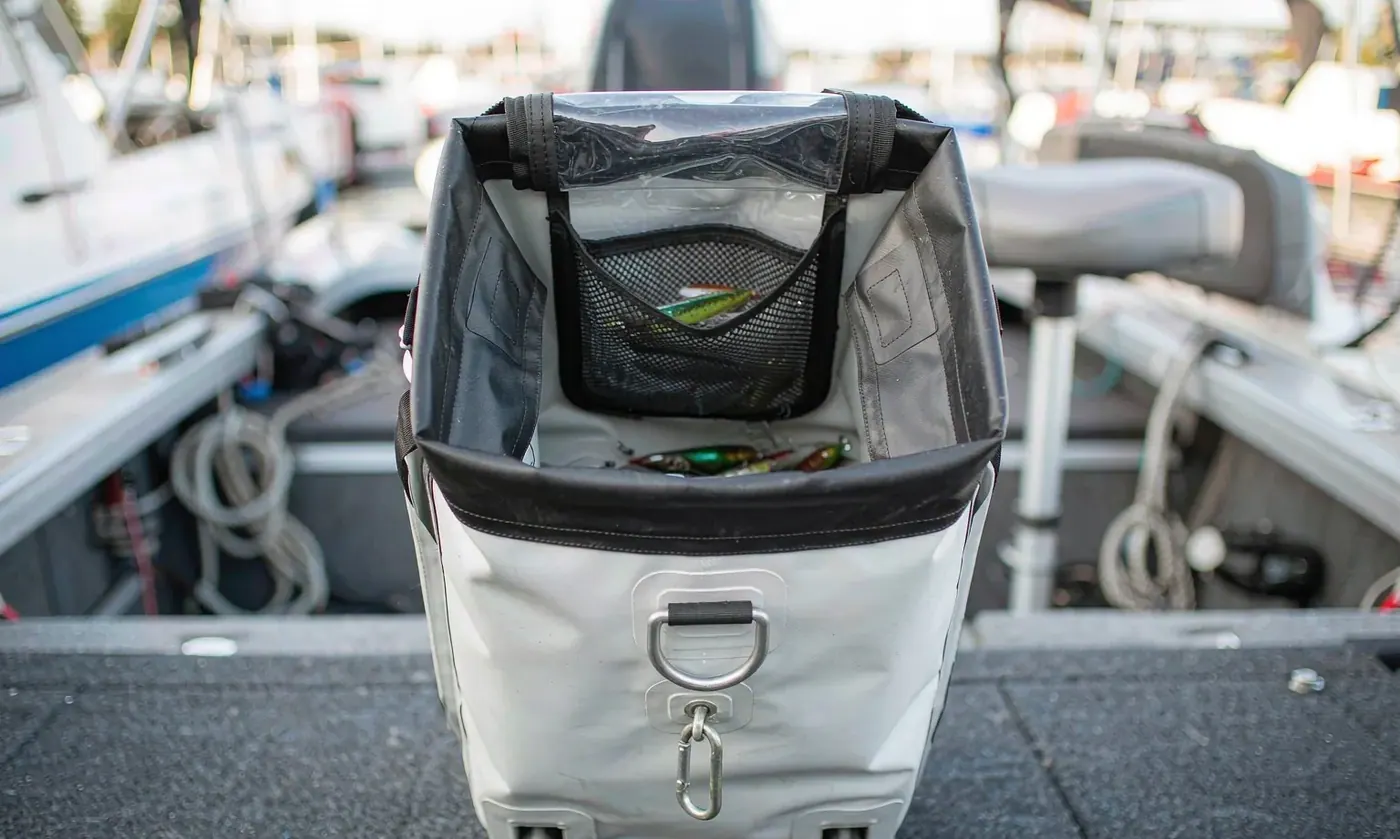
Tarpaulin here means a heavy PVC-coated polyester scrim rather than a truck sheet, typically 1,000D, weighing 900-1,300 grams per square metre and reaching 8,000-15,000 mm of head. It is used where a bag is dragged across a deck, dropped on gravel, or stood on a rough surface daily, and nowhere else, because it is very heavy.
The honest framing for tarpaulin is that it solves abrasion rather than water. Any weldable film already reaches a head far beyond what a fishing bag needs, so the extra 300-600 grams per square metre buys scrape resistance and puncture resistance and nothing else. A body of 0.5 square metres in tarpaulin rather than 500D PVC film gains roughly 200 grams, which compounds through the whole product and is only worth paying where the base genuinely gets dragged.
TPU Film: Best Performance, Highest Cost
TPU film laminate is the premium weldable option at 400-650 grams, reaching 8,000-20,000 mm of head and staying flexible down to about -40 C, at 7-12 USD per metre. It welds cleanly, resists abrasion better than PVC at equal weight, and carries a lighter compliance burden because it needs no plasticiser to stay flexible.
The one genuine weakness is hydrolytic ageing. Ester-based TPU absorbs moisture and slowly degrades, losing strength in a process accelerated by heat and humidity, typically becoming noticeable after four to seven years in storage. Ether-based grades resist hydrolysis much better at roughly a 25 percent cost premium, and specifying the ether grade matters for anything held in warehousing in a humid climate before sale.
| Property | TPU ether grade | TPU ester grade | PVC film | PU-coated nylon |
|---|---|---|---|---|
| Weight at 500D | About 480 g/m2 | About 470 g/m2 | About 620 g/m2 | About 340 g/m2 |
| Hydrostatic head | 8,000-20,000 mm | 8,000-20,000 mm | 5,000-10,000 mm | 1,500-5,000 mm |
| Cold flexibility | About -40 C | About -30 C | About -20 C | About -10 C |
| Hydrolytic ageing | Low risk | Noticeable 4-7 years | Not applicable | Not applicable |
| RF weldable | Yes | Yes | Yes | No |
| Cost per metre | 9-12 USD | 7-10 USD | 3-6 USD | 1.5-4 USD |
Insulation and Foam Liners
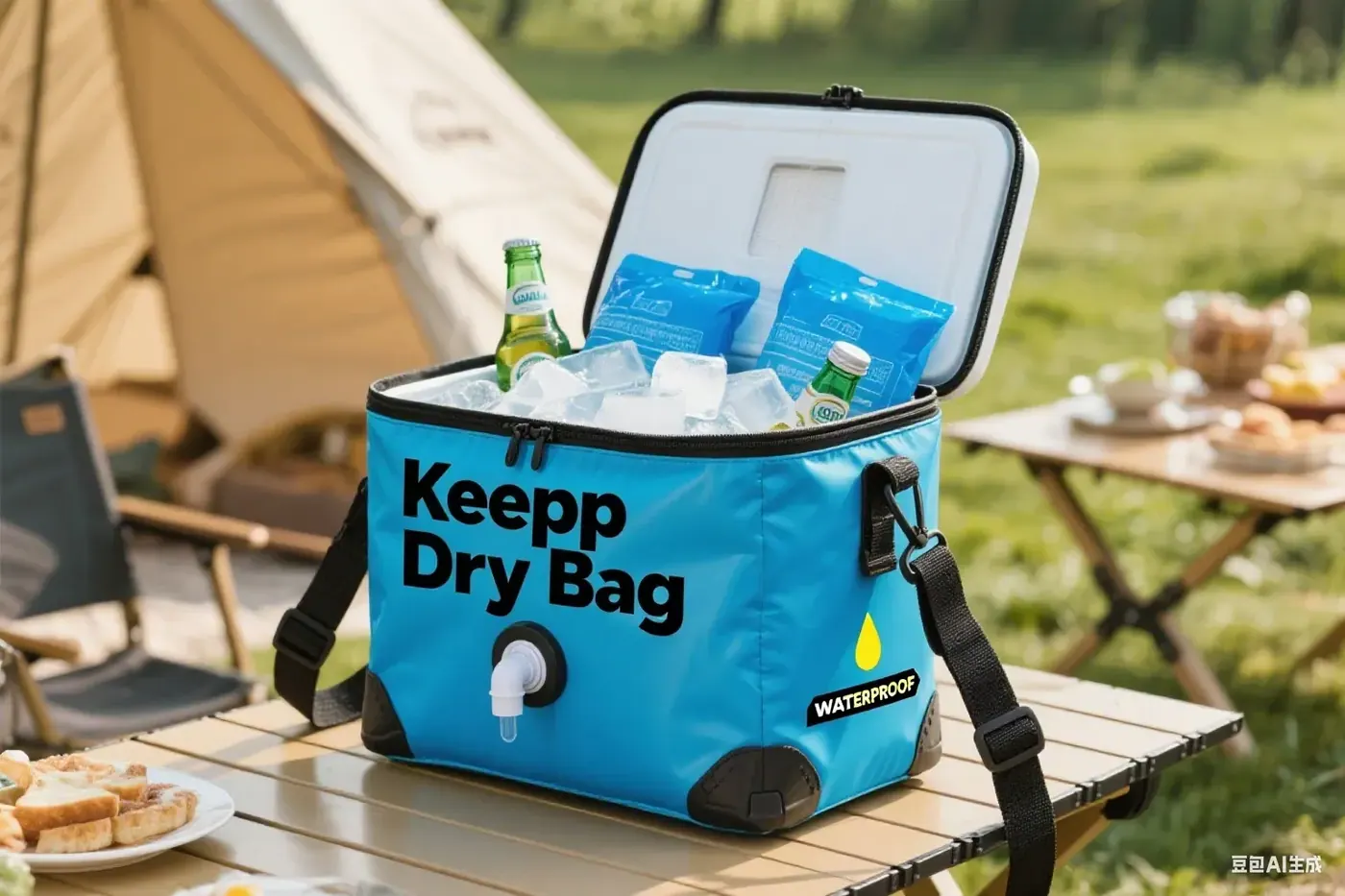
Insulated bodies introduce a fourth material class because the shell is doing temperature work rather than water work. A closed-cell foam liner of 4-8 mm laminated inside a coated polyester outer gives most of the available benefit, and going beyond 8 mm adds weight and bulk quickly for diminishing returns in ice retention.
| Liner | Thickness | Ice retention at 20 C | Added weight | Added cost |
|---|---|---|---|---|
| Closed-cell foam, light | 4 mm | About 6-8 h | 180 g | 1.10 USD |
| Closed-cell foam, standard | 6 mm | About 10-13 h | 260 g | 1.60 USD |
| Closed-cell foam, heavy | 8 mm | About 14-18 h | 340 g | 2.20 USD |
| Reflective inner plus foam | 6 mm plus foil | About 16-20 h | 310 g | 2.60 USD |
Two construction details decide whether an insulated body survives its second season, and neither involves the foam. The inner liner seam must be welded or heat sealed rather than stitched, because melt water will sit against it for hours, and there must be a drain at the lowest point. An insulated bag with no drain collects several litres of melt water and becomes impossible to empty without inverting it, which nobody does.
Moulded EVA in Bases and Structure
Ethylene-vinyl acetate appears in fishing bags as a compression-moulded base rather than as fabric, typically at 3-6 mm thickness with a durometer in the region of 55-70 Shore A. It gives a base that stands up on wet ground, sheds water, and protects the shell floor from the abrasion that destroys sewn bases first.
The specification to get right is density as much as thickness. A low-density EVA base at 4 mm compresses permanently under a loaded tray stack within two seasons, while a mid-density grade at the same thickness recovers and keeps standing. Verifying permanent compression rather than initial thickness is what separates a base that works from one that merely looks substantial in a photograph.
Testing Each Material Properly
Materials should be specified with the method and the acceptance number attached, because without both there is nothing to enforce. A widespread habit of quoting a hydrostatic figure with no stated method produces numbers that cannot be compared across two offers, which is precisely what makes material sourcing feel opaque.
| Property | Common method family | Typical acceptance | What it catches |
|---|---|---|---|
| Hydrostatic head | Hydrostatic pressure test | 3,000 mm minimum after three washes | Thin or uneven coating |
| Abrasion resistance | Martindale or oscillating cylinder | 20,000 cycles at 500D | Coating that rubs off |
| Tear strength | Tongue or trapezoidal method | Above the stated newtons | Weave that propagates a cut |
| Cold crack | Low-temperature bend test | No cracking at -20 C | PVC grade unsuited to winter |
| Accelerated weathering | Xenon arc exposure | Under 30 percent strength loss at 500 h | Nylon that degrades in sun |
| Seam strength | Weld peel and shear test | 80 percent of base fabric | Poor weld parameters |
Test methods for textiles and coated fabrics are published by ASTM International, and accelerated weathering and xenon-arc methods are maintained by the International Organization for Standardization. Citing a numbered method rather than a description turns disagreement into a measurement, and it costs nothing to write onto a brief.
Compliance Differs Sharply by Material
Restricted-substance screening is not equally loaded across these four materials, and the difference should be priced in rather than discovered at a port. PVC carries the heaviest burden because plasticisers and stabilisers are the parts most scrutinised, TPU is lighter but not exempt, and coated nylon is mostly about surface treatments and finishes.
| Material | Main screening focus | Documentation burden | Practical effect |
|---|---|---|---|
| PVC film and tarpaulin | Plasticisers and stabilisers | Highest | Requires a full material dossier per colourway |
| TPU film | Residual monomers and additives | Moderate | Standard screening usually sufficient |
| PU-coated nylon | Surface treatment and dye | Moderate | Watch PFAS-based finishes specifically |
| Insulated foam liner | Blowing agent residues | Low to moderate | Confirm the foam grade separately |
| Moulded EVA base | Residual monomer and colourant | Low | Screen colour masterbatch too |
Chemical restrictions on these substances are administered under REACH by the European Chemicals Agency, and there is a separate California requirement that most buyers meet at the same time to avoid splitting production. The practical advice is simple: request the screening record per material rather than per finished bag, because colourants and inks change far more often than the base polymer does.
Choosing by Where the Bag Lives
Material selection gets much easier once stated as where the bag actually sits during use. Three situations cover nearly every product decision, and each maps onto exactly one sensible material choice rather than requiring a trade-off discussion.
| Where the bag sits | Dominant stress | Material to specify | Why it wins |
|---|---|---|---|
| Dry on the body all day | Weight borne by the wearer | PU-coated nylon, 210-420D | Light and cheap, never immersed |
| Set down on wet ground often | Abrasion at the base | PVC film with a moulded EVA base | Welded shell plus a real base |
| Standing in bilge water for hours | Prolonged immersion | TPU film, welded seams | Highest head and best hydrolysis resistance |
| Dragged across decks and gravel | Scrape and puncture | PVC tarpaulin, 1,000D | Abrasion beats everything else |
| Holding ice and bait | Melt water and temperature | Coated polyester plus welded foam liner | Welded liner and a drain |
Reading that table downward also reads as increasing cost per unit, which is why mixing materials across one body is so common and so sensible. A bag can legitimately use coated nylon for the upper body, a PVC film band along the lower 150 mm where it sits in water, and a moulded EVA base, and that combination delivers most of the performance of a fully welded build at roughly half the added cost.
Care Requirements Follow the Material
Each material wants slightly different treatment at the end of a session, and following the wrong routine shortens service life in ways that look like defects rather than like maintenance errors.
- Rinse PVC and tarpaulin bodies in fresh water after salt exposure, because salt crystals remain hygroscopic and hold water against the surface indefinitely.
- Never store a film body folded hard along the same line twice, as a crease becomes a crack line once plasticiser migration has stiffened the sheet.
- Avoid solvent cleaners on TPU, because some solvents attack the surface and leave it permanently tacky to the touch.
- Renew the finish on coated nylon roughly every fifteen washes, since once the face stops beading the coating beneath does extra work and seams fail earlier.
- Dry insulated bodies with the liner fully open and the drain plug removed, because a sealed damp liner grows mildew within about four days.
The fifth habit is the one most often missed and the one that destroys otherwise sound insulated bodies. Melt water and bait residue together create conditions that no antimicrobial treatment survives indefinitely, and propping the liner open to dry is a two-second action that prevents almost every complaint about odour.
Programme, Pricing, and Sampling
Material choice is the largest single lever on unit cost in this category, often larger than geometry or hardware. Moving from TPU to PVC across a mid-size body reduces material cost by roughly 3-5 USD per unit, and moving from PVC film to coated nylon reduces it again by about 1.5-2 USD, though both moves change the seam route and the achievable water rating.
| Programme item | Baseline | Note |
|---|---|---|
| MOQ | 500 pcs per design and colour | Material MOQ may be lower below 500 for stock colours |
| Sampling | 6-10 working days | Add 3-5 days for a non-stock film or colour |
| Bulk | 35-50 days | From approved sample and deposit |
| Colour matching | Stock colours free above 500 m | Bespoke colour may add a material minimum |
| Inspection | AQL 2.5 | Include weld peel, head check, and cold bend where relevant |
| Compliance | REACH and California Prop 65 | Request a record per material, not per finished bag |
QUANZHOU JUNYUAN BAGS has developed waterproof bag programmes since 2014, with the founding team working in the trade since 2004. Monthly output of 200,000 units is verified by SGS, and BSCI and ISO 9001 systems structure the workflow. Materials are screened for REACH and California Prop 65, and every bulk order is inspected at AQL 2.5 before shipment.
A material brief can be emailed to service@junyuanbags.com with target material, seam route, head requirement, cold limit, and quantity. FOB Xiamen or DDP service to more than 100 countries follows an approved sample and a complete test record. Buyers weighing the heavier gauge options should also read the 1,000D PVC guide before committing.
People Also Ask
What material is best for a fishing bag?
TPU film for genuinely wet use and coated nylon where weight dominates. There is no single best option because the material also decides whether seams can be welded rather than sewn.
Is PVC or TPU better for waterproof bags?
TPU performs better at lower weight and stays flexible to about -40 C, but costs 7-12 USD per metre against 3-6 USD for PVC. PVC is the volume choice and TPU suits prolonged immersion.
What does hydrostatic head mean on a bag?
The water column height in millimetres a fabric withstands before leaking. Coated nylon reaches 1,500-5,000 mm, PVC film 5,000-10,000 mm, and TPU up to 20,000 mm.
Are nylon fishing bags waterproof?
Water resistant rather than waterproof, typically 1,500-5,000 mm of head. Nylon cannot be RF welded, so its seams are sewn and taped, which caps what the whole body can achieve.
How thick should an insulated fishing bag liner be?
4-8 mm of closed-cell foam. Three times the benefit comes from welding the liner seam and adding a drain than from going beyond 8 mm of thickness.
Does PVC get stiff with age?
Yes, because plasticiser migrates out of the matrix over roughly three to five years, causing stiffening and eventually cracking at fold lines. Avoid storing the body folded hard.
Frequently Asked Questions
Q1. What are fishing bags usually made of?
Four materials: PU-coated nylon or polyester for lightweight sewn bodies, PVC film for the volume weldable mid-range, PVC tarpaulin for abrasion work, and TPU film for high-performance welded bodies.
Q2. Which is better, PVC or TPU, for a fishing bag?
TPU for performance at 400-650 g/m2 and flexibility to -40 C, and PVC for value at 550-900 g/m2 and 3-6 USD per metre. PVC is usually the sensible volume choice.
Q3. Can nylon fishing bags be waterproof?
Not truly, because nylon cannot be RF welded. Sewn and taped seams give 1,500-5,000 mm of head, which resists rain but not submersion.
Q4. What is PVC tarpaulin used for in fishing bags?
Abrasion resistance where a bag is dragged across decks or gravel. At 900-1,300 g/m2 it solves scrape and puncture rather than water, which any weldable film already handles.
Q5. How much does material affect bag cost?
Material is usually the largest lever. TPU to PVC saves roughly 3-5 USD per unit and PVC to coated nylon another 1.5-2 USD, though both change the achievable water rating.
Q6. What hydrostatic head do I need?
3,000 mm for rain-only bodies, above 8,000 mm for anything sitting in water for hours. Beyond about 10,000 mm the fabric is rarely the limiting factor any more.
Q7. Does TPU degrade over time?
Ester-based TPU shows hydrolytic ageing noticeable after four to seven years, accelerated by heat and humidity. An ether-based grade costs about 25 percent more and largely removes the risk.
Q8. Why does PVC crack in cold weather?
Standard grades stiffen near -20 to -30 C and then crack at a fold. Specify a low-temperature grade for any product sold into freezing markets.
Q9. Should I worry about UV on nylon?
Yes for bags left on boat decks. Nylon loses more tensile strength per thousand hours than polyester ripstop, which costs 8-12 percent more and largely removes the issue.
Q10. Is a moulded EVA base worth specifying?
Yes for any bag set down on wet ground. Use a mid-density grade at 3-6 mm, because low-density EVA compresses permanently within two seasons under a loaded tray stack.
Q11. What testing should I ask for on materials?
Hydrostatic head after three washes, abrasion cycles to a named method, tear strength, cold bend at the target temperature, and weld peel at 80 percent of base fabric strength.
Q12. Which material has the heaviest compliance burden?
PVC, because plasticisers and stabilisers are the most scrutinised components. Request a screening record per material rather than per finished bag, since colourants change more often than polymers.
Q13. What is the MOQ and lead time by material?
MOQ is 500 pcs per design and colour, samples take 6-10 working days plus 3-5 days for a non-stock film or colour, and bulk runs 35-50 days from approved sample and deposit.