One thousand denier PVC tarpaulin remains the default shell for hard-used fishing bags because nothing else delivers its combination of puncture resistance, weldability, and price. The numbers to know: a finished cloth between 610 and 900 grams per square metre at 0.55 to 0.90 millimetres thick, a hydrostatic head from 3000 to 10000 millimetres, tensile strength of 2500 to 4000 newtons per fifty millimetres, and tear strength around 300 to 600 newtons. It welds exceptionally well in a high frequency field, costs roughly a third of a comparable thermoplastic polyurethane laminate, and its two real weaknesses are stiffness below about minus ten degrees and gradual plasticiser loss after three to six years.
What Denier Actually Measures
Denier is a yarn count, not a strength figure and not a quality grade. One denier is the mass in grams of nine thousand metres of a single filament yarn, so a thousand denier yarn weighs a thousand grams per nine thousand metres, which is a hundred and eleven grams per thousand metres. Working that through the density of polyester gives a yarn roughly a third of a millimetre across, thick enough that a woven cloth made from it resists puncture by hooks, weights, and rod ferrules in a way no light pack cloth can approach.
Confusion arises because yarn count says nothing about weave density or about coating. Two cloths both described as one thousand denier can differ by a fifth in weight and by half in tear strength depending on how many yarns are packed into each inch and how much polymer sits on top. Any serious comparison therefore starts from grams per square metre rather than from the headline count.
| Figure | Meaning | Typical value here |
|---|---|---|
| Denier | Grams per 9000 metres of yarn | 1000, giving 111 grams per 1000 metres |
| Approximate yarn diameter | Derived from count and density | About 0.32 millimetres |
| Weave density | Yarns per inch in each direction | Roughly 20 by 20 for standard tarpaulin |
| Fabric weight before coating | Mass per square metre | About 300 to 420 grams |
| Finished weight after coating | Mass per square metre | 610 to 900 grams |
| Finished thickness | Fabric plus both coating layers | 0.55 to 0.90 millimetres |
Reading a Tarpaulin Specification Sheet
A proper sheet lists eight properties and each one answers a specific question about how the material will behave. Skipping any of them is how programmes get into trouble months later, usually with goods that performed perfectly in every respect except the one nobody specified.
| Property | Typical range for 1000D PVC | What it predicts |
|---|---|---|
| Finished weight | 610 to 900 grams per square metre | Durability and carried weight |
| Coating thickness per face | 0.18 to 0.30 millimetres | Puncture resistance and weld behaviour |
| Hydrostatic head | 3000 to 10000 millimetres | Resistance to water under pressure |
| Tensile strength, warp and weft | 2500 to 4000 newtons per 50 millimetres | Whether seams and panels hold under load |
| Tear resistance | 300 to 600 newtons | Whether a small cut propagates |
| Coating adhesion | 80 to 120 newtons per 50 millimetres | Whether the coating delaminates after flexing |
| Cold crack temperature | Minus 20 to minus 30 degrees | Winter behaviour when flexed frozen |
| Ultraviolet rating | 500 to 1500 hours accelerated | Chalking and fade in continuous sun exposure |
Ask two questions of any figure offered. Which test method produced it, since several plausible methods give different numbers for the same cloth; and whether the value is a typical result or a guaranteed minimum. The difference between those two answers regularly explains warranty disputes later.
Strength Numbers in Context
Abstract strength figures mean little until compared with what a bag actually experiences. A loaded forty litre tackle pack weighs around twelve kilograms, and even a hard drop loads a strap anchor at well under a thousand newtons. A 1000-denier cloth at three thousand newtons per fifty millimetres is therefore enormously stronger than static requirements suggest, and its real value lies elsewhere: in resisting the concentrated, repeated abuse that fishing creates.
| Real event | Load involved | How 1000D responds |
|---|---|---|
| Hooks left loose in a pocket | Point loads of tens of newtons | Coating resists puncture where lighter cloth fails |
| Bag dragged across gravel | Abrasion with grit | Thick coating sacrifices itself and still seals |
| Rod ferrule pressed against a panel | Concentrated point under leverage | Weave resists spreading the yarn |
| Full bag dropped from waist height | Impulse of several hundred newtons | Panel unaffected; strap anchor is the weak point |
| Cut from a knife tip | Localised tear initiation | Tear resistance governs whether it propagates |
The second row is the genuinely important one. Most fishing bag failures are not structural collapses; they are slow accumulation of abrasion in one place, usually the base and the lower third of the shell. Spending money on the thickest affordable coating for those areas returns more real durability than buying stronger yarn that nothing will ever stress.
Where This Fabric Beats Everything Else
Three use cases justify the weight every time. Boat decks, where a loaded bag is slid across non-skid surfaces all season. Bank fishing through scrub, where abrasion against vegetation and rock is continuous. And any programme where repairability matters, because PVC accepts adhesive patches and solvent welding with a success rate that other coated fabrics cannot match.
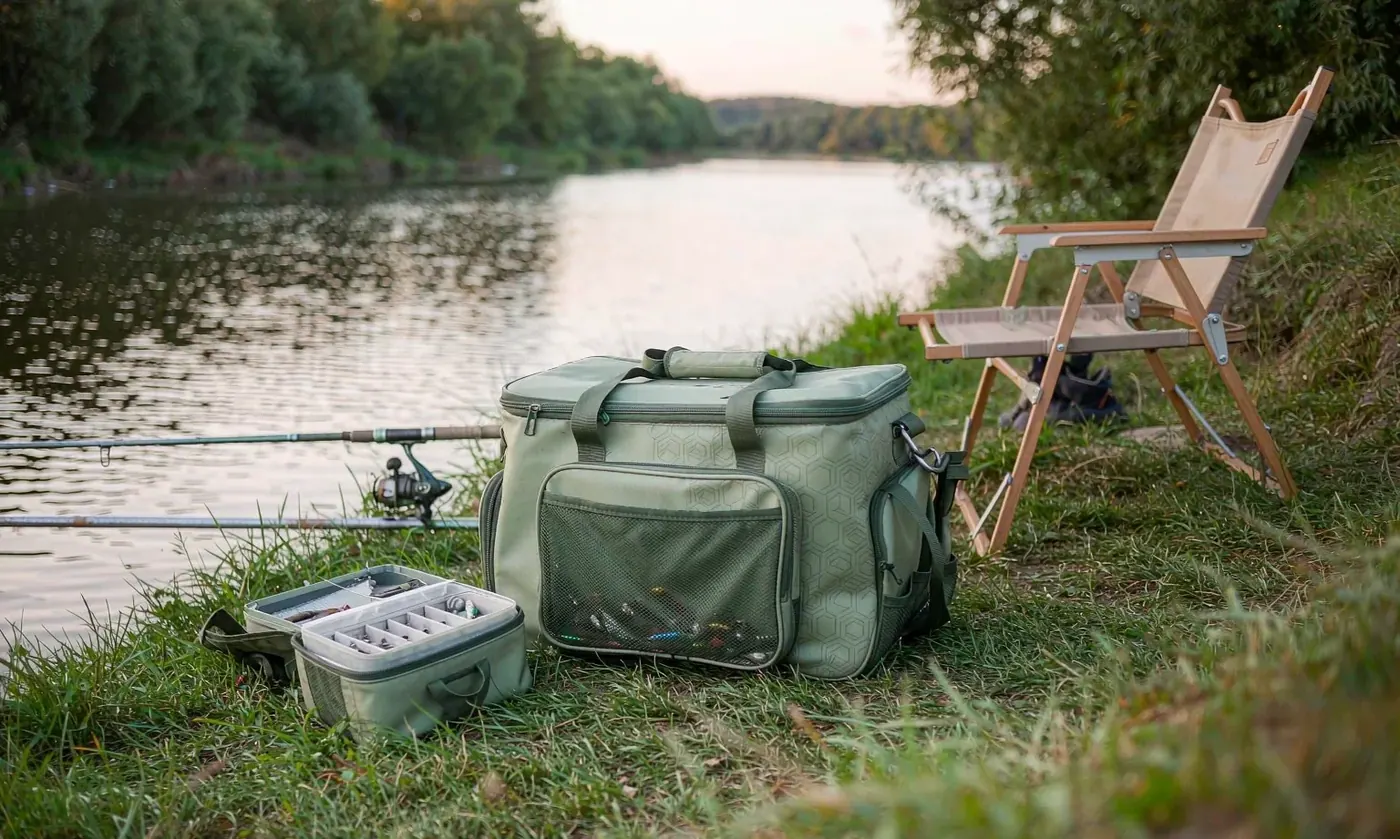
There is also a quiet economic argument. At roughly three to six dollars per metre of finished cloth depending on coating specification, it allows a genuinely durable bag at retail prices under fifty dollars, which no laminate construction currently matches. For a brand serving price-sensitive markets, that alone decides the question before any technical comparison begins.
Where It Loses
Weight is the obvious penalty and it compounds through the whole product. A thirty litre bag built from 900 gram material carries perhaps 1.3 kilograms of shell before any contents, against 0.7 kilograms for a laminated alternative, and that difference is felt rather than calculated. Stiffness is the second, since the cloth will not conform to awkward loads or pack down small when empty.
Cold is the third and the one buyers discover too late. Standard PVC compound stiffens noticeably from about plus five degrees and becomes board-like by minus ten, so folding a frozen bag risks creasing rather than merely discomfort. Winter and ice programmes should either specify a cold-crack grade rated to minus thirty or switch film chemistry entirely.
Abrasion and How the Coating Is Sacrificed
Abrasion resistance is really coating thickness plus topcoat chemistry. The weave underneath provides the structure, the coating provides the wear surface, and once coating is gone in one spot the yarn ravels quickly. Accelerated abrasion tests express this as cycles to a defined end point, and heavy tarpaulins typically reach thirty to one hundred thousand rubs before the coating is breached, depending on grade.
| Zone on a bag | Typical wear pattern | Specification answer |
|---|---|---|
| Base panel | High abrasion from setting down | Thicker coating, or a moulded base instead |
| Lower third of the shell | Contact with rough ground and boat decks | Topcoat with silicone or acrylic finish |
| Strap contact areas | Rubbing against clothing | Smooth topcoat rather than textured |
| Corners | Point abrasion on every set-down | Reinforcement patches before assembly |
| Upper panels | Light contact only | Standard coating is sufficient |
Topcoat chemistry deserves a mention because two otherwise identical cloths can perform very differently in the field. An acrylic or silicone-modified topcoat reduces dirt pick-up and improves abrasion figures noticeably, typically adding half a dollar per metre, and it also makes a bag considerably easier to rinse clean after a saltwater session.
Load Points and Hardware Attachment
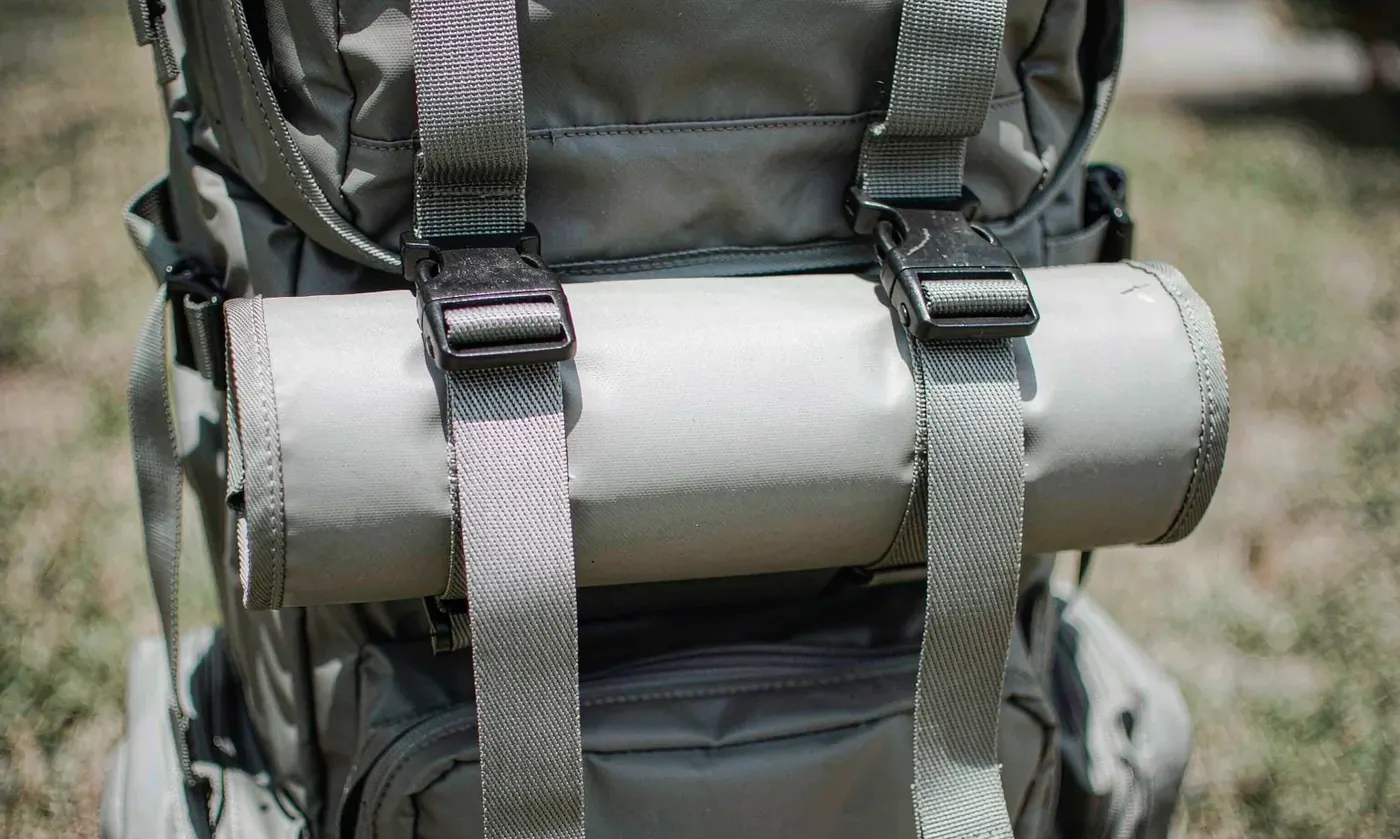
Heavy cloth is easy to weld and easy to stitch, but it imposes particular demands at hardware. Stiff material concentrates strain at the edge of any webbing anchor rather than distributing it, so strap points need generous reinforcement patches and rounded rather than square corners. Anything square-cornered becomes the start of a tear after a season of loaded walking.
| Attachment detail | Minimum recommended | Reason |
|---|---|---|
| Reinforcement patch | Two layers, fifty by fifty millimetres | Spreads strain beyond the immediate anchor |
| Corner radius | Ten millimetres minimum on patches | Square corners initiate tears |
| Stitch rows per anchor | Two or three, never one | One row cannot distribute panel stiffness |
| Welded anchor dimensions | Twenty-five millimetres of bonded width | Stiff panels pull harder than soft ones |
| Backing washer for bolt-through | Thirty millimetres diameter | Prevents pull-through under impulse loads |
Water Resistance and Coating Thickness
Water resistance in this material comes almost entirely from the coating rather than the weave, which is why head figures track coating thickness so closely. At 0.55 millimetres total including both faces, three thousand millimetres of head is a reasonable expectation; by 0.75 millimetres most grades exceed five thousand; above that the returns flatten and money is better spent elsewhere.
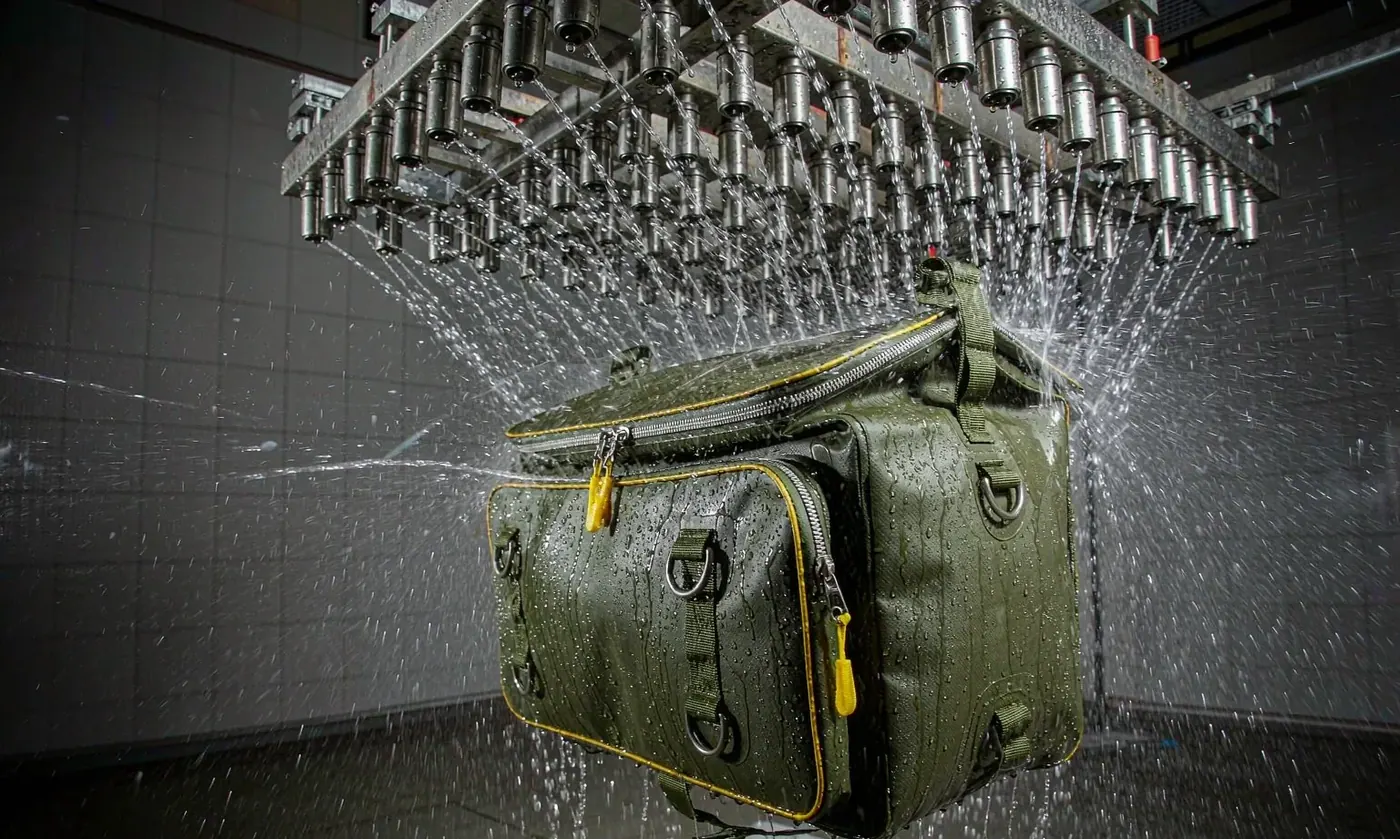
Pressure behaviour is worth separating from spray behaviour. A cloth with five thousand millimetres of head resists immersion pressure well, yet the same bag will still take water if its seams are stitched and untaped, because the fabric is never the limiting element. Checking the construction before arguing about fabric figures saves everyone time.
Chemical Compliance and Plasticiser Questions
Flexibility in PVC comes from plasticisers, and the chemistry of those additives is where regulatory attention falls. Traditional ortho-phthalate plasticisers are restricted in several markets, and modern compounders substitute alternatives such as terephthalate or bio-based types, usually at a cost premium of ten to twenty percent. Materials supplied into the European Union must satisfy REACH requirements, and into California the relevant Prop 65 warnings.
Buyers should ask for a compliance file rather than a reassurance, since the useful evidence is a declaration plus third-party testing dated within twelve months. Restricted substance lists and candidate list updates are published by the European Chemicals Agency, and referencing that list in a brief costs nothing while removing an entire category of downstream risk.
Care Rules That Extend Service Life
Care for PVC is simple and mostly about what not to do. Plasticiser migration is the life-limiting process and three things accelerate it: heat, solvents, and ultraviolet. Keeping a bag out of direct sun when not in use and never washing it with solvents together add several years to how long it stays supple.
| Care action | Effect | Why |
|---|---|---|
| Store out of direct sun | Extends coating life substantially | Ultraviolet drives plasticiser loss |
| Rinse salt, never solvent wipe | Slows surface crazing | Solvents extract plasticiser from the surface |
| Dry below fifty degrees | Avoids accelerated ageing | Migration roughly doubles per ten degrees |
| Keep away from petroleum products | Prevents softening | Contact extracts additives quickly |
| Store unrolled and uncreased | Avoids permanent set | Creased film whitens and weakens along the fold |
Comparing Against the Alternatives
No single shell material wins every comparison, and the honest answer for most ranges is to use two. Heavy PVC where contact, abrasion, and price dominate; laminated TPU where weight, packability, and cold-weather handling matter. The table below sets out where each sits on the properties that usually decide a brief.
| Property | 1000D PVC | 500D PVC | 420D TPU laminate |
|---|---|---|---|
| Weight per square metre | 610 to 900 g | 420 to 560 g | 280 to 420 g |
| Typical hydrostatic head | 3000 to 10000 mm | 2000 to 5000 mm | 5000 to 20000 mm |
| Abrasion cycles to breach | 30,000 to 100,000 | 15,000 to 40,000 | 20,000 to 60,000 |
| Cold flex behaviour | Stiff below minus 10 degrees | Stiff below minus 5 degrees | Flexible below minus 30 degrees |
| Relative material cost | Low | Lower | Two to three times higher |
| RF weld response | Excellent | Excellent | Good with tight control |
The decision usually resolves to a single question about where the bag spends its life. Anything that sits on a deck or gets dragged over gravel belongs in PVC. Anything carried long distances or used below freezing belongs in a laminate, and programmes running both are usually right to do so. Material families as a whole are compared in the fishing bag materials guide, and the head-to-head PVC-versus-TPU argument is set out in the PVC versus TPU comparison.
How the Weave and Coating Are Made
Understanding the build sequence explains several behaviours that otherwise look arbitrary. Filament yarn is woven into a plain-weave cloth, then passed through a coating line where PVC compound is applied to both faces and fused in an oven at roughly one hundred and sixty to one hundred and ninety degrees. Applying coating to both sides is what makes the material waterproof rather than merely water-resistant, since neither face can draw water into the weave.
| Process stage | Typical setting | Effect on the finished cloth |
|---|---|---|
| Weave | Plain weave, about 20 by 20 yarns per inch | Sets dimensional stability and tear strength |
| Coating application | 0.18 to 0.30 millimetres per face | Sets puncture resistance and head figure |
| Fusion oven | 160 to 190 degrees over thirty to sixty seconds | Underfused coating delaminates, overfusing embrittles it |
| Topcoat application | Acrylic or silicone modified, thin film | Improves dirt release and abrasion figures |
| Cooling and inspection | Controlled cooling under tension | Prevents internal stress and later shrinkage |
Fusion temperature is the variable most worth auditing. A coating applied at slightly too low a temperature looks perfect and fails adhesion testing within weeks of flexing, because the layers were never properly merged. Requiring adhesion results of eighty to one hundred and twenty newtons per fifty millimetres per production batch catches this before goods ship rather than after customers report flaking.
Failure Modes Worth Recognising Early
Four ways of failing account for nearly all end-of-life scenes with this material, and two of them give months of warning. Knowing the difference between recoverable cosmetic ageing and genuine structural failure is largely what separates a satisfied owner from an angry one.
| Sign | What it means | Action |
|---|---|---|
| Surface chalking that rubs off | Ultraviolet exposure of the topcoat | Cosmetic for years; store out of sun |
| Stiffening plus faint cracking at folds | Plasticiser loss | Accept ageing or replace within a season |
| Coating lifting in sheets from the weave | Underfused coating or solvent damage | Not repairable; a batch quality issue |
| Yarn visible through coating at wear points | Coating worn through | Patch before ravel starts |
| White crease line that stays after unfolding | Film set from long storage folded | Cosmetic, but it weakens along that fold over time |
The one that deserves professional attention is sheet delamination, because it is not wear and it is not ageing. Coating separating from the weave within the first year points either at a fusion problem during coating or at solvent contact, and either way it is a quality conversation rather than a maintenance one.
Colour, Print, and Why Darker Shells Cost More
Colour choice affects durability as well as appearance. Darker pigments absorb more infrared, raising surface temperature by fifteen to twenty-five degrees on a sunny day, which accelerates plasticiser loss and shortens coating life measurably in hot climates. Print areas add another consideration, since ink films sit on the topcoat and can craze differently from the surface beneath.
| Colour or finish decision | Effect on service life | Recommendation |
|---|---|---|
| Black or very dark navy | Shortest life in hot climates | Reserve for temperate markets |
| Mid tones such as olive or grey | Balanced performance | Best all-round choice |
| Bright safety colours | Better visibility, faster fade | Use where visibility is a safety need |
| Large printed panels | Crazing risk grows with area | Keep prints under thirty percent coverage |
| Reflective trims | Minimal effect | Useful addition, low risk |
Specifying It Into a Programme
QUANZHOU JUNYUAN BAGS has built waterproof bag programmes since 2014 on the experience of a founding team active since 2004. Monthly capacity reaches 200,000 units with SGS verification, structured around BSCI and ISO 9001. REACH and California Prop 65 assessments cover every material, and no order ships without AQL 2.5 inspection. Strength, tear, and abrasion values should be required against methods published by ASTM International, with a stated minimum rather than a typical figure.
Open a material brief with finished weight, coating thickness per face, minimum head, minimum tensile and tear, cold crack requirement, and the compliance file expected. Add litres, colour, hardware grade, and quantity last. Minimum quantity sits at 500 pieces per design and colour. Budget six to ten working days for samples and thirty-five to fifty days for bulk after approval and deposit, with FOB Xiamen available alongside DDP service to more than one hundred countries. Send the brief to service@junyuanbags.com. How the shell fits into overall water performance is explained in the waterproof construction guide.
People Also Ask
What does 1000D mean in bag fabric?
Yarn count: one thousand grams per nine thousand metres of filament, giving a yarn around 0.32 millimetres across. It describes the yarn, not the finished strength.
How heavy is 1000D PVC tarpaulin?
Between 610 and 900 grams per square metre finished, at roughly 0.55 to 0.90 millimetres thick, depending on weave density and coating thickness.
Is 1000D PVC fully waterproof?
The material is, with heads between 3000 and 10000 millimetres. The bag is only as good as its seams, since stitched and untaped joins leak regardless of fabric figures.
Does 1000D PVC crack in cold weather?
Standard grades stiffen from about plus five degrees and are board-like by minus ten. Cold-crack grades rated to minus thirty exist and cost slightly more.
How long does a PVC fishing bag last?
Typically three to six years before plasticiser loss makes the coating brittle, accelerated by heat, solvents, and ultraviolet exposure at roughly double per ten degrees.
Is 1000D PVC better than TPU laminate?
Neither overall. PVC wins on abrasion, puncture, weldability, and price. TPU wins on weight by roughly half, cold flexibility below minus thirty, and higher head figures.
Frequently Asked Questions
Q1. Why is 1000D PVC the default fishing bag fabric?
It resists puncture from hooks and rod ferrules, survives being dragged over gravel and non-skid decks, welds extremely well, and costs about a third of laminated alternatives.
Q2. How much weight does a 1000D PVC bag add?
A thirty litre shell built from 900 gram material weighs about 1.3 kilograms empty, against roughly 0.7 kilograms for a laminated build of the same volume.
Q3. What hydrostatic head should I specify?
Three thousand millimetres minimum for general use and five thousand or more for anything claimed to resist immersion, always with the test method cited.
Q4. How thick should the coating be?
About 0.18 to 0.30 millimetres per face. Above roughly 0.75 millimetres total thickness, additional coating gives diminishing returns for the cost.
Q5. Does PVC tarpaulin meet REACH and Prop 65?
It can, using non-phthalate plasticisers such as terephthalate types, typically adding ten to twenty percent to material cost. Require a compliance file dated within twelve months.
Q6. Can 1000D PVC be RF welded?
Yes, better than almost any other bag film. It responds readily to the field and tolerates a wider parameter window than thermoplastic polyurethane laminates.
Q7. Why does my PVC bag get stiff after a few years?
Plasticiser migration. Heat, solvents, and ultraviolet draw the additives out, and the rate roughly doubles for every ten degrees of temperature increase.
Q8. How should hardware be attached to stiff PVC?
Use fifty by fifty millimetre reinforcement patches, ten millimetre corner radii, and three rows of stitching or twenty-five millimetres of bonded width, since stiff panels concentrate strain.
Q9. What topcoat is worth paying extra for?
An acrylic or silicone-modified finish, typically half a dollar per metre, which improves both abrasion figures and how easily the bag rinses clean after salt use.
Q10. Is a heavier denier always better?
No. Yarn count alone tells little without weave density and coating weight; compare grams per square metre and tear strength rather than the denier number.
Q11. How should I care for a PVC fishing bag?
Rinse salt with clean water, never use solvents, dry below fifty degrees, keep it out of direct sun when stored, and avoid creasing it along the same fold repeatedly.
Q12. What is the MOQ for a heavy-duty PVC programme?
The opening quantity is 500 units in each design and colour variant, six to ten working days are needed for the sample, and the bulk run follows thirty-five to fifty days after approval and deposit.