Fabric should be chosen by climate before anything else, because the identical bag fails for entirely different reasons in Arizona, Borneo, and northern Finland. In hot arid regions the dominant problem is ultraviolet dose above roughly 300 MJ per square metre a year combined with surface temperatures past 70 degrees Celsius, which suits TPU with an elevated stabiliser package. Sustained tropical humidity above 75 percent attacks ordinary polyester TPU through hydrolysis, so a polyether grade is required there. Below freezing, standard PVC embrittles and cracks along folds, which calls for a winter grade film or TPU flexible to minus 30 degrees Celsius. Pick the climate first and the specification follows.
Four Climates, Four Failure Routes
Rather than comparing materials in the abstract, it is far more useful to start from where the bags will live. Each climate has a dominant failure mechanism, and once that is named the appropriate film, denier, and hardware follow almost automatically.
| Climate | Dominant stress | Typical fault | Best film |
|---|---|---|---|
| Hot arid, high desert | UV dose and heat ageing | Chalking, stiff coating | TPU with elevated UV package |
| Tropical humid | Hydrolysis and microbial growth | Tacky soft film within years | Polyether TPU |
| Cold continental and ice | Low temperature embrittlement | Cracks along the closure fold | TPU, or winter grade PVC |
| Temperate maritime | Wet and dry cycling with salt | Creep hardware failure plus wear | Either film, taped or welded |
Note that only one of those four rows selects for cost rather than for performance, which is the temperate maritime case. Everything else demands a specific answer, and the cost difference between getting it right and getting it wrong is approximately one replacement bag per customer per five years, which dwarfs the individual measures listed later in this guide.
Establishing which climate applies is easier than most buyers expect. Climate statistics and solar resource data are published by NOAA for the United States and comparable agencies operate elsewhere, so annual ultraviolet dose and humidity figures can be checked rather than guessed for any target market. Where several territories are involved, weighting the specification toward the harshest rather than the largest is nearly always correct, because a single season of failures in one climate generates more complaints than modestly higher cost across all of them.
Hot and Arid: Ultraviolet and Heat
Desert and high steppe regions combine two stresses that act together rather than separately, which is why failures there arrive sooner than either factor alone would predict. Heat accelerates whatever ultraviolet has started.
| Factor | Typical value | Effect on film | Response |
|---|---|---|---|
| Annual ultraviolet dose | 300-450 MJ per square metre | Chalking, colour shift, tackiness | Elevated stabiliser package |
| Peak surface temperature | Above 70 degrees Celsius | Plasticiser migration in PVC | Avoid PVC above sustained 60 degrees Celsius |
| Diurnal temperature swing | 25-40 degrees Celsius daily | Expansion and contraction cycling | Allow seam flexibility |
| Relative humidity | Often below 25 percent | Film dries and stiffens | Specify flexible formulations |
| Dust and grit load | High with frequent wind | Abrasion against base and seams | Higher denier and base protection |
Colour deserves a specific note for these regions, because it is usually chosen by marketing and has real thermal consequences. A dark shell on open desert ground easily exceeds 70 degrees Celsius at its surface, while a mid-tone reflecting 30-40 percent more solar load stays materially cooler. The difference in coating life across three seasons is measurable, and it costs nothing to achieve.
Storage between trips compounds the same effect in a way few people consider. Equipment left in a vehicle in high sun regularly sees interior temperatures above 60 degrees Celsius regardless of outside conditions, so even a well-chosen film suffers if the bag habitually lives in a hot car. Advising customers to store the bag indoors costs nothing and extends service life more than most paid upgrades manage.
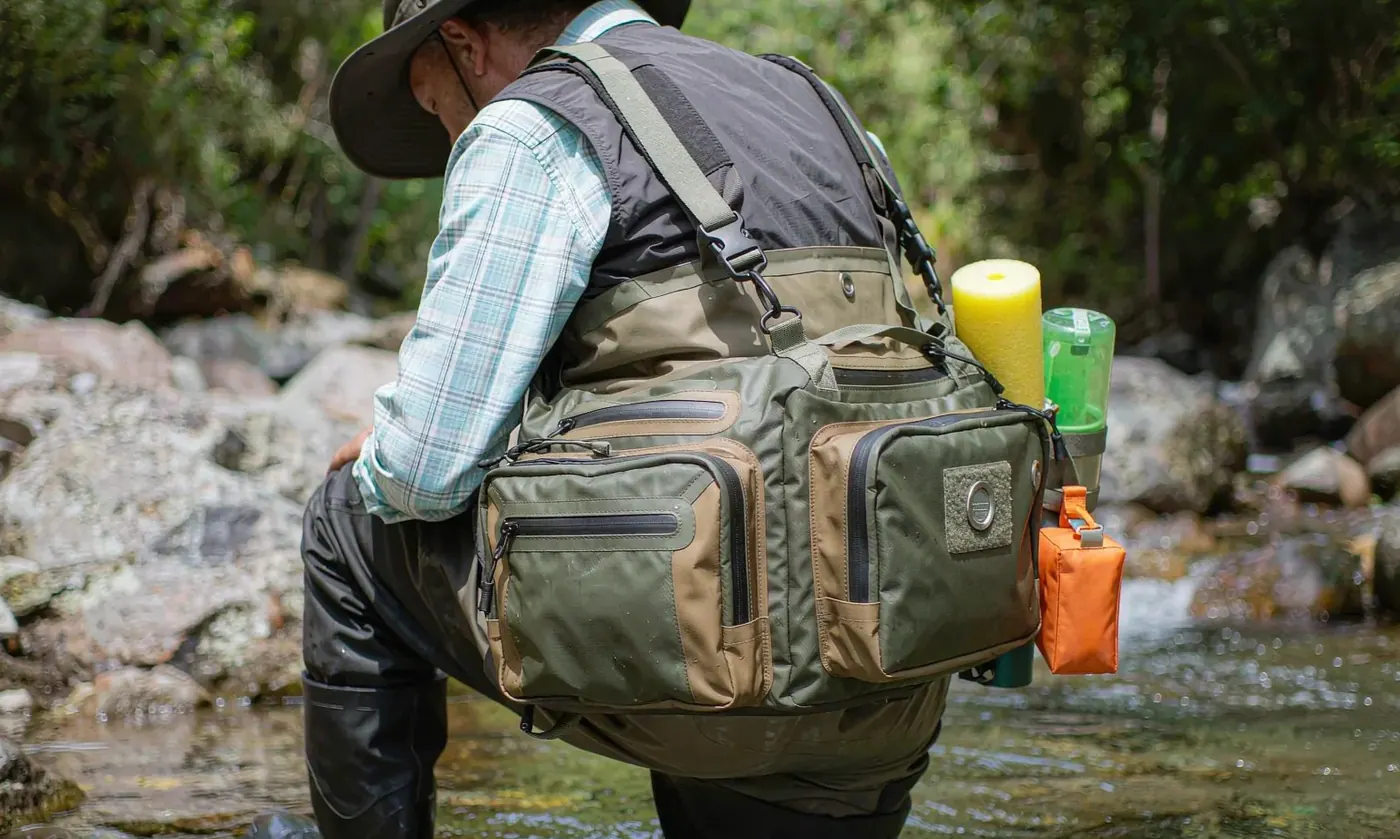
Tropical Humid: Hydrolysis Is the Enemy
Warm humidity is the quietest failure route of the four because bags look and feel fine for years before suddenly going soft. Understanding the chemistry involved prevents it entirely at modest cost.
- Polyester-based TPU loses 30-50 percent of tensile strength over five to seven years in sustained heat and humidity.
- Polyether grades retain more than 80 percent of strength over ten years under the same conditions, which is why they are specified for these markets.
- The premium for a polyether grade runs around 1.10-1.80 USD per unit, small against the cost of a failure.
- Relative humidity above 75 percent sustained for weeks also encourages mildew in linings and pockets, which airflow rather than chemicals prevents.
- PVC loses plasticiser rather than undergoing hydrolysis, so surface tackiness rather than structural loss is the typical tropical complaint there.
The practical recommendation for programmes covering Southeast Asia, the Gulf, equatorial Latin America, or similar is unambiguous: specify polyether TPU by name and ask for the polymer family to be stated on the specification. Vague references to high-grade TPU are not sufficient, since both families look identical on a finished bag and perform very differently over five years. Buyers should also note that failure arrives without warning: hydrolysis develops from the inside out, so a bag appears unchanged until its seams begin separating under loads that were previously routine.
Cold and Ice: Where Standard Films Fail
Cold is the harshest of the four environments and the one where a wrong choice produces visible damage within a single season rather than gradual decline. This also happens to be the easiest to specify against, since low temperature behaviour is well characterised and cheaply tested.
| Condition | TPU behaviour | Standard PVC | Winter grade PVC |
|---|---|---|---|
| Flexible at 0 degrees Celsius | Yes, unchanged | Stiff with memory set | Slightly stiff |
| Cold bend at minus 25 degrees Celsius | Passes with no cracking | Fails with visible cracks | Passes |
| Impact at minus 30 degrees Celsius | Absorbs impact well | Brittle failure | Marginal |
| Possible to roll a closure tight | Yes | Difficult below about 5 degrees Celsius | Possible down to minus 20 degrees Celsius |
| Added cost versus standard | Baseline for TPU | Cheapest option | About 0.60 USD extra |
Ice fishing deserves particular mention because it stacks disadvantages: sub-zero temperatures, a bag set directly on ice and snow, and repeated wetting followed by freezing. Everything that can stiffen will, so welded seams rather than adhesive tape, wider closure folds, and larger hardware for gloved hands all matter in that application. A bag that freezes shut between sessions is worse than useless, which argues for drainage positioned where it will not freeze solid and closures generous enough to operate while wearing gloves.
Low temperature flexibility is measured by published bend and impact methods maintained by ASTM International, so specifying a temperature and expecting a pass rather than a description is entirely reasonable. Conditioning samples at temperature before testing is essential, since results obtained at room temperature say almost nothing about cold behaviour.
Temperate Maritime: The Forgiving Case
Most European and North American coastal programmes fall here, and it is the one climate where almost any reasonable specification performs adequately. That creates scope to spend money elsewhere, though three details still deserve attention.
| Factor | Consideration | Response |
|---|---|---|
| Frequent wet and dry cycling | Salt concentrates as it dries | Rinse protocol and drainage |
| Freeze and thaw across seasons | Trapped water expands in hardware | 316 or polymer hardware |
| Moderate ultraviolet dose | Slower but real ageing | Standard package suffices |
| Salt load in coastal situations | Corrosion rather than film failure | Marine hardware matters more |
| Seasonal storage dampness | Mildew in closed pockets | Ventilation and drying guidance |
The third row is reassuring for cost purposes. Standard ultraviolet packages perform well at annual doses below roughly 250 MJ per square metre, which covers most temperate markets, so there is no reason to pay for a tropical level stabiliser unless distribution genuinely requires it.
Colour fastness and fabric appearance over time are assessed by methods published by AATCC, whose exposure procedures allow a numeric colour change target to be specified. For any programme selling on appearance, quoting a permissible colour shift rather than simply hoping is worth the small effort involved.
Construction Details That Change by Climate
Film choice is only part of the response. Several construction elements should change alongside it, and specifying them as a package delivers considerably more than changing one thing in isolation.
| Element | Hot arid | Tropical humid | Cold |
|---|---|---|---|
| Film | TPU with elevated UV package | Polyether TPU | TPU or winter grade PVC |
| Film thickness | 0.40-0.50 mm | 0.35-0.45 mm | 0.45-0.50 mm |
| Base fabric | 840-1000D for grit resistance | 420-840D, lighter dries faster | 840D with flexibility retained |
| Seam construction | Welded preferred | Welded, no tape | Welded, tape embrittles |
| Hardware | UV stable polymer | 316 or polymer | Larger polymer for gloves |
| Colour strategy | Mid-tone to reflect heat | Any stable pigment | Darker helps snow glare little |
Denier often surprises people in the hot arid row. Higher is not automatically better, since heavier fabric retains heat and dries more slowly, and the reason it is specified there is resistance to wind-driven grit rather than anything else. In humid climates lower denier with better airflow dries faster and reduces mildew, which is the opposite of the intuition many buyers bring to the decision.
Thread specification also shifts with climate more than most people realise. Standard bonded polyester suits temperate and arid conditions well, but anything stored damp for long periods benefits from a marine-grade thread finish that resists microbial attack, costing around 0.20-0.40 USD per unit. The failure symptom is distinctive: a seam that opens cleanly while its thread still looks intact indicates thread degradation rather than stitch failure, and it appears almost exclusively in humid storage conditions.
Planning for Where Bags Actually Travel
A complication worth naming is that bags travel, sometimes far more than the brands selling them expect. A specification written for one territory frequently ends up somewhere else entirely, and planning for that reality costs very little.
| Situation | Risk | Practical answer |
|---|---|---|
| Retail customers relocating or reselling | A temperate bag arrives in the tropics | Assume the widest reasonable envelope |
| Online export beyond the intended market | Unknown destination conditions | Polyether TPU covers all cases |
| Guide and lodge fleets serving international guests | Equipment follows every visitor home | Specify globally rather than locally |
| Seasonal migration of stock between regions | Summer stock meets winter conditions | Never shipwithout checking service range |
| Charity and promotional distribution | Destinations often unknown entirely | Choose the forgiving mid specification |
Note the recurring theme in that table: wherever destinations are uncertain, the mid-gauge polyether specification from the earlier decision table is the safe answer. It performs adequately in all four climates rather than superbly in one, which is precisely what unknown conditions require. The alternative is a regional range with labelling clearly stating intended conditions, which works well where distribution is properly controlled and poorly where it is not.
One practical detail finishes this section. Where a bag is genuinely specified for one climate only, saying so on a product page or hangtag is not an admission of weakness. It prevents warranty claims in entirely the wrong environment and is appreciated by buyers rather than resented, provided the statement is clear before purchase rather than discovered afterwards.
Cost of Climate Proofing
Every measure above has a known cost, and presenting them in one place allows a buyer to allocate budget against actual distribution rather than against caution.
| Measure | Added cost | Where it pays |
|---|---|---|
| Elevated ultraviolet package | About 0.25 USD | Above 300 MJ per square metre |
| Polyether grade film | 1.10-1.80 USD | Sustained tropical humidity |
| Winter grade PVC formulation | About 0.60 USD | Regular use below freezing |
| Welded rather than taped seams | Depends on the profile | Every climate, notably cold and humid |
| 316 or polymer hardware | 2.40-4.80 USD | Coastal and tropical |
| Higher denier base fabric | 0.80-2.20 USD | Arid and abrasive environments |
The most useful way to read that table is against distribution rather than against the whole programme. Where stock is split by territory, which is common for larger accounts, applying each package only where it is needed typically costs less than half of applying every measure everywhere, and it avoids pricing a temperate-market bag out of its own price band. Where splitting is not practical, the earlier mixed-distribution recommendation applies and the single-fixture approach wins on simplicity alone.
Verifying the Specification
Climate performance can be stated as numbers rather than trusted as descriptions, and doing so makes a specification enforceable across multiple production runs.
- State exposure hours and a permissible colour change rather than simply requesting ultraviolet resistance, typically 1,000 hours with a limit of 4-5 on the grey scale.
- Name the polymer family, polyester or polyether, anywhere hydrolysis risk exists, and require it to appear on the material declaration.
- Require a low temperature bend test at a stated figure, usually minus 25 degrees Celsius, conditioned at temperature beforehand.
- Ask for hydrolysis ageing data such as retained tensile percentage after a defined period at elevated temperature and humidity.
- Cross-check any claim against a recognised method rather than accepting a single internal test result without context.
Documentation is what makes those four enforceable over several years of repeat orders. Keeping the original material declaration on file and comparing each new one against it catches quiet substitution of film grade, which no visual inspection will ever reveal and which typically appears as a wave of complaints two seasons after the change was made.
QUANZHOU JUNYUAN BAGS has developed waterproof bag programmes since 2014, with the founding team working in the trade since 2004. Monthly output of 200,000 units is verified by SGS, and BSCI and ISO 9001 systems structure the workflow. Materials are screened for REACH and California Prop 65, every bulk order is inspected at AQL 2.5 before shipment, and material declarations state the polymer family for every film supplied.
Choosing by Region
Everything above collapses into one short table, which is usually all a buyer needs once distribution is known.
| If distribution is mainly | Specify | Key number |
|---|---|---|
| Southwest deserts and high plateaus | TPU 0.40-0.50 mm, elevated UV package | Above 300 MJ per square metre |
| Southeast Asia or the Gulf | Polyether TPU 0.35-0.45 mm | Sustained humidity above 75 percent |
| Northern Europe, Canada, ice fishing | TPU 0.45-0.50 mm or winter grade PVC | Flexible at minus 30 degrees Celsius |
| Temperate coastal anywhere | Either film with marine hardware | Standard ultraviolet package suffices |
| Mixed global distribution | Polyether TPU 0.40-0.45 mm | Widest acceptable performance envelope |
The mixed distribution row is usually the right answer for anyone uncertain, because a mid-gauge polyether TPU handles cold, heat, humidity, and salt acceptably while costing less than specifying three regional variants. It is not optimal anywhere and adequate everywhere, which is exactly what a global SKU needs to be. Treating that compromise as a weakness misses the point: regional optimisation pays only where volumes in each territory justify the additional development and stock complexity, which for most programmes they do not.
A climate specification can be emailed to service@junyuanbags.com with target markets, expected yearly volume, target unit cost, and intended service life. FOB Xiamen or DDP service to more than 100 countries follows an approved sample. Further reading includes the fishing bag materials overview, the PVC versus TPU comparison, and the 1000D PVC fabric breakdown.
People Also Ask
Which fishing bag fabric suits hot climates?
TPU laminate at 0.40-0.50 mm with an elevated ultraviolet package, plus a mid-tone colour reflecting 30-40 percent more solar load to keep surface temperature below the 60 degrees Celsius where PVC suffers.
Do I need polyether TPU in the tropics?
Yes for sustained humidity above about 75 percent. Standard polyester TPU loses 30-50 percent of tensile strength in five to seven years, while polyether grades retain above 80 percent over ten years.
What fabric survives freezing temperatures?
TPU, which stays flexible to minus 30 degrees Celsius, or a winter grade PVC formulation valid to about minus 20 degrees Celsius. Standard PVC cracks along fold lines below about minus 10 degrees Celsius.
Is denier more important than film type?
No. Climate decides the film first and denier follows: higher denier resists grit in arid regions, while lower denier dries faster and reduces mildew in humid ones.
How much does climate proofing add per unit?
Around 0.25 USD for an ultraviolet package, 1.10-1.80 USD for polyether film, and 0.60 USD for a winter grade formulation, with 2.40-4.80 USD needed for marine hardware.
Should I use one specification for global distribution?
Usually. A mid-gauge polyether TPU at 0.40-0.45 mm performs acceptably in every climate and avoids the cost of developing several regional variants.
Frequently Asked Questions
Q1. How do I choose fishing bag fabric for my climate?
Identify the dominant stress first: ultraviolet dose and heat in arid regions, hydrolysis in the humid tropics, embrittlement below freezing, or wet and dry cycling in temperate coastal areas. The film follows from that.
Q2. What is the difference between ultraviolet dose and sunlight hours?
Dose measures accumulated ultraviolet energy rather than duration, so two regions with similar daylight can differ twofold. Above roughly 300 MJ per square metre annually, an elevated stabiliser package is worthwhile.
Q3. Does heat alone damage fishing bag fabric?
Yes, but mostly indirectly. Above sustained 60 degrees Celsius, PVC begins losing plasticiser and the surface grows tacky, which is why TPU is preferred wherever surface temperatures run high.
Q4. Why do bags go soft in tropical countries?
Hydrolysis. Moisture attacks the polymer chains in standard polyester TPU, which gradually loses tensile strength, whereas polyether grades are far more resistant to the same mechanism.
Q5. Is PVC usable in cold climates?
Standard PVC embrittles below about minus 10 degrees Celsius and cracks along closure folds. A winter grade formulation extends this to roughly minus 20 degrees Celsius for about 0.60 USD per unit.
Q6. What denier should I specify for my region?
Around 840-1000D where wind-driven grit abrades the base, and 420-840D in humid climates where lighter fabric dries faster and reduces mildew risk.
Q7. Does colour really affect how long a bag lasts?
It affects surface temperature, and through it coating life. A mid-tone shell reflects 30-40 percent more solar load than a very dark one, keeping the surface materially cooler in open sun.
Q8. Can I use the same specification everywhere?
Yes with compromise. A mid-gauge polyether TPU performs acceptably in every climate, though it is optimal in none, which suits a single global product rather than a regional range.
Q9. How do I verify a climate claim rather than trusting it?
Ask for exposure hours with a numeric colour change limit, the polymer family named on the material declaration, and a low temperature bend result conditioned at temperature before testing.
Q10. Do sealed seams matter for climate performance?
Yes, particularly in cold and humid regions. Adhesive tape embrittles in freezing conditions and hydrolyses in sustained humidity, so welded construction is more reliable in both.
Q11. What are the MOQ and lead time?
MOQ is 500 pcs per design and colour. Samples take 6-10 working days and bulk production runs 35-50 days from approved sample and deposit.