A moulded ethylene-vinyl acetate base turns the floor of a fishing bag from the weakest part into the strongest, and it changes four behaviours at once: it spreads load over the whole base instead of point contacts, lifts contents clear of standing water to around eighty millimetres, absorbs the repeated impact of being set down loaded, and adds about three quarters of a kilogram of buoyant lift per litre of displaced volume. Typical wall thickness is three to six millimetres with structural ribs eight to fifteen millimetres deep, adding two hundred and fifty to four hundred and fifty grams to the bag and fifteen hundred to four thousand dollars in tooling at twenty-five to forty days of lead time.
Four Jobs a Base Does at Once
Structural flooring entered fishing bags not because it looked premium but because it solved four problems simultaneously, none of which fabric solves well. It distributes weight so nothing presses through the bottom layer into whatever is below. It keeps the interior floor above whatever the bag is standing in. It absorbs the repeated impact of a twelve kilogram bag being set down fifty times a day. And it gives the whole bag a shape that stands up unaided.
The order of importance varies by use, which is why some bags have elaborate bases and some have none. A boat bag benefits from all four. A lightweight hiking pack benefits mainly from the first, and can get most of that from a stiffer base panel rather than a moulding. That difference is worth settling before deciding anything else.
| Job | Without a rigid base | With a moulded base | Where it matters most |
|---|---|---|---|
| Load spreading | Point contacts from spike and weights | Distributed over the whole footprint | Bags carrying dense tackle |
| Clearance above standing water | Zero, water enters through base seams | Sixty to eighty millimetres of freeboard | Boat decks and wet launches |
| Impact absorption | Impact passes to contents and closures | Absorbed in five to eight millimetres of foam | Boats, rock, gravel |
| Self-standing shape | Slumps when empty and loosely packed | Stands square whether full or empty | Charter work, retail presentation |
Material Properties That Decide Performance
Ethylene-vinyl acetate in this application is a closed-cell foam moulded into a pan rather than a sheet. Closed cells are the critical property, because a closed cell neither absorbs water nor supports capillary movement, which is what allows the base to act as a buoyancy element and as a water barrier at the same time. Typical density runs 0.18 to 0.35 grams per cubic centimetre, and hardness is usually quoted around Asker C fifty-five to seventy.
| Property | Typical value | Why it matters |
|---|---|---|
| Density | 0.18 to 0.35 grams per cubic centimetre | Sets buoyancy and weight penalty together |
| Hardness | Asker C 55 to 70 | Below this it bottoms out, above it transmits impact |
| Cell structure | Closed cell, above ninety percent closed | Prevents water absorption over years |
| Shore behaviour when cold | Stiffens below about minus five degrees | Cold-climate bags need a softer grade |
| Moulded shrinkage | 1.2 to 2.0 percent linear | Must be allowed for in tooling dimensions |
| Typical wall thickness | 3 to 6 millimetres | Thicker adds weight without adding stiffness |
Density and hardness are only comparable when the test method is stated, since several plausible protocols give different figures for identical foam. Requiring the standard cited alongside the value removes most disagreements: cellular plastics density measurement is covered by ISO, and indentation hardness behaves similarly. Never accept a figure without the method attached to it.
Density deserves a moment because it sets the whole trade. Halving density halves weight but also halves how much load the foam carries before bottoming out, so choosing a very light grade produces a base that looks identical in photographs and flattens under a loaded bag by the end of the first season. Anything carrying above about eight kilograms wants the heavier end of that range.
The Features Worth Paying For
Five features separate a useful moulding from a decorative one, and each costs very little once tooling exists. Feet raise the pan clear of whatever the bag stands in; ribs add stiffness without adding material across the whole area; a sump collects water rather than letting it sit under contents; a drain point lets that water leave without inverting the bag; and a rounded perimeter resists cracking where the pan meets the shell.
| Feature | Recommended dimension | What happens without it |
|---|---|---|
| Feet or standoffs | 6 to 10 millimetres high, four positions | Base sits in the water it excluded |
| Structural ribs | 8 to 15 millimetres deep on a 40 millimetre pitch | Pan flexes and eventually cracks at the corners |
| Internal sump | 15 to 25 millimetres deep, central | Water pools under trays and stays for days |
| Drain point | 8 to 10 millimetres with a plug or flap | Requires tipping the whole bag to empty |
| Perimeter radius | Minimum 5 millimetres inside corners | Cracks start at square corners within a season |
The internal sump is the feature most often omitted and most often missed. Even a bag with welded upper seams accumulates litres of water from wet trays, wet clothing, and rain entering at the lid, and without somewhere for that to go it sits against the contents for days. Twenty millimetres of depth in the middle of the pan costs nothing beyond tooling and prevents the majority of the mildew complaints heard in this category.
Buoyancy: The Number Nobody Quotes
Closed-cell foam displaces water at a rate driven purely by density. A base moulding occupying two litres of volume in a foam of 0.25 grams per cubic centimetre weighs half a kilogram and displaces two kilograms of water, giving roughly 1.5 kilograms of net lift. That is not enough to float a heavy bag unaided, but it is enough to keep one at the surface relatively high, which materially improves the odds of recovery after going overboard.
| Base volume | Foam weight at 0.25 density | Water displaced | Net lift |
|---|---|---|---|
| 1.0 litre | 250 grams | 1000 grams | 750 grams |
| 2.0 litres | 500 grams | 2000 grams | 1500 grams |
| 3.0 litres | 750 grams | 3000 grams | 2250 grams |
| 4.0 litres | 1000 grams | 4000 grams | 3000 grams |
Anyone specifying for kayak or small boat use should treat that figure as a requirement rather than a bonus. Asking for a minimum displaced volume in litres, rather than for a bag that floats vaguely, produces a design whose behaviour can actually be tested in a bathtub before shipping.
On Deck: Where It Pays Back Fastest
Nothing destroys a fabric-bottomed bag faster than a boat deck. Bilge water sits on the non-skid, the bag is loaded to ten or twelve kilograms, and every wave pushes it sideways against grip tape. Contact pressure at the base while sliding is high enough to abrade through a coating in a season, whereas a moulded base slides on its own feet and carries the contact instead of the fabric.
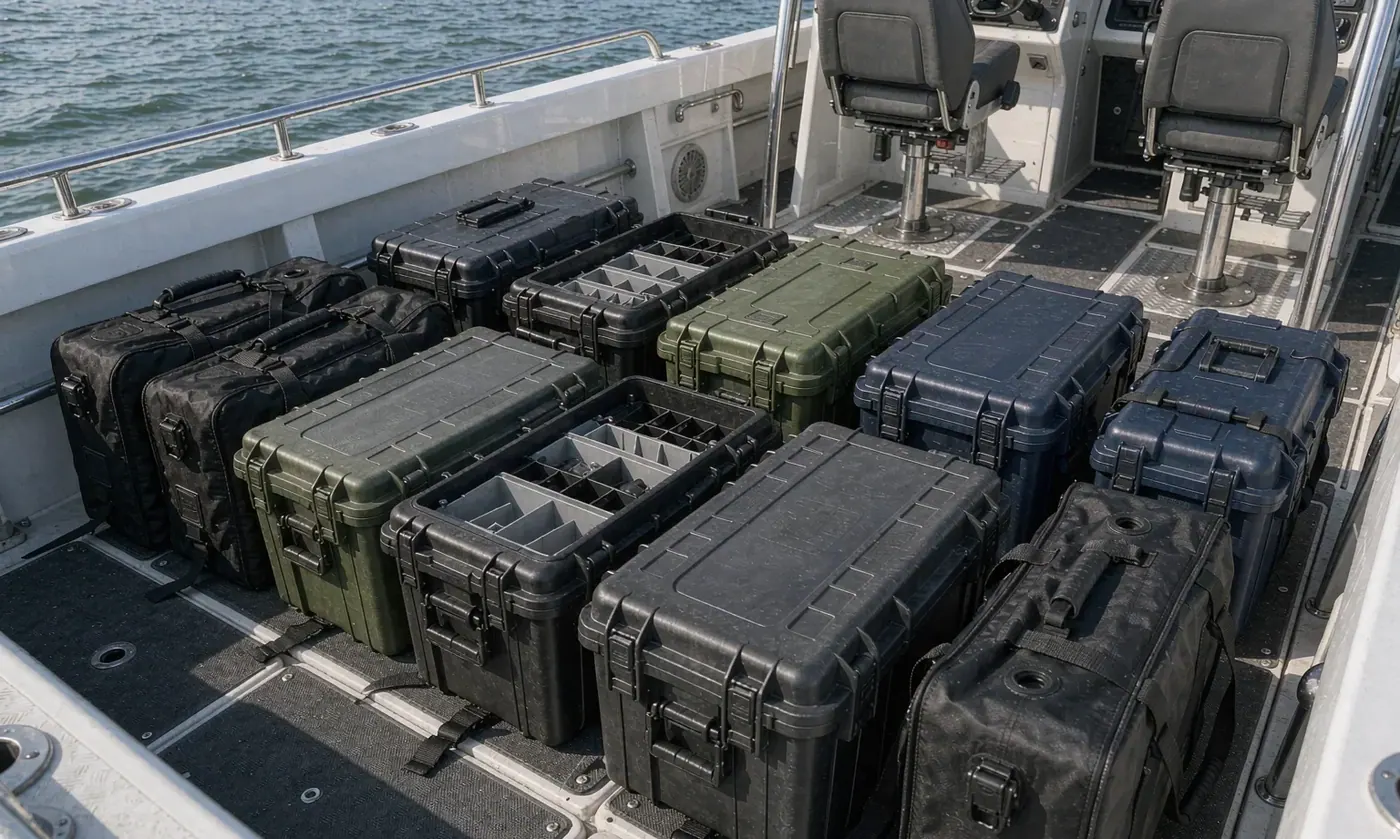
The second deck benefit is grip and stability. A moulded base with a textured or slightly compliant underside resists sliding noticeably better than coated fabric, which tends to skate on wet gelcoat. Specifying a stippled rather than smooth underside costs nothing and measurably reduces how often a bag has to be caught mid-wave.
Transport and Storage Behaviour
Anyone who has put a wet bag into a car boot has met the other half of the argument. A fabric base transfers whatever the bag stood in directly to upholstery or carpet, and it keeps the load resting on whatever sharp object it happens to land on. A rigid base spreads the load across four feet and keeps the wet shell clear of anything precious.
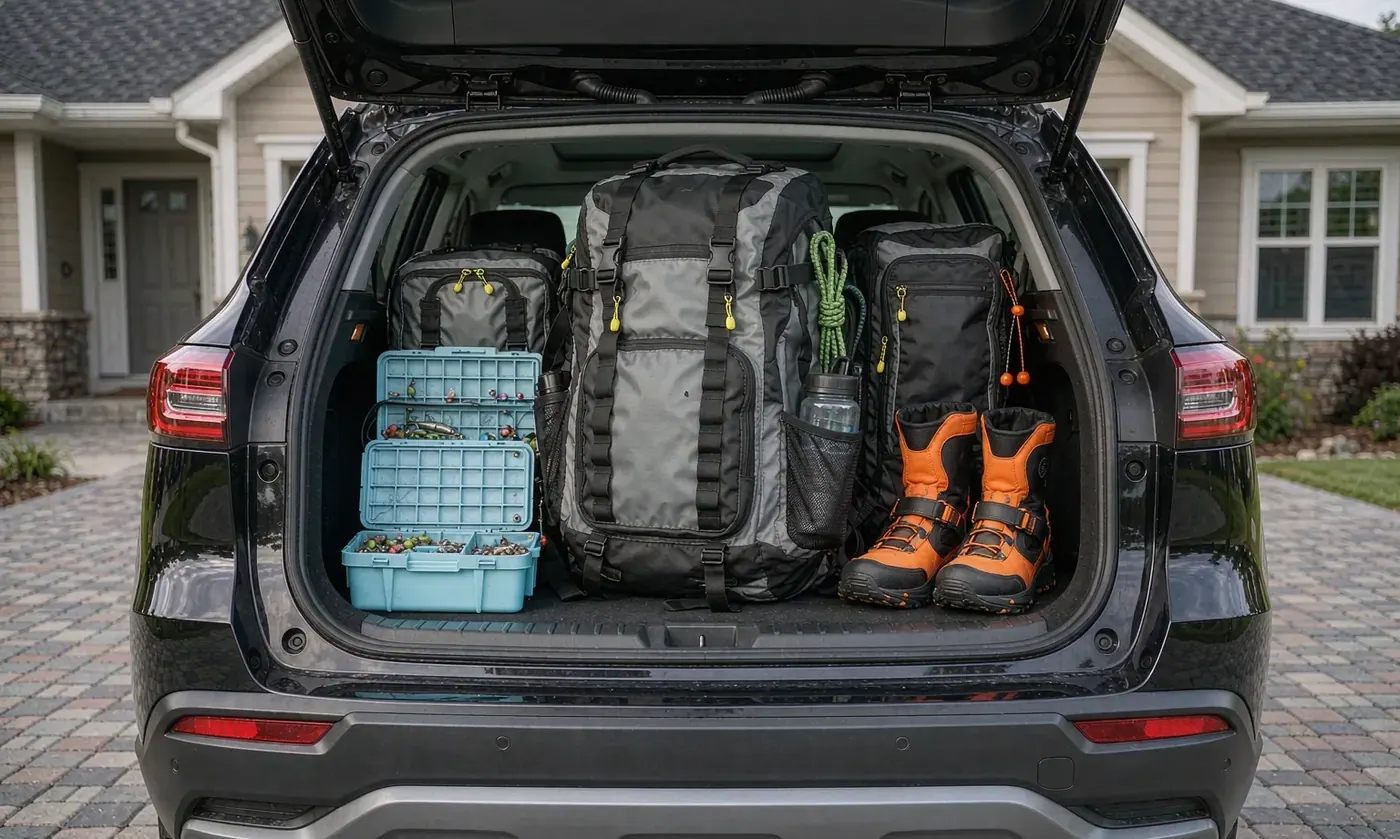
Storage benefits follow the same logic. Bags with moulded bases stand upright on shelves and in garages for months without slumping, they stack two high safely, and they do not develop the flat spots that permanently deform padded fabric bases. Everything about that behaviour is worth roughly three hundred grams.
How It Changes the Way a Bag Carries
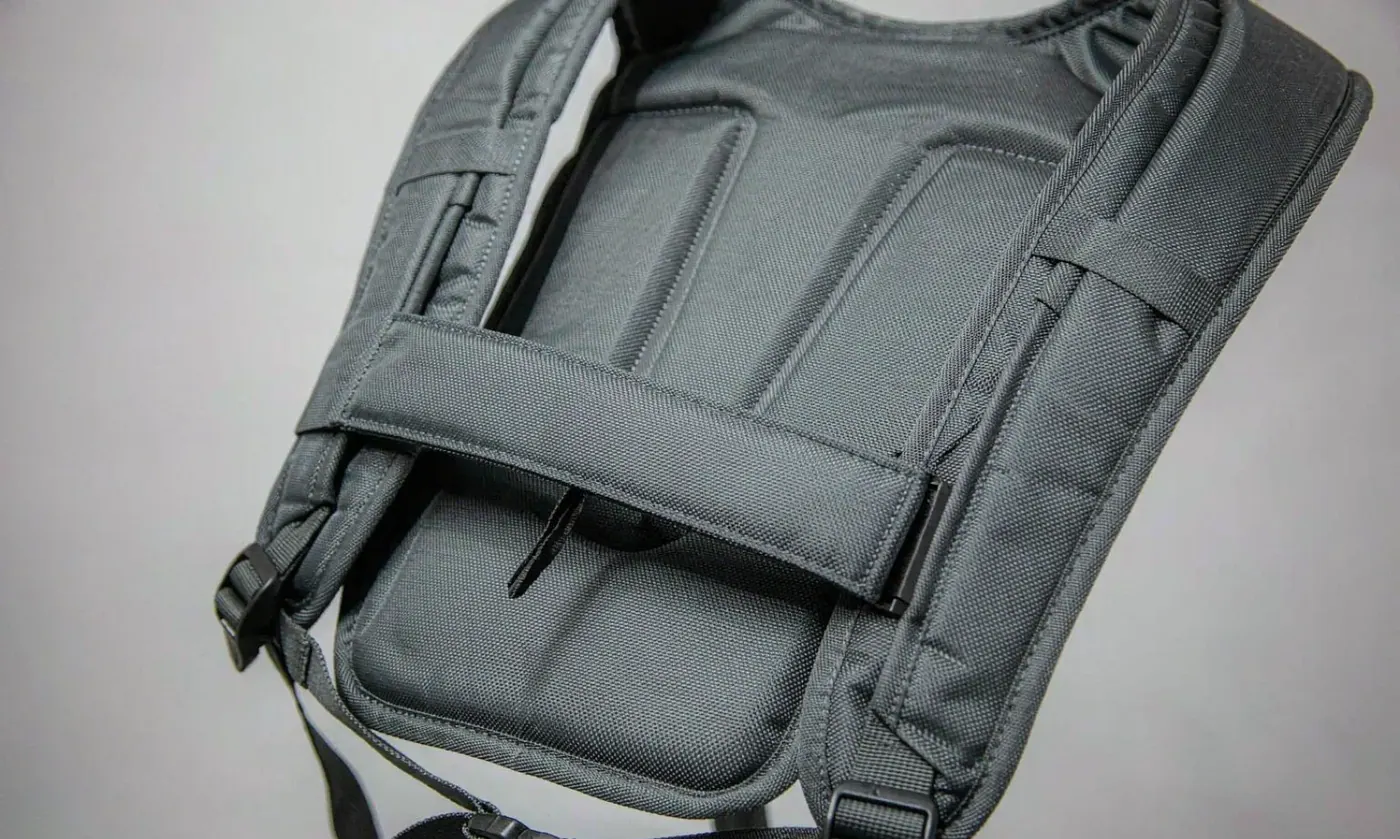
Adding a rigid floor also changes load transfer into the harness, mostly for the better. A fabric base lets dense contents sag into a curve, pulling the centre of gravity backwards and downwards and increasing leverage on the straps. A moulded base keeps the floor flat, so heavy items stay where they were packed and the load sits twenty to thirty millimetres closer to the spine.
The one place to be careful is the strap anchor line, because a stiff base concentrates stress at the point where webbing meets the pan rather than distributing it. Good designs either anchor straps into the shell above the pan line or weld them through a reinforced flange of the moulding with a thirty millimetre backing washer. Both work; the version that fails is webbing stitched directly to the edge of the pan.
Weight Penalty and When It Is Worth Paying
Roughly two hundred and fifty to four hundred and fifty grams, depending on size and foam density, which is real but usually acceptable. Against that, the base often allows thinner or lighter shell fabric elsewhere, because it no longer has to survive ground contact. Net effect on total bag weight is frequently under two hundred grams, considerably less than the headline figure suggests.
| Bag type | Verdict | Reasoning |
|---|---|---|
| Boat tackle bag over twelve litres | Always include | Deck contact, sliding, standing water |
| Kayak crate bag | Always include | Freeboard, buoyancy, and standing shape |
| Surf backpack set on wet sand | Include if budget allows | Set-down contact is constant |
| Light day pack under twenty litres | Usually omit | Weight penalty outweighs benefits |
| Bank fishing bag on footpaths | Optional | Depends on load and distance |
| Hard-case fishing bag alternative | Compare carefully | Hard shells add more weight for more protection |
Tooling, Cost, and Development Time
Moulds for a bag base are usually cut from aluminium because volumes do not justify steel, and a single cavity typically costs fifteen hundred to four thousand dollars depending on complexity and finish. Lead time is twenty-five to forty days, which is the longest single item in most development programmes and therefore worth starting before anything else is settled.
| Element | Typical figure | Note |
|---|---|---|
| Single cavity aluminium tool | 1500 to 4000 dollars | Scales with size and feature complexity |
| Tooling lead time | 25 to 40 days | Longest item in development; start early |
| Added unit cost | 2.50 to 6 dollars | Depends on foam density and pan size |
| Shots per tool before service | 50,000 to 150,000 | Aluminium wears faster than steel |
| Minimum sensible programme size | Above 500 units | Below that, tooling dominates unit cost |
One detail saves money later: decide whether the pan is bonded permanently into the shell or removable. Permanent bonding gives a stiffer result and a better seal, while a removable pan allows easier cleaning and replacement. Fixing that choice during design avoids discovering after tooling is cut that the decision was made accidentally.
Failure Modes and Prevention
Three failures account for nearly all moulded base problems, and all three are visible before the base actually fails. Cracking begins at corners and radiates; compression set shows as a pan that no longer returns flat after heavy load; and delamination appears as the shell pulling away from the edge of the pan. None of them are repairable at home, which makes prevention the only sensible strategy.
| Failure | Cause | Prevention |
|---|---|---|
| Corner cracking | Sharp internal radii, usually under 2 millimetres | Specify 5 millimetres minimum on all internal corners |
| Compression set | Foam too soft for the carried load | Match density to load; above 8 kg needs 0.30 density or more |
| Shell delamination from the pan | Incompatible bonding chemistry or poor surface prep | Match adhesive to both surfaces and test bond per batch |
| Sump cracking under point load | Heavy items dropped into the pan centre | Increase local thickness or add a central rib |
| Feet wearing flat | Abrasion against non-skid surfaces | Use deeper feet and consider replaceable pads |
Care Rules That Keep It Working
Very little about a moulded base needs maintenance, which is part of its appeal, but three habits preserve it. Rinse the sump after every trip, since sitting water eventually attacks the bond line where the pan meets the shell. Never lever the pan to free something stuck, because prying at a bonded edge is the fastest way to start a delamination. And avoid leaving a loaded bag standing for months on the same spot, which is how compression set develops even in correctly specified foam.
- Empty and rinse the sump after every session, particularly after salt use, and leave the drain open to air.
- Check the bond line once a season by pressing along the perimeter; any movement under thumb pressure deserves attention.
- Stand empty bags upright in storage rather than on a corner, so the feet take the load rather than one edge.
- Avoid petroleum solvents near the base, which attack the bonding adhesive faster than the foam itself.
- Expect some cosmetic scuffing on the feet and underside, which is normal and does not affect performance.
The simple version of all of that is that a moulded base rewards being treated like a boat component rather than like cloth. Rinse it, let it dry, do not pry at it, and it will usually outlast everything else on the bag including the shell.
How It Is Inspected Before Shipping
Four production checks catch most problems and none takes more than a minute per unit. Dimensional checking against the drawing catches shrinkage errors early; a bond push test along the perimeter reveals adhesive failures; a twenty-four hour loaded rest test shows whether the foam recovers fully; and a simple water fill into the sump confirms the drain path clears as intended.
| Check | Method | Pass condition |
|---|---|---|
| Dimensional | Compare three critical points against the drawing | Within plus or minus 1.5 millimetres |
| Bond integrity | Thumb pressure around the full perimeter | No movement or audible release |
| Recovery after load | Twelve kilograms for twenty-four hours, then inspect | Returns flat within thirty minutes |
| Drain function | Two hundred millilitres into the sump, drain open | Empties in under thirty seconds |
Comparing Base Options
A moulding is one of four ways to make a bag base, and each is correct for something. Nothing at all is fine for light bags that never touch wet ground. A stiff inserted board improves shape cheaply. A moulded pan delivers the whole set of benefits described here. A fully hard shell gives impact protection as well, at substantially greater weight and cost.
| Base option | Added weight | Added cost | Best for |
|---|---|---|---|
| Fabric only | None | None | Light day packs and dry-bag shapes |
| Inserted board or sheet | 120 to 250 grams | Under one dollar | Shape improvement on mid-tier bags |
| Moulded EVA pan | 250 to 450 grams | 2.50 to 6 dollars | Boat, kayak, and surf duty |
| Hard shell construction | 600 to 1400 grams | 8 to 20 dollars | Camera gear and crush protection |
QUANZHOU JUNYUAN BAGS has maintained waterproof bag programmes since 2014, with a founding team whose sector career began in 2004. Output runs at 200,000 units monthly, SGS verified, within BSCI and ISO 9001 systems. REACH and California Prop 65 checks apply to every material, and inspection at AQL 2.5 precedes shipment. Compression set and impact absorption figures should be verified against published methods from ASTM International, and batch bond tests recorded alongside them.
Open a base brief with pan volume in litres, minimum displaced volume, wall thickness, rib depth, corner radii, feet height, and whether the pan is bonded or removable; then add shell material, litres, colours, and quantity. Order quantities begin at 500 units for every design and colour; six to ten working days turns around a sample, and production needs thirty-five to fifty days after the sample clears and the deposit lands. FOB Xiamen and DDP routing to upward of one hundred countries can be arranged. Send the brief to service@junyuanbags.com. Broader material context sits in the fishing bag materials guide, the structural argument is compared in the hard shell versus soft bag breakdown, and current builds are shown on the fishing tackle backpack page.
People Also Ask
Why do fishing bags have moulded bases?
They solve four problems at once: spreading dense loads, lifting contents clear of standing water to about eighty millimetres, absorbing repeated set-down impact, and letting the bag stand unaided.
How much buoyancy does an EVA base add?
About three quarters of a kilogram of net lift per litre of displaced volume. A two litre pan in foam of 0.25 density gives roughly 1.5 kilograms of lift.
Does a moulded base add much weight?
Between two hundred and fifty and four hundred and fifty grams, though the base often allows lighter shell fabric elsewhere, so the net effect is usually under two hundred grams.
How long does base tooling take?
Twenty-five to forty days for a single cavity aluminium tool costing fifteen hundred to four thousand dollars, which is the longest single item in a typical development programme.
Can a cracked EVA base be repaired?
Not reliably at home. Adhesive holds briefly against flex, so prevention through adequate corner radii and correct foam density is the practical answer.
Is a moulded base better than a hard shell?
Neither universally. Moulded bases add moderate weight and solve water and load problems; hard shells add six hundred to fourteen hundred grams and protect against crushing too.
Frequently Asked Questions
Q1. What is a moulded EVA base on a fishing bag?
A closed-cell ethylene-vinyl acetate pan forming the floor, typically three to six millimetres thick with eight to fifteen millimetre structural ribs, bonded into the shell or made removable.
Q2. Why is closed-cell foam important for a bag base?
Closed cells neither absorb water nor wick it, so the base functions as a buoyancy element and a water barrier at the same time. Open-cell foam would slowly soak up weight.
Q3. How much water can a bagged base keep out?
With sixty to eighty millimetres of freeboard and a welded shell above the pan line, a bag can stand in shallow water for several minutes without interior wetting.
Q4. What foam density should I specify?
Around 0.18 to 0.35 grams per cubic centimetre. Anything carrying above eight kilograms wants the upper end, since softer foam bottoms out and takes a permanent set.
Q5. Do moulded bases crack in cold weather?
The foam stiffens below about minus five degrees, but cracking is far more often caused by sharp internal corners. Specify five millimetre radii minimum on all internal corners.
Q6. Should the base be bonded in or removable?
Permanent bonding gives better stiffness and sealing; removable pans are easier to clean and replace. Decide during design, since it is very expensive to change afterwards.
Q7. How much does tooling cost for one size?
Fifteen hundred to four thousand dollars for a single cavity aluminium tool, taking twenty-five to forty days, which is why programmes usually start above five hundred units.
Q8. Should strap anchors attach to the base?
Not directly to the pan edge. Anchor into the shell above the base line, or into a bonded flange with a thirty millimetre backing washer.
Q9. How does a moulded base affect carrying comfort?
Positively, keeping the floor flat means heavy contents stay positioned and the load sits twenty to thirty millimetres closer to the spine.
Q10. Is it worth adding to a light day pack?
Usually not. Below twenty litres the weight penalty outweighs benefits, unless the bag is used on a boat deck or in consistently wet conditions.
Q11. What is the minimum displaced volume worth specifying?
For kayak or small boat use, require a figure in litres rather than asking vaguely for it to float, so the result can be tested in a bathtub before shipping.