A fishing sling pack is the right format when the angler walks between spots and fishes each one for twenty minutes: it swings to the back for the walk and to the front for access without ever being taken off. Nine builds were assessed for 2026 across 8-18 usable litres, 0.48-1.10 kg empty, and IPX5 to IPX7, with FOB Xiamen bands from 14 to 38 dollars per unit at MOQ 500 pcs per design and colour. Samples take 6-10 working days and bulk runs 35-50 days. The deciding factor is not volume but the swing: a bearing that rotates under load in one motion, without a buckle to release.
Why the Sling Format Wins on the Move
The sling answers a rhythm problem. A backpack has to be removed to reach anything, which costs about 30 seconds and a wet patch of ground every time. A chest pack is always in the way when walking. A sling rotates around the torso on a single strap, so the angler wears it on the back for the walk and swings it to the chest to fish, and the whole transition takes about two seconds with one hand.
That rhythm suits bank and wading fishing specifically, where the angler covers 1-4 km and fishes perhaps a dozen spots. It suits still-water fishing badly, where the angler stands in one place for hours and a chest pack is simply better. Buyers should stock both formats rather than treating the sling as a replacement, because angler preference in this split is genuinely divided rather than trending one way.
| Activity | Best format | Why | Volume band |
|---|---|---|---|
| Bank fishing, 1-4 km covered | Sling pack | Swing access without removal | 10-16 L |
| Wading a river, moving upstream | Sling pack | Stays clear when walking | 8-12 L |
| Still water, one spot for hours | Chest pack | Work surface at chest height | 5-9 L |
| Kayak fishing | Sling or small backpack | Low profile, seat clearance | 8-12 L |
| Full day with layers and food | Backpack | Load above 6 kg needs two straps | 28-40 L |
The Nine Builds at a Glance
Volume in this category is small and every litre is contested, so the figures below are usable litres measured with the bag loaded rather than the external figure. Empty weight excludes the liner pouch. Price bands are indicative FOB Xiamen references for a 500-piece first order in one colourway with one printed logo.
| Build | Volume | Rating | Weight | Box slots | FOB band |
|---|---|---|---|---|---|
| Swing 12 All-Round | 12 L | IPX6 | 0.75 kg | Two 3600 | 22-29 USD |
| Wade 9 Compact | 9 L | IPX7, 1 m / 30 min | 0.55 kg | One 3600 | 18-24 USD |
| Bank 14 Box-Carry | 14 L | IPX5 | 0.85 kg | Two 3600 plus utility | 20-26 USD |
| Trout 8 Minimal | 8 L | IPX5 | 0.48 kg | One shallow | 14-19 USD |
| Photo 16 Hybrid | 16 L | IPX6 | 1.00 kg | Two 3600 plus insert | 30-38 USD |
| Guide 18 Heavy | 18 L | IPX6 | 1.10 kg | Three 3600 | 28-34 USD |
| Kayak 10 Low-Profile | 10 L | IPX7, 1 m / 30 min | 0.62 kg | One 3600 | 19-25 USD |
| Hot 12 Ventilated | 12 L | IPX5 | 0.70 kg | Two 3600 | 21-27 USD |
| Travel 13 Packable | 13 L | IPX5 | 0.58 kg | Two 3600 | 16-22 USD |
Swing Mechanics: The Part That Decides Everything
Almost every sling pack on the market gets the swing wrong, and it is the single feature that matters. There are three mechanisms. A fixed strap requires the angler to lift the whole bag over the head, which nobody does twice. A buckle-release strap requires two hands and about eight seconds, which defeats the purpose. A true rotating bearing lets the bag slide around the torso in one motion with one hand, and it is the only design worth specifying.
The bearing is a wear item, and it should be specified as one. Look for a moulded slider on a webbing track rather than a strap twisted through a ring, because the ring wears the webbing within a season. Test it with 500 loaded swings and inspect for fraying, and require a strap that can be replaced without opening the bag body, since the strap will outlast the bearing and not the other way round.
| Mechanism | Transition time | Hands needed | Verdict |
|---|---|---|---|
| Fixed strap | Not practical | Two, over the head | Avoid entirely |
| Buckle release | About 8 seconds | Two | Defeats the purpose |
| Rotating bearing on webbing | About 2 seconds | One | The only design to specify |
| Magnetic assist plus bearing | About 2 seconds, more stable | One | Best for heavier loads |
The second mechanical point is stabilisation. A swinging bag that is not stabilised will pendulum on every step, which is tiring and eventually pulls the strap anchor. A secondary stabiliser strap of 15-20 mm from the bag body to the main strap, or a magnetic catch at the resting position, removes nearly all of it for a cost of under 1 USD per unit.
1. Swing 12 All-Round: Best Overall
The Swing 12 is the default recommendation at 12 L, 0.75 kg, and two 3600 slots, with a rotating bearing that survives 500 loaded swings without measurable webbing wear. Rating is IPX6, which covers rain, spray, and a slip. The strap is 38 mm with 8 mm foam, which is wider than most slings manage and is the reason it stays comfortable at the top of its volume band.
The compromise is box count. Two 3600 boxes is a half-day kit, and anyone carrying more should be looking at a backpack rather than a bigger sling. Reference band is 22-29 USD FOB Xiamen at 500 pieces, and it is the build to lead a range with because it has no weakness that shows up in the first season.
2. Wade 9 Compact: Best for Wading
Wading needs a small, high-riding, submersible bag, and the Wade 9 is exactly that: 9 L, 0.55 kg, IPX7 at 1 m for 30 minutes, and a body narrow enough to stay clear of a cast. It holds one 3600 box, tippet on a shoulder station, and a 3 L sealed liner for a phone and licence. The closure is a covered zip that can be worked one-handed.
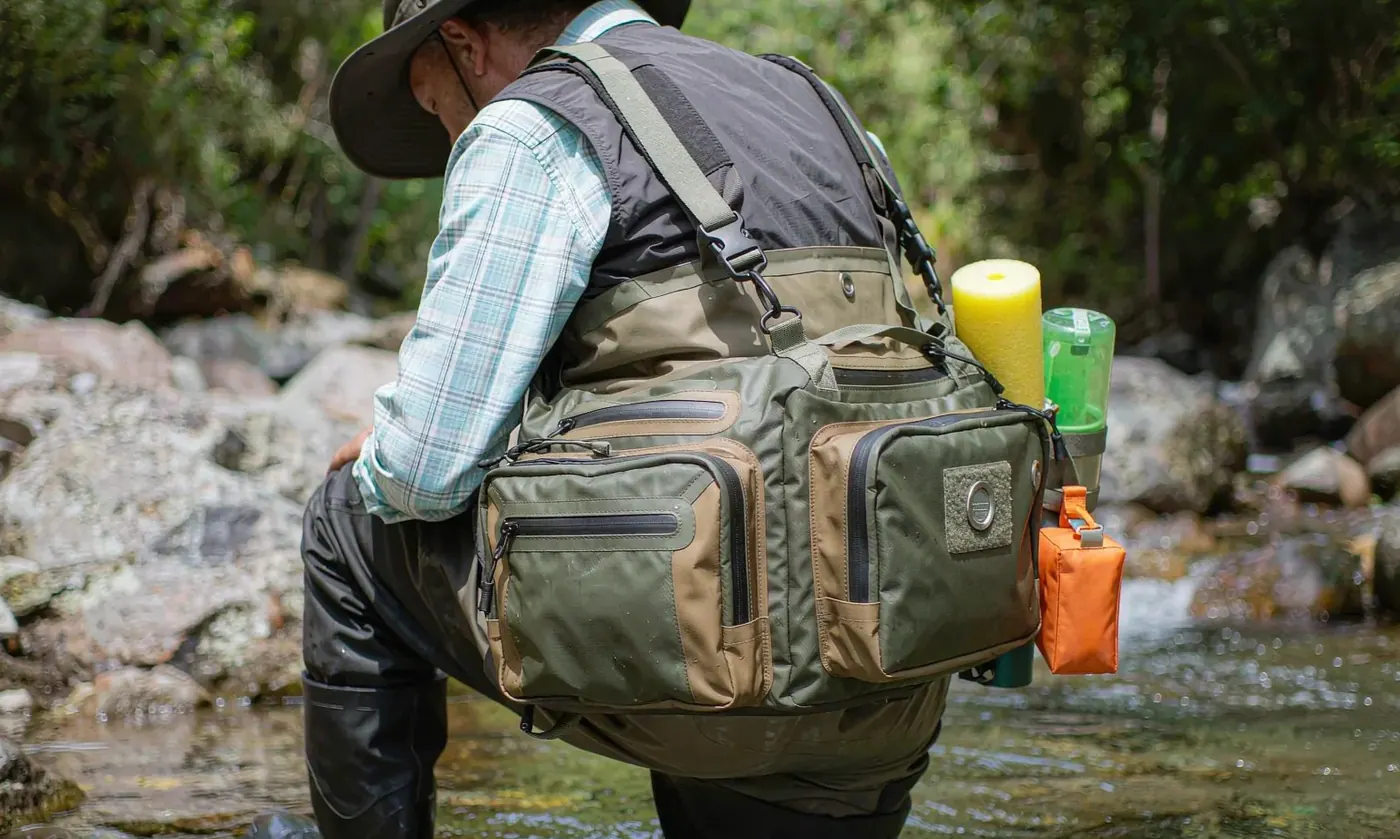
Drainage is the standout feature. The base and lower back panel use open mesh so a dunk sheds within about 90 seconds, and the strap dries faster than any padded harness in this ranking. Reference band is 18-24 USD, and it is the build to pair with a chest pack rather than to replace one.
3. Bank 14 Box-Carry: Best for Bank Fishing
Bank anglers carry more than wading anglers because they are further from the vehicle and they fish more methods in a session. Fourteen litres, 0.85 kg, two 3600 slots plus a shallow utility tray, and a full-width front pocket for a reel or a small camera. Rating is IPX5, which is honest for bank use and keeps the weight down.
The useful detail is the external tool dock: two sheath points at the shoulder for pliers and forceps and a drainable net sleeve at the rear. Those three additions turn a general sling into a fishing sling, and they are the details most often cut to hit a price point. Reference band is 20-26 USD, and it is the volume seller for bank-focused retailers.
4. Trout 8 Minimal: Best Lightweight Build
Eight litres and 0.48 kg is the minimum useful sling. It holds one shallow tray, tippet, tools, and a shell, and nothing else. That sounds severe and it is exactly what a summer trout angler carries. Rating is IPX5, the strap is a simple 32 mm webbing with no padding, and the whole bag packs flat into a jacket pocket when empty.
The honest limitation is that it has no liner pouch and no meaningful water protection beyond the rating, so a phone goes in a jacket pocket rather than in the bag. At 14-19 USD it is the entry price point in a range and the build most often bought as a second bag by someone who already owns a backpack.
5. Photo 16 Hybrid: Best for Anglers Who Shoot
A growing share of anglers carry a camera or a phone gimbal, and a padded divided insert is the only way to protect one in a soft bag. Sixteen litres with a removable insert rated for a body plus two lenses, two 3600 slots alongside, and 1.00 kg empty. Rating is IPX6 and the insert compartment has its own covered closure, so wet trays never share space with the camera.
Two things make it work: the insert must be removable in under 20 seconds, or the angler will leave it in and lose half the bag, and the compartment must open away from the body so the camera can be drawn without putting the bag on the ground. Reference band is 30-38 USD, and it is the highest-margin build in a fishing range.
6. Guide 18 Heavy: Best for Guide Duty
Eighteen litres is the ceiling for a sling, and this build only works at that size because the harness is serious: a 45 mm padded strap, a magnetic stabiliser, and a load-bearing hip wing that transfers part of the weight to the pelvis. Three 3600 slots, 1.10 kg empty, IPX6, and a 1000D face with 316 stainless hardware throughout.
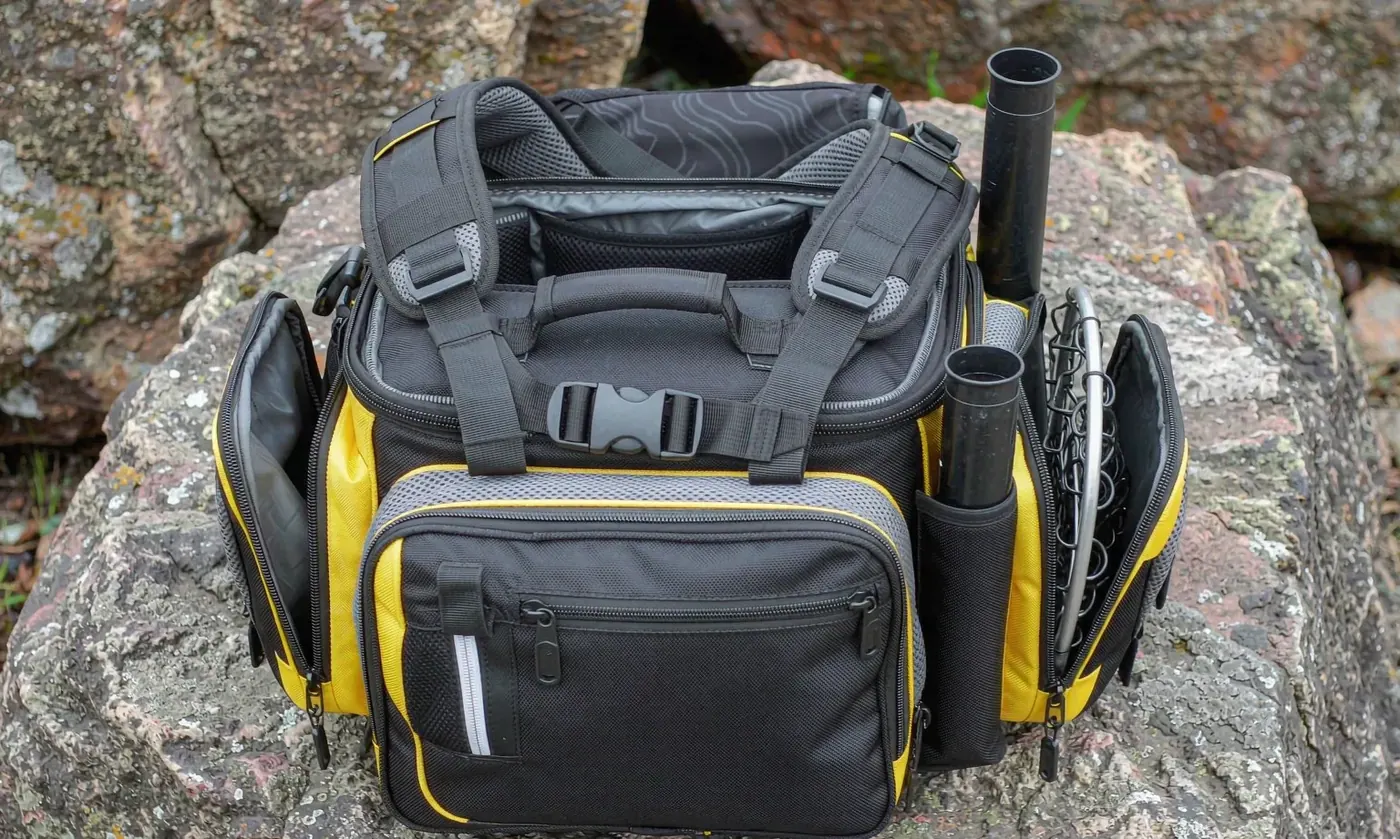
The reason to cap the volume at 18 L is biomechanical. Above roughly 3.5 kg on one shoulder, most anglers develop a neck or trapezius complaint within a season regardless of strap padding, and the fix is a second strap rather than a better first one. Reference band is 28-34 USD, and it suits guide operations and long bank days rather than general retail.
7. Kayak 10 Low-Profile: Best for Small Craft
Kayak use imposes two constraints that land-based buyers rarely think about: the bag must sit below the seat back, and it must not catch on the coaming when the angler turns. Ten litres, 0.62 kg, a flattened profile of about 120 mm front to back, and IPX7 at 1 m for 30 minutes because kayak bags go in the water more than any other fishing bag.
The strap is deliberately narrow at 32 mm so it does not foul a life jacket shoulder, and the hardware is all acetal or 316 stainless with no exposed ferrous part. Reference band is 19-25 USD, and it is usually sold alongside a crate system rather than as the primary tackle carrier.
8. Hot 12 Ventilated: Best for Warm Weather
A sling covers one shoulder and part of the back, and in warm weather that area becomes the sweatiest part of the angler body. The Hot 12 answers with a raised mesh spacer panel, a 3D spacer strap rather than closed-cell foam, and a light colourway option that reflects rather than absorbs. Twelve litres, 0.70 kg, IPX5, two 3600 slots.
Ventilation costs waterproofing, and it should be stated as a trade rather than hidden. The mesh panel is not sealed, so this build is weather resistant rather than waterproof, and the liner pouch is supplied as standard rather than as an option. Reference band is 21-27 USD, and it sells strongly in subtropical and summer markets.
9. Travel 13 Packable: Best for Travel Anglers
The travel angler needs a bag that disappears into luggage and still works on arrival. Thirteen litres at 0.58 kg, with a body that folds flat to about 45 mm, a removable strap, and two 3600 slots that survive being packed. Rating is IPX5, the face is a light 300D ripstop with a TPU laminate, and the whole thing weighs less than a full water bottle.
Packability is bought with structure: there is no moulded base and no stiffener, so the bag slumps when empty and needs to be packed to hold shape. That is the right trade for travel and the wrong one for daily use. Reference band is 16-22 USD, and it is the fastest-selling add-on item in a fishing range.
Ambidextrous Design and Strap Geometry
Roughly one angler in ten is left-handed, and a sling that only works on one shoulder excludes them or forces an awkward reversal. True ambidextrous design means the strap can be moved to either side without tools, the bearing works in both directions, and the tool docks are mirrored rather than on a fixed side. It costs 1-2 USD per unit and it is the single most appreciated detail in the category.
| Geometry element | Recommended | Symptom if wrong | Correction |
|---|---|---|---|
| Strap width | 38-45 mm at 12 L or more | Strap rolls and cuts in | Widen and add 8 mm foam |
| Strap path | Over the shoulder, across the chest | Bag slides down the arm | Raise the anchor point |
| Stabiliser | 15-20 mm secondary strap or magnet | Bag pendulums on each step | Add a magnetic catch |
| Bearing | Moulded slider on webbing | Webbing frays in one season | Replace with a moulded track |
| Ambidextrous option | Strap and docks mirrored | Excludes left-handed anglers | Costs 1-2 USD to fix |
The mechanical comparison with a backpack is set out in the fishing backpack versus sling comparison, and the wider format range is covered in the fishing sling pack overview. Both matter here because the most common buyer mistake in this category is ordering a sling where the market actually wants a small backpack.
What Fits in Twelve Litres
Twelve litres is the median sling size and it is a genuinely small space, so the packing list should be written before the bag is specified. Two 3600 boxes, tippet, tools, a light shell, 750 ml of water, and a phone is about the honest limit, and adding a third box means dropping the shell or the water. Buyers who expect more should be redirected to a 28 L backpack rather than sold a bigger sling.
| Item | Space used | Priority | Note |
|---|---|---|---|
| Two 3600 boxes | 3.5-4.0 L | High | The reason for the bag |
| Tippet and leader wallet | 0.5 L | High | Docks at the shoulder |
| Tools on retractors | External | High | Never in a pocket |
| Light rain shell | 1.5-2.0 L | Medium | Compression straps if left outside |
| 750 ml water | 0.9 L | Medium | More than 1 L needs a backpack |
| Phone and licence | 0.3 L | High | In the sealed liner |
| Snack and sunscreen | 0.5 L | Low | First thing dropped |
Weight discipline follows from the list. A loaded 12 L sling should land between 2.5 and 3.5 kg, and above 3.5 kg the single-strap format stops being comfortable regardless of how good the strap is. That figure, more than any litre rating, is what should decide whether the customer buys a sling or a backpack.
Where a Sling Stops Working
Three situations break the format and all three are common. The first is a load above 3.5 kg, which needs two straps. The second is a full day with layers and food, which needs 28 L or more. The third is boat fishing, where the angler sits in one place and wants trays open on a flat surface rather than on the body.
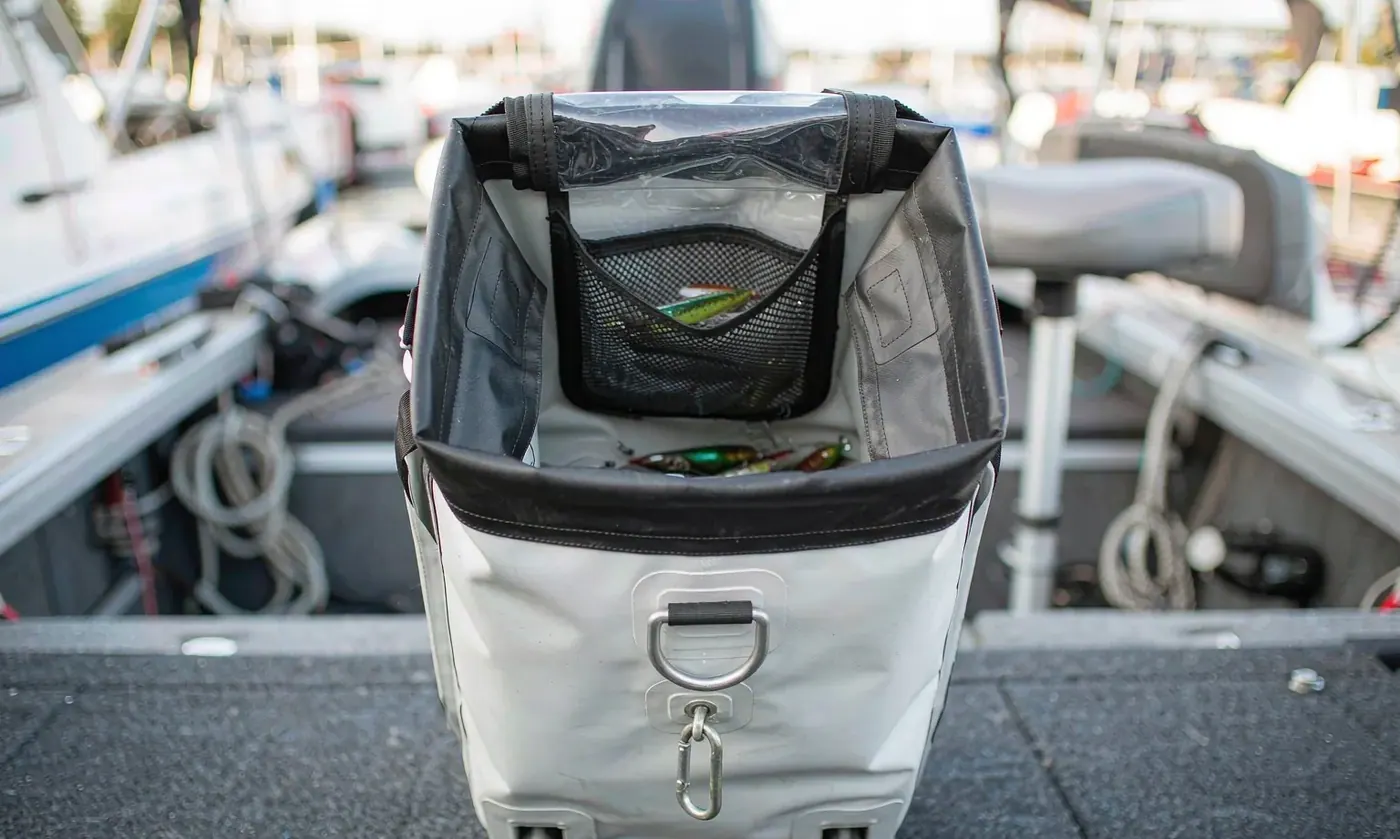
For the boat case the answer is an open-top tote rather than a bigger sling, and for the load case the answer is a small backpack. A buyer who stocks all three formats will place the right product far more often than one who tries to stretch the sling into every situation, and the return rate difference is visible within a single season.
Materials, Ratings, and Testing
Fabric in a sling takes less abrasion than in a backpack because the bag is rarely set down on its base while being worn, but the strap takes far more. Require a strap pull result and an abrasion cycle count using published methods from ASTM International, and require the bearing to survive 500 loaded swings with no webbing fraying.
Ratings follow the same rule as every other fishing bag: the condition carries the meaning. Ingress codes are defined by the IEC ingress protection framework, so IPX7 without a depth and a duration is not a specification. IPX5 suits bank use, IPX6 is the sensible floor for a bag that gets splashed or dropped, and IPX7 matters for wading and kayak builds.
Programme, Pricing, and Compliance
Sling packs are the cheapest fishing bags to develop and the easiest to get wrong, because the swing mechanism is a small part that carries the whole experience. Specify it explicitly, test it on the approval sample rather than on a drawing, and require a strap replacement path. Everything else in the brief is standard and follows the baseline below.
| Programme item | Baseline | Note |
|---|---|---|
| MOQ | 500 pcs per design and colour | Colour split negotiable above the baseline |
| Sampling | 6-10 working days | Add 3-5 days for a moulded bearing |
| Bulk | 35-50 days | From approved sample and deposit |
| Inspection | AQL 2.5 | Include swing cycle, strap pull, box fit, water screen |
| Compliance | REACH and California Prop 65 | Screen coatings, films, inks, hardware |
QUANZHOU JUNYUAN BAGS has developed waterproof bag programmes since 2014, with the founding team active in the industry since 2004. Monthly output of 200,000 units is verified by SGS, and BSCI and ISO 9001 systems structure the workflow. Materials are screened for REACH and California Prop 65, and every bulk order is inspected at AQL 2.5 before shipment.
A sling brief can be emailed to service@junyuanbags.com; include litres, box count, swing mechanism, ambidextrous requirement, market, and quantity. FOB Xiamen or DDP service to more than 100 countries follows an approved sample and a complete test record. Waterproof-specific sling results are collected in the waterproof sling comparison.
People Also Ask
What size fishing sling pack should I buy?
Twelve litres covers two 3600 boxes, tools, a shell, and water for a half day. Go to 8-10 L for wading or kayak use and 16-18 L only with a serious padded harness.
How does a sling pack swing to the front?
A rotating bearing on a webbing track lets the bag slide around the torso in about two seconds with one hand. Fixed straps and buckle releases both defeat the purpose.
Are sling packs comfortable for long walks?
Up to about 3.5 kg, yes. Above that, a single strap causes neck and shoulder complaints and a small backpack is the better answer.
Can left-handed anglers use a sling pack?
Only if it is ambidextrous. The strap must move to either side and the tool docks must be mirrored, which costs 1-2 USD per unit to specify.
Is a sling pack waterproof enough for wading?
Choose IPX7 with a stated depth and duration for wading and kayak use. IPX5 is fine for bank fishing and IPX6 is the sensible floor elsewhere.
Should I choose a sling or a small backpack?
Choose a sling when covering 1-4 km and fishing a dozen short spots. Choose a backpack when the load exceeds 3.5 kg or the day needs layers and food.
Frequently Asked Questions
Q1. What is the best fishing sling pack overall?
A 12 L build at about 0.75 kg with a rotating bearing, a 38 mm padded strap, and two 3600 slots. The swing mechanism matters more than the litre figure.
Q2. How much can a sling pack comfortably carry?
Between 2.5 and 3.5 kg loaded. Above 3.5 kg a single strap causes neck and shoulder complaints regardless of strap padding.
Q3. What is the right sling pack size for wading?
Eight to 10 L, riding high and narrow, with IPX7 at a stated depth and duration and a sealed liner for a phone and licence.
Q4. Why does the swing mechanism matter so much?
Because it is the entire advantage of the format. A fixed strap or a buckle release makes the bag slower to access than a backpack, which defeats the point of buying one.
Q5. Do sling packs work for left-handed anglers?
Only if designed ambidextrously, with the strap movable to either side and mirrored tool docks. It costs 1-2 USD per unit and is widely appreciated.
Q6. What waterproof rating suits a fishing sling pack?
IPX5 for bank use, IPX6 as the sensible floor for splash and a dunk, and IPX7 with a stated depth and duration for wading or kayak builds.
Q7. How many tackle boxes fit in a sling pack?
Two 3600 boxes in a 12 L build, three in an 18 L build. Above that, a backpack is the better format rather than a bigger sling.
Q8. Is a sling pack better than a chest pack?
For walking between spots, yes. For standing in one run for hours, a chest pack is better because it provides a work surface at chest height.
Q9. What strap width should a sling pack have?
38-45 mm with about 8 mm foam at 12 L or more, and 32 mm on a minimal 8 L build. Narrower straps roll and cut in under load.
Q10. Can a sling pack be used for kayak fishing?
Yes, if it is low-profile at about 120 mm front to back so it clears the seat back, and rated IPX7 because kayak bags go in the water often.
Q11. What should I carry in a 12 litre sling pack?
Two 3600 boxes, a tippet wallet, tools on retractors, a light shell, 750 ml of water, and a phone in a sealed liner. A third box means dropping the shell or the water.
Q12. When should I choose a backpack instead of a sling?
When the load exceeds 3.5 kg, when the day needs layers and food, or when the fishing is boat-based and trays need to be laid out flat.
Q13. What is the MOQ and lead time for a sling pack programme?
MOQ is 500 pcs per design and colour, samples take 6-10 working days, and bulk runs 35-50 days from approved sample and deposit.