Fishing backpacks split into six architectures defined by how they open, and that single choice drives access time, water resistance, tray count, and price far more than any activity label does. A front-loader lays flat and exposes every tray in about three seconds, while a roll-top submersible takes roughly twelve seconds to open and twenty to reseal but survives a dunk that would end the day for anything else. The six are compared below on access time of 3-40 seconds, tray capacity of two to four deep 3700 trays, ingress levels from IPX2 to IPX7, empty weight of 0.9-2.1 kg, and FOB Xiamen bands of 20-58 USD at MOQ 500 pcs per design and colour, with samples in 6-10 working days and bulk in 35-50 days.
Why Opening Architecture Comes First
Buyers usually sort packs by activity: bank, boat, kayak, hike-in. That taxonomy breaks down immediately, because the same angler needs different things on different days and no brand can print six activity labels on one hang tag. Opening architecture is the better primary filter, since it determines what the angler can physically do with the pack: how fast trays come out, whether it can be opened in rain without soaking the contents, and how much structure the shell needs.
| Architecture | Access time to second tray | Ingress level | Empty weight | FOB band |
|---|---|---|---|---|
| Front-loader | 3 s | IPX2-IPX3 | 1.5-1.9 kg | 30-48 USD |
| Sleeved tray loader | 8 s | IPX2-IPX4 | 1.3-1.8 kg | 26-44 USD |
| Top lid loader | 20 s | IPX2-IPX3 | 1.1-1.6 kg | 22-36 USD |
| Convertible pack and sling | 6 s | IPX2-IPX4 | 0.9-1.4 kg | 24-38 USD |
| Modular rail loader | 10 s | IPX2-IPX3 | 1.6-2.1 kg | 34-52 USD |
| Roll-top submersible | 12 s open, 20 s close | IPX6-IPX7 | 1.2-1.7 kg | 38-58 USD |
The relationship to notice is that access speed and water protection move in opposite directions almost linearly. Anything that opens wide and fast relies on a coated zip or a flap, and neither survives immersion, while anything that survives immersion needs a rolled and clipped mouth that cannot be opened quickly. There is no eighth architecture that delivers both, and any product page claiming otherwise is describing a compromise rather than escaping one.
1. Front-Loader: Fastest Access
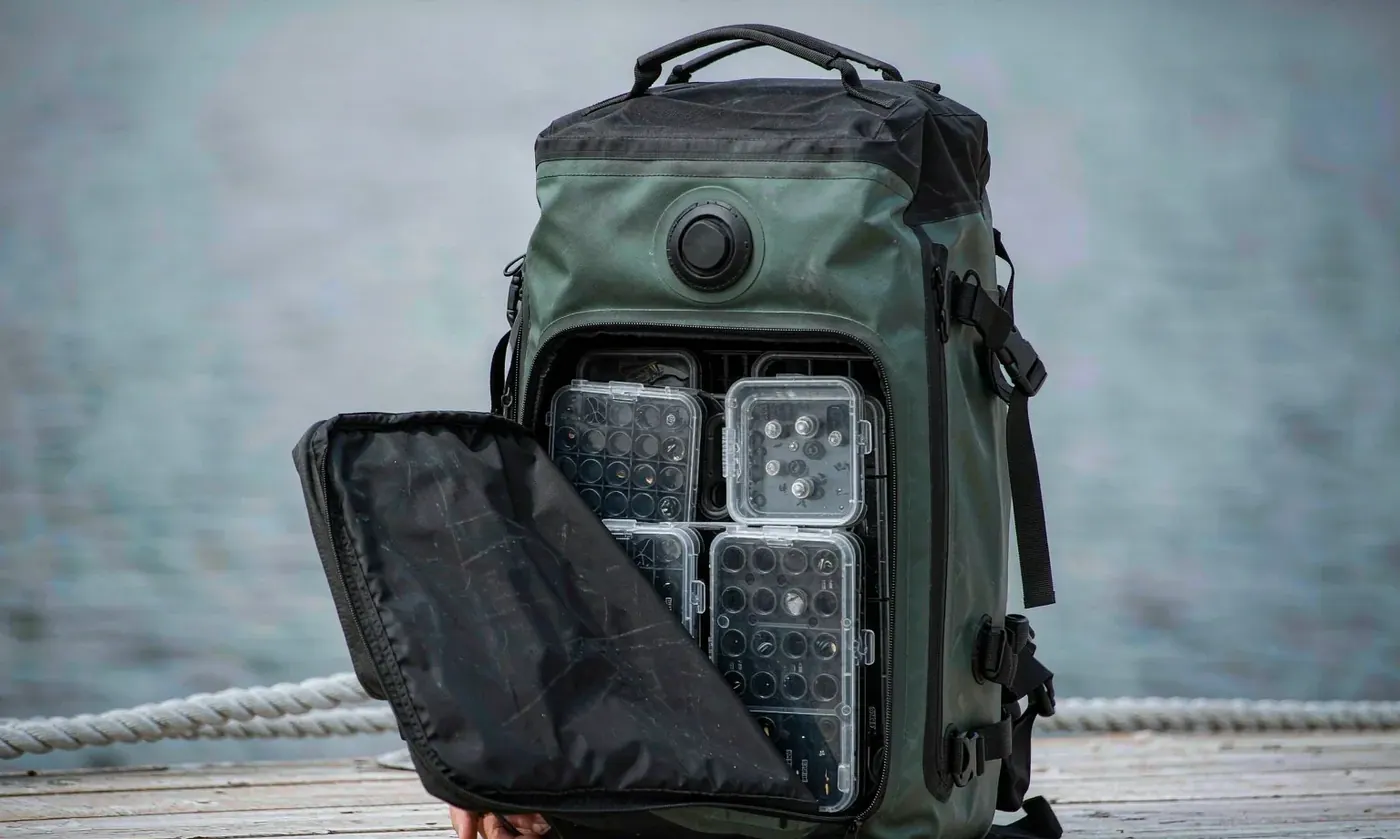
A front-loader opens on three sides and lays the body flat, exposing the whole tray stack at once in roughly three seconds. It carries three or four deep 3700 trays in a rigid sleeve, weighs 1.5-1.9 kg empty, and sits at 30-48 USD. The format belongs to anyone changing terminal tackle constantly: guides, coaches, and competition anglers.
The cost of that speed is structure. A shell that opens on three sides has no hoop strength of its own, so the sleeve and a perimeter frame have to supply rigidity, and together they add 300-500 g over a top loader. Buyers should also require a zip with a storm flap rather than an exposed coil, because a full-perimeter zip is the largest single leak path on any pack this side of a roll-top.
2. Sleeved Tray Loader: The Default Choice
The sleeved tray loader opens at the top or upper front and holds three or four trays upright in a moulded internal sleeve, accessing the second tray in about eight seconds at 1.3-1.8 kg and 26-44 USD. It is the format most of the industry calls simply a tackle backpack, and it is what most buyers should build a range around.
It wins on balance rather than excellence at any one thing. The sleeve keeps trays upright and prevents the rotation that ruins unbaffled totes, the single opening leaves the shell structurally sound without a frame, and the price sits below the front-loader. The compromise is that the third tray has to come out to reach the fourth, which is an annoyance rather than a defect for an angler who knows what is in each layer.
3. Top Lid Loader: Lightest and Cheapest
A traditional top loader with a lid pocket accessing everything through one mouth at the top, reaching the second tray in about twenty seconds, at 1.1-1.6 kg and 22-36 USD. It is the lightest and cheapest architecture here and it still sells in volume to anglers who unpack once and settle in one swim.
Twenty seconds to the second tray is the honest figure and it is why this format belongs in specific hands rather than as a general answer. An angler who sets up once and stays put loses nothing, because everything comes out at the start and stays out. An angler moving every twenty minutes will have moved on to a front-loader within a season, and no price advantage changes that.
4. Convertible Pack and Sling
A convertible body runs on a single strap that can be split into two, or a double strap that can be drawn into one, accessing contents in about six seconds at 0.9-1.4 kg and 24-38 USD. It suits the angler halfway between two formats, who wants hands free while casting and a two-shoulder carry for the walk home.
The strap mechanism is the entire product and the only thing worth inspecting closely. A buckle system that converts cleanly uses two webbing paths with a load-rated tri-glide on each side, and it costs about 2.40 USD. Cheaper builds convert by running one strap through a fabric loop that wears through in roughly forty cycles, at which point the pack is permanently a sling whether the owner wanted that or not.
5. Modular Rail Loader
A modular body carries external webbing rails accepting pouches, holsters, and tool sheaths, with internal access to three trays in about ten seconds, at 1.6-2.1 kg and 34-52 USD. It serves anglers whose kit changes by season rather than by hour and who prefer attaching a new pouch to buying a new pack.
The rails should be specified by standard rather than by appearance: webbing rows at 25 mm pitch with bar-tacked attachment every 38 mm is the common pattern, and a pouch bought from any brand will fit it. Proprietary slot systems lock the customer into one accessory catalogue, which is good for one party and bad for the angler, and retailers discover this at the point where accessories stop being available.
6. Roll-Top Submersible
A roll-top body seals by rolling the mouth four times and clipping a side buckle, opening in about twelve seconds and resealing in twenty, rated IPX6 to IPX7 at 1.2-1.7 kg and 38-58 USD. It is the only architecture here that survives immersion, and it is what the IPX8 submersible technology discussion covers in engineering detail.
Four rolls is the number that matters and the number most often cheated. Three rolls leave roughly 2 litres of trapped air and a perceived seal that fails under the pressure of a single kneel, while four rolls with a stiffener strip produces a consistent line contact along the whole width. Sealing performance should be verified against the ingress code published by the International Electrotechnical Commission, which defines both the duration and the depth a rating implies.
Fit Across the Six Architectures
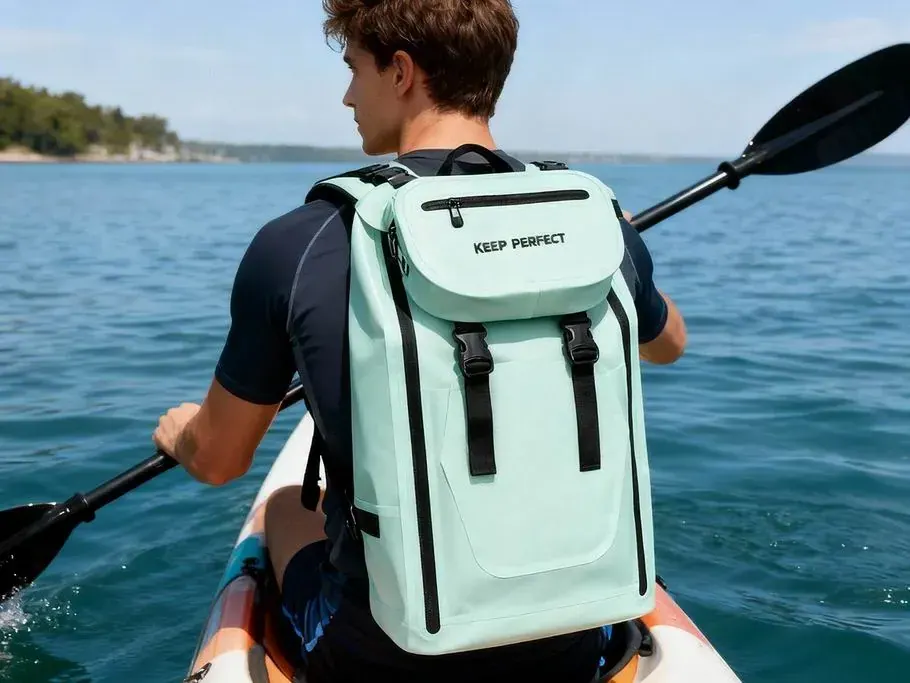
Harness geometry is shared across the six architectures and it is where complaints originate. A pack feels comfortable or uncomfortable because of torso length, hip belt angle, and strap padding width, none of which appear in a specification of opening style, and yet these are the three things that generate most returns.
| Fit element | Target for a fishing pack | Failure below target | Cost to fix |
|---|---|---|---|
| Torso length match | 420-520 mm adjustable range | Load rides on the shoulders alone | 3.10 USD |
| Hip belt width | Minimum 65 mm, padded | Pressure point at the iliac crest | 2.40 USD |
| Shoulder strap width | Minimum 70 mm at the top | Strap rolls and cuts in | 1.80 USD |
| Load lifter angle | 25-35 degrees above horizontal | Pack pulls away from the back | 1.20 USD |
| Sternum strap | Sliding, 300-420 mm travel | Straps splay outward when casting | 0.90 USD |
A fishing pack has one fit requirement no hiking pack shares, which is clearance for a cast. The shoulder straps must sit outside a 300 mm radius above each shoulder so a rod butt passes cleanly, and a wide load lifter that intrudes into that space turns every cast into a negotiation. This is the reason fishing harnesses look narrower than hiking equivalents and why copying a trekking harness rarely works here.
Choosing by Session Rather Than by Angler Type
The practical way to pick an architecture is to ask two questions a customer can answer without any product knowledge: how often does the kit move during a session, and how wet does the pack get. Those two answers place every angler in the table below, and they are more reliable than any profile built around age or experience.
| Moves per session | Pack gets wet | Recommended architecture | Reason |
|---|---|---|---|
| Once, settle in one spot | Light rain | Top lid loader | Access does not matter, weight and price do |
| Every 30-60 min | Light rain | Sleeved tray loader | Balanced access at a middle price |
| Every 10-20 min | Light rain | Front-loader | Three seconds to any tray |
| Every 30-60 min | Submersion risk | Roll-top submersible | Only architecture rated IPX6-IPX7 |
| Every 10-20 min | Submersion risk | Roll-top with wet compartment | Sealed body plus separated wet kit |
| Varies by season | Light rain | Modular rail loader | Add pouches instead of replacing the pack |
Note that the top right cell of that matrix, frequent moves combined with real submersion risk, has no cheap answer. It requires a roll-top body plus a separate wet compartment plus the discipline to put wet kit there rather than in the main body, and it typically lands at 44-58 USD. Buyers looking for that combination below 40 USD are looking for something that does not exist.
Materials by Architecture
Each architecture has a natural shell material, and specifying against that grain costs money without improving the product. A roll-top needs a soft film that rolls to a tight line, whereas a front-loader needs a stiff coated fabric that holds shape with one wall removed.
| Architecture | Shell material that suits it | Typical denier or film | Why not the alternative |
|---|---|---|---|
| Front-loader | PU-coated polyester | 420D-600D | Soft film cannot hold the open shape |
| Sleeved tray loader | PU-coated nylon | 210D-500D | Abrasion balance against weight |
| Top lid loader | PU-coated nylon | 210D-420D | Weight matters more than stiffness |
| Convertible | PU-coated nylon | 210D-500D | Strap paths need a tear-resistant face |
| Modular rail loader | PU-coated polyester | 600D-1000D | Rails pull hard on the face fabric |
| Roll-top submersible | PVC or TPU film | 500D-1000D equivalent | Coated fabric will not roll to a seal |
Denier is the most misread number on a fishing pack because it measures yarn thickness and says nothing about coating. A 210D nylon with a 0.12 mm PU coat resists water and abrasion better than a 420D with a 0.04 mm coat, despite being lighter and appearing weaker on a specification sheet. Specifying the coating thickness alongside the denier removes the ambiguity, and the detail is unpacked further in the PVC against TPU shell comparison.
Abrasion and tear resistance should be verified using methods published by ASTM International, and fabric wetting behaviour with methods maintained by AATCC. Citing the method and the acceptance number turns an argument about durability into a measurement that either passes or fails.
Maintenance Differs by Architecture
Care requirements follow the closure mechanism, and the two that need the most attention are also the easiest to damage by cleaning them wrongly. Get these right and every architecture here lasts several seasons longer.
- Roll-top mouths should be rinsed and air dried rolled open rather than closed, because a film stored rolled and damp bonds to itself along the fold line.
- Full-perimeter zips on front-loaders should be brushed fresh and lubricated with a silicone-free product about every third trip, then wiped so grit does not bind.
- Internal sleeves should be removed and dried inside out, because water trapped between the sleeve and the shell grows mildew in about four days.
- Webbing rails on modular builds trap salt crystals at the bar tacks, and should be soaked rather than wiped after any saltwater session.
- Convertible strap paths should be inspected for wear every twenty cycles, since a worn loop converts a pack into a sling permanently.
The storage rule that applies across all six is simple and widely ignored: dry fully before storing closed. A pack put away damp for a week develops mildew in the sleeve and along zip tape, and harness foam that stays damp loses resilience permanently. Storage practices that extend service life are covered in the off-season fishing bag storage guide.
Field Checks Before Approving a Sample
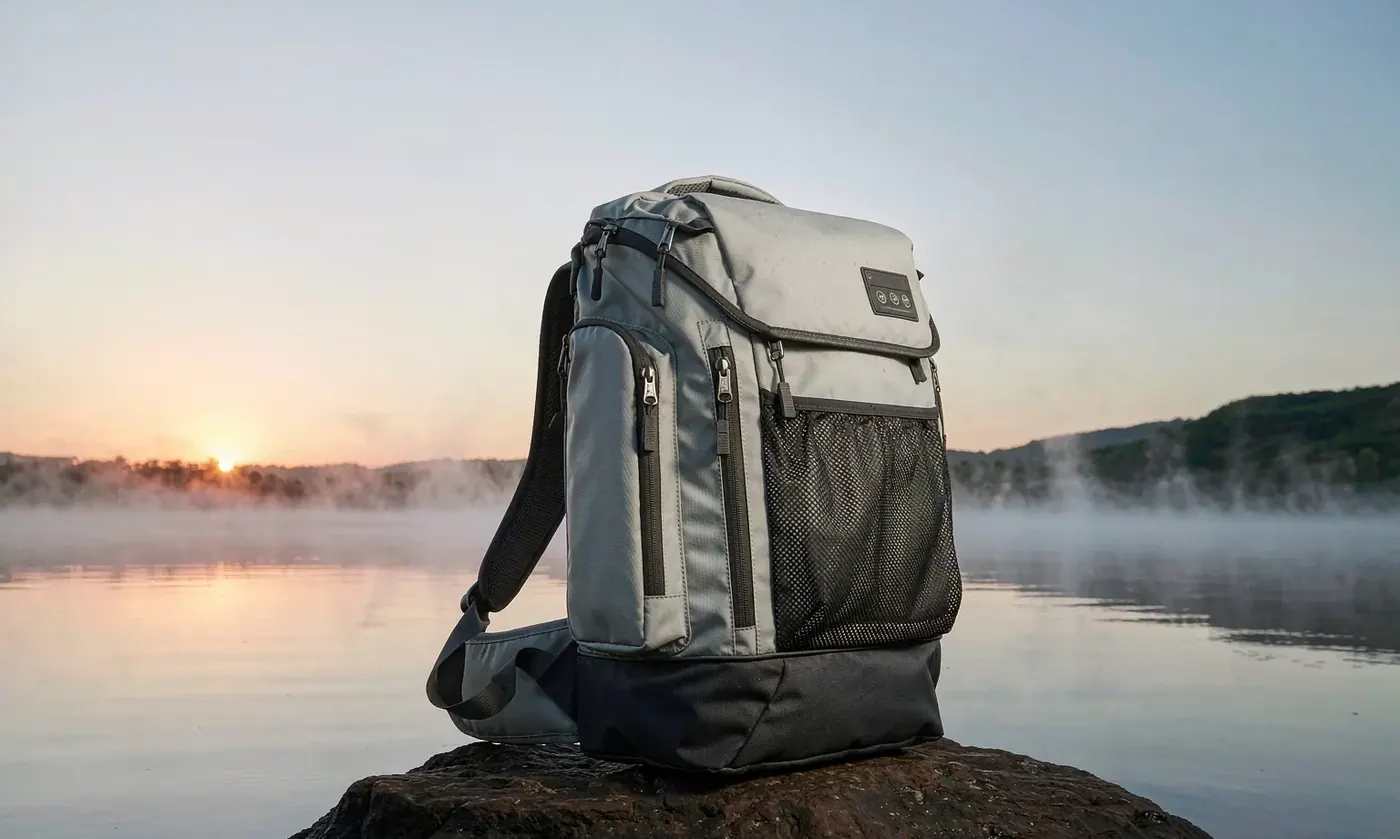
Bench inspection catches dimensional faults and misses everything that matters about how the pack behaves on a bank. Six checks take about ninety minutes per sample, need a loaded tray set and access to water, and reliably separate builds that sell from builds that get returned.
| Check | Method | Pass condition | Catches |
|---|---|---|---|
| Access drill | Remove tray two with the pack on | Under the stated time, seated and standing | Geometry that works only on a bench |
| Cast clearance | Complete 20 casting strokes | No contact at the shoulder | Load lifter intruding into the cast arc |
| Immersion or spray | Protocol per the stated ingress level | No ingress at the rated depth and time | Four-roll claim executed as three |
| Harness load | Carry 12 kg for 3 km | No pressure hotspot at the hip | Hip belt below 65 mm wide |
| Sleeve fit | Insert and remove trays 30 times | No jam, no visible wear | Sleeve tolerance under 4 mm per dimension |
| Strap conversion | Cycle a convertible 100 times | No loop wear at the strap path | Fabric loop instead of a load-rated glide |
The cast clearance drill deserves particular emphasis because nothing else catches that fault. A harness that looks correct in a photograph can still place a load lifter 40 mm inside the casting arc, and twenty full strokes with a rod will find contact every time. This is a five-minute test and it prevents the most common reason an otherwise good pack gets returned after one session.
Programme, Pricing, and Compliance
Programmes across these architectures open at MOQ 500 pcs per design and colour. Sampling takes 6-10 working days from confirmed artwork, and anything using a roll-top closure or a tray sleeve should add 2-3 days because both change the panel layout rather than simply adding components. Bulk runs 35-50 days from approved sample and deposit.
| Programme item | Baseline | Note |
|---|---|---|
| MOQ | 500 pcs per design and colour | Colour split negotiable above 2,000 pcs |
| Sampling | 6-10 working days | Add 2-3 days for a first roll-top or sleeve layout |
| Bulk | 35-50 days | From approved sample and deposit |
| Inspection | AQL 2.5 | Include access drill, immersion protocol, sleeve fit, strap cycles |
| Compliance | REACH and California Prop 65 | Screen shell, coating, film, inks, hardware, foam |
QUANZHOU JUNYUAN BAGS has developed waterproof bag programmes since 2014, with the founding team working in the trade since 2004. Monthly output of 200,000 units is verified by SGS, and BSCI and ISO 9001 systems structure the workflow. Materials are screened for REACH and California Prop 65, and every bulk order is inspected at AQL 2.5 before shipment.
A architecture brief can be emailed to service@junyuanbags.com with opening style, tray count, harness spec, hardware level, and quantity. FOB Xiamen or DDP service to more than 100 countries follows an approved sample and a complete test record. Buyers still narrowing the field should read the tackle backpack selection guide and compare against the tackle backpack range before requesting samples.
People Also Ask
How many types of fishing backpack are there?
Six architectures defined by how they open: front-loader, sleeved tray loader, top lid loader, convertible pack and sling, modular rail loader, and roll-top submersible.
Which fishing backpack type gives the fastest access?
A front-loader, which opens on three sides and exposes every tray in about three seconds. A sleeved tray loader takes roughly eight seconds and a top lid loader about twenty.
Is a roll-top fishing backpack worth it?
Yes if there is real submersion risk, because only a roll-top reaches IPX6-IPX7. It costs 38-58 USD and takes about twenty seconds to reseal, which is the trade-off.
What is the difference between a fishing backpack and a normal backpack?
Fishing packs carry a moulded tray sleeve and keep shoulders clear for a cast, typically outside a 300 mm radius above the shoulder. A hiking harness copied directly interferes with casting.
How many trays fit in a fishing tackle backpack?
Three to four deep 3700 trays in a sleeved or front-loading body of 25-40 L. Allow 4 mm of sleeve tolerance per dimension so moulded draft does not jam the tray.
Does higher denier mean a stronger fishing pack?
Not alone, because coating matters more than yarn thickness. A 210D nylon with a 0.12 mm PU coat outperforms a 420D with 0.04 mm despite being lighter.
Frequently Asked Questions
Q1. What are the six types of fishing backpacks?
Front-loader, sleeved tray loader, top lid loader, convertible pack and sling, modular rail loader, and roll-top submersible, distinguished by how each opens.
Q2. Which type of fishing backpack is best?
A sleeved tray loader for most anglers, at 26-44 USD and eight seconds of access. A front-loader suits constant changes and a roll-top suits real submersion risk.
Q3. How fast should I be able to reach a tray?
Three seconds in a front-loader, about eight in a sleeved loader, and roughly twenty in a top lid loader. Anything slower than twenty moves anglers away from the format.
Q4. Are roll-top fishing backpacks waterproof?
Rated IPX6 to IPX7 when the mouth is rolled four times and clipped. Three rolls leaves trapped air and fails under the pressure of a single kneel.
Q5. What is a convertible fishing pack?
A body with one strap that splits into two, or two that draw into one, accessing contents in about six seconds. Specify a load-rated tri-glide rather than a fabric loop.
Q6. How many trays fit in a fishing backpack?
Three to four deep 3700 trays at 25-40 L. The third tray must come out to reach the fourth, so layer contents by how often they are needed.
Q7. Do I need MOLLE rails on a fishing pack?
Only if kit changes by season rather than by hour. Require 25 mm webbing pitch bar-tacked every 38 mm so third-party pouches fit rather than locking into one catalogue.
Q8. What shell material is best for a fishing backpack?
PU-coated nylon of 210D-500D for sewn builds, and PVC or TPU film of 500D-1000D equivalent for a roll-top. Coating thickness matters more than denier alone.
Q9. How should a pack harness fit for fishing?
420-520 mm of torso adjustment, a hip belt at least 65 mm wide, shoulder straps at least 70 mm, and clearance outside a 300 mm radius above the shoulder for a clean cast.
Q10. How do I clean a fishing backpack?
Rinse fresh, air dry rolled open for a roll-top, remove and dry the sleeve inside out, soak rather than wipe the webbing after saltwater, and never store closed while damp.
Q11. How long should a good fishing backpack last?
Several seasons in regular use if dried properly between sessions. Mildew in the sleeve and zip corrosion are the two failures that end service life early.
Q12. What is the MOQ and lead time for these architectures?
MOQ is 500 pcs per design and colour, samples take 6-10 working days plus 2-3 days for a first roll-top or sleeve layout, and bulk runs 35-50 days from approved sample and deposit.