A fishing tackle tote is an open-top body of 15-30 L built for a boat deck, a pier, or a garage, where the bag stays put and access matters more than weather sealing. Because there is no closure, the realistic protection ceiling is around IPX3 to IPX4: it handles spray and a short shower but not immersion or sustained rain. Specify a rigid or moulded base with drainage, a tray slot that takes three or four trays standing upright, and a handle drop of 200-250 mm. Programme baseline is MOQ 500 pcs per design and colour, samples in 6-10 working days, and bulk in 35-50 days.
What an Open-Top Tote Is Actually For
A tote exists to stand still and be reached into. On a boat deck, a pier, a cleaning table, or a garage workbench, an opening that never has to be unzipped or unrolled saves more time than any organisational feature. That is the entire value proposition, and it explains why the format persists despite having the lowest weather protection of any fishing bag.
The trade is deliberate: open access in exchange for a low waterproof ceiling. A tote will take spray, a brief shower, and a wipe-down, and it will not survive a capsize, a surf landing, or an hour of rain. Buyers who understand that buy the right product; buyers who expect a tote to behave like a dry bag end up disappointed and blame the construction.
| Setting | Tote suitability | Why | Better alternative in weather |
|---|---|---|---|
| Boat deck | Excellent | Stays put, instant access | Waterproof backpack in spray |
| Pier or jetty | Excellent | Stable on a flat surface | Sealed backpack in rain |
| Garage or workshop | Excellent | Organisation, no sealing needed | None needed |
| Surf or kayak | Poor | No closure, sand and immersion | Welded submersible pack |
| Long bank walk | Poor | Hand carry, unbalanced | Tackle backpack |
The most useful way to think about the format is as a mobile drawer rather than as a bag. It organises, it drains, it is easy to rinse, and it does not pretend to be sealed. That framing also makes the specification easier: rigidity, drainage, and tray access are the three things worth paying for.
Why Open Tops Have a Waterproof Ceiling
Waterproof performance depends on a sealed boundary, and an open top is by definition a hole. Under the IEC ingress protection framework, an open-top body realistically sits at IPX3 to IPX4, covering light spray rather than jets or immersion. Any claim above that on an open tote should be treated as marketing unless a fitted cover or an internal liner is part of the product.
| Build | Realistic level | What it handles | What it does not |
|---|---|---|---|
| Plain open top | IPX3 | Light spray, brief shower | Sustained rain, immersion |
| Open top plus cover | IPX4 to IPX5 | Rain with the cover fitted | Immersion, forgetful users |
| Open top plus liner | Depends on liner | Contents protected inside | Shell still gets wet |
| Sealed roll-top tote | IPX6 to IPX7 | Spray and immersion | Instant open access |
There is a middle option worth knowing: a sealed tote with a wide roll-top or a gasket lid that opens fully. It gives most of the access benefit with a genuine rating, at the cost of a closure step and roughly 1-2 L of usable volume. For programmes selling into wet coastal markets, that hybrid frequently outsells the plain open version.
A fitted cover is the cheaper path and it works, with one caveat. The cover has to be found and fitted, and in practice it is fitted about half the time. Where a cover is supplied, specify one that stays attached to the body when stowed so it cannot be left in a vehicle, and size it for the loaded shape rather than the empty one.
Hands-Free Formats Compared With a Tote
A tote occupies one hand whenever it moves, which is fine on a deck and awkward on a walk. Where the angler needs both hands for a rod, a net, or a scramble over rock, a chest or waist format carries far better. The practical split is simple: tote for stationary organisation, hands-free body for moving.
| Format | Hands free | Access | Weather ceiling |
|---|---|---|---|
| Open-top tote | No | Instant, both hands in | IPX3 to IPX4 |
| Chest pack | Yes | Front panel, quick | IPX4 to IPX5 |
| Waist or hip pack | Yes | Side rotation | IPX4 to IPX5 |
| Sling pack | Mostly | Rotate to chest | IPX5 to IPX6 |
| Sealed backpack | Yes | Set down and open | IPX6 to IPX7 |
Many anglers use a tote and a chest pack together: the tote stays on the deck or in the vehicle with bulk and spare trays, and the chest pack carries the four or five items needed at the water edge. The waterproof fishing tackle bag overview places all five formats side by side with their protection levels.
Capacity, Tray Slot, and Base Rigidity
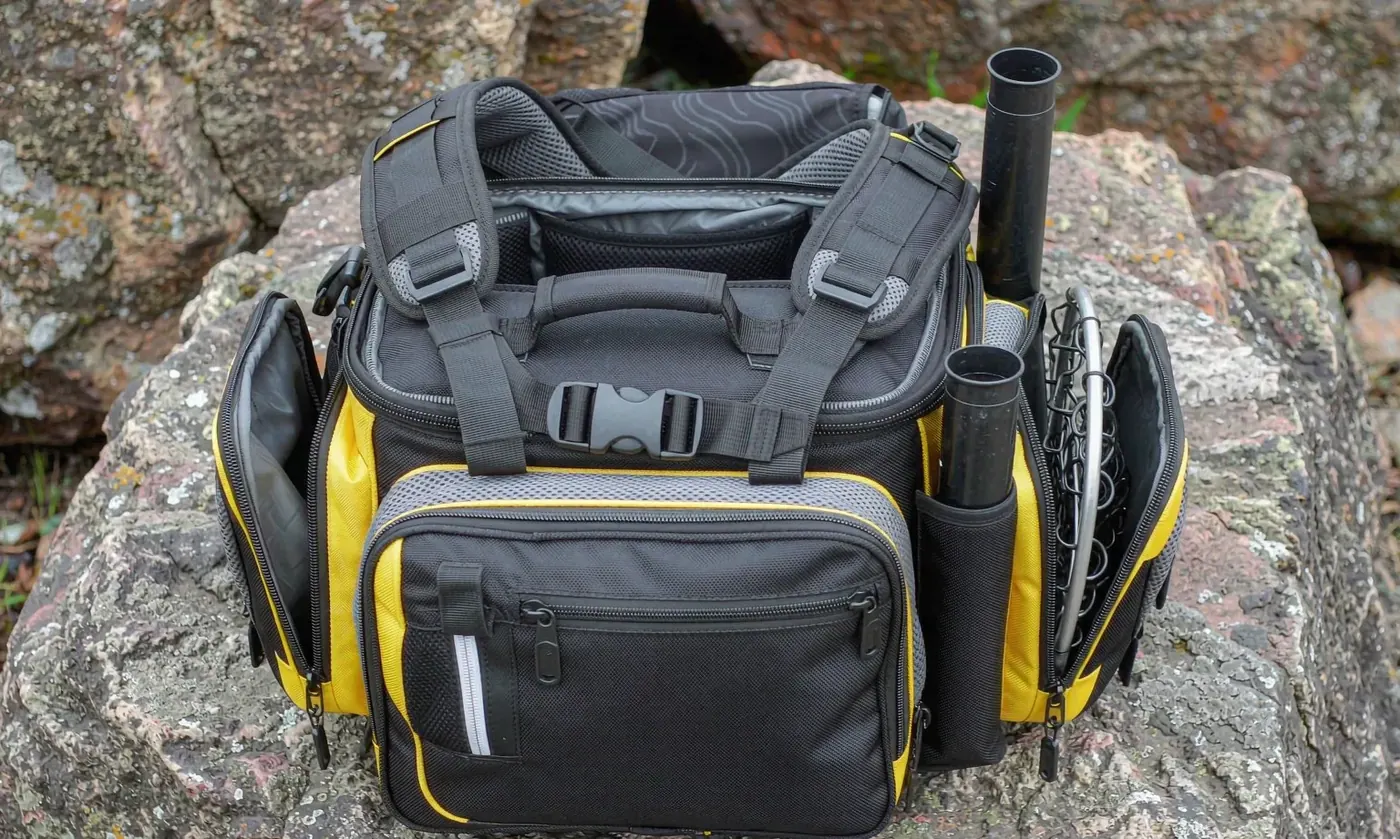
Fifteen to 30 L covers the format. A 15-20 L tote suits a small boat or a pier bag with two or three trays. A 22-26 L body suits a deck bag with three or four trays plus tools and a drink. A 28-30 L body is a transport tote for a full kit and is heavy enough that a backpack is usually the better answer for anything involving a walk.
Tray orientation is the defining internal decision. In a tote, trays usually stand upright in a slot so any tray can be lifted straight out, rather than lying flat in a stack that must be unpacked from the top. An upright slot needs an internal width of 190-210 mm for trays of the smaller standard and 240-260 mm for the larger one, plus 15-20 mm of clearance so a loaded tray lifts out without binding.
| Volume | Tray capacity | Internal width | Typical loaded weight |
|---|---|---|---|
| 15-20 L | 2 to 3 trays upright | 190-210 mm | 5-8 kg |
| 22-26 L | 3 to 4 trays upright | 240-260 mm | 8-12 kg |
| 28-30 L | 4 to 5 trays upright | 240-260 mm, taller | 11-15 kg |
| Above 30 L | Transport only | As specified | Use a backpack instead |
Base rigidity separates a good tote from a collapsing one. A moulded or stiffened base of 4-8 mm keeps the body upright when loaded, resists a wet deck, and stops trays from racking out of square. A soft base lets the tote slump, which jams the tray slot and tips the whole body on a moving deck. Where the tote meets saltwater, the base should be a moulded closed-cell material rather than a foam that absorbs water.
Handles, Carry Comfort, and Load Limits
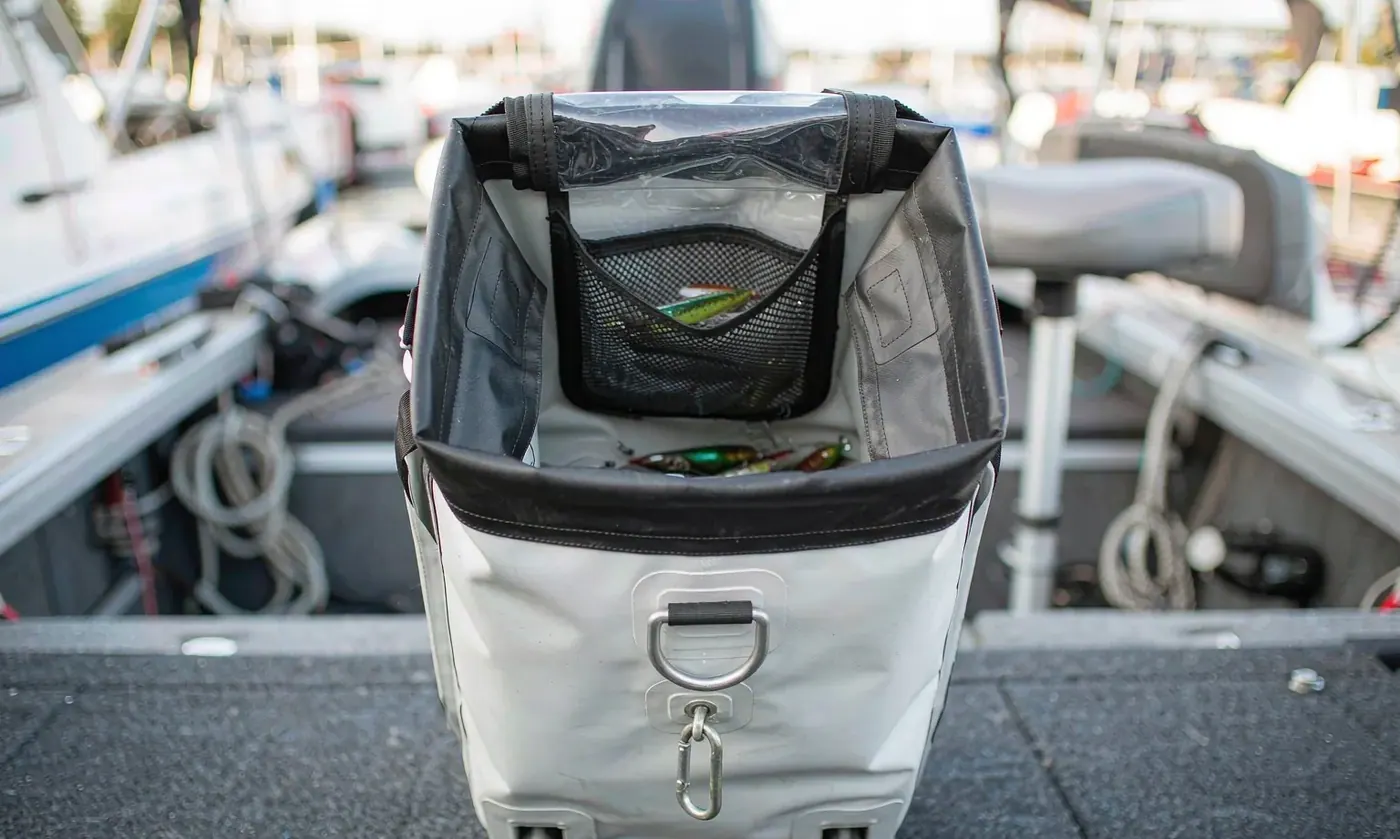
Handles are the least glamorous and most complaint-generating part of a tote. A handle drop of 200-250 mm clears a loaded body and a gloved hand; below 180 mm the knuckles contact the tray tops. Webbing of 25-38 mm with a padded wrap suits loads to 12 kg, and the handle should be anchored through reinforcement that reaches the base rather than stitched into the rim, because rim attachment is the most common tear location.
Carry distance is the real limit. A tote loaded to 10 kg is comfortable for 50-100 m and uncomfortable beyond that, because the load hangs from one hand and pulls the shoulder out of level. Design the product for the distance it will actually be carried: a pier bag needs 30 m of carry, a vehicle-to-boat bag needs 100 m, and anything longer belongs in a backpack.
- Specify a handle drop of 200-250 mm so a gloved hand clears loaded trays.
- Use 25-38 mm webbing with a padded wrap for loads to 12 kg.
- Anchor handles through reinforcement that reaches the base, not into the rim.
- Add a second side handle for two-handed lifting above 10 kg.
- Publish the carry-distance expectation in the product information.
A shoulder strap option is worth offering on bodies above 22 L. It converts a 30 m carry into a 300 m carry without changing the product architecture, and it costs a few grams. Where a strap is included, anchor it at two points on the body rather than at the rim, and make it detachable so it cannot snag on deck hardware. A detachable strap also solves a storage problem: a tote hung by its handles in a garage keeps its shape, while one left on a floor with a strap attached tends to be dragged rather than lifted, which is how bases get worn through.
Drainage, Sand, and Cleaning
An open tote collects water, and that is acceptable as long as it leaves again. Specify two to four drain grommets of 6-10 mm at the lowest corners, positioned so they do not sit flat against a deck surface when the tote is set down. A tote that holds 200 ml of water at the base after a rinse will smell within two days and will rust every hook in the bottom tray.
Sand is the surf and beach problem. It enters through the open top, settles in the tray slot, and grinds against tray rails and drain holes. Choose a smooth welded interior with no fabric crevices at the base, and rinse the interior as well as the exterior after a beach session. A drain design that traps rather than sheds sand is worse than no drain at all in that environment.
| Issue | Design response | Check | Frequency |
|---|---|---|---|
| Standing water | 2 to 4 grommets at 6-10 mm | Empty within 60 seconds | Every rinse |
| Sand in tray slot | Smooth welded interior | Slot clears after a rinse | After beach use |
| Odour | Full drain plus 8-24 h drying | No smell after 24 h | Weekly in season |
| Rust in bottom tray | Dry trays before stowing | Inspect hooks and swivels | Every session |
| Rim collapse | Stiffened rim or moulded lip | Body holds shape loaded | Monthly |
Cleaning is straightforward because there is no closure to protect: fresh water rinse, mild pH-neutral soap, a soft brush on the tray slot, and air dry inverted for 8-24 hours. Never machine wash and never use solvents on a moulded base, because solvents attack the surface and leave it tacky and prone to picking up sand.
Rain and Spray Management for an Open Body
Three tactics make an open tote workable in wet conditions. First, keep the trays that matter covered, using the tray lids themselves rather than relying on the bag. Second, use a fitted cover when rain is forecast, and size it for the loaded body. Third, accept that the shell gets wet and design for it: welded seams, drainage, and hardware that tolerates water are more useful than any attempt to seal an opening that is meant to stay open.
Where a session involves sustained rain, a sealed backpack is the correct companion rather than a covered tote. The best fishing tote bags roundup compares open and hybrid bodies, and the fishing duffel comparison covers the sealed transport alternative for anglers who need volume more than instant access.
Care, Storage, and Off-Season
Empty the tote completely after every session, rinse it inside and out, and dry inverted for 8-24 hours. Remove trays so they dry separately, and check drain grommets for blockage at the same time. A tote stored with trays in place and water in the base will rust the bottom tray within a week.
- Rinse inside and out with fresh water after every saltwater session.
- Dry inverted for 8-24 hours with trays removed.
- Check drain grommets for blockage at every clean.
- Use mild pH-neutral soap only; no solvents on a moulded base.
- Store dry and out of direct sun at 15-25 degrees.
Abrasion and load performance of webbing and base materials can be checked against published methods from ASTM International, which gives buyer and seller a shared basis for a claim. Weather and water conditions should always be reviewed before a session; NOAA weather resources support that check in the United States, and equipment preparation is not a substitute for local judgement on the water.
Organising an Open Tote So It Stays Usable
An open tote fails organisationally long before it fails structurally. Because everything is visible, everything gets thrown in, and within three sessions the tray slot is blocked by a spare spool, a pair of pliers, and a drink bottle. Two rules prevent that: give every non-tray item a fixed home, and keep the top third of the body clear so the tray slot can be reached with one hand.
| Zone | Contents | Rule | Why |
|---|---|---|---|
| Tray slot | Labelled utility trays | Nothing loose in the slot | Blocking the slot stops all access |
| Outer pockets | Pliers, line, leader spools | Fixed position per tool | Reachable without unpacking |
| Base zone | Heavy items, drink | Below tray level only | Keeps the centre of mass low |
| Top third | Kept clear | No loose items above trays | One-handed tray retrieval |
| Drained pocket | Wet rag, fish measure | External and drained only | Keeps water out of the chamber |
Labelling trays is the cheapest improvement available and the one anglers skip most often. A 40 x 20 mm label on the tray end, read while the tray stands upright in the slot, removes the need to open three trays to find one lure type. Programmes that ship labelled trays consistently report fewer returns for access problems, which is notable because labelling costs almost nothing.
Rotation matters too. Put the most-used tray nearest the handle side and re-sort at the start of each season, because lure selection changes with the water and a layout that worked in spring is often wrong by late summer. A tote reorganised twice a year stays usable; one left alone for two seasons becomes the bag nobody wants to open.
Programme Brief and Acceptance Criteria
Write one document covering usable litres, tray standard and orientation, internal clearance, base construction and thickness, handle drop and anchoring, drain specification, hardware grade, and compliance. Add acceptance criteria for dimensions, rigidity under load, drain rate, seam appearance, and colour fastness. Approve at least three samples, because rigidity and drain behaviour vary more between builds than any other property in this format.
| Programme item | Baseline | Note |
|---|---|---|
| MOQ | 500 pcs per design and colour | Colour split negotiable above baseline |
| Sampling | 6-10 working days | Add 5-8 days for a moulded base tool |
| Bulk | 35-50 days | From approved sample and deposit |
| Inspection | AQL 2.5 | Include tray slot clearance, drain rate, rigidity |
| Compliance | REACH and California Prop 65 | Screen coatings, mouldings, inks, hardware |
QUANZHOU JUNYUAN BAGS has developed waterproof bag programmes since 2014, with the founding team active in the industry since 2004. Monthly output of 200,000 units is verified by SGS, and BSCI and ISO 9001 systems structure the workflow. Materials are screened for REACH and California Prop 65, and every bulk order is inspected at AQL 2.5 before shipment.
A tote brief can be emailed to service@junyuanbags.com; include volume, tray standard and orientation, base type, market, and quantity. FOB Xiamen or DDP service to more than 100 countries follows an approved sample and a complete test record. The rule that matters is to sell the tote for what it is: the fastest thing to reach into on a deck, and the wrong thing to take into a surf landing.
People Also Ask
Is an open-top fishing tote waterproof?
No, not in the sealed sense. An open body realistically reaches IPX3 to IPX4 and handles spray and a brief shower, but not sustained rain or immersion. Use a fitted cover or a sealed body in wet conditions.
How many trays fit in a fishing tackle tote?
Two to five standing upright, depending on volume. A 15-20 L body takes two or three, and a 22-26 L body takes three or four with 15-20 mm of clearance for lifting.
Should trays stand upright or lie flat in a tote?
Upright in a slot is better in a tote, because any tray can be lifted straight out. Flat stacks force unpacking from the top and are better suited to backpacks.
Why does my tote hold water at the bottom?
Drain grommets are blocked, positioned too high, or sitting flat against the deck. Specify two to four grommets of 6-10 mm at the lowest corners and check them at every clean.
Can I use a tote for surf fishing?
It works for carrying gear to the beach but not in the wash zone, because sand and water enter freely. Rinse the interior after every beach session to protect the tray slot.
Is a tote with a cover better than a sealed backpack?
Only where instant access matters more than weather protection. On a deck or pier the covered tote wins; in sustained rain or on a kayak a sealed backpack is the correct choice.
Frequently Asked Questions
Q1. Are fishing tackle totes waterproof?
Not in the sealed sense. An open-top body realistically reaches IPX3 to IPX4, handling spray and short showers but not rain for an hour or any immersion.
Q2. What size tackle tote should I buy?
Fifteen to 20 L for a pier or small boat bag, 22-26 L for a deck bag with three or four trays, and a sealed backpack instead of anything larger that has to be carried far.
Q3. How many trays does a tote hold?
Two to five standing upright. A 15-20 L body takes two or three and a 22-26 L body takes three or four, with 15-20 mm of clearance above each tray.
Q4. Should trays stand up or lie flat?
Upright in a slot, so any tray lifts straight out without unpacking. Flat stacks suit backpacks better than totes.
Q5. Why does my tote tip over on the boat?
A soft base lets the body slump under load. Specify a moulded or stiffened base of 4-8 mm and check that the body stands upright when fully loaded.
Q6. What handle drop is comfortable?
Two hundred to 250 mm, so a gloved hand clears the loaded tray tops. Below 180 mm the knuckles contact the trays on every lift.
Q7. How heavy can a loaded tote be?
Comfortable to 10 kg over 50-100 m. Beyond that distance, or above 12 kg, use a backpack or add a detachable shoulder strap.
Q8. How do I stop a tote smelling after use?
Fit two to four drain grommets of 6-10 mm, rinse inside and out, and dry inverted for 8-24 hours with trays removed. A tote holding 200 ml at the base will smell within two days.
Q9. Is a cover worth having on an open tote?
Yes, provided it stays attached when stowed so it cannot be left behind. Size it for the loaded shape rather than the empty one.
Q10. Can I clean a tote in a washing machine?
No. Hand rinse with mild pH-neutral soap and air dry inverted. Solvents damage a moulded base and leave it tacky and prone to picking up sand.
Q11. Should I choose a tote or a backpack?
A tote for a deck, pier, or workshop where it stands still; a backpack for walks beyond 100 m, loads above 12 kg, or any wet and sandy environment.
Q12. What is the MOQ and lead time for a tote programme?
MOQ is 500 pcs per design and colour, samples take 6-10 working days plus 5-8 days for a moulded base tool, and bulk runs 35-50 days.