An open-top fishing tote should be chosen by its base footprint before anything else, because everything it does well follows from that rectangle. A medium tote measuring 40 by 22 by 26 centimetres gives roughly 20 litres, accepts up to five standard trays stacked vertically, and stays upright provided its height does not exceed about 1.3 times its narrower base dimension. Larger deck models at about 50 by 28 by 30 centimetres reach 38 to 42 litres and eight trays, which is around the practical ceiling for carrying one by hand: above 12 to 15 kilograms the grip, not the volume, becomes the limiting factor.
Measure the Base First
Closed bags are measured by volume because their contents are enclosed and their shape does not have to stand up unaided. An open tote is different: it is a rectangle that must sit square on a moving deck and must accept rigid trays through the top. Both behaviours start from the base, which is why length and width come before litres and why two totes with the same stated capacity behave completely differently.
Two consequences follow immediately. A longer base accepts trays lying flat and side by side, while a taller one merely stacks them higher and becomes tippy. And a base that fits between deck fittings matters more than volume ever will, since a tote that cannot sit flat where it is needed will be carried around instead, which defeats the purpose of an open design.
| Measurement | Why it leads | Typical check |
|---|---|---|
| Base length | Sets what can lie flat inside | Must exceed 28 centimetres for standard trays |
| Base width | Decides whether the tote fits its intended space | Compare against the deck space or locker |
| Wall height | Determines how much can be stacked | Keep below 1.3 times the narrower base figure |
| Mouth opening | Decides how easily contents come out | Prefer within 20 millimetres of the base size |
| Wall taper | Reduces usable volume at the bottom | Ask for the internal rather than external figure |
Standard Sizes and What Each Holds
Four sizes cover almost everything made today, from a compact pier companion to a full deck carrier. Figures below are internal dimensions with typical traits rather than claims, since every maker rounds differently. Use them as the starting point and adjust for the taper stated by the particular design.
| Size class | Internal base and height | Approximate litres | Holds |
|---|---|---|---|
| Compact | 33 x 18 x 22 centimetres | 11 to 13 litres | Two trays plus tools |
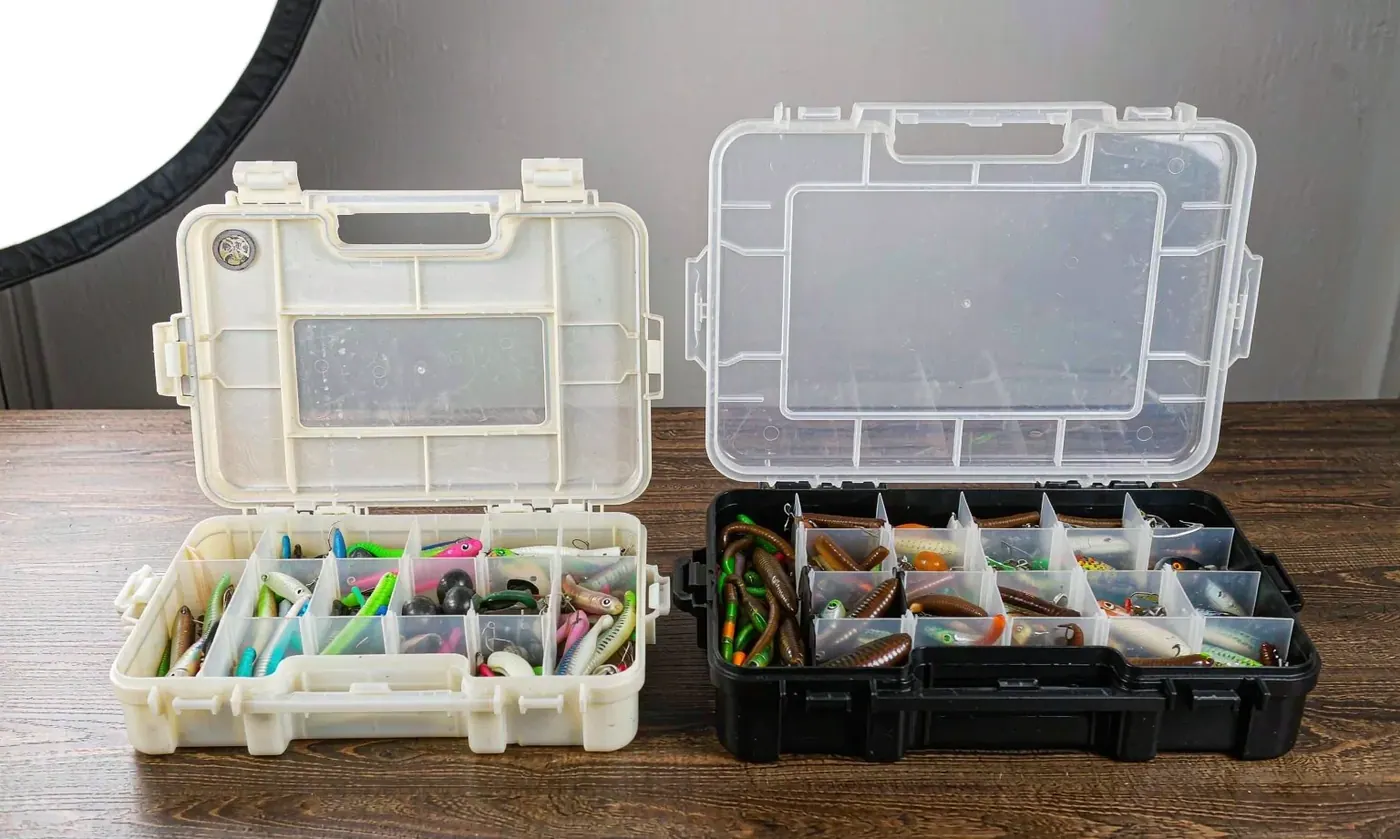
| Medium | 40 x 22 x 26 centimetres | 19 to 21 litres | Five trays stacked, or four plus lunch |
| Large | 50 x 28 x 30 centimetres | 38 to 42 litres | Eight trays, or six plus a cooler insert |
| Deck carrier | 58 x 33 x 33 centimetres | 55 to 60 litres | Twelve trays; superseded by a rolling carrier |
The medium class is the workhorse, and it is the size almost everyone settles on eventually. Anything smaller feels cramped the moment weather clothing goes in, and anything larger becomes genuinely unpleasant to carry further than the vehicle.
The Working Volume Formula
Volume for an open top is straightforward to estimate and rarely matches the printed figure, because none of them include the two reductions that matter: taper, and the practical fill line. Nothing should be loaded to the rim, since contents above that level fall out the moment the tote is lifted or the boat rolls.
- Multiply internal length by width by height, in centimetres, then divide by one thousand for litres.
- Deduct 10 to 15 percent for taper, which reduces the effective footprint toward the base.
- Treat roughly 90 percent of wall height as usable, leaving a practical fill line below the rim.
- Deduct a further litre if there is an internal divider or a moulded sump occupying space.
- Compare that figure against the budget for the session rather than against the printed number.
| Size | Naive litres | After taper and fill line | Realistic |
|---|---|---|---|
| Compact 33 x 18 x 22 | 13.1 litres | Minus about 22 percent | 10 to 11 litres |
| Medium 40 x 22 x 26 | 22.9 litres | Minus about 20 percent | 18 to 19 litres |
| Large 50 x 28 x 30 | 42 litres | Minus about 18 percent | 34 to 35 litres |
| Deck carrier 58 x 33 x 33 | 63 litres | Minus about 18 percent | 51 to 52 litres |
Stability and the Aspect Ratio
Tip resistance is the most common complaint about tall open totes, and it is entirely predictable from one number: the ratio of wall height to the narrower base dimension. Keep it under about 1.3 and the tote behaves well on a moving deck; go beyond 1.6 and it falls over with a bump, whatever the base area is.
| Height to narrow base ratio | Behaviour | Where it works |
|---|---|---|
| Below 1.0 | Very stable, hard to tip | Boat decks and open ground |
| 1.0 to 1.3 | Stable enough for most uses | General purpose; the target range |
| 1.3 to 1.6 | Tips when nudged, especially when empty | Sheltered spots only |
| Above 1.6 | Falls with a bump or a wave | Avoid, regardless of how much it holds |
Balance helps as much as proportion. Loading trays low and keeping only light soft goods above maintains a centre of mass around a third of the wall height, whereas stacking high dramatically increases how much the tote rocks with each movement of the deck.
How Handles Change Everything
Handle geometry is the second design variable unique to this format, and it is frequently wrong. A two-handed tote carrying 12 kilograms asks for a grip that clears the top tray by 60 to 80 millimetres, a contact width of at least 25 millimetres so it does not cut into the palm, and optionally a shoulder strap allowing hands-free movement for the few hundred metres from vehicle to water.
- Grip clearance above the rim should exceed 60 millimetres, otherwise knuckles meet tray lids with every step.
- Webbing width below 20 millimetres becomes painful above about 8 kilograms; 25 to 38 is comfortable.
- Shoulder strap drop should land between 250 and 350 millimetres for most adults to clear hip movement.
- Reinforcement should continue below the rim line, since grips tearing at the top of a wall is the classic failure.
- A second pair of low handles makes emptying far easier, particularly when contents are wet and heavy.
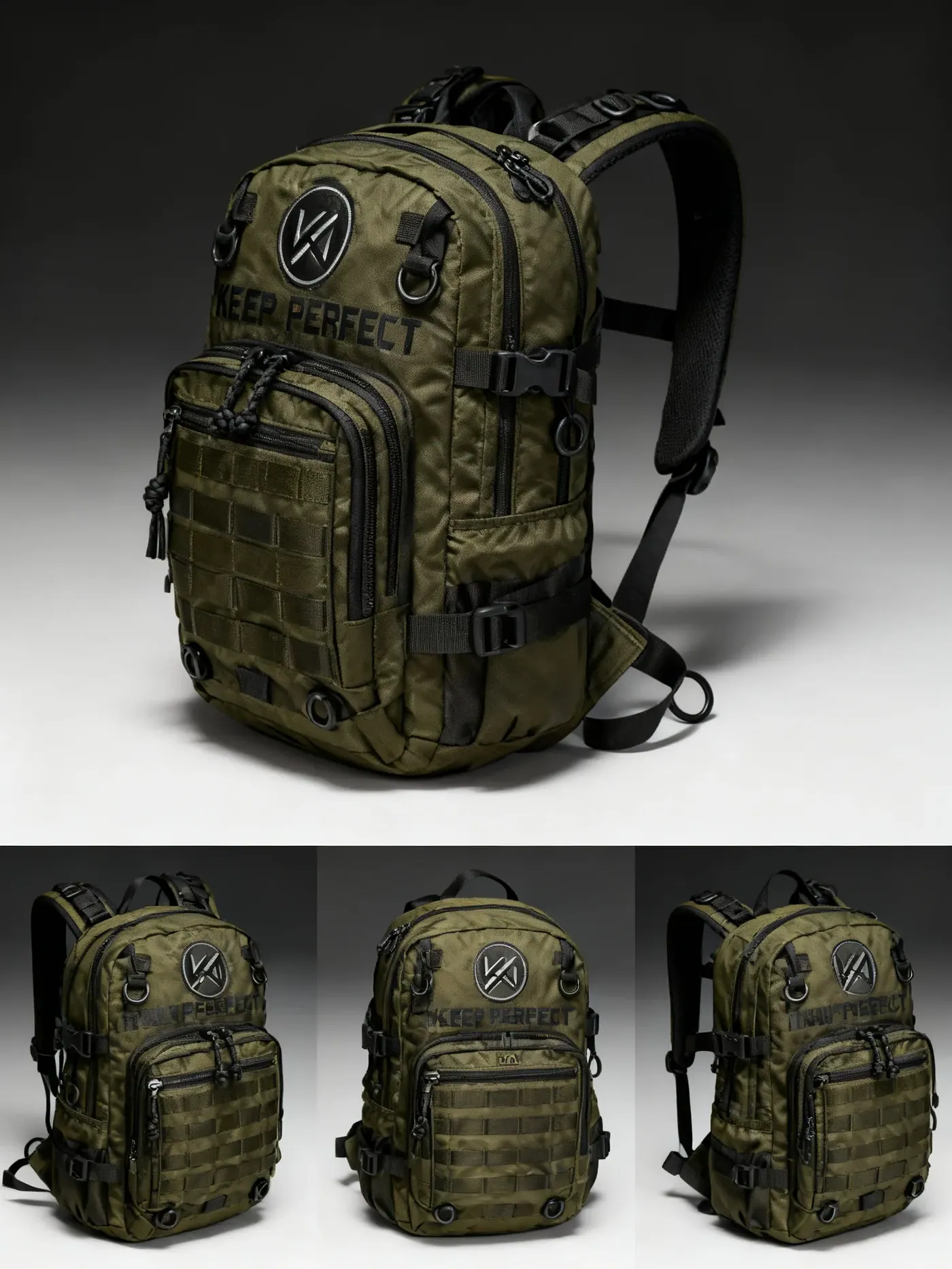
Where a tote will genuinely be carried some distance rather than set down and slid along a deck, a shoulder strap is not optional. Anything above eight kilograms carried by hand for more than a couple of hundred metres stops being amusing by the halfway point.
Two-piece or fold-over handle systems deserve mention for anyone who fishes alone. A grip that can be opened wide makes loading and unloading far easier than one fixed in place, particularly when the tote is full and has to be lifted into a boat from a dock several centimetres higher.
Trays, Inserts and Compatibility
Open tops are unusually forgiving about tray width, because loading from above removes every constraint the zip opening imposes on a backpack. A tote whose internal base exceeds 37 centimetres in one direction accepts standard 3700 trays flat, and one exceeding 29 accepts 3600 trays; nothing about either arrangement requires the exact clearances needed in a zippered bay.
| Internal base dimension | What it accepts | How many, stacked |
|---|---|---|
| Over 29 centimetres one way | Standard 3600 trays flat | Three to six depending on height |
| Over 37 centimetres one way | Standard 3700 trays flat | Two to five depending on height |
| Over 42 centimetres both ways | Two 3600 trays side by side | Doubles stacking capacity |
| Any size with a vertical divider | Trays filed on edge | Access improves; capacity drops slightly |
Filing trays on edge inside a tote gives the same access advantage it gives in a pack, with the added benefit that nothing has to be lifted over the rim to be withdrawn. The trade is that the column needs restraint, otherwise the first decent wave lays it flat.
Water Ingress: The Open Top Problem
The single real weakness of this format is arithmetic anyone can do. A medium tote has a mouth roughly 0.088 square metres across; ten millimetres of rain delivers about 0.9 litres into it, and an hour of heavy rain at 25 millimetres per hour adds well over two litres. On an open boat, spray and wash do the same work faster. Anyone leaving one uncovered for a session should expect the contents to be wet.
| Exposure | Water into a medium tote | Mitigation |
|---|---|---|
| Ten millimetres of rain | About 0.9 litres | A fitted cover, or invert it when not in use |
| Heavy rain for an hour | Over two litres | Cover, or work under a gunwale |
| Bow spray at speed | Larger and intermittent | Keep it behind the windscreen line |
| Deck washdown | Substantial and immediate | Cover directed face-down before washing |
| Condensation in storage | Only dampness | Store dry and open, away from direct sun |
Two design features soften the problem considerably. A drain grommet of 8 to 10 millimetres at the base lets collected water out in seconds without tipping everything, and a raised internal floor of 15 to 25 millimetres keeps trays clear of whatever collects until it can drain.
Open Top Versus Closed Bag
The choice is about access against protection, and the honest answer is that each wins at a different distance from the vehicle. Within a couple of hundred metres on flat ground nothing beats an open top; beyond that, everything about a closed bag becomes preferable. Many experienced anglers own both and use them for different halves of the same trip, which is why the two formats have never displaced one another.
| Factor | Open top tote | Closed backpack |
|---|---|---|
| Access to contents | Instant, one-handed | Requires opening and digging |
| Rain behaviour | Collects water continuously | Sheds everything but the heaviest conditions |
| Carrying beyond 300 metres | Awkward above 8 kilograms | Comfortable well beyond that distance |
| Stability when set down | Stable if proportions are right | Can be knocked over |
| Cleaning after a messy session | Hose it out in seconds | Slower; drains poorly |
| Typical on-board role | Main working container | Transport to the water's edge |
Cleaning and Material Behaviour
Open-top bags are chosen partly because they are easy to clean, and the material decides how easy that actually is. Coated fabrics wipe well but hold residue in their seams; moulded and injection-moulded shells hose out completely and dry in minutes but add weight. Either way, bait residue, fish slime and scale material left overnight become genuinely unpleasant by the following morning, so the rinse should happen the same day.
| Material | Cleaning behaviour | Drying time | Watch for |
|---|---|---|---|
| Coated fabric shell | Wipes clean; seams hold residue | 30 to 60 minutes in air | Seam grime if rinsing is skipped |
| Injection-moulded or moulded shell | Hoses out completely | Around 10 minutes | Higher weight for the same volume |
| Laminated insert or liner | Removable and washable | Depends on liner thickness | Must be removed or it mildews |
| Textile interior with no coating | Poor; absorbs odours | Several hours | Avoid for bait or catch use |
Sun and cold deserve a mention too. Polymers exposed to strong ultraviolet lose surface sheen and stiffen within a couple of summers, while some coatings become noticeably board-like below freezing, which matters for anyone launching in winter. Asking about both is reasonable, and neither answer should cost extra.
Fitting a Tote to Your Boat
Every hull type offers a different rectangle, and buying to the boat rather than to the tackle dramatically improves how the tote behaves on the water. Measure the intended space before ordering, allowing for hatches that swing, seats that swivel and anything else that shares the area.
| Craft | Typical available space | Recommended size | Note |
|---|---|---|---|
| Kayak tank well | Around 40 x 30 centimetres | Compact or medium | Must sit below the bungee line |
| Jon boat or small aluminium | Open floor, variable | Medium to large | Bias toward stability over height |
| Centre console, 18 to 22 feet | Under gunwale or leaning post | Medium | Check clearance under the gunwale |
| Pontoon or deck boat | Generous open deck | Large | Height still matters in chop |
| Pier or jetty fishing | Whatever is railed or flat | Medium | Tip resistance matters most |
Where the space is genuinely tight, insist on internal rather than external dimensions, and add 10 to 15 millimetres to every side for handles that protrude. Nothing is more predictable than a tote that arrives a centimetre too wide for the only place it can live.
Storing and Transporting Them Empty
Empty behaviour matters more than buyers expect, particularly for anyone shipping or storing several. Nesting taper dictates how many fit into a given height, and handle placement decides whether they nest at all. Good designs stack at 45 to 70 millimetres per unit when nested, which is why a dozen of them occupy little more shelf space than three.
- Check nested height per unit before planning returns; above 70 millimetres and a dozen becomes a real storage problem.
- Store empty totes upside down so nothing collects inside and UV falls on the outer face less directly.
- Avoid stacking loaded totes where possible, since plastic rims deform slowly under sustained point loads.
- Keep them out of direct sun between seasons; covered storage doubles the visual life of most materials.
- If shipping flat is an option, ask whether the design collapses; it can cut landed cost per unit substantially.
None of these points decide whether the tote fishes well, but together they decide whether owning several of them is convenient or a nuisance, and that distinction shows up every time the season starts.
Choosing Between Two Sizes That Both Fit
Buyers regularly narrow the field to two sizes and then stall, usually because both genuinely fit the available space. Six questions resolve it quickly, and they consistently push people toward the smaller option, which is the direction most people later wish they had taken.
| Question | Points to the smaller size | Points to the larger size |
|---|---|---|
| Is it carried more than 200 metres? | Yes | Only vehicle to deck |
| Does anything else live in the space? | Yes, and competes for room | The space is dedicated |
| Will it be lifted by one person regularly? | Yes | Two people or rarely moved |
| Are most sessions short? | Yes | Full days with changing conditions |
| Does it ever sit uncovered in rain? | Smaller collects less | Cover exists or it is sheltered |
| Will children use it? | Yes, strongly smaller | Adults only |
When in doubt, the smaller tote nearly always proves correct, because a container that runs slightly short forces prioritisation and a large one merely accommodates growth that nobody wanted. Trays left at home are the cheapest capacity upgrade available, and they weigh nothing.
The one exception is worth stating plainly: where the tote stays put on a boat and functions as deck storage rather than as a carried item, buy as large as the allocated rectangle allows. Nothing about carrying penalties applies, and the extra space gets used within a couple of trips.
Sizing for a Programme
QUANZHOU JUNYUAN BAGS has handled waterproof bag work since 2014, behind a founding team whose trade experience began in 2004. Monthly output reaches 200,000 units under SGS verification and BSCI and ISO 9001 governance; materials are screened against REACH and California Prop 65 and lots are inspected at AQL 2.5 before release. Tote geometry is developed from the base rectangle upwards, since that is what determines both tray compatibility and tip resistance.
Send internal base dimensions, target volume, intended tray format, handle specification, whether a drain and raised floor are required, material, colours, and quantity. Coated fabric and seam performance can be specified against published methods from ASTM International, and exposure assumptions for open decks can be checked against sea and weather data published by NOAA. Development starts at 500 pieces per design and colour, with six to ten working days for sampling and thirty-five to fifty days for bulk from approval and deposit, shipped FOB Xiamen or DDP to more than one hundred destinations. Send drawings to service@junyuanbags.com. The current range is shown on the fishing tackle tote page, models are compared in the tote roundup, and capacity conversion is explained in the litres guide.
People Also Ask
What size is a standard open-top fishing tote?
Medium models measure about 40 by 22 by 26 centimetres internally, giving roughly 19 to 21 litres and holding five trays. Large ones run near 50 by 28 by 30 centimetres.
Should I measure a tote by litres or by its base?
By the base. The footprint decides what can lie flat inside, whether it fits its space, and whether it stays upright, none of which follow from litres alone.
What stops an open tote tipping over?
Keeping wall height below about 1.3 times the narrower base dimension, and loading heavy trays low so the centre of mass stays near a third of the height.
How much rain does an open tote collect?
A medium mouth of roughly 0.088 square metres takes about 0.9 litres per ten millimetres of rain, and heavy rain adds more than two litres in an hour.
Can a tote hold larger 3700 trays?
Yes, if any internal base dimension exceeds about 37 centimetres. Loading from above removes the zip constraints that limit smaller bags.
Is a tote better than a backpack on a boat?
Yes within a short carry, since everything stays reachable one-handed. Beyond about three hundred metres, or when it rains, the closed bag wins clearly.
Frequently Asked Questions
Q1. What dimensions should I look for in a fishing tote?
Start with the internal base: around 29 centimetres lets standard trays lie flat, 37 accepts larger ones, and wall height should stay under about 1.3 times the narrower base figure.
Q2. How many litres is a 40 by 22 by 26 centimetre tote?
About 23 litres naive, and around 18 to 19 realistically once taper and a practical fill line below the rim are deducted.
Q3. Why does my tote fall over when empty?
Its height to base ratio is too tall, usually above 1.6, so even a light nudge moves the centre of mass outside the footprint.
Q4. How much can a fishing tote carry comfortably?
Up to about 8 kilograms carried one-handed for short distances. Larger deck carriers go beyond that, but they are slid along decks rather than carried.
Q5. Do I need a drain in a tote?
Yes if it will sit uncovered. An 8 to 10 millimetre grommet empties collected water in seconds, and a raised floor of 15 to 25 millimetres keeps trays clear meanwhile.
Q6. How much rain can I expect inside during a session?
Roughly a litre per ten millimetres for a medium tote, and over two litres in an hour of heavy rain, so a cover or shelter is genuinely necessary rather than optional.
Q7. What handle specification matters most?
Grip clearance above the rim above 60 millimetres and webbing at least 25 millimetres wide, reinforced below the rim rather than stitched into it.
Q8. Can I file trays on edge inside a tote?
Yes, and it improves access considerably, provided something restrains the column; without restraint the first real wave lays it flat.
Q9. Is a larger base better than extra height?
Almost always. Base area adds stability and tray options, whereas height merely raises the centre of mass and the chance of tipping.
Q10. When should I choose a backpack over a tote?
Whenever the carry exceeds a few hundred metres or the weather is genuinely wet, since a closed shell protects contents and carries mass far more comfortably.