A fishing duffel is a stowage format rather than a carry format, and it beats a backpack on a boat for one reason: it can be loaded, stacked, and pushed into a hatch without being worn. Nine duffel and boat gear builds were assessed for 2026 across 30-70 litres, removable tray inserts holding two to eight 3600 trays, moulded drained bases, IPX5 to IPX7 protection, and 22-54 USD FOB Xiamen bands at MOQ 500 pcs per design and colour. Sampling runs 6-10 working days and bulk 35-50 days. The pick is the 45 L deck duffel at 1.35 kg.
Why a Duffel Wins on a Boat and Loses on the Bank
On a boat the bag does not need to be comfortable, because it is carried 50-200 m from the vehicle to the deck and then sits still for eight hours. What it needs is a flat stable base, a shape that fits the stowage space, and a mouth that opens wide enough to reach anything inside without unpacking. A backpack is worse at all three, because a backpack is optimised for the opposite job.
On a bank the calculation reverses completely. A duffel carried over 1 km is uncomfortable regardless of strap padding, because a single shoulder strap or a pair of grab handles cannot stabilise a 12 kg load against the body. The honest specification is therefore a carry distance limit, and stating it in the listing prevents the most common wrong purchase in this category.
| Carry distance | Right format | Why | Wrong choice |
|---|---|---|---|
| Under 100 m | Duffel or tote | Stowage shape matters more than comfort | Backpack, harder to load |
| 100-500 m | Duffel with a shoulder strap | Short haul, then stowage | Wheeled bag on soft ground |
| 500 m to 2 km | Convertible duffel with a harness | Needs real load transfer | Pure duffel, shoulder fatigue |
| Over 2 km | Backpack | Two shoulders and a hip belt | Any duffel format |
Stowage Dimensions Come Before Litres
A boat gear bag is bought by litre and used by dimension, and those two rarely agree. A 60 L duffel that is 600 mm wide does not enter a hatch of 360 mm, and it does not fit a kayak tankwell either. The three dimensions that decide whether a bag works on a given boat are width, height, and whether the body can be compressed by about 15 percent when loaded.
| Stowage space | Opening | Body that fits | Volume that fits | Note |
|---|---|---|---|---|
| Boat hatch | 360 mm round | Under 340 mm wide | 30-45 L | Compressible body helps |
| Kayak tankwell | 400 x 500 mm | Under 360 mm tall | 30-40 L | Low profile beats volume |
| Rod locker | 250 mm deep | Under 230 mm tall | 25-35 L | Flat bags only |
| Cabin berth | Unrestricted | Any | Up to 70 L | Shape irrelevant, weight matters |
Compression is the specification buyers overlook. A body with a moulded base but a soft upper can be squeezed by 15 percent at the mouth, which is the difference between a 45 L bag entering a 360 mm hatch and staying on the dock. That behaviour requires the base to be rigid and the upper to be unstructured, which is exactly how the best boat bags in this group are built.
Tray Inserts: Why a Duffel Needs Structure
A duffel without an insert is a sack, and trays in a sack lie at whichever angle gravity chooses, which usually means on their side with the lids pointing at the floor. The fix is a removable semi-rigid insert with rails, and it is the single feature that separates a fishing duffel from a general sports bag.
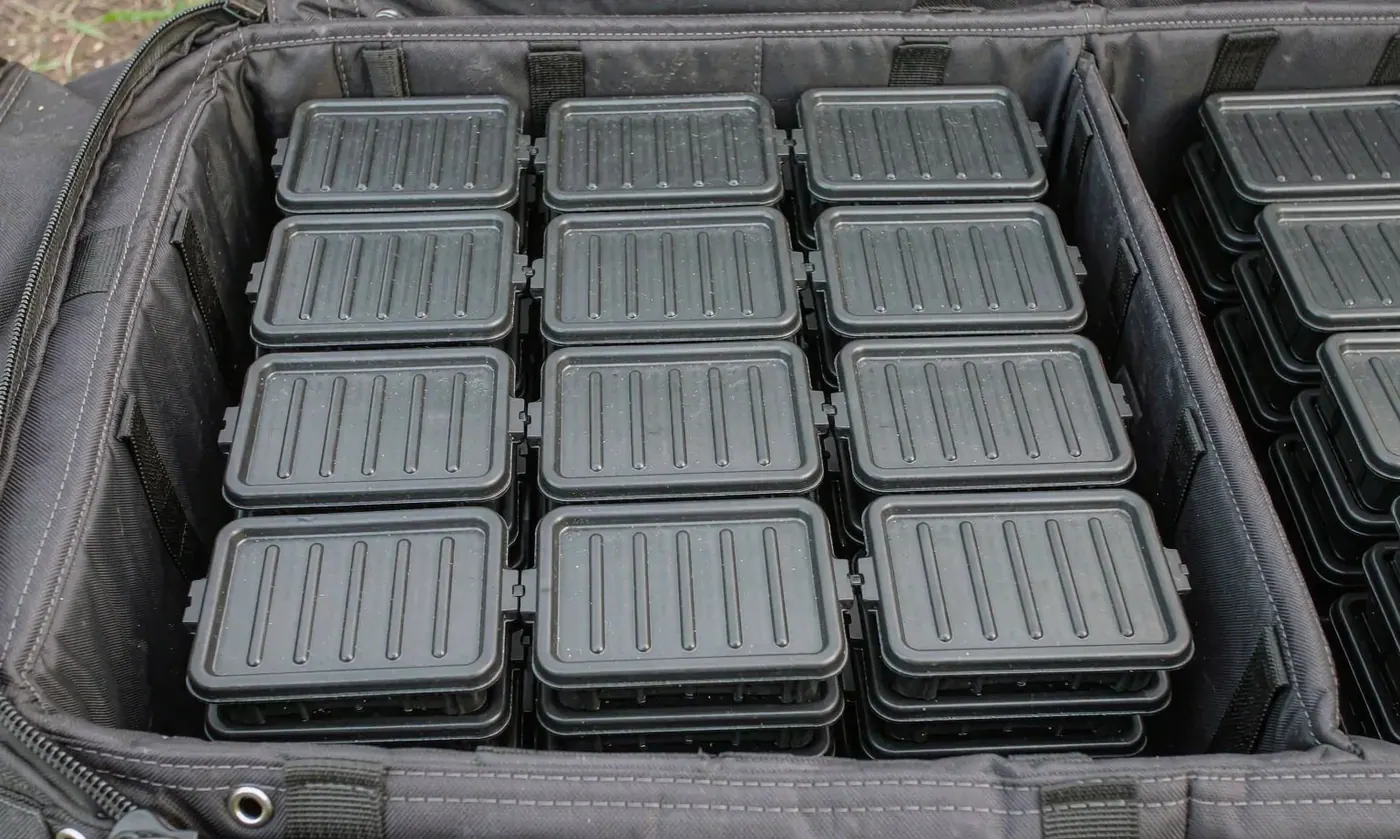
The insert should be removable because a duffel is also used for clothing, wet gear, and a catch bag, and a fixed rail system ruins those uses. A good insert weighs 350-500 g, holds two to eight trays depending on shell size, and lifts out in about 10 seconds. Its rails need the same 3-5 mm pitch allowance over tray height as a backpack, since trays are held to about plus or minus 0.8 mm.
The Nine Builds at a Glance
Volume is main-chamber capacity with the insert fitted. Base type is listed because it decides whether the bag can be set down on a wet deck without soaking the contents, and it is the most expensive single component after the closure. The wider tote format is tracked in the fishing tote ranking, and wheeled options are compared in the rolling tackle bag guide.
| Build | Volume | Weight | Trays in insert | Base | FOB band |
|---|---|---|---|---|---|
| Deck 45 | 45 L | 1.35 kg | 4 x 3600 | Moulded, drained | 28-35 USD |
| Gear 60 | 60 L | 1.75 kg | 6 x 3600 | Moulded, drained | 34-42 USD |
| Compact 30 | 30 L | 1.05 kg | 2 x 3700 | Moulded | 22-28 USD |
| Submersible 55 | 55 L | 2.10 kg | 6 x 3600 | Welded, sealed | 44-54 USD |
| Multi-Day 70 | 70 L | 2.40 kg | 8 x 3600 plus clothing | Moulded, drained | 42-52 USD |
| Wet-Gear 40 | 40 L | 1.50 kg | 4 x 3600 | Moulded, drained, divided | 26-33 USD |
| Convertible 50 | 50 L | 1.85 kg | 5 x 3600 | Moulded, drained | 36-45 USD |
| Kayak 35 | 35 L | 1.20 kg | 3 x 3600 | Moulded, low | 28-35 USD |
| Charter 65 | 65 L | 2.20 kg | 6 x 3700 | Moulded, replaceable | 40-49 USD |
1. Deck 45: Best Overall
Forty-five litres at 1.35 kg with a removable insert holding four 3600 trays, a moulded drained base, and a U-shaped mouth that opens to 480 mm. It fits a 360 mm hatch once compressed at the mouth and it stands upright on a wet deck. The FOB band is 28-35 USD.
It leads because the three boat-specific requirements are all met without over-specifying: the base is moulded so the contents stay off the deck, the insert is removable so the bag also works for clothing, and the mouth is wide enough to reach the bottom tray without lifting the insert. Nothing about it is designed for carrying, which is correct.
2. Gear 60: Best Capacity
Sixty litres at 1.75 kg holding six 3600 trays in a two-tier insert, with a moulded drained base and four external grab handles placed so two people can carry a 15 kg load. The FOB band is 34-42 USD.
Handle placement is the specification that matters at this size. A 15 kg duffel lifted by two handles at the ends puts the load on the wrists and strains the closure, and four handles spaced at 300 mm intervals let two people carry it properly. Handles should be bar-tacked through a reinforced patch carrying at least 25 kg, not stitched into the face fabric.
3. Compact 30: Best for Small Boats
Thirty litres at 1.05 kg holding two 3700 trays, sized at 330 mm wide so it drops through a standard hatch without any compression trick. The FOB band is 22-28 USD, and it is the build for kayaks, small aluminium boats, and anglers who already keep a bigger bag in the vehicle.
The useful detail is the flat profile at 230 mm tall, which lets it slide under a seat or into a rod locker. Capacity is genuinely modest, and that should be stated plainly: two deep trays and tools, or one deep tray plus clothing. Buyers who want four trays need the 45 L build and a wider hatch.
4. Submersible 55: Best for Open Boats
Fifty-five litres at 2.10 kg inside a welded liner rated IPX7 for 30 minutes at 1 m, holding six 3600 trays, with a sealed base and a drain path. The FOB band is 44-54 USD, roughly 14 USD above the equivalent spray-rated duffel.
A submersible duffel needs a drain, and this is where most attempts fail: a welded shell with no drain becomes a bath once trays go in wet. A grommet at the base plus a channel in the moulded floor costs about 1.20 USD and removes the problem. Ratings are defined by the IEC ingress protection framework, and a claim without a depth and duration means nothing.
5. Multi-Day 70: Best for Travel
Seventy litres at 2.40 kg with eight 3600 trays in the insert plus a separated clothing chamber at one end, on a moulded drained base. It is the build for a travelling angler or a charter trip of several days from one base. The FOB band is 42-52 USD.
Separation is what makes 70 L usable rather than cavernous. Clothing and tackle in one chamber means lifting the insert to find a jacket, and in practice anglers stop using the clothing space entirely. A divider costs about 3.20 USD. At 2.40 kg this bag should be carried with the harness or by two people, and never over 500 m.
6. Wet-Gear 40: Best for Wet Kit
Forty litres at 1.50 kg with a divided base compartment: a drained lower section for wet boots, waders, and a rain shell, and a dry upper section with the insert holding four 3600 trays. The FOB band is 26-33 USD.
The drainage specification is the whole product. The lower section needs a moulded floor sloped at about 3 degrees toward two 12 mm grommets, so water leaves rather than pooling at one corner. Airflow matters as much as drainage: two vent panels of 80 x 120 mm with mesh stop a wet compartment turning sour within a weekend.
7. Convertible 50: Best for Mixed Carries
Fifty litres at 1.85 kg with a stowable backpack harness that zips into a rear sleeve, holding five 3600 trays on a moulded drained base. It suits an angler who walks 500 m to 1 km and then wants stowage shape. The FOB band is 36-45 USD.
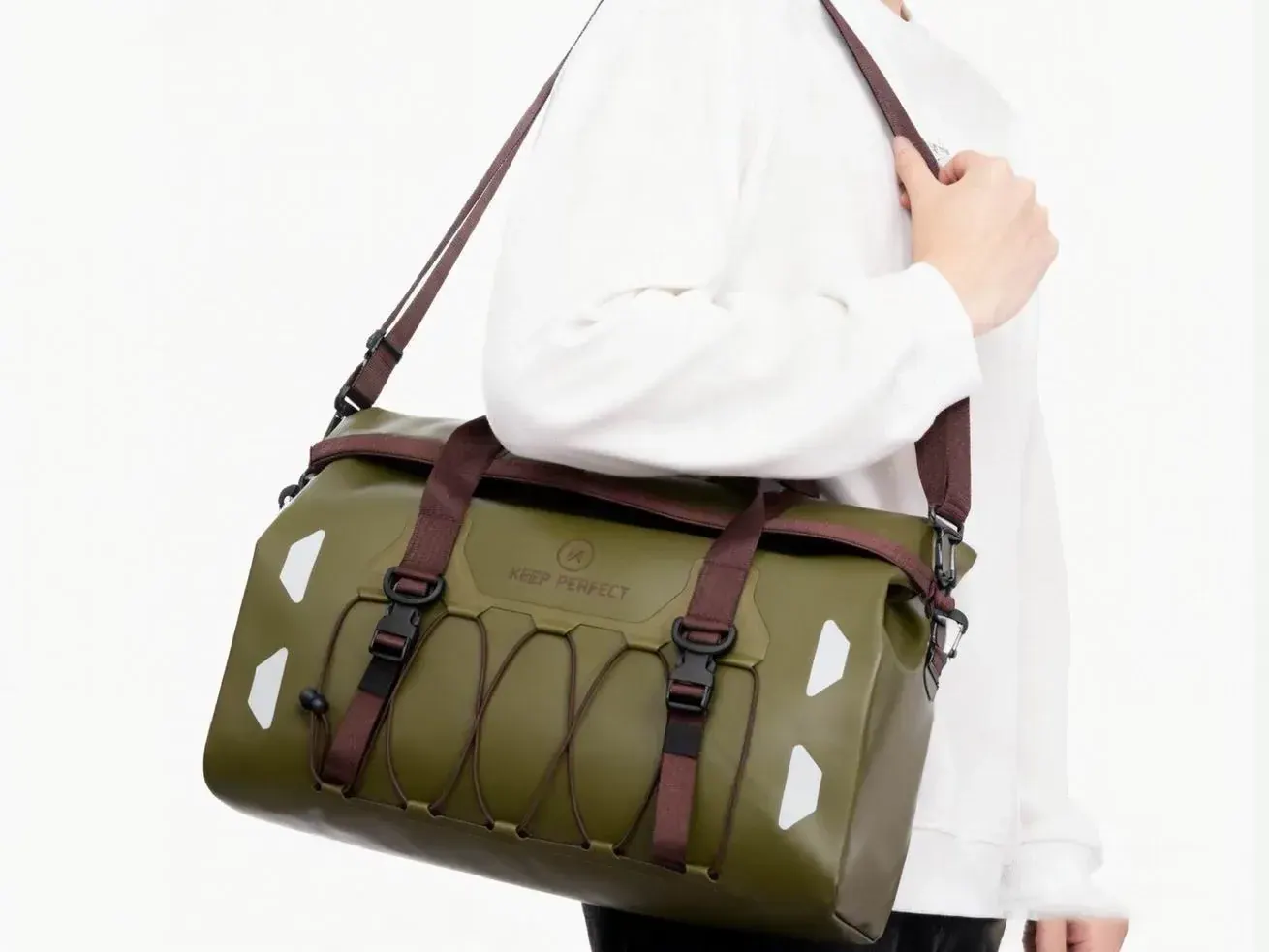
The harness must be real to be worth the 3.50-4.50 USD it costs: 45 mm straps with 8 mm foam and a webbing belt, not two unpadded webbing loops. It also must stow flush, because a bag with harness webbing protruding catches on hatch lips and on vehicle seats. Test the conversion both ways with the bag loaded, since an empty conversion proves little.
8. Kayak 35: Best for Kayaks
Thirty-five litres at 1.20 kg built low at 340 mm tall and narrow at 320 mm, holding three 3600 trays, with corner leash points and a closed-cell float panel. The FOB band is 28-35 USD.
Height is the governing dimension in a tankwell, and 340 mm is what clears a seat back and a paddle stroke. Flotation is the second kayak requirement: a bag holding 8 kg of tackle sinks, and a panel adding float for 5-6 kg costs about 1.50 USD. Flotation aids for people are regulated and a bag is not one of them, as the United States Coast Guard guidance on personal flotation devices makes clear, so the panel is about recovering gear, not about safety.
9. Charter 65: Best for Charter and Guide Use
Sixty-five litres at 2.20 kg holding six deep 3700 trays, built for daily commercial use with a replaceable base panel, bolted handles, and a serviceable closure. The FOB band is 40-49 USD, which reflects duty cycle rather than capacity.
Serviceability is what earns the price. A charter bag is dragged across a deck 150 times a season and the base wears through first, so a base panel that unbolts in about 10 minutes turns a replacement into a repair. Handles are bolted rather than stitched for the same reason, and the closure is a model available as a spare part.
Keeping Valuables and Electronics Dry
A boat bag sits where spray lands and where a wash-down hose reaches, and the contents most at risk are not the lures. A phone, a set of keys, a licence, and a camera body are carried on every trip, and a duffel mouth that has been opened ten times in the rain has let water in ten times.
| Item | Exposure on a boat | Protection | Cost |
|---|---|---|---|
| Phone and keys | Spray and wash-down | Sealed liner pouch | 1.00-2.00 USD |
| Camera body | Salt spray, condensation | Liner plus silica sachet | 1.80-2.60 USD |
| Licence and documents | Rain through the mouth | Rigid waterproof sleeve | 1.60-2.40 USD |
| Spare clothing | Wet gear compartment | Divided dry chamber | 3.00-4.50 USD |
| Bait and food | Cross-contamination | Sealed insulated pocket | 3.50-5.00 USD |
Condensation deserves a specific note because it is mistaken for leakage. A sealed bag loaded with wet trays and closed on a hot deck will show moisture on the inside of the shell within two hours, and buyers read that as a failed seam. A vented liner plus a silica sachet resolves it for about 1.20 USD, and it should be mentioned in the care card rather than left to be discovered.
Checks Before Approving a Boat Bag Sample
Boat bags fail in ways that are easy to test and expensive to discover after 500 units are cut. Five checks take about an hour on an approval sample, and the first two are the ones that decide whether the bag can be sold as a boat bag at all.
| Check | Method | Pass condition | Catches |
|---|---|---|---|
| Hatch test | Push loaded bag through a 360 mm hatch | Passes without force | Wide body sold for boats |
| Wet deck test | Stand on a wet deck 30 minutes | Contents dry | Fabric base instead of moulded |
| Drain test | Pour 2 L into the wet compartment | Drains in under 60 seconds | Flat floor, no slope |
| Handle pull | Pull each handle to 25 kg | No stitch pull-out | Handles sewn to face fabric |
| Insert lift | Remove the loaded insert, timed | Under 10 seconds | Insert that traps the trays |
Strength and coating requirements should be written against published methods from ASTM International, including abrasion on the base panel, which is the component that fails first in service. A bag that passes every check but wears through its base in one charter season is a bag that gets returned by the trade rather than by the customer.
Programme, Pricing, and Compliance
A boat bag brief should open with the stowage opening, because that decides the shape and therefore the rest of the design. Specify the base type next, then drainage, then tray insert capacity, and treat litres as an outcome. Settling shape first avoids the most expensive revision in this category, which is a re-cut body after sampling.
| Programme item | Baseline | Note |
|---|---|---|
| MOQ | 500 pcs per design and colour | Base colour can be split above the baseline |
| Sampling | 6-10 working days | Add 5-7 days for a moulded base tool |
| Bulk | 35-50 days | From approved sample and deposit |
| Inspection | AQL 2.5 | Include hatch test, wet deck, drain time, handle pull |
| Compliance | REACH and California Prop 65 | Screen coatings, films, inks, hardware, foam |
QUANZHOU JUNYUAN BAGS has run waterproof bag programmes since 2014, with the founding team active in the trade since 2004. Monthly output of 200,000 units is verified by SGS, and BSCI and ISO 9001 systems structure the workflow. Materials are screened for REACH and California Prop 65, and every bulk order is inspected at AQL 2.5 before shipment.
A boat gear brief can be emailed to service@junyuanbags.com with stowage opening, tray count, base type, rating, and quantity. FOB Xiamen or DDP service to more than 100 countries follows an approved sample and a complete test record. The open-top alternative sits in the fishing tackle tote range.
People Also Ask
Is a duffel better than a backpack for boat fishing?
Yes for carries under 500 m, because a duffel loads, stacks, and enters a hatch without being worn. Over 2 km a backpack wins on comfort every time.
What size duffel fits through a boat hatch?
A body under 340 mm wide for a standard 360 mm hatch, which usually means 30-45 L. Width decides fit, not litres.
Do fishing duffel bags need a tray insert?
Yes. Without a removable semi-rigid insert, trays lie on their side with lids pointing at the floor. A good insert weighs 350-500 g and lifts out in about 10 seconds.
Why does my boat bag smell after a weekend?
Wet trays or wet gear in a compartment with poor drainage and no airflow. A floor sloped about 3 degrees to two 12 mm grommets plus mesh vent panels fixes it.
Should a fishing duffel be submersible?
Only for open boats and kayaks. IPX7 adds 11-14 USD and needs a drain path, because a welded shell holding wet trays becomes a bath without one.
How much weight can duffel handles carry?
Handles should be rated to 25 kg and bar-tacked through a reinforced patch. On a 60 L bag, four handles spaced at 300 mm let two people share a 15 kg load.
Frequently Asked Questions
Q1. What is the best fishing duffel bag?
A 45 L build at 1.35 kg with a removable insert for four 3600 trays, a moulded drained base, and a 480 mm mouth, at a 28-35 USD FOB band.
Q2. What size fishing duffel suits a boat?
30-45 L for a standard 360 mm hatch, and up to 70 L where stowage is unrestricted. Width under 340 mm is the dimension that decides whether it goes aboard.
Q3. Can a fishing duffel hold tackle trays?
Yes, with a removable semi-rigid insert. Two trays in a 30 L shell, four in 45 L, six in 55-60 L, and eight in 70 L.
Q4. How far can I carry a fishing duffel comfortably?
About 200 m with a shoulder strap and 500 m with a stowable harness. Beyond 2 km a backpack is the correct format regardless of strap padding.
Q5. Should a boat gear bag have a moulded base?
Yes. A moulded drained base keeps the contents off a wet deck and adds about 2.40-4.00 USD. It also gives the compression behaviour needed to enter a hatch.
Q6. Why does water pool in my duffel compartment?
The floor is flat and the grommets are too small. A floor sloped about 3 degrees toward two 12 mm grommets drains 2 L in under 60 seconds.
Q7. Is a waterproof duffel worth the extra cost?
For open boats and kayaks, yes: IPX7 adds 11-14 USD and requires a drain path. For cabin boats and short trips, IPX5 with a moulded base is enough.
Q8. What is a wet gear compartment?
A divided lower section with a sloped drained floor and mesh vents, holding wet boots, waders, and a shell separately from trays and clothing.
Q9. How many handles should a 60 litre duffel have?
Four, spaced at about 300 mm, each rated to 25 kg and bar-tacked through a reinforced patch. Two end handles put a 15 kg load on the wrists and strain the closure.
Q10. Will a fishing duffel float if it goes overboard?
Only if built with a closed-cell float panel, which costs about 1.50 USD and is sized for 5-6 kg. A bag is not a personal flotation device under USCG rules.
Q11. Why is there moisture inside my sealed bag?
Condensation from wet trays on a hot deck, not leakage. A vented liner plus a silica sachet resolves it for about 1.20 USD, and it belongs in the care card.
Q12. What is the MOQ and lead time for a fishing duffel programme?
MOQ is 500 pcs per design and colour, samples take 6-10 working days plus 5-7 days for a moulded base tool, and bulk runs 35-50 days from approved sample and deposit.