Kayak fishing gear is chosen on fit before features: the tank well or hatch decides the dimensions, and immersion is the default rather than the exception. Nine bags and crates were assessed for 2026 across 12-45 usable litres, with plan footprints from 300 x 220 mm to 460 x 340 mm, rod holder counts from zero to four, and IPX6 to IPX7 ratings, at 16-46 dollar FOB Xiamen bands for MOQ 500 pcs per design and colour. Samples take 6-10 working days and bulk runs 35-50 days. The best all-round choice is the 30 L tank-well bag with four tie-down loops.
The Kayak Constraint: Fit Before Features
Every other fishing format lets the buyer choose volume first and worry about where the bag goes afterwards. Kayak fishing does not. A tank well has a fixed footprint, a hatch has a fixed aperture, and a bag that does not fit either is useless no matter how good it is. That is why the dimension table below comes before the volume table, and why the most common return in this category is a bag that is simply too big.
The second constraint is that the angler is seated and strapped in. Anything needed during the session has to be reachable without standing, which means the bag either sits behind the seat within arm reach or in front of it on the deck. That single fact decides whether a buyer should be looking at a bag, a crate, or a hatch insert, and it is the question to answer before any specification is written.
| Position | Typical aperture or footprint | Access while seated | Best format |
|---|---|---|---|
| Rear tank well | 400 x 300 mm to 600 x 400 mm | Reach behind, partial | Crate or tank-well bag |
| Round hatch | 150-250 mm diameter | No, storage only | Hatch bag or dry liner |
| Oval hatch | About 300 x 450 mm | No, storage only | Hatch bag, larger items |
| Front deck | Open, bungee rigged | Yes, full | Deck bag or small crate |
| Behind the seat, on deck | About 300 x 250 mm | Yes, full | Seat-back bag |
The Nine Builds at a Glance
Plan footprint is the base of the bag measured flat, and it is the number to compare against the tank well. Rod holders are counted as vertical tubes capable of holding a rod butt, not as straps. Buoyancy is whether the build floats when fully loaded and closed, which matters more on a kayak than anywhere else because anything that goes overboard without a leash is gone.
| Build | Volume | Plan footprint | Rod holders | Rating | FOB band |
|---|---|---|---|---|---|
| Tankwell 30 | 30 L | 400 x 300 mm | Two | IPX6 | 24-31 USD |
| Crate 35 System | 35 L | 360 x 330 mm | Four | Not rated | 30-38 USD |
| Hatch 18 | 18 L | Fits a 200 mm round hatch | Zero | IPX7, 1 m / 30 min | 20-26 USD |
| Crate 24 Compact | 24 L | 330 x 300 mm | Two | Not rated | 22-29 USD |
| Rod Tube 22 | 22 L | 380 x 260 mm | Three tubes | IPX6 | 26-33 USD |
| Seat-Back 12 | 12 L | 300 x 250 mm | One | IPX6 | 18-24 USD |
| Crate 45 Heavy | 45 L | 460 x 340 mm | Four | Not rated | 38-46 USD |
| Dry 25 Submersible | 25 L | 360 x 280 mm | Zero | IPX7, 1 m / 30 min | 28-35 USD |
| Starter 20 | 20 L | 340 x 260 mm | One | IPX5 | 16-21 USD |
Immersion Is the Default, Not the Exception
A kayak bag is wet from the first minute. Water sits in the tank well, spray comes over the bow, and a capsize puts everything in the water. That is why every soft build in this ranking is rated IPX6 or better, and why the two highest-rated builds are rated IPX7 at 1 m for 30 minutes. Ingress codes are defined by the IEC ingress protection framework, and the depth and duration are the part that carries the meaning.
Crates are the exception and it should be stated honestly: an open crate is not waterproof and cannot be. That is acceptable because a crate holds trays that are already in sealed boxes, and because the crate is tied down rather than sealed. What a crate needs instead is drainage, so it does not carry litres of water in the bottom for the whole trip.
| Exposure | Rating or answer | Design feature | Note |
|---|---|---|---|
| Standing water in the well | IPX6 minimum | Raised base, drain grommets | Base grommets 15-25 mm up |
| Spray over the bow | IPX6 | Covered closure | Garage over the zip |
| Capsize | IPX7, 1 m / 30 min | Roll-top or sealed liner | Plus a leash on the bag |
| Open crate | Not applicable | Drain holes in the floor | Trays are sealed boxes anyway |
| Electronics | Sealed 3-5 L liner | Separate from trays | Bright colour, tested seasonally |
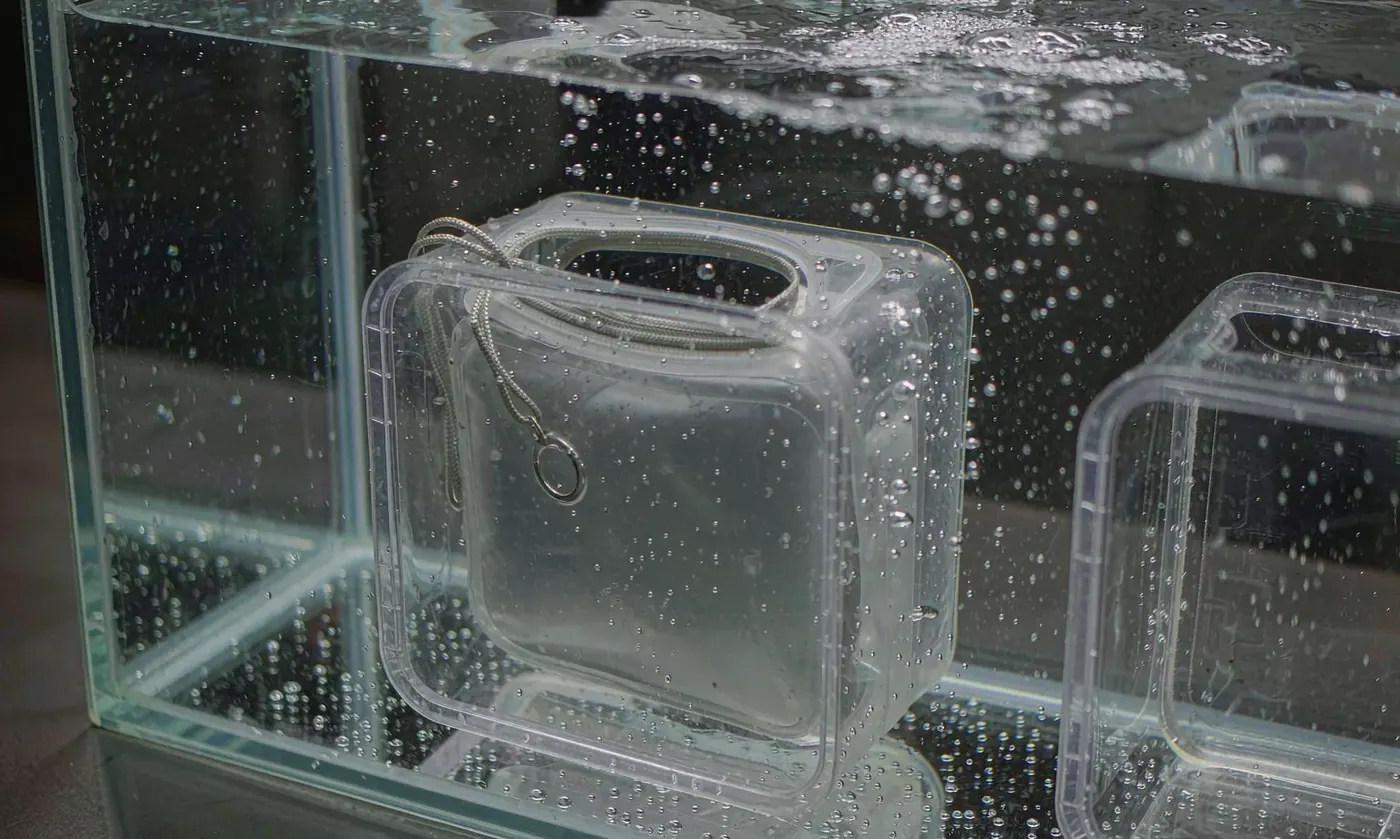
The practical answer for electronics is always a liner rather than a bag rating. A 3-5 L sealed pouch in a bright colour holds a phone, keys, and a licence, costs 1-2 USD, and can be tested on its own in a sink in about a minute. It is the single highest-value item in a kayak kit and it should be supplied rather than sold separately.
Rod Storage on a Kayak
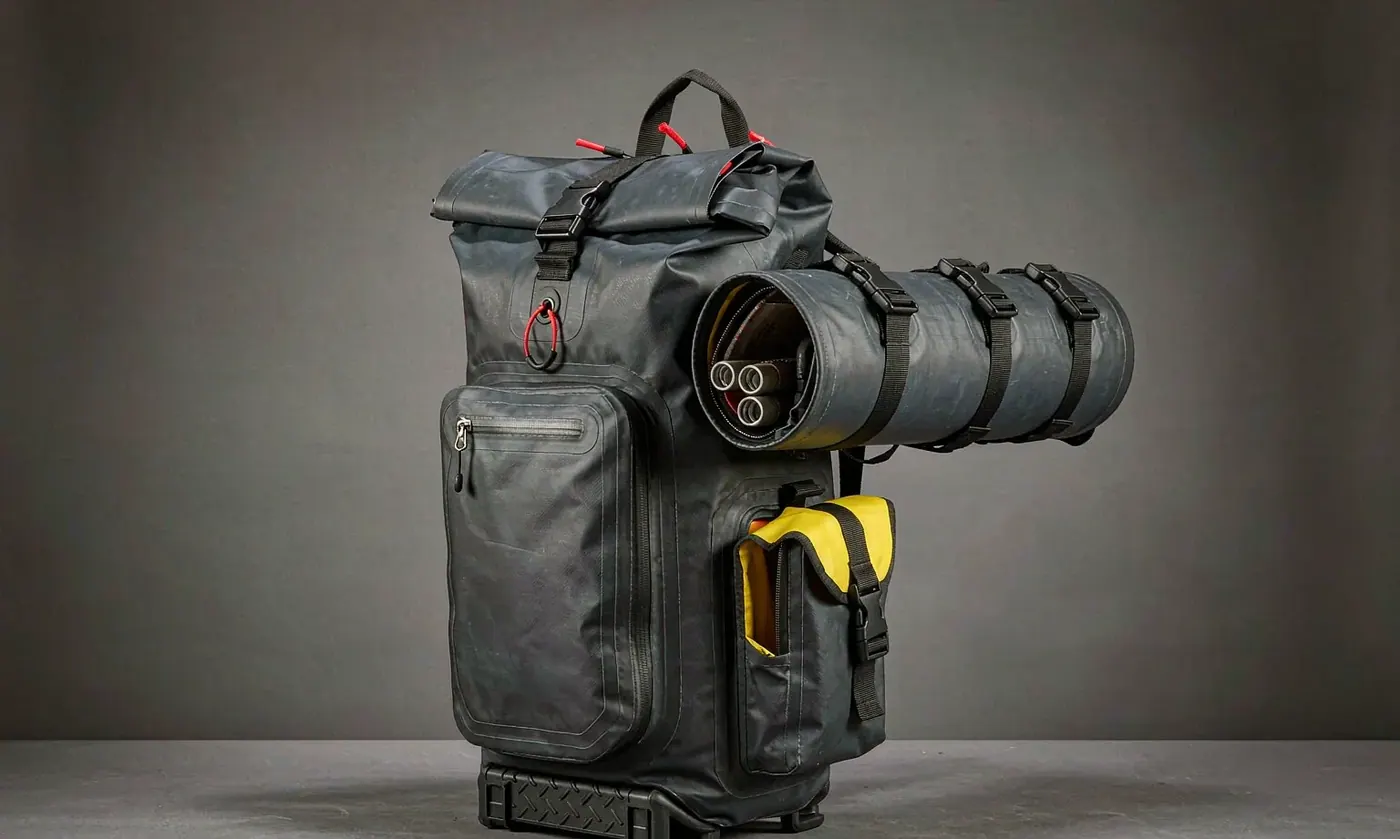
Rod carry is where kayak gear differs most from bank gear. Kayak anglers routinely take two to four rods, they need them stowed while paddling, and they need at least one within reach while fishing. The two solutions are vertical tubes behind the seat for paddling and a horizontal rack or flush mount within reach for fishing, and most serious setups use both.
Vertical tubes need a closed bottom and enough depth: 450 mm of tube depth holds a rod butt securely, and anything shallower lets a rod lever out when the kayak rolls. Horizontal storage needs a retaining bungee across the rod, because a rod lying loose in a well will slide out the moment the boat tips. Both should have a leash point, since a rod that goes overboard is the single most expensive loss in the sport.
| Rod position | Depth or retention | Best for | Risk if wrong |
|---|---|---|---|
| Vertical tube behind the seat | 450 mm minimum, closed bottom | Paddling between spots | Rod levers out on a roll |
| Horizontal rack at the side | Bungee retention across the rod | Fishing, quick change | Rod slides out when the boat tips |
| Flush mount in the hull | Installed fitting | Trolling | Hull penetration if badly fitted |
| Rod leash point | Webbing loop plus a clip | Every rod on board | Rod lost overboard |
The comparison between a crate system and a soft bag is set out in the crate versus tackle backpack article, and hatch sizing is covered in the kayak hatch sizing guide. Both should be read before specifying, because the two decisions interact: a kayak with a good hatch needs less tank-well storage, and one without needs a crate.
1. Tankwell 30: Best All-Round Kayak Bag
A 400 x 300 mm footprint fits the great majority of recreational fishing kayak tank wells, and thirty litres fills it to a sensible height without blocking the rear view or catching on a paddle stroke. Two vertical rod tubes, four corner tie-down loops, base drain grommets at 20 mm, and IPX6. Weight is 1.05 kg and the reference band is 24-31 USD.
The tie-down loops are the feature that earns the recommendation. Four loops at the corners, each with a reinforcing patch, let the bag be bungeed to the well rigging so it cannot shift or leave the boat in a capsize. That is worth more than any pocket count, and it costs about 0.40 USD per unit. Rating is IPX6 because a tank-well bag sits in water rather than under it.
2. Crate 35 System: Best Crate Setup
A crate is the established kayak storage answer for good reasons: it holds trays upright and visible, it takes bolt-on rod holders, it drains, and it costs less than a bag of the same volume. This build is 360 x 330 mm, which fits the same wells as the Tankwell 30, with four rod holder positions and a 35 L usable volume. Reference band is 30-38 USD.
The two specification points are moulding and drainage. Injection-moulded construction keeps the corners square under load where a folded soft crate slumps, and a drain pattern in the floor sheds water in seconds. Add a bungee across the top to retain trays, because an unsecured crate tips its contents the first time the kayak rolls. Rod holders should be bolted rather than clipped.
3. Hatch 18: Best for Hatch Storage
A hatch bag exists to use space that nothing else can reach, and it is sized by the aperture rather than by volume. This build passes through a 200 mm round hatch, which covers the most common recreational size, and holds 18 L once inside. Rating is IPX7 at 1 m for 30 minutes, because anything stored in a hull compartment must be assumed to get wet. Reference band is 20-26 USD.
The practical detail is the grab loop. A bag inside a hull compartment is retrieved blind, by feel, so it needs a webbing loop at the top that can be found with one hand and pulled. Without it, the bag becomes permanent storage, which is a complaint rather than a feature. A bright interior colour also helps, because hull compartments are dark.
4. Crate 24 Compact: Best for Small Kayaks
Smaller kayaks and paddleboards have tank wells around 330 x 300 mm, and a standard crate does not fit. This build is dimensioned for them at 24 L with two rod holder positions, a lower profile of 240 mm so it does not block the rear view, and the same moulded construction and floor drainage as the larger crate. Reference band is 22-29 USD.
The honest limit is capacity: two rod holder positions and 24 L is a half-day kit. Buyers should pair it with a hatch bag rather than try to stretch it, and the combination of a 24 L crate plus an 18 L hatch bag covers more real use than one oversized crate. Weight is 0.95 kg and it can be carried one-handed from vehicle to water.
5. Rod Tube 22: Best for Multi-Rod Anglers
Anglers carrying three rods need dedicated storage, and this build provides it: three vertical tubes of 460 mm depth with closed bottoms, a drain channel between them, and 22 L of tray space alongside. Footprint is 380 x 260 mm, weight 1.15 kg, rating IPX6, and the reference band is 26-33 USD. Each tube takes a rod up to 2.4 m with the butt seated.
Tube spacing is the detail that matters and is usually wrong on cheap designs. Tubes need at least 60 mm between centres, or reels foul each other and rods cannot be withdrawn independently. This build uses 70 mm, which allows a reel to be left on one rod without jamming the next. Add a leash point per tube, because three rods is three losses in a single capsize.
6. Seat-Back 12: Best for Immediate Access
The bag that sits directly behind the seat is the one the angler actually uses during fishing, and it should be small, stable, and within arm reach without turning. Twelve litres, a 300 x 250 mm footprint, one rod tube, a moulded base that grips the deck, and two tool docks at the top. Weight is 0.60 kg and the reference band is 18-24 USD.
Stability is the whole design problem here, because a bag behind the seat that slides is worse than no bag at all. The answer is a textured moulded base plus two webbing loops that clip to the seat frame. Rating is IPX6. The bag should hold only what is needed during fishing: two fly or tackle boxes, tools, tippet, and a drink.
7. Crate 45 Heavy: Best for Big Kayaks and Guide Use
Big pedal-drive kayaks have tank wells of 600 x 400 mm or more, and a 460 x 340 mm crate uses that space properly. Forty-five litres, four rod holder positions, a moulded construction rated for a 30 kg load, and a reinforced floor with a drain pattern. Reference band is 38-46 USD and the build suits guide fleets and anglers who fish all day from one boat.
The specification worth paying for is the rail interface. A crate that bolts to a gear track rather than sitting loose in a bungee will not shift, and it can be removed in about 20 seconds at the end of a session. That interface costs 3-5 USD and it is the difference between a crate that feels fitted and one that feels carried.
8. Dry 25 Submersible: Best Waterproof Build
Twenty-five litres, IPX7 at 1 m for 30 minutes, a roll-top closure with no teeth, and welded seams throughout. This is the build for the angler who fishes surf launches, rough water, or anywhere a capsize is likely rather than possible. Footprint is 360 x 280 mm, weight 1.10 kg, and the reference band is 28-35 USD.
Buoyancy is the extra feature: a closed-cell panel in the base and back gives positive flotation when the bag is closed and loaded, so it floats rather than sinks if it goes overboard. That is not a substitute for a leash, and the leash point is standard. The trade is access speed, since a roll-top takes about 10 seconds, which is why a dry bag belongs in the well and a crate belongs within reach.
9. Starter 20: Best Budget Kayak Bag
Twenty litres, a 340 x 260 mm footprint, one rod tube, IPX5, and 0.85 kg at a 16-21 USD band. This is the entry build for a buyer testing a market, and the honest summary is that it does the job for a first season of occasional use and should not be sold to anyone fishing weekly.
What is missing is worth listing: no drain grommets in the base, one tie-down loop at each end rather than four corners, and a covered zip rather than a roll-top. Each of those is a reasonable economy at this price and each becomes a limitation with regular use. Pair it with a sealed liner, because IPX5 will not protect a phone in a capsize.
Tie-Down, Leashes, and Loss Prevention
Everything on a kayak should be tied down, because a capsize loses whatever is not. The rule is one attachment point per item and a leash on anything worth more than about 40 dollars. That means the bag or crate is bungeed to the well rigging, each rod has a leash, and the crate has a secondary cord in addition to the bungee.
| Item | Attachment | Secondary | Risk if unsecured |
|---|---|---|---|
| Tank-well bag | Bungee to the well rigging | One cord to a pad eye | Bag lost in a capsize |
| Crate | Bungee across the top | Bolt to a gear track if fitted | Crate tips and loses contents |
| Each rod | Leash to a pad eye | Tube or bungee retention | Rod overboard |
| Paddle | Paddle leash | None needed | Paddle lost, no return |
| Electronics | Inside a sealed liner | Liner clipped inside the bag | Phone and key lost |
Safety equipment belongs on the angler rather than in the bag. A personal flotation device should be worn, not stowed, and United States Coast Guard guidance covers selection and carriage. Weather and sea state should be checked before every launch, and NOAA marine weather resources support that review for United States waters.
What Belongs in a Dry Liner
A kayak kit should be split into three groups: what must stay dry, what can get wet, and what should be tied down. The first group is small and it all goes in one sealed pouch. The second group is most of the fishing kit and it does not matter if it is wet. The third group is every rod and the bag itself.
| Group | Contents | Where | Check |
|---|---|---|---|
| Must stay dry | Phone, keys, licence, spare battery | Sealed 3-5 L liner, bright colour | Sink test each season |
| Can get wet | Trays, tools, leader, pliers | Crate or tray chamber | Rinse and dry after each trip |
| Must be tied down | Rods, paddle, crate, bag | Leashed to a pad eye | Tug test before launch |
| Spare and warm | Shell, food, water | Hatch bag or crate | Reachable without standing |
The reason to keep the liner small is that it makes the test easy. A 3-5 L pouch can be filled with air, submerged in a sink, and checked for bubbles in about a minute, and that test should be run at the start of every season. A 20 L bag cannot be tested that way, which is why relying on the bag rating alone is the wrong strategy.
Programme, Sizing, and Compliance
A kayak gear brief should open with dimensions rather than with litres, and it should name the kayak models the product is intended to fit. That single change removes most of the returns in this category. The second item is the attachment interface: bungee loops, a gear-track foot, or bolt-on rod holders, and the choice should follow the kayaks in the target market rather than convenience.
| Programme item | Baseline | Note |
|---|---|---|
| MOQ | 500 pcs per design and colour | Colour split negotiable above the baseline |
| Sampling | 6-10 working days | Add 10-15 days for a moulded crate |
| Bulk | 35-50 days | From approved sample and deposit |
| Inspection | AQL 2.5 | Include footprint check, immersion screen, drain rate, tie-down pull |
| Compliance | REACH and California Prop 65 | Screen coatings, films, inks, hardware, mouldings |
QUANZHOU JUNYUAN BAGS has developed waterproof bag programmes since 2014, with the founding team active in the industry since 2004. Monthly output of 200,000 units is verified by SGS, and BSCI and ISO 9001 systems structure the workflow. Materials are screened for REACH and California Prop 65, and every bulk order is inspected at AQL 2.5 before shipment.
A kayak brief can be emailed to service@junyuanbags.com; include tank well or hatch dimensions, rod count, rating target, attachment interface, market, and quantity. FOB Xiamen or DDP service to more than 100 countries follows an approved sample and a complete test record. The full category sits in the kayak fishing crate bag overview.
People Also Ask
How do I measure a kayak for a tackle bag?
Measure the tank well footprint or the hatch aperture first. A 400 x 300 mm footprint fits most recreational fishing kayaks, and fit causes more returns than any other factor.
Should I use a crate or a bag on a kayak?
A crate for trays that need to be visible and reachable, and a waterproof bag for anything that must stay dry. Many anglers run a crate in the well and a hatch bag inside the hull.
Do kayak fishing bags need to be submersible?
IPX6 is the minimum for a tank-well bag because the well holds water. IPX7 at a stated depth and duration is right for hatch storage and anything at risk in a capsize.
How should rods be carried on a kayak?
Vertical tubes of at least 450 mm with a closed bottom for paddling, a horizontal rack with bungee retention for fishing, and a leash on every rod.
What stops gear being lost from a kayak?
One attachment point per item: bungee the bag or crate to the well rigging, leash each rod, and keep electronics in a clipped-in sealed liner.
Why use a small dry liner instead of a waterproof bag?
A 3-5 L pouch can be air-filled and checked for bubbles in a sink in about a minute. A 20 L bag cannot be tested that way, so the liner is the more reliable strategy.
Frequently Asked Questions
Q1. What is the best kayak fishing tackle bag overall?
A 30 L tank-well bag with a 400 x 300 mm footprint, two rod tubes, four corner tie-down loops, base drain grommets, and an IPX6 rating.
Q2. Is a crate better than a bag for kayak fishing?
For trays that must be visible and reachable, yes. For anything that must stay dry, a waterproof bag is better. Most anglers run both.
Q3. What size bag fits a kayak tank well?
A footprint of 400 x 300 mm fits most recreational fishing kayaks. Always measure the well before ordering, since fit causes more returns than any other factor.
Q4. What waterproof rating do I need on a kayak?
IPX6 minimum for a tank-well bag because the well holds water. IPX7 at a stated depth and duration for hatch storage or anywhere a capsize is likely.
Q5. How deep should kayak rod tubes be?
At least 450 mm with a closed bottom, and spaced at 60 mm or more between centres. Shallower tubes let a rod lever out when the kayak rolls.
Q6. How many rods can a kayak carry?
Two to four is realistic. Three vertical tubes need 70 mm spacing so reels do not foul, and every rod needs a leash point.
Q7. Do open crates need drainage?
Yes, more than bags do. A drain pattern in the floor sheds water in seconds, and an undrained crate carries litres of water all trip.
Q8. What should I keep in a dry liner on a kayak?
A phone, keys, licence, and a spare battery in a 3-5 L sealed pouch in a bright colour, clipped inside the bag and sink-tested each season.
Q9. How do I stop gear going overboard?
One attachment point per item: bungee the bag or crate to the well rigging, leash every rod, and use a secondary cord on the crate.
Q10. What is the best kayak storage for a small kayak?
A 24 L compact crate with a 330 x 300 mm footprint and a 240 mm profile, paired with an 18 L hatch bag for the rest.
Q11. Does a kayak bag need to float?
It helps. Closed-cell panels in the base and back give positive flotation when the bag is closed, but a leash is still required because an unsecured bag drifts faster than a swimmer.
Q12. What hatch bag size fits a round hatch?
A build that passes through a 200 mm round aperture covers the most common recreational size and holds about 18 L once inside. It needs a grab loop, because retrieval is blind.
Q13. Should a kayak crate bolt to a gear track?
Yes if the kayak has one. A bolted crate cannot shift and can still be removed in about 20 seconds, and the interface costs 3-5 USD.
Q14. What is the MOQ and lead time for a kayak bag programme?
MOQ is 500 pcs per design and colour, samples take 6-10 working days plus 10-15 for a moulded crate, and bulk runs 35-50 days from approved sample and deposit.