A kayak crate and a tackle backpack solve the same problem in opposite ways, and the choice is decided by how many hands an angler has free at the launch rather than by how much either holds. A crate gives upright tray access while seated and a rigid frame for rod holders, but occupies both hands on the carry and raises the centre of gravity once loaded to 12-18 kg. A backpack of 25-40 litres leaves one hand free for a paddle or a rod, fits through a hatch for hull storage, and can be built to float. Both are compared here on tankwell fit, stability, capsize behaviour, launch logistics, and FOB bands of 20-48 USD at MOQ 500 pcs per design and colour.
Free Hands Decide It Before Storage Does
Every kayak storage decision is made at the launch rather than on the water. A loaded crate needs two hands, so the paddle has to be put down first and picked up afterwards, while a backpack leaves a hand free for one of the two things an angler is always carrying. That single difference explains the bulk of actual preferences better than any capacity comparison.
| Launch step | Crate | Backpack | Difference |
|---|---|---|---|
| Carry from vehicle to hull | Two hands required | One hand free | Backpack wins |
| Set down while rigging | Stays put in the well | Can tip on a slope | Crate wins |
| Launch through surf | Awkward, both hands full | Paddle stayed in hand | Backpack wins |
| Retrieve after capsize | Usually stays lashed | May float away | Crate wins if lashed |
| Load at the end of the day | Lift 12-18 kg once | Lift 8-12 kg once | Backpack slightly easier |
The surf launch row is worth expanding because it is decisive and rarely discussed. Launching through even modest surf requires a hand on the paddle to steady the hull against each wave while the other hand controls something else, and a crate occupier of both hands turns that into two trips across soft sand with a heavy object. Anglers launching from beaches overwhelmingly prefer a soft body for this reason alone.
Tankwell Fit and Footprint
A crate is bought by litre and installed by footprint, and the two rarely agree. Tankwells run from about 400 x 300 mm on a recreational sit-on-top to roughly 500 x 400 mm on a large pedal kayak, and a crate that overhangs the well catches water and slows the boat measurably.
| Kayak class | Tankwell size | Largest workable crate | Backpack alternative |
|---|---|---|---|
| Recreational sit-on-top | 400 x 300 mm | 380 x 280 mm, about 30 L | 25-30 L body stowed aft |
| Mid-size fishing kayak | 450 x 350 mm | 420 x 320 mm, about 40 L | 30-35 L body behind the seat |
| Large pedal kayak | 500 x 400 mm | 480 x 380 mm, about 50 L | 35-40 L body plus a bag-in-crate |
| Small or youth kayak | 350 x 250 mm | 330 x 240 mm, about 22 L | 20-25 L body only |
Height matters more than length or width once the footapis correct. A crate filled to 330 mm puts roughly 15 kg with its centre some 200 mm above the deck, and that is enough to be felt in a beam sea. Keeping loaded height under 300 mm on a pedal hull and under 250 mm on anything smaller preserves the planted feel that makes a wide hull reassuring, and it is why so many purpose-built kayak crates are deliberately shallow.
Centre of Gravity and Stability
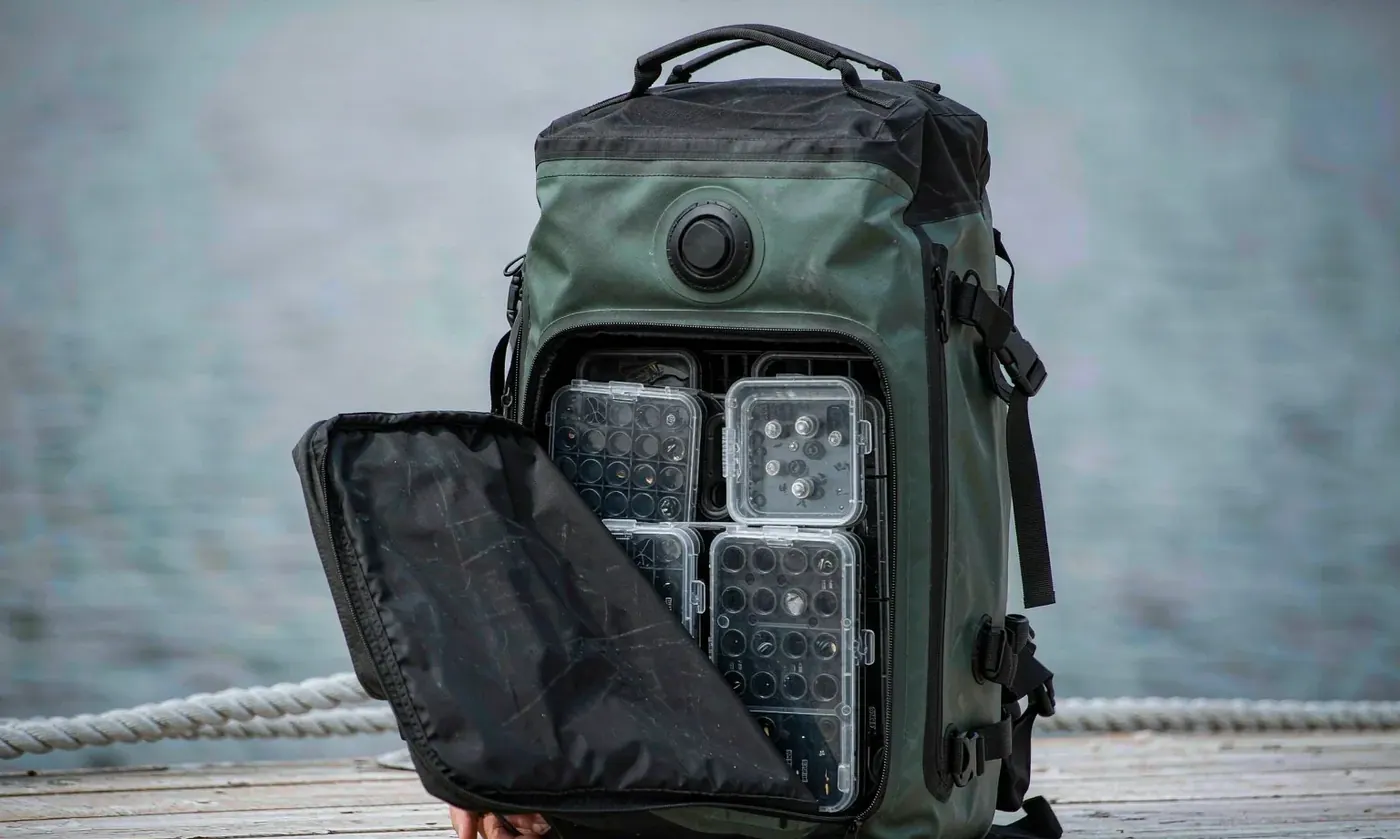
Weight distribution is the argument most often made against crates and it deserves quantifying rather than repeating. Every kilogram placed 200 mm above the deck produces roughly twice the roll moment of the same kilogram at 100 mm, so loading order and basket height matter more than total weight.
- Heavy items belong low and forward, with the two most-used trays uppermost and toward the angler rather than anywhere convenient.
- A crate loaded with its centre below 120 mm feels planted, while the same load centred above 200 mm feels nervous in a beam sea.
- A soft body stowed flat behind the seat typically centres its load around 90-120 mm, which is why it handles better than its weight suggests.
- Anything mounted above the rail line, including rod holders and flags, adds moment disproportionately because the lever arm is longest there.
- A partially loaded crate can be worse than a full one if contents are free to shift, which moves the centre during a turn.
That final point is the one worth designing against. A crate holding four trays with air around them lets the trays slide on every turn, moving the centre of gravity unpredictably and making the hull feel inconsistent from one wave to the next. Holding trays captive, whether in a liner or inside a soft bag dropped into the crate, removes the effect at a cost of about 4.50 USD.
Access While Seated
Access from a seated position is where the crate earns its reputation. Everything is upright and immediately visible, and nothing requires bending forward or lifting anything out of the hull. Practical differences do exist between the two approaches, though, and they are worth mapping.
| Access situation | Crate | Backpack | Better |
|---|---|---|---|
| Change lure every few minutes | Reach back and lift a tray | Rotate round or lift from behind | Crate |
| Open without unstrapping anything | Yes, the lid and trays are free | Usually needs unstrapping first | Crate |
| See everything at once | Yes, looking back | No, one tray at a time | Crate |
| Access while paddling | Yes, one hand rearward | No, requires stopping | Crate |
| Retrieve something small and dropped | Lost into the crate floor | Contained in a tray | Backpack |
Crate wins four of those five rows, which is the honest summary of why it remains popular with anglers who fish seated all day. The losing row is a genuine one though: anything small dropped into a bare crate falls to the floor between trays and effectively disappears until the whole thing is emptied ashore, while the same item dropped from a tray stays in the tray.
Capsize Behaviour
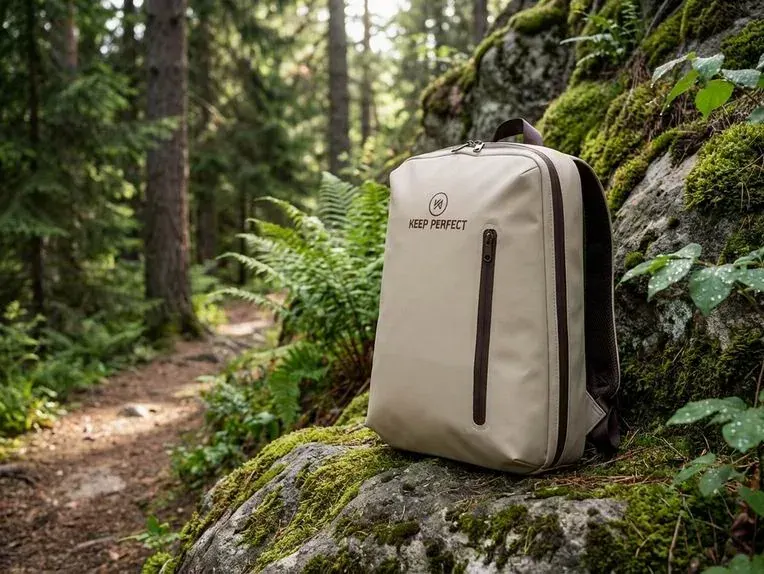
A capsize turns out to be less about keeping things dry than about whether the kit can be recovered at all, and here the two options separate sharply. Neither is a flotation device in the regulatory sense, and it is worth saying plainly that no item of fishing equipment substitutes for an approved personal flotation device.
| Capsize event | Crate lashed correctly | Backpack stowed freely | Mitigation |
|---|---|---|---|
| Hull rolls to 90 degrees | Stays with the boat | May leave the deck | Leash every soft item |
| Trays wash out | Very likely | Contents stay in trays | Either way, lids closed |
| Rods leave the holders | Likely without retention | Not applicable | Leash every rod |
| Kit recovered afterwards | Crate yes, contents maybe | If leashed, usually whole | Leash lines cost about 0.80 USD |
| Electronics survive | Only above the waterline | Only in a sealed case | Use a rated dry pouch |
The pattern is that the crate stays with the boat and loses its contents, while the soft body keeps its contents and loses the body itself. Leashing is therefore not optional for either approach, and it costs roughly 0.80 USD per item for rated line. Carriage requirements for personal safety equipment are set out by USCG Boating, and none of this discussion substitutes for complying with them.
Rod Storage Changes What Fits
Rod carriage is frequently the real reason an angler chooses one option over the other, because each makes a different promise. A crate offers a rigid structure that accepts four rod holders on a frame, while a backpack offers a single tube and nothing else.
| Rod need | Crate capability | Backpack capability | Verdict |
|---|---|---|---|
| Two rods raked back at 15-30 degrees | Four holders standard | One or two leashes only | Crate |
| Four rods rigged and ready | Practical with correct spacing | Not possible | Crate |
| One rod broken down for transport | No dedicated storage | Integrated 700-900 mm tube | Backpack |
| Rods safe through a surf launch | Must be removed first | Tube retains them | Backpack |
| Rod accessible while seated | Yes, behind the seat | Requires turning fully round | Crate |
Spacing is what makes a crate rod system usable rather than merely present. Holders of the same height foul each other's reels, so they should be separated by at least 140 mm across the frame and offset by 60-80 mm vertically, each with a closed bottom and a bungee across the top. Four is the practical maximum on a 420 mm wide crate, and a fifth turns every retrieval into a shuffle.
The Hybrid Most Anglers Settle On
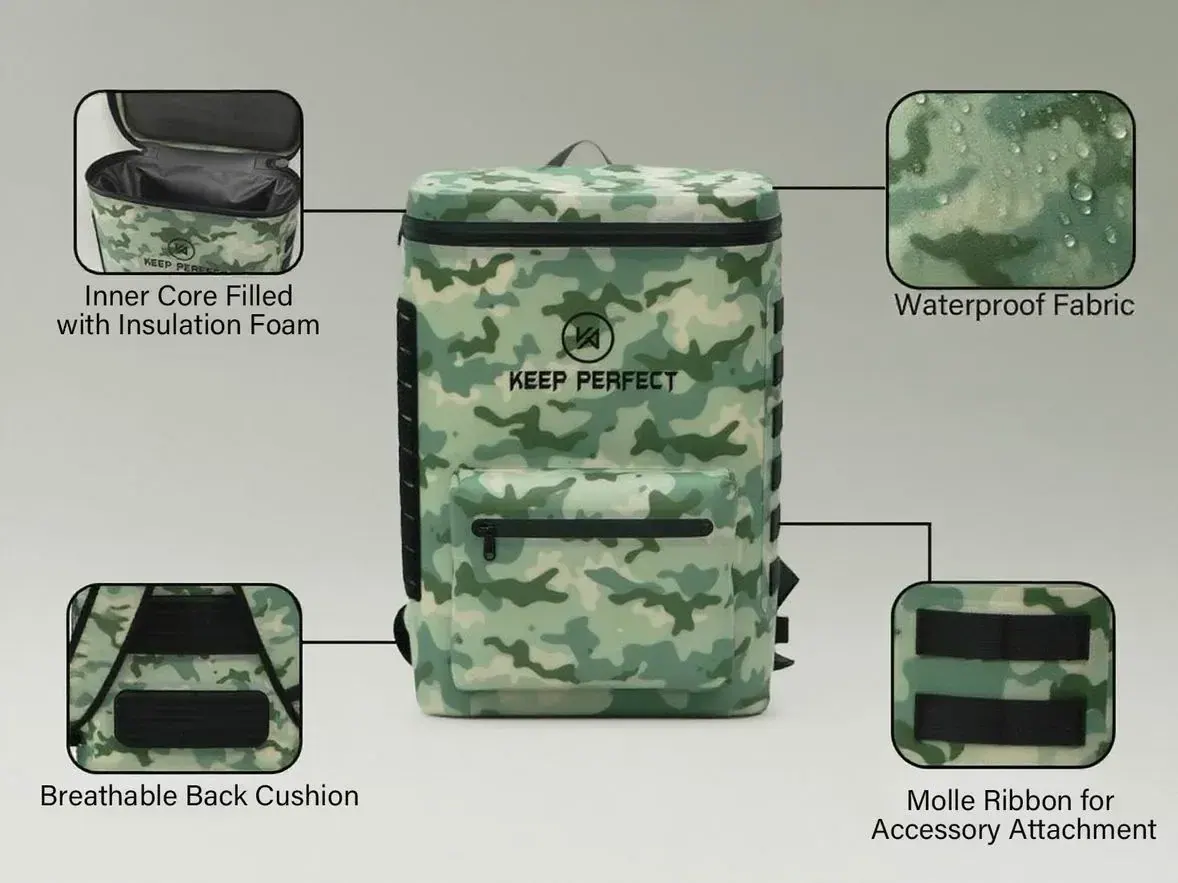
There is a third arrangement that is neither purely one nor the other, and it is what most experienced kayak anglers end up running. A compact soft bag drops inside a crate, holding three or four trays captive, and lifts out in about eight seconds for the carry to and from the water.
| Benefit | Detail | Cost |
|---|---|---|
| Trays stay captive in a turn | No sliding, no unpredictable centre of gravity | About 4.50 USD |
| One-handed carry to the hull | Lift the bag out, carry, drop back in | Included |
| Crate still takes rod holders | Frame is unchanged | No cost |
| Contents recoverable after a capsize | Lift the whole bag clear | Included |
| Crate can serve other uses | Remove the bag and use it for gear or a catch | No cost |
The last benefit is underrated and it is why the hybrid keeps paying off beyond fishing days. A crate emptied of its tackle liner becomes a gear box, a camera box, or somewhere to put wet clothing on the drive home, and that flexibility costs nothing once a liner exists.
Hull Storage and Multi-Day Trips
A soft body can go places a crate cannot, and hull storage is the clearest example. Through a 203 mm round hatch, a compressible soft body passes at roughly 70 percent load where nothing rigid goes at all, which matters enormously when the angler needs the deck clear.
- Hull storage keeps the deck free for landing fish, casting, and moving, which changes how a kayak fishes.
- A compressible body requires no internal frame and no moulded base, which is the trade-off against better base protection.
- Multi-day trips favour soft bodies because several compact bags distribute through the hull better than one large rigid container.
- Anything stored inside the hull should be leashed as well, because retrieving it from inside is impossible while afloat.
- Food, scent and anything attractive should never be stored inside the hull overnight, particularly in bear country.
The second point deserves restating because it is a genuine compromise rather than a free benefit. Compression and structure are opposing properties, so a body specified to squeeze through a hatch will not stand up on a wet bank, and buyers should name which property matters for the model in question rather than expecting both.
Seasonal and Second-Boat Use
One argument for the crate rarely appears in comparisons and it matters to buyers across several seasons. A rigid body is not tied to fishing in the way a specific tackle backpack is, so it moves between uses and between boats without being replaced, and it tolerates being stored outdoors in a way fabric does not.
| Use | Crate suitability | Backpack suitability | Note |
|---|---|---|---|
| Off-season storage outdoors | Tolerates it for years | Degrades, especially in sun | Ultraviolet exposure ages fabric fastest |
| Second boat or a rental hull | Transfers unchanged | Fits but less purposefully | A crate is hull-shape dependent |
| Non-fishing use around a vehicle | Genuinely useful | Useful but less robust | Crate doubles as a gear box |
| Carrying wet clothing home | Works, and drains | Needs a wet compartment | Neither should stay sealed damp |
| Resale value after several years | Retains useful value | Low resale | Reflected in total cost |
The resale row is worth a note for anyone calculating value rather than price. A moulded crate retains genuine second-hand utility five to eight years in, because it has no coating to fail and no fabric to abrade, whereas a three-year-old fabric body with a tired coating and a faded shell is worth very little. Spread over a realistic ownership period, the crate often costs less per year despite the additional hardware.
Cost, Wear, and Lifespan
Total cost of ownership runs closer than the headline bands suggest, because a crate needs hardware the backpack does not. Four to six tie-down points, a leash, and the rod holders themselves add up quickly, and a crate also wears the hull in a way a soft body does not.
| Item | Crate | Backpack | Note |
|---|---|---|---|
| Base unit, FOB | 20-42 USD | 26-48 USD | Crate cheaper at equal volume |
| Tie-down and leash hardware | 5-8 USD | 1-2 USD | Crate needs four to six points |
| Rod holder hardware | 4-12 USD | 0-3 USD | Crate carries far more |
| Liner or bag | Optional 4.50 USD | Included | Closes most of the gap |
| Typical service life | Five to eight years | Three to five years | Rigid shell outlasts fabric |
Hull wear belongs in any honest assessment even though it costs nothing monetary. A rigid crate corner sitting on a polyethylene deck abrades it with every wave flex, and over several seasons this produces visible scuffing and sometimes permanent marking. A padded base pad costing about 2.20 USD prevents nearly all of it and should be specified on every crate programme.
The Decision Table
Every consideration above reduces to a short set of questions, and answering them in order produces a recommendation quickly. Note that several rows point toward owning both, which is the truthful outcome for most kayak anglers rather than a hedge.
| If this is true | Choose | Reason |
|---|---|---|
| Fishing seated all day with four rods | Crate | Upright tray access and a rigid rod frame |
| Launching through surf regularly | Backpack | One hand stays free for the paddle |
| Two or more rods rigged and ready | Crate | Four holders with correct spacing |
| Kit should be recoverable after a capsize | Backpack, leashed | Contents stay in trays and the body floats |
| Small or youth kayak | Compact backpack | A workable crate is too small to be useful |
| Multi-day trip with hull storage | Several soft bodies | Nothing rigid passes a 203 mm hatch |
| Unsure between the two | Crate plus a liner bag | Captures most benefits of each |
That final row is the genuinely useful recommendation, and it is worth stating to customers rather than treating as a failure to decide. A crate fitted with a liner bag costs about 26-46 USD in total and delivers the handling of a soft body with the sitting-day convenience of a rigid frame, which no single option manages alone.
Programme, Pricing, and Compliance
Crate and backpack programmes diverge more than any other pair in this category, because a new rotational moulding tool is the single largest cost in a crate development and nothing in a soft programme compares to it.
| Programme item | Crate | Tackle backpack |
|---|---|---|
| MOQ | 500 pcs per design and colour | 500 pcs per design and colour |
| Tooling | New rotational mould, 15-25 days | Cutting patterns only |
| Sampling | 6-10 working days plus tooling time | 6-10 working days |
| Unit cost band | 20-42 USD | 26-48 USD |
| Bulk | 35-50 days | 35-50 days from approved sample and deposit |
| Inspection | AQL 2.5 plus rod pull and tie-down cycles | AQL 2.5 plus float and immersion protocol |
Impact and structural behaviour of a moulded body should be referenced to methods published by ASTM International, with a stated drop height and temperature, since a crate dropped from a tailgate at 1 m in cold weather is a realistic event rather than an abuse case.
QUANZHOU JUNYUAN BAGS has developed waterproof bag programmes since 2014, with the founding team working in the trade since 2004. Monthly output of 200,000 units is verified by SGS, and BSCI and ISO 9001 systems structure the workflow. Materials are screened for REACH and California Prop 65, and every bulk order is inspected at AQL 2.5 before shipment.
A kayak storage brief can be emailed to service@junyuanbags.com with hull model, tankwell footprint, rod count, launch conditions, and quantity. FOB Xiamen or DDP service to more than 100 countries follows an approved sample and a complete test record. Buyers comparing specific builds should read the kayak crate ranking, the crate rigging guide, and the kayak crate bag range.
People Also Ask
Is a kayak crate better than a tackle backpack?
For seated all-day fishing with several rods, yes. For surf launches, small hulls, or capsize recovery, a soft backpack wins. Most settled anglers run a crate with a liner bag inside it.
What size crate fits my kayak tankwell?
Match the footprint rather than the litres: roughly 380 x 280 mm for a recreational sit-on-top, 420 x 320 mm for a mid-size fishing kayak, and 480 x 380 mm for a large pedal hull.
Why does my kayak feel tippy with a loaded crate?
Centre of gravity. A load centred 200 mm above the deck produces roughly twice the roll moment of the same load at 100 mm, so keep loaded height under 300 mm.
Do crates or bags survive a capsize better?
Each loses something different. A lashed crate stays with the boat and loses its contents, while a leashed soft body keeps its contents and can float away itself.
Can I put a tackle backpack inside a kayak hull?
Yes, if it has no internal frame and no moulded base. A soft 18-25 L body passes a 203 mm round hatch at roughly 70 percent load.
How many rod holders should a kayak crate have?
Two to four. Spacing must be at least 140 mm across the frame with 60-80 mm of vertical offset, or the reels foul each other on every retrieval.
Frequently Asked Questions
Q1. What is the difference between a kayak crate and a tackle backpack?
A crate is a rigid body lashed into the tankwell giving upright tray access and a rod holder frame, while a soft body is carried on the shoulders or stowed behind the seat and can be built to float.
Q2. Which is better for kayak fishing?
A crate for all-day seated fishing with several rigged rods. A backpack for surf launches, small hulls, and anyone who needs a free hand at the launch.
Q3. What size crate fits a kayak tankwell?
380 x 280 mm for a recreational sit-on-top, 420 x 320 mm for a mid-size fishing kayak, and 480 x 380 mm for a large pedal kayak. Height matters more than footprint once fitted.
Q4. Why does my kayak feel unstable with gear loaded?
Centre of gravity above the deck. Keeping loaded height under 300 mm on a pedal hull and under 250 mm on anything smaller restores the planted feel.
Q5. Does a kayak crate float?
The moulded body usually does, though the contents do not. Leashing the crate to the hull is what turns a capsize into a recovery rather than a loss.
Q6. Can I leave a tackle backpack unstrapped on the deck?
No. It leaves the deck in any capsize. Leash every soft item with rated line, which costs about 0.80 USD each and is the cheapest insurance available.
Q7. How many rods can a kayak crate hold?
Two to four, spaced 140 mm across the frame and offset 60-80 mm vertically with a closed bottom and a bungee across the top.
Q8. Should I use a liner bag inside my crate?
Almost always. It keeps trays captive so the centre of gravity stops shifting in turns, and it lifts out in about eight seconds for the carry.
Q9. Can a tackle backpack fit through a kayak hatch?
Yes if it has no internal frame and no moulded base. A soft 18-25 L body passes a 203 mm round hatch at roughly 70 percent load.
Q10. Does a crate damage a kayak hull?
It can over several seasons, because rigid corners abrade a polyethylene deck on every wave flex. A base pad costing about 2.20 USD prevents nearly all of it.
Q11. Which costs more once rigged fully?
They converge. A cheaper crate at 20-42 USD needs 5-8 USD of tie-down hardware and 4-12 USD of rod holders, closing most of the gap against a 26-48 USD backpack.
Q12. What is the MOQ and lead time for each?
MOQ is 500 pcs per design and colour. Crate development adds 15-25 days of rotational tooling before sampling, both sample in 6-10 working days thereafter, and bulk runs 35-50 days.