A kayak fishing crate beats a soft bag when the boat has a tankwell and the angler fishes seated, and it loses when the angler has to carry the kit any distance: a loaded crate weighs 12-18 kg and is awkward beyond about 50 m. Six crate and modular systems were assessed for 2026 across 30-50 litres, tankwell footprints of 400 x 300 mm, rod holder angles of 15-30 degrees, four-point tie-downs on 6 mm shock cord, and 20-42 USD FOB Xiamen bands at MOQ 500 pcs per design and colour. Samples take 6-10 working days and bulk 35-50 days. The pick is the 40 L crate with four rod holders at 24-30 USD.
Crate or Bag: The Decision Is About Distance
The choice between a crate and a soft tackle bag comes down to how far the kit is carried and where the angler fishes from. A crate gives upright tray access while seated, a rigid frame for rod holders, and a shape that stays put in a tankwell. A soft bag gives portability, a shoulder carry, and the ability to become a backpack for the walk to the water.
| Factor | Crate | Soft tackle bag | Winner |
|---|---|---|---|
| Carry beyond 50 m | Awkward at 12-18 kg | Comfortable with a harness | Bag |
| Tray access while seated | Immediate, upright | Requires unzipping and reaching | Crate |
| Rod holder mounting | Rigid frame, four positions | Limited to two, flexible | Crate |
| Tankwell fit | Footprint matched | Slumps and rolls | Crate |
| Capsize behaviour | Stays lashed, contents wash | Floats if built with a panel | Depends on lashing |
| Transport in a car | Rigid, stacks | Packs flat | Bag |
Most kayak anglers end up running both, and the split is predictable: the crate holds the bulk inventory and the rods in the tankwell, and a small body-worn pack holds what is needed when the angler leaves the boat to wade a flat or land a fish. Advising customers to buy one or the other produces a worse outcome than advising the combination.
Footprint Comes Before Capacity
A crate is bought by litre and installed by footprint, and the two rarely agree. Tankwells on common fishing kayaks measure roughly 400 x 300 mm to 500 x 400 mm, and a crate that overhangs the well catches water and slows the boat. The dimension to brief first is the base footprint, followed by height, because a tall crate raises the centre of gravity and makes a kayak feel tippy in a following sea.
| Kayak class | Tankwell | Crate footprint | Max height | Volume |
|---|---|---|---|---|
| Recreational sit-on-top | 400 x 300 mm | 380 x 280 mm | 280 mm | 30-35 L |
| Mid-size fishing kayak | 450 x 350 mm | 420 x 320 mm | 300 mm | 35-45 L |
| Large pedal kayak | 500 x 400 mm | 480 x 380 mm | 330 mm | 45-50 L |
| Small or youth kayak | 350 x 250 mm | 330 x 240 mm | 250 mm | 20-28 L |
Height deserves a caution that litre figures hide. A crate filled to 330 mm with four loaded trays and a tackle box puts roughly 15 kg at a height of 200 mm above the deck, and that raises the centre of gravity enough to be felt in a beam sea. The practical limit is 300 mm of loaded height for a pedal kayak and 250 mm for a smaller hull, which is why several builds below are deliberately shallow.
Rod Holders on a Crate: Angle and Spacing
Rod holders are the reason most anglers buy a crate rather than a bag, and two numbers decide whether they work. Angle first: a rod raked back at 15-30 degrees from vertical clears a paddle stroke and keeps the tip above the water in chop, while a vertical tube puts the tip in the spray and a horizontal rack catches the paddle on every stroke.
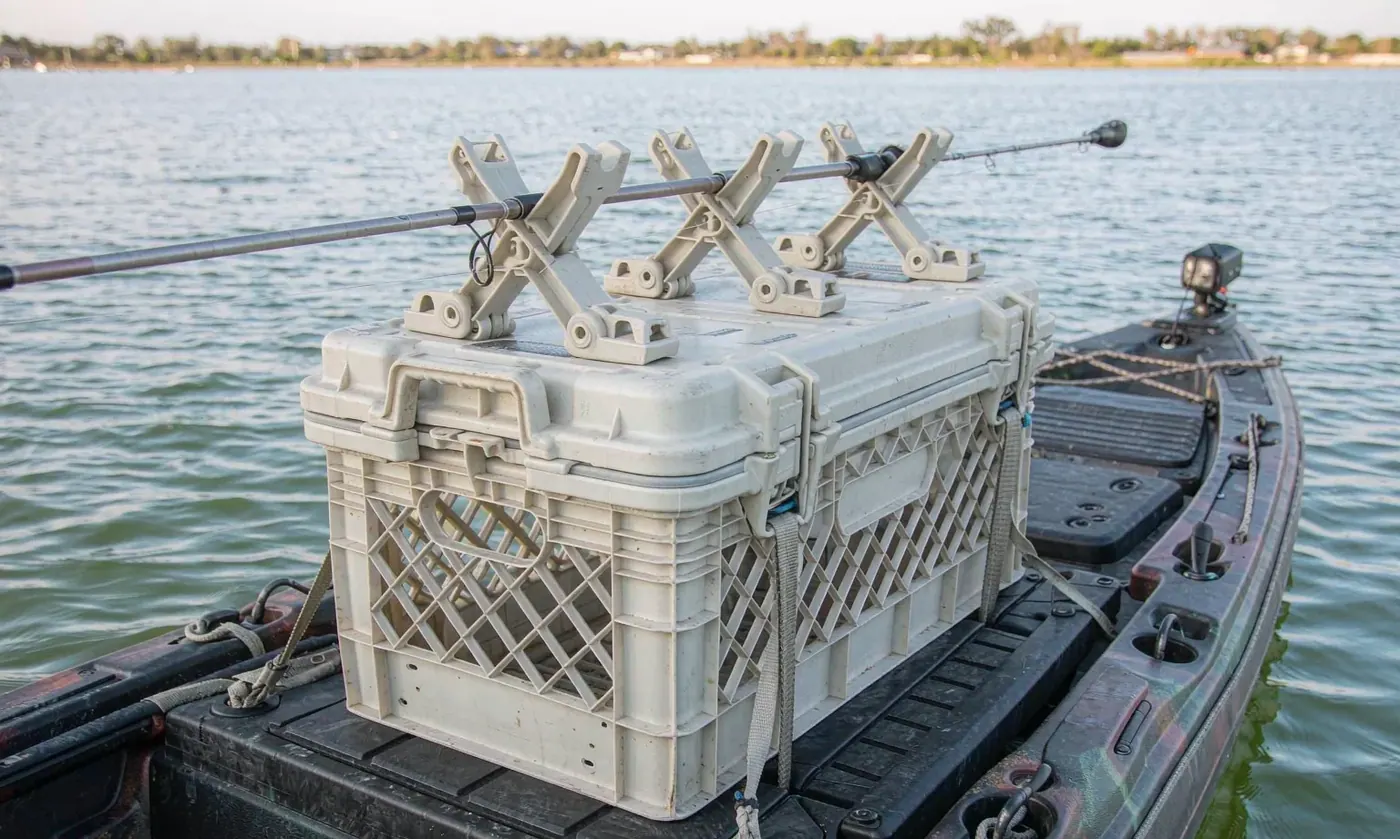
Spacing is the second number. Reels foul each other when holders sit at the same height, so holders should be offset by 60-80 mm and separated by at least 140 mm across the frame. Four holders is the practical maximum on a 420 mm wide crate, and a fifth turns every retrieval into a shuffle. Each holder needs a closed bottom plus a bungee retention, because a rod dropped in an open tube falls through when the boat rolls.
| Element | Number | Why | Failure if wrong |
|---|---|---|---|
| Rake angle | 15-30 degrees from vertical | Clears the stroke, tip out of spray | Paddle contact or a wet tip |
| Holder spacing | 140 mm across, offset 60-80 mm | Reels do not foul | Every retrieval disturbs the next rod |
| Tube depth | 200 mm minimum, closed | Rod stays in when rolling | Rod drops through |
| Internal diameter | 45-55 mm | Accepts a reel fitted | Reel catches on the rim |
| Retention | Bungee across the top | Holds through a roll | Rod leaves the holder |
Mounting the holder to the crate is where the leverage problem appears. A holder carrying a 2 kg rod at 250 mm of lever arm generates a meaningful moment at the mount, and a holder pop-riveted through a single wall works loose within a season. The correct fix is a backing plate spreading the load over at least 3,000 square millimetres, which costs about 1.40 USD per holder.
Rigging and Tie-Down
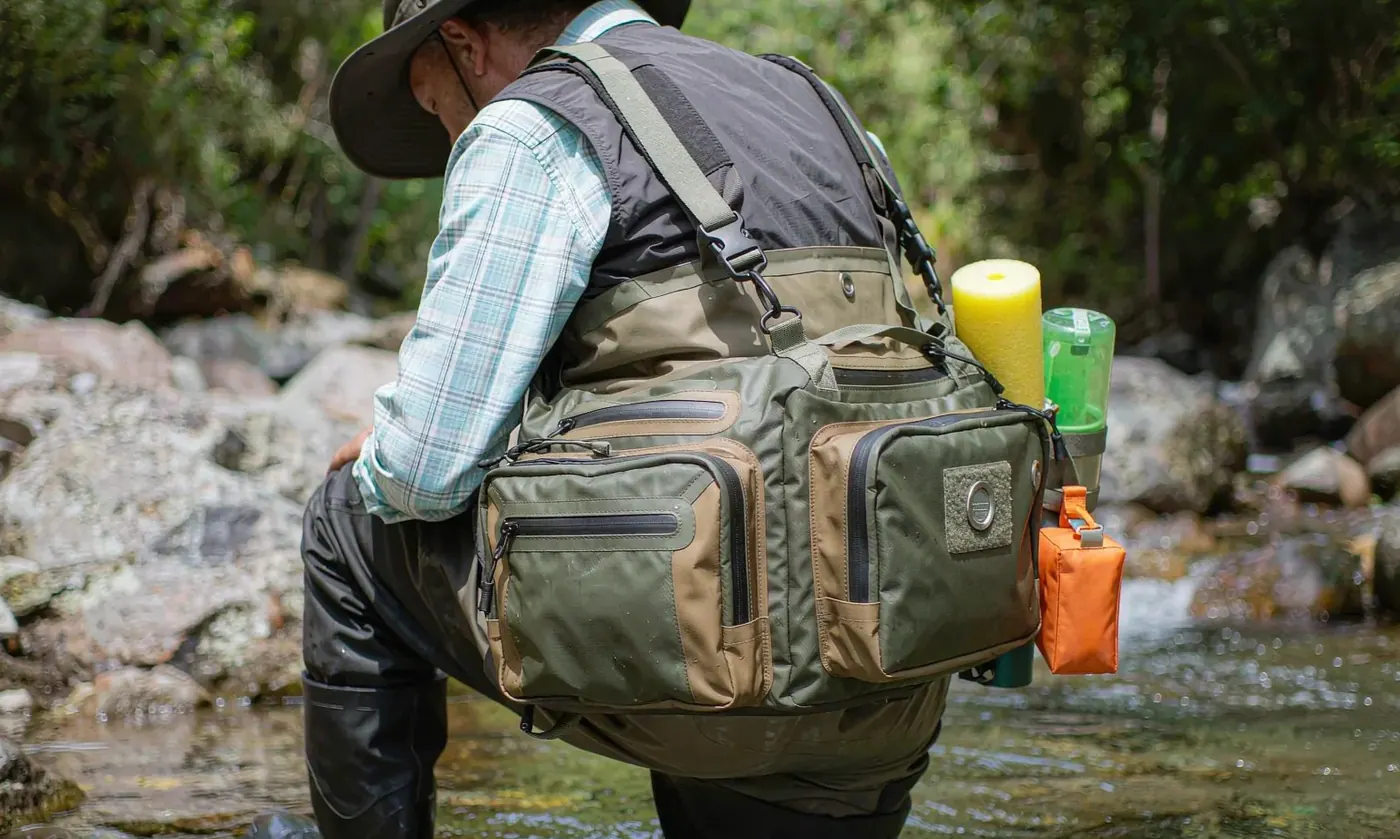
A crate that is not tied down is a crate that leaves the boat. Four points is the minimum and six is better: two forward, two aft, and two diagonal, each on 6 mm shock cord with a hook or a cam. Static cord is the common error, because a crate shifts under load and a non-elastic line goes slack on the second wave.
| Element | Specification | Why | Cost |
|---|---|---|---|
| Tie-down points | Four minimum, six preferred | Stops rotation in a following sea | 0.60 USD |
| Cord | 6 mm shock cord | Elastic takes up the slack | 1.20 USD |
| Hardware | Acetal cam or 316 hook | Rusts in salt otherwise | 0.90-1.60 USD |
| Backing plate | 3,000 square millimetres per mount | Spreads the lever load | 1.40 USD each |
| Leash | Rated line on the crate | Recovery if the boat rolls | 0.80 USD |
Loading order matters as much as the tie-down itself. Heavy items belong low and forward in the crate, with the two most-used trays at the top and toward the angler, because a crate loaded top-heavy makes the kayak feel tippy long before anything actually moves. Placing 15 kg with its centre below 120 mm rather than above 200 mm is the difference between a boat that feels planted and one that feels nervous in a beam sea.
Leashing the crate is worth a specific note. A rolled kayak releases everything in the tankwell, and a leashed crate stays with the hull while the contents wash out. Recovery of an empty crate is a very different proposition from losing four trays and two rods, and the line costs about 0.80 USD. Safety equipment for the person remains a separate matter and is governed by carriage rules published by the United States Coast Guard, which a crate does not satisfy.
The Six Systems at a Glance
Volume is the usable internal capacity with trays fitted. Rod positions count usable holders with retention. Loaded weight assumes four 3700 trays, two rods, and tools. The soft alternatives for the same water are compared in the kayak tackle bag ranking, and the bag-in-crate approach is covered by the kayak crate bag range.
| Build | Volume | Footprint | Rod positions | Trays | FOB band |
|---|---|---|---|---|---|
| Standard 40 | 40 L | 420 x 320 mm | 4 | 4 x 3700 | 24-30 USD |
| Modular 45 | 45 L | 480 x 380 mm | 4 plus rail | 5 x 3700 | 32-40 USD |
| Slim 30 | 30 L | 380 x 280 mm | 2 | 3 x 3700 | 20-26 USD |
| Liner 38 | 38 L | 420 x 320 mm | 3 | 4 x 3700 in a liner | 34-42 USD |
| Hybrid 42 | 42 L | 450 x 350 mm | 4 plus handle | 4 x 3700 | 26-33 USD |
| Fold-Flat 35 | 35 L | 420 x 320 mm | 2, removable | 3 x 3700 | 30-38 USD |
1. Standard 40: Best Overall
Forty litres on a 420 x 320 mm footprint with four rod holders raked at 20 degrees, holding four deep 3700 trays and weighing about 15 kg loaded. The FOB band is 24-30 USD, and it is the configuration most kayak anglers should buy first.
It leads because it is the right size for the most common tankwell and because its rod geometry is correct: 20 degrees of rake, 150 mm of spacing, and a closed bottom with a bungee. The body is rotationally moulded in one piece, so there are no seams to fail, and the rim is shaped to accept a bungee without the cord slipping off.
2. Modular 45: Best for Reconfigurable Rigs
Forty-five litres on a 480 x 380 mm footprint with an accessory track on three faces, so rod holders, a cup holder, a camera mount, and a fish-finder bracket bolt anywhere along the rail. Five 3700 trays, at 32-40 USD.
A track system is worth the 8-10 USD premium when the angler changes rig between seasons, and it is a liability when the track is proprietary: a customer who cannot buy a third-party mount is locked in. The specification to require is a standard slot profile of 25 mm with an M6 captive nut, which accepts common accessories.
3. Slim 30: Best for Small Kayaks
Thirty litres on a 380 x 280 mm footprint with two rod holders, holding three 3700 trays, at a 20-26 USD band. It suits a recreational sit-on-top and a youth kayak where a 420 mm crate simply will not sit in the well.
The compromise is honest and should be stated at the point of sale: three trays and two rods. An angler who wants four of each needs a bigger boat rather than a cleverer crate. Height is held to 250 mm, which keeps the centre of gravity low on a narrower hull where it matters most.
4. Liner 38: Best for Tray Organisation
Thirty-eight litres with a soft removable liner that holds four 3700 trays upright and lifts out in about 8 seconds, three rod holders, and a 34-42 USD band. It is the answer to the complaint that a crate is a box in which trays lie at random angles.
The liner is the whole product. It keeps trays upright and lid-up, it lifts out so the crate can be used for a catch or for clothing, and it stops the rattle that a bare crate produces in chop. A fabric liner adds about 4.50 USD and 400 g, and it should drain, because paddle drip collects in the crate floor otherwise.
5. Hybrid 42: Best for Carrying
Forty-two litres with a moulded carry handle integrated into the rim and a shoulder strap that clips to two points, four rod holders, and a 26-33 USD band. It addresses the crate weakness directly: a loaded crate is awkward to carry.
The handle has to be moulded into the structure rather than bolted on, because a bolted handle carrying 15 kg pulls through the wall. This build moulds a grip into the rear rim with a wall thickness of 6 mm at the grip, which takes the load. The shoulder strap converts a two-handed carry into a one-handed one for the walk to the water.
6. Fold-Flat 35: Best for Travel and Storage
Thirty-five litres that folds to 90 mm for storage and transport, with two removable rod holders, holding three 3700 trays, at a 30-38 USD band. It suits an angler who flies to a fishery, rents a kayak, and needs a crate that travels in a bag.
Folding is the feature and the risk: every hinge is a failure point, and a crate that folds under load is dangerous. This build uses a hinge with a positive lock that engages when the walls are raised, plus a secondary pin, and the specification to require is a fold test at 15 kg of internal load rather than an empty demonstration.
Body-Worn Kit Alongside the Crate
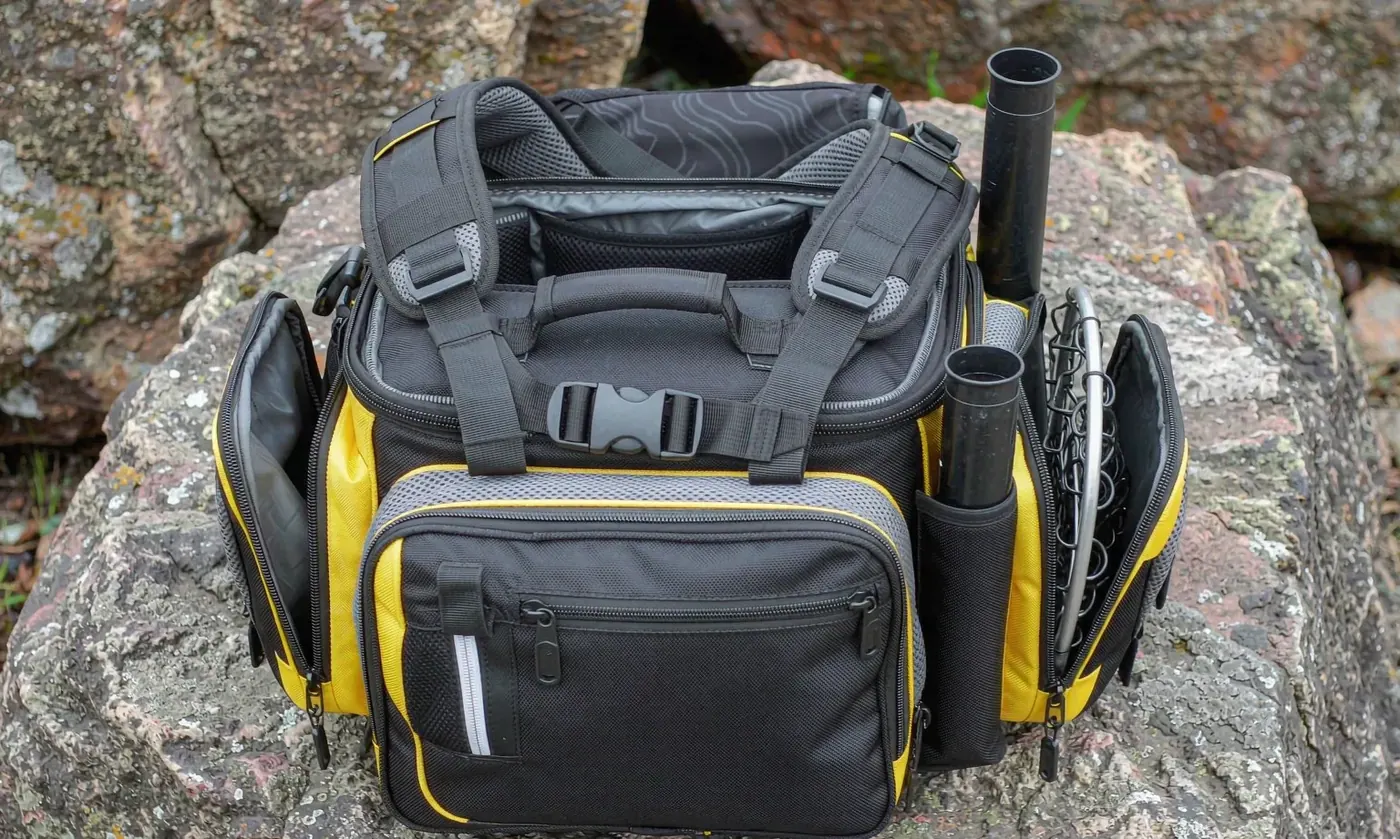
A crate stays with the boat, which means everything the angler needs away from the boat has to be on the body. That is the argument for a small waist or chest pack holding two trays of the patterns in use, pliers, a leader spool, a phone, and a licence, and it is why crate buyers are also pack buyers.
| Item | Stays in the crate | Goes on the body | Reason |
|---|---|---|---|
| Bulk tray inventory | Yes | No | Too heavy to wear |
| Two patterns in use | No | Yes | Needed away from the boat |
| Pliers and leader | No | Yes | Used constantly |
| Phone and licence | No | Yes, in a sealed pouch | One dunk and they are gone |
| Spare rods | Yes | No | Racked in the holders |
Two trays of the patterns in use is the right amount on the body, and three is too many. A chest or waist pack carrying two shallow 3600 trays weighs about 3 kg, which is comfortable for a full day, while a third tray pushes past 4 kg and the pack starts to interfere with a cast. Shallow trays are the correct choice here because the kit is a working selection rather than an inventory.
Rigging guidance for a crate, including tie-down patterns and rod holder placement, is set out in the kayak crate rigging guide. The single most useful habit is to rig the crate at home and photograph it, so the layout can be rebuilt identically after a capsize or a rental, rather than re-invented on a wet beach.
Checks Before Approving a Crate Sample
Crate failures are structural and they happen under load, so the approval protocol should be weighted toward loaded testing. Five checks take about an hour and require a kayak or a mock tankwell, which is more than most buyers arrange and far less than a season of broken rod holders costs.
| Check | Method | Pass condition | Catches |
|---|---|---|---|
| Tankwell fit | Seat the loaded crate in the well | No overhang, no rocking | Footprint too large for the hull |
| Rod pull | Pull each holder to 12 kg | No movement at the mount | Rivets without a backing plate |
| Tie-down cycle | Rig and release 100 times | Cord and hooks hold tension | Static cord and plated hooks |
| Loaded height | Measure loaded height in the well | Under the hull limit | Tall crate raising the centre of gravity |
| Fold lock, if folding | Load to 15 kg, attempt to fold | Lock holds | Hinge that folds under load |
Structural and abrasion requirements should reference published methods from ASTM International, including impact resistance of the moulded body, which matters because a crate dropped from a vehicle tailgate at 1 m in cold weather is a realistic event rather than an abuse case.
Programme, Pricing, and Compliance
A crate brief should open with the tankwell footprint, because that decides the tool and everything else follows. Specify height next, then rod holder count and geometry, then tray capacity. Settling the footprint first matters, because a rotational moulding tool is the single largest cost in the programme and it cannot be adjusted after it is cut.
| Programme item | Baseline | Note |
|---|---|---|
| MOQ | 500 pcs per design and colour | Colour split negotiable above the baseline |
| Sampling | 6-10 working days | Add 10-15 days for a new moulding tool |
| Bulk | 35-50 days | From approved sample and deposit |
| Inspection | AQL 2.5 | Include tankwell fit, rod pull, tie-down cycle, fold lock |
| Compliance | REACH and California Prop 65 | Screen polymer, coatings, inks, hardware |
QUANZHOU JUNYUAN BAGS has developed waterproof bag programmes since 2014, with the founding team in the trade since 2004. Monthly output of 200,000 units is verified by SGS, and BSCI and ISO 9001 systems structure the workflow. Materials are screened for REACH and California Prop 65, and every bulk order is inspected at AQL 2.5 before shipment.
A crate programme brief can be emailed to service@junyuanbags.com with footprint, height limit, rod positions, tray count, and quantity. FOB Xiamen or DDP service to more than 100 countries follows an approved sample and a complete test record.
People Also Ask
Is a kayak crate better than a tackle bag?
For seated fishing with a tankwell, yes, because a crate gives upright tray access and a rigid frame for rod holders. For carries beyond 50 m or for flying to a fishery, a soft bag wins.
What size crate fits a kayak tankwell?
Match the footprint to the well: 380 x 280 mm for a recreational sit-on-top, 420 x 320 mm for a mid-size fishing kayak, and 480 x 380 mm for a large pedal kayak.
How many rod holders should a kayak crate have?
Two to four. Four is the practical maximum on a 420 mm wide crate, spaced 140 mm apart and offset by 60-80 mm so reels do not foul.
What angle should kayak rod holders be?
15-30 degrees from vertical. That clears the paddle stroke and keeps rod tips out of the spray, where a vertical tube does not.
How do I secure a crate in a kayak tankwell?
Four tie-down points minimum, six preferred, on 6 mm elastic shock cord with acetal cams or 316 hooks. Static cord goes slack on the second wave.
Should I carry a pack as well as a crate?
Yes. The crate stays with the boat, so two patterns in use, pliers, phone, and licence should be on the body in a small chest or waist pack.
Frequently Asked Questions
Q1. What is the best kayak fishing crate?
A 40 L crate on a 420 x 320 mm footprint with four rod holders raked at 20 degrees, holding four deep 3700 trays, at a 24-30 USD FOB band.
Q2. What size kayak crate do I need?
Match the tankwell footprint rather than the litre figure. A mid-size fishing kayak takes 420 x 320 mm and about 40 L, and a recreational sit-on-top takes 380 x 280 mm and about 30 L.
Q3. How many rod holders fit on a kayak crate?
Two to four. Four needs a crate at least 420 mm wide, with holders spaced 140 mm apart and offset by 60-80 mm in height.
Q4. Should rod holders be vertical or angled?
Angled at 15-30 degrees from vertical. That clears the paddle stroke and keeps tips above the spray, while a vertical tube puts the tip in the water in chop.
Q5. How heavy is a loaded kayak crate?
About 12-18 kg with four trays, two rods, and tools. That is why a crate is awkward to carry beyond roughly 50 m and why a hybrid build with a handle helps.
Q6. How do I stop a crate moving in the tankwell?
Four to six tie-down points on 6 mm elastic shock cord with acetal cams or stainless hooks, plus a rated leash to the hull so a roll does not separate them.
Q7. Do kayak crates float?
The moulded body usually does, but the contents do not. Leashing the crate to the hull is what turns a capsize into a recovery of the crate rather than a loss of trays and rods.
Q8. What is a crate liner?
A soft removable insert holding trays upright that lifts out in about 8 seconds. It costs about 4.50 USD and 400 g, and it stops the rattle and the random tray angles of a bare crate.
Q9. Can a kayak crate be used as a carry bag?
Only with a moulded handle or a shoulder strap system. A bolted handle pulls through the wall at 15 kg, so the grip must be moulded into the rim.
Q10. Are fold-flat crates strong enough?
They are if the hinge locks positively under load. Require a fold test at 15 kg of internal load rather than accepting an empty demonstration.
Q11. What should I carry on my body with a crate?
Two patterns in use, pliers, a leader spool, and a phone and licence in a sealed pouch. The crate stays with the boat, so anything needed away from it must be worn.
Q12. What is the MOQ and lead time for a kayak crate programme?
MOQ is 500 pcs per design and colour, samples take 6-10 working days plus 10-15 days for a new moulding tool, and bulk runs 35-50 days from approved sample and deposit.