A kayak rod and tackle bag has to satisfy a constraint no bank angler thinks about: nothing may intrude into the paddle arc, so any rigid or tall item must sit behind the seat or below about 220 mm within roughly 500 mm of the paddler. Eight 2026 builds were assessed on rod tube length of 700-900 mm, hatch entry through a 203 mm round opening, usable volume of 18-46 litres, tie-down point count, and corrosion-managed hardware. The recommendation is the 30-litre build with an integrated 780 mm rod tube and four tie-down points at 26-33 USD FOB Xiamen. MOQ is 500 pcs per design and colour, samples take 6-10 working days, and bulk runs 35-50 days.
The Kayak Constraint Nobody Puts on the Box
Standard tackle bags are designed for an angler standing on a bank, and the geometry that works there fails on a hull. A kayak angler sits low, rotates through a cast, and sweeps a paddle through an arc roughly 1,900 mm across, and any storage that intrudes into that arc is contacted on every stroke. The practical envelope is therefore set by reach and height rather than by litres.
| Zone on the hull | Usable footprint | Height limit | What lives there |
|---|---|---|---|
| Directly behind the seat | 400 x 300 mm | Unlimited within balance limits | Main tackle bag or crate |
| Beside the hip, either side | 300 x 200 mm | 220 mm | Two shallow trays, tools |
| Under the seat frame | 350 x 250 mm | 150 mm | Flat bag, pliers, leader spool |
| In the tankwell, forward | 500 x 400 mm | 300 mm | Buoy bag, spare rods |
| Inside the hull via hatch | Limited by hatch | 250 mm flexible | Off-season or spare kit |
Height limits vary with the hull and are worth verifying against a specific model rather than assuming. A pedal-drive kayak has more clearance beside the hip than a narrow sit-on-top because the hull is wider at the rail, and a pack designed for one will foul a paddle on the other. Brand buyers who serve a single kayak model can tune to it, and those who sell across models should default to the tighter geometry.
Rod Storage: Tube Length Against Reached Length
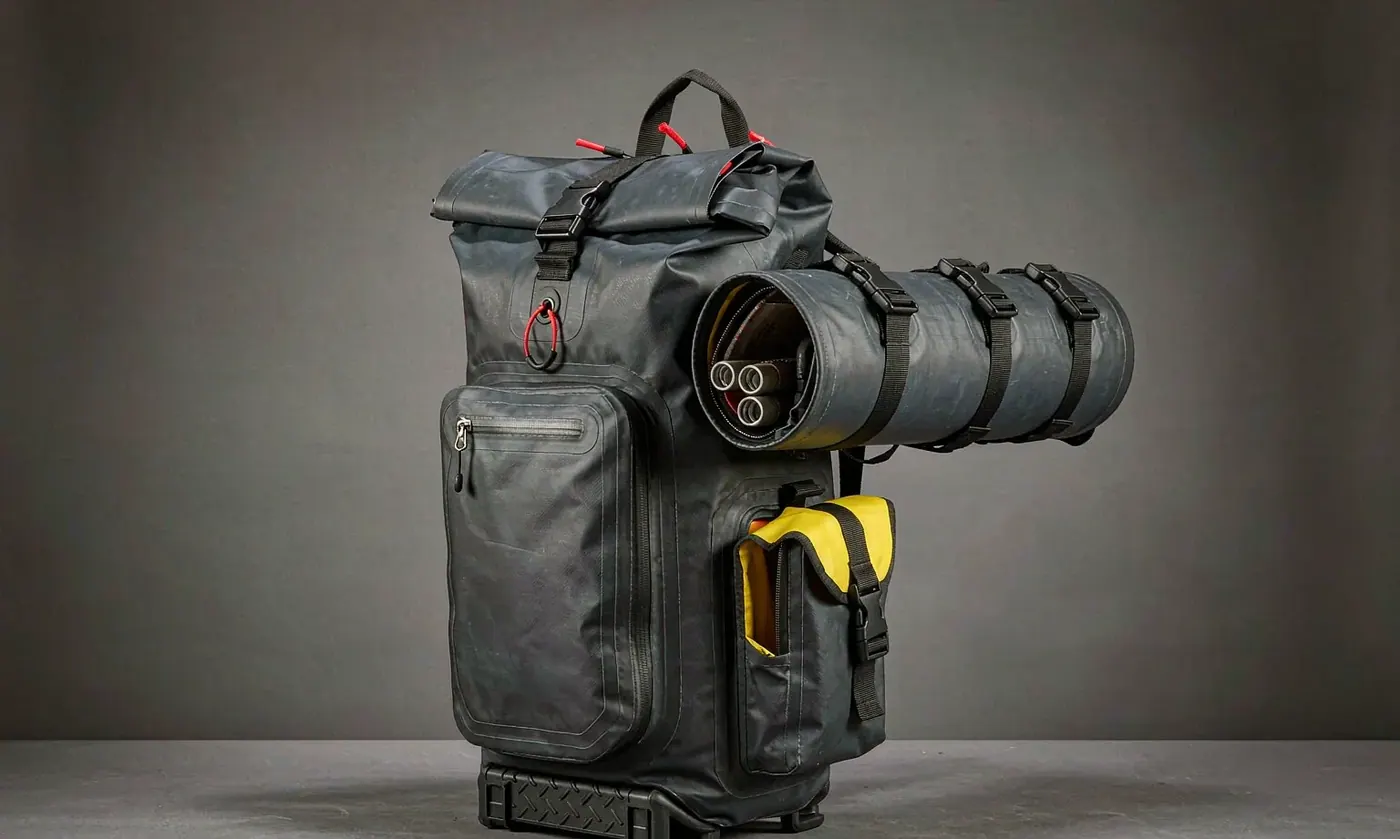
Rod storage on a kayak divides into carried-ready and carried-broken-down, and the choice determines the bag. A rod rest that keeps a rigged rod vertical is convenient and is the first thing to break in a surf launch, while a side tube that accepts a two-piece rod broken down to about 780 mm survives almost anything at the cost of a two-minute setup at the launch.
| Rod solution | Tube or rack size | Survives a surf launch | Cost added | Verdict |
|---|---|---|---|---|
| Vertical rod rest | Tube 200 mm deep, 45-55 mm ID | No | 3.20 USD | Calm water only |
| Angled rod rest, 20 degrees | Tube 250 mm deep | Rarely | 4.10 USD | Sheltered estuaries |
| Side tube, broken rod | 700-900 mm long, 50 mm ID | Yes | 5.80 USD | Open water and surf |
| Bungee rod leash only | 2 mm cord, 10 kg rated | Partly | 0.90 USD | Mandatory backup |
| Hull storage via hatch | Entry 203 mm minimum | Yes | 0 USD | Spare rods only |
Whichever solution is chosen, a leash is not optional. A rod that leaves the boat is gone in about four minutes of paddling, and a leash rated at 10 kg costs under 1 USD to specify while a good rod costs several hundred. Personal flotation and carriage requirements around water are set by authorities such as USCG Boating, and no storage bag satisfies any part of them.
Hatch Entry and Compression
Many kayak anglers store a secondary bag inside the hull, and the gatekeeper dimension is not bag volume but hatch diameter. Round twist-lock hatches commonly measure 203 mm and 254 mm, oval kayak hatches often measure 420 x 320 mm at the widest, and a bag that is nominally 30 litres but holds its shape simply will not go through a 203 mm opening even when it is only half full.
| Hatch type | Opening | Max bag shell height when full | Recommended bag volume |
|---|---|---|---|
| Round twist-lock, small | 203 mm diameter | 180 mm soft-sided | 12-18 L |
| Round twist-lock, large | 254 mm diameter | 220 mm soft-sided | 20-28 L |
| Oval rubber hatch | 420 x 320 mm | 300 mm soft-sided | 30-40 L |
| Bow day hatch | 300 x 240 mm | 240 mm soft-sided | 22-30 L |
Compression is the property to specify rather than volume alone. A bag with a soft unstructured body and no internal frame can be rolled and pushed through an opening roughly 25 percent smaller than its stated width, while a bag with a moulded EVA base cannot be compressed at all despite offering better water protection at the base. This is the trade-off buyers should name explicitly rather than discovering it on the water.
The Eight Builds at a Glance
Volume is usable internal capacity with trays fitted. Rod clearances assume a two-piece rod broken down unless noted. Tie points are lash points rated at 10 kg each. Weight is empty including straps. Buyers choosing between a soft bag and a rigid box for the same water should read the kayak crate against tackle backpack comparison before committing to a tool.
| Build | Volume | Rod solution | Tie points | Weight | FOB band |
|---|---|---|---|---|---|
| SeatBox 22 | 22 L | Two leashes, no rest | 2 | 0.95 kg | 18-24 USD |
| StowTube 30 | 30 L | 780 mm side tube | 4 | 1.30 kg | 26-33 USD |
| Tankwell 40 | 40 L | Two angled rests, 20 deg | 4 | 1.48 kg | 24-31 USD |
| HatchSlim 18 | 18 L | Hull stored only | 2 | 0.78 kg | 20-26 USD |
| CrateLiner 35 | 35 L | Crate mounted separately | 4 | 1.36 kg | 22-28 USD |
| PaddleSide 26 | 26 L | Two leashes, no rest | 3 | 1.12 kg | 21-27 USD |
| SaltKayak 38 | 38 L | 820 mm tube, welded base | 4 | 1.62 kg | 36-46 USD |
| FloatSafe 28 | 28 L | 700 mm tube plus float panel | 4 | 1.44 kg | 28-34 USD |
1. SeatBox 22: Best Under-Seat Bag
Twenty-two litres shaped to drop into the seat-frame recess of a recreational sit-on-top, measuring 350 x 250 x 150 mm so it clears the hull floor, holding three shallow 3600 trays flat, at 950 g and 18-24 USD. It is the cheapest way to add organised storage to a kayak that has none.
It wins on access rather than capacity: everything is within a forearm without turning, which matters more than litres when the angler is seated and the water is moving. The limitation is real and should be stated to customers, because three shallow trays is a working kit rather than an inventory and an angler wanting more needs a tankwell bag alongside it.
2. StowTube 30: Best Overall
Thirty litres with an integrated 780 mm rod tube along the left flank, four lash points, three deep 3700 trays upright in an internal sleeve, at 1.30 kg and 26-33 USD. It is the configuration most kayak anglers should buy first because it solves rod carriage and tackle carriage in one object.
The tube geometry is what deserves scrutiny. At 780 mm it takes two-piece rods up to about 8 ft broken down, at 50 mm internal diameter it accepts a rod with the reel fitted, and with a closed bottom plus a bungee across the mouth it retains the rod through a roll. The tube also stiffens the bag along one edge, which is an unexpected benefit that stops the body slumping when it is set down wet.
3. Tankwell 40: Best for Long Paddles
Forty litres shaped for a forward luggage well with four lash points arranged fore and aft, two rod rests angled at 20 degrees, holding four deep trays and a rain shell, at 1.48 kg and 24-31 USD. It suits an angler covering several kilometres of water before starting to fish.
Weight distribution matters more than the number suggests, and this build is shaped to be loaded forward rather than tall. Keeping the loaded centre below about 120 mm stops the stern lifting in a following sea, which is a handling problem rather than a comfort one. Rests angled at 20 degrees are included but they are the calm-water option from the table above, and any buyer whose customers fish open water should be advised against relying on them.
4. HatchSlim 18: Best for Hull Storage

Eighteen litres with an unstructured body that compresses through a 203 mm round twist-lock hatch even when loaded to about 70 percent, at 780 g and 20-26 USD. It is the second bag most organised kayak anglers eventually buy, used for clothing, food, and the kit needed away from the boat.
The specification to require is honestly named: no internal frame and no moulded base. Every gram of structure added to make the bag stand up on a bank costs an equivalent amount of compressibility, and a bag that must be emptied to enter a hatch is not a hull bag at all despite what its product page suggests.
5. CrateLiner 35: Best Bag-in-Crate
Thirty-five litres shaped to drop into a 420 x 320 mm crate, with a stiffened rim holding the mouth open, four lash points that align with the crate handles, at 1.36 kg and 22-28 USD. It converts an existing crate into a removable tackle organiser and is the cheapest genuine upgrade in this list.
Two measurements decide success and both should be on the brief. Internal height above the crate rim should be 30-50 mm so the bag does not sag into the crate, and the handles should reach at least 160 mm so they clear the lip when the liner is lifted out loaded. Rigging patterns that make this arrangement work are set out in the kayak crate rigging guide, and the matching product construction is covered by the kayak crate bag range.
6. PaddleSide 26: Best for Anglers Who Walk In
Twenty-six litres with a full shoulder harness rather than a webbing sling, three lash points, and two bungee rod leashes, at 1.12 kg and 21-27 USD. It suits the angler who carries the kit several hundred metres to a launch and then stows it at their feet or behind the seat.
A real harness with a sternum strap is the distinguishing feature, because a single webbing sling is uncomfortable past about 8 kg and genuinely unstable when stepping over wet rock. Buyers should note the harness adds roughly 180 g and 1.90 USD over a sling, which is money well spent whenever the launch is more than 200 m from the vehicle.
7. SaltKayak 38: Best for Saltwater
Thirty-eight litres combining an 820 mm rod tube with an RF-welded lower shell 150 mm deep rated IPX6, 316 stainless and acetal hardware, and a coated reverse-coil zip under a storm flap, at 1.62 kg and 36-46 USD. It addresses the single most expensive failure mode in kayak fishing, which is a bag that gives up in a second season of salt.
A welded lower band is specifically a kayak solution rather than a general one. Water enters a hull, sits in the tankwell, and remains in contact with the base of the bag for hours rather than draining away as it would on a bank, so protecting the lower 150 mm delivers most of the benefit of a fully welded build at about 40 percent of the added cost. Immersion exposure and cold-water risk make this worth stating alongside guidance published by NOAA on water temperature and immersion.
8. FloatSafe 28: Best for Surf Launches
Twenty-eight litres with a closed-cell foam panel moulded into the rear panel giving positive buoyancy rated at 3 kg of payload, a 700 mm rod tube, four lash points, and a high-visibility panel, at 1.44 kg and 28-34 USD. It is built for the surf zone where a capsize is a probability rather than a possibility.
Buoyancy claims need to be read carefully and specified just as carefully. This rating of 3 kg covers the bag plus contents at that weight, and it does not cover rods stowed alongside; a single rod and reel displaces little and sinks. Buyers should require a float test with the stated payload, held for 30 minutes in chop rather than in a calm tank, before accepting any buoyancy figure.
Straps, Lash Points, and Hardware

Four lash points is the working minimum for anything behind the seat, and they should be distributed rather than clustered: two forward, two aft, each with a webbing loop rather than a punched eyelet. A punched eyelet tears through coated fabric at roughly 6 kg of shock load, while a 25 mm webbing loop box-stitched into a load path holds past 25 kg.
| Element | Specification | Failure if wrong | Cost added |
|---|---|---|---|
| Lash points | 4 minimum, 25 mm webbing loop | Eyelet pulls through at 6 kg | 0.85 USD |
| Cord | 5 mm shock cord with hook | Static line slackens on wave two | 1.10 USD |
| Hardware | 316 stainless or acetal | zinc seizes after about 20 exposures | 2.20 USD |
| Zipper | Coated reverse coil under a flap | Salt crystals jam the slider | 1.70 USD |
| Leash points | 2 minimum, rated 10 kg | Rod or tools lost overboard | 0.90 USD |
Corrosion is the costliest avoidable failure and it is worth measuring rather than guessing. A salt exposure cycle of 24 hours of mist followed by a fresh rinse leaves normal zinc alloy hardware chalk-white inside ten cycles and seized by about forty, which for a charter operation running 120 days a year is a single working season. The upgrade to acetal and 316 stainless adds about 2.20 USD and typically triples service life.
What to Keep on the Body
Everything stored on the hull is unavailable the moment the angler leaves the kayak to wade a flat or land a fish, and that is a separate decision from which bag to buy. The inventory carried on the body is small, fixed, and valuable, and it is what the angler still has after a capsize.
- Two patterns currently in use, in a shallow tray rather than a full selection, because the body kit is for the next cast rather than the whole day.
- Pliers, line cutters, and a leader spool, which are used every few minutes and should never require turning round.
- A phone and licence in a sealed pouch rated IPX7 or better, because one dunk ends both.
- A compact first-aid item and a whistle, carried rather than stowed, which is also a carriage expectation in many waters.
- Nothing heavier than about 3 kg in total, because above that weight the pack interferes with a cast.
The three-kilogram limit is not arbitrary. A body pack carrying two shallow trays and tools reaches about 2.6 kg and remains comfortable through a full day, and adding a third tray pushes past 3.5 kg and begins to restrict shoulder rotation enough to shorten a cast noticeably.
Sample Approval for a Kayak Programme
Kayak programmes fail in ways a bank-fishing programme never meets, so the approval protocol should be weighted toward salt, structural load, and lash behaviour. Six checks take roughly two hours per sample and require a hull or a mock tankwell, which is more than most buyers arrange and much less than a season of warranty claims.
| Check | Method | Pass condition | Catches |
|---|---|---|---|
| Tankwell or seat fit | Install loaded and paddle 500 m | No shift, no paddle contact | Footprint too large for the hull |
| Lash load | Apply 10 kg laterally to each point | No stitch movement | Punched eyelet instead of a loop |
| Rod tube retention | Roll to 90 degrees and back | Rod stays in the tube | Tube without a closed bottom |
| Float test | Float with 3 kg payload for 30 min | No water ingress to contents | Buoyancy claim with no real margin |
| Salt cycle | 10 cycles of mist and rinse | No seizure, no red rust | zinc hardware sold as stainless |
| Hatch entry | Push through the target hatch | Passes at 70 percent load | Structure that cannot compress |
Structural methods should be referenced rather than invented, and published testing methods are maintained by ASTM International, including abrasion and seam strength protocols that map directly onto these failure modes. Naming the method, the cycle count, and the acceptance number makes a specification enforceable in a way that asking for a strong bag does not.
Programme, Pricing, and Compliance
A kayak rod and tackle program opens at MOQ 500 pcs per design and colour. Sampling takes 6-10 working days from confirmed artwork, and an integrated rod tube adds about 3 days to the first sample because it changes the panel layout rather than simply adding a part. Bulk runs 35-50 days from approved sample and deposit.
| Programme item | Baseline | Note |
|---|---|---|
| MOQ | 500 pcs per design and colour | Colour split negotiable above 2,000 pcs |
| Sampling | 6-10 working days | Add about 3 days for a first rod-tube layout |
| Bulk | 35-50 days | From approved sample and deposit |
| Inspection | AQL 2.5 | Include lash load, float test, salt cycle, hatch entry |
| Compliance | REACH and California Prop 65 | Screen shell, coating, film, inks, hardware, foam |
QUANZHOU JUNYUAN BAGS has developed waterproof bag programmes since 2014, with the founding team in the trade since 2004. Monthly output of 200,000 units is verified by SGS, and BSCI and ISO 9001 systems structure the workflow. Materials are screened for REACH and California Prop 65, and every bulk order is inspected at AQL 2.5 before shipment.
A kayak programme brief can be emailed to service@junyuanbags.com with hull model, tankwell or seat footprint, rod solution, tape count, and quantity. FOB Xiamen or DDP service to more than 100 countries follows an approved sample and a complete test record. Buyers still deciding between hull-mounted and worn storage should start from the kayak tackle bag ranking.
People Also Ask
How do I carry rods on a kayak safely?
Either angle rests at 20 degrees for calm water or a 700-900 mm side tube holding a broken two-piece rod for open water. Whichever is used, leash every rod at 10 kg.
What size bag fits through a kayak hatch?
A 203 mm round hatch accepts a soft unstructured bag of 12-18 L loaded to about 70 percent. Structure or a moulded base removes the compressibility needed to pass.
Do kayak tackle bags need to float?
They should if the bag holds anything worth keeping. A float panel rated at 3 kg of payload is the realistic target, verified with a 30-minute test rather than a calm-tank demo.
How many lash points does a kayak bag need?
Four minimum, distributed fore and aft, each a 25 mm webbing loop rather than a punched eyelet, which pulls through coated fabric at roughly 6 kg.
What hardware survives saltwater kayak fishing?
316 stainless springs and acetal buckles. Zinc alloy shows white corrosion within about ten salt cycles and seizes by forty, which is one season for a full-time guide.
Should I keep tackle on my body in a kayak?
Yes. Two patterns in use, pliers, leader, and a sealed phone pouch belong on the body, because hull storage is unavailable once the angler leaves the boat to wade or land a fish.
Frequently Asked Questions
Q1. What is the best kayak rod and tackle storage bag?
A 30 litre build with an integrated 780 mm side rod tube, four lash points, and three deep trays upright, at 1.30 kg empty and a 26-33 USD FOB band.
Q2. Can I keep a rod rigged on a kayak?
Yes on calm water with a 20-degree rest, but not in open water or surf. A rod stowed broken down in a 700-900 mm tube survives conditions that cost rigged rods.
Q3. How long should a rod tube be?
780 mm suits two-piece rods up to about 8 ft broken down. Go to 900 mm for longer rods, and keep the internal diameter near 50 mm so a rod with the reel fitted slides in.
Q4. Will my tackle bag fit through my kayak hatch?
Only if the bag has no internal frame and no moulded base. A soft 18 L body passes a 203 mm round hatch at roughly 70 percent load.
Q5. How do I stop a bag moving in the tankwell?
Four distributed lash points on 5 mm shock cord with hooks, rather than static line. Static cord slackens on the second wave and the bag works loose within an hour.
Q6. Do kayak tackle bags float?
Some do, and only with a stated payload. Require a 30-minute float test carrying the rated weight in chop, and note that rods stowed alongside still sink.
Q7. What hardware should I specify for saltwater?
316 stainless springs and acetal buckles with a coated reverse-coil zip under a storm flap. The upgrade adds about 2.20 USD and typically triples service life.
Q8. How much tackle can I carry beside my hip?
Restricted to about 300 x 200 mm and 220 mm tall. Anything taller intrudes into the paddle arc and gets contacted on every stroke.
Q9. Is a crate bag better than a stand-alone bag?
A crate liner is the cheapest upgrade if a crate already exists, converting it into a removable organiser. A stand-alone tankwell bag suits a hull with no crate footprint.
Q10. Should I use a harness or a sling to carry kit to the launch?
A harness with a sternum strap past about 8 kg or 200 m. A single webbing sling is uncomfortable at that weight and unstable over wet rock.
Q11. What should be carried on the body rather than stowed?
Two patterns in use, pliers, leader, and a phone and licence in a sealed pouch, capped at about 3 kg total so the pack does not shorten a cast.
Q12. What is the MOQ and lead time for a kayak storage bag?
MOQ is 500 pcs per design and colour, samples take 6-10 working days plus about 3 days for a first rod-tube layout, and bulk runs 35-50 days from approved sample and deposit.