A rolling tackle bag works when the wheel diameter matches the surface and fails when it does not: soft sand needs wheels of at least 180 mm with a 60-80 mm contact width, while a concrete ramp is better served by 90-120 mm wheels that keep the load low. Eight wheeled builds were assessed for 2026 across 40-75 litres, two to ten 3600 trays, 2.40-4.60 kg empty, sealed or shielded bearings, and 32-76 USD FOB Xiamen bands at MOQ 500 pcs per design and colour. Samples take 6-10 working days and bulk 35-50 days. The pick is the 55 L beach build on 200 mm wheels at 3.60 kg.
Wheel Diameter Is the Whole Decision
Wheel size decides whether a rolling bag is a pleasure or a second job. The physics is contact pressure: a bag carrying 18 kg on two wheels of 90 mm diameter concentrates load into a small footprint and sinks into sand, while the same load on 200 mm wheels with a 70 mm contact width spreads it enough to roll. The rule of thumb used across the category is simple and it holds: sand needs 180 mm or more, ramps and paving need 90-120 mm.
Material is the second variable and it is where cheap bags fail. Polypropylene wheels are hard, cheap, and they crack at the hub in cold weather and chip on a concrete ramp edge. Polyurethane wheels cost about 2.40-3.60 USD more per pair, absorb the shock of a kerb, and last several seasons. Foam-filled wheels cost more again and give up a little rolling efficiency for the advantage that they cannot puncture, which matters on a beach littered with shell.
| Surface | Wheel diameter | Contact width | Material | Bearing |
|---|---|---|---|---|
| Soft dry sand | 200-230 mm | 70-80 mm | Foam-filled or soft PU | Sealed, sand-rated |
| Firm wet sand | 180-200 mm | 60-70 mm | PU | Sealed |
| Concrete ramp | 90-120 mm | 30-40 mm | PU | Shielded is enough |
| Gravel car park | 120-150 mm | 40-50 mm | PU | Sealed |
| Boat deck and dock | 80-100 mm | 25-35 mm | PU, non-marking | Shielded |
Bearings, Sand, and the Failure Nobody Tests
Sand destroys wheeled bags from the inside, and it does so through the bearing rather than the tyre. A shielded bearing keeps grit out for a season and then grinds; a sealed bearing with a rubber lip survives salt and sand for several seasons and costs about 0.90-1.40 USD more per wheel. The difference is invisible in a product photograph, which is exactly why it is the specification to write into a brief.
The second sand-specific detail is the axle. A hollow axle with an open end collects sand at the hub and the wheel seizes within a season, while a solid axle with a closed cap costs about 0.60 USD more and keeps turning. Buyers should require a written bearing and axle specification rather than a wheel diameter, because wheel diameter is easy to verify and bearing quality is not.
| Component | Budget choice | Serviceable choice | Added cost | Failure it prevents |
|---|---|---|---|---|
| Bearing | Shielded steel | Sealed with a rubber lip | 0.90-1.40 USD each | Grinding seizure from grit |
| Axle | Hollow, open end | Solid with a closed cap | 0.60 USD each | Sand packed into the hub |
| Wheel core | Polypropylene | Polyurethane | 2.40-3.60 USD per pair | Hub cracking in cold weather |
| Wheel attachment | Riveted | Bolted, replaceable | 1.60-2.20 USD | Whole bag scrapped for one wheel |
| Frame rail | Steel, painted | Anodised aluminium | 4.00-6.00 USD | Rust at the ramp within a season |
Frame material follows the same logic as hardware elsewhere on a fishing bag: a painted steel rail rusts within a season of ramp use and an anodised aluminium rail does not, for 4.00-6.00 USD. Rust is not only cosmetic, because a seized rail turns a rolling bag into a heavy duffel that nobody wants to carry. Corrosion behaviour is covered in more depth in the saltwater hardware guide.
The Eight Builds at a Glance
Capacity is main-chamber litres with the tray insert fitted, and the tray count is what the insert actually holds rather than what the shell could swallow. Handle height is measured from the ground to the top of the grip when extended, and it should fall between 900 and 1050 mm for most adults, since below 900 mm the bag has to be tilted and the wheels take the load instead of rolling. The wider decision between wheeled and carried formats is set out in the rolling versus backpack comparison.
| Build | Volume | Weight | Wheels | Trays | FOB band |
|---|---|---|---|---|---|
| Beach 55 | 55 L | 3.60 kg | 200 mm foam-filled | 6 x 3600 | 48-60 USD |
| Ramp 70 | 70 L | 3.20 kg | 100 mm PU | 8 x 3600 | 42-52 USD |
| Compact 45 | 45 L | 2.60 kg | 90 mm PU | 4 x 3700 | 34-42 USD |
| All-Terrain 60 | 60 L | 4.20 kg | 230 mm foam-filled | 6 x 3700 | 58-72 USD |
| Convertible 50 | 50 L | 3.40 kg | 110 mm PU plus harness | 5 x 3600 | 46-58 USD |
| Surf 65 | 65 L | 3.90 kg | 200 mm PU, sealed | 6 x 3600 plus rod tubes | 52-64 USD |
| Carry-On 40 | 40 L | 2.40 kg | 80 mm PU | 4 x 3600 | 32-40 USD |
| Charter 75 | 75 L | 4.60 kg | 120 mm PU, replaceable | 10 x 3600 | 62-76 USD |
What Happens at the Ramp: Immersion
A ramp is the one place where a wheeled bag reliably ends up in the water. The tail of a trailer goes in, the water is deeper than it looks, and the bag standing behind it gets a dunk to a depth of 300-500 mm for the 20-60 seconds it takes to sort out a boat. A bag rated only for spray will take water through the base seam and the zip in exactly that situation.
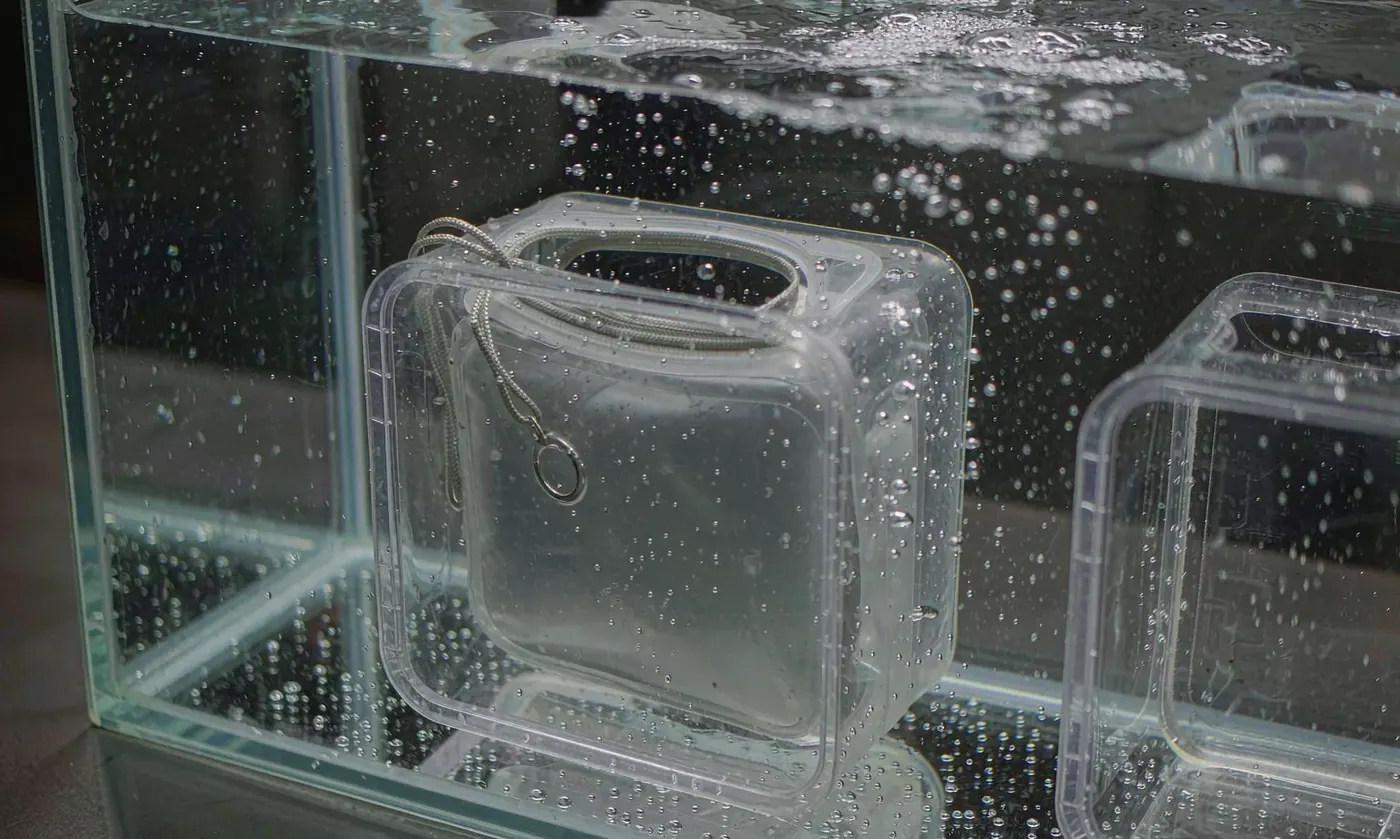
The specification that answers it is a welded base pan carrying the water rating up to at least 120 mm from the floor, which keeps the contents dry through a shallow dunk without the cost of a fully welded shell. That approach adds about 6.50-8.00 USD against 11-14 USD for a full liner. Water ingress codes are defined by the IEC ingress protection framework, and the condition has to be stated as a depth and a duration.
1. Beach 55: Best Overall
Fifty-five litres at 3.60 kg on 200 mm foam-filled wheels with sealed bearings and a solid axle, holding six 3600 trays, with a handle extending to 1,020 mm. It rolls across soft sand at 18 kg loaded without the wheels ploughing. The FOB band is 48-60 USD.
Foam-filled wheels are the reason it leads. They cannot puncture on shell or a fish hook, they absorb the shock of a kerb, and they give up perhaps 10 percent of rolling efficiency on a hard surface, which is a fair trade for a bag bought for a beach. The handle locks at two heights, which matters because a 1,020 mm grip is right for a tall angler and wrong for a short one.
2. Ramp 70: Best for Ramps and Paved Access
Seventy litres at 3.20 kg on 100 mm polyurethane wheels with shielded bearings, holding eight 3600 trays, with a handle to 1,000 mm. It is the build for a concrete ramp, a marina dock, and a paved car park, where small wheels roll efficiently and keep the centre of gravity low. The FOB band is 42-52 USD.
The advantage of small wheels here is height: at 100 mm the body sits lower, which makes an eight-tray load more stable when the bag is stationary and easier to lift into a vehicle. The limitation is honest and should be stated: this bag does not work in soft sand, and a buyer who wants both surfaces needs the all-terrain build at 60 L.
3. Compact 45: Best for Small Vehicles
Forty-five litres at 2.60 kg on 90 mm wheels, holding four 3700 trays, with a two-stage handle and a body 480 mm wide so it lies flat in a hatchback boot. The FOB band is 34-42 USD.
Boot fit is the buying reason and the dimension to publish. A wheeled bag that has to travel upright or on its side loses most of its convenience, and 480 mm width with a 340 mm height is what fits a small hatch. The compromise is sand performance: at 90 mm this bag is a ramp and dock bag, and it should not be sold as a beach bag.
4. All-Terrain 60: Best for Soft Sand
Sixty litres at 4.20 kg on 230 mm foam-filled wheels with a 78 mm contact width and sealed sand-rated bearings, holding six 3700 trays. It is the build for a long carry across soft sand to a surf or a flat, and it lands at 58-72 USD, the second highest in this group.
Contact width is the number that makes it work and the one most builders under-specify. A narrow 230 mm wheel still ploughs, because diameter alone does not reduce contact pressure; the 78 mm width is what spreads an 18 kg load. The cost is weight and bulk: at 4.20 kg and 620 mm wide this bag is awkward in a vehicle and excellent on sand.
5. Convertible 50: Best for Mixed Terrain
Fifty litres at 3.40 kg on 110 mm wheels with a stowable backpack harness, holding five 3600 trays. It rolls where there is a path and is carried where there is not, which is the reality of most surf access. The FOB band is 46-58 USD.
The harness has to be genuine, meaning 45 mm straps with 8 mm foam and a webbing belt, and it must stow behind a panel rather than hang, because loose webbing catches on a wheel. The wheels also need a guard: a harness worn against a wheel that has been in the sand transfers grit to clothing within one carry, and a moulded cover costs about 1.80 USD.
6. Surf 65: Best for Surf Anglers
Sixty-five litres at 3.90 kg on 200 mm sealed wheels, holding six 3600 trays plus two external rod tubes, with a sand-shedding base and a drain path. The FOB band is 52-64 USD. It is the build for a long walk to a surf break with rods, a spike, and a full tray set.
Sand shedding is the specification that separates a surf bag from a beach bag. A flat moulded base collects sand at the rim and the angler carries 400 g of it back to the vehicle; a base with a 5-degree chamfer and four drain slots sheds most of it. Sealed bearings are not optional here, because a surf bag goes through salt water at least once a season.
7. Carry-On 40: Best for Travel
Forty litres at 2.40 kg on 80 mm non-marking wheels with a two-stage handle that retracts flush, holding four 3600 trays. It is sized to airline cabin limits at 550 x 400 x 250 mm and it lands at 32-40 USD. The FOB band is the lowest in this group.
Cabin limits are the design constraint and they are tighter than most buyers assume, with many carriers at 550 x 400 x 250 mm including wheels and handles. A bag built to that dimension with a flush handle passes; the same bag with a protruding handle does not. Trays need protection in transit, since a moulded tray loaded in a soft shell cracks at the latch under airline handling.
8. Charter 75: Best for Heavy Duty
Seventy-five litres at 4.60 kg on 120 mm bolted wheels with a replaceable frame rail, holding ten 3600 trays in a two-tier insert. It is built for charter and guide work where the bag is rolled daily across a dock. The FOB band is 62-76 USD.
Replaceability is the whole argument. Wheels bolt rather than rivet so a worn wheel is a 5-minute swap, and the frame rail unbolts so a bent rail does not scrap the bag. At this duty cycle the wheel is a consumable, and a bag designed so the consumable can be replaced is worth roughly 15 USD more than one that cannot be.
Rod Tubes and External Carry on a Wheeled Bag
Rods are the awkward item on a rolling bag, because a rod in a tube adds length that catches on door frames and because the tube sits at the point of maximum leverage. The workable answer is two tubes mounted vertically at the back of the body, which keeps the bag within its footprint and puts the rod weight close to the axle where it does not tip the load.
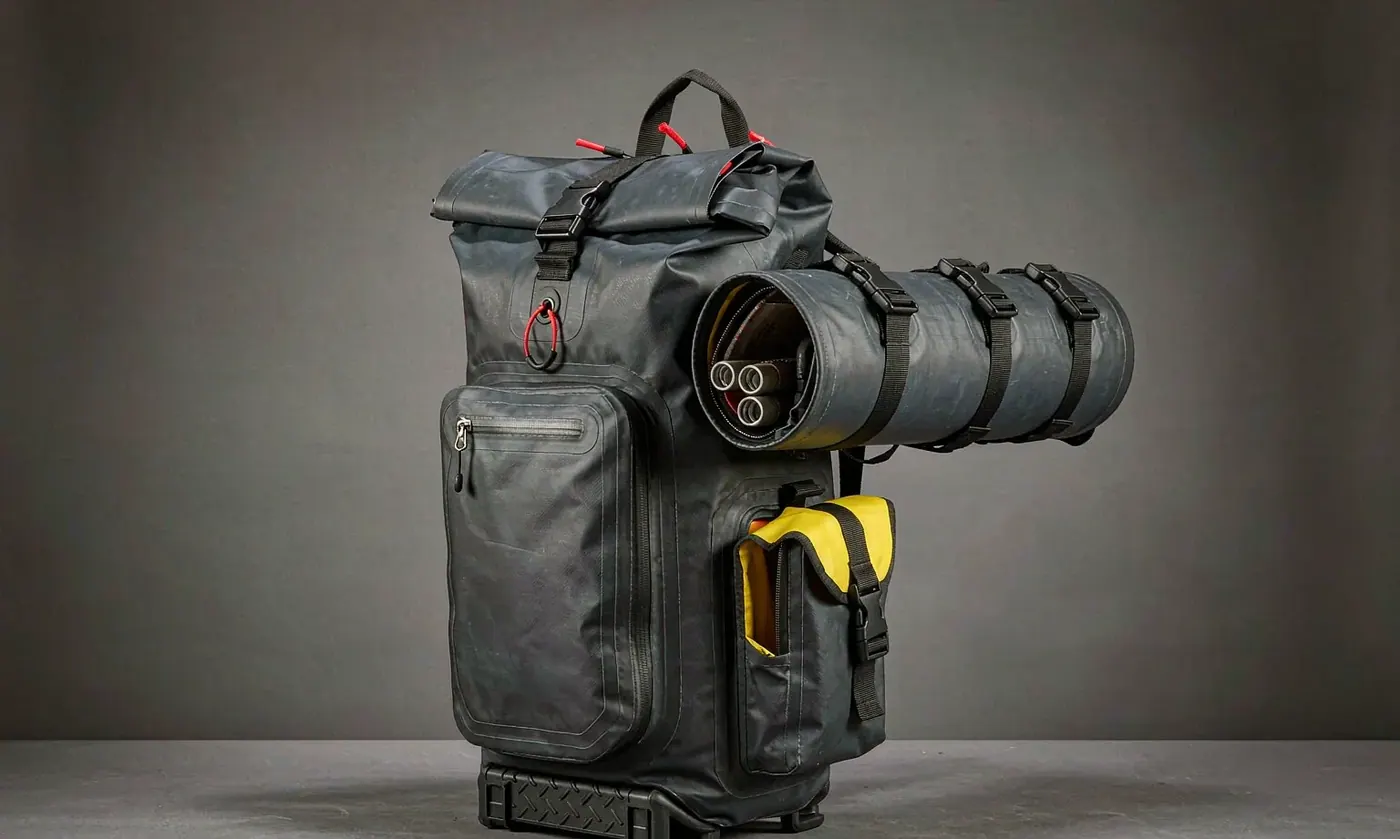
Mounting matters more than tube length. A tube attached only at the top pivots and the butt swings into the wheel on every bump, so tubes need two mounts separated by at least 300 mm with reinforced patches. A tube also needs a drain hole, because rods go in wet and an undrained tube holds salt water against the blank for the whole drive home.
Keeping Catch, Bait, and Food Apart
A wheeled bag is large enough that everything goes in it, which is exactly how cross-contamination starts. Bait juice, fish slime, and a warm drink in the same chamber produce a bag that smells within one trip and cannot be cleaned properly, because the offending liquid gets under a welded seam rather than sitting on a surface that can be wiped.
| Item | Compartment | Why separate | Cost to add |
|---|---|---|---|
| Bait | Sealed insulated pocket | Juice contaminates soft plastics | 3.50-5.00 USD |
| Catch, if kept | Drained moulded base pan | Slime and meltwater need to leave | 6.50-8.00 USD |
| Food and drink | Insulated pocket, own liner | Cross-contamination and odour | Same pocket, divided |
| Wet rain shell | External drained sleeve | Traps water against trays | 1.80-2.60 USD |
| Phone and keys | Sealed liner inside the lid | One dunk at the ramp | 1.00-2.00 USD |
Checks Before Approving a Wheeled Sample
Wheeled bags fail in the field rather than in the sample room, so the approval protocol needs a terrain test rather than a bench test. Five checks take about an hour and require a stretch of sand and a kerb, which is more than most buyers ask for and far less than a season of returns costs.
| Check | Method | Pass condition | Catches |
|---|---|---|---|
| Sand pull | Pull 18 kg across 100 m of soft sand | Rolls, wheels do not plough | Under-sized or narrow wheels |
| Kerb test | Drop the loaded bag off a 100 mm kerb 50 times | No hub crack, no rail bend | Polypropylene wheels, painted rail |
| Handle cycle | Extend and retract 500 times | No wobble, no jam | Thin telescopic tube |
| Immersion | Submerge the base to 120 mm for 60 s | Contents dry | Spray-rated base seam |
| Wheel removal | Remove and refit one wheel | Under 5 minutes with tools | Riveted wheels |
Mechanical requirements should be written against published methods from ASTM International, covering wheel and handle fatigue as well as fabric abrasion. A bag that rolls beautifully for 100 m and then loses a wheel on the first kerb is a warranty problem, and warranty rates in this category are driven by the wheel assembly rather than by the fabric.
Programme, Pricing, and Compliance
A wheeled brief should open with the surface, because that decides wheel diameter and therefore the frame, the handle, and the base. Specify bearing and axle next, then tray capacity, then cabin or boot dimensions if the bag must travel. Settling the wheel specification first matters, because a change of wheel size after sampling forces a new frame.
| Programme item | Baseline | Note |
|---|---|---|
| MOQ | 500 pcs per design and colour | Wheel colour can be split above the baseline |
| Sampling | 6-10 working days | Add 6-8 days for a moulded base tool |
| Bulk | 35-50 days | From approved sample and deposit |
| Inspection | AQL 2.5 | Include sand pull, kerb test, handle cycle, immersion |
| Compliance | REACH and California Prop 65 | Screen coatings, films, inks, hardware, foam, wheel polymer |
QUANZHOU JUNYUAN BAGS has developed waterproof bag programmes since 2014, with the founding team active in the trade since 2004. Monthly output of 200,000 units is verified by SGS, and BSCI and ISO 9001 systems structure the workflow. Materials are screened for REACH and California Prop 65, and every bulk order is inspected at AQL 2.5 before shipment.
A wheeled brief can be emailed to service@junyuanbags.com with surface, tray count, wheel specification, and quantity. FOB Xiamen or DDP service to more than 100 countries follows an approved sample and a complete test record. Beach-specific carry alternatives sit in the surf fishing bag range and the tackle tote range.
People Also Ask
What size wheels does a beach fishing bag need?
At least 180 mm of diameter with a 60-80 mm contact width for soft sand. Ramps and paving are better served by 90-120 mm wheels that keep the load low.
Are foam-filled wheels better than pneumatic ones for fishing bags?
Yes for beaches, because they cannot puncture on shell or hooks. They give up about 10 percent of rolling efficiency on hard surfaces, which is a fair trade where sand is the main surface.
Why do rolling tackle bags seize after one season?
Sand enters the bearing and packs into the hub. A sealed bearing with a rubber lip and a solid axle with a closed cap prevent it for about 0.90-2.00 USD per wheel.
How high should the handle on a rolling tackle bag be?
Between 900 and 1050 mm from the ground to the grip. Below 900 mm the bag has to be tilted and the wheels take the load instead of rolling.
Can a wheeled tackle bag survive being dunked at a boat ramp?
Only with a welded base pan rated to at least 120 mm from the floor. A ramp dunk puts the bag 300-500 mm under water for up to a minute.
Should rods go on a rolling tackle bag?
Yes, in two vertical tubes mounted at the back with mounts at least 300 mm apart. Vertical mounting keeps rods inside the footprint and puts the weight near the axle.
Frequently Asked Questions
Q1. What is the best rolling tackle bag for beach and ramp?
A 55 L build at 3.60 kg on 200 mm foam-filled wheels with sealed bearings, holding six 3600 trays, with a handle to 1,020 mm, at a 48-60 USD FOB band.
Q2. What wheel size do I need for soft sand?
At least 180 mm of diameter, and 200-230 mm with a 70-80 mm contact width is better. Diameter alone is not enough: contact width is what spreads an 18 kg load.
Q3. Are polyurethane wheels worth the extra cost?
Yes. They cost 2.40-3.60 USD more per pair than polypropylene, absorb kerb shock, and do not crack at the hub in cold weather.
Q4. What bearings should a beach fishing bag have?
Sealed bearings with a rubber lip, plus a solid axle with a closed cap. Shielded bearings and hollow axles let sand in and the wheel seizes within a season.
Q5. How much weight can a rolling tackle bag carry?
About 18-20 kg comfortably on the right surface. Above that the wheels plough in sand and the frame rail becomes the limiting component rather than the fabric.
Q6. Does a rolling tackle bag work on a concrete ramp?
Yes, and small wheels are better there. A 90-120 mm wheel keeps the centre of gravity low, rolls efficiently on paving, and makes the bag easier to lift into a vehicle.
Q7. Can a rolling tackle bag go in the water?
Not unless the base is welded. A ramp dunk reaches 300-500 mm and lasts up to a minute, so specify a welded base pan rated to at least 120 mm from the floor.
Q8. How tall should the telescopic handle be?
Between 900 and 1050 mm to the grip, and preferably locking at two heights. Below 900 mm the bag must be tilted, which puts the load on the wheels instead of rolling it.
Q9. How do I keep sand out of a beach tackle bag?
Sealed bearings, a solid axle with a closed cap, and a base with a 5-degree chamfer and drain slots so sand sheds rather than collecting at the rim.
Q10. Are replaceable wheels worth it on a charter bag?
Yes. Wheels are a consumable at daily duty, and bolted wheels that swap in about 5 minutes justify roughly 15 USD over a riveted design.
Q11. Will a wheeled tackle bag fit in a small car boot?
A 45 L body at 480 x 340 mm lies flat in most hatchbacks. Check the published width and height rather than the litre figure, since litres say nothing about boot fit.
Q12. What is the MOQ and lead time for a rolling tackle bag programme?
MOQ is 500 pcs per design and colour, samples take 6-10 working days plus 6-8 days for a moulded base tool, and bulk runs 35-50 days from approved sample and deposit.