A surf fishing bag is defined by sand before it is defined by water. Fine beach sand enters zipper teeth, drains, and tray rails, and it grinds through coatings faster than any other exposure. Specify covered or reversed closures, a base with no upward-facing crevices, drainage that sheds rather than traps, and 25-40 L for a 1-3 km beach walk at 8-14 kg. Hardware must be 304 stainless or better, and the bag needs a fresh water rinse after every single session. Programme baseline is MOQ 500 pcs per design and colour, samples in 6-10 working days, and bulk in 35-50 days.
Sand Is the Defining Problem, Not Water
Water can be sealed against; sand cannot. It is carried by wind, by wet hands, and by the bag itself every time it is set down, and it works into any opening that faces upward or any channel that does not shed. A surf bag that keeps water out perfectly can still be ruined in one season by sand in the closure, which is why sand management should be the first line of the specification.
Sand damage is mechanical rather than chemical. A grain trapped between a zipper slider and its teeth abrades the sealing surface every time the closure runs, and the same grain in a tray rail grinds the rail with every tray movement. That is why the design response is geometry: no upward-facing openings, no dead-end channels, and surfaces that shed rather than collect.
| Sand entry point | Poor design | Better design | Why |
|---|---|---|---|
| Zipper | Exposed coil zip | Covered or reversed zip with a garage | Sand never reaches the teeth |
| Drain grommet | Small hole with a lip | Sloped channel, no lip | Grains wash through, not in |
| Tray rails | Narrow slot | Open radius rail | Grains fall out instead of jamming |
| Pocket tops | Open elastic rim | Covered flap | Wind-blown sand cannot settle |
| Base | Stitched corner boxes | Welded smooth base | No crevice to hold grit |
Abrasion resistance can be specified and measured. Published methods from ASTM International cover coated fabric abrasion, and requiring a stated cycle count is far more useful than asking for a heavy duty material. For a bag dragged across wet sand daily, 500 cycles at a defined load is a reasonable minimum and 1,000 cycles suits charter or guide use.
Closures, Openings, and Sandproof Geometry
Closure choice is where surf bags diverge from other fishing bags. An exposed coil zipper is the weakest option on a beach and should be avoided entirely on the main compartment. A covered zip with a fabric garage, a reversed zip with the coil facing inward, or a roll-top all perform far better, and a roll-top is the strongest of the three because it has no teeth at all.
Roll-tops do cost volume and access speed. A three-turn roll consumes 3-4 L and takes about 10 seconds to open and close, which is acceptable for a main chamber and inconvenient for a pocket that is used every few minutes. Most well-designed surf bags use a roll-top or covered zip on the main body and a magnetic or elastic flap on the frequently used pocket.
| Closure | Sand resistance | Access speed | Best position |
|---|---|---|---|
| Roll-top, three turns | Excellent | 10 seconds | Main chamber |
| Covered zip with garage | Good | 3 seconds | Secondary compartment |
| Reversed zip | Good | 3 seconds | Internal pocket |
| Magnetic or elastic flap | Moderate | 1 second | Frequently used pocket |
| Exposed coil zip | Poor | 2 seconds | Avoid on any surf bag |
One habit extends closure life more than any material choice: brush the closure before operating it. A two-second pass with a wet hand or a soft brush removes the grains that would otherwise be ground into the sealing surface, and it is the single most effective maintenance action available on a beach.
Rod Tube, Spike, and Long-Item Carry
Surf fishing carries items no other fishing format does: a rod tube or assembled rod, a sand spike, and often a bait bucket. A rod tube of 1.2-1.8 m needs two support points separated by at least 400 mm so it cannot pivot, and the lower support should be closed so the tube cannot slide through when the bag is set down on sand.
A sand spike is awkward because it is long, dirty, and usually wet. Give it an external drained sleeve at the side rather than an internal home, and make sure the sleeve has an open bottom so sand falls out rather than collecting at the base. Carrying a dirty spike inside a bag is the fastest way to fill a chamber with grit.
| Long item | Carry method | Requirement | Check |
|---|---|---|---|
| Rod tube 1.2-1.8 m | Two-point side straps | 400 mm separation, closed lower cup | Walk test on soft sand |
| Sand spike | External drained sleeve | Open bottom, sheds sand | Invert and shake clean |
| Bait bucket | External cradle or rear dock | Drained, away from trays | Check drip path |
| Landing net | Rear dock, one-hand release | Clear of the casting arm | Full cast rehearsal |
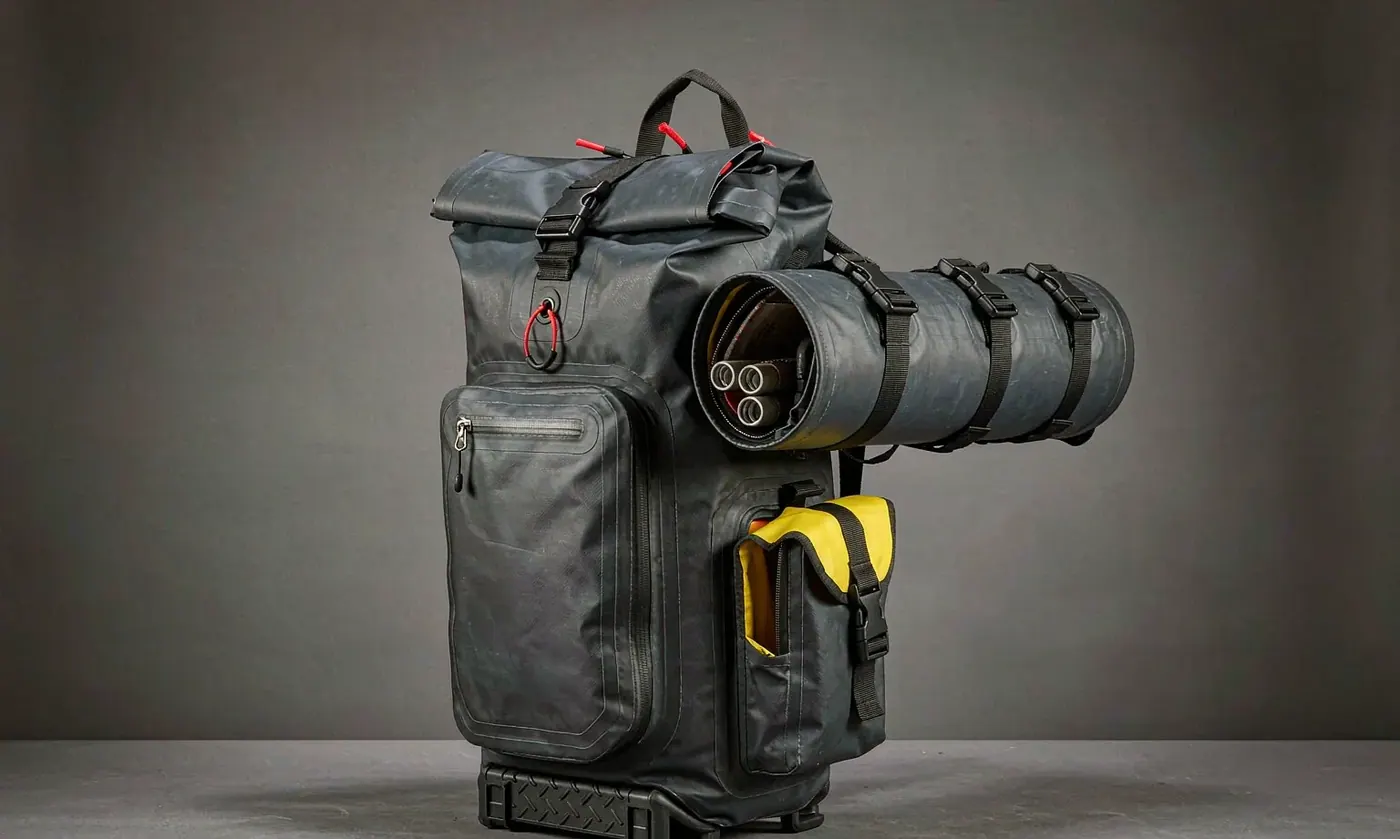
Capacity and Load for a Beach Walk
Surf fishing involves the longest carry of any shore format. A 1-3 km walk on soft sand with 8-14 kg is normal, and that combination drives both volume and harness specification. Twenty-five to 32 L suits a half-day session; 32-40 L suits a full day or an overnight bait session with a shell, food, and water.
Soft sand changes the arithmetic. Walking on sand costs roughly 1.5 to 2 times the energy of walking on a firm surface, so a load that feels fine for 2 km on a path becomes tiring at 1 km on a beach. Reduce the volume target by about 10 percent compared with a bank-fishing bag for the same kit, or accept a heavier harness and a real hip belt.
| Session | Volume | Loaded weight | Walk distance |
|---|---|---|---|
| Two to four hours | 25-30 L | 8-10 kg | Up to 1 km |
| Half day | 30-35 L | 10-12 kg | 1-2 km |
| Full day | 32-40 L | 11-14 kg | 2-3 km |
| Overnight bait session | 38-45 L | 13-16 kg | Short, shuttle if possible |
The surf fishing packing guide covers load order in detail. The short version is that dense items sit close to the spine between hip and shoulder-blade height, water sits centrally and low, and anything wet goes in an external drained zone rather than beside the trays. Build the load the night before where possible, because packing in the dark on a beach is when items get left behind and closures get made badly.
Water volume deserves its own calculation rather than a guess. Plan 500-750 ml per hour in warm conditions and more when walking soft sand in full sun, then add 50 percent as a margin for a longer return or a delayed pick-up. That usually means 2-4 L carried, which is 2-4 kg of the total load and the single heaviest single category in a surf bag.
Waterproof Level and Layering
Surf exposure is spray, wash, and the occasional full immersion when a wave catches the angler at the waterline. IPX6 is the sensible floor, and IPX7 with a stated depth and duration suits anyone who wades deeper than the knee or works from a washed rock platform. Ingress codes are defined by the IEC ingress protection framework, and any immersion claim must carry its condition.
Layering is the more reliable strategy in practice. A sealed dry bag of 5-10 L inside the main chamber protects phone, keys, licence, and a spare layer, and it means a single closure failure or one wave over the top does not end the session. Choose a bright colour so it can be found quickly in a bag full of gear, and test the liner separately once a season.
Salt, Corrosion, and Hardware
Surf is the most corrosive shore environment because salt spray is continuous and drying is uneven. Specify 304 stainless as the baseline and 316 stainless for guide or charter use, and prefer UV-stabilised engineering plastic for buckles and drains where load allows. Plain steel and uncoated zinc will show rust bloom within one season on a surf bag.
- Use 304 stainless minimum, 316 for high-use or poorly rinsed programmes.
- Rinse with fresh water after every session, including the closure and drains.
- Dry open for 8-24 hours; never store a surf bag closed and damp.
- Inspect hardware monthly for bloom and pitting.
- Re-screen the bag in water every three months.
Rinsing is the whole corrosion strategy. Fresh water over the shell, the closure, every metal part, and the drain channels after each session removes chloride before evaporation concentrates it. Skipping the rinse typically halves hardware life, and it is the most common cause of a corrosion complaint on a correctly specified bag.
Cooler, Bait, and Water Management
A surf bag usually carries a cooler section for bait or drinks, and it is the part most likely to cause problems. Insulation of 6-10 mm with a welded liner and a drain is the baseline, the drain must clear sand as well as water, and the compartment must be physically isolated from tray storage because condensation rusts hooks faster than most splashes.
Bait storage deserves a specific note. Bait juice is more aggressive than seawater and it seeps into seams. Use a removable sealed bait container rather than loading bait directly into a compartment, and rinse that container separately at the end of every session. A compartment that has held bait directly will carry the odour permanently.
Walk Comfort and Load Distribution
At 10-14 kg on soft sand, harness specification matters more than any other feature. Use 60-75 mm shoulder straps with 10-15 mm foam, a hip belt that transfers 60-70 percent of the load to the pelvis, and a sternum strap adjustable across 80 mm of height. A suspended back panel helps in warm weather but adds depth, so check that the bag still passes through doorways and vehicle openings.
Load order on a beach walk differs slightly from a trail walk. Water and bait are the heaviest items and should sit centrally and low, because a high dense load on soft sand pulls balance backward on every step. Keep the rod tube and spike symmetrical or alternate sides, because a one-sided long item creates a rotational pull that is very tiring over 2 km.
| Comfort factor | Specification | Failure sign | Correction |
|---|---|---|---|
| Strap width | 60-75 mm with 10-15 mm foam | Trapezius pain in 30 min | Widen straps or reduce load |
| Hip belt | Transfers 60-70 percent of load | Load sits on shoulders | Refit belt to the iliac crest |
| Water placement | Central and low | Backward pull on each step | Move water down and inward |
| Long items | Symmetrical or alternated | Rotational pull to one side | Alternate sides or split the load |
| Total load | Under 14 kg for 2 km | Fatigue before the mark | Reduce kit or shuttle gear |
Weather, swell, and tide should be checked before every session, and NOAA marine weather resources support that review in the United States. Surf conditions change faster than most anglers expect, and a bag is never a reason to extend a session beyond safe limits on a washed platform or a rising tide.
Footwear, Clothing, and the Wet Layer
Surf anglers carry more wet clothing than any other shore format: a wet shell, often waders or bootfoot footwear, and a wet rag or glove. None of that belongs in the main chamber. Specify an external wet zone of 6-10 L with a drain, and use it every session rather than treating it as optional, because a wet shell packed beside trays will dampen everything within an hour.
Waders are the awkward item. They are bulky, wet, and sandy on the outside, and they will not fit in any realistic wet zone. Carry them strapped externally at the rear with two compression straps, or leave them in the vehicle if the session allows. Trying to pack waders inside a bag is the most common cause of an overpacked closure, which then fails the water screen for reasons that have nothing to do with the build.
| Wet item | Water carried | Where it goes | Why |
|---|---|---|---|
| Wet rain shell | 50-150 ml | External drained wet zone | Wets out the main chamber fast |
| Waders or bootfoot | 200-500 ml | Strapped externally or left in vehicle | Too bulky for any internal zone |
| Wet rag or glove | 20-60 ml | External drained pocket | Grit and bait residue |
| Bait container | Sealed | Removable container, rinsed separately | Juice seeps and odours permanently |
| Landed fish measure | Wet and slimy | External drained pocket | Keeps slime off the trays |
A simple rule keeps the bag usable: nothing wet crosses the boundary of the main chamber. That rule is easy to state, easy to follow, and it prevents the great majority of damp-interior complaints that would otherwise be blamed on the waterproof construction.
Rinse and Care Routine
The routine after a surf session is longer than for any other format, and it is not optional. Rinse the shell, closure, drains, and hardware with fresh water; invert the bag and shake out sand; remove trays and dry them separately; then dry the bag open for 8-24 hours with every closure undone.
| Task | Frequency | Method | Pass condition |
|---|---|---|---|
| Fresh water rinse | Every session | Low pressure over all hardware | No visible salt residue |
| Sand shake-out | Every session | Invert and shake, brush drains | No grit in rails or grommets |
| Closure brush | Every session | Soft brush before operation | Slider runs freely |
| Full dry | Every session | 8-24 hours, closures open | Interior completely dry |
| Water re-screen | Every 3 months | 60 min spray, loaded | All indicator tissue dry |
Off-season, remove everything, check elastic and webbing for ultraviolet damage, and replace any drain grommet that has hardened. Store loose and dry at 15-25 degrees out of direct sun. A surf bag stored properly will outlast two seasons of careless use by a wide margin.
Programme Brief and Acceptance Criteria
Write one document covering usable litres, closure type with sand management, base and drain geometry, rod tube and spike carry, harness specification and load rating, protection level with the test condition, hardware grade, abrasion cycle count, and compliance. Add acceptance criteria for dimensions, litres, seam appearance, coating thickness, drain rate, and colour fastness.
| Programme item | Baseline | Note |
|---|---|---|
| MOQ | 500 pcs per design and colour | Colour split negotiable above baseline |
| Sampling | 6-10 working days | Add 3-5 days for a rod tube or spike sleeve change |
| Bulk | 35-50 days | From approved sample and deposit |
| Inspection | AQL 2.5 | Include closure cover, drain rate, harness travel, water screen |
| Compliance | REACH and California Prop 65 | Screen coatings, films, inks, hardware |
QUANZHOU JUNYUAN BAGS has developed waterproof bag programmes since 2014, with the founding team active in the industry since 2004. Monthly output of 200,000 units is verified by SGS, and BSCI and ISO 9001 systems structure the workflow. Materials are screened for REACH and California Prop 65, and every bulk order is inspected at AQL 2.5 before shipment.
A surf fishing brief can be emailed to service@junyuanbags.com; include walk distance, load range, rod and spike dimensions, market, and quantity. FOB Xiamen or DDP service to more than 100 countries follows an approved sample and a complete test record. The waterproof fishing tackle bag overview and the best surf fishing backpack comparison cover the wider category.
People Also Ask
What makes a fishing bag sandproof?
Geometry rather than material. Covered or reversed closures, sloped drains with no lip, open tray rails, and a smooth welded base with no upward-facing crevices.
Are exposed zippers bad on a surf fishing bag?
Yes. Sand grains abrade the sealing surface every time the slider runs. Use a roll-top or a covered zip with a garage on the main compartment.
How much should a surf fishing bag hold?
Twenty-five to 32 L for a half day and 32-40 L for a full day, at 8-14 kg loaded. Reduce the volume target about 10 percent compared with bank fishing, because soft sand makes carrying much harder.
Do I need IPX7 for surf fishing?
IPX6 is the sensible floor, and IPX7 with a stated depth suits anyone wading past the knee or working a washed platform. A 5-10 L dry liner inside the bag is the more reliable practical answer.
How do I carry a rod and sand spike on a surf bag?
A rod tube needs two supports at least 400 mm apart with a closed lower cup. A sand spike belongs in an external drained sleeve with an open bottom so sand falls out.
How should I rinse a surf fishing bag?
Fresh water over the shell, closure, drains, and hardware; invert and shake out sand; remove trays; then dry open for 8-24 hours with every closure undone.
Frequently Asked Questions
Q1. What is the most important feature on a surf fishing bag?
Sand management. Covered closures, sloped drains, open tray rails, and a smooth welded base matter more than any waterproof rating on a beach.
Q2. Are roll-top closures better than zips in sand?
Yes for the main chamber. A three-turn roll has no teeth to abrade, though it costs 3-4 L of volume and about 10 seconds of access time.
Q3. What size surf fishing bag do I need?
Twenty-five to 32 L for a half-day session at 8-10 kg, and 32-40 L for a full day at 11-14 kg. Reduce the target about 10 percent versus a bank-fishing bag.
Q4. How heavy is a loaded surf fishing bag?
Typically 8-14 kg. Walking on soft sand costs roughly 1.5 to 2 times the energy of a firm surface, so plan the load for the softer ground.
Q5. What waterproof rating suits surf fishing?
IPX6 is the sensible floor, and IPX7 with a stated depth and duration suits deeper wading or a washed platform. Always pair it with a 5-10 L dry liner inside.
Q6. How do I carry a rod tube on a surf bag?
Use two support points at least 400 mm apart with a closed lower cup so the tube cannot slide through when the bag is set down on sand.
Q7. Where should a sand spike go?
In an external drained sleeve with an open bottom. Carrying a dirty spike inside the bag fills the chamber with grit within one session.
Q8. What hardware grade suits a surf fishing bag?
Use 304 stainless as the baseline and 316 for guide or charter use. Plain steel and uncoated zinc show rust bloom within one season.
Q9. Can I put bait directly in the cooler compartment?
No. Use a removable sealed bait container, because bait juice seeps into seams and the odour becomes permanent. Rinse the container separately.
Q10. How often should a surf bag be rinsed?
After every session, with fresh water over the shell, closure, drains, and all hardware. Invert and shake out sand, then dry open for 8-24 hours.
Q11. Does sand damage the waterproof coating?
Yes, mechanically. Abrasion wears coatings and grinds closure surfaces, which is why a stated abrasion cycle count belongs in the specification.
Q12. What is the MOQ and lead time for a surf bag programme?
MOQ is 500 pcs per design and colour, samples take 6-10 working days, and bulk runs 35-50 days from approved sample and deposit.