Surf fishing ranks backpacks on sand resistance before it ranks them on water, because grit works into closures, rails, and drains long before a wave becomes the problem. Specify a roll-top or a fully covered zip, a smooth welded base with no stitched corner box, 500 abrasion cycles minimum, and two rod support points 400 mm apart. Ten builds were assessed for 2026 across 24-45 usable litres and 20-48 dollar FOB Xiamen bands at MOQ 500 pcs per design and colour. Samples take 6-10 working days and bulk runs 35-50 days.
How Sand Changes the Ranking
Every fishing format deals with water. Surf is the only one where a solid grain that never dissolves decides the service life of the product. Sand enters an exposed zip, jams a tray rail, blocks a drain grommet, and grinds a coating, and it does all of that while the bag is otherwise perfectly waterproof. A ranking that ignores sand will put a bag at the top that comes back within a season.
The ranking below therefore scores four sand-specific criteria alongside the usual ones: closure type, base geometry, abrasion result, and drain rate. Volume, rating, and harness are scored too, but they carry less weight than they would in any other fishing format, because a surf angler will forgive a heavy bag far more readily than a seized zip.
| Criterion | Weight | Top score | Bottom score |
|---|---|---|---|
| Closure sand resistance | 30 percent | Roll-top, no teeth at all | Exposed coil zip |
| Base geometry | 25 percent | Smooth welded, no crevice | Stitched corner box |
| Abrasion result | 25 percent | 1,000 cycles at a stated load | Under 300 cycles |
| Drain rate | 20 percent | Sloped channel, no lip, under 90 s | Lipped grommet that traps grit |
One habit extends the life of any surf bag more than any specification, and it is worth stating because it costs nothing: brush the closure before operating it. A two-second pass with a wet hand or a soft brush removes the grains that would otherwise be ground into the sealing surface, and it prevents the majority of closure failures in the field.
The Ten Builds at a Glance
The sand score is a five-point summary of the four sand criteria above, and it is the column to read first. Walk rating is the comfortable loaded distance on soft sand, which for most anglers is the number that decides whether the session happens at all. Rating is the ingress level of the main chamber, and drain time is measured after a full dunk in shallow surf.
| Build | Volume | Sand score | Rating | Walk rating | FOB band |
|---|---|---|---|---|---|
| Dune 35 All-Round | 35 L | 5 | IPX6 | 2.5 km at 12 kg | 32-40 USD |
| Beach 40 Big Session | 40 L | 5 | IPX6 | 2.0 km at 14 kg | 36-44 USD |
| Estuary 30 Mixed | 30 L | 4 | IPX6 | 3.0 km at 10 kg | 28-35 USD |
| Rock 28 Platform | 28 L | 4 | IPX7, 1 m / 30 min | 1.5 km at 11 kg | 30-38 USD |
| Night 34 Dark | 34 L | 4 | IPX6 | 2.5 km at 12 kg | 33-41 USD |
| Light 26 Fast | 26 L | 4 | IPX5 | 4.0 km at 8 kg | 24-31 USD |
| Charter 45 Heavy | 45 L | 5 | IPX6 | 1.0 km at 16 kg | 40-48 USD |
| Launch 32 Kayak | 32 L | 4 | IPX7, 1 m / 30 min | 1.5 km at 12 kg | 34-42 USD |
| Budget 24 Entry | 24 L | 3 | IPX5 | 2.0 km at 9 kg | 20-26 USD |
| Storm 38 Extreme | 38 L | 5 | IPX7, 1 m / 30 min | 2.0 km at 13 kg | 38-46 USD |
Sand in the Tray Chamber
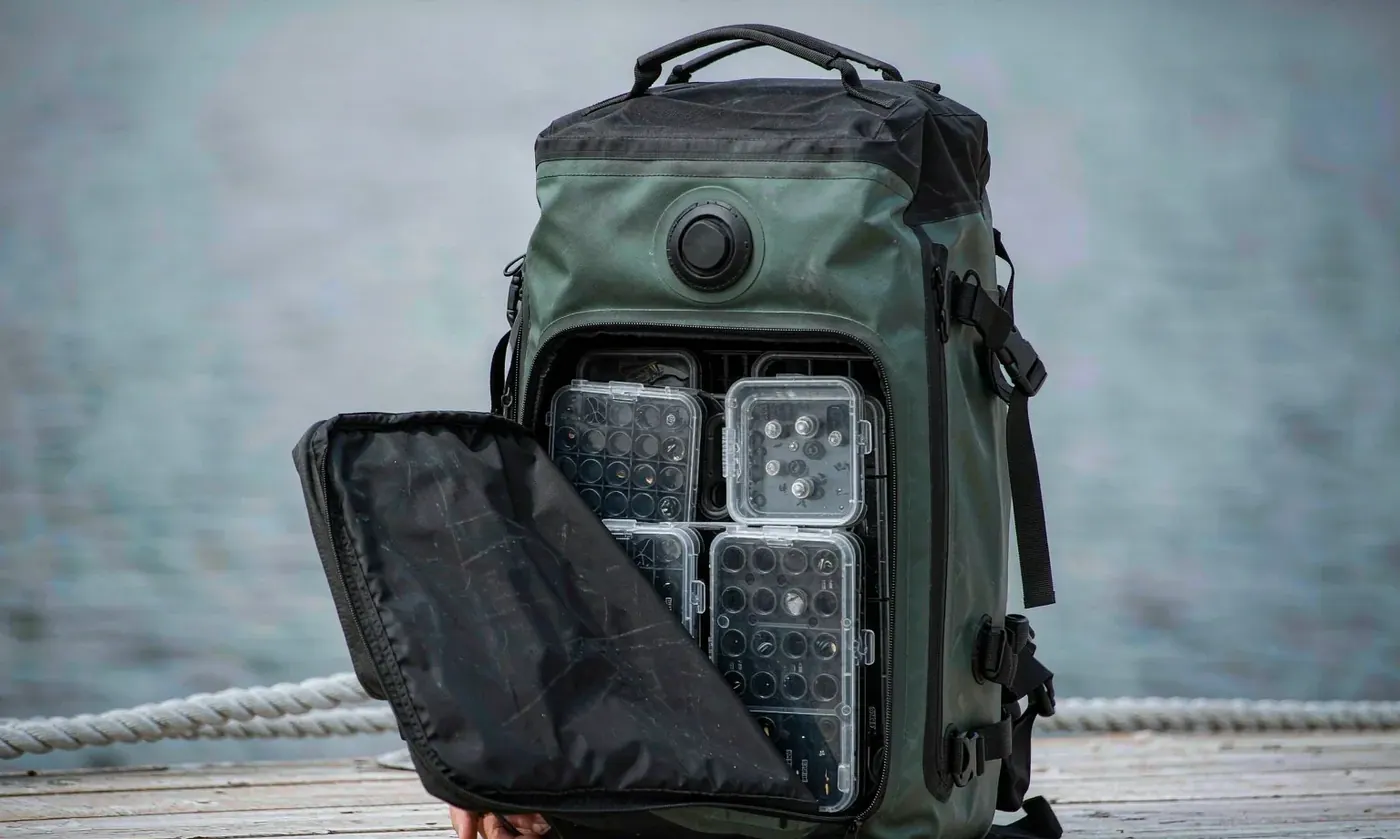
The tray chamber is where sand does the most damage and where it is least noticed. Grains settle in the rail slot, and every tray insertion grinds them along the rail, which widens the slot and eventually lets the tray drop out of alignment. The answer is an open-radius rail rather than a narrow slot, so grains fall through instead of jamming, and a chamber that can be inverted and shaken clean.
The second chamber decision is whether to seal it at all. A sealed tray chamber keeps sand out and also keeps damp in, which rusts hooks faster than any splash. The better answer for surf is an open-drained chamber with sealed boxes inside, because the boxes are the real barrier and a drained chamber can be hosed out in about ten seconds at the end of a session.
| Chamber element | Sand-smart design | Poor design | Consequence |
|---|---|---|---|
| Tray rail | Open radius, no narrow slot | Narrow slot rail | Grit jams and widens the rail |
| Chamber floor | Drained, hose-out in 10 s | Sealed with a lip | Damp trapped beside the boxes |
| Box storage | Sealed boxes inside | Loose trays in the open | Hooks rust and grit everywhere |
| Closure on the chamber | Covered zip or roll-top | Exposed coil zip | First thing to seize on a beach |
| Clean-out access | Invert and shake, no tools | Fixed liner | Sand accumulates permanently |
Abrasion deserves its own number rather than a description. Published methods from ASTM International cover coated fabric abrasion, and requiring a stated cycle count at a stated load is enforceable where the phrase heavy duty is not. For a bag dragged across wet sand weekly, 500 cycles is a reasonable minimum and 1,000 suits guide or charter use.
1. Dune 35 All-Round: Best Overall
Thirty-five litres with a three-turn roll-top, a smooth welded base, 1,000-cycle abrasion, and open-radius rails is the configuration that scores five on sand and still works as a general beach bag. Loaded at 12 kg it is comfortable for about 2.5 km on soft sand, which covers the great majority of surf sessions. Weight is 1.35 kg and the reference band is 32-40 USD.
The roll-top is the reason it wins: no teeth means nothing to abrade, and a roll can be brushed clean in two seconds. The cost is 3-4 L of volume and about 10 seconds of access time, which is the right trade on a beach and the wrong one in a boat. Hardware is 316 stainless with acetal drains, and the base rail is smooth with no slot to trap grit.
2. Beach 40 Big Session: Best for Full Days
Forty litres suits an overnight bait session or a full day with food, water, and a shell. It carries four 3600 boxes, a 2 L drink, and a bait container in an external drained cradle. Sand score is five, rating IPX6, and the loaded figure is 14 kg over about 2 km, which is the honest limit of the format rather than a marketing claim.
The harness is the part worth specifying at this size: 70 mm shoulder straps with 12 mm foam, a hip belt transferring 60-70 percent of the load, and a sternum strap adjustable across 80 mm. Without that, 14 kg on soft sand is unpleasant within 800 m. Reference band is 36-44 USD, and the build is the one to specify for anglers who walk once and fish for eight hours.
3. Estuary 30 Mixed: Best for Mixed Water
Surf anglers often fish estuary mouths and sheltered water as well as open beach, and a 40 L bag is too much for that. Thirty litres, 10 kg loaded, comfortable for about 3 km, and a sand score of four because it uses a covered zip rather than a roll-top on the main chamber. Rating is IPX6 and the reference band is 28-35 USD.
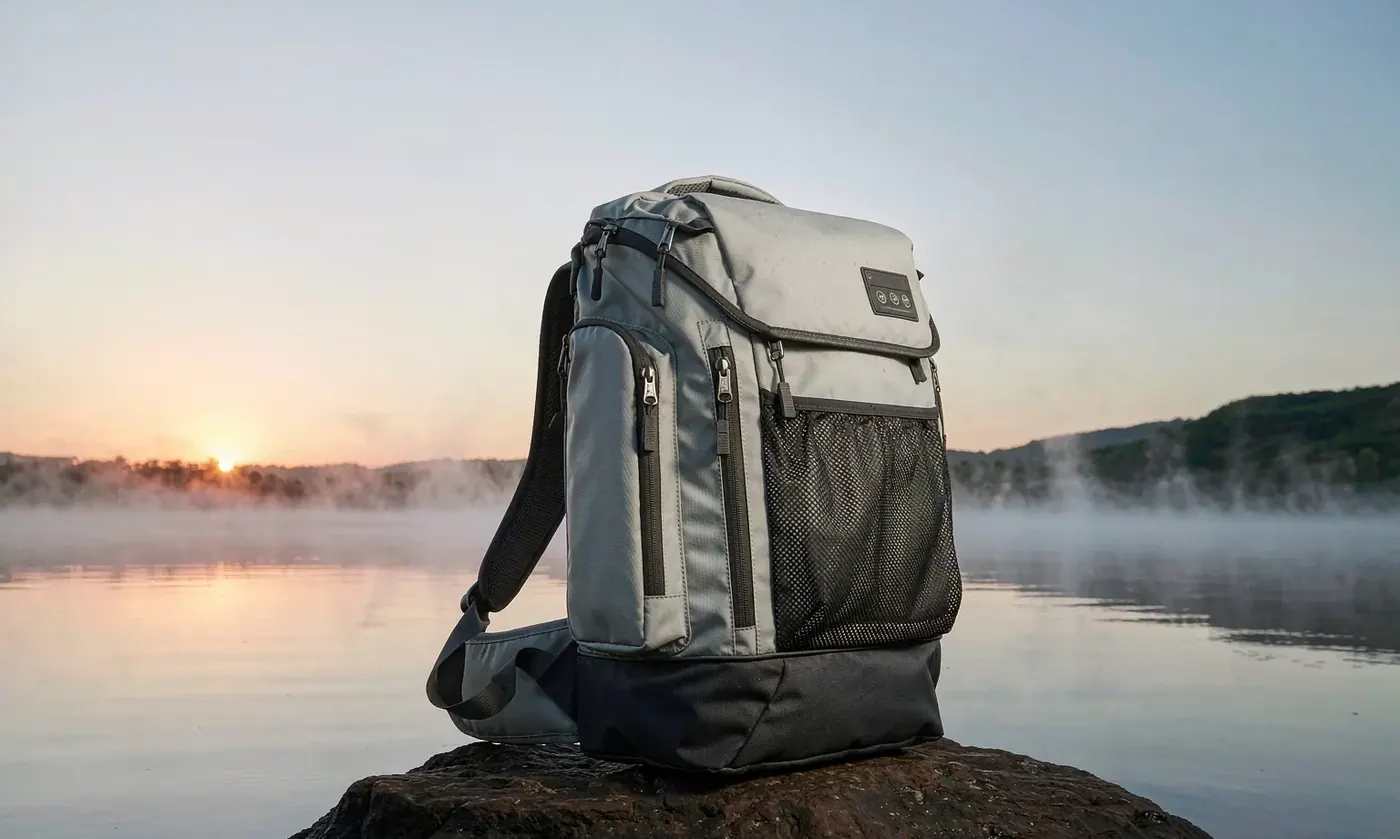
The covered zip with a fabric garage is a three-second closure against the ten seconds of a roll-top, which matters when the angler moves every twenty minutes. It scores one point lower on sand because there are teeth to protect, and the mitigation is a full garage plus a brush before every operation. A good choice for an angler whose water varies.
4. Rock 28 Platform: Best for Washed Platforms
Fishing from a washed rock platform is a genuine immersion case: waves come over the ledge, the bag is set down in standing water, and the angler cannot step back quickly. Twenty-eight litres, IPX7 at 1 m for 30 minutes, a welded base with a 25 mm upstand, and a sand score of four. Weight is 1.15 kg and the reference band is 30-38 USD.
The safety note belongs in the specification rather than in a footnote. A rock platform is the most dangerous shore environment in this category, and a bag is never a reason to extend a session. Check swell and tide before going out, keep the load low enough to move quickly, and use a bag that can be dropped rather than one the angler will try to save.
5. Night 34 Dark: Best for Night Sessions
Night surf fishing changes the requirements in ways daylight buyers forget: everything has to be findable by touch, and visibility to other people on the beach matters. Thirty-four litres with a reflective trim strip of at least 25 mm, light-coloured interior lining so items can be seen, and a torch sleeve at the shoulder. Sand score is four and the reference band is 33-41 USD.
Two details make it work. The closure puller should be oversized and in a contrasting colour, because finding a small black puller in the dark with cold hands is the most common night complaint. And the drain grommets should be audible, in the sense that the angler can hear water leaving, which confirms the bag is draining rather than holding a litre of seawater.
6. Light 26 Fast: Best for Long Walks
Some surf anglers walk 4 km or more along a beach before fishing, and for them weight beats everything. Twenty-six litres, 8 kg loaded, 0.95 kg empty, and a sand score of four with a covered zip. Rating is IPX5, which is the honest trade for the weight, and the reference band is 24-31 USD.
The specification that makes it work is the harness geometry at low load: a narrower 55 mm strap, a minimal hip belt, and a short body that keeps the load high and close. A long-walk bag should not carry a heavy harness, because the harness is part of the weight being carried. Rod carry is two straps 400 mm apart rather than a moulded sleeve, saving about 200 g.
7. Charter 45 Heavy: Best for Guide and Charter
Charter and guide use on surf beaches means 16 kg, six days a week, and a bag that is hosed down rather than carefully dried. Forty-five litres with a 1000D face, 1,000-cycle abrasion, 316 stainless throughout, a moulded base with a replaceable wear strip, and a sand score of five. Weight is 1.95 kg and the reference band is 40-48 USD.
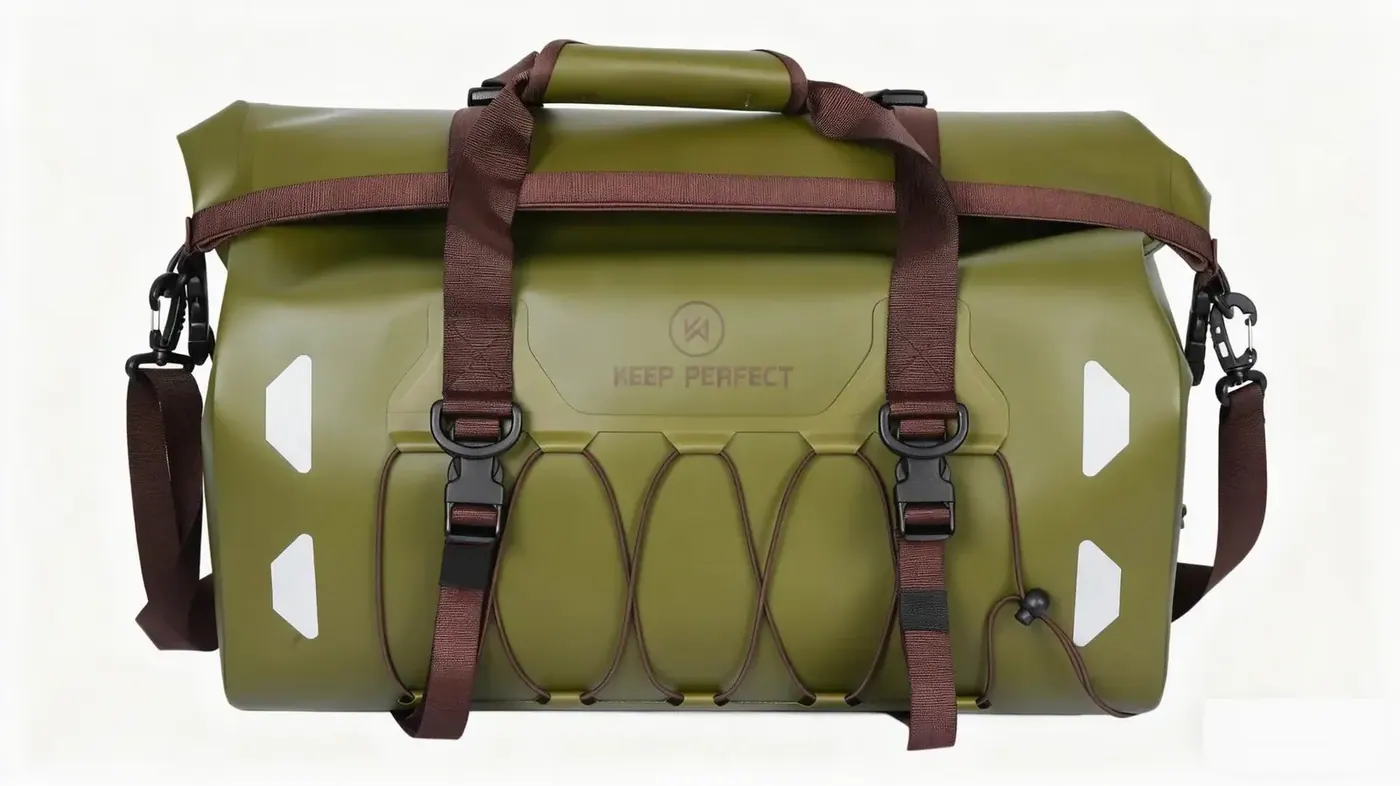
Service life on charter duty is two to three seasons against four to six for the Dune 35 on personal use, which is the correct comparison rather than unit price. The wear strip on the base is the specification that matters most, because it is the only part that can be replaced rather than the whole bag. Walk rating is 1 km, which is fine because charter groups rarely walk further.
8. Launch 32 Kayak: Best for Surf Launches
Launching a kayak through surf is the hardest combination in the category: the bag has to survive a dunk, stay put once loaded, and drain fast. Thirty-two litres, IPX7 at 1 m for 30 minutes, four base grommets at 20 mm, corner tie-down loops, and a sand score of four. Weight is 1.30 kg and the reference band is 34-42 USD.
Tie-down is the non-negotiable part. Four loops at the corners, each with a reinforcing patch, let the bag be bungeed into the tank well so a capsize in the surf does not cost the whole kit. The drain rate matters most here, because a bag launched through surf takes in water every single time, and a drain time above 120 seconds makes the boat heavy all day.
9. Budget 24 Entry: Best Budget Build
Twenty-four litres, 9 kg loaded, a sand score of three, and a 20-26 USD band. This is the entry build, and the honest description is that it has a covered rather than fully garaged zip, a coated rather than welded base, and 300-cycle abrasion. It will last two to three seasons of occasional use and one season of weekly use.
What it keeps is the important part: a covered closure, a drained base, and 304 hardware, all of which are the minimum viable set for surf. What it drops is the moulded base, the second rod support point, and the higher abrasion result. Sold as an entry item with honest limits it performs well; sold as a full-spec surf bag it generates returns.
10. Storm 38 Extreme: Best for Rough Conditions
Thirty-eight litres built for winter surf and storm sessions: a roll-top closure, IPX7 at 1 m for 30 minutes, 1,000-cycle abrasion, a welded base with a 30 mm upstand, and a sand score of five. Weight is 1.55 kg, loaded figure 13 kg, and the reference band is 38-46 USD. It is the most over-specified bag in the ranking and that is the point.
The feature that earns the price is the closure system: a roll-top main chamber plus a fully garaged secondary zip, so there is no exposed tooth anywhere on the outside of the bag. In a winter storm with driving sand, that is the difference between a bag that opens on day thirty and one that opens on day three hundred. Ingress codes are defined by the IEC ingress protection framework, and both ratings here carry a stated depth and duration.
Walking Soft Sand: Load and Distance
Soft sand costs roughly 1.5 to 2 times the energy of a firm surface, so a load that feels fine for 3 km on a path becomes tiring at 1.5 km on a beach. That is the reason the walk rating column exists and why it should be read alongside the volume. A buyer who sells a 45 L surf bag to an angler who walks 3 km has set up a return, whatever the sand score says.
| Loaded weight | Comfortable distance on soft sand | Harness requirement | Note |
|---|---|---|---|
| 8 kg | Up to 4 km | 55 mm strap, minimal belt | Long-walk configuration |
| 10 kg | About 3 km | 60 mm strap, light belt | Mixed-water day |
| 12 kg | About 2.5 km | 70 mm strap, real hip belt | Standard surf session |
| 14 kg | About 2 km | 70 mm strap, loaded hip belt | Full day, short walk |
| 16 kg | About 1 km | 75 mm strap, hip belt, shuttle if possible | Charter or very short walk |
Water planning deserves its own calculation on a beach. Plan 500-750 ml per hour in warm conditions and add 50 percent as a margin, because walking soft sand in full sun is thirstier than most anglers expect. That usually means 2-4 L carried, which is 2-4 kg of the total load and the heaviest single category in the bag.
Weather, swell, and tide should be checked before every session, and NOAA marine weather resources support that review in the United States. Surf conditions change faster than most anglers expect. The wider packing argument is set out in the surf fishing packing guide, and format trade-offs are covered in the rolling versus backpack comparison.
Programme, Pricing, and Compliance
A surf brief should lead with closure type and base geometry, because those two decide the sand score and therefore the service life. Specify the closure, the base weld, the abrasion cycle count, and the drain rate, and treat volume and pockets as secondary. The most expensive change after sampling is a base redesign, so settle the base before the sample is made.
| Programme item | Baseline | Note |
|---|---|---|
| MOQ | 500 pcs per design and colour | Colour split negotiable above the baseline |
| Sampling | 6-10 working days | Add 7-10 days if abrasion testing is required |
| Bulk | 35-50 days | From approved sample and deposit |
| Inspection | AQL 2.5 | Include closure check, base weld, drain rate, abrasion sample |
| Compliance | REACH and California Prop 65 | Screen coatings, films, inks, hardware |
QUANZHOU JUNYUAN BAGS has developed waterproof bag programmes since 2014, with the founding team active in the industry since 2004. Monthly output of 200,000 units is verified by SGS, and BSCI and ISO 9001 systems structure the workflow. Materials are screened for REACH and California Prop 65, and every bulk order is inspected at AQL 2.5 before shipment.
A surf brief can be emailed to service@junyuanbags.com; include litres, closure type, base construction, abrasion requirement, market, and quantity. FOB Xiamen or DDP service to more than 100 countries follows an approved sample and a complete test record. The full category sits in the surf fishing bag overview.
People Also Ask
What makes a backpack good for surf fishing?
Sand resistance before water resistance. A roll-top closure, a smooth welded base, 500 abrasion cycles or more, and a drain time under 90 seconds matter more than a high ingress rating.
Are exposed zips really bad on a beach?
Yes. Grains abrade the sealing surface every time the slider runs. Use a roll-top on the main chamber or a zip with a full fabric garage, and brush it before operating.
What volume suits a day on the beach?
Thirty to 35 L for a standard session at 12 kg, 40 L for a full day, and 24-26 L for long walks. Reduce the volume target about 10 percent versus bank fishing.
Does soft sand change how far I can walk?
Yes. Expect about 2.5 km at 12 kg and 4 km at 8 kg, because soft sand costs roughly 1.5 to 2 times the energy of a firm surface.
Should tray chambers be sealed against sand?
No. A drained chamber with sealed boxes inside is better, because it can be hosed clean in seconds and does not trap damp beside the hooks.
How is abrasion measured on a surf bag?
By a cycle count at a stated load using ASTM methods: at least 500 cycles for regular use and 1,000 for guide or charter duty, rather than a description such as heavy duty.
Frequently Asked Questions
Q1. What is the best surf fishing backpack overall?
A 35 L build with a three-turn roll-top, a smooth welded base, 1,000 abrasion cycles, open-radius rails, and a drain time under 90 seconds, comfortable for about 2.5 km at 12 kg.
Q2. Why is sand more of a problem than water on a beach?
Because grit works into closures, rails, and drains continuously, while a wave is occasional. A perfectly waterproof bag can still be ruined in one season by sand in the closure.
Q3. Are roll-top closures better than zips for surf?
Yes on the main chamber. A roll has no teeth to abrade, though it costs 3-4 L of volume and about 10 seconds of access time.
Q4. What abrasion result should I require?
At least 500 cycles at a stated load using ASTM methods, and 1,000 for guide or charter duty. A cycle count is enforceable where the phrase heavy duty is not.
Q5. How much should a surf fishing backpack hold?
Thirty to 35 L for a standard session at 12 kg and 40 L for a full day. Reduce the target about 10 percent compared with a bank-fishing bag.
Q6. How far can I walk on soft sand with a loaded bag?
About 2.5 km at 12 kg and 4 km at 8 kg. Soft sand costs roughly 1.5 to 2 times the energy of a firm surface.
Q7. Should the tray chamber be sealed against sand?
No. Use a drained chamber with sealed boxes inside so it can be hosed clean in seconds, and avoid trapping damp next to the hooks.
Q8. What rating suits fishing from a rock platform?
IPX7 at 1 m for 30 minutes, because waves come over the ledge and the bag sits in standing water. Pair it with a welded base with a 25 mm upstand.
Q9. How do I carry a rod on a surf backpack?
Two support points at least 400 mm apart with a closed lower cup, or a rigid sleeve for a tube. A single top strap lets the rod pivot into the leg on every step.
Q10. What suits night surf fishing?
A reflective trim strip of at least 25 mm, a light-coloured interior lining, an oversized closure puller in a contrasting colour, and a torch sleeve at the shoulder.
Q11. Do I need IPX7 for surf fishing?
IPX6 is the sensible floor for beach use. IPX7 at a stated depth suits wading past the knee, a washed rock platform, or a kayak surf launch.
Q12. How much water should I carry on a surf session?
Plan 500-750 ml per hour in warm conditions and add 50 percent as a margin. That usually means 2-4 L, which is the heaviest single category in the bag.
Q13. What is the MOQ and lead time for a surf bag programme?
MOQ is 500 pcs per design and colour, samples take 6-10 working days plus 7-10 if abrasion testing is required, and bulk runs 35-50 days from approved sample and deposit.