In saltwater the bag does not fail because water gets in; it fails because the hardware corrodes, the thread degrades, and the closure seizes. A corrosion-proof build needs 316 stainless or a non-metallic alternative at every metal point, polyester thread rather than nylon, a zip that can be rinsed, and a stated salt spray result, typically 240 to 500 hours to first red rust. Ten builds were assessed for 2026 across 20-50 usable litres and 18-50 dollar FOB Xiamen bands at MOQ 500 pcs per design and colour. Samples take 6-10 working days and bulk runs 35-50 days.
Corrosion Is the Failure Mode, Not Water
Freshwater anglers worry about leaks. Saltwater anglers should worry about hardware, because a bag that keeps water out perfectly is still finished when a buckle snaps, a zip slider seizes, or a strap ring rusts through. Chloride attack is continuous, it is invisible for the first several weeks, and it concentrates wherever water evaporates rather than drains, which is exactly where the hardware sits.
The second reason corrosion dominates is that salt damage compounds. A seized slider is forced by the angler, which cuts the tape, which lets water in, which carries more salt deeper into the bag. A single rusting ring will stain a panel, weaken the webbing it is stitched to, and eventually pull out. Every one of those starts as a 2 USD specification decision made months earlier.
| Failure | First sign | Time to failure in salt | Prevention |
|---|---|---|---|
| Rusting ring or D-ring | Brown bloom at the stitch line | 3-9 months on 304 | 316 stainless or acetal |
| Seized zip slider | Pull force rises sharply | 4-12 months unrinsed | Rinse, dry, low-temperature lube |
| Snapped buckle | Crack at the ladderlock | 6-18 months on dry nylon | Acetal hardware |
| Thread degradation | Seam opens at a stress point | 12-24 months on nylon thread | Polyester or bonded polyester thread |
| Stained panel | Rust bleed around hardware | 1-3 months | Isolate metal from the face fabric |
The Ten Builds at a Glance
Every build below is rated by exposure class rather than by price, because the right question in saltwater is how much chloride the bag sees and how often it gets rinsed. Inshore means estuary and bay use with regular rinsing. Offshore means continuous spray and infrequent rinsing. Surf means salt plus sand, which is the hardest combination of all. Salt spray hours are the neutral salt spray figure to first red rust on the hardware set.
| Build | Volume | Exposure class | Hardware | Salt spray hours | FOB band |
|---|---|---|---|---|---|
| Inshore 32 | 32 L | Inshore, rinsed | 304 stainless | 240 h | 24-31 USD |
| Offshore 45 | 45 L | Offshore, continuous | 316 stainless | 500 h | 36-45 USD |
| Surf 38 | 38 L | Surf, salt plus sand | 316 plus acetal | 480 h | 30-38 USD |
| Pier 28 | 28 L | Pier, moderate | 304 stainless | 240 h | 22-29 USD |
| Flats 24 | 24 L | Flats, light use | 316 stainless | 360 h | 20-26 USD |
| Kayak 26 | 26 L | Kayak, immersion | 316 plus acetal | 480 h | 25-32 USD |
| Charter 50 | 50 L | Charter, daily | 316 stainless | 500 h | 40-50 USD |
| Travel 34 | 34 L | Travel, mixed | 316 stainless | 360 h | 28-35 USD |
| Wade 20 | 20 L | Wading, immersion | 316 plus acetal | 480 h | 18-24 USD |
| All-Round 36 | 36 L | Mixed inshore and offshore | 316 stainless | 480 h | 31-39 USD |
Hardware Grades and Galvanic Pairs
The grade question is straightforward once the exposure class is known. 304 stainless handles inshore use with a regular rinse and costs less. 316 adds molybdenum, which raises resistance to chloride pitting substantially, and it is the correct default for offshore, charter, and surf duty. Titanium and high-grade engineering polymer remove the corrosion question entirely and are worth considering for any part that is both load-bearing and hard to rinse.
The part buyers miss is galvanic coupling. Two dissimilar metals in contact in an electrolyte produce a cell, and the less noble metal corrodes fast. An aluminium ring against a stainless screw in salt water will destroy the ring in weeks. The rule is to keep one metal family per assembly, or to isolate the pair with a plastic washer or a coating, and that rule costs nothing to apply at the design stage and cannot be applied after assembly.
| Pair | Risk | Result | Answer |
|---|---|---|---|
| 304 stainless ring on a nylon webbing | Low | Bloom at the stitch line over 6-9 months | Rinse regularly or move to 316 |
| Aluminium against stainless | High | Aluminium destroyed in weeks | Never mix; isolate or match |
| Zinc-plated steel anywhere | Very high | Rust within one trip | Remove from the specification |
| Acetal against any metal | Low | No galvanic cell | Preferred for buckles and drains |
| Titanium against stainless | Low to moderate | Stainless corrodes slowly | Isolate if both are structural |
How Corrosion Screening Works
The standard screen is a neutral salt spray chamber, in which a fine mist of sodium chloride solution is held at a controlled temperature and the sample is inspected at intervals for the first appearance of red rust. It is an accelerated comparison rather than a prediction of field life, but it separates grades reliably and it is cheap enough to run on every approval sample. Published procedures come from ASTM International, and the equivalent international method sits in the ISO standards collection.
Interpreting the numbers needs a rule of thumb rather than a conversion factor. Around 240 hours to first red rust on 304 hardware corresponds to inshore use with a regular rinse. Around 480-500 hours on 316 corresponds to offshore or charter duty. Anything below 120 hours should be rejected outright for saltwater, whatever the grade claim on the drawing says, because the result means the passivation or the alloy is wrong.
| Result to first red rust | Interpretation | Suitable duty | Verdict |
|---|---|---|---|
| Under 120 hours | Wrong alloy or no passivation | None in saltwater | Reject |
| 120-240 hours | Plated or low-grade steel | Freshwater only | Reject |
| 240-360 hours | Sound 304 stainless | Inshore with regular rinsing | Accept for inshore |
| 360-480 hours | Sound 316 stainless | Offshore with occasional rinsing | Accept for most salt use |
| 500 hours or more | 316 with passivation, or non-metallic | Charter and offshore daily | Accept for all duty |
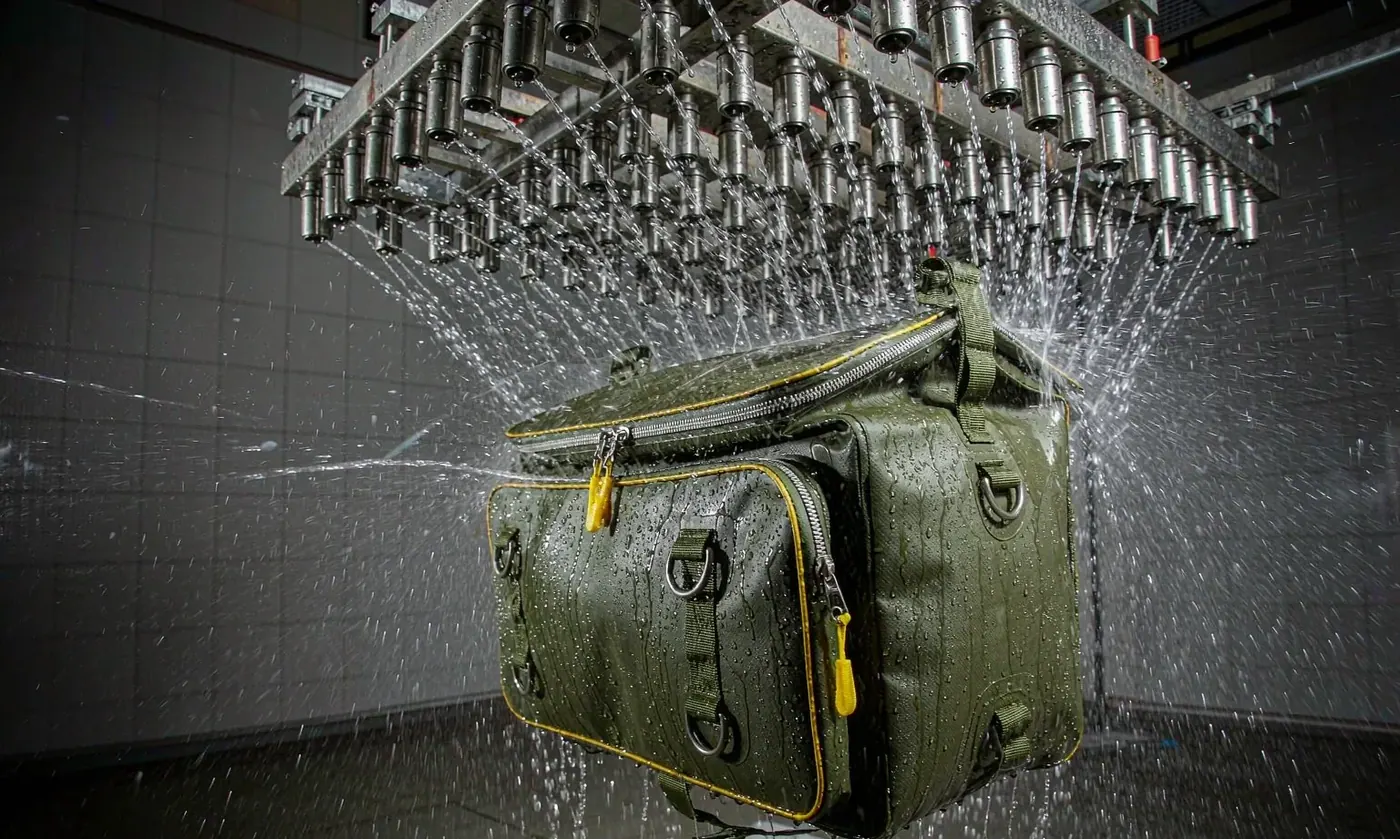
Before the salt chamber, run the water screen, because a bag that leaks cannot be judged on corrosion at all. A 60-minute spray test on a loaded bag with indicator tissue inside catches the closure and seam problems that account for the majority of early returns, and it takes an afternoon rather than a week. The sequence should always be water first, then salt.
Transport, Storage, and the Boot Problem
More salt damage happens in the car boot than on the water. A bag placed in a closed vehicle after a session sits in warm humid air with chloride concentrated on every surface, and that combination is more aggressive than the session itself. A bag left in a boot for three days without a rinse will show rust bloom that a season of properly rinsed use would not produce.
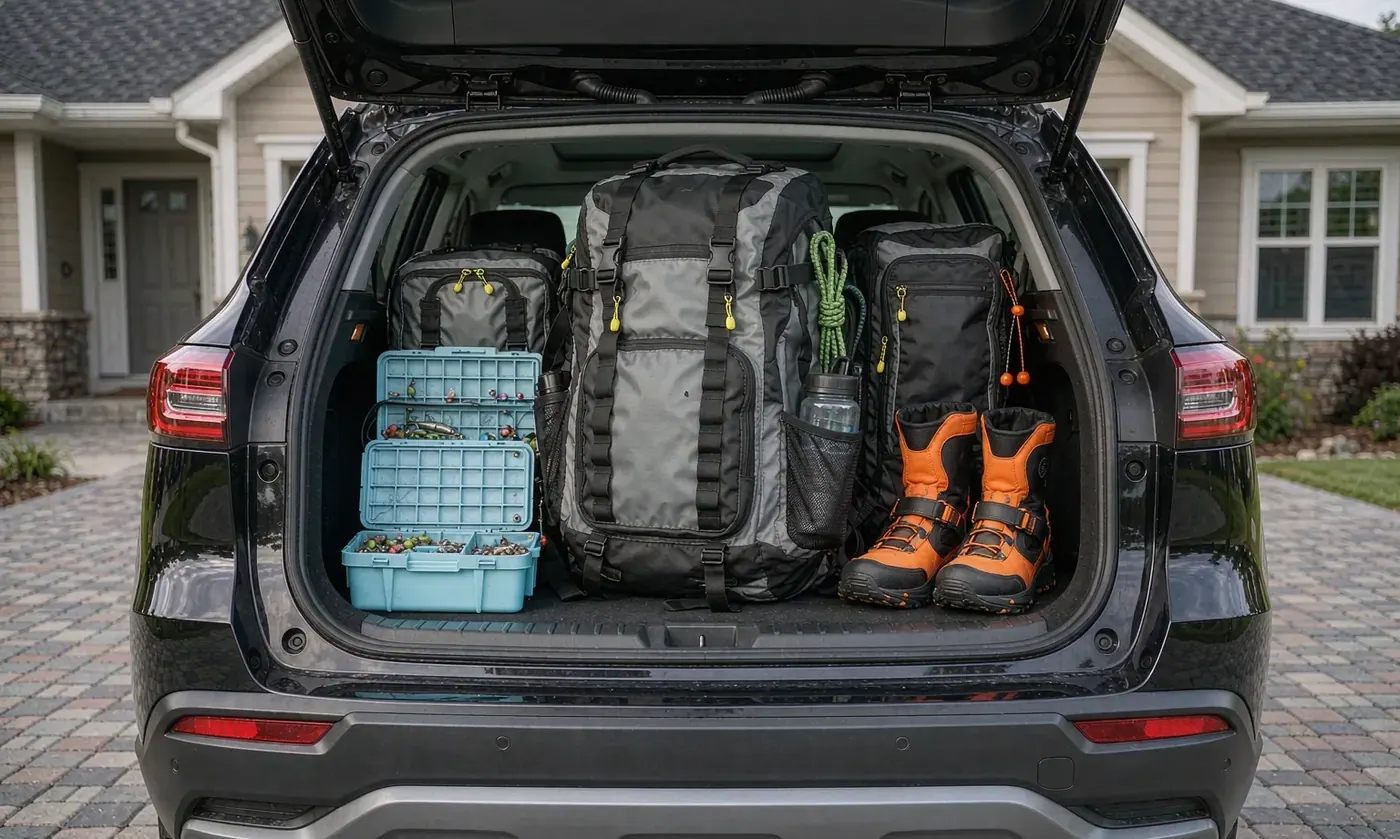
The rules are simple and they cost nothing. Rinse before the bag goes in the vehicle, or at worst rinse the same day. Never store it closed and damp. Open every closure for the drive home where that is safe, and dry it fully within 24 hours. Store it in a ventilated space rather than a sealed plastic box, and if a bag must be stored wet for a day, a fresh water soak is better than leaving salt on it.
| Storage habit | Effect | Corrosion outcome | Rule |
|---|---|---|---|
| Rinsed and dried within 24 hours | Chloride removed | Full service life | The standard |
| Rinsed late, dried within 48 hours | Some concentration | Mild bloom at rings | Acceptable occasionally |
| Unrinsed, stored closed in a boot | Chloride concentrated | Bloom within days | Never do this |
| Unrinsed for a week | Deep attack at stitch lines | Hardware replacement | Avoid or accept the cost |
| Stored wet in a sealed box | No evaporation at all | Odour plus corrosion | Ventilate instead |
1. Inshore 32: Best for Estuary and Bay
Inshore fishing means estuaries, bays, and sheltered water, with the boat or the angler back at a ramp the same day and a rinse available. The Inshore 32 is built for exactly that: 32 L, 304 stainless hardware with a 240-hour salt spray result, a covered zip, and a coated 600D face. At 1.15 kg it is light enough for a walk to a spot, and the 24-31 USD band leaves good margin.
The honest limitation is the grade. 304 will bloom at the rings within six to nine months if the rinse is skipped, and it should not be sold into a market where the angler has no fresh water at the ramp. Where a rinse is realistic, this build gives three to four seasons, which is a better outcome per dollar than over-specifying 316 for a sheltered-water customer.
2. Offshore 45: Best for Offshore Duty
Offshore is continuous spray, infrequent rinsing, and bigger loads. The Offshore 45 answers with 45 L, 316 stainless throughout at a 500-hour salt spray result, acetal buckles and drains, and a 1000D face with a welded base rail that does not trap salt. At 1.70 kg it is heavy, and the weight is the correct trade for the duty.
Three details make it work offshore. The hardware is isolated from the face fabric by a backing washer so rust bleed cannot stain the panel. The drains are acetal with a sloped channel and no lip, so salt water leaves rather than pooling. And the closure has a full fabric garage, which is the single feature that most extends zip life in salt. Reference band is 36-45 USD.
3. Surf 38: Best for Salt Plus Sand
Surf is the hardest environment in this ranking because it combines chloride with abrasion. Sand grains work into the closure and the drain channels, they grind the sealing surfaces, and they hold damp salt against the metal. The Surf 38 answers with a roll-top main closure that has no teeth to abrade, open-radius tray rails that shed grains, and 316 hardware with acetal drain grommets.
The base is the other surf-specific item: a smooth welded panel with no stitched corner box, because a stitch line at the base collects both sand and salt and is the first place a surf bag fails. Thirty-eight litres, 1.40 kg, and a 480-hour salt spray result. Reference band is 30-38 USD, and the rinse requirement is absolute: fresh water after every session, no exceptions.
4. Pier 28: Best for Pier and Jetty
Pier fishing is a moderate-exposure case that is often over-specified. The angler walks to a fixed spot, sets the bag down on a wet concrete or timber surface, and fishes from one place. Twenty-eight litres, 304 stainless at 240 hours, a moulded base panel that protects against the abrasive deck surface, and 1.05 kg. Reference band is 22-29 USD.
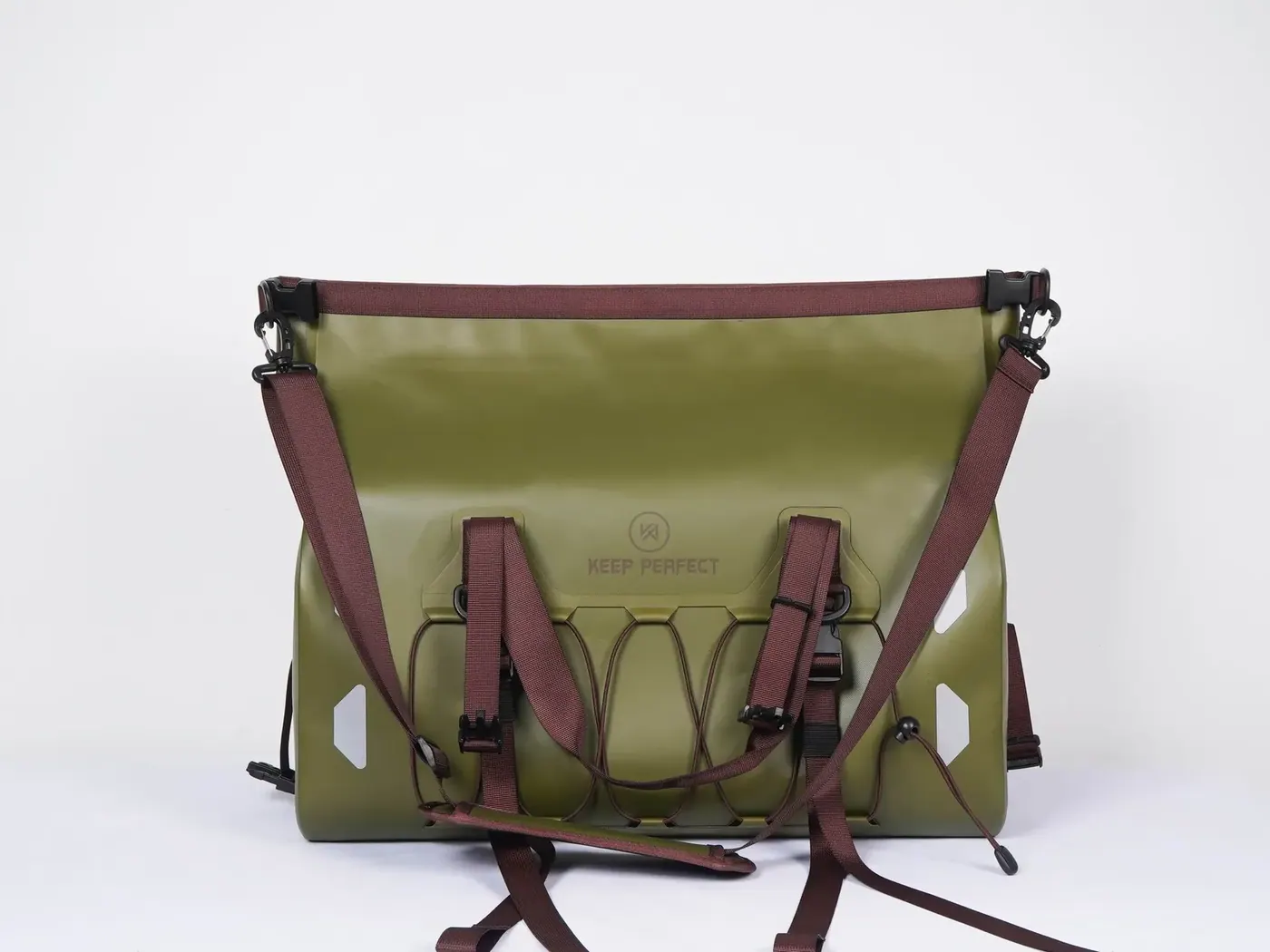
The feature that matters on a pier is a stable base rather than a high rating. A bag that tips off a narrow pier rail is gone, so the base should be wide and textured, and a webbing loop for a safety leash is worth adding at about 0.30 USD. Rating is IPX5, which is sufficient because pier fishing does not immerse the bag.
5. Flats 24: Best Lightweight Salt Build
Flats anglers walk long distances in warm weather and carry little, so weight dominates. Twenty-four litres, 0.88 kg, 316 stainless at a 360-hour result, and a light 420D face with a TPU laminate. The compromise is abrasion, and this build should not be sold for guide duty or for anywhere the bag is dragged.
Ventilation is the second flats requirement and it conflicts with waterproofing, which is worth stating plainly. A raised mesh back panel is not sealed, so the build ships with a 3 L sealed liner for the phone and licence rather than claiming a rating it cannot support. Reference band is 20-26 USD, and it is the build most often bought as a second bag by a saltwater angler.
6. Kayak 26: Best for Saltwater Kayak Use
Kayak fishing is the only format where the bag is regularly immersed rather than sprayed, so the rating and the drainage both matter. Twenty-six litres, IPX7 at 1 m for 30 minutes, four base grommets, and 316 hardware with acetal buckles at a 480-hour result. The profile is flattened to about 130 mm so it clears a kayak seat back.
Tie-down is the kayak-specific requirement: four webbing loops at the corners so the bag can be bungeed to the well rigging, because an unsecured bag in a capsize is lost. Reference band is 25-32 USD, and the build is normally sold alongside a crate system. Rinsing is easier here than anywhere else, since a kayak is usually hosed down anyway.
7. Charter 50: Best for Charter and Daily Use
Charter duty is the extreme case: loaded to 15-18 kg, hosed down, left damp, and used six days a week. Fifty litres, 316 stainless with passivation at 500 hours, a 1000D face, a moulded base with a replaceable wear strip, and doubled strap anchors tested to three times the loaded weight. At 1.95 kg it is the heaviest build in the ranking.
Service life is two to three seasons against one for a mid-tier saltwater bag, which makes the cost per season lower despite the 40-50 USD band. The specification that makes the difference is passivation on the hardware after forming, because a cut or formed edge in 316 will still rust if the surface is not treated. Reference band is 40-50 USD and the build is aimed at commercial operators.
8. Travel 34: Best for Travel Anglers
The travel angler needs a bag that packs flat, survives a charter boat for a week, and comes home. Thirty-four litres, 0.95 kg, 316 hardware at 360 hours, and a body that folds to about 60 mm with a removable stiffener. The reference band is 28-35 USD, and the build includes a sealed liner pouch as standard.
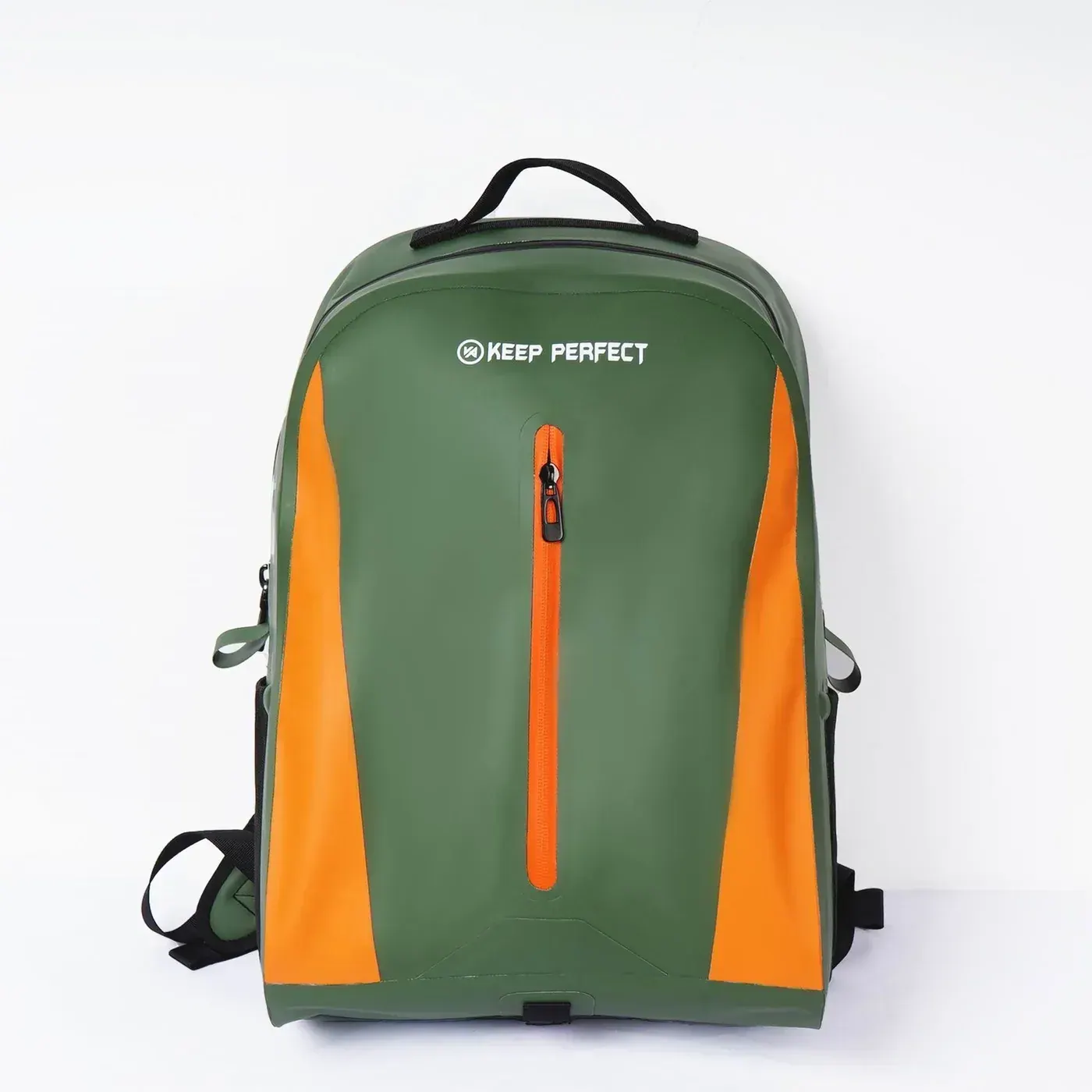
Two travel-specific details matter. The bag should have no external webbing loops long enough to catch on a conveyor, and it should be dryable in a hotel room within 12 hours, which means mesh rather than closed-cell foam at the back panel. Both are cheap to specify and both are missed on most travel fishing bags.
9. Wade 20: Best for Salt Wading
Salt wading means flats, surf edges, and estuary crossings, and it is a small-bag case: 20 L, 0.72 kg, IPX7 at 1 m for 30 minutes, 316 hardware with acetal buckles at 480 hours. The body is narrow, at about 230 mm, so it stays clear of a cast, and the drainage is open mesh at the base and lower back panel so a dunk sheds in about 90 seconds.
The liner is standard rather than optional at this size, because there is no room for a second chamber. Reference band is 18-24 USD and the build is the strongest entry price point in a saltwater range. The rinse requirement is the same as everywhere else in saltwater: fresh water over every metal part, every session, without exception.
10. All-Round 36: Best Single Saltwater Build
A buyer stocking one saltwater backpack should stock this one. Thirty-six litres, 316 stainless at 480 hours, acetal buckles and drains, a covered zip with a full garage, a welded base rail, and a moulded EVA base insert. It carries four 3600 boxes, weighs 1.35 kg, and handles inshore, offshore, and pier duty without a weakness that shows up in the first season.
What it gives up against the specialists is optimised: it is heavier than the Flats 24, less abrasion resistant than the Charter 50, and less submersible than the Kayak 26. For a general retail range that is the correct trade, because a buyer cannot know which exposure class each customer falls into. Reference band is 31-39 USD.
Rinse Regime and Service Life
Rinsing is the whole corrosion strategy and it is worth being specific about it, because a vague instruction is not followed. Fresh water over the shell, every metal part, the closure teeth, and the drain channels, at low pressure, for about 60 seconds, after every single session. Then dry open for 8-24 hours. That routine roughly doubles hardware life against the same bag used without it.
| Task | Frequency | Method | Pass condition |
|---|---|---|---|
| Fresh water rinse | Every session | 60 seconds, low pressure, all hardware | No visible salt residue |
| Closure clean and dry | Every session | Water over the teeth, operate twice | Slider runs freely |
| Full dry open | Every session | 8-24 hours, every closure undone | Interior completely dry |
| Hardware inspection | Monthly | Look for bloom and pitting | No red rust anywhere |
| Water re-screen | Every 3 months | 60-minute spray, loaded | Indicator tissue dry |
Weather and sea state should be checked before every trip, and NOAA marine weather resources support that review for United States waters. Salt conditions change quickly, and a bag is never a reason to extend a session. The wider cleaning routine is set out in the saltwater bag cleaning guide, and the hardware argument in detail is in the corrosion-proof hardware article.
Programme, Specifications, and Compliance
A saltwater brief should be written around hardware and thread before anything else, because those two decide service life and both are cheap to get right. Specify the alloy and the salt spray result, specify bonded polyester thread rather than nylon, specify a covered closure with a garage, and specify acetal or 316 for every drain and buckle. Fabric choice is the fourth priority, not the first.
| Programme item | Baseline | Note |
|---|---|---|
| MOQ | 500 pcs per design and colour | Colour split negotiable above the baseline |
| Sampling | 6-10 working days | Add 7-10 days if salt spray testing is required |
| Bulk | 35-50 days | From approved sample and deposit |
| Inspection | AQL 2.5 | Include hardware grade check, spray screen, drain rate, closure cycle |
| Compliance | REACH and California Prop 65 | Screen coatings, films, inks, hardware, plating |
QUANZHOU JUNYUAN BAGS has developed waterproof bag programmes since 2014, with the founding team active in the industry since 2004. Monthly output of 200,000 units is verified by SGS, and BSCI and ISO 9001 systems structure the workflow. Materials are screened for REACH and California Prop 65, and every bulk order is inspected at AQL 2.5 before shipment.
A saltwater brief can be emailed to service@junyuanbags.com; include exposure class, litres, hardware grade, salt spray requirement, market, and quantity. FOB Xiamen or DDP service to more than 100 countries follows an approved sample and a complete test record. The full category sits in the saltwater fishing bag overview.
People Also Ask
Is 316 stainless worth the extra cost on a fishing bag?
Yes for offshore, charter, and surf duty. 316 reaches 480-500 salt spray hours to first red rust against 240 for 304, and it is the difference between one season and three.
How long does hardware last in saltwater?
Three to four seasons on 304 with a regular rinse, and four to six on 316. Unrinsed, 304 shows bloom within three to nine months.
What is a good salt spray test result?
240 hours to first red rust for 304 inshore hardware and 480-500 hours for 316. Anything under 120 hours should be rejected for saltwater regardless of the grade claimed.
Why does a zip seize in saltwater?
Chloride dries on the slider and teeth and the pull force rises until the slider is forced off track. Rinse after every session and use a low-temperature lubricant.
Can I store a saltwater bag in the car boot?
Only after a full rinse and dry. A bag shut into a warm boot with salt on it shows rust bloom in days, which is faster damage than the session itself causes.
What thread should a saltwater fishing bag use?
Bonded polyester rather than nylon. Nylon thread loses strength in a chloride environment and seams open at stress points within 12-24 months.
Frequently Asked Questions
Q1. What makes a fishing backpack corrosion-proof?
316 stainless or non-metallic hardware at every metal point, bonded polyester thread, a covered closure that can be rinsed, and a stated salt spray result of at least 240 hours to first red rust.
Q2. Is 316 stainless worth the extra cost?
Yes for offshore, charter, and surf duty. It reaches 480-500 salt spray hours against 240 for 304, and it typically triples service life in continuous spray.
Q3. Can I use 304 stainless in saltwater?
Yes for inshore use with a regular rinse, where it gives three to four seasons. It will bloom at the rings within six to nine months if the rinse is skipped.
Q4. What salt spray result should I require?
At least 240 hours to first red rust for inshore hardware and 480-500 hours for offshore. Anything under 120 hours should be rejected for saltwater entirely.
Q5. Why does my fishing bag zip seize?
Chloride dries on the slider and teeth, the pull force rises, and the slider is eventually forced off track. Rinse after every session and use a low-temperature lubricant.
Q6. What thread should a saltwater bag use?
Bonded polyester. Nylon thread degrades in a chloride environment and seams open at stress points within 12-24 months.
Q7. What are galvanic pairs and why do they matter?
Two dissimilar metals in contact in salt water form a cell and the less noble one corrodes fast. An aluminium ring against a stainless screw fails in weeks, so keep one metal family per assembly.
Q8. How often should I rinse a saltwater fishing bag?
After every single session: fresh water over the shell, every metal part, the closure teeth, and the drain channels, then dry open for 8-24 hours.
Q9. Can I leave a saltwater bag in the car boot?
Only rinsed and dried. A bag shut into a warm boot with salt on it concentrates chloride on every surface and shows bloom within days.
Q10. What is the best size for a saltwater fishing backpack?
Thirty-six litres covers four 3600 boxes and a layer for mixed use. Go to 24-28 L for flats and pier work and 45-50 L for offshore or charter duty.
Q11. Which build suits surf fishing?
A 38 L roll-top build with open-radius rails and a smooth welded base. Surf combines chloride with abrasion, which is the hardest environment in this category.
Q12. Do kayak anglers need a different saltwater bag?
Yes. Kayak bags are immersed rather than sprayed, so they need IPX7 with a stated depth, four base grommets, and corner tie-down loops so the bag cannot be lost in a capsize.
Q13. What is the best single saltwater backpack to stock?
A 36 L build with 316 hardware at 480 hours, acetal buckles and drains, a covered zip with a garage, and a moulded EVA base. It covers inshore, offshore, and pier duty.
Q14. How long does a saltwater fishing bag last?
Three to four seasons on 304 with regular rinsing and four to six on 316. Charter duty gives two to three seasons regardless of grade, because the hardware wears first.
Q15. What is the MOQ and lead time for a saltwater programme?
MOQ is 500 pcs per design and colour, samples take 6-10 working days plus 7-10 if salt spray testing is required, and bulk runs 35-50 days from approved sample and deposit.