The same bag lasts five to seven years in freshwater and two to three years in saltwater if the hardware is not specified for it, because chloride attacks metal, salt crystals abrade thread, and retained moisture hydrolyses coatings. A saltwater build differs in five specific ways: 316 stainless or marine-grade hardware instead of zinc-plated steel, non-metallic or resin zippers with drainage, more drain capacity in the base, heavier thread allowances at every anchor, and a rinse protocol written into the care instructions. Those five changes add roughly 4.80-9.60 USD per unit on a 30 litre body and roughly double service life, which makes them the cheapest reliability purchase available on any coastal programme.
What Actually Differs, Listed Once
The differences are often described vaguely as marine-grade construction, which tells a buyer nothing they can specify or verify. Reduced to testable items, a saltwater build changes hardware alloy, zipper type, drainage capacity, thread and stitch allowance, and care instruction. Fabric film choice barely changes at all, which surprises people who assume the whole bag must be different.
| Element | Freshwater build | Saltwater build | Added cost |
|---|---|---|---|
| Hardware alloy | Zinc-plated steel standard | 316 stainless or marine alloy | 2.40-4.80 USD |
| Zipper | Standard coil, metal slider | Resin coil, marine slider, no exposed steel | 0.90-2.20 USD |
| Base drainage | One or two 6 mm holes | Two to four 10 mm grommets plus channels | 0.60-1.30 USD |
| Thread and anchors | Size 69, standard bar-tacks | Size 92 at anchors, sealed thread | 0.50-1.10 USD |
| Care instruction | Air dry after use | Rinse in fresh water within two hours | Written, no cost |
| Expected service life | Five to seven years | Four to six years with the above | About 4.80-9.60 USD total |
Frame the third row properly: adding drainage is arguably the most valuable item on that list per dollar spent, yet it is the first thing cut when a design is value-engineered. Standing salty water inside a base panel is what destroys soft goods fastest, because it never fully evaporates and instead leaves crystals behind that grind against coating and thread with every movement.
Why Chloride Is So Much Worse Than Fresh Water
Seawater carries around 35 grams of dissolved salt per kilogram, roughly 19 grams of that being chloride ions, and chloride defeats the passive oxide layer that protects stainless and aluminium alloys. Fresh water at typical inland hardness does almost nothing by comparison, which is why the same component can differ in life by a factor of five between the two environments.
- Chloride penetrates the chromium oxide film on stainless locally, producing pitting rather than uniform rust, so a part looks sound and then fails structurally at one small spot.
- Evaporation concentrates rather than removes the salt, so a bag dried without rinsing ends up with a stronger solution than the sea it came from.
- Salt crystals are harder than the coating they sit against, so any retained crystal abrades film and thread mechanically during transport.
- Dissimilar metals in contact with an electrolyte create galvanic corrosion, which is why a steel rivet in an aluminium bracket corrodes far faster than either metal alone.
- Warm coastal humidity accelerates every one of these mechanisms, roughly doubling corrosion rates for each 10 degrees Celsius rise in temperature.
The practical reading is that corrosion is never uniform and always starts somewhere specific, which is why inspecting the same dozen points after every season finds trouble early. Those points are the zipper slider, every rivet and grommet, the strap anchor bar-tacks, the base rail corners, and any place where two different metals touch.
Corrosion testing used across the industry is standardised, and the salt spray method maintained by ASTM International allows hardware finishes to be compared on hours to first red rust rather than on adjectives. Specifying a number of hours at a defined standard converts a vague request for marine quality into something a purchaser can verify on arrival.
Hardware: The Decision That Matters Most
Hardware is where saltwater and freshwater builds genuinely diverge, because this is the only category of component that can fail structurally rather than cosmetically. A corroded buckle that releases under load loses fish and equipment, and it does so without much warning.
| Component finish | Hours to first corrosion | Suitability | Cost index |
|---|---|---|---|
| Zinc-plated steel | 48-96 hours | Freshwater only | Baseline |
| Brass, nickel plated | 96-200 hours | Occasional salt use | 1.6x |
| Anodised aluminium | 300-600 hours | Good but watch galvanic contact | 2.1x |
| 304 stainless | 200-500 hours, pits later | Light coastal use | 2.4x |
| 316 stainless | 500-1,200 hours | Correct choice for salt | 3.2x |
| Marine-grade polymer | Unaffected, UV limited | Excellent where load permits | 1.4x |
The polymer row deserves promotion rather than being treated as the budget option. Modern marine acetal and reinforced polyamide hardware is completely immune to chloride, weighs 30-45 percent less than steel, and costs around 1.4 times a zinc-plated baseline. Its limitation is creep under sustained high load, so it suits buckles, ladder locks, and strap adjusters while 316 stainless remains correct for high-stress points such as rod holder mounts and load-bearing D-rings.
Two practical notes end this section. First, salt spray testing ranks finishes rather than predicting calendar years, so a result of 500 hours should be read as a comparison against another finish rather than as a promise of 500 days outdoors. Second, hardware should always be sourced with its alloy documented, because two visually identical fittings can differ by a factor of five in chloride resistance and there is no way to tell them apart once installed.
Zippers Fail First and Fail Loudly
Every warranty analysis in this category points at the same component, and it is always the zipper. It combines moving parts, tight tolerances, dissimilar metals, and direct exposure, which is precisely the set of conditions that chloride exploits fastest.
| Zip option | Saltwater behaviour | Freshwater behaviour | Recommendation |
|---|---|---|---|
| Metal teeth, steel slider | Seizes within 20-40 trips | Acceptable | Never for salt |
| Standard resin coil | Runs well, slider corrodes | Excellent | Fit a marine slider |
| Resin coil with marine slider | 300-500 cycles then service | Excellent | Correct choice |
| Waterproof TIZIP style | Good with rinsing, needs lubrication | Good | Rinse the teeth every trip |
| Moulded tooth with covered slider | Best available behaviour | Excellent | Specify on open boats |
Rinsing is not optional for any of them and it takes about ninety seconds. Running fresh water along the closed zip from one end to the other, then opening and closing it five or six times while still wet, removes the majority of the salt load. A monthly lubrication with a silicone-free product rated for marine zips extends cycle life from roughly 300 to about 700 cycles, and the whole protocol costs less than 2 USD a year.
Drainage, Drying, and Interior Layout
A bag used offshore is going to get water inside it regardless of how well it is sealed, because it gets loaded in spray and because wet gear is put into it. The design question is therefore what happens to that water next, and freshwater and saltwater builds answer it very differently.
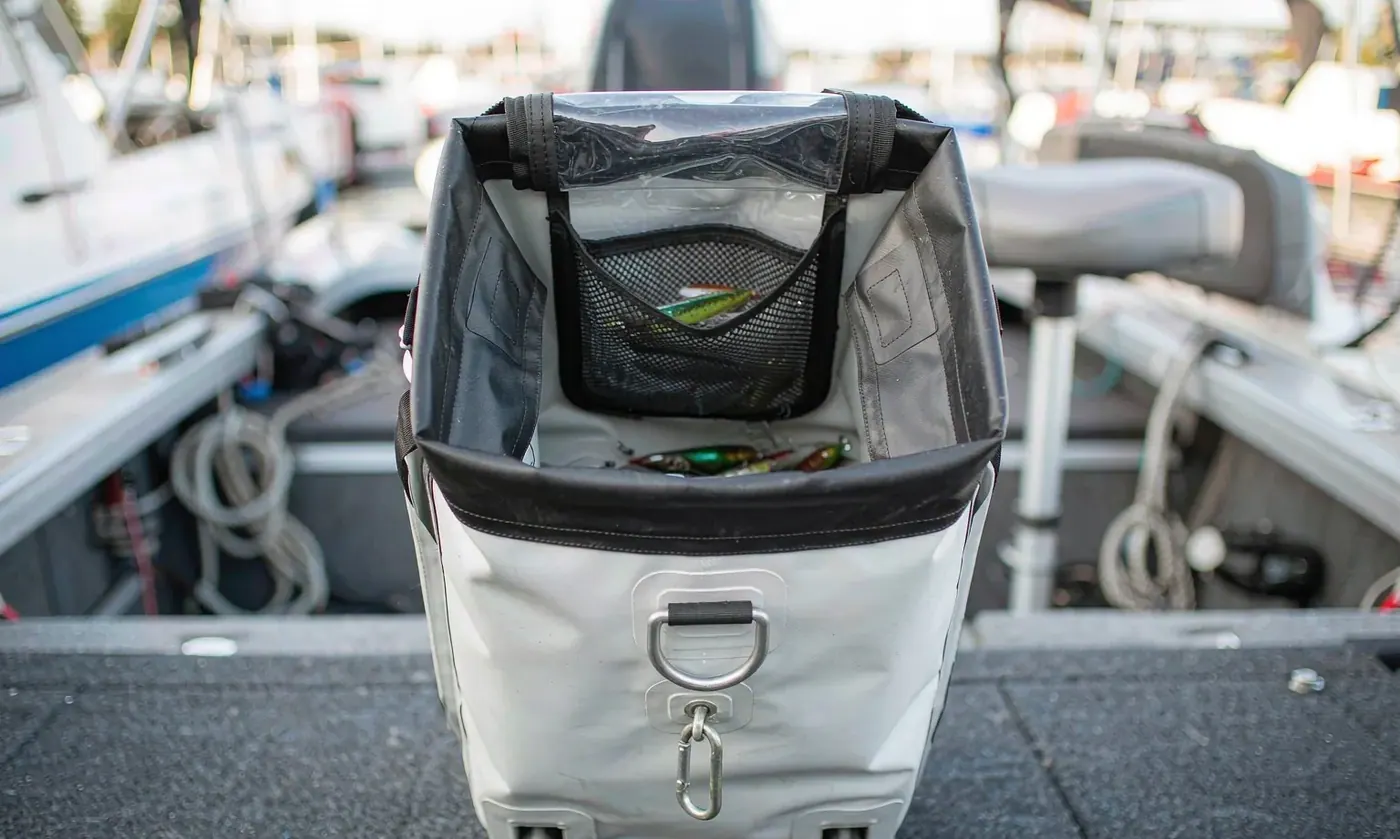
- A saltwater body should carry two to four 10 mm grommets in the lowest panel, positioned clear of any seam so they do not drain directly onto a joint.
- Base channels moulded or sewn at 10-15 mm depth keep water moving toward the grommets instead of pooling in the middle of the floor.
- Every internal pocket needs a drainage path or a mesh base, because a sealed liner that holds water becomes a salt bath.
- Anything that cannot be rinsed easily should be removable; fixed linings that trap salt crystals at the corners are a recurring source of premature wear.
- A light-coloured interior helps here, because salt residue is visible and prompts a rinse, whereas dark linings hide it until damage is done.
There is a subtlety about grommet placement that is easy to get wrong. A drain hole placed directly above a seam or a base rail puts the entire outflow onto the joint it is meant to protect, which simply moves the failure rather than preventing it. Offsetting every grommet by at least 25 mm from any joint costs nothing at the design stage and cannot be corrected afterwards.
Fabric and Thread Differences
Film choice changes less than most buyers expect. Both TPU laminate and PVC coated polyester survive salt exposure well, and neither is meaningfully attacked by chloride. What changes is how they are protected against ultraviolet load, because coastal fishing means open horizons and reflected light off water, roughly doubling the effective dose.
| Element | Freshwater | Saltwater | Reason |
|---|---|---|---|
| UV stabiliser package | Standard | Elevated, about 0.25 USD extra | Reflected light off open water |
| Thread size at anchors | Size 69 | Size 92 minimum | Crystals abrade fine thread |
| Seam construction | Taped acceptable | Welded preferred | Standing water sits in bags |
| Base protection | Standard film | Add moulded EVA base pad | Abrasion plus wet contact |
| Colour choice | Any | Avoid very dark shells near heat | Deck temperatures above 60 degrees Celsius |
Colour selection deserves a note because it is usually decided by marketing alone. A dark shell on an open deck in the tropics easily reaches above 60 degrees Celsius at the surface, which accelerates plasticiser migration in PVC and softens some coatings. Specifying a mid-tone outer panel reflects perhaps 30-40 percent more solar load and measurably slows coating ageing at no cost.
Corrosion testing for the alloy components is also covered by the neutral salt spray method published by ISO, and quoting hours against that method alongside the ASTM figure gives a buyer a cross-check against optimistic figures taken from a single internally-run test.
Inside the Bag: Trays, Hooks, and Rust
Salt does not stop at the bag. The most common complaint from coastal anglers is not that their bag failed but that everything inside it rusted, and this is partly a design question rather than purely one of maintenance.
| Interior issue | Freshwater | Saltwater | Fix |
|---|---|---|---|
| Hook points rusting in trays | Slow, cosmetic | Within days, ruins hooks | Dry hooks before storing |
| Plier corrosion | Minor | Joints seize solid | Rinse tools separately |
| Tray rail metal components | Fine | Corrode and stain fabric | Specify polymer rails |
| Salt crystals in tray corners | Not applicable | Abrades through film | Rinse trays out every trip |
| Odour from retained organic matter | Moderate | Strong and persistent | Dry fully open between trips |
Designing against that table means specifying rust-resistant tray rails and avoiding any metal component inside the body that is not 316 stainless or polymer. It also means providing enough ventilation that a closed bag can actually dry, since the worst cases always involve a bag shut wet for a week between trips. Adding two mesh vents of about 120 square centimetres each on opposite sides costs under 1 USD and allows genuine through-drying.
What Freshwater Builds Can Safely Save
There is a real risk of overspecifying, and buyers serving inland markets should say no to marine hardware they will never need. The savings below are genuine and cost nothing in performance for lake, river, and reservoir use.
| Item saved | Saving per unit | Where it is safe | Where it is not |
|---|---|---|---|
| Zinc-plated hardware instead of 316 | 2.40-4.80 USD | Inland lakes and rivers | Any tidal or coastal water |
| Standard coil zip with steel slider | 0.90-2.20 USD | Freshwater only | Estuaries and brackish water |
| Reduced drainage provision | 0.60-1.30 USD | Where bags stay dry inside | Kayak and boat decks |
| Lighter thread at anchors | 0.50-1.10 USD | Light loads under 8 kg | Heavy multi-tray loads |
| Standard UV package | 0.25-0.40 USD | Forested or shaded banks | Open reservoirs and high altitude |
The trap in that table is the estuary and brackish row. Brackish water carries a meaningful fraction of seawater chloride and behaves much more like salt than fresh, so any programme distributing into estuary fisheries, tidal rivers, or coastal lagoons should be built as saltwater even though the product sits in a freshwater catalogue.
The Maintenance Protocol That Doubles Life
Specification and maintenance are not alternatives; the best hardware still fails early without rinsing, and good care cannot rescue zinc-plated steel in a coastal climate. Written into a care label and followed consistently, the protocol below is what turns a four-year saltwater bag into a six-year one.
| When | Action | Time | Effect |
|---|---|---|---|
| Within two hours of leaving the water | Rinse in fresh water, running rather than soaking | 2-3 minutes | Removes most chloride load |
| Same day, at the zip | Run water along the closed zip and cycle it six times | 90 seconds | Prevents slider seizure |
| Monthly in regular use | Lubricate the zip with a marine rated product | 2 minutes | Extends cycles from 300 to 700 |
| Every three months | Soak base and grommets in fresh water for 15 minutes | 15 minutes | Clears retained crystals |
| Start and end of each season | Inspect all 12 stress points and replace any suspect fitting | 20 minutes | Catches failures before use |
QUANZHOU JUNYUAN BAGS has developed waterproof bag programmes since 2014, with the founding team working in the trade since 2004. Monthly output of 200,000 units is verified by SGS, and BSCI and ISO 9001 systems structure the workflow. Materials are screened for REACH and California Prop 65, and every bulk order is inspected at AQL 2.5 before shipment.
Choosing the Right Build
Reducing everything above to a purchasing decision takes one table and about a minute, provided the buyer is honest about where the bags will actually be used rather than where the marketing photographs were taken.
| Distribution situation | Build | Reason |
|---|---|---|
| Coastal, offshore, or open boat | Full saltwater specification | Spray and immersion both routine |
| Surf fishing from beaches | Full saltwater specification | Constant spray plus sand abrasion |
| Estuary and tidal river | Full saltwater specification | Brackish water behaves like seawater |
| Kayak on inland lakes | Freshwater with welded seams | Immersion without chloride exposure |
| Trout and freshwater streams | Freshwater build | No chloride, lower UV on wooded water |
| Mixed national distribution | Saltwater specification | About 5-9 USD more, avoids all warranty risk |
| Budget promotional line | Freshwater build, stated clearly | Honest limitations beat silent failure |
The mixed distribution row is worth emphasising because it avoids an argument that otherwise recurs every season. Coastal customers represent maybe 20-35 percent of a national account but generate most corrosion complaints, and the added cost of building everything to the marine standard runs 4.80-9.60 USD against typical warranty handling costs several times that per claim. Where a clear product-page statement of intended use is possible, splitting the line is reasonable; where it is not, build all of it to the coastal standard.
A build question can be put emailed to service@junyuanbags.com with the fishery type, expected units per year, target unit cost, and required service life. FOB Xiamen or DDP service to more than 100 countries follows an approved sample. Relevant further reading covers the saltwater fishing bag range, the corrosion proof hardware guide, and the how to clean a saltwater fishing bag guide.
People Also Ask
Do I really need a saltwater specific fishing bag?
If you fish coastal, offshore, estuary, or tidal water, yes. Chloride corrodes zinc-plated hardware within 48-96 salt spray hours, so a freshwater build loses two to three years of service life in salt conditions.
What hardware survives salt water best?
316 stainless at 500-1,200 hours to first corrosion, followed by marine-grade polymer, which is immune to chloride and 30-45 percent lighter. Avoid zinc-plated steel entirely for coastal use.
How much extra does a saltwater build cost?
About 4.80-9.60 USD per unit on a 30 litre body, mostly the 2.40-4.80 USD for 316 stainless hardware. It roughly doubles service life, making it the cheapest reliability purchase available.
Why does my zip seize after beach fishing?
Salt crystals form inside the slider and between the teeth as water evaporates. Rinse along the closed zip and cycle it six times after every trip, then lubricate monthly to extend cycles from 300 to about 700.
Can I use a freshwater bag in estuaries?
Not if you want it to last. Brackish water carries a meaningful share of seawater chloride, so any tidal or estuary fishery should be treated as saltwater regardless of how the catalogue positions it.
Should all my bags be built to the marine standard?
For mixed national distribution, usually yes. Coastal users are 20-35 percent of volume but generate most corrosion claims, and the extra cost is far below the claim handling cost per incident.
Frequently Asked Questions
Q1. What is the difference between a saltwater and a freshwater fishing bag?
A saltwater build uses 316 stainless or marine polymer hardware, resin zips with marine sliders, extra base drainage, heavier thread at anchors, and a higher ultraviolet package. A freshwater build can use zinc-plated hardware and standard zips without penalty.
Q2. How long do hardware finishes last in salt spray testing?
Zinc-plated steel reaches first corrosion at 48-96 hours, brass at 96-200, 304 stainless at 200-500, anodised aluminium at 300-600, and 316 stainless at 500-1,200 hours.
Q3. Is stainless steel always rust proof in sea water?
No. Chloride penetrates the passive oxide film locally, so 304 pits after 200-500 hours of exposure. Only 316, with its molybdenum content, resists pitting properly for the working life of the bag.
Q4. What zip should a saltwater fishing bag use?
A resin coil with a marine grade slider and no exposed steel components. A moulded tooth zip with a covered slider performs best on open boats, and every zip should be rinsed after each trip.
Q5. How often should I rinse a saltwater fishing bag?
Within two hours of leaving the water, using running fresh water rather than a soak, for about two to three minutes. Add a 15 minute monthly soak at the base and grommets to clear retained crystals.
Q6. Do I need drain holes in a fishing bag?
Yes for any boat or kayak use. Two to four 10 mm grommets in the lowest panel, offset at least 25 mm from any seam, clear standing water that otherwise leaves abrasive crystals inside.
Q7. Can a freshwater bag be used in the sea occasionally?
It will survive a few trips if rinsed immediately each time, but expect hardware corrosion to begin within a season and zip problems sooner. Occasional use deserves at least a polymer hardware upgrade.
Q8. Does salt damage the fabric itself?
Very little. Both TPU laminate and PVC coating resist chloride well. The damage comes indirectly, from retained crystals abrading coating and thread and from the higher ultraviolet dose typical of open coastal water.
Q9. Why do hooks rust inside my bag?
Because salt residue remains in tray corners and holds moisture against them. Rinse trays separately, dry hooks before storing them, and dry the bag fully open rather than rolled.
Q10. Is the extra cost of a saltwater build worth it?
Yes for any coastal distribution. Around 4.80-9.60 USD per unit roughly doubles service life from two to three years to four to six, and costs far less than the warranty handling it prevents.
Q11. What should a care label say for a saltwater bag?
Rinse in fresh water within two hours, run water along the closed zip and cycle it six times, dry fully open, never machine wash, and inspect all hardware points at the start and end of each season.
Q12. What is the MOQ and lead time?
MOQ is 500 pcs per design and colour. Samples take 6-10 working days and bulk runs 35-50 days from approved sample and deposit, with salt spray verification available for every hardware finish.