The best waterproof fishing backpack in 2026 is the 40 L roll-top build at roughly 1.25 kg with an IPX7 rating stated as 1 m for 30 minutes, because it covers wading, boat, and bank use without a compromise that shows up in the field. Ten builds are worth specifying this year, spanning 20-55 L, IPX6 to IPX8, and 0.72-1.70 kg empty, with FOB Xiamen reference bands from 17 to 58 dollars per unit at MOQ 500 pcs per design and colour. Samples take 6-10 working days and bulk runs 35-50 days from an approved sample. Ranking depends on rating evidence, drain rate, and hardware grade far more than on litres.
How These Ten Builds Were Ranked
This ranking is built for buyers who specify bags rather than for anglers who buy one, so the scoring weights evidence over comfort. Four criteria carry the ranking: whether the waterproof claim arrives with a stated test condition, how fast the bag sheds water after a dunk, what grade of hardware it uses in a salt environment, and whether the tray and pocket layout matches the litres claimed. Each build below is a complete configuration, not a single product, so the same platform can be ordered in several fabrics and colours.
Price bands are indicative FOB Xiamen references for a 500-piece first order in a single colourway with one printed logo. They move with fabric choice, hardware grade, quantity, and the number of tooling items such as a moulded base or a branded puller. Treat them as a way to compare configurations rather than as a quotation, and always pair them with the compliance and inspection line in the programme table at the end.
| Scoring criterion | Weight | What earns a high score | What loses points |
|---|---|---|---|
| Rating evidence | 30 percent | Stated IPX level with depth and duration | A rating with no test condition |
| Drain and dry rate | 25 percent | Drained base, sheds in under 2 minutes | Fabric base that holds water |
| Hardware grade | 25 percent | 304 or 316 stainless, acetal buckles | Plain steel or uncoated zinc |
| Layout honesty | 20 percent | Litres matched to the stated tray count | Volume claimed, boxes do not fit |
Two categories were deliberately excluded. Rolling bags are out because wheels fail in slush and sand within one season, and hard-shell cases are out because they cannot be carried comfortably over any distance. Both have a place in a range, but neither belongs in a ranking about backpacks that actually go on a back.
The Ranking at a Glance
The table below compresses the ten builds to the six numbers buyers ask for first. Volume is usable litres rather than the external figure, which is usually 8-12 percent higher and is the number most often quoted misleadingly. Empty weight excludes trays, because tray count is a separate ordering decision on most programmes.
| Build | Volume | Rating | Weight | Face fabric | FOB band |
|---|---|---|---|---|---|
| Deepwater 40 Roll-Top | 40 L | IPX7, 1 m / 30 min | 1.25 kg | TPU on 840D | 28-36 USD |
| Tideline 30 Welded | 30 L | IPX7, 1 m / 30 min | 1.05 kg | TPU on 600D | 24-31 USD |
| Flats 24 Sling-Carry | 24 L | IPX6 | 0.88 kg | TPU on 420D | 19-25 USD |
| Offshore 55 Duffel-Back | 55 L | IPX6 | 1.60 kg | 1000D PVC | 34-44 USD |
| Backwater 35 Four-Tray | 35 L | IPX6 | 1.35 kg | TPU on 600D | 26-33 USD |
| Rainshadow 28 Hybrid | 28 L | IPX5 | 0.95 kg | Recycled PET with TPU | 22-29 USD |
| Coldfront 38 Winter | 38 L | IPX6 | 1.45 kg | Cold-flex TPU | 30-38 USD |
| Skiff 20 Compact | 20 L | IPX7, 1 m / 30 min | 0.72 kg | TPU on 420D | 17-23 USD |
| Bluewater 45 Submersible | 45 L | IPX8, 2 m / 60 min | 1.70 kg | TPU with airtight zip | 46-58 USD |
| Bankrunner 32 Value | 32 L | IPX6 | 1.15 kg | TPU on 600D | 21-27 USD |
Waterproof Ratings: What IPX6, IPX7 and IPX8 Mean Here
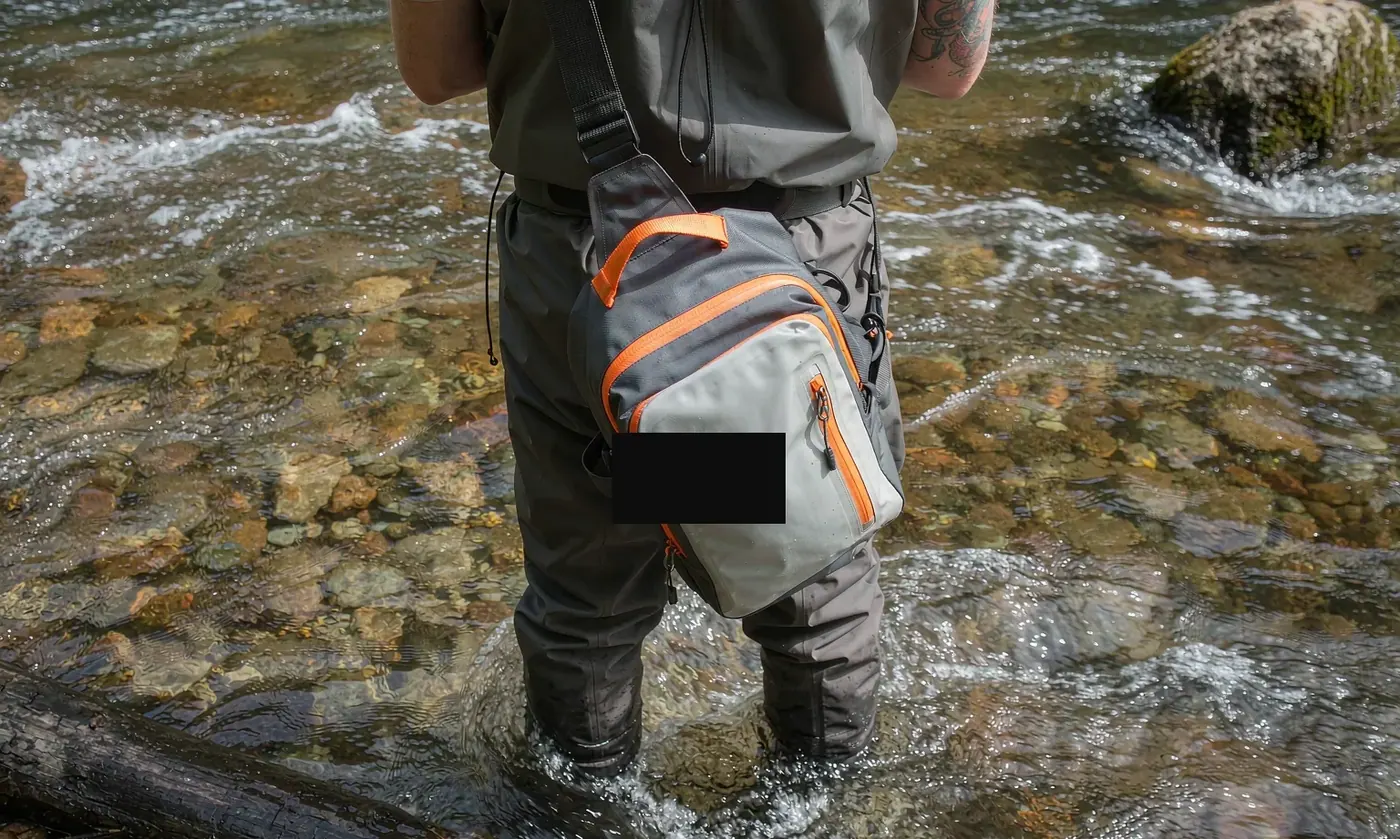
The letters matter less than the condition attached to them. IPX6 means the bag withstood powerful water jets; IPX7 means it survived temporary immersion at a stated depth for a stated time, conventionally 1 m for 30 minutes; IPX8 means continuous immersion beyond that, again with a condition set by the specifier. A bag sold as IPX7 with no depth and no duration has not told the buyer anything, and it is the most common form of rating inflation in this category.
The codes themselves are defined by the IEC ingress protection framework, which is why the condition belongs in the claim. For fishing, IPX6 is the sensible floor for rain, spray, and a dunk, IPX7 suits wading and boat use where the bag goes overboard, and IPX8 is only worth paying for when the bag is genuinely meant to sit underwater, such as a kayak tank-well build or a scuba-support bag.
| Rating | Test meaning | Fishing situation | Notes |
|---|---|---|---|
| IPX5 | Low-pressure jets | Rain and light spray | Fine for bank fishing in fair weather |
| IPX6 | Powerful jets | Heavy spray, a short dunk | The floor for serious use |
| IPX7 | Temporary immersion | Overboard, deep wading | Must state depth and duration |
| IPX8 | Continuous immersion | Tank well, submerged storage | Condition set by the specifier |
The distinction between weather resistance and true waterproofing is treated at length in the waterproof versus water-resistant comparison. In short, a coated face with a taped seam resists weather; a welded seam with a sealed closure keeps water out under pressure. Buyers should decide which one their market actually needs before comparing price.
1. Deepwater 40 Roll-Top: Best Overall
The 40 L roll-top is the build that most programmes should start from. It carries four 3600 trays plus a layer and a flask, it closes with a three-turn roll that has no teeth to fail, and at 1.25 kg empty it is light enough for a 2 km walk-in. Rating is IPX7 at 1 m for 30 minutes, and the weld is a radio-frequency seam rather than a taped one, which is the reason it holds up after a season of being set down wet.
The compromise is access speed. A three-turn roll takes about 10 seconds to open and close and consumes 3-4 L of usable volume, so the main chamber is not the place for anything retrieved every few minutes. Pair it with a covered side pocket on a magnetic flap and the trade disappears in practice. Reference band is 28-36 USD FOB Xiamen at 500 pieces, and the build is the one we recommend when a buyer is unsure which configuration to choose.
2. Tideline 30 Welded: Best for Wading
Wading changes the arithmetic because volume is a liability below the waist. Thirty litres sits high enough on the back to stay clear of a deep wade, and at 1.05 kg it does not shift the angler balance when turning in current. The Tideline uses the same IPX7 condition as the Deepwater, 1 m for 30 minutes, with a shorter body and a narrower profile that keeps the arms clear on a cast.
Drainage is the standout. A drained base with open mesh at the low edge sheds about 90 percent of an internal dunk within two minutes, so the bag does not carry an extra kilogram of water for the rest of the session. That is worth more in the field than any rating step up. Reference band is 24-31 USD, and the build takes a moulded tool dock at the shoulder without a tooling charge above 1,000 pieces.
3. Flats 24 Sling-Carry: Best Light Option
At 24 L and 0.88 kg, the Flats is the build for anglers who walk more than they stand. It converts between a two-strap carry and a single-strap sling using a removable second strap, which lets the angler swing it to the front for access and to the back for the walk. Rating is IPX6, which is honest for the use case: a flats or bank angler is not immersing the bag, and paying for IPX7 here buys weight that is felt all day.
The face is a lighter 420D with a TPU laminate, which cuts weight but drops abrasion resistance, so this is the one build in the ten that should not be specified for guide or charter duty. Reference band is 19-25 USD, and it suits a retail range positioned at entry level where the weight figure sells better than the rating.
4. Offshore 55 Duffel-Back: Best for Boat and Charter
Charter and offshore use is a volume and abuse problem rather than a weight problem. Fifty-five litres swallows six trays, a rain shell, food for a full day, and a catch bag, and the 1000D PVC face takes the scraping that comes from being dragged across a deck. At 1.60 kg it is too heavy to enjoy on a walk, which is fine because it is not meant for one. Rating is IPX6, appropriate for deck wash and spray.
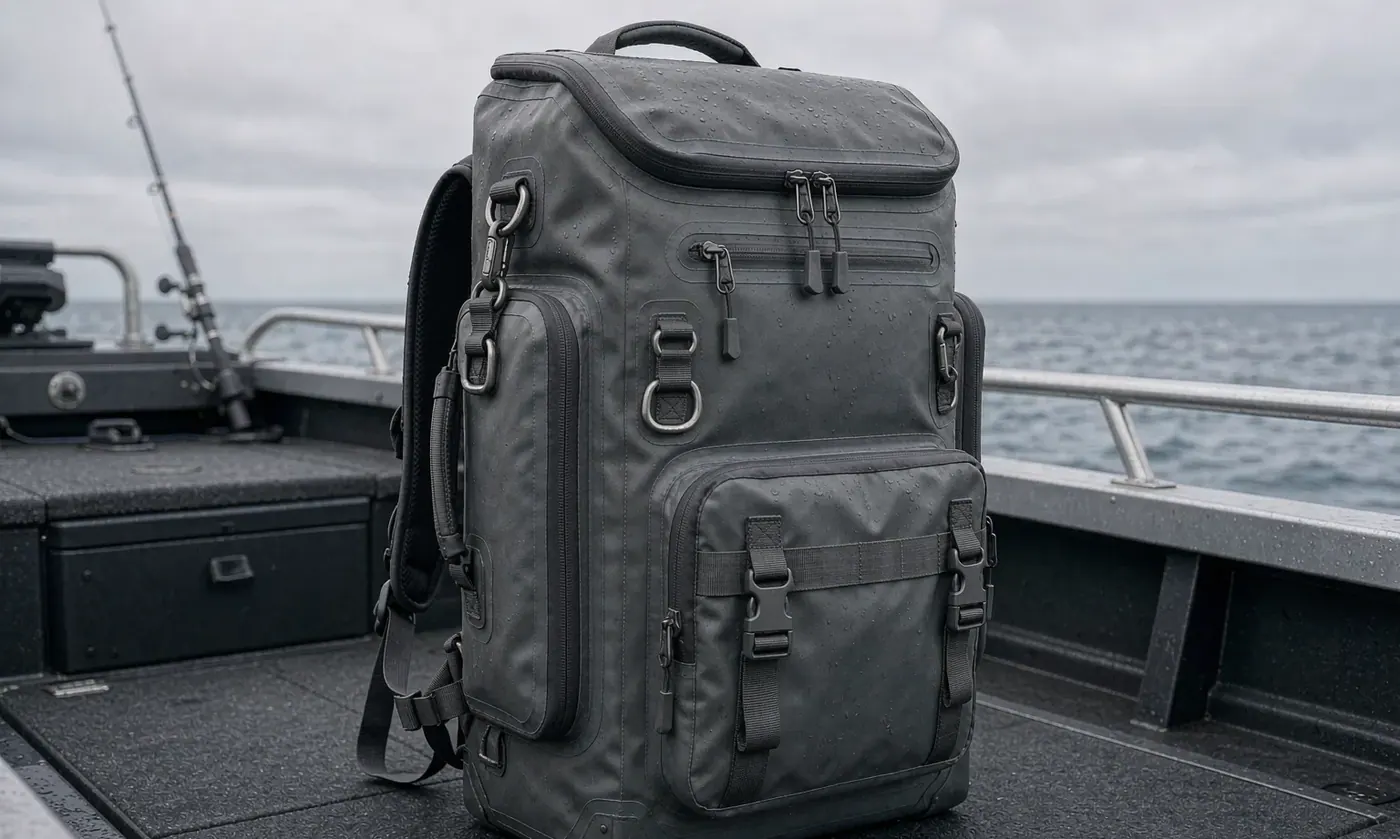
Hardware is where this build earns its place: 316 stainless throughout, acetal buckles, and a welded base rail that does not trap salt. The base is also the reason it sits stable on a moving deck, which matters more than any pocket count once the boat is underway. Reference band is 34-44 USD, and it is the build most often ordered by charter operators replacing bags every one or two seasons.
5. Backwater 35 Four-Tray: Best Tackle Organisation
The Backwater is dimensioned around trays rather than around litres. It holds four 3600 boxes vertically in a divided chamber, two 3700 boxes if the divider is removed, and a shallow tool wallet at the front. Thirty-five usable litres is the result rather than the target, which is the right way round for this category: a bag that claims 35 L but only fits two boxes has not been designed, only measured.
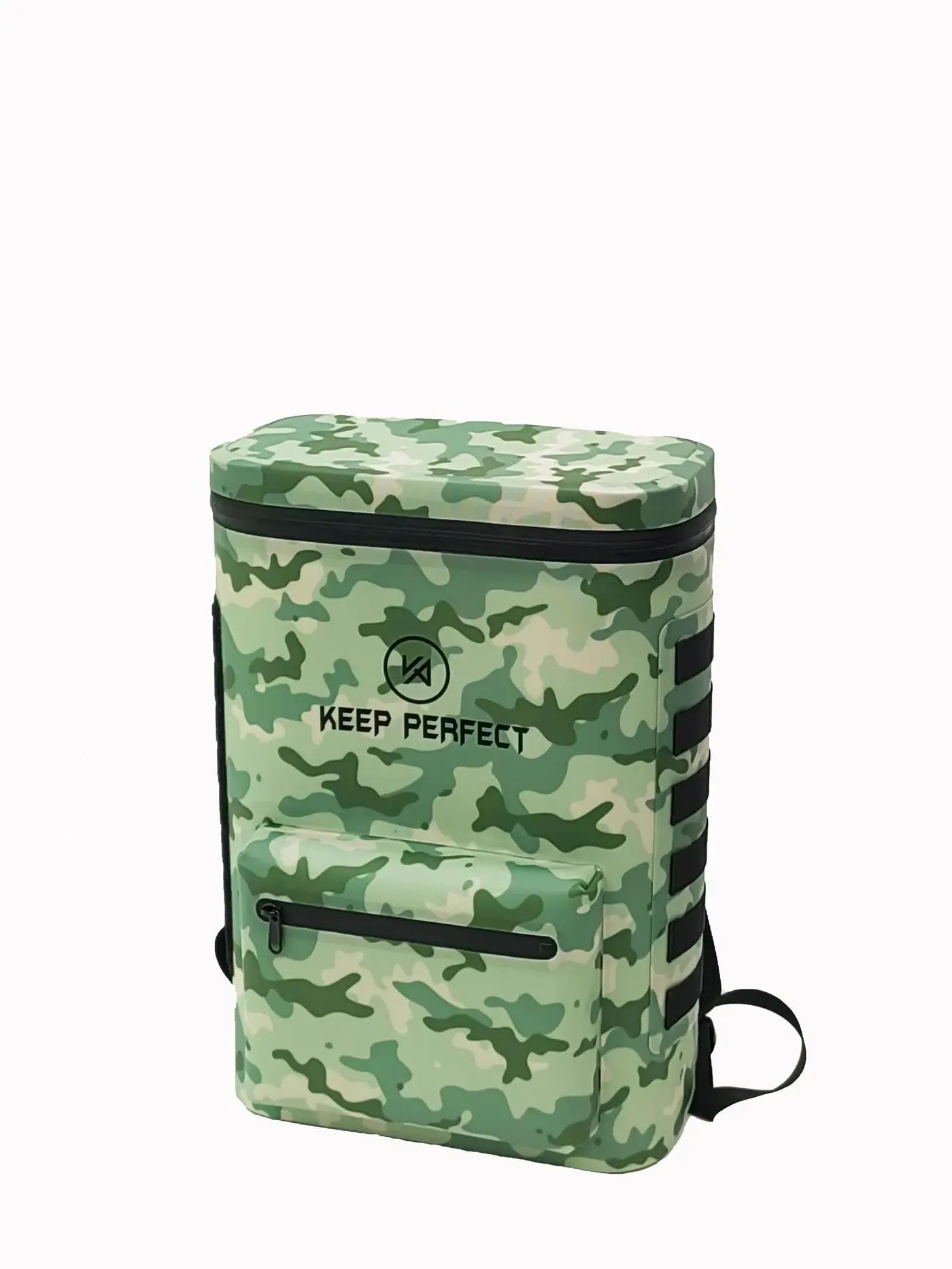
The cooler section is the other reason to choose it: 6-10 mm insulation with a welded liner and a drain, physically isolated from the tray chamber so condensation does not reach the hooks. Reference band is 26-33 USD, and it is the strongest all-round retail configuration for a buyer stocking one fishing backpack rather than three.
6. Rainshadow 28 Hybrid: Best Dual-Use
A dual-use build sells to a buyer whose customer fishes twice a month and commutes every day. The Rainshadow does that with a recycled PET face under a TPU laminate, a flat 15-inch sleeve against the back panel, and a roll-top that tucks down to a normal profile when lightly loaded. Rating is IPX5, which is genuinely enough for a commute and a fair-weather session, and it keeps the weight at 0.95 kg.
The honest limit is that it is not a serious offshore or wading bag, and it should never be presented as one. Reference band is 22-29 USD, and it is the fastest-growing configuration in the range because it answers the question a retailer hears most often: can I use it for something else. Environmental claims on recycled content should be supported by documentation, and material screening for REACH and California Prop 65 still applies.
7. Coldfront 38 Winter: Best for Cold Water
Cold is a materials test, and most backpacks fail it silently. The Coldfront specifies a cold-flex TPU face with a stated low-temperature bend result, acetal hardware instead of dry nylon, and an oversized zip puller that can be worked with a winter glove. Thirty-eight litres carries the extra layer and flask a cold day demands, and the base uses no fabric face so it does not bond to ice.
The rating is IPX6, because slush and meltwater are low-pressure and continuous rather than a submersion case. Low-temperature bend behaviour of coated fabrics is covered by published methods from ASTM International, and a spec that states no cracking after four hours at minus 30 degrees is enforceable where the phrase winter grade is not. Reference band is 30-38 USD.
8. Skiff 20 Compact: Best Submersible Small Build
Twenty litres and 0.72 kg is the smallest build that still reaches IPX7, which makes it the right choice for kayak anglers, wade anglers, and anyone whose bag has to fit inside a hatch. It holds two trays and a shell, it sits high enough to clear a kayak seat back, and the welded base is small enough to pass through a round hatch of 200 mm or more.
The limit is obvious and worth stating: two trays is a half-day kit, and anyone fishing longer needs the Tideline or the Deepwater. Reference band is 17-23 USD, which makes it the entry price point in a range and the most common first order for a buyer testing a new market. Sub-hatch sizing is covered in more detail in the kayak hatch sizing notes.
9. Bluewater 45 Submersible: Best True Immersion
The Bluewater is the only build here rated IPX8, tested at 2 m for 60 minutes with an airtight closure rather than a roll-top. That level costs real money because the zipper alone is a significant part of the bill of materials, and it adds maintenance, since an airtight closure needs cleaning and lubrication to keep its seal. It is the right answer for a scuba-support bag, a tank-well bag, or any situation where the bag is meant to be underwater.
It is the wrong answer for everyone else. At 1.70 kg and a 46-58 USD band, it is nearly twice the price of the Bankrunner for a capability 95 percent of anglers will never use. Buy it when the use case is genuine, and specify the closure care routine alongside it, because a neglected airtight seal is the single most common warranty claim in this tier.
10. Bankrunner 32 Value: Best Price-to-Capacity
The Bankrunner exists to answer a specific buyer question: what is the cheapest configuration that still holds up for a season of weekend bank fishing. Thirty-two litres, IPX6, a 600D TPU face, and 304 stainless rather than 316, landing at 1.15 kg and a 21-27 USD band. It holds three 3600 trays, which is exactly what a bank angler carries.
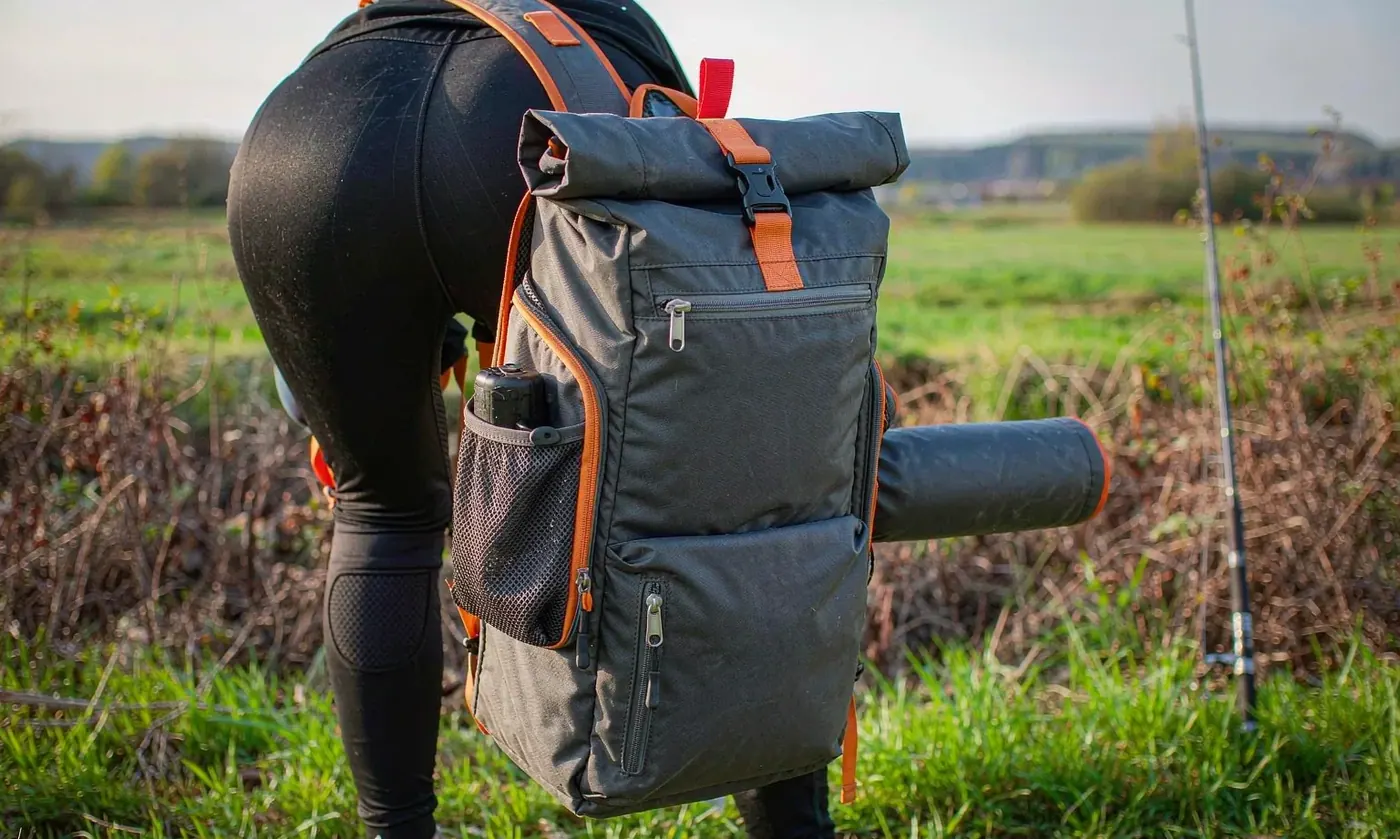
What is removed to reach that price is worth listing: no moulded base, a taped rather than welded seam on the secondary compartment, and a simpler harness with a fixed sternum strap. None of those matter on a bank, and all of them matter offshore. Choosing correctly between this and the Offshore is most of the value a buyer adds in this category.
How We Tested: The Five Checks
Every build above went through the same five checks, and any programme should repeat them on the approval sample before a bulk order is released. They are cheap, they need no laboratory, and they catch the failures that account for the great majority of field complaints. Run them on a loaded bag, not an empty one, because load changes how seams and closures behave.
| Check | Method | Pass condition | Catches |
|---|---|---|---|
| Spray screen | 60 minutes at three nozzles, loaded | Indicator tissue inside stays dry | Closure and seam leaks |
| Immersion screen | Stated depth for the stated time | Interior dry, tissue dry | Rating inflation |
| Drain rate | Fill with 5 L, time to empty | Under 2 minutes to 90 percent | Fabric base that holds water |
| Closure cycle | 500 open and close cycles wet | No coating cut, slider tracks true | Tape wear and slider failure |
| Hardware soak | 72 hours in salt solution, then rinse | No bloom or pitting on 304 or 316 | Wrong hardware grade |
The mechanism behind these results is explained in the guide to how waterproof fishing bags work. The short version is that water enters at closures and seams rather than through fabric, which is why the checks above concentrate there, and why a heavier face fabric is rarely the fix for a leak.
Buyer Checklist Before You Order
Six decisions determine whether a fishing backpack programme succeeds, and five of them are made before anybody looks at a sample. Write them down in the brief, because a change to any one of them after sampling restarts the clock on both cost and lead time. The most expensive single change is a hardware grade step, because it affects every buckle, ring, and slider on the build.
| Decision | Options | Effect on price | Effect on lead time |
|---|---|---|---|
| Face fabric | 420D, 600D, 840D, 1000D | 6-11 USD per unit across the range | None |
| Seam method | Taped, RF welded | 2-5 USD per unit | None |
| Closure | Roll-top, covered zip, airtight | 3-16 USD per unit | Adds 3-5 days for airtight |
| Hardware grade | 304, 316, acetal options | 1-4 USD per unit | Adds 2-4 days for 316 |
| Moulded base | None, EVA insert, moulded rail | 1-6 USD per unit | Adds 10-15 days for tooling |
| Tray count supplied | Zero, two, four | 2-9 USD per unit | Adds 5-8 days |
Two figures should be fixed before anything else: the target FOB price per unit and the market compliance set. Everything downstream, from fabric choice to tray count, is a trade against those two. A buyer who fixes only the litres will get a bag that fits the brief and misses the margin.
Care, Re-Screening, and Service Life
A waterproof fishing backpack that is rinsed and dried properly will outlast two seasons of careless use by a wide margin, and the routine is short. Rinse with fresh water after any salt exposure, empty the bag, open every closure, and dry it for 8-24 hours. Re-run the spray screen every three months on a bag that is used weekly, and re-proof the face when water stops beading, which is usually after 30-40 sessions.
Service life splits by tier in practice. A 420D face on weekend bank duty lasts three to five seasons. A 600D or 840D TPU face on regular wading duty lasts four to six. A 1000D PVC face on charter duty lasts two to three, not because the fabric fails but because the hardware and the closure wear first. Budget replacement cycles on that basis rather than on the fabric specification alone.
Programme and Compliance Notes
Quality and compliance documentation travels with the shipment and should be requested in the brief rather than after it. Material screening for REACH and California Prop 65 covers coatings, films, inks, and hardware; inspection at AQL 2.5 covers the batch; and the quality system behind it is structured under both BSCI and ISO 9001 frameworks, with ISO standards referenced for the management system itself.
| Programme item | Baseline | Note |
|---|---|---|
| MOQ | 500 pcs per design and colour | Colour split negotiable above the baseline |
| Sampling | 6-10 working days | Add 3-5 days for an airtight closure |
| Bulk | 35-50 days | From approved sample and deposit |
| Inspection | AQL 2.5 | Include spray screen, drain rate, closure cycle, hardware check |
| Compliance | REACH and California Prop 65 | Screen coatings, films, inks, hardware |
QUANZHOU JUNYUAN BAGS has developed waterproof bag programmes since 2014, with the founding team active in the industry since 2004. Monthly output of 200,000 units is verified by SGS, and BSCI and ISO 9001 systems structure the workflow. Materials are screened for REACH and California Prop 65, and every bulk order is inspected at AQL 2.5 before shipment.
A configuration brief can be emailed to service@junyuanbags.com; include litres, rating target, hardware grade, market, and quantity. FOB Xiamen or DDP service to more than 100 countries follows an approved sample and a complete test record. The full category sits in the waterproof fishing backpack overview.
People Also Ask
Which waterproof rating is enough for a fishing backpack?
IPX6 is the practical floor for spray and a short dunk. IPX7 with a stated depth and duration suits wading and boat use, and IPX8 is only worth paying for when the bag is genuinely meant to sit underwater.
What size waterproof fishing backpack do most anglers need?
Thirty to 40 L covers four trays, a layer, and a flask for a full day. Go to 20-24 L for kayak or wade use and 45-55 L for charter or offshore duty.
How much does a waterproof fishing backpack weigh?
Between 0.72 kg for a 20 L compact build and 1.70 kg for a 45 L submersible build, empty and without trays. Most full-day builds land between 1.05 and 1.35 kg.
Is TPU better than PVC on a fishing backpack?
TPU stays flexible in the cold and is lighter at equal strength, while 1000D PVC resists deck abrasion better and costs less. Choose by duty, not by reputation.
How do I check a waterproof claim before ordering?
Run a 60-minute spray screen on a loaded bag with indicator tissue inside, then a drain test: 5 L should empty to 90 percent in under two minutes.
Do waterproof fishing backpacks need special care?
Rinse in fresh water after salt use, dry open for 8-24 hours, re-run the spray screen every three months, and re-proof the face after 30-40 sessions.
Frequently Asked Questions
Q1. What is the best waterproof fishing backpack overall?
A 40 L roll-top build at about 1.25 kg with an IPX7 rating stated as 1 m for 30 minutes. It covers wading, boat, and bank use without a compromise that shows in the field.
Q2. Is IPX7 enough for fishing?
Yes for wading and boat use, provided the depth and duration are stated. A rating without a condition tells the buyer nothing.
Q3. What does IPX8 add over IPX7?
Continuous immersion beyond the IPX7 condition, typically tested at 2 m for 60 minutes. It costs roughly twice as much and needs closure maintenance, so specify it only for genuine submersion.
Q4. Should I choose a roll-top or a zip closure?
A roll-top has no teeth to fail and holds its seal longer, but costs 3-4 L and about 10 seconds of access. A covered zip is faster and better for a frequently used pocket.
Q5. How many trays fit in a 35 litre fishing backpack?
Four 3600 boxes vertically in a divided chamber, or two 3700 boxes with the divider removed. Dimension the bag around trays rather than around a litre figure.
Q6. What is the lightest waterproof fishing backpack worth buying?
Around 20 L and 0.72 kg reaches IPX7 and fits a kayak hatch. Below that, the bag stops carrying a useful tray load.
Q7. Is a 1000D PVC face better than TPU?
Not universally. 1000D PVC resists deck abrasion and costs less, while TPU stays flexible in the cold and is lighter at equal strength. Match the face to the duty.
Q8. How much should a waterproof fishing backpack cost?
FOB Xiamen reference bands run from 17-23 USD for a 20 L compact build to 46-58 USD for a 45 L submersible build, with most full-day builds in the 24-36 USD band.
Q9. Do welded seams matter more than the closure?
Both are leak paths, but the closure is the one the angler operates every session, so closure specification usually delivers more reliability per dollar than a seam upgrade.
Q10. What hardware grade suits saltwater use?
304 stainless as the baseline and 316 for charter or offshore duty, with acetal buckles. Plain steel and uncoated zinc show rust bloom within a season.
Q11. How fast should a fishing backpack drain?
Five litres should empty to 90 percent within two minutes. That matters more in the field than a rating step up, because retained water is carried all day.
Q12. Can one backpack serve both bank and offshore fishing?
Only with compromise. A 32 L value build suits the bank and a 55 L heavy build suits the deck; the 40 L roll-top is the honest middle option.
Q13. What is the realistic service life of a fishing backpack?
Three to five seasons for a 420D face on weekend duty, four to six for a 600D or 840D TPU face on regular wading, and two to three for a charter build whose hardware wears first.
Q14. Are recycled fabrics as waterproof as virgin ones?
Yes, when the face carries the same TPU laminate and the seams are built the same way. The recycled content affects marketing and cost, not the waterproof mechanism.
Q15. What compliance documents should I request?
REACH and California Prop 65 screening for coatings, films, inks, and hardware, plus an AQL 2.5 inspection record for the batch and the rating test conditions in writing.
Q16. What is the MOQ and lead time for a fishing backpack programme?
MOQ is 500 pcs per design and colour, samples take 6-10 working days, and bulk runs 35-50 days from approved sample and deposit.