A waterproof fishing sling pack is the right format up to about 7 kg of kit and the wrong one above it, because a single strap cannot distribute more than that without shoulder fatigue within 45 minutes. Eight sling builds were assessed for 2026 across 8-16 litres, 0.55-1.10 kg, IPX5 to IPX7 water protection, strap widths of 65-95 mm, and 15-38 USD FOB Xiamen bands at MOQ 500 pcs per design and colour. Samples take 6-10 working days and bulk 35-50 days. The pick is the 12 L submersible sling at 0.85 kg.
What Waterproof Means on a Sling Pack
Water resistance on a sling is harder to achieve than on a backpack, because a sling has one long curved seam running across the body and that seam is the first place water enters. A shell can carry a coated fabric and still fail through the seam tape, which is why the rating has to be tested on the finished bag rather than inferred from the fabric specification.
Three levels cover the real market. IPX5 resists a nozzle jet of 12.5 litres per minute, which is heavy rain and spray. IPX6 resists 100 litres per minute at three metres for three minutes, which is a deck wash and a breaking wave. IPX7 means 30 minutes at one metre of submersion, which is a capsize or a pack that goes overboard. Each level costs real money: IPX6 adds about 3.50 USD over IPX5 and IPX7 with a welded liner adds 11-14 USD.
| Level | Test condition | Real situation | Added cost over IPX5 | Who needs it |
|---|---|---|---|---|
| IPX5 | 12.5 L/min nozzle, 3 min | Heavy rain, light spray | Baseline | Bank and urban anglers |
| IPX6 | 100 L/min at 3 m, 3 min | Deck wash, breaking wave | 3.50-5.00 USD | Inshore boat anglers |
| IPX7 | 30 min at 1 m submersion | Capsize, overboard | 11-14 USD | Kayak and offshore |
| IPX8 | Deeper or longer, stated | Rarely needed | 18-25 USD | Specialist only |
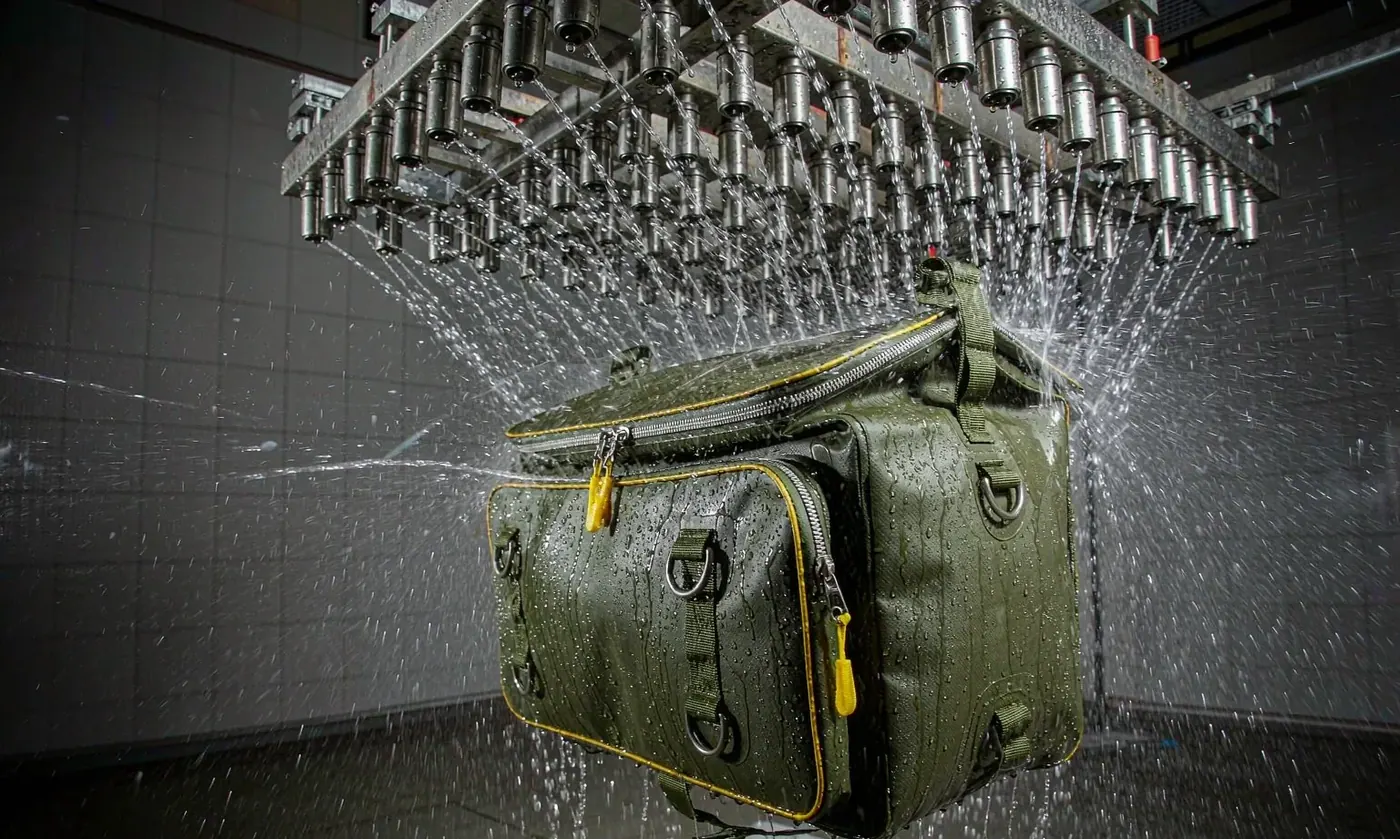
The distinction between showerproof and submersible is spelled out with test methods in the waterproof versus water-resistant comparison, and the code definitions themselves are maintained by the IEC ingress protection framework. Any rating quoted without a duration and a test condition is decoration on a hangtag.
The Eight Builds at a Glance
Capacity is quoted as main-chamber litres excluding the external pockets, because sling makers routinely count a water bottle sleeve and two tool docks in the headline figure. Strap width is listed because it is the single best predictor of comfort in this format: below 70 mm at 6 kg, the strap creates a pressure line across the trapezius in about 30 minutes. Rotation is the third column and the one buyers rarely ask about.
| Build | Volume | Weight | Rating | Strap | FOB band |
|---|---|---|---|---|---|
| Submersible 12 | 12 L | 0.85 kg | IPX7 | 90 mm, rotating anchor | 26-33 USD |
| Spray 9 | 9 L | 0.68 kg | IPX5 | 75 mm | 18-24 USD |
| Wade 14 | 14 L | 0.95 kg | IPX6 | 85 mm, high mount | 24-31 USD |
| Kayak 10 | 10 L | 0.80 kg | IPX7 | 80 mm, leash point | 22-29 USD |
| Minimalist 8 | 8 L | 0.55 kg | IPX5 | 65 mm | 15-20 USD |
| Guide 16 | 16 L | 1.10 kg | IPX6 | 95 mm, padded yoke | 30-38 USD |
| Convertible 11 | 11 L | 0.92 kg | IPX6 | 85 mm, dual mode | 25-32 USD |
| Fly-Out 13 | 13 L | 0.88 kg | IPX6 | 80 mm, drop-out tray | 27-34 USD |
Strap Geometry and the Swing Problem
Every sling swings. The question is how much and how it is controlled, and two design decisions govern it. The first is the anchor angle: a strap anchored at roughly 45 degrees from the top corner lets the pack rotate around the torso and sit on the chest, while a strap anchored vertically drags the pack down the back and makes rotation a two-handed fight.
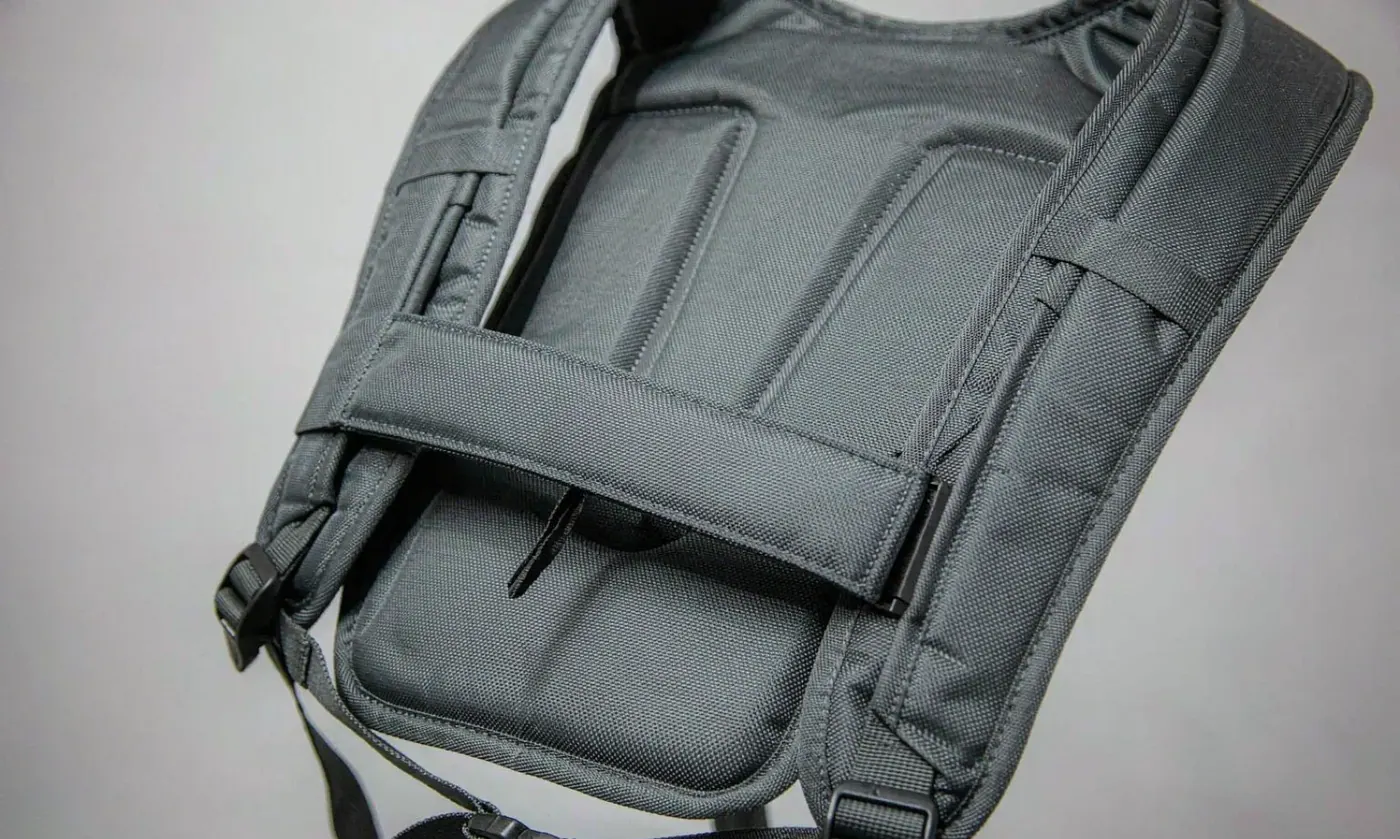
The second is a stabiliser strap under the opposite arm. Without it, a loaded sling swings 100-150 mm on each stride and rotates away during a cast, and the angler spends the day correcting it. A 20 mm webbing stabiliser with a cam buckle costs about 1.30 USD and removes most of the movement. It should be removable, because some anglers find a stabiliser restrictive when casting.
| Loaded weight | Strap width | Swing without stabiliser | Comfortable duration | Verdict |
|---|---|---|---|---|
| Under 3 kg | 65 mm | 60-80 mm | Full day | No stabiliser needed |
| 3-5 kg | 70-80 mm | 80-120 mm | 4-6 hours | Stabiliser advised |
| 5-7 kg | 85-95 mm | 120-150 mm | 2-4 hours | Stabiliser required |
| Above 7 kg | Not suitable | Uncontrolled | Under 60 minutes | Use a backpack instead |
Padding density matters as much as width. A 90 mm strap with 6 mm of open-cell foam compresses to nothing at 6 kg and the webbing edge cuts in, whereas 10 mm of closed-cell foam holds its thickness. Closed-cell foam also matters in this category for a second reason: open-cell foam under a waterproof shell absorbs water through the stitch line and the strap stays wet for the rest of the day.
What a Sling Leaves Behind
The honest framing for a sling is that it is a second bag, not a replacement. It carries the four things an angler needs within arm reach: two trays, tools, water, and a rain shell. It does not carry a spare jacket, a lunch, a camera, and four more trays, and a buyer who expects it to will be disappointed however good the sling is.
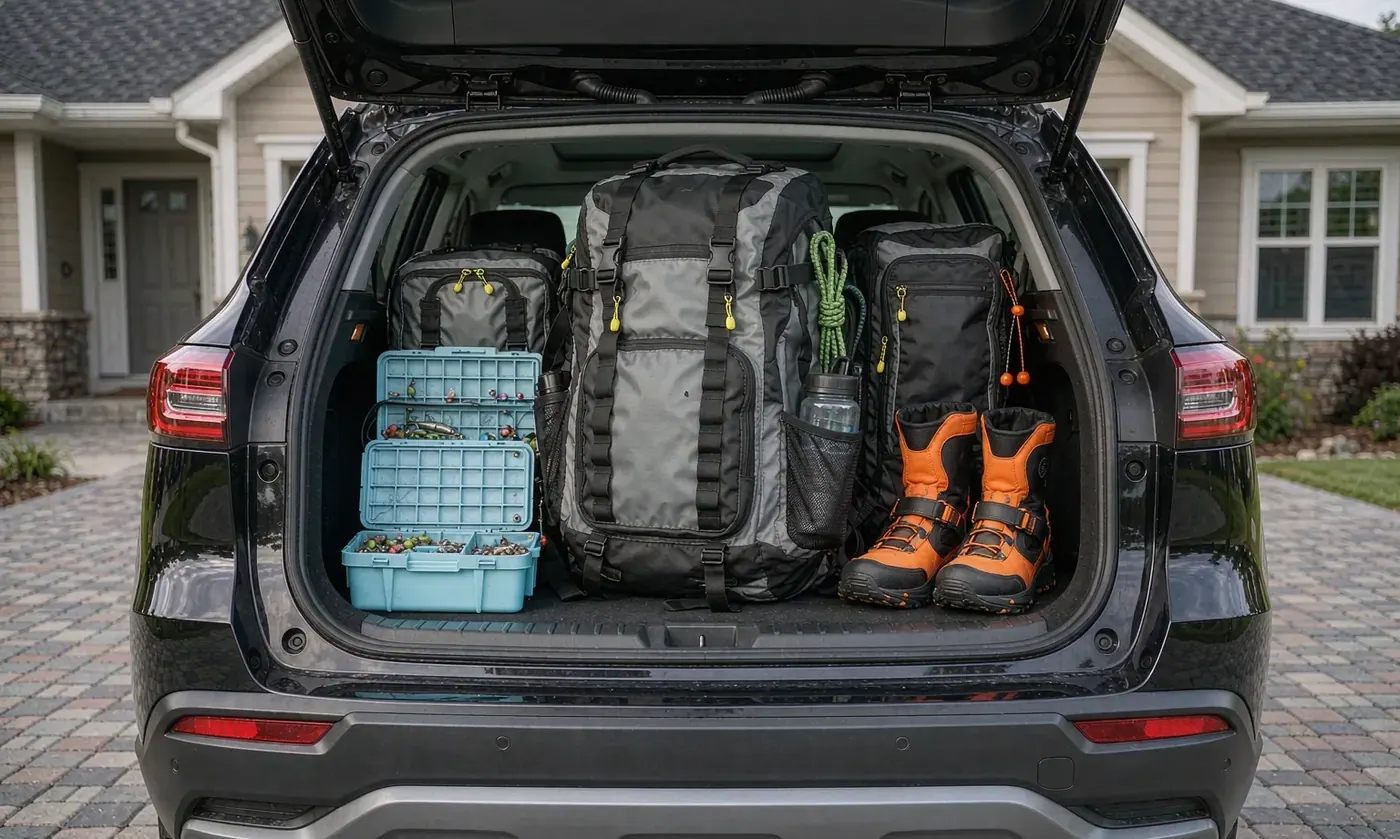
That framing is commercially useful, because a sling sold as an addition outsells a sling sold as a substitute. Retail data from this category consistently shows the sling bought alongside a 30-40 L backpack rather than instead of one, and the pack that works best in that role has a flat profile so it can be dropped inside the bigger bag on the walk back.
1. Submersible 12: Best Overall
Twelve litres at 0.85 kg with a welded liner and a submersible zip rated IPX7 for 30 minutes at 1 m, on a 90 mm strap with a rotating anchor and a removable stabiliser. It holds two 3600 trays plus tools and water. The FOB band is 26-33 USD, roughly 11 USD above the equivalent spray-rated sling.
It leads because the waterproof claim and the geometry are both right. A sling is the format most likely to go in the water, since it is worn while wading and while leaning over a gunwale, and a spray rating does not survive that. The rotating anchor is the other reason: submersible zips are stiff, and being able to swing the pack to the chest to work the slider matters.
2. Spray 9: Best Value
Nine litres at 0.68 kg rated IPX5, holding two 3600 trays, with a 75 mm strap and one external tool dock. The FOB band is 18-24 USD and it is the volume seller in this group. Two trays, tools, and a bottle is the honest capacity.
What the price buys is a coated 600D shell with taped seams and a coated coil zip, which handles rain and spray and fails at a dunk. That is the correct trade for bank anglers and for a promotional line, provided the listing does not imply more. The strap is 75 mm with 8 mm foam, which is adequate to about 5 kg and thin above it.
3. Wade 14: Best for Wading
Fourteen litres at 0.95 kg rated IPX6, mounted high so the body clears a wading belt at about 300 mm above the hip, with base drainage and a mesh panel. It holds three 3600 trays. The FOB band is 24-31 USD.
High mounting is the specification that decides a wading sling. A body that rides on a wading belt pulls the angler backward in current and makes rotation to the chest impossible. Drainage is the second requirement, because a wading pack takes water over the top every session and a sealed base holding a wet tray sours within two trips.
4. Kayak 10: Best for Kayak Anglers
Ten litres at 0.80 kg rated IPX7, built low and narrow at 350 mm tall so it clears a seat back and a paddle stroke, with a leash point at each corner and a closed-cell float panel. The FOB band is 22-29 USD.
Buoyancy is the specification buyers skip and then regret. A 10 L sling holding 5 kg of tackle sinks, and recovery from a kayak means losing it; a closed-cell panel adding float for 4-6 kg costs about 1.50 USD. The leash point matters for the same reason, and it should be load-rated rather than a decorative loop.
5. Minimalist 8: Best for Short Sessions
Eight litres at 0.55 kg rated IPX5, one 3600 tray plus a utility tray, a 65 mm strap, and nothing else. The FOB band is 15-20 USD, and it is the build for a two-hour session on a known water where the angler already knows what to tie on.
At 0.55 kg the pack is light enough to forget, which is the entire appeal and the entire limitation. A 65 mm strap is comfortable to about 3 kg and thin above it, so this build should not be sold with a four-tray claim. It also suits junior anglers and travel, since it packs flat at about 45 mm.
6. Guide 16: Best for Guide Duty
Sixteen litres at 1.10 kg rated IPX6, with a 95 mm strap on a padded yoke that spreads load across the shoulder blade, four 3600 trays, and serviceable hardware. The FOB band is 30-38 USD, the highest before the convertible.
The yoke is the reason it works at 16 L. A sling at 8 kg concentrates load on one trapezius, and a yoke spreading that across 200 mm of shoulder blade roughly halves the pressure. Serviceability is the second guide-specific detail: the strap anchors bolt through rather than being stitched, so a worn strap is a 10-minute replacement rather than a new bag.
7. Convertible 11: Best for Mixed Use
Eleven litres at 0.92 kg rated IPX6, with a second strap that stows in a rear sleeve so the pack converts from a sling to a small backpack. It holds two 3600 trays and suits an angler who walks a long way and then wants front access. The FOB band is 25-32 USD.
Conversions usually compromise both modes, and this build avoids that by keeping the second strap genuinely usable: 45 mm with 8 mm foam rather than a token webbing loop. The cost is 120 g and about 3.50 USD, and the benefit is that a 3 km walk becomes comfortable. The stowed strap must not protrude, or it catches on a seat back.
8. Fly-Out 13: Best for Fast Lure Changes
Thirteen litres at 0.88 kg rated IPX6 with a modular drop-out tray: the upper tray slides out of the body and hangs from a lanyard while the angler works, then slides back one-handed. It holds two 3600 trays plus a utility tray. The FOB band is 27-34 USD.
The drop-out mechanism is the whole argument and the main risk. It needs a positive stop so the tray does not leave the body when the pack is inverted, and the lanyard attachment must carry 3 kg of shock load. Tested properly, it cuts a lure change to about 8 seconds against 20 seconds for a pack that has to be set down.
Sling, Chest, or Waist: Picking the Front-Body Format
Three formats compete for the same job of keeping a few trays within arm reach, and they differ in where the load sits. A sling puts it on one shoulder with the body behind or at the side, a chest pack puts it on the sternum with the body in front, and a waist pack puts it on the hips with the body behind. The right choice follows from how deep the angler wades and how far they walk.
| Format | Load sits on | Best depth | Walk distance | Trade-off |
|---|---|---|---|---|
| Sling | One shoulder | Knee to waist | Up to 2 km | Swing without a stabiliser |
| Chest | Sternum and neck | Waist to chest | Under 800 m | Neck strain above 3 kg |
| Waist | Hips | Any depth | Up to 5 km | Interferes with a wading belt |
| Small backpack | Both shoulders | Any depth | 5 km plus | Must be removed to reach trays |
The practical guidance is that a sling wins for mixed bank and boat use, a chest pack wins when the angler is working a run and needs a tray open continuously, and a waist pack wins on long walks in shallow water. Retailers benefit from stocking two of the three rather than all three, because the chest and waist formats overlap heavily for most customers, and the wider comparison is set out in the sling versus waist pack guide.
Checks Before Approving a Sling Sample
Sling-specific failures are about rotation and strap comfort rather than capacity, so the approval protocol should reflect that. Five checks cover the field in about 30 minutes, and the rotation test is the one that separates a good sling from a backpack with one strap.
| Check | Method | Pass condition | Catches |
|---|---|---|---|
| Rotation | Rotate to the chest, loaded, 20 times | One hand, under 3 seconds | Vertical strap anchor |
| Swing | Walk 200 m loaded, observe movement | Under 50 mm of swing | Missing stabiliser strap |
| Strap comfort | Wear at 6 kg for 45 minutes | No pressure line | Thin or open-cell foam |
| Submersion, if claimed | 30 min at 1 m with tissue inside | Tissue dry | Coated coil zip sold as submersible |
| Inversion | Hold inverted 10 seconds | Trays and tools retained | No positive stop on drop-out trays |
Hardware and coating requirements should reference published methods from ASTM International for strength and abrasion, and chemical screening should be evidenced against the substance lists maintained by the European Chemicals Agency for REACH purposes. A sling that rotates beautifully and fails a chemical screen cannot be shipped into the EU market.
Programme, Pricing, and Compliance
A sling brief should open with the water rating and the loaded weight, because those two decide the closure and the strap. Specify strap width and foam next, then the anchor angle and whether a stabiliser is included, and only then the tray count. Settling the rating first matters because a change from IPX5 to IPX7 after sampling rewrites the shell.
| Programme item | Baseline | Note |
|---|---|---|
| MOQ | 500 pcs per design and colour | Strap colour can be split above the baseline |
| Sampling | 6-10 working days | Add 4-6 days for a submersible zip |
| Bulk | 35-50 days | From approved sample and deposit |
| Inspection | AQL 2.5 | Include rotation, swing, submersion, inversion |
| Compliance | REACH and California Prop 65 | Screen coatings, films, inks, hardware, foam |
QUANZHOU JUNYUAN BAGS has developed waterproof bag programmes since 2014, with the founding team in the trade since 2004. Output of 200,000 units a month is verified by SGS, and BSCI and ISO 9001 systems structure the work. Materials are screened for REACH and California Prop 65, and every bulk order is inspected at AQL 2.5 before shipment.
A sling brief can be emailed to service@junyuanbags.com with rating, litres, strap width, tray count, and quantity. FOB Xiamen or DDP service to more than 100 countries follows an approved sample and a complete test record. The wider format sits in the fishing sling pack range and the sling pack ranking.
People Also Ask
How much weight can a fishing sling pack carry?
About 7 kg, and comfortably closer to 5 kg. A single strap cannot spread more than that, and shoulder fatigue arrives within 45 minutes above 7 kg.
What does IPX7 mean on a fishing sling?
Thirty minutes of submersion at one metre without ingress. It needs a welded liner and a genuine submersible zip, which add 11-14 USD over a spray-rated shell.
Is IPX6 enough for boat fishing?
Usually yes. IPX6 resists 100 litres per minute at three metres for three minutes, which covers a deck wash and a breaking wave but not a capsize.
How do I stop a sling pack swinging?
Use a 20 mm stabiliser strap under the opposite arm and check that the main strap anchors at about 45 degrees. Uncontrolled swing at 6 kg is 120-150 mm per stride.
Can a sling pack replace a tackle backpack?
No. It carries two trays, tools, water, and a shell, and the backpack stays in the vehicle with the rest. A sling sells best as a second bag rather than a substitute.
What strap width is comfortable on a fishing sling?
70-80 mm at 3-5 kg and 85-95 mm at 5-7 kg, with 10 mm of closed-cell foam. Below 70 mm at 6 kg the strap leaves a pressure line in about 30 minutes.
Frequently Asked Questions
Q1. What is the best waterproof fishing sling pack?
A 12 L build at 0.85 kg rated IPX7, with a welded liner, a submersible zip, a 90 mm strap on a rotating anchor, and a removable stabiliser, at a 26-33 USD FOB band.
Q2. What waterproof rating should a fishing sling have?
IPX5 for rain and spray, IPX6 for deck wash and breaking waves, and IPX7 for kayaks and any situation where the pack can go overboard. IPX7 adds 11-14 USD.
Q3. How much can a fishing sling pack hold?
Two to four 3600 trays depending on the build, and realistically two trays plus tools and a bottle. Above 7 kg of kit the format stops working.
Q4. Why does my sling pack swing when I walk?
The strap is anchored vertically or there is no stabiliser strap. Anchor at about 45 degrees and add a 20 mm stabiliser under the opposite arm, which costs about 1.30 USD.
Q5. Is a sling pack better than a backpack for fishing?
For short sessions and fast access, yes, because the pack rotates to the chest in about three seconds. For walks over 1 km or kit above 7 kg, a backpack wins.
Q6. What strap width do I need on a fishing sling?
70-80 mm for 3-5 kg and 85-95 mm for 5-7 kg. Width alone is not enough: the foam should be 10 mm of closed-cell material, which does not absorb water through the stitch line.
Q7. Do waterproof sling packs float?
Only if they are built to. A closed-cell panel adding float for 4-6 kg costs about 1.50 USD and turns a capsize loss into a recovery, so specify it for kayak builds.
Q8. What suits wading with a sling pack?
A high-mounted body clearing a wading belt at about 300 mm above the hip, rated IPX6, with base drainage and a mesh panel so a wet tray does not sour the chamber.
Q9. Can I use a sling pack as hand luggage on a flight?
Yes. Most are 8-16 L and pack flat at 45-60 mm, and a 12 L sling fits under a seat. Check the tray chamber is protected, since moulded trays crack under airline handling.
Q10. What is a drop-out tray on a sling?
An upper tray that slides out of the body and hangs from a lanyard while the angler works, cutting a lure change to about 8 seconds. It needs a positive stop so it survives inversion.
Q11. How do I test whether a sling is really waterproof?
Submerge it for 30 minutes at 1 m with tissue inside for an IPX7 claim, or run a jet test for IPX5 and IPX6. A shower test proves nothing about submersion.
Q12. What is the MOQ and lead time for a fishing sling programme?
MOQ is 500 pcs per design and colour, samples take 6-10 working days plus 4-6 days for a submersible zip, and bulk runs 35-50 days from approved sample and deposit.