A perforated EVA tote is sandproof in the only sense that matters on a beach: sand leaves it rather than being kept out. Beach sand grains measure 0.06 to 2 millimetres and the holes in a moulded body measure 8 to 14 millimetres, so every grain that reaches the base falls straight through, and a fully perforated body drains in 4 to 7 seconds after a dunk. The open top then ventilates the whole interior, which is why a wet load reaches touch-dry in about five hours in shade rather than staying damp for a day. QUANZHOU JUNYUAN BAGS specifies hole layout and open area from 500 pieces per design and colour.
Sandproof Means Sand Leaves, Not Sand Stays Out
The word sandproof is used loosely and it is worth defining before it misleads anyone. A perforated body does not keep sand out; nothing open-topped can. What it does is ensure that sand which gets in gets out again, without being trapped in a weave, a lining or a seam allowance. That distinction is the whole design idea, and it is why a bag that is visibly full of holes performs better on a beach than one engineered to exclude sand entirely.
The alternative approach — a tight weave or a closed liner — keeps sand out until the first time the bag is set down on a beach, at which point sand arrives on towels, on shoes, on hands and on everything else that goes inside. From that moment the closed bag holds it permanently, because there is nowhere for it to go. The open body accepts sand continuously and sheds it continuously, and after a season the difference is not that one bag has sand in it and the other does not; it is that one has to be emptied and the other does not.
| Design approach | Sand on day one | Sand after a season | Owner effort |
|---|---|---|---|
| Perforated moulded body | Falls straight through | None retained | Shake once, hose occasionally |
| Tight woven fabric | Stays on the surface | Trapped in the weave | Brush and vacuum regularly |
| Lined fabric with a seam allowance | Stays on the surface | Collected at the seams and corners | Turn out and brush every session |
| Mesh panel construction | Passes through the mesh | Collected where the mesh meets fabric | Rinse and brush the join |
| Closed moulded body with no holes | Sits in the base | All of it, permanently | Empty and wipe every time |
Grain Size Against Hole Diameter
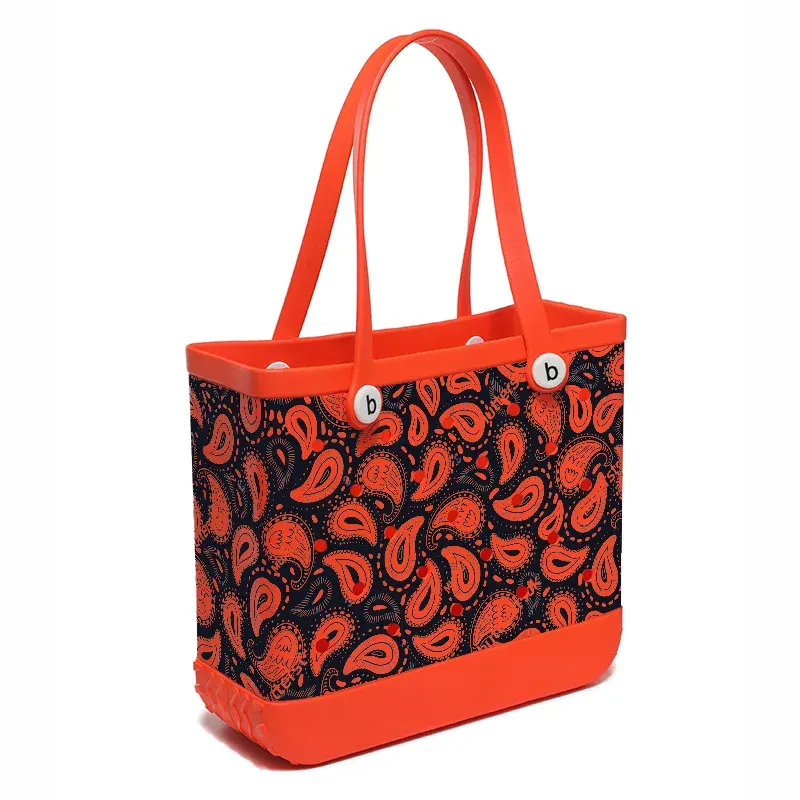
The arithmetic behind the whole category is a ratio of about ten to one, and it is worth stating because it explains why the design is reliable rather than lucky. Beach sand grains run from 0.06 millimetres for the finest to 2 millimetres for coarse grains, with most between 0.2 and 0.6 millimetres. The holes in a moulded body run 8 to 14 millimetres. A grain therefore has roughly ten to twenty times the clearance it needs, and there is no realistic condition in which sand bridges across a hole of that size.
The consequence is that hole diameter is not the variable that governs sand performance. Anything above about 6 millimetres passes sand freely, and the decision about hole size is made for other reasons: drainage speed, charm fit, print area and how the body looks. A buyer optimizing for sand alone has nothing to optimize. What actually matters is coverage — how much of the body is open — and where the open area sits, which is the next section.
| Hole diameter | Sand behaviour | Drain behaviour | Charm fit | Typical use |
|---|---|---|---|---|
| 6 to 7 millimetres | Passes freely | Slower, 15 to 25 seconds | Slim studs only | Small bodies and kids sizes |
| 8 to 9 millimetres | Passes freely | Moderate, 8 to 14 seconds | Slim silicone studs | Minis and personal sizes |
| 10 to 11 millimetres | Passes freely | Good, 6 to 10 seconds | Letters and small shapes | The most common production size |
| 12 to 14 millimetres | Passes freely | Fastest, 4 to 7 seconds | The widest charm range | Large utility bodies |
| Above 14 millimetres | Passes freely | Fastest | Charms sit loose | Rare, reduces wall strength |
Open Area and Drain Time
Open area is the percentage of the body surface that is hole rather than material, and it is the number that governs how fast a body clears water. A fully perforated body typically runs 15 to 30 percent open area across the walls and base; a semi-perforated one runs 6 to 12 percent; a base-only layout runs under 6. Drain time follows those figures closely, and the relationship is not linear, because surface tension in a small aperture resists flow more than the area alone would suggest.
| Perforation layout | Open area | Drain time after a dunk | Print area available | Best for |
|---|---|---|---|---|
| Full coverage, walls and base | 15 to 30 percent | 4 to 7 seconds | Small, between the holes | Beach, wet kit, sand |
| Lower wall and base only | 10 to 15 percent | 8 to 14 seconds | Large solid upper panel | Branded resort programmes |
| Base and lower third only | 6 to 10 percent | 14 to 22 seconds | Most of the wall available | Retail ranges with artwork |
| Base only | Under 6 percent | 22 to 35 seconds | Whole wall available | Garden and utility carry |
| Fully solid, no holes | 0 percent | Does not drain | Whole surface available | Not a beach body at all |
Two practical readings follow. First, a body marketed as a beach bag that drains in 25 seconds is not a draining body; the threshold worth specifying is under 10 seconds, which only a full-coverage layout reliably achieves. Second, the print area trade is real and it is the reason semi-perforated bodies dominate branded programmes: moving from full coverage to a solid upper panel roughly doubles the printable area and roughly doubles the drain time, which is an acceptable trade for a resort bag and a bad one for a family beach bag.
Why Wet Sand Behaves Differently
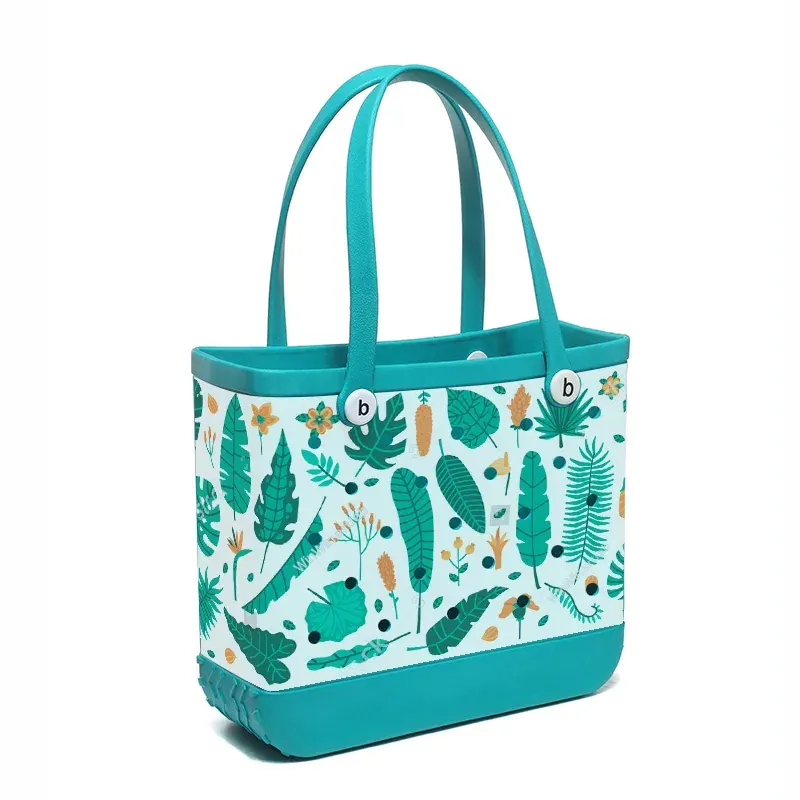
Dry sand and wet sand are different materials to design against, and the difference is surface tension rather than grain size. Dry grains are independent and fall through a hole under gravity with nothing holding them together. Add water and a thin film forms between grains, which produces cohesion strong enough to hold a clump together and to stick it to a wall. Every beachgoer has seen this: dry sand pours, damp sand clumps, and a damp clump does not fall through a hole no matter how large it is.
The answer is not a larger hole but water, and this is why the perforated design still wins. A clump of damp sand on the inside wall breaks up as soon as it is rinsed, and the rinse water carries the grains out through the base. A fabric bag in the same condition cannot be rinsed through, so the sand stays in the weave and dries there, and the bag gets heavier and grittier across a season. The moulded body resets to clean in about thirty seconds, which is the practical definition of sandproof on a beach.
One design detail helps measurably: the interior surface finish. A glossy moulded wall releases a damp clump far more easily than a matte or textured one, because there is less area for the water film to grip. Buyers specifying a body for wet-sand conditions should ask for a polished cavity finish on the inside face, which costs nothing at tooling and makes the rinse step noticeably faster.
Drying: Airflow and the Open Top
Drainage removes standing water in seconds; drying removes the water held in the contents, and it takes hours. The open top is what makes the second half work, because it allows continuous air exchange through the whole body rather than only at the mouth. A perforated body with an open top ventilates from the base upward as warm air leaves through the top and cooler air enters through the holes, and that convection is what takes a wet towel from soaked to touch-dry in about five hours in shade.
| Body configuration | Air exchange | Wet towel to touch-dry | Odour risk after 48 hours | Verdict |
|---|---|---|---|---|
| Perforated walls and base, open top | Continuous through the body | 4 to 6 hours in shade | Low | The reference design |
| Perforated base only, open top | From the base upward, limited | 8 to 12 hours | Moderate | Acceptable for light use |
| Solid body, open top | At the mouth only | 12 to 24 hours | High | Not suitable for wet kit |
| Perforated body, closed lid | Blocked at the top | 10 to 16 hours | High | Defeats the perforation |
| Fabric body, any construction | Through the weave, slow | 18 to 36 hours | High without washing | Slowest of all |
The fourth line of that table is the trap worth naming explicitly. Adding a lid or a zip top to a perforated body stops the convection that makes the perforation useful, and produces a bag that drains into its own closed interior and then cannot dry. Anyone buying a closed-top body expecting the drying performance of an open one will be disappointed, and the specification should say so in plain terms at the point of sale.
What Actually Holds Sand
A perforated body sheds sand from its interior, but a bag has other parts, and the parts rather than the body are what retain sand after a session. Knowing where those places are is what turns a thirty second rinse into a genuinely clean bag.
- The handle roots, where sand settles in the radius between the handle and the rim.
- The rim bead, which has a small channel on its underside that collects grains.
- Any insert or divider sitting in the base, which blocks the holes beneath it.
- Charms seated in the lower holes, around which damp sand collects.
- The tread on the underside of the base, which holds sand until it is rinsed or tapped.
- A dropped-in towel lying flat across the base, which stops anything leaving at all.
The last item is the one owners never think about and it is the most common reason a draining bag appears not to drain. A towel laid flat over the base covers every hole in it, so water and sand sit on top of the towel rather than leaving. The fix is trivial — lift the towel — and it is worth saying on a hangtag, because a bag returned as not draining is usually a bag with a towel in the bottom of it.
The Rinse Routine That Keeps It Working
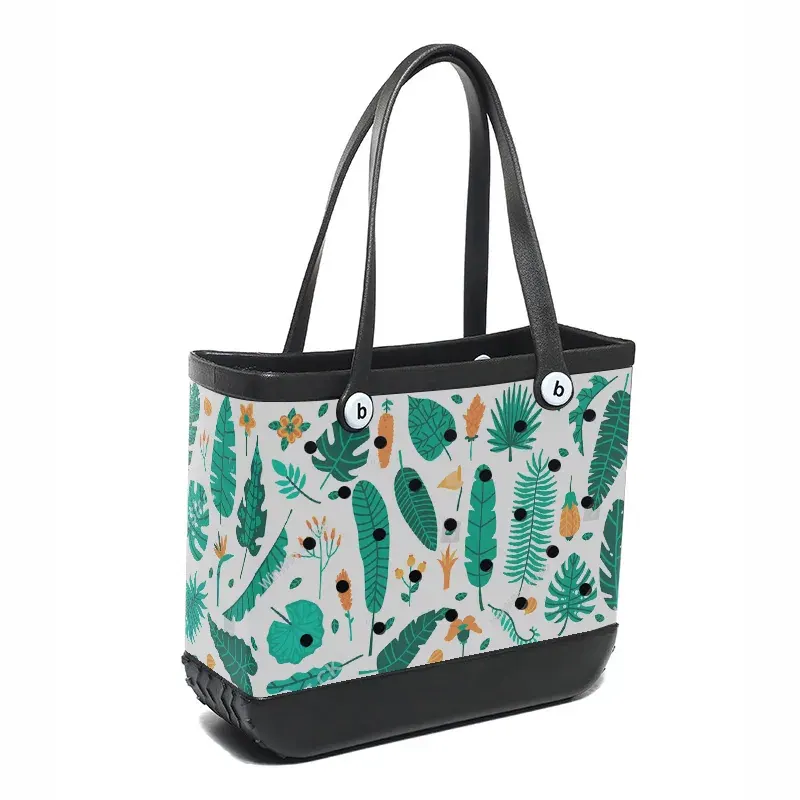
The whole maintenance routine for this category is under a minute and it works because there is nothing in the bag to hold anything. The steps below are the version worth printing, and they are identical for sand, salt and mud.
- Tip the body out and shake it once, which removes most dry sand in about five seconds.
- Rinse at tap pressure through the walls and across the base for 30 to 60 seconds.
- Lift any towel or insert lying flat on the base so the holes underneath can work.
- Run water over the rim bead and the handle roots, which are where sand settles.
- Stand the body open and upside down in shade for 30 to 60 minutes.
- Store out of direct sun, since a dark body passes 60 degrees within an hour in summer.
Two things should never be done. A pressure washer above roughly 40 bar can deform a thin wall, and solvents attack the surface and leave it tacky. Neither is needed: water at tap pressure and, occasionally, mild detergent and a soft brush remove everything this category encounters. Care and chemical guidance for consumer articles aligns with the safer chemical practice published by the United States Environmental Protection Agency, and physical test methods for the dimensional and drainage checks used to verify a specification are published by ASTM International.
Sandproof Against the Other Constructions
Three constructions compete with a moulded perforated body at the beach, and the comparison is worth making on the property that matters rather than on appearance. Each of the alternatives wins something and loses on sand or drying, and the table below puts the trade in one place.
| Construction | Sand behaviour | Wet kit behaviour | Empty weight, 32 litres | Cleaning |
|---|---|---|---|---|
| Perforated molded EVA | Falls through, rinses clean | Drains in 4 to 7 seconds, dries in hours | 1.8 to 2.4 kilograms | Hose, 3 minutes |
| Mesh and fabric beach bag | Passes the mesh, collects at joins | Drips, dries slowly | 0.6 to 1.2 kilograms | Brush and air dry |
| Canvas tote | Held in the weave and seams | Absorbs, dries in a day | 0.8 to 1.4 kilograms | Machine wash, slow dry |
| Woven polypropylene | Held in the weave | Passes water, holds damp | 0.4 to 0.9 kilograms | Hose, dries slowly |
| Closed molded body | Sits in the base permanently | Holds water with nowhere to go | 2.0 to 2.8 kilograms | Empty and wipe |
The honest summary is that the moulded perforated body wins on sand, wet kit and cleaning, and loses on weight and packed size. A mesh bag weighs a third as much and folds flat, which matters for a traveller rather than a family. For anyone whose bag is going to be set on sand, loaded with wet towels and hosed down at the end of the day, the moulded body is the only construction on that table that resets to clean in under a minute.
Specifying a Sand-Friendly Body
A buyer writing a specification for beach use has six lines to set, and all six have measurable consequences. Setting them in this order produces a body that performs without over-specifying anything, and each line is cheap to confirm before sampling.
- Perforation coverage: full walls and base for beach use, which is the only layout that drains under 10 seconds.
- Hole diameter: 10 to 14 millimetres, which passes every sand grain and fits the widest charm range.
- Drain time: specify under 10 seconds from a full dunk, and test it on the sample rather than accepting a claim.
- Interior surface finish: request a polished cavity so damp sand releases instead of clinging.
- Base holes: confirm they run through the base and are not blocked by a moulded foot or a logo panel.
- Open top: no lid or zip, so the convection that dries the contents is not blocked.
The third and fifth of those are the two most often skipped and the two that decide whether a body works. Drain time is measurable in a minute with a bucket, and a body that fails it will be complained about. Base holes blocked by a decorative foot or a solid logo panel are invisible in a photograph and obvious on a beach, and they turn a draining body into one that holds water at the lowest point.
What a Season on the Beach Does
Sand is abrasive rather than corrosive, and it is worth being precise about what that means over a season of daily use. Quartz, which is most of beach sand, sits at 7 on the Mohs scale against a moulded EVA surface somewhere near 2, so sand is harder than the bag and it does abrade it. In practice the effect is a gradual loss of surface gloss on the base tread and on the contact points, visible after two or three seasons and never structural. A body that is hosed rather than scrubbed keeps its finish far longer, because scrubbing drives the grains across the surface under pressure.
Salt is the agent that ends bags, and it acts on the parts that are not the body. Moulded EVA is unaffected by salt water, so a body used daily in the sea for five seasons shows nothing but surface dulling. What fails is the hardware: a plated hook, a rivet or a slider seizes within a season unless it is rinsed, and a seized strap anchor is the most common reason a bag is retired. The owner routine that prevents it is thirty seconds of fresh water over the fittings, and the specification that prevents it is corrosion-resistant hardware, which is worth the 0.40 to 0.90 dollars it adds.
Programme Notes
Perforation layouts sit on the perforated EVA tote page, cleaning detail in the EVA tote washability guide, and the rubberised end of the range on the waterproof rubber beach tote page. Buyers comparing body options should start from the injection-molded EVA tote guide. QUANZHOU JUNYUAN BAGS has run waterproof bag programmes since 2014 with a founding team in this trade since 2004, at monthly output of 200,000 units verified by SGS, under BSCI and ISO 9001, with materials screened for REACH and California Prop 65 and every bulk shipment inspected at AQL 2.5 before release.
Send the body size, the perforation layout, the hole diameter, the interior finish requirement and the quantity to service@junyuanbags.com, and ask for the drain time measured on the sample rather than a description of the perforation, because the seconds are the figure that can be checked against a bulk delivery. Sampling runs 6 to 10 working days and bulk 35 to 50 days.
People Also Ask
Are EVA totes really sandproof?
In the sense that matters, yes: sand grains of 0.06 to 2 millimetres pass 8 to 14 millimetre holes, so every grain that reaches the base falls straight through.
How fast does a perforated tote drain?
4 to 7 seconds after a full dunk for a fully perforated body. Anything over 10 seconds means the layout is partial rather than full.
Why does wet sand stick inside the bag?
Surface tension. A water film between grains holds them together and to the wall, so a rinse rather than a shake is needed.
How long does a wet towel take to dry in an EVA tote?
About four to six hours in shade, because the open top and perforated base allow continuous convection through the body.
Does a lid or zip stop a tote drying?
Yes. It blocks the convection at the top, which is why a closed-top perforated body drains into its own interior and then cannot dry.
What is the best perforation layout for sand?
Full coverage across the walls and base, which gives 15 to 30 percent open area and the only drain times reliably under 10 seconds.
Frequently Asked Questions
Q1. What makes an EVA tote sandproof?
Perforations of 8 to 14 millimetres across the walls and base, which every sand grain passes freely, plus an open body with no lining to trap anything.
Q2. How big are the holes compared with sand grains?
Ten to twenty times larger. Grains run 0.06 to 2 millimetres and holes run 8 to 14 millimetres, so sand cannot bridge across them.
Q3. How long should a tote take to drain?
Under 10 seconds from a full dunk. A fully perforated body achieves 4 to 7 seconds; a partial layout takes 14 to 35.
Q4. Does hole size affect sand performance?
Not above about 6 millimetres. Anything larger passes sand freely, so hole size is chosen for drainage, charm fit and print area instead.
Q5. Why does my tote hold water in the base?
Usually holes blocked by a towel lying flat across the base, or by a moulded foot or logo panel covering the base perforations.
Q6. How do I remove wet sand from the bag?
Rinse it. Water breaks the surface tension holding the grains together and carries them out through the base in about thirty seconds.
Q7. Does a polished interior help?
Yes. A glossy moulded surface releases a damp clump of sand far more easily than a matte or textured one, and it costs nothing at tooling.
Q8. Should I choose full or partial perforation?
Full coverage for beach use, because it is the only layout that drains under 10 seconds. Partial coverage is chosen when print area matters more.
Q9. Will a zip-top EVA tote still dry?
Much more slowly. A closed top blocks the convection that dries the contents, turning a draining body into one that holds damp.
Q10. Where does sand collect on a tote?
In the handle roots, under the rim bead, around charms in the lower holes and in the tread on the underside of the base.
Q11. Can I use a pressure washer to clean it?
Not above about 40 bar, which can deform a thin wall. Water at tap pressure and a soft brush remove everything this category encounters.